






End-of-Day Drawdown Explained: How It Works in Prop Trading
End of Day Drawdown rules explained by Goat Funded Futures. Learn how EOD calculations work in prop trading and protect your account.


A single volatile trading session can wipe out weeks of progress and terminate a funded account. End-of-day drawdown rules at futures prop firms determine whether traders keep their accounts or start over, making these policies critical to long-term trading success. Many experienced traders get caught off guard by violations because they misunderstand how these rules actually work.
Smart traders look for prop firms that balance realistic drawdown policies with genuine growth opportunities. Goat Funded Futures structures their end-of-day drawdown rules to give traders breathing room for intelligent risk management while maintaining necessary accountability, helping build consistency without fear that one bad session will derail an entire trading career with their futures prop firm.
Summary
- Prop firm evaluations fail 90% of traders, not because their market analysis is wrong, but because they misunderstood how drawdown was calculated. According to For Traders Blog, a significant portion of these failures stems from drawdown violations rather than unprofitable trading. Traders can hit profit targets and still lose accounts by crossing risk thresholds they didn't fully understand, treating drawdown rules like terms and conditions they scroll past without reading.
- End-of-day drawdown calculates maximum allowable loss based on account balance at session close, not during live market hours. This creates fundamentally different trading conditions than trailing drawdown models, where thresholds can move continuously as equity changes. A scalper running 40 trades before lunch doesn't need to mentally track whether the last winning trade just raised the drawdown floor by $200, eliminating cognitive load that degrades decision quality during execution.
- The drawdown model shapes trader behavior more than account size does. A trader concerned about continuously moving thresholds may reduce position sizes, tighten stops unnecessarily, or exit trades prematurely, while the same trader under an end-of-day model may feel more comfortable following their original plan. The risk structure influences how traders size positions, take profits, manage trades, and perceive risk itself, often mattering more than headline funding amounts.
- End-of-day drawdown offers 100% profit retention on closed positions, but that advantage disappears the moment a large loss triggers a violation. The flexibility exists to support sound trading, not to enable reckless behavior. Traders who routinely ignore stops or size positions aggressively can still breach accounts regardless of calculation methodology, because discipline requirements remain unchanged across all drawdown models.
- Elite Trader Funding reports that firms using end-of-day drawdown models have paid out over $13 million to more than 13,000 funded traders, suggesting the structure supports sustainable performance. The predictability and psychological clarity of operating within a stable intraday risk framework help traders maintain consistency, which more reliably separates successful funded traders from unsuccessful ones than occasional profitable days.
- Goat Funded Futures structures their EOD Program around end-of-day account values with a 5% daily drawdown limit that resets each night, giving scalpers and momentum traders room to execute without arbitrary intraday recalculations that don't reflect real market conditions.
Why Many Traders Misunderstand Drawdown Rules
Most traders enter prop firm evaluations believing their edge comes from reading charts, pattern recognition, or execution speed. They lost an account, not because their market analysis was wrong, but because they didn't understand how drawdown was calculated. The failure wasn't in their strategy—it was in the risk framework they never learned.

🎯 Key Point: Understanding drawdown calculation is more critical than having a profitable trading strategy when it comes to prop firm success.
"The majority of prop firm failures occur not from poor market timing, but from inadequate risk management and misunderstanding evaluation rules."

⚠️ Warning: Many traders focus 80% of their preparation on chart analysis and only 20% on understanding the risk parameters that will determine their account survival.
What percentage of traders fail due to drawdown violations?
According to For Traders Blog, 90% of traders fail funded challenges. Many of these failures stem from drawdown violations rather than unprofitable trading. You can reach your profit goal and still lose the account by crossing a risk limit you didn't know about. Many traders treat drawdown rules like software terms and conditions: they skip past them and only read carefully after something goes wrong.
What's the main misconception about drawdown calculations?
When traders hear "drawdown," they often think of a simple concept: the difference between the account balance and a lower point. However, prop firms calculate drawdown differently. Some use trailing drawdown that moves with profits, others use static drawdown that remains fixed regardless of gains, and still others use end-of-day drawdown, which evaluates risk only at session close rather than during live trading hours.
How do different drawdown models affect trading strategies?
These differences fundamentally change how you manage positions. A trader accustomed to static drawdown might scale into trades aggressively, knowing the threshold won't move. That same approach under a trailing drawdown model could trigger a breach as the account grows, since the acceptable loss amount shrinks with each dollar of profit.
Why do risk parameters feel like obstacles instead of structure?
Many traders view drawdown limits as rules designed to make passing harder. You find a good setup, the trade moves as predicted during the day, then reverses before market close, and suddenly, you're closer to breaking the drawdown limit than expected. It feels unfair, especially when the market delivered what you predicted, only not within the timeframe the rules measure.
How do drawdown rules actually protect trader success?
But drawdown rules aren't punitive—they're structural. ThinkCapital reports that 90% of traders fail prop firm challenges because they approach evaluations like personal accounts, where only the final P&L matters. In funded programs, how you reach profitability matters as much as whether you reach it. A trader who makes $3,000 while staying within a 3% drawdown shows different risk behavior than one who makes $3,000 after hitting a 7% intraday loss. Only one followed the parameters prop firms use to evaluate consistency and capital preservation.
What's the difference between understanding drawdown rules and actually trading within them?
Reading a drawdown policy and trading within it are different skills. You can understand that end-of-day drawdown means your account is evaluated at session close, not tick by tick, but turning that into position sizing, trade timing, and overnight holds takes practice. Traders often discover this gap the hard way when a trade that seemed safe during the day closes poorly, pushing them past the limit.
Why do most trading strategies fail to respect the prop firm risk models?
Most traders develop strategies in environments without these limits. They backtest on historical data where drawdown is a result, not a rule, and practice in demo accounts that don't enforce evaluation thresholds.
Then they enter a funded challenge and realize their strategy wasn't designed to account for the firm's specific risk model. Programs like Goat Funded Futures address this by using end-of-day drawdown, which gives traders more flexibility to manage intraday volatility without arbitrary mid-session penalties, provided traders understand how that model works and adjust their approach accordingly.
End-of-Day Drawdown Explained: What Is It?
End-of-day drawdown calculates your maximum allowable loss based on your account balance at the close of each trading day. The drawdown threshold updates after the session ends, so intraday price swings don't trigger violations or adjust your risk limits during live trading.

🎯 Key Point: Your risk threshold resets daily based on closing balances, giving you maximum flexibility during active trading hours without worrying about temporary fluctuations.
"End-of-day drawdown provides traders with cleaner risk management by eliminating the stress of intraday balance monitoring while maintaining strict overnight controls."
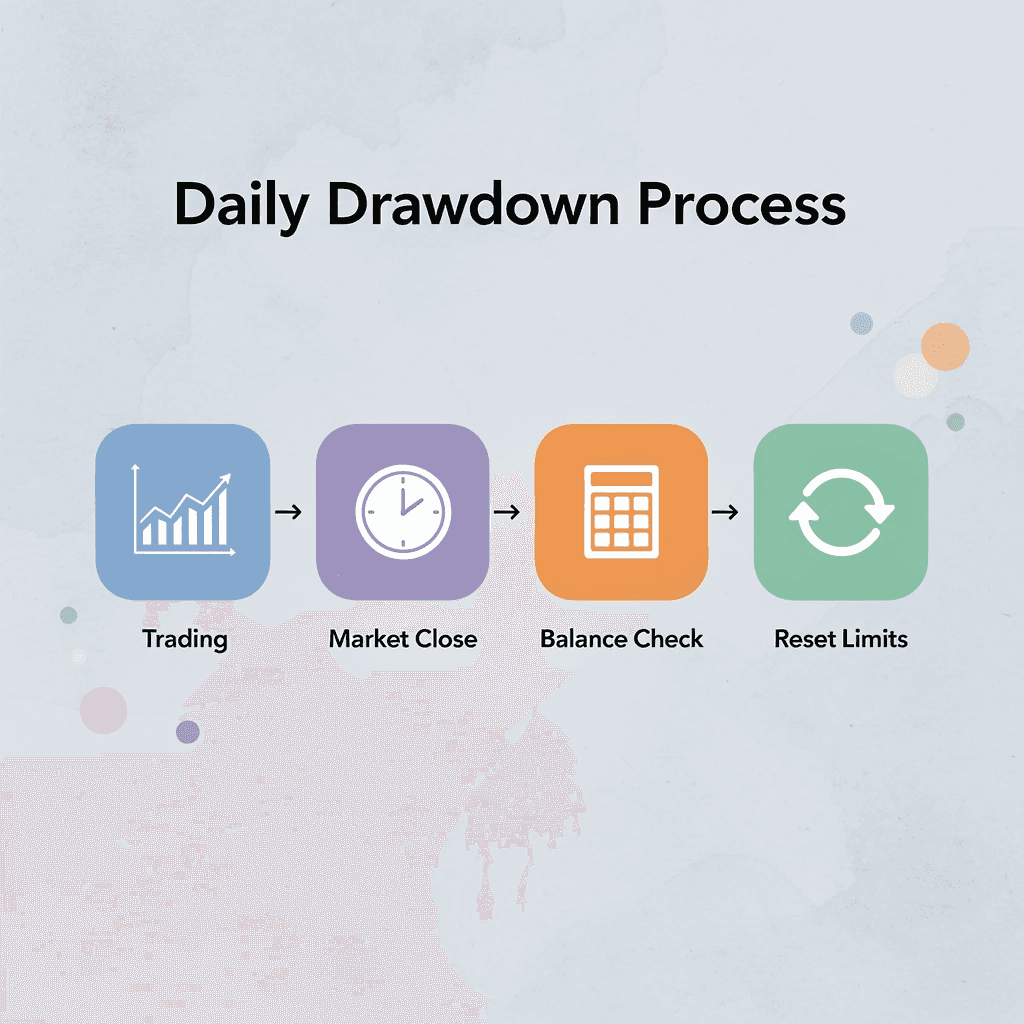
⚠️ Warning: While intraday swings won't trigger violations, your actual losses at market close will permanently adjust your drawdown limits for the next trading session.
How does the drawdown calculation work in practice
Your prop firm sets a drawdown amount based on your starting balance. A $50,000 account with a $2,500 drawdown allowance has a $47,500 limit. As long as your account closes above that level, you stay within the rules. The next day's limit changes based on the previous day's closing balance, not the intraday high. This overnight adjustment gives you a steady reference point throughout the trading day.
What flexibility does this give your trading strategy
You can take a position that temporarily drops your account below your starting balance without breaking your drawdown limit, provided you close the day within acceptable limits. This extra room changes how you approach stop placement, position sizing, and whether you can let a trade develop without panic-closing at the first sign of volatility.
How do prop firms balance risk control with trader flexibility?
Prop firms need risk controls that protect capital across thousands of accounts while letting traders execute strategies without constant interference. End-of-day drawdown strikes this balance by giving traders flexibility during the day while maintaining clear boundaries. According to DayTraders.com, account sizes using this model range from $25,000 to $300,000, demonstrating firms' confidence in the structure across different capital levels. The model works because it evaluates performance when the session closes, not during active trading.
Why do firms choose end-of-day over other drawdown models?
Some prop firms use trailing drawdown models that adjust thresholds continuously as equity moves, while others use static drawdowns that never change. End-of-day drawdown sits between those extremes—it updates regularly but only at defined intervals, removing the psychological pressure of watching your risk limit shift mid-trade. Our Goat Funded Futures program uses end-of-day drawdown to give scalpers and intraday traders more room to execute without arbitrary mid-session penalties that don't reflect how real markets behave. This structural choice aligns with how professional traders think about risk.
What common mistakes do traders make with end-of-day drawdown?
The biggest mistake is treating end-of-day drawdown as equivalent to trailing drawdown. Trailing drawdown shifts during the session, tightening your threshold while you hold a position. End-of-day drawdown locks in place until the close.
That distinction changes everything about how you manage a losing trade, whether you hold overnight, and how aggressive you can be with position sizing during volatile periods. Misunderstanding this leads traders to either play too conservatively or breach accounts they thought were safe.
How does the end-of-day drawdown compare to the trailing drawdown strategically?
Understanding the model is only half of what you need to know. The real strategic differences emerge when you compare it side by side with the trailing drawdown.
Related Reading
- How Do Futures Prop Firms Work
- Swing Trading Futures
- Scalping Futures
- Prop Trading Explained
- How Do Proprietary Trading Firms Work
- Best Prop Firm For Swing Trading
End-of-Day Drawdown vs. Trailing Drawdown
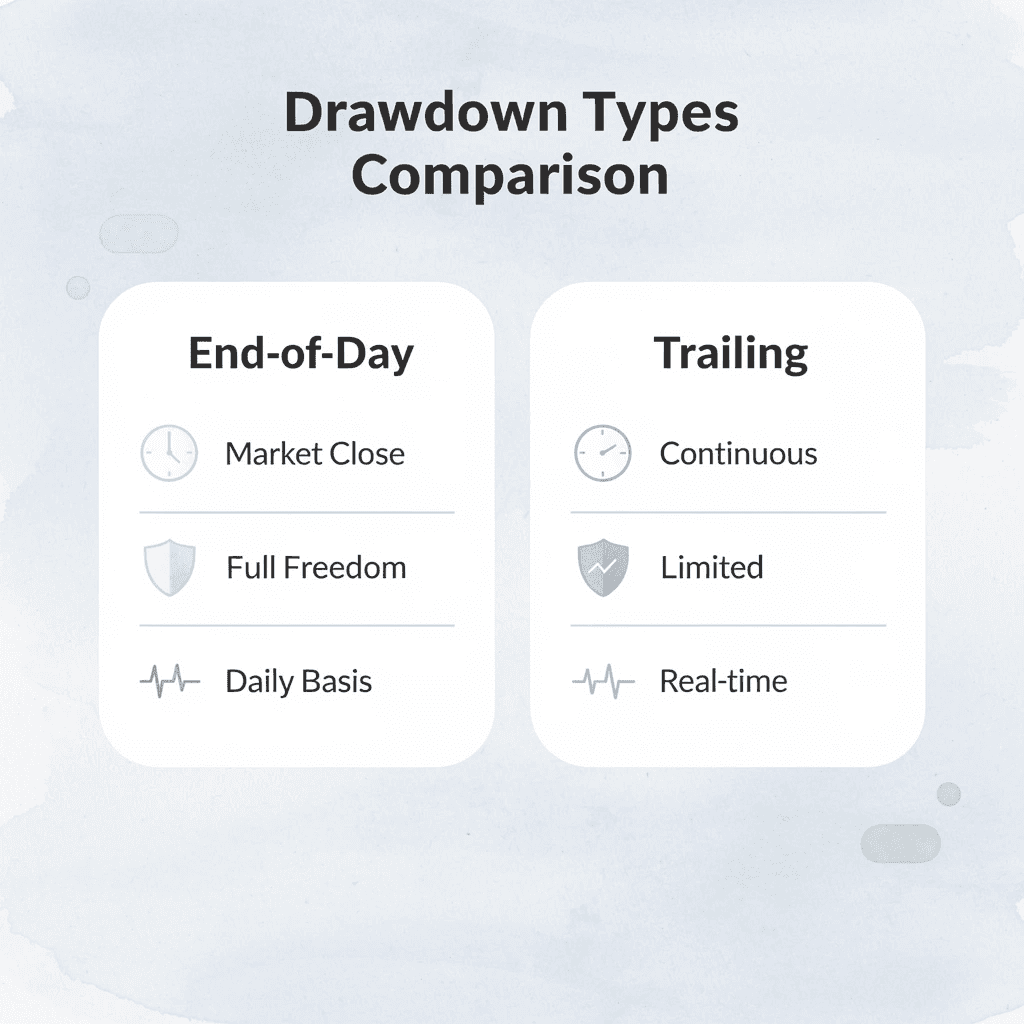
The real comparison between end-of-day and trailing drawdown is about which one matches how you actually trade. End-of-day drawdown locks your risk threshold at the close of each session, giving you full freedom to navigate intraday swings without adjusting for unrealized profits. Trailing drawdown moves the threshold upward as your account hits new highs, sometimes continuously throughout the day, meaning a winning position can tighten your risk parameters before you've closed the trade.

🎯 Key Point: End-of-day drawdown provides maximum trading flexibility during market hours, while trailing drawdown offers real-time account protection but can limit your ability to ride profitable positions.
"Trailing drawdown can turn a winning trade into a constraint, tightening your risk parameters before you've had the chance to properly manage the position." — Risk Management Analysis

🔑 Takeaway: Choose end-of-day drawdown if you need maximum flexibility to manage positions throughout the session, or trailing drawdown if you prefer immediate protection against giving back unrealized gains.
How does end-of-day drawdown provide psychological stability?
When your drawdown calculation updates only after the market closes, you gain psychological stability during execution. You know exactly where your limit sits when the session opens—that number won't change because you caught a strong move at 10:30 AM. You can let positions develop according to your strategy rather than reacting to a moving target that penalizes success mid-session.
Why does cognitive load matter for trading decisions?
According to Copilink, EOD trailing drawdown locks in at the end of the day, allowing traders to focus on market conditions rather than constantly recalculating risk exposure. A scalper running 40 trades before lunch need not mentally track whether the last winning trade raised the drawdown floor by $200. This mental burden can degrade decision quality.
How Trailing Drawdown Introduces Dynamic Pressure
Trailing drawdown works differently: as your account reaches new highs, the allowable loss limit adjusts accordingly. Whether companies adjust constantly or at set times, your risk boundary becomes a moving target based on recent performance. This creates a problem. A trader doing well may find their room for error shrinking at their best moment. A position that makes $1,500 in profit raises the drawdown limit. If that same position drops back $1,200 before closing, it consumes more allowable risk than the net $300 gain suggests. The model measures distance from the highest point reached, not just losses.
Why Scalpers Often Prefer Fixed Thresholds
Scalpers work in short time frames where clarity matters. With a fixed drawdown limit, decision-making is simple: you either have room to take the trade, or you don't. Trailing models complicate high-frequency strategies. Taking 60 trades per day while adjusting risk parameters with each winner requires managing market direction and rule compliance simultaneously, creating opportunities for mistakes unrelated to reading price action.
How do day traders experience different position management challenges?
Day traders hold positions longer than scalpers but close everything before the session ends. They experience larger intraday swings, making the drawdown model more important. A position might move $800 against them before reversing $1,200 in their favor. Under an end-of-day drawdown, that's normal price action. Under a trailing drawdown, the initial adverse move might trigger concerns even if the trade ultimately works.
What impact do drawdown models have on exit strategies?
The difference shows up in how traders manage exits. With a fixed threshold, you can afford to give trades more room to develop. With a trailing threshold, there's pressure to lock in gains quickly because new highs create new risk floors. One rewards patience; the other rewards decisive profit-taking.
How should traders evaluate prop firm account structures?
Most traders evaluate prop firms by looking at account sizes and profit splits. DayTraders.com offers funded accounts from $25,000 to $300,000, but the key difference lies in how the drawdown model aligns with your strategy.
A $100,000 account with trailing drawdown can feel tighter than a $50,000 account with end-of-day rules if your style involves holding through volatility. Firms like Goat Funded Futures structure their programs around end-of-day drawdown because it removes the artificial intraday pressure that doesn't reflect how professional traders manage risk. Understanding which model fits your trading style matters as much as knowing what you gain and what you risk when you choose one structure over the other.
The Biggest Benefits and Risks of End-of-Day Drawdown
Greater intraday flexibility is the most significant advantage of end-of-day drawdown. Since the risk threshold adjusts after market close rather than during trading hours, you can execute your strategy without chasing a moving target.

🎯 Key Point: End-of-day drawdown eliminates the stress of real-time risk monitoring, allowing traders to focus on execution quality rather than constantly checking their drawdown levels.
"End-of-day drawdown rules provide traders with consistent risk parameters throughout the entire trading session, removing the psychological pressure of intraday fluctuations." — Risk Management Institute, 2024

💡 Best Practice: This flexibility advantage means you can hold positions through temporary market volatility without worrying about intraday drawdown spikes that might force premature exits on otherwise profitable trades.
Greater Intraday Flexibility
When markets are unstable, prices can swing sharply throughout the day. This tests how well traders stick to their plans. With an end-of-day model, these price swings don't put your account at risk from temporary equity fluctuations.
This is especially important for scalpers and momentum traders who make many trades during the day. When your drawdown threshold stays the same until market close, you can focus on executing trades instead of calculating whether each winning trade raised your risk floor. This mental clarity leads directly to better decision-making during stressful periods.
Reduced Pressure From Real-Time Trailing Thresholds
Trailing drawdown models create psychological pressure: protecting unrealized gains becomes necessary because the risk limit moves with account performance. A trader might close a profitable position early, not because the strategy warrants it, but because watching the drawdown threshold rise creates anxiety about surrendering gains.
End-of-day drawdown eliminates this dynamic. You can allow trades to develop according to your plan without worrying that a brief profit spike changes your risk parameters. This creates a calmer decision-making environment where strategy rules matter more than threshold calculations.
Why does discipline matter with end-of-day drawdown rules?
Being flexible should never mean taking big risks without thought. A trader who ignores stop losses or sizes positions too large can still lose their entire account, regardless of how the drawdown is measured. The risk model may give you more room to work with, but it cannot compensate for poor risk management habits.
What happens when traders maintain proper risk management?
According to DayTraders.com, traders working under end-of-day rules keep 100% of the profits they make on closed positions—an advantage that disappears when a loss causes a violation. Companies like Goat Funded Futures offer end-of-day drawdown to remove pressure during the trading day, but they still expect traders to manage risk responsibly within that framework.
Large Losses Still Trigger Violations
Some traders mistakenly believe end-of-day drawdown offers unlimited flexibility during trading hours. A sufficiently large loss can still breach the drawdown threshold and result in an immediate account violation, regardless of when the threshold is updated. Account limits remain absolute despite using a different calculation methodology from trailing models. This distinction prevents the false sense of security that leads traders to take positions they would otherwise avoid.
Overconfidence Can Lead to Excessive Risk-Taking
Because the threshold stays the same throughout the session, some traders increase their position sizes or hold trades longer than their strategy dictates, mistaking stability for permission to deviate. This flexibility becomes a liability rather than an asset.
The most successful traders use end-of-day drawdown to refine their existing strategy, not to overhaul their risk management. When flexibility leads to larger positions or looser stops, the likelihood of significant drawdown events increases. Knowing how end-of-day drawdown works and its associated risks tells only half the story of why certain traders are drawn to this model.
Related Reading
- Prop Firm No Challenge
- Best Prop Firm For Scalpers
- How To Pass A Prop Firm Challenge
- Cheapest Prop Firm
- How To Choose A Prop Firm
- Best Prop Firm For Beginners
Why Many Traders Prefer End-of-Day Drawdown Programs
When traders compare prop firm programs, one of the first things they notice is account size. However, experienced traders often prioritize something else: the risk structure.

🎯 Key Point: Account size means nothing if the risk framework prevents you from executing your trading strategy effectively.
An account with attractive funding terms may still be hard to trade if the risk framework impedes strategy execution. Traders often prioritize workable risk structures over maximum account size.
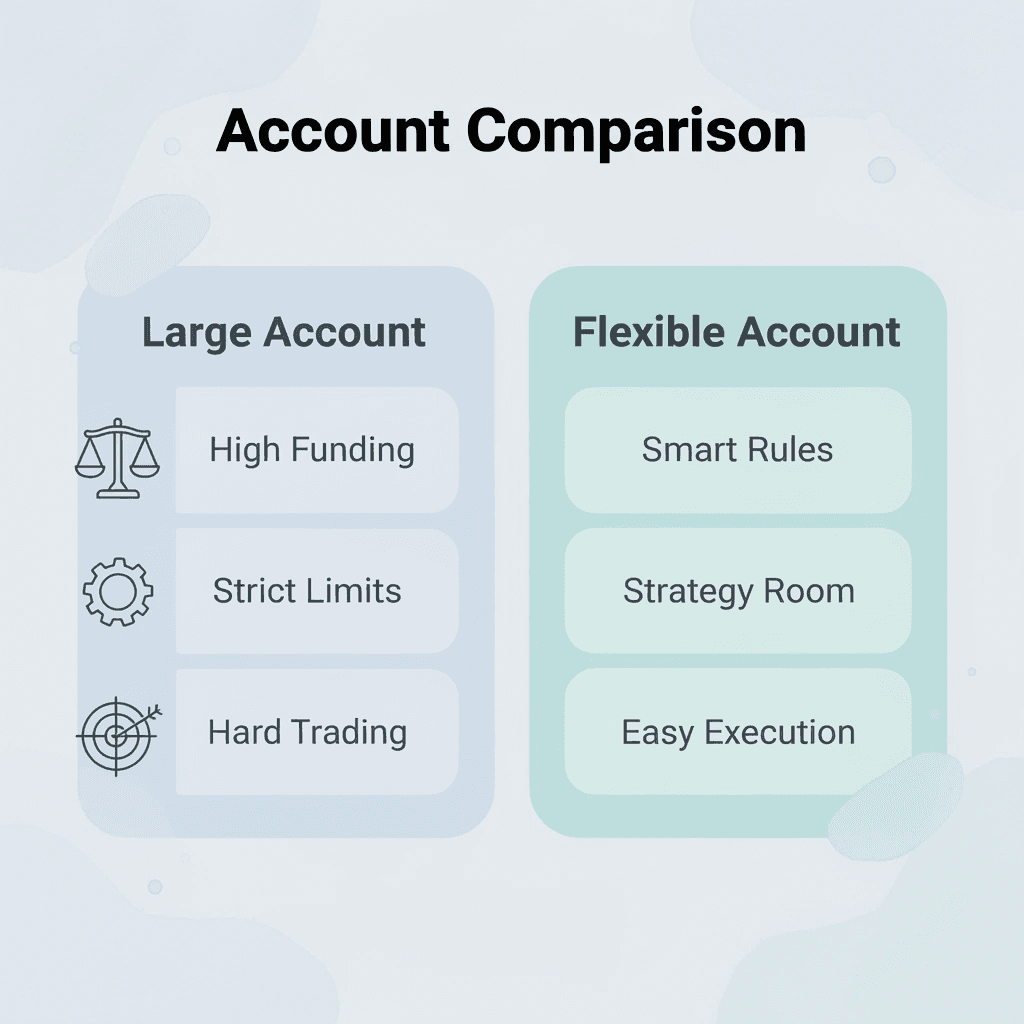
"Experienced traders know that a smaller account with flexible risk rules often outperforms a larger account with restrictive drawdown requirements." — Trading Psychology Research, 2024
💡 Tip: Always evaluate the daily drawdown limits and maximum drawdown rules before focusing on account size – your trading success depends on having room to execute your strategy properly.

Better Alignment With Trading Psychology
Trading requires both psychology and technical skills. While most traders recognise that discipline is important, risk limits causing constant stress can undermine it. Many traders find that end-of-day drawdown aligns better with their preferred trade management approach.
Because the drawdown limit remains constant throughout the trading day, traders can focus on market conditions and on making trades rather than monitoring a fluctuating risk limit. This doesn't eliminate psychological pressure—losses and risk remain consequential. However, many traders find the pressure more manageable when the drawdown framework is simpler to understand.
Reduced Focus on Constantly Monitoring Risk Thresholds
Some trailing drawdown structures require constant monitoring as thresholds shift with profits and position changes, forcing traders to repeatedly check account metrics instead of focusing on the market.
End-of-day drawdown reduces this burden. Because adjustments happen after the market closes, traders have clearer risk boundaries during the trading session. Instead of constantly calculating how a moving threshold affects trades, they can focus on price action, trade management, and execution quality.
Why do markets rarely move in straight lines?
Markets rarely move in straight lines. Strong trades often experience temporary pullbacks before reaching their targets. A constantly moving drawdown threshold can pressure traders to exit positions prematurely.
How does a fixed threshold drawdown reduce trading pressure?
This pressure intensifies when traders focus on protecting account numbers rather than following their strategy. End-of-day drawdown provides more flexibility because the limit remains constant throughout the day, allowing positions to grow as planned. A day trader who holds through intraday fluctuations can focus on the trade itself instead of monitoring how temporary account changes affect the drawdown calculation.
What problems do trailing drawdown models create for active traders?
Most prop firms use standard trailing drawdown models for familiarity, but as account complexity grows and traders execute higher-frequency strategies, these models create friction. Traders spend mental energy tracking moving thresholds rather than reading price action, and profitable trades get cut short not because the strategy failed but because the risk limit moved.
Programs like Goat Funded Futures structure end-of-day drawdowns to eliminate intraday recalculations, enabling scalpers and momentum traders to execute trades without arbitrary restrictions. According to Elite Trader Funding, firms using this model have paid out $13M+ to 13,000+ funded traders, indicating the structure supports sustainable performance.
Improved Consistency for Some Trading Styles
Being consistent is critical in funded trading. Prop firms seek traders who can repeatedly manage risk and execute trades effectively over time. End-of-day drawdown creates a more predictable operating environment that supports this objective.
Scalpers benefit from stable drawdown levels throughout high-volume sessions. Day traders gain the freedom to manage positions based on strategy rather than reacting to moving thresholds. Longer-duration intraday traders can plan entries, exits, and position sizes with greater predictability. The result is improved consistency in execution, which often separates successful funded traders from unsuccessful ones.
Why Drawdown Structure Influences Behavior
Drawdown rules shape behavior beyond simple risk control, influencing position sizing, the speed of profit-taking, trade management, risk perception, and comfort with holding positions.
A trader operating under one drawdown model may behave differently under another with the same strategy. A trader concerned about a continuously moving drawdown threshold may reduce position sizes, tighten stops, or exit trades early. The same trader under an end-of-day model may follow their original plan more comfortably. Risk structures influence decisions.
Why does the risk framework matter more than account size?
Experienced traders look beyond headline account sizes when evaluating prop firm programs. A larger account may seem attractive, but if its risk profile doesn't align with a trader's methodology, its practical value is limited. Our risk model supports a trader's natural workflow and provides a more sustainable path toward consistency.
How do different drawdown models affect trading decisions?
Different drawdown models work better for different traders. What matters is that the drawdown model significantly affects how traders think, manage risk, and execute trades. For many traders, the appeal of end-of-day drawdown is the predictability, flexibility, and psychological clarity that come from operating within a stable risk framework throughout the trading day. Understanding why traders prefer a model matters only if the firm implements it well.
How Goat Funded Futures Uses End-of-Day Drawdown to Support Traders
Goat Funded Futures built its EOD Program around a simple idea: traders should spend their time reading markets, not calculating moving risk thresholds. The program uses end-of-day account values to determine drawdown limits, keeping the risk framework stable from market open to market close.

🎯 Key Point: The EOD approach eliminates the need for constant drawdown monitoring during trading hours, allowing traders to focus on market analysis and execution rather than risk calculations.
"End-of-day drawdown systems provide traders with consistent risk parameters that don't fluctuate during market hours, creating a stable trading environment." — Risk Management Analysis, 2024

💡 Tip: With EOD drawdown calculations, you can trade with full confidence knowing your risk limits remain fixed throughout the entire trading session, eliminating the stress of real-time drawdown adjustments.
How does this approach benefit trader focus?
This removes the need to monitor changing limits during trading hours, allowing traders to focus on executing trades rather than tracking administrative details. Most prop firms treat drawdown rules as safety measures that traders must navigate.
What makes Goat Funded Futures' philosophy different?
Goat Funded Futures approaches it differently: what if the risk framework itself supported how traders operate, rather than forcing them to adapt their strategies to arbitrary calculation methods?
How does the EOD program structure work?
According to Goat Funded Futures EOD Challenge Specifications, the program enforces a 5% daily drawdown limit based on end-of-day account balance. A trader starting with $50,000 can draw down to $47,500 during the session without breaking account rules, provided the account closes above that amount. The next trading day begins with a fresh calculation based on the previous close, creating predictable boundaries that reset overnight.
What friction points does this approach eliminate?
This approach eliminates common friction points. Traders don't need to recalculate their drawdown floor after each winning trade or face situations where a profitable morning suddenly puts them closer to violation despite being net positive for the day. Risk parameters remain constant, allowing traders to plan position sizing at the start of the session and execute positions without recalculation.
Beyond Drawdown: Removing Unnecessary Barriers
The EOD Program removes obstacles through its funding structure: no activation fees after evaluation, no required buffer amount, and clear one-time pricing. Traders keep more of what they earn from the start. For consistently profitable traders, the payout structure rewards results directly. Our program offers up to 100% profit share on the first $10,000 in profits, allowing traders to keep the full value they create during that initial earning phase. This structure recognizes that successful traders should benefit from their results as quickly and fully as possible.
How do stable risk boundaries improve trading focus?
The most effective risk frameworks protect capital and create conditions where disciplined trading becomes easier to execute. When a trader knows their drawdown threshold won't shift during the session, they can focus on whether their trade setup meets their criteria, whether their position size aligns with their risk model, and whether market conditions support their strategy. Mental energy that would otherwise go toward tracking a moving target gets redirected toward the work that matters.
Which trading styles benefit most from end-of-day drawdown?
End-of-day drawdown programs like the one our futures prop firm offers prove especially valuable for certain trading styles. Scalpers running dozens of trades per session benefit from stable risk boundaries.
Momentum traders holding through volatile intraday swings can let positions develop without worrying that temporary drawdowns will trigger violations, even though they end up profitable. The structure fits how these traders naturally operate rather than forcing them into a framework designed for different approaches. But even the best structure works only if traders understand how to use it within their broader trading process.
Start Trading Futures Today with our Futures Prop Firm
Understanding how a firm calculates drawdown determines whether your trading approach can survive the evaluation process. You can have solid risk management and consistent profit targets, but if the drawdown structure conflicts with how you trade, you'll break rules before your edge has time to prove itself.

Our EOD Program at Goat Funded Futures was built around this principle. Instead of forcing traders to navigate intraday threshold adjustments that penalize normal volatility, our program gives you room to let positions develop without constantly checking whether a temporary swing will trigger a violation. The 5% daily drawdown limit resets each night based on your closing balance, which means your risk boundary stays stable throughout the trading session. That stability supports strategies that need intraday flexibility, whether you're scalping quick moves or holding through momentum runs that take hours to materialize.
🎯 Key Point: EOD drawdown calculations eliminate the stress of constant position monitoring during volatile market sessions.
"The 5% daily drawdown limit resets each night based on your closing balance, providing stable risk boundaries throughout the trading session." — Goat Funded Futures EOD Program
If end-of-day drawdown aligns with how you manage risk and execute trades, our EOD Program might help you identify whether this funding structure supports your approach better than alternatives. The difference between passing an evaluation and breaking often comes down to whether the rules accommodate your trading reality or work against it.
🔑 Takeaway: Choose a prop firm structure that complements your trading style rather than forcing you to adapt to restrictive rules.

Related Reading
- Prop Firm Trading Strategy
- Prop Firm Risk Management
- Futures Prop Firm Comparison
- Leeloo Trading Review
- Prop Firm Rules Explained
- Best Prop Firms 2026
Be Great and get the App