






Goat Funded Trader vs FundedNext Review
Goat Funded Trader vs FundedNext: consistency rules, scaling plans, instant funding, account reset and payout terms compared.

Both firms are frequently shortlisted together, and the reason is that each was built for the trader who wants options in place of a single fixed path.
Goat Funded Trader came on board in 2023, built around a broader account structure, with six markets placed inside one login and three instant tiers offered alongside the structured routes. FundedNext was launched in March 2022 and has grown into one of the larger firms by trader volume.
The similarities end at the surface. Entry routes are counted differently at each firm. Market coverage differs by two full asset classes. Consistency requirements are applied at one firm across almost every model and removed at the other across four separate routes. Account resets are handled in opposite ways.
Across this Goat Funded Trader vs FundedNext review, the comparison is organised around the path a trader actually walks: choosing an entry, paying for it, trading under the rules, getting paid, growing the account, and recovering when a session goes wrong. Both beginner and experienced angles are covered at each stage.
Key Takeaways
-
Entry choice separates the two firms first, with five routes offered at Goat Funded Trader against four at FundedNext, and three instant tiers offered against a single instant product.
-
Market coverage differs by two full asset classes, as metals and stocks are covered at Goat Funded Trader and absent from the FundedNext lineup.
-
A prop firm consistency rule is applied across the majority of FundedNext models and absent across four separate Goat Funded Trader routes, including the PREMIUM instant tier.
-
Starting allocation reaches $400,000 against $200,000, so compounding begins against a base twice the size before any prop firm scaling plan is applied at either firm.
-
Payout speed is where FundedNext performs strongest, with a 24-hour guarantee and median processing near five hours, faster than the 2-business-day guarantee applied at Goat Funded Trader.
-
For traders seeking a FundedNext alternative, the decision concentrates on three points: broader market access, more entry routes, and a prop firm account reset available before and after a breach.
Goat Funded Trader vs FundedNext: The Short Answer
| Point | Goat Funded Trader | FundedNext |
|---|---|---|
| Structured routes | 1-Step GOAT, 2-Step: GOAT and Standard | Stellar 1-Step, Stellar 2-Step, Stellar Lite |
| Instant routes | Three tiers: HERO, GOAT, PREMIUM | One: Stellar Instant |
| Starting allocation | Up to $400,000 | Up to $200,000 |
| Profit split | 80%, climbing to 100% | 80%, reaching 95% via paid upgrade |
| Markets | Forex, crypto (major pairs), indices, metals, commodities, stocks | Forex, crypto, indices, commodities |
| Platforms | MT5, cTrader, MatchTrader, TradeLocker | MT4, MT5, cTrader |
| Consistency rule | None on four separate routes | Applied across most models |
| Account reset | Available before and after a breach | Not offered in comparable form |
| Payout guarantee | 2 business days or $1,000 | 24 hours or $1,000 credit |
Step One: How Many Ways In Are Offered
Entry choice is where a Goat Funded Trader vs FundedNext decision separates first. Interestingly, the count differs considerably.
Five routes are offered at Goat Funded Trader.
-
Three are structured: the 1-Step Goat and the 2-Step (Goat and Standard)
-
Three are instant: HERO, GOAT, and PREMIUM.
A trader is therefore allowed to select both the shape of the evaluation and the character of the funded account independently.
Four routes are offered at FundedNext across its lineup.
-
Stellar 2-Step and Stellar 1-Step form the structured pair; Stellar Lite sits between them with tighter parameters.
-
Stellar Instant provides the single instant option.
The differences widen on the instant side specifically.
FundedNext: One instant funded account product is offered, so a trader wanting immediate funding accepts whatever terms are attached to it.
Goat Funded Trader: Three tiers are offered, and each was built for a different priority.
HERO is positioned as the lowest-cost entry.
GOAT holds the widest maximum loss allowance of the three.
PREMIUM removes the consistency requirement entirely.
| Entry type | Goat Funded Trader | FundedNext |
|---|---|---|
| One-phase structured | 1-Step Goat | Stellar 1-Step |
| Two-phase structured | 2-Step: Goat and Standard | Stellar 2-Step |
| Reduced-parameter option | Covered across the three structured routes | Stellar Lite |
| Instant funded account | HERO, GOAT, PREMIUM | Stellar Instant |
Step Two: What Getting Started Costs
Pricing varies by model, account size, and the type of funding route selected. FundedNext centres its offering around the Stellar challenge models, while Goat Funded Trader separates its products into Challenge Accounts and Instant Funding Accounts.
FundedNext starts at around $59 for a $6,000 Stellar 2-Step account, with account sizes extending to $200,000. The Stellar models also include a refundable fee structure, with the qualifying fee returned alongside the first payout after the required conditions are met.
Goat Funded Trader's challenge accounts start at $44 for a $5,000 1-Step account, with the 1-Step range extending to $200,000. Its 2-Step (GOAT and Standard models) both start at $17 for $5,000 accounts, with both available up to $200,000. This gives GFT several low-cost routes for traders who prefer to complete an evaluation before receiving funded access.
GFT also offers instant funding, which is a separate category
-
The Instant GOAT starts at $65 for a $5,000 account and can scale to a maximum allocation of $400,000.
-
Instant HERO starts at $17 for $5,000, also with a maximum allocation of $400,000.
-
Instant Premium starts at $95 for $5,000 and has a maximum allocation of $150,000.
Instant funding allows traders to bypass the challenge and begin trading under the applicable funded-account rules immediately.
The pricing difference reflects two distinct approaches. FundedNext's entry point is tied to its Stellar evaluation range, while GFT offers both low-cost challenges and immediate-access funding. The better fit therefore depends on whether the priority is paying less to complete an evaluation or paying for direct access without going through a challenge.
Step Three: The Rules You Trade Under
Rule structure is where the difference between Goat Funded Trader vs FundedNext becomes clearer. Profit targets and drawdown limits are always important, but the rules surrounding those limits can have an even greater effect on how a trading strategy is executed and how profits can eventually be withdrawn.
Evaluation Rules
Goat Funded Trader uses static maximum-loss limits across its main evaluation models. On the 1-Step, the maximum loss is 6% of the initial account balance, creating a permanent floor at 94% of starting capital. The 2-Step Standard uses a 10% static maximum loss, leaving the floor at 90% of the initial balance. Neither overall-loss limit moves higher as profits accumulate.
The daily-loss rules are separate. GFT 1-Step uses a 3% daily drawdown for accounts purchased from August 1, 2026 onward, while the 2-Step Standard uses 5%. Both are calculated using the account's balance or equity at the daily calculation point.
FundedNext follows a similar static approach on its Stellar challenges. The Stellar 1-Step has a 6% maximum loss and a 3% daily loss limit, while the Stellar 2-Step has a 10% maximum loss and a 5% daily loss limit. The overall floors therefore line up closely with GFT's corresponding models.
| Evaluation Rule | GFT 1-Step | GFT 2-Step | FundedNext Stellar 1-Step | FundedNext Stellar 2-Step |
|---|---|---|---|---|
| Profit target | 10% | 10% then 5% | 10% | 8% then 5% |
| Daily drawdown | 3% | 5% | 3% | 5% |
| Max overall loss | 6% static | 10% static | 6% static | 10% static |
| Minimum trading days | 3 | 3 per phase | 2 | 5 per phase |
| Consistency rule | None | None | None in challenge | None in challenge |
Quick notes: The GFT 1-Step daily limit changed from 4% to 3% for accounts purchased from August 1, 2026 onward. GFT's 2-Step Standard requires 4 trading days per payout for accounts purchased from July 25, 2026 onward; the evaluation phases require 3 valid trading days each.
Prop firm Consistency Rule
-
GFT's main evaluation models do not impose a consistency rule, so a trader can reach the required target without having to distribute profits according to a separate daily-performance formula. Both the 1-Step and 2-Step Standard explicitly list no consistency rule.
-
FundedNext's current challenge rules also do not impose a consistency requirement simply to pass the Stellar 1-Step or 2-Step. However, traders who select the On-Demand Rewards add-on must satisfy a 40% consistency rule before requesting a reward. This means the best trading day cannot account for more than 40% of total generated profit at the time of the request.
The distinction makes the Goat Funded Trader vs FundedNext comparison more about how much freedom is retained after the account starts making money. GFT's evaluation models keep the rules comparatively straightforward: hit the target, respect the loss limits, and avoid prohibited behaviour, without adding a consistency calculation to the evaluation.
Instant Funding Changes the Drawdown Model
-
Instant Funding GOAT uses a 3% trailing daily drawdown and a 6% trailing maximum loss. The overall loss limit follows account performance upward, and the maximum-loss level resets after a payout. A 15% consistency rule also applies.
-
The Instant Premium model takes a different approach. It keeps a 3% daily drawdown and a 6% intraday-trailing maximum loss, but does not impose a consistency rule. Similar to GFT’s other funding routes, Instant Premium rewards are paid bi-weekly.
Both instant models also contain a floating-loss restriction that needs to be considered when sizing positions.
- Instant GOAT uses a 2% floating-loss rule, while Instant Premium uses a tighter 1.5% threshold. These limits can matter even when the account's broader daily or maximum drawdown has not yet been breached.
The result is a useful split in GFT's product range. The evaluation models favour traders who want static overall drawdown and no consistency rule, while Instant Premium provides an immediate-access route without a consistency requirement.
FundedNext offers a lower Phase 1 target on its Stellar 2-Step, but GFT provides more choice in how the rules can be approached. It is particularly for traders who do not want profits constrained by a consistency calculation.
Step Four: What Can Actually Be Traded
Market coverage can become important when a strategy depends on moving between asset classes. Both firms cover the major markets used by retail traders, but Goat Funded Trader offers a broader range within its standard trading environment.
FundedNext offers forex, indices, commodities, and cryptocurrencies. The available markets include major and minor currency pairs, global stock indices, metals such as gold and silver, energy markets such as oil, and leading cryptocurrencies including Bitcoin and Ethereum.
Goat Funded Trader adds stocks to that mix and explicitly lists metals as a separate market category. Its available instruments cover FX pairs, indices, metals, commodities, stocks, and cryptocurrencies (major CFD pairs). This allows you to move between currencies, indices, precious metals, commodities, individual equities, and digital assets within the same trading environment.
Platform Choice
The platform options are also broader at GFT. FundedNext currently supports MT4, MT5, cTrader, and Match-Trader for its CFD accounts. Goat Funded Trader supports MT5, cTrader, Match-Trader and TradeLocker.
The difference is therefore less about whether either firm supports the major markets; both do. What is important is how much choice is available around those markets. FundedNext provides a solid selection of core asset classes and four major platforms, while GFT combines a wider instrument mix with multiple platform options.
So, if you want to switch between asset classes or already have a preferred platform outside the MetaTrader ecosystem, that additional flexibility can make GFT the more accommodating choice.
Step Five: Getting Paid
Payout speed is where FundedNext performs strongest across this entire comparison. A 24-hour payout guarantee is applied, backed by a $1,000 credit should the window be missed.
At Goat Funded Trader, payouts are settled bi-weekly as standard, with on-demand withdrawal available. A 2-business-day guarantee is applied, backed by $1,000 in compensation should the deadline slip. Rise, crypto, Skrill, and bank transfer are all supported, giving a trader in a region with difficult banking infrastructure several viable routes home.
Both firms therefore attach real accountability to payout timing, with compensation paid when a guarantee is missed. FundedNext moves faster on the clock. Goat Funded Trader offers a wider set of settlement rails alongside a predictable bi-weekly rhythm and an on-demand option layered on top.
Step Six: Growing the Account
Scaling decides long-run earnings far more heavily over an entry fee. Two major figures separate the firms in a Goat Funded Trader vs FundedNext matchup.
-
Starting allocation reaches $400,000 at Goat Funded Trader against $200,000 at FundedNext. Compounding therefore begins against a base twice the size before any prop firm scaling plan is applied at all.
-
Split progression separates them further. FundedNext applies 80% as standard, with 95% reachable through a structure combining a 90% base and a 15% challenge-phase share. Reaching the headline 95% requires a paid upgrade at checkout. Goat Funded Trader offers 80% at the opening stage, with progression carried toward 100%. Nothing is required to be repurchased at any tier along the prop firm scaling plan ladder.
Step Seven: When a Session Goes Wrong
A rule breach is close to certain across a long enough trading career, and prop firm account reset terms decide what it costs.
FundedNext drawdown breach closes the account. Both the daily drawdown and the maximum drawdown terminate outright, while other rule violations delay or reduce a payout without ending the relationship. A fresh purchase is required to continue after a hard breach.
The prop firm account reset at GFT is available in both directions.
-
Breached accounts can be restored without a full-price repurchase.
-
A reset applied proactively, while equity is drifting toward a limit and before anything breaks, restores the original parameters and allows trading to continue uninterrupted.
The proactive application is the part overlooked the most. A trader watching equity approach a floor is given a choice beyond trading defensively or waiting for the breach to happen.
Which Prop Firm is Best For You?
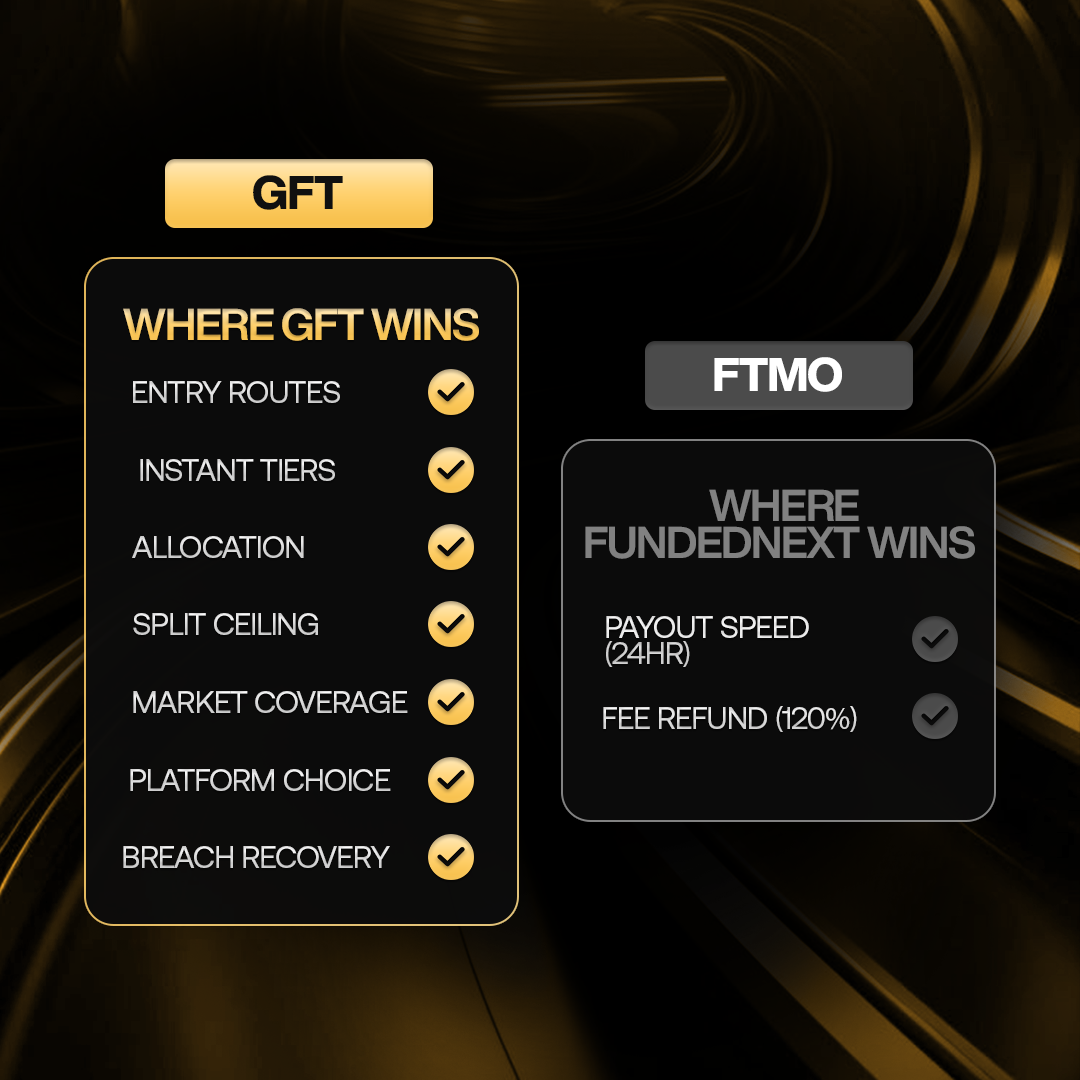
Goat Funded Trader vs FundedNext offers several features that are appealing. However, which is best for you?
For anyone looking for flexibility across account types, markets, and payout structures, Goat Funded Trader is the stronger overall choice.
The biggest advantage is the room to adapt. GFT offers multiple challenge and instant-funding routes, account resets that preserve completed phases, and 100% profit-split upgrades. Its 1-Step and 2-Step evaluations also carry no consistency rule, giving traders more freedom to reach their targets without having to spread profits across multiple days.
FundedNext still has an edge in specific areas, particularly its faster payout processing. This feature can make it attractive to traders who place greater weight on receiving profits quickly.
Yet, GFT offers the more flexible package. The combination of resets, multiple funding routes, broad market access, and higher profit-split potential gives traders more ways to build an account around their strategy.
If the search is specifically for a FundedNext alternative, Goat Funded Trader is the more compelling option when flexibility is prioritized more than payout speed.
A Funding Model for Every Trading Style
Goat Funded Trader does not force every strategy through the same evaluation. Five routes provide different ways to reach a funded account, from the single-stage 1-Step model to two-stage evaluations and instant funding.
- Prefer one clear hurdle? 1-Step GOAT keeps the path simple.
-
Want targets split across two phases? 2-Step GOAT and Standard take a more measured approach.
-
Prefer to skip evaluation altogether? HERO, GOAT, and PREMIUM provide instant funding, with PREMIUM carrying no consistency rule.
Across the range, GFT combines multiple markets, up to $400,000 in permitted allocation, a $2M scaling ceiling, profit-split upgrades reaching 100%, and a Reset option that preserves completed evaluation phases after a breach.
The route should always fit the strategy, not the other way around. Click here to compare our funding routes, get funded, and start trading the markets today!
Frequently Asked Questions (FAQs)
Can profits be withdrawn during the evaluation phase at either firm?
Profit withdrawal during an evaluation is uncommon across the industry, with rewards typically released only after a funded account has been issued. Certain models at specific firms have offered evaluation-stage rewards historically, so the current terms attached to your chosen model should be confirmed at checkout.
Are copy trading and account mirroring permitted?
Copy trading between accounts is prohibited at the majority of prop firms, including both Goat Funded Trader vs FundedNext. Detection systems flag correlated positions opened across linked accounts, and permanent closure with forfeited profit is the standard penalty applied when mirroring is identified.
What happens to an account left inactive for several weeks?
Inactivity policies differ between firms, with some closing dormant accounts after a defined period and others permitting indefinite pauses. Confirming the dormancy window before funding an account is advisable for any trader expecting to step away during busy periods away from the screen.
Is a minimum number of trading days required before a first withdrawal?
Minimum trading day requirements are applied by both firms, though the figure differs by model. The requirement exists to show consistency over a single fortunate session, and the specific count attached to your chosen route should be verified before a reward request is submitted.
Be Great and get the App