






How Much Do Forex Traders Make In a Day? Realistic Earnings Explained
How much do forex traders make in a day? Realistic daily earnings by account size and return, with worked examples from Goat Funded Trader.


How much can a forex trader realistically make in a day? There is no fixed answer and no reliable average forex trader income figure that applies across the retail market.
Forex does not pay a daily wage. Results depend on account size, risk per trade, strategy, market conditions, and the number of valid setups available. Some sessions may produce a profit, others a loss, and some may offer no worthwhile trade at all.
For that reason, understanding potential earnings starts with the numbers behind a trading account rather than an arbitrary daily income target.
This guide breaks those numbers down across different account sizes and levels of trading performance, giving a clearer picture of what daily forex trading profits can look like in practice. It also covers how traders can approach forex through Goat Funded Trader, with a worked example showing what the numbers look like in a funded account.
Key Takeaways
-
Average forex trader income is driven primarily by account size and percentage return. Independent traders earn nothing beyond what their capital and strategy produce.
-
Earnings per day should be treated as an average across many sessions, given how unevenly trading income arrives across winning, flat, and losing days.
-
The question “how much can you make trading forex?” is answered through percentage returns applied to capital, with a 2% to 6% monthly range treated as strong performance across professional sources.
-
Daily forex trading profits tend to scale directly with account size at a given return percentage. In practical terms, this means a $100,000 account at a 5% monthly target produces a considerably larger daily average than a $10,000 account at the identical return.
-
At Goat Funded Trader, allocation reaches $400,000 with scaling toward $2,000,000. This removes the capital ceiling that limits average forex trader income on small personal accounts. Several challenges and instant funding routes are available, and payouts are real.
-
As of July 2026, we recorded over $2M+ paid to traders of forex, stocks, etc, which brought our total amount paid to traders to $25,000,000.
How Much Do Forex Traders Make a Day, on Average?
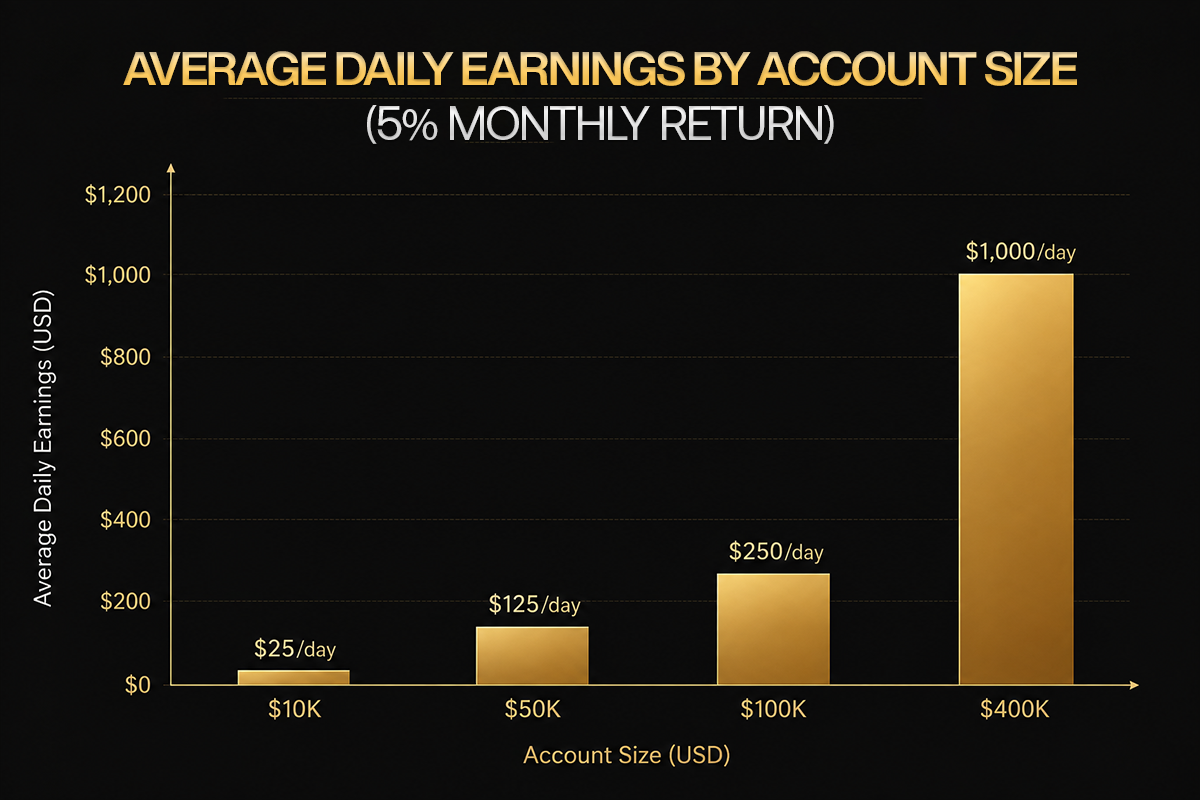
One of the best ways to estimate potential forex trader earnings per day is through account size and a realistic return over a longer period.
For example, a trader generating a 2% to 6% monthly return on a consistently profitable strategy would produce very different dollar results depending on the capital being managed. The percentage also will not arrive evenly: some months can be stronger, others weaker, and losing periods are part of trading.
Spread the monthly result across roughly 20 trading sessions and an average daily figure can be calculated. This is only an average across profitable, losing, and flat days. It does not count as an amount a trader should expect to collect every day.
| Account Size | 5% Monthly Return | Average Per Trading Day |
|---|---|---|
| $10,000 | $500 | $25 |
| $50,000 | $2,500 | $125 |
| $100,000 | $5,000 | $250 |
| $400,000 | $20,000 | $1,000 |
| $2,000,000 | $100,000 | $5,000 |
What Determines How Much a Forex Trader Earns
Four factors shape daily forex trading profits:
-
Account size sets the dollar scale: A 5% monthly return on $10,000 produces $500, while the same return on $400,000 produces $20,000. The percentage return has not changed; the capital behind it has.
-
Risk per trade controls the size of each outcome: Risking 0.5% on a position creates a very different profit and loss profile from risking 2%, even with identical entries and win rates. Position size should be calculated from the amount being risked and the stop-loss distance rather than simply using the largest position available.
-
Win rate and reward-to-risk determine expectancy: Winning frequently does not automatically mean earning more. A strategy with a lower win rate can outperform one with more winning trades if its average winners are sufficiently larger than its average losses.
-
Market conditions create the final layer of variation: A clean trending market can provide several high-quality setups, while a choppy session may offer little worth trading. Even a well-tested strategy will therefore produce uneven results from day to day.
How Much Can You Make Trading Forex by Account Size
The frequently asked question, “how much can you make trading forex,” depends almost entirely on how much capital sits behind the strategy. The table below shows the same 3%, 5%, and 8% monthly returns applied across a range of account sizes.
| Account Size | 3% Monthly | 5% Monthly | 8% Monthly |
|---|---|---|---|
| $10,000 | $300 | $500 | $800 |
| $25,000 | $750 | $1,250 | $2,000 |
| $100,000 | $3,000 | $5,000 | $8,000 |
| $400,000 | $12,000 | $20,000 | $32,000 |
| $2,000,000 | $60,000 | $100,000 | $160,000 |
Forex Trader Earnings Per Day: Converting Monthly Targets Into a Daily Number
Forex trader earnings per day is a figure best treated as an estimate built from monthly performance, as real trading income rarely arrives in identical daily instalments.
For example, a $100,000 account that targets 5% monthly produces $5,000 across the month, an average of roughly $250 per trading day when spread across 20 sessions. The actual distribution looks nothing like a flat $250 every day.
- Three sessions might produce $600 each.
- Ten might produce nothing.
- Two might produce a loss.
The average holds across the month, though no individual day matches it exactly.
| Account Size | Monthly Target | Rough Daily Average | Realistic Daily Pattern |
|---|---|---|---|
| $50,000 | $2,500 (5%) | $125 | Several strong days, several flat, occasional loss |
| $100,000 | $5,000 (5%) | $250 | Same pattern, larger dollar swings |
| $400,000 | $20,000 (5%) | $1,000 | Same pattern, considerably larger swings |
Treating a daily average as a guaranteed daily outcome is one of the fastest ways to develop high expectations. This tends to push traders toward oversized positions on a slow day, trying to hit an imaginary target.
Average Forex Trader Income by Experience Level
Average forex trader income shifts considerably as experience builds. The change happens for two reasons working together: growing skill and account size.
-
Beginners typically start with a small personal account (commonly under $10,000) and a return swinging between profit and loss month to month while a strategy is being refined. Daily income at this stage is minimal and inconsistent, closer to a training investment than an income source.
-
Average forex trader income at this stage begins climbing. An intermediate trader has usually developed a repeatable strategy and moved toward consistent monthly returns in the 2% to 4% range, across a larger personal account or an initial funded allocation. Daily income becomes meaningful here, though still variable session to session.
-
Professional or funded traders operating a six-figure allocation with a consistent 4% to 6% monthly return see daily averages that could reach several hundred to several thousand dollars. However, this still depends on account size. Consistency at this stage becomes the defining trait separating this group from the two above it.
| Experience Level | Typical Account | Typical Monthly Return | Daily Income Character |
|---|---|---|---|
| Beginner | Under $10,000 | Inconsistent, sometimes negative | Minimal, largely a learning investment |
| Intermediate | $10,000 to $100,000 | 2% to 4% | Meaningful but variable |
| Professional or funded | $100,000+ | 4% to 6% | Substantial, still session-variable |
Professional Forex Trader Salary vs Independent Trading Income
A professional forex trader salary earned inside a bank or hedge fund is structured completely differently from independent trading income.
-
Institutional traders draw a base salary regardless of daily results (reported between $55,000 and $80,000 annually at entry level), $104,000 for intermediate roles, and $120,000 to $250,000 or beyond for senior traders once performance bonuses are included. This base salary is paid regardless of a given week's result.
-
Independent traders, including those on funded accounts, earn nothing beyond what their strategy actually produces. A strong month produces high income, while a weak month produces little or nothing.
This structural difference is precisely why account size and consistency are important to anyone pursuing forex trading as a primary income source outside institutional employment.
Is Trading Forex on a Prop Firm Different?
Yes, and the difference sits in what "capital" means. At a broker or exchange, a deposit becomes the trading capital directly. Trading $100,000 in real exposure without heavy leverage means roughly $100,000 already sitting in the account. Average forex trader income stays tied to the deposit, dollar for dollar.
A prop firm works on a different structure entirely. A trader pays a modest one-time fee, commonly under $50-$100, to attempt a little evaluation to prove a strategy works inside set risk limits. Passing unlocks access to a much larger pool of the firm's simulated capital, up to $400,000 on a challenge account, without personally depositing the amount at any point.
The fee buys a skills test. Daily forex trading profits then scale against the larger allocation.
How to Start Trading Forex With Goat Funded Trader (GFT)
At Goat Funded Trader, closing the gap between a small personal account and daily income starts with three decisions:
-
Choose a path first: Prove a strategy before capital sits behind it through the 1-Step and 2-Step Challenges, with neither stage burdened by a consistency requirement. Skip the proving stage entirely through several instant funding routes (Instant HERO, GOAT, and PREMIUM), each suited to a different trading style and risk appetite.
-
Choose an allocation second: Starting capital reaches $400,000 on a challenge account, with consistent performance scaling the allocation toward $2,000,000 over time. Splits begin at 80% and are increased toward 100% as performance is demonstrated.
-
Start trading third: Six markets are covered inside one account: forex, CFD crypto for major pairs, indices, metals, commodities, and stocks. Five platforms are supported, including MT5, cTrader, MatchTrader, and TradeLocker, so a strategy already built around a familiar platform continues working exactly as it does now.
Payout reliability was demonstrated clearly in July 2026, the largest month recorded by GFT to date. $2,112,844.33 was paid out to traders across the month, pushing total lifetime payouts past $25,000,000.
The Only Variable Left Is Capital
Every table above leads to the identical conclusion. Skill matters, but capital decides the figure landing in an account. If you have a proven 5% edge, you may earn $500 on $10,000 and $20,000 on $400,000. The strategy stays fixed.
GFT removes the ceiling. Prove an edge through a phased Challenge, or skip straight to funded trading through several instant funding routes:
- HERO for the leading affordable entry point.
- GOAT for the highest maximum loss allowance among instant options.
- PREMIUM for traders wanting no consistency rule attached at all..
Max allocation starts at $400,000, scaling toward $2,000,000, across six markets and five platforms.
$25,000,000 has already been paid to traders who made this decision. Click here to choose your funding model, get funded, start trading, and cement your name on our payout books!
Frequently Asked Questions (FAQs)
Can a beginner realistically make $100 a day trading forex?
$100 a day is achievable on a modest account with disciplined risk management, though consistency takes considerably longer to build over the target itself. A $20,000 account at a 5% monthly return produces roughly $1,000 monthly, close to $50 daily on average. So, $100 daily typically requires a larger account or a higher, harder-to-sustain return.
Does trading more currency pairs increase daily forex trading profits?
Trading more pairs adds complexity without automatically adding profit. Also, spreading attention across too many pairs commonly dilutes setup quality over improving it. Focused expertise in two or three pairs, understood deeply across their typical volatility and session behaviour, tends to outperform shallow exposure to a dozen pairs at once.
How much capital is needed before daily income becomes high?
High daily income generally starts appearing once an account crosses roughly $50,000 to $100,000 at a consistent 4% to 6% monthly return, producing daily averages in the low hundreds of dollars. Below this range, strong percentage returns still translate into modest dollar amounts, which is precisely the capital gap funded accounts addressed directly.
Do professional forex traders track their earnings by the day or by longer periods?
Professionals track results across weeks and months through daily numbers mainly for journaling and pattern recognition. Judging performance by one day invites overreaction to normal variance, while monthly review reveals if a strategy holds a genuine, repeatable edge.
Be Great and get the App