







How to Borrow Against Stocks: A Step-by-Step Guide for 2026
How to borrow against stocks: Goat Funded Trader's complete 2026 guide reveals step-by-step strategies to unlock your portfolio's value safely.


Portfolio growth often creates a cash flow paradox: investors need liquidity for immediate opportunities but don't want to sell appreciating assets. Capital Growth Trading strategies solve this through securities-based lending, where stocks serve as collateral for loans rather than being liquidated. Portfolio loans, margin facilities, and stock-backed credit lines allow investors to access cash while maintaining their market positions.
These borrowing techniques require skill in managing leverage and collateral requirements across different market conditions. Practicing with firm capital through a prop firm allows traders to develop expertise in securities-based lending without risking their personal assets.
Summary
- Borrowing against stocks lets investors access liquidity without selling their holdings, typically unlocking 50% to 70% of portfolio value as cash while keeping positions fully invested. J.P. Morgan notes that most lenders apply a 50% loan-to-value ratio on stocks, meaning a $200,000 portfolio could provide $100,000 in immediate cash. This approach avoids triggering capital gains taxes and preserves future appreciation potential, but it requires pledging securities as collateral that lenders can liquidate if values drop.
- Tax deferral drives adoption among wealthy households who've mastered the borrow-instead-of-sell strategy. Yale Budget Lab research from March 2025 found that households with net worth over $100 million hold approximately $1.5 trillion in unrealized capital gains, largely because loan proceeds are not counted as income. Selling appreciated stocks triggers federal capital gains rates up to 20% plus state taxes of up to 13%, meaning accessing $100,000 might require liquidating $125,000 worth of holdings after accounting for taxes.
- Forced liquidation through margin calls creates the biggest danger when borrowing against securities. When portfolio values drop below maintenance thresholds (typically requiring 30% to 50% equity), lenders issue margin calls demanding immediate cash deposits or additional collateral within 48 hours. The 2021 Archegos collapse demonstrated this risk at scale, with counterparty banks liquidating over $20 billion in stocks within days after margin calls went unmet, triggering more than $10 billion in losses across lenders before borrowers could respond.
- Interest rate risk compounds market volatility concerns because securities-based loans typically float with benchmark rates. What starts as a 4% borrowing cost can climb to 6% or higher as rates increase, creating unpredictable debt service obligations. Mat Sorensen's analysis of wealth-building strategies notes that the wealthiest Americans secure rates as low as 2% to 3% through relationship depth and portfolio size, whereas most borrowers face higher costs that fluctuate throughout the loan term.
- Securities-based lending approvals move faster than traditional loans because diversified portfolios reduce lender risk and eliminate most underwriting friction. Banks take weeks to approve home equity lines, requiring extensive documentation and appraisals, while securities-based credit lines fund within 48 to 72 hours of application. This speed matters for time-sensitive opportunities like real estate purchases or business investments where delays cost deals, though the convenience comes with daily mark-to-market monitoring and potential forced sales during corrections.
- Goat Funded Trader's prop firm offers traders access to simulated capital up to $2M through performance-based evaluation rather than collateral pledges, providing 80% to 100% profit splits with on-demand withdrawals while eliminating margin calls and personal portfolio risk entirely.
What Does It Mean to Borrow Against Stocks?
Borrowing against stocks means using your investment portfolio as collateral to get a loan without selling your holdings. You pledge eligible securities—stocks, bonds, ETFs, mutual funds—and receive cash based on a percentage of their value, typically 50% to 70% for equities.

🎯 Key Point: Securities-based lending allows investors to access liquidity while maintaining their long-term investment positions and market exposure.
"Securities-based loans typically offer loan-to-value ratios of 50% to 70% for equity holdings, providing substantial liquidity without triggering taxable events." — Federal Reserve Economic Data, 2024
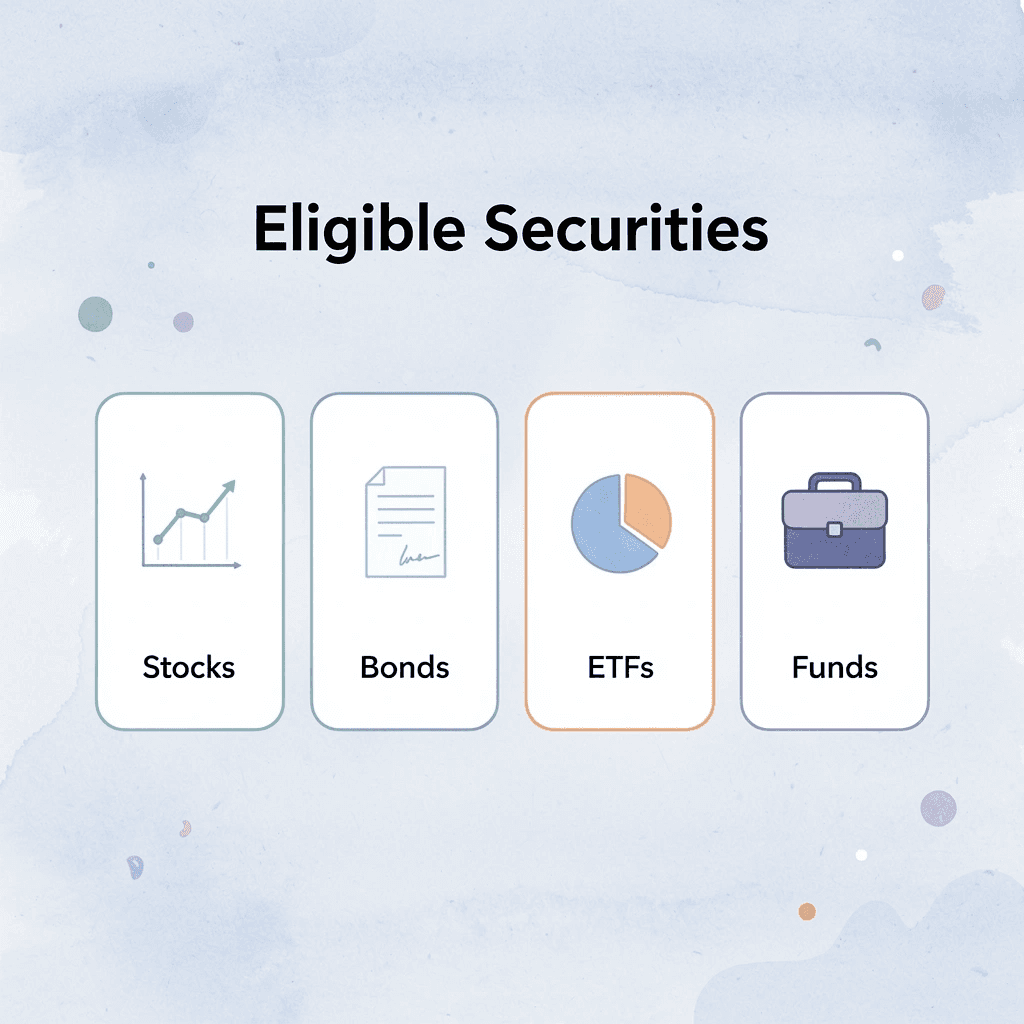
🔑 Takeaway: This financing strategy is particularly valuable for investors who need immediate cash but want to avoid the tax consequences and opportunity costs of selling appreciated securities.
How does securities-based lending preserve your investment strategy?
Your investments stay in your account, continue earning returns, and you repay the loan on your schedule while paying interest only on what you borrow. This approach, called securities-based lending, provides liquidity without triggering capital gains taxes or disrupting your long-term investment strategy.
The lender holds a lien on your pledged assets until you repay the loan, but you retain ownership and any appreciation or dividends those securities generate. According to J.P. Morgan, most lenders apply a 50% loan-to-value ratio on stocks: a $200,000 portfolio could unlock $100,000 in immediate cash.
What happens when you apply for a securities-based loan?
You approach a bank, brokerage, or specialized lender with details about your taxable investment account. They evaluate your holdings, assign lending values based on asset type and volatility, and approve a credit line within days. Stable assets like Treasury bonds receive higher lending percentages than volatile small-cap stocks. Once approved, you can draw funds as needed, similar to a home equity line of credit, and pay interest only on the amount you borrow. Your pledged securities remain fully invested in your account.
Why is borrowing against stocks faster than traditional loans?
Securities-based loans skip the hassle of traditional loans: no extensive paperwork, credit checks, or waiting weeks. Because the collateral is liquid and easy to value, you can access six-figure sums within a week, making this tool useful for time-sensitive opportunities such as real estate purchases, business investments, or bridging cash flow gaps.
How does borrowing against stocks help you avoid tax consequences?
Selling stocks creates a taxable event. If you've held appreciated assets for years, liquidating them means paying capital gains taxes, potentially at rates up to 20% federal plus state taxes. That $100,000 you need might require selling $125,000 worth of stock after accounting for taxes. Borrowing against those holdings lets you access cash while deferring taxes indefinitely, keeping more of your wealth compounded and invested.
Why maintain your investment positions while accessing cash?
Many investors hold positions they believe will increase significantly in value. Selling now means missing future gains. Borrowing provides immediate access to money while maintaining full investment in assets expected to outperform the loan's interest rate. When your portfolio grows faster than interest accrues, you're using leverage to preserve upside exposure.
What market risks should you consider when borrowing against stocks?
Market volatility creates the biggest danger. When your collateral value drops, lenders issue margin calls requiring you to add cash or securities to restore the required loan-to-value ratio. If you fail to meet that demand, the lender liquidates your holdings to cover the shortfall, forcing sales at the worst possible moment.
Interest rates on securities-based loans typically float with benchmark rates, meaning your borrowing costs can rise unpredictably. A 4% loan might climb to 6% or higher if rates increase. Stress-test your ability to repay the debt under higher rate scenarios before borrowing.
How does leverage amplify risk when you borrow against stocks?
The challenge with borrowing against stocks is that you're layering leverage on top of assets that already carry market risk. When markets fall, your collateral shrinks while your debt remains fixed, creating a squeeze that can force difficult decisions.
Active traders face an alternative: instead of risking personal portfolios through collateralized loans, Goat Funded Trader provides access to simulated trading capital up to $2M with profit splits reaching 100%, allowing you to use leverage and test advanced strategies without pledging your own assets or facing margin calls on personal holdings.
Related Reading
- How Much Do Day Traders Make Per Month
- How Is Margin Interest Calculated
- Can You Make A Living Day Trading
- How To Compare Brokers By Margin Interest Rates
- Financing Stock Options
- Options Trading Cash Flow Strategies Explained
- How Does Margin Work at Interactive Brokers
- Why Is Schwab Margin Rate So High
- How Much Margin Does Fidelity Offer
- How Does Margin Interest Work
- How Does Margin Work On Robinhood
- No Consistency Rule Prop Firm
- What Is A Prop Firm Forex
- Why Are Fidelity Margin Rates So High
Why Do Investors Borrow Against Their Stocks?
Investors borrow against their stocks to get urgent cash without selling. Selling holdings triggers immediate capital gains taxes, forfeits future growth, and exits positions built over years. Borrowing avoids these penalties while keeping your portfolio intact and working.

🎯 Key Point: Stock-backed loans let you access liquidity without triggering tax events or losing your investment positions.
"Borrowing against securities allows investors to maintain their market exposure while accessing needed capital, avoiding the double penalty of taxes and lost growth potential." — Financial Planning Association
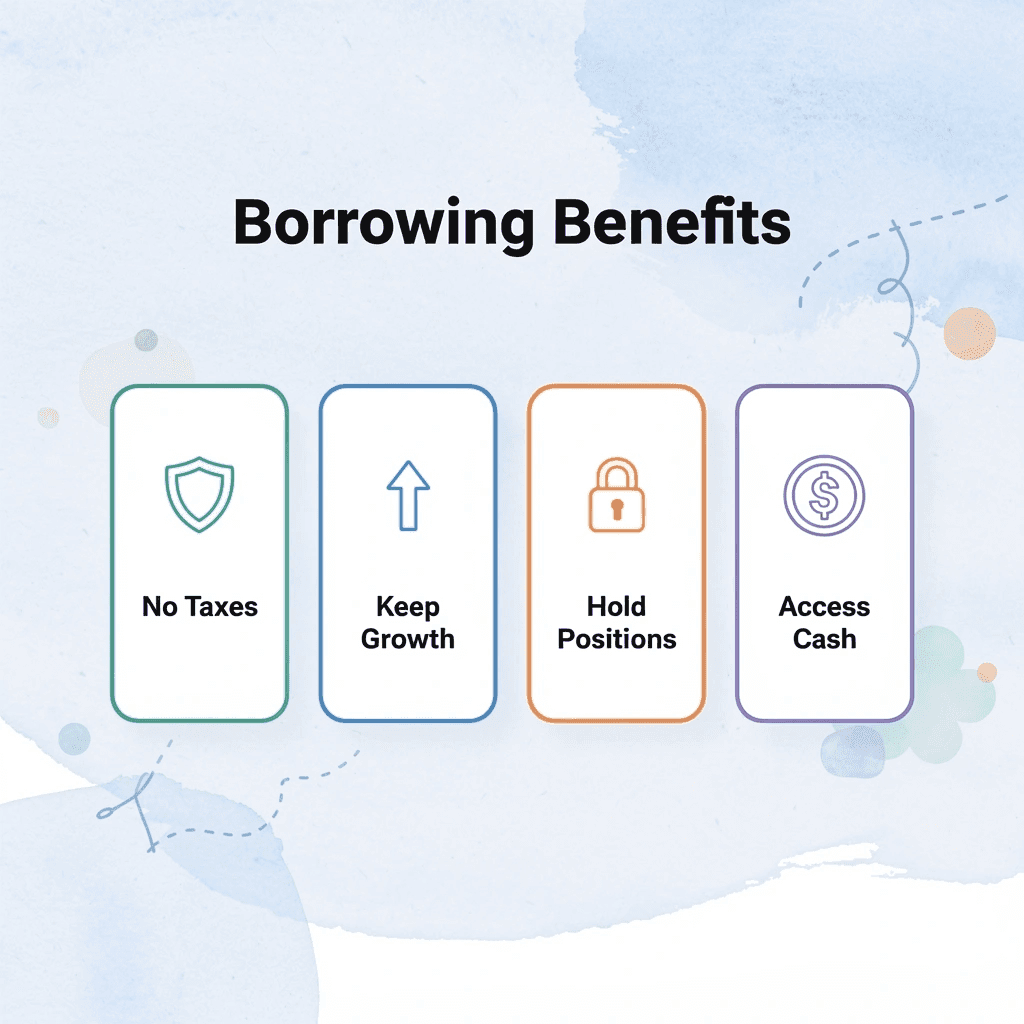
💡 Tip: This strategy works especially well for long-term investors who need temporary cash flow but want to keep their winning positions for continued appreciation.
Tax Avoidance Drives the Strategy
Selling appreciated stocks triggers immediate taxes: 20% federal capital gains rates plus 3–13% state taxes. Households with net worth over $100 million hold approximately $1.5 trillion in unrealized capital gains, according to Yale Budget Lab research from March 2025, because borrowing against assets avoids this tax hit. Loan proceeds don't count as income, allowing indefinite tax deferral while assets appreciate within the portfolio. This approach preserves more capital for growth and wealth transfer.
Maintaining Market Exposure Protects Long-Term Returns
Forced liquidation locks in losses during corrections and causes you to miss recovery rallies. Borrowing keeps every share invested, capturing dividends, price appreciation, and the full trajectory of your original allocation—a continuity difficult to replicate after selling and re-entering the market.
Speed and Flexibility Beat Traditional Lending
Banks take weeks to approve home equity lines or personal loans, requiring extensive paperwork, appraisals, and credit checks. Securities-based credit lines fund within days because your diversified portfolio serves as collateral, reducing lender risk and eliminating most underwriting friction.
You draw only what you need, pay interest solely on borrowed amounts, and repay on your schedule without prepayment penalties. This structure lets you act decisively on time-sensitive deals, such as real estate purchases or business expansions, without waiting for bureaucratic approvals.
What alternatives exist for traders seeking leverage without collateral risk?
The traditional approach puts you in a bind: borrow against personal assets and accept margin call risk, or liquidate holdings and surrender growth potential. For active traders seeking leverage without pledging their own portfolios, Goat Funded Trader offers simulated capital accounts up to $2M with profit splits reaching 100% and on-demand withdrawals. This eliminates collateral risk while providing access to substantial trading capital through performance-based evaluation. But accessing liquidity through borrowing introduces a risk most investors underestimate until it's too late.
Can I Lose My Stocks When Borrowing Against Them?
Yes, you can lose your stocks through forced liquidation when their value drops below the lender's maintenance threshold. The lender sells your holdings without permission to recover the loan balance, often within days of a margin call, and you have no control over which securities are sold or when.

⚠️ Warning: Once a margin call is triggered, you typically have 24-48 hours to either deposit additional funds or face automatic liquidation of your portfolio.
"Forced liquidation occurs when securities are sold automatically to meet margin requirements, often at the worst possible time for the investor." — Securities Industry Standards
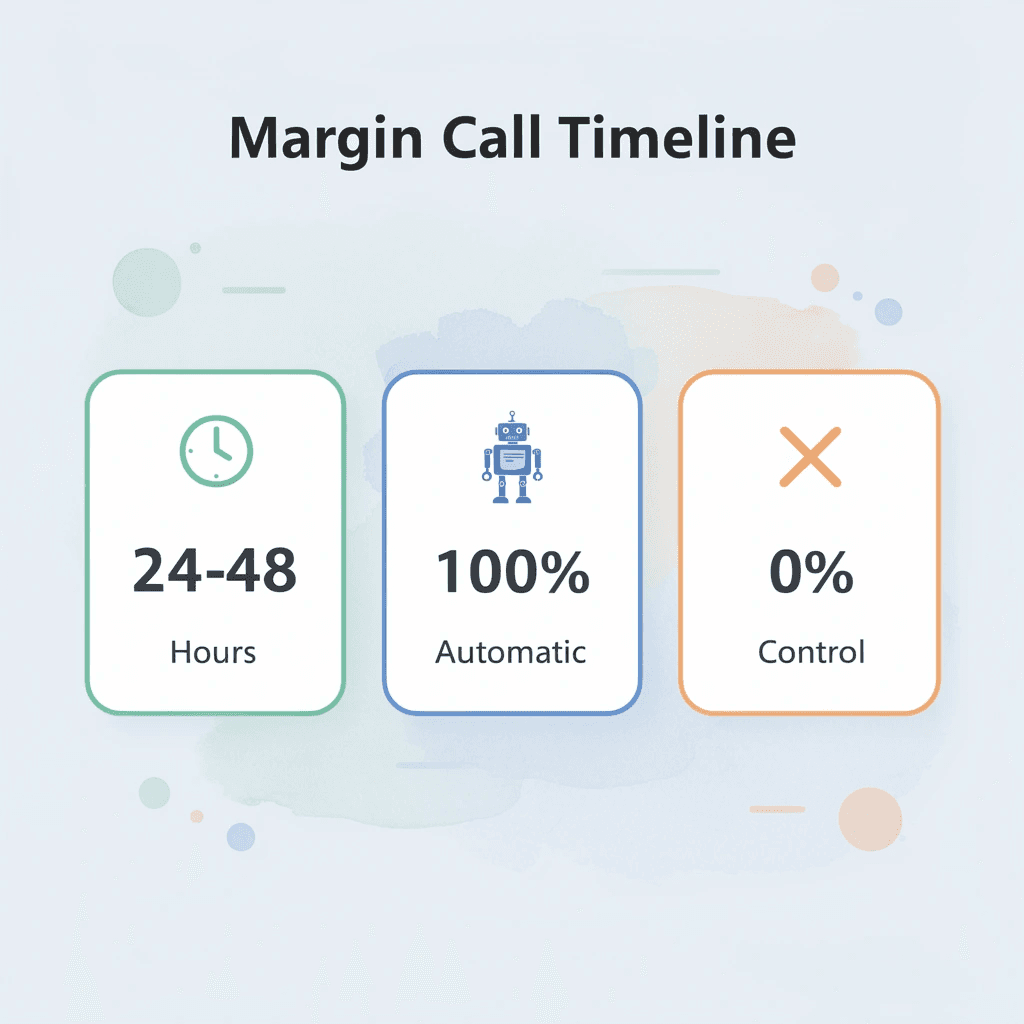
🔑 Takeaway: The biggest risk of borrowing against stocks isn't just market volatility - it's the complete loss of control over your investment timing and forced selling during market downturns.
The Margin Call Mechanism
Lenders monitor your loan-to-value ratio continuously. When your portfolio drops below the maintenance requirement (typically 30-50% equity, as noted by J.P. Morgan), you receive a margin call. You must deposit cash, transfer securities, or repay part of the loan within 48 hours. If you miss this deadline, the lender will sell your holdings at its discretion to restore compliance. Your investment plan becomes irrelevant once collateral value falls below the threshold.
What Forced Sales Actually Look Like
The 2021 Archegos collapse demonstrated this risk at scale. Counterparty banks liquidated over $20 billion in stocks after margin calls went unpaid, triggering more than $10 billion in losses across lenders. When asset values drop by 50-70%, companies that borrow heavily against illiquid collateral face immediate repayment demands. Forced sales reprice entire portfolios before borrowers can respond, and tax bills on realized gains arrive regardless of whether the sale was voluntary.
How to Avoid Losing Control
Borrow carefully and use much less than the maximum amount allowed. This way, normal market fluctuations won't put your loan at risk. Keep cash reserves equal to at least 20% of what you borrowed, accessible within hours if needed. Diversify your investments so that a single stock's decline won't threaten your entire portfolio.
What specific requirements should you review with your lender?
Check your lender's specific maintenance requirements, house call policies, and notification timelines, as these vary significantly. Treat the loan as short-term bridge financing with a clear repayment plan, not as permanent leverage.
How can traders access leverage without borrowing against stocks?
For traders seeking leverage without pledging personal assets, a prop firm provides simulated capital accounts up to $2M, where performance unlocks funding rather than collateral. With Goat Funded Trader, you gain access to substantial trading capital through evaluation, keep profit splits reaching 100%, and withdraw earnings on demand with no margin calls, forced liquidations, or personal portfolio at risk.
How to Borrow Against Stocks: A Step-by-Step Guide
You open your brokerage app, see six figures in unrealized gains, and wonder if you can use that value without selling. You can. Securities-based lending turns portfolio equity into accessible cash while your positions stay fully invested. The process moves faster than a home equity line and skips the credit scrutiny of traditional loans, but it demands precision at every stage.
🎯 Key Point: Securities-based lending allows you to access liquidity from your portfolio without triggering taxable events from selling appreciated stocks.
"Securities-based lending provides immediate access to capital while maintaining full market exposure on your underlying investments." — Financial Planning Association, 2024
⚡ Pro Tip: Most lenders offer same-day approval and can fund your account within 24-48 hours, making this one of the fastest financing options available to investors.

Confirm Your Portfolio Meets Lender Standards
Check your taxable brokerage accounts for qualifying securities. Lenders accept blue-chip stocks, investment-grade bonds, and liquid ETFs, but reject penny stocks, thinly traded shares, and concentrated single-stock positions exceeding 20% of total value. Retirement accounts like IRAs are ineligible. Most firms require a minimum of $100,000 in qualifying assets, though private banks serving high-net-worth clients may require $500,000 or more. Review your holdings against these criteria before applying.
Compare Lenders and Negotiate Terms
According to Mat Sorensen's analysis of wealth-building strategies, the wealthiest Americans can borrow against their stock portfolios at interest rates as low as 2-3%. Your rate depends on your relationship depth with the lender, portfolio size, and market conditions. Request quotes from your current brokerage, its affiliated bank, and at least one independent lender specializing in securities-based lines of credit. Compare advance rates (the percentage of portfolio value you can borrow), maintenance requirements, margin call policies, and whether rates change with SOFR or remain fixed. Established clients at firms like Schwab or Fidelity often receive better pricing and faster approvals.
Submit Documentation and Pledge Collateral
The application requires identification, account statements, and portfolio details. It doesn't need employment verification or debt-to-income calculations since your securities back the loan. You'll sign a pledge agreement allowing the lender to hold your assets in a separate account and sell them if you breach the maintenance requirements. Approval typically occurs within 48 to 72 hours, with funds transferring to your linked bank account once the collateral pledge is recorded.
Draw Conservatively and Monitor Daily
J.P. Morgan's investment strategy guidance notes that lenders commonly offer a 50% loan-to-value ratio, meaning a $200,000 portfolio unlocks $100,000 in borrowing capacity. Interest accrues only on borrowed funds, so avoid using your entire line of credit. Borrow 60% to 70% of your limit to create a safety cushion: if your portfolio drops 15%, you still meet the requirements without needing to find cash quickly. Check your account daily through the lender's website, monitoring both your debt and the current value of your pledged securities.
What are the alternatives to borrowing against stocks?
Most traders borrow against stocks to preserve capital or defer tax events, but this ties personal wealth to market swings and lender discretion. Performance-based funding models like prop firm offer an alternative: our platform provides access to $2M in simulated capital through evaluation rather than collateral, eliminates margin calls entirely, and lets you keep profit splits reaching 100% without pledging shares you own. No forced liquidations when markets reverse. But borrowing comes with an unavoidable reality: you still owe the money back, and interest never stops accruing.
Related Reading
- How To Become A Trader From Home
- Best Prop Firm For Stocks
- How To Stay Consistent In Trading
- Position Sizing In Trading
- Sbloc Vs Margin Loan
- How To Day Trade Without 25k
- Is Issuing Common Stock A Financing Activity
- Prop Trading Firms' Profit-Sharing Models
- How Do You Profit From Day Trading Stocks
- Can I Borrow Against My Stocks
- Position Sizing Day Trading
- Lowest Margin Rates Brokers
- How Do You Take Profit In Crypto Trading
- Best Crypto Prop Firm
How Goat Funded Trader Acts as a Safer Alternative to Borrowing Against Stocks
When you pledge stocks as collateral, you give up complete control to a lender. Goat Funded Trader changes this. Instead of borrowing against assets you've built, our platform gives you access to up to $2M in simulated trading capital through performance-based evaluation and lets you keep 80% to 100% of your gains without risking a single share. No lender watches your portfolio, no margin calls come during market drops, and no forced liquidations erase your wealth.
🔑 Key Takeaway: Traditional stock-backed loans put your existing wealth at risk, while Goat Funded Trader provides capital access through skill demonstration rather than asset pledging.

"No lender watches your portfolio, no margin calls come during market drops, and no forced liquidations erase your wealth." — Goat Funded Trader Platform Benefits
Stock-Backed Loans vs Prop Trading (Goat Funded Trader)
- Capital exposure
- Stock-backed loans: Risk existing assets
- Prop trading: Zero personal capital risk
- Control
- Stock-backed loans: Lender controls collateral
- Prop trading: You maintain trading control (within rules)
- Margin calls
- Stock-backed loans: No margin calls ever (loan structure-based)
- Prop trading: Forced liquidation risk if rules are violated
- Downside risk
- Stock-backed loans: Interest payments required regardless of performance
- Prop trading: No liquidation threats from personal capital, but account rules apply
- Profit retention
- Stock-backed loans: Not directly tied to trading profits
- Prop trading: Keep 80–100% of profits depending on model
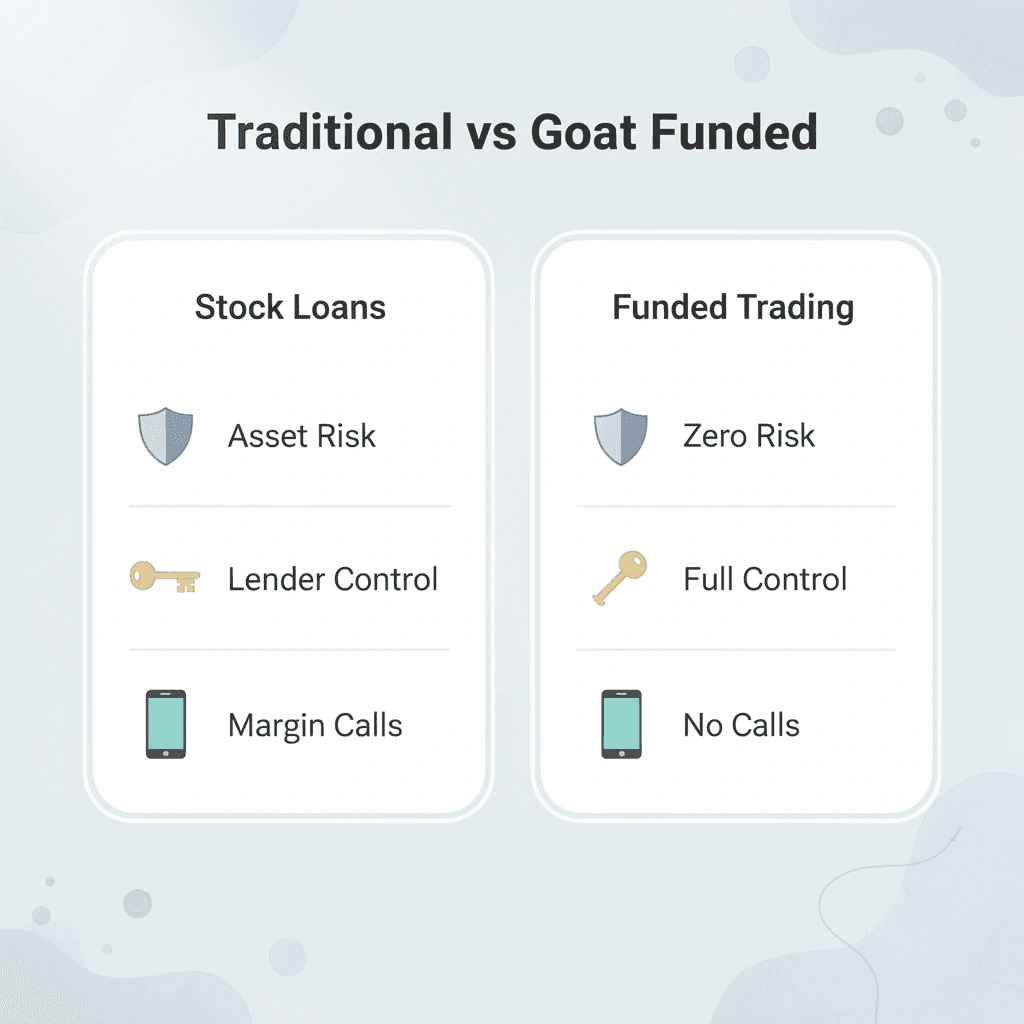
⚠️ Warning: Stock-backed borrowing can lead to devastating losses during market volatility, while funded trading programs eliminate this downside risk entirely.
You Keep Full Ownership of Your Portfolio
Securities-based loans require lenders to obtain legal rights to sell your holdings if the values drop or you miss payments. Goat Funded Trader eliminates that threat. You pass evaluation phases using simulated capital, receive funded status, and trade forex, stocks, ETFs, or crypto on your preferred platform while your personal portfolio remains untouched. A trader with $500,000 in blue-chip stocks can access $2 million in trading capital without pledging a single share, keeping dividends, voting rights, and full control intact.
Fixed Risk Rules Replace Unpredictable Margin Calls
Borrowing against stocks exposes you to daily price fluctuations and unexpected margin calls requiring immediate cash payment or asset sales within 48 hours. Our Goat Funded Trader program enforces clear risk limits: a 3% daily loss limit and a 6% maximum drawdown. Breaking these rules incurs a small fee to restart the evaluation, not loss of personal assets. The worst outcome is restarting an evaluation, not watching your retirement portfolio disappear because the S&P 500 dropped 8% in a week.
You Earn Real Profits Without Debt Service
Traditional borrowing charges interest daily, eroding trading profits and straining cash flow. Goat Funded Trader offers 80% to 100% profit splits on successful trades, with withdrawals every two weeks or processed within 24 to 48 hours on demand. You earn real cash rewards while the firm absorbs simulated losses. Grow your account, generate consistent monthly returns, and earn five-figure payouts without debt to a lender.
Unlimited Trading Time and Platform Flexibility
Securities-based loans come with repayment schedules, collateral maintenance requirements, and lender restrictions that conflict with long-term trading strategies. Our Goat Funded Trader program offers unlimited trading periods, news trading permissions, weekend holding flexibility, and access to MT5 with tight spreads and fast execution. You focus on strategy and performance without loan maturities, interest rate resets, or forced deleveraging during volatile markets. This freedom lets you execute swing trades, hold positions through earnings cycles, and capitalize on opportunities unfolding over weeks rather than days.
Get 25-30% off Today - Sign up to Get Access to Up to $800K Today
You've researched lenders, compared rates, and mapped out your collateral strategy. But borrowing against your stocks means pledging the portfolio you spent years building. One volatile week, one margin call, one forced sale at the worst possible moment, and your wealth erodes while you pay interest.

Goat Funded Trader offers a different path. Our platform provides access to up to $2 million in simulated trading capital without risking a single share from your personal holdings. Pass a straightforward evaluation, keep 80 to 100% of your profits as real withdrawals, and trade under clear rules (3% daily loss limit, 6% maximum drawdown). Your stock portfolio stays untouched and fully invested while you build trading income on capital we provide.
"Over 250,000 traders have chosen this model, and we've paid out more than $20 million in real profits." — Goat Funded Trader
🎯 Key Point: Your personal portfolio remains completely protected while you access institutional-level trading capital.
Use code FIRSTGFT for 50% off your first account. The one-time fee is fully refundable once you're funded, with no credit card required to explore. Start your evaluation today.
🔑 Takeaway: Why risk your carefully built portfolio when you can trade with up to $2 million in capital that's not yours to lose?

Related Reading
- Best Forex Prop Firm
- Best Margin Rates Brokers
- Margin Loan vs. Securities-Based Lending
- How Does A Margin Loan Work
- How to Become a Full Time Trader
- How To Trade Forex With A Prop Firm
- Forex Trading Strategies For Consistent Profits
- Options Trading Strategies For Consistent Income
- How To Get Profit In Option Trading
- Day Trading Strategies For Consistent Profits
- Trading Cash Flow
- Recommended Prop Trading Firms With Growth Plans
- Best Trading Strategies For Consistent Profits
Be Great and get the App