







SBLOC vs Margin Loan: Which Protects Your Portfolio?
SBLOC vs Margin Loan: Discover which borrowing strategy better protects your portfolio. Goat Funded Trader breaks down the key differences.
.jpeg)

When building wealth through Capital Growth Trading, leveraging your portfolio can accelerate returns or create unnecessary risk. Securities-backed lines of Credit and margin loans both allow borrowing against investments, but they differ sharply in interest rates, collateral requirements, liquidation risks, and repayment flexibility. Understanding these differences helps traders protect their assets while accessing the capital they need.
Making informed decisions about borrowing strategies requires proper education and an understanding of risk management principles. Traders benefit from structured programs that teach them how to evaluate loan options as part of their overall approach to the markets. Many successful traders develop these skills through training at a prop firm specializing in comprehensive trader development.
Summary
- SBLOCs provide significantly lower risk than margin loans because they eliminate the leverage trap that magnifies portfolio losses. When you borrow through an SBLOC, you access cash for personal or business needs without buying additional securities, which keeps your portfolio at its natural exposure level. Margin loans do the opposite, letting you purchase more assets on credit, which doubles down on market risk and turns moderate declines into severe portfolio damage. During the 2022 downturn, margin accounts at major brokerages declined by an average of 35% to 40%, compared to 20% to 25% for cash accounts, with that extra 15 to 20 percentage points of loss coming directly from leverage, which multiplied downside exposure.
- Forced liquidations hit margin accounts harder and faster than SBLOC arrangements. When your margin account equity falls below maintenance requirements, typically 25% to 40%, brokerages can sell your holdings immediately without warning. U.S. margin debt plunged 27% by June 2022 from its October 2021 peak of $936 billion as forced sales cascaded through leveraged accounts, locking in losses at market lows and stripping investors of recovery potential. SBLOC structures are built with larger equity cushions and slower response windows, with lenders typically allowing days or weeks to add collateral or pay down balances rather than liquidating immediately.
- Advance rates and maintenance buffers differ substantially between the two products. SBLOCs offer advance rates between 50% and 95%, depending on asset quality, with conservative lenders typically landing around 70% for diversified equity portfolios. Under Regulation T, margin loans start at 50% for initial purchases and require maintenance margins between 25% and 40%, leaving less room for market swings before action is required. If you borrow $350,000 against a $500,000 portfolio through an SBLOC at 70% advance rate, your equity cushion sits at $150,000 before you approach the danger zone, while the same portfolio in a margin account with a 30% maintenance requirement leaves you just $50,000 above the line.
- Interest structures create different cost pressures depending on how you use borrowed funds. SBLOC interest accrues only on drawn amounts at variable rates tied to SOFR plus a spread, with most lenders requiring monthly interest payments while letting you repay principal on your own timeline. Margin interest also varies with market rates but often allows interest to compound into your balance without mandatory monthly payments, which reduces your available equity and pushes you closer to maintenance thresholds during downturns. Margin borrowers pay interest on funds used to buy more securities, so rising rates hit them twice through higher borrowing costs and potential portfolio losses if rate hikes pressure equity valuations.
- Liquidation speed distinguishes between the two products when portfolio values fall below the required thresholds. Margin calls can be issued with as little as 24 to 48 hours' notice during market volatility, and you might receive a call in the morning and face forced liquidation by afternoon if you don't deposit cash or securities immediately. SBLOCs typically allow borrowers several days to a week to restore equity ratios through additional collateral, partial repayment, or market recovery, thereby protecting long-term holdings from panic sales during temporary volatility. This breathing room lets you make strategic decisions instead of panic moves, preserving long-term holdings and tax efficiency.
- Goat Funded Trader addresses this collateral risk entirely by providing traders access to simulated capital accounts up to $2M with profit splits reaching 100% and on-demand withdrawals, eliminating the need to pledge personal assets or take on debt while maintaining full upside participation.
What Is an SBLOC, and How Does It Work?
A Securities-Backed Line of Credit (SBLOC) lets you borrow cash using your investment portfolio as collateral without selling shares. You pledge stocks, bonds, ETFs, or mutual funds held in taxable brokerage accounts and receive a revolving credit line based on a percentage of those assets' value. You pay interest only on what you borrow, your portfolio stays invested and continues growing, and you avoid capital gains taxes from liquidation.

🎯 Key Point: An SBLOC transforms your investment portfolio into immediate liquidity without triggering tax consequences or forcing you to sell assets.
"Securities-backed lending allows investors to access cash while maintaining their investment positions, providing flexibility without portfolio disruption." — Financial Planning Association

💡 Example: If you own $100,000 in diversified securities, you might qualify for an SBLOC of $50,000-$70,000, depending on the loan-to-value ratio your lender offers.
- Collateral
- Your stocks, bonds, ETFs, and mutual funds are used as security
- Credit line
- Typically 50–70% of your portfolio value is made available
- Interest
- You only pay interest on the amount you actually borrow (not the full credit line)
- Portfolio status
- Your investments remain fully invested and continue to grow while serving as collateral

What qualifies as collateral
Publicly traded stocks, investment-grade bonds, mutual funds, ETFs, and cash equivalents in non-retirement accounts qualify. Retirement accounts like IRAs don't qualify due to IRS restrictions. According to Charles Schwab, most institutions offer a 70% loan-to-value ratio on diversified equity portfolios, while Treasury bonds can reach 95%. Individual stocks with high volatility support only 50% advance rates. You can pledge multiple accounts to increase your line of credit.
How lenders calculate your borrowing power
Your credit line depends on your asset mix and risk profile, not income. A $500,000 portfolio split between blue-chip stocks and bonds might unlock $300,000 to $350,000 in available credit, while portfolios with all cash or mostly Treasury bonds can reach $475,000. The line remains flexible: draw what you need, repay the principal when cash is available, and borrow again without reapplying. There's no income verification, setup fees, or annual maintenance charges in most cases.
The application and funding timeline
You pledge securities, the lender reviews your portfolio, and approval is typically completed within a few business days to two weeks. Approved funds sit ready for immediate draws with no fees on unused portions. You retain full trading rights in pledged accounts, though lenders continuously monitor their values. If your portfolio drops below the required collateral ratios, you'll face a maintenance call requiring you to add assets or repay part of the line within days. In severe downturns, lenders can sell securities to restore the ratio without your approval.
Interest rates and repayment flexibility
Interest accrues only on the money you use. The interest rate adjusts based on benchmarks such as SOFR, plus a spread. Larger credit lines qualify for lower spreads, sometimes as low as 1.90% on lines exceeding $3 million. Each month, you pay only the accrued interest. You decide when to pay down the principal while your investments continue growing, with no set repayment schedule. This setup works well if you need short-term funds, need to bridge a financing gap, or face a one-time expense such as purchasing real estate, investing in a business, or paying taxes, all without disrupting your long-term investment plan.
When does the SBLOC vs margin loan choice matter for trading
But what happens when you want leverage specifically for trading, not liquidity? The mechanics shift entirely.
What Is a Margin Loan, and How Does It Work?
A margin loan lets you borrow cash from your brokerage using securities in your portfolio as collateral. Unlike an SBLOC, which keeps your investment account separate from your borrowing, margin combines both functions directly within your brokerage account. You can access funds to buy more securities or pay for other expenses, with interest accruing only on the amount you borrow.

🎯 Key Point: Margin loans provide immediate access to cash without requiring you to sell your investments, making them ideal for short-term liquidity needs or investment opportunities.
"Margin trading allows investors to leverage their existing portfolio value to access additional purchasing power for investment strategies." — Financial Industry Regulatory Authority

💡 Example: If you own $10,000 worth of stocks in your brokerage account, you might be able to borrow up to $5,000 against those holdings, depending on your broker's margin requirements and the specific securities you own.
Setting Up a Margin Account
To start using margin, you need at least $2,000 in your account under federal regulations. However, you'll want more to cushion against price fluctuations. Your brokerage determines which holdings can serve as collateral. They typically accept stocks, ETFs, bonds, and some mutual funds, but exclude retirement accounts like IRAs. Approval is quick because your broker already holds your securities and continuously monitors your account.
How Borrowing Limits Get Calculated
Charles Schwab lets you borrow up to 50% of the value of marginable securities under Regulation T, though your borrowing capacity fluctuates daily as portfolio values change. Maintenance requirements mandate at least 25% to 30% equity in the account, though many brokerages enforce stricter house rules of 30% to 40%. Your borrowing capacity rises and falls with market movements, tying your access to funds directly to portfolio performance rather than income or credit score.
Interest Costs and Repayment Flexibility
Interest charges apply to your outstanding balance at variable rates: typically, a broker base rate plus or minus a spread that decreases with larger loan sizes. You pay interest monthly, while principal repayment is optional as long as you maintain the required equity levels. This flexibility suits short-term cash needs, but rising rates increase costs when market pressure is already straining your account.
The Margin Call Reality
When markets drop, your collateral value drops too, triggering margin calls that force you to deposit cash, add securities, or face automatic liquidation. Brokers can sell your positions to restore equity ratios, locking in losses and potentially leaving you owing more than your initial investment. Brokerages have no obligation to contact you before liquidating: volatile positions get sold first, regardless of your long-term strategy or tax consequences. The real question isn't whether margin loans offer leverage, but whether that leverage protects you or exposes you when markets turn.
Related Reading
- How Does Margin Work On Robinhood
- Options Trading Cash Flow Strategies Explained
- Can You Make A Living Day Trading
- How Much Margin Does Fidelity Offer
- No Consistency Rule Prop Firm
- How Does Margin Work at Interactive Brokers
- What Is A Prop Firm Forex
- Why Are Fidelity Margin Rates So High
- How Is Margin Interest Calculated
- How Does Margin Interest Work
- How Much Do Day Traders Make Per Month
- How To Compare Brokers By Margin Interest Rates
- Why Is Schwab Margin Rate So High
- Financing Stock Options
Are SBLOCs Safer Than Margin Loans?
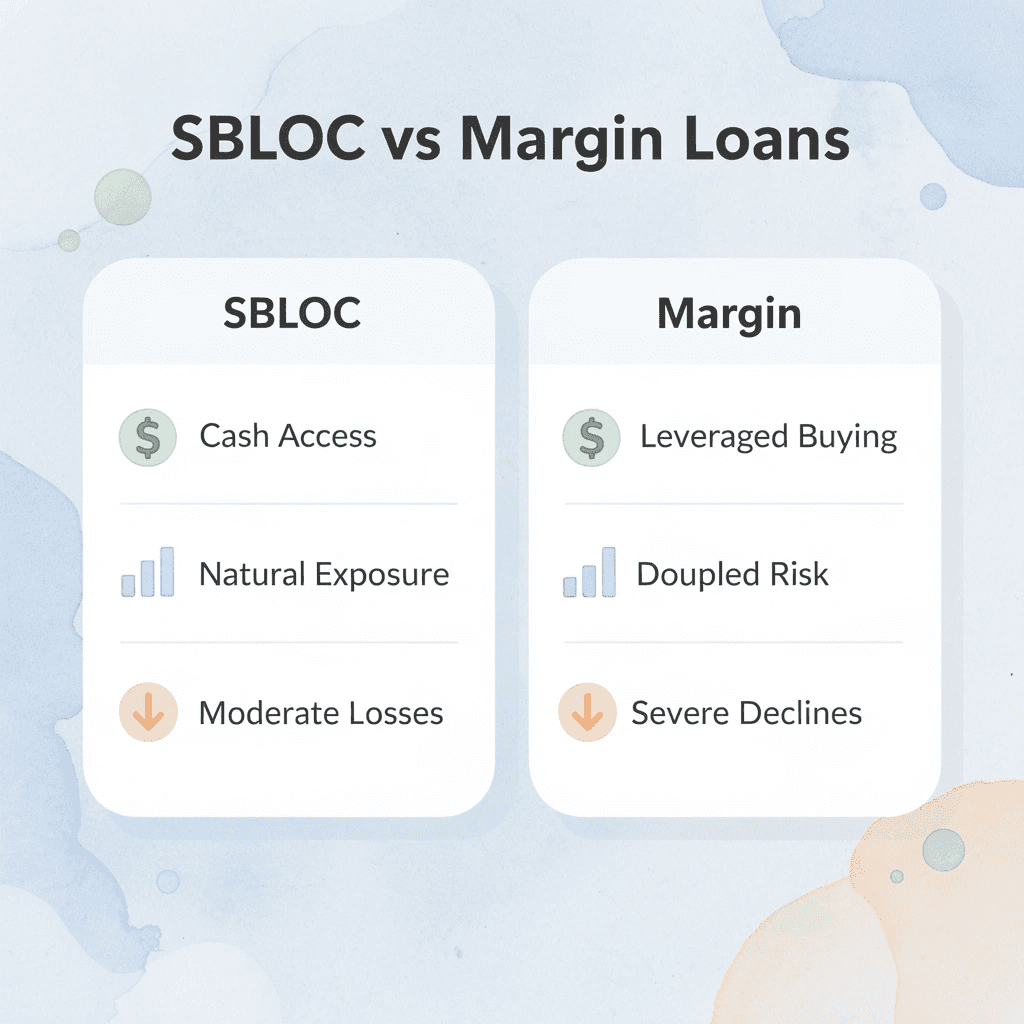
SBLOCs deliver lower risk than margin loans because they eliminate the leverage trap that magnifies losses. When you borrow through an SBLOC, you access cash without purchasing additional securities, keeping your portfolio at its natural exposure level. Margin loans let you purchase more assets on credit, which compounds market risk and turns moderate declines into severe portfolio damage.

🎯 Key Point: SBLOCs provide liquidity without increasing your market exposure, while margin loans multiply your risk by enabling leveraged purchases.
"SBLOCs eliminate the leverage trap that magnifies losses, keeping portfolios at their natural exposure level rather than doubling down on market risk."

SBLOC vs Margin Loan Features
- Cash access without new purchases
- SBLOC: Access liquidity from existing portfolio without selling assets
- Margin loan: Borrow funds to actively buy additional securities
- Portfolio exposure
- SBLOC: Natural exposure maintained (you keep your investments)
- Margin loan: Leveraged exposure increases overall market risk
- Risk amplification
- SBLOC: Moderate losses remain proportional to portfolio performance
- Margin loan: Losses are amplified due to leverage
- Downside impact
- SBLOC: Drawdowns affect portfolio value but not position size
- Margin loan: Declines can lead to severe losses and margin calls
⚠️ Warning: The fundamental difference lies in leverage amplification – margin loans turn your portfolio into a high-risk instrument, while SBLOCs keep risk levels unchanged.
What makes the SBLOC vs. the margin loan risk profiles different
The critical difference isn't how much you can borrow—it's what happens to your risk profile after you borrow. Margin loans are held in brokerage accounts, where daily mark-to-market calculations track every price swing. FINRA notes that margin loans typically allow you to borrow up to 50% of the value of marginable securities, but this borrowing power fuels additional purchases that amplify volatility. SBLOCs sit outside your investment account, providing liquidity without adding market exposure. This keeps your downside limited to portfolio performance alone rather than portfolio performance multiplied by leverage.
Why do investors confuse SBLOC vs margin loan risks
Most investors miss this difference because both products use securities as collateral. They assume risk comes from pledging assets when it actually comes from what you do with the borrowed funds. Margin borrowers add new positions to existing holdings, compounding losses when markets drop. SBLOC borrowers can fund home renovations or business expansions while leaving their portfolio untouched to recover naturally when valuations rebound.
How do margin calls affect your trading timeline?
Margin calls happen on tight timelines with little room for negotiation. When your account equity drops below maintenance requirements, typically 25% to 40%, brokerages can sell your holdings immediately without warning. The 2022 bear market demonstrated the severity of this risk. U.S. margin debt plunged 27% by June from its October 2021 peak of $936 billion as forced sales swept through leveraged accounts, locking in losses at market lows and preventing investors from recovering.
Why does SBLOC vs margin loan matter for liquidation protection?
SBLOC structures are built with larger equity cushions and slower response windows. Lenders set loan-to-value ratios conservatively, often 50% to 70% for diversified equity portfolios, creating natural headroom against declines. When maintenance calls occur, lenders typically provide days or weeks to add collateral or pay down balances rather than liquidating immediately. This breathing room lets you make strategic decisions instead of panic moves, preserving long-term holdings and tax efficiency.
How do amplified losses affect your account performance
During the 2022 downturn, margin accounts at major brokerages declined an average of 35% to 40%, compared to 20% to 25% for cash accounts. The extra 15 to 20 percentage-point loss resulted from leverage multiplying the downside exposure. When your portfolio drops 20% but you've borrowed to buy more securities, your equity falls by a much steeper percentage because losses hit both your original capital and your leveraged positions.
What alternatives exist to SBLOC vs margin loan risks
For traders seeking access to capital without risking personal assets, prop firms like Goat Funded Trader offer an alternative to SBLOC and margin-loan mechanics. You trade with practice capital, retain up to 100% of profits with flexible withdrawals, and access up to $2M in trading capital while keeping personal investments safe. This removes collateral risk, margin calls, and tax complications from selling your holdings.
Interest Rate Risk Exists in Both, but Leverage Magnifies the Damage
Both SBLOCs and margin loans charge variable interest tied to benchmark rates, so borrowing costs rise when the Federal Reserve tightens policy. Margin borrowers face compounding damage: higher borrowing costs plus potential portfolio losses if rate hikes pressure equity valuations. SBLOC borrowers pay interest on non-investment funds, so rate increases hurt without the leveraged market exposure multiplier.
SBLOC vs Margin Loan Key Differences
The differences between an SBLOC and a margin loan change everything from how much you can borrow to what happens when your portfolio drops 15% in a week. An SBLOC unlocks cash for life expenses while keeping your investment strategy intact, while a margin loan adds leverage directly into your portfolio by funding new positions. This distinction cascades into borrowing limits, interest structures, liquidation timelines, and how much breathing room you get when volatility hits.
🔑 Key Takeaway: SBLOCs provide cash access without affecting your investment strategy, while margin loans directly amplify your market exposure and risk.
SBLOC vs Margin Loan Features
- Primary purpose
- SBLOC: Cash for life expenses
- Margin loan: Fund new investments
- Investment impact
- SBLOC: Strategy stays intact (no need to sell assets)
- Margin loan: Adds direct leverage to positions
- Risk profile
- SBLOC: Lower overall risk
- Margin loan: Higher amplified risk
- Liquidation timeline
- SBLOC: More breathing room before any action is taken
- Margin loan: Faster margin calls possible
- Borrowing limits
- SBLOC: Conservative lending ratios (typically 50–70%)
- Margin loan: Higher leverage ratios available
"The key difference lies in purpose: SBLOCs provide liquidity without leverage, while margin loans provide leverage with liquidity." — Financial Planning Analysis, 2024
⚠️ Warning: During market downturns, margin loans can trigger forced liquidations much faster than SBLOCs, potentially locking in losses at the worst possible time.

How does SBLOC vs Margin Loan handle collateral differently?
SBLOCs work through a separate lending agreement outside your main brokerage account, so day-to-day trading doesn't trigger constant collateral recalculations. Your lender reviews the portfolio's value periodically rather than continuously, so short-term price swings rarely prompt immediate action. Margin loans integrate directly into your brokerage margin account, where every trade, price movement, and dividend payment adjusts your available borrowing power in real time. This tight coupling makes margin accounts more reactive and restrictive when rebalancing or shifting allocations.
What control do you maintain over your holdings?
The separation affects how much control you maintain over your holdings. SBLOC lenders focus on overall portfolio stability and diversification, so they rarely restrict individual stock sales or sector rotations as long as total value stays above the loan-to-value threshold. Margin accounts monitor specific positions because those securities serve as direct collateral for leveraged trades; your broker may block sales of certain assets if doing so would breach maintenance requirements.
How do SBLOC vs Margin Loan advance rates compare?
SBLOCs offer advance rates between 50% and 95%, depending on asset quality, with conservative lenders typically landing around 70% for diversified equity portfolios and higher percentages for stable fixed-income holdings. According to FINRA's investor guidance, these higher advance rates include built-in volatility buffers that provide borrowers with a greater cushion before reaching critical thresholds. Margin loans start at 50% under Regulation T for initial purchases and require maintenance margins of 25%-40%, leaving limited room for market swings before action is required.
What happens during market volatility with each option?
If you borrow $350,000 against a $500,000 portfolio through an SBLOC at 70% advance rate, your equity cushion sits at $150,000 before approaching the danger zone. The same portfolio in a margin account with a 30% maintenance requirement leaves only $50,000 above the line; a 10% market drop could trigger forced liquidation rather than a request to add funds.
How do SBLOC vs margin loan interest structures differ?
SBLOC interest accrues only on the money you use. The interest rate is based on SOFR plus an additional margin and changes accordingly. Most lenders require monthly interest payments. For example, if you draw $100,000, you pay interest on that $100,000; the unused portion incurs no cost.
Why do margin loan payment structures create additional risk?
Margin interest changes with market rates and often accrues in your balance without required monthly payments, reducing available equity and pushing you closer to maintenance thresholds during downturns. Many traders prefer the capital access model that prop firms like Goat Funded Trader provide because it eliminates interest burden entirely. Our platform gives qualified traders access to simulated capital accounts up to $2M, with profit splits up to 100% and no interest expense eroding returns. This structure eliminates personal portfolio risk while maintaining full upside participation.
How quickly do SBLOC vs margin loan liquidations occur?
When portfolio values drop below required levels, brokers monitor equity in real time and face regulatory pressure to limit exposure. You might receive a margin call in the morning and face forced liquidation by afternoon if you don't deposit cash or securities immediately. SBLOCs typically provide several days to a week to restore equity ratios through additional collateral, partial repayment, or market recovery, protecting long-term holdings from panic sales during temporary volatility.
What drives the difference in liquidation response times?
The speed difference reflects the lender's risk tolerance. Margin lenders must maintain minimum account balances under regulatory requirements, so they sell investments quickly to comply. SBLOC lenders structure loans with built-in safety margins from the start, giving them more time to weather anticipated market fluctuations when determining loan amounts.
Related Reading
- How To Day Trade Without 25k
- How Do You Profit From Day Trading Stocks
- Best Prop Firm For Stocks
- Position Sizing Day Trading
- How Do You Take Profit In Crypto Trading
- How To Stay Consistent In Trading
- Lowest Margin Rates Brokers
- Can I Borrow Against My Stocks
- Is Issuing Common Stock A Financing Activity
- Best Crypto Prop Firm
- Prop Trading Firms' Profit-Sharing Models
- Position Sizing In Trading
- How To Borrow Against Stocks
- How To Become A Trader From Home
Which Protects Your Portfolio, and How to Make the Right Choice
An SBLOC protects your portfolio better than a margin loan if your goal is cash flow without disrupting your investment strategy. SBLOCs keep borrowing separate from trading activity, preventing leverage from amplifying market swings. Margin loans sit inside your brokerage account and encourage additional purchases that multiply risk, especially during volatility.

🎯 Key Point: SBLOCs offer true portfolio protection by maintaining separation between your borrowing needs and investment decisions, while margin loans create dangerous incentives to over-leverage during market uncertainty.
"Securities-based lending provides liquidity without forcing asset sales, preserving long-term investment strategies while meeting immediate cash needs." — Financial Planning Association, 2023

💡 Best Practice: Choose an SBLOC when you need predictable cash flow and want to avoid the temptation of leveraged trading that comes with margin accounts.
How SBLOCs Insulate Your Core Holdings
SBLOCs work as standalone credit lines backed by your portfolio but not tied to your trading decisions. Lenders structure advance rates conservatively (typically 50-70% for diversified equities) and monitor collateral periodically rather than in real time. Your original positions remain untouched because loan proceeds cannot fund new security purchases. You maintain full control over asset allocation, rebalancing, and tax-loss harvesting without concern that a lender will force sales to meet ratio requirements.
How Margin Loans Amplify Portfolio Volatility
Margin loans let you buy more securities with borrowed money through your brokerage account. Brokers enforce strict maintenance requirements (25-40% of the total account value) and continuously monitor your collateral. When your equity falls below that threshold, a margin call forces you to sell positions immediately to restore the required ratio: you lose control over which assets get sold and when. Because margin lets you buy additional securities, a downturn hits both your original holdings and leveraged positions simultaneously, amplifying losses faster than most investors anticipate.
Choosing Based on Your Cash Needs and Risk Tolerance
Pick an SBLOC when you need funds for expenses outside the market (home renovations, business investments, tuition, tax payments) and want to keep your portfolio's structure the same. Choose a margin loan only if you plan to make short-term tactical trades and accept the risk of forced liquidation during periods of volatility.
Diversified holdings with stable blue-chip stocks, bonds, and ETFs support higher SBLOC advance rates and lower call risk, while concentrated positions in volatile sectors trigger tighter limits and faster margin calls. Model a 20-30% market decline and calculate how close you'd come to maintenance thresholds under each structure. Borrow conservatively at 50-60% of the eligible collateral maximum regardless of which option you select, and establish a clear repayment timeline tied to expected cash flows.
Why do traders seek alternatives to SBLOC vs Margin Loan options?
Both SBLOCs and margin loans require pledging existing assets as collateral, risking portfolio liquidation during market downturns. Active traders often need access to capital without locking up their portfolios or borrowing money.
What are the benefits of funded trading platforms?
Platforms like Goat Funded Trader offer simulated capital accounts up to $2M without risking personal assets or borrowing against existing holdings. You keep profit splits up to 100% with on-demand withdrawals, and your portfolio remains separate from trading activity. This provides capital leverage without collateral risk or interest costs. The smartest choice depends on whether you prioritize liquidity, leverage, or capital preservation. Understanding how each option works prevents costly surprises when markets move against you.
Related Reading
- Best Forex Prop Firm
- Best Margin Rates Brokers
- Margin Loan vs. Securities-Based Lending
- How Does A Margin Loan Work
- How to Become a Full Time Trader
- How To Trade Forex With A Prop Firm
- Forex Trading Strategies For Consistent Profits
- Options Trading Strategies For Consistent Income
- How To Get Profit In Option Trading
- Day Trading Strategies For Consistent Profits
- Trading Cash Flow
- Recommended Prop Trading Firms With Growth Plans
- Best Trading Strategies For Consistent Profits
How Goat Funded Trader Acts as a Safer Alternative to SBLOC and Margin Loan
Goat Funded Trader removes the main risk of both SBLOCs and margin loans: your personal portfolio never serves as collateral. You trade with firm-provided simulated capital, so market downturns, drawdowns, or losing streaks cannot trigger calls against your retirement accounts, taxable holdings, or long-term investments. Your wealth stays protected regardless of trading outcomes.
🎯 Key Point: Unlike traditional leverage methods, funded trading programs create a complete separation between your personal assets and your trading activities, eliminating the collateral risk that makes SBLOCs and margin loans potentially dangerous.

"The biggest advantage of funded trading is that your personal wealth remains completely insulated from trading losses, unlike margin trading where your entire portfolio can be at risk." — Trading Risk Management Study, 2024
⚠️ Warning: While SBLOCs and margin loans can seem attractive due to their immediate access to capital, they both put your existing investments at risk during market volatility - a risk that funded trading programs completely eliminate.
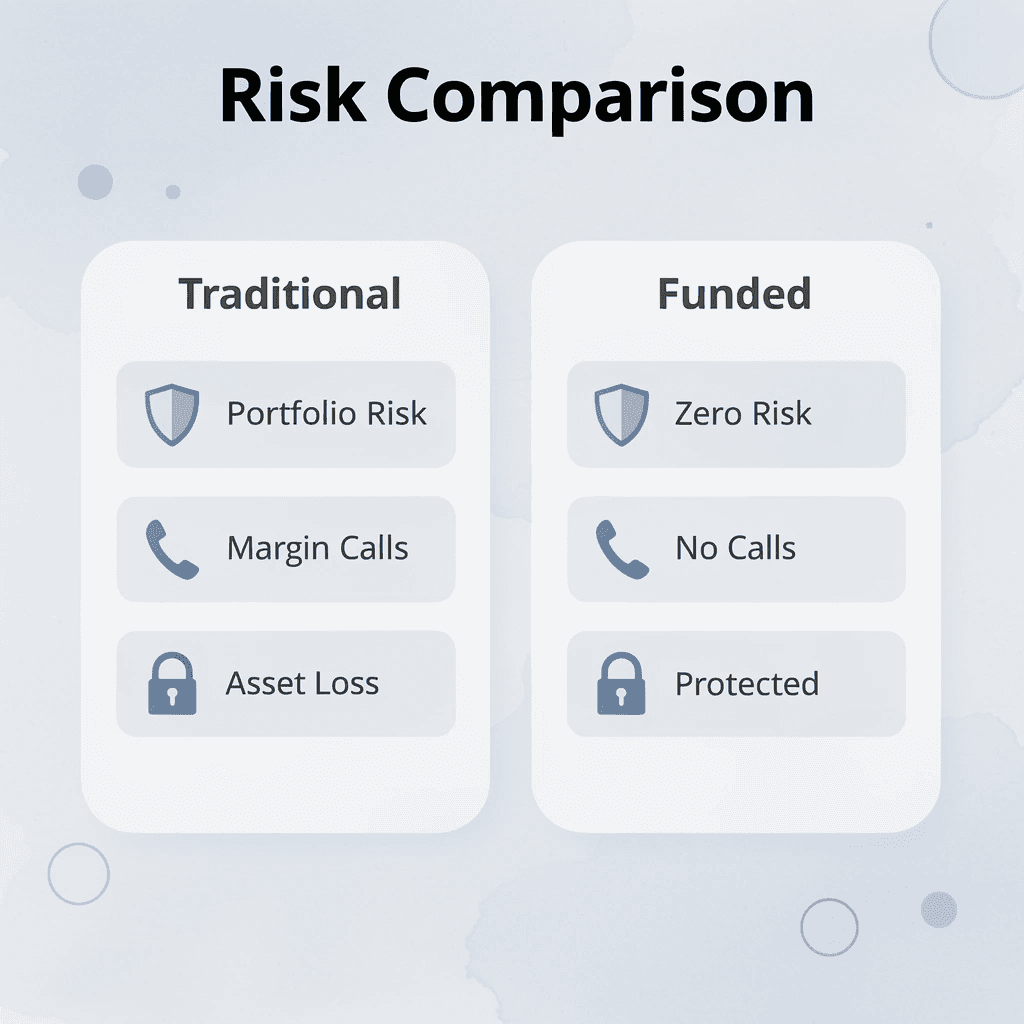
Your Assets Stay Completely Separate
SBLOCs and margin loans create a direct link between your portfolio's value and borrowing capacity. When markets drop, margin calls can be triggered with as little as 24 to 48 hours' notice, forcing immediate liquidations at the worst possible moment. Goat Funded Trader breaks this connection completely. You pass an evaluation, gain access to simulated capital, and trade without any connection to your personal holdings. If a trade goes wrong, the firm absorbs the loss, not your brokerage account.
Interest Charges Disappear
Both SBLOCs and margin loans charge variable interest on money you draw, with costs rising when central banks tighten policy. Goat Funded Trader charges zero interest because you are not borrowing money. You pay a one-time evaluation fee that is 100% refundable after your first payout, then keep profit splits from 80% up to 100% with no carrying costs. Every dollar you earn flows directly to you, undiminished by debt service or fluctuating rates.
How do SBLOC vs Margin Loan risk parameters differ?
Margin accounts have maintenance requirements that fluctuate with market conditions, often surprising traders during periods of high activity. Goat Funded Trader sets clear, fixed risk parameters: 3% maximum daily loss and 6% overall maximum loss on simulated capital. If you exceed those limits, the account closes, but your personal money remains safe. You won't need to sell long-term investments, rush to cover margin calls, or watch retirement savings disappear from leveraged positions.
What capital access model do prop firms offer?
Prop firms like Goat Funded Trader change how you access capital. Instead of borrowing money against existing assets, you earn the right to trade the firm's capital by demonstrating trading skill. Traders can access up to $2M in simulated trading capital, make profits without taking on debt, and grow based on their performance. Over $20 million has already been paid to traders worldwide, demonstrating that this model provides real earnings without risking personal capital. To access that capital, you need to demonstrate consistent, profitable trading.
Get 25-30% off Today - Sign up to Get Access to Up to $800K Today
Both SBLOCs and margin loans trap your portfolio in collateral risk, interest charges, and forced liquidations. The question is whether you need to borrow against your assets at all.

Goat Funded Trader removes that equation entirely. Pass a straightforward evaluation, trade with up to $2M in simulated capital, keep 80-100% of your profits, and carry zero liability for losses. Your personal investments stay untouched—no pledges, no debt, no interest. Over $20M has been paid to traders who chose performance over collateral. Start today with code FIRSTGFT for 50% off your first account, instant dashboard access, and payouts within 24 hours, or the firm adds $1,000 as a guarantee.
🎯 Key Point: Traditional borrowing methods put your entire portfolio at risk, while funded trading accounts eliminate personal liability completely.
"Over $20M has been paid to traders who chose performance over collateral." — Goat Funded Trader Performance Data
🔑 Takeaway: Why risk your own capital when you can trade with firm money and keep the majority of profits without downside exposure?
Be Great and get the App