






Top Prop Firms for Egyptian Traders
Compare the top prop firms for Egyptian traders, including the things you need to know before choosing a firm, like EGP, payment, and banking realities.


What should Egyptian traders actually look for when choosing a prop firm in 2026? Finding the top prop firms for Egyptian traders involves more than checking challenge prices, account sizes, or profit splits. Access from Egypt, trading rules, payout methods, platform availability, and the practical cost of paying in foreign currency can all affect the experience.
For Egyptian traders in particular, EGP volatility, foreign-currency card restrictions, local banking conditions, and regulatory warnings around crypto payments add another layer to the decision.
In this guide, we shortlist prop firms available to Egyptian traders and assess what matters most before choosing one. This includes challenge formats, drawdown limits, trading conditions, funding options, and payout terms.
Prop Firms for Egyptian Traders at a Glance
The table below gives a fast side-by-side view of the top prop firms for Egyptian traders. Fuller write-ups follow further down, covering the rules and tradeoffs a table can't capture.
| Best Prop Firms in Egypt | Egypt Eligibility | Account Size Range | Profit Split | Payout Methods |
|---|---|---|---|---|
| Goat Funded Trader | Yes | $5,000 to $400,000, scalable to $2,000,000 | 80%, up to 100% add-on | Direct EGP bank transfer, Rise, Skrill, crypto |
| FTMO | Yes | Up to $200,000, scalable to $2,000,000 | 80% to 90% | Bank wire, crypto |
| FundedNext | Yes | Up to $300,000 on CFDs, scalable to $4,000,000 | Up to 95% | Bank transfer, Rise, crypto (USDT/USDC), FNmarkets deposit |
| The5ers | Yes | $2,500 to $250,000, scalable to $4,000,000 | 50% to 100%, program dependent | Bank transfer, crypto |
| FundingPips | Yes | Varies by model, up to $200,000 | Up to 100%, cycle dependent | Card, Rise, bank transfer, crypto (USDT/USDC) |
What Egyptian Traders Need to Know Before Choosing a Prop Firm
The top prop firms for Egyptian traders cannot be judged by challenge fees and profit splits alone. For traders based in Egypt, the full process has to be considered: how an account is paid for, which currency is charged, how rewards can be withdrawn, and how much may be lost to conversion along the way.
1. Why the Egyptian Pound Changes the Calculation
USD-denominated rewards are attractive when local purchasing power is under pressure. Egypt moved to a flexible exchange-rate regime in March 2024, and the International Monetary Fund described exchange-rate unification as part of Egypt’s reform programme. This makes the exchange-rate layer central for Egyptian traders reviewing prop firm fees and rewards.
Here is an example:
-
$65 fee can feel small on a global pricing page. But the cost is the EGP amount charged at the bank’s exchange rate, plus card markup, failed-payment risk, and any extra fee from the processor.
-
$1,000 payout can also arrive with different values depending on the withdrawal route, conversion rate, and timing.
This is why best prop firms in Egypt research should be tied to account affordability. The fee, drawdown limit, payout method, and reward cycle should be reviewed together.
2. Card Payments and Bank-Level Friction
Payment friction is not theoretical in Egypt. Some banks publish detailed international card rules, monthly limits, and debit-card restrictions.
-
EG Bank lists USD-equivalent credit-card limits, a 3% markup fee, and suspended international limits on all debit cards.
-
HSBC Egypt also states international debit-card transactions are stopped, apart from debit cards linked to foreign-currency accounts. Its credit-card limits are shown by card type.
A trader may have enough EGP in the account and still see a failed payment. The cause may be card type, bank limit, foreign-currency control, or merchant-category review.
For any Egypt prop firm purchase, the payment method should be checked before the account is selected.
3. Egypt's Financial Regulatory Authority and Broker Warnings
The Financial Regulatory Authority, known as the FRA, oversees non-banking financial activity in Egypt, including capital markets and investment services. It has repeatedly warned the public against unlicensed platforms soliciting funds online, flagging fraudulent investment schemes across gold, real estate, and digital currencies.
The structural difference:
-
A prop firm's evaluation-based funded account is a fundamentally different product compared with a retail forex broker holding client deposits. It doesn't take custody of a trader's capital the way a broker does.
-
The trader pays a one-time fee to show a trading approach on simulated capital. A passed evaluation then unlocks profit-sharing on the resulting simulated account.
Why Payout Method Choice Matters More for Egyptian Traders
For Egyptian traders, payout methods need to be assessed alongside EGP volatility, foreign-currency conversion costs, and the friction attached to international bank and card transactions. A withdrawal route that works smoothly for a trader in Dubai can behave very differently once it reaches an Egyptian bank.
USDT and USDC payouts become relevant at this point. They serve as a faster alternative and provide an additional withdrawal route when a prop firm's bank-based options are limited, expensive, or inconvenient for a trader in Egypt.
Yet, they still should not be presented as a universally safer or more reliable option. USDT and USDC are stablecoins under the broader “cryptocurrency” term which remains restricted in Egypt. The Central Bank of Egypt has issued repeated warnings against dealing in cryptocurrencies, with Law No. 194 of 2020 prohibiting trading or promoting crypto assets without prior CBE approval.
- Any crypto-based payout method therefore has to be considered within a trader's own local regulatory and banking circumstances.
The practical advantage here is choice. A prop firm offering several payout methods, including direct bank transfer in local currency, Rise, Skrill, and crypto, gives Egyptian traders the flexibility to select the route workable for their situation.
The Top Prop Firms for Egyptian Traders

Every prop firm below accepts Egyptian traders. They are reviewed on eligibility, account sizing, evaluation structure, profit split and scaling, payout methods, and one honest drawback.
1. Goat Funded Trader (GFT)
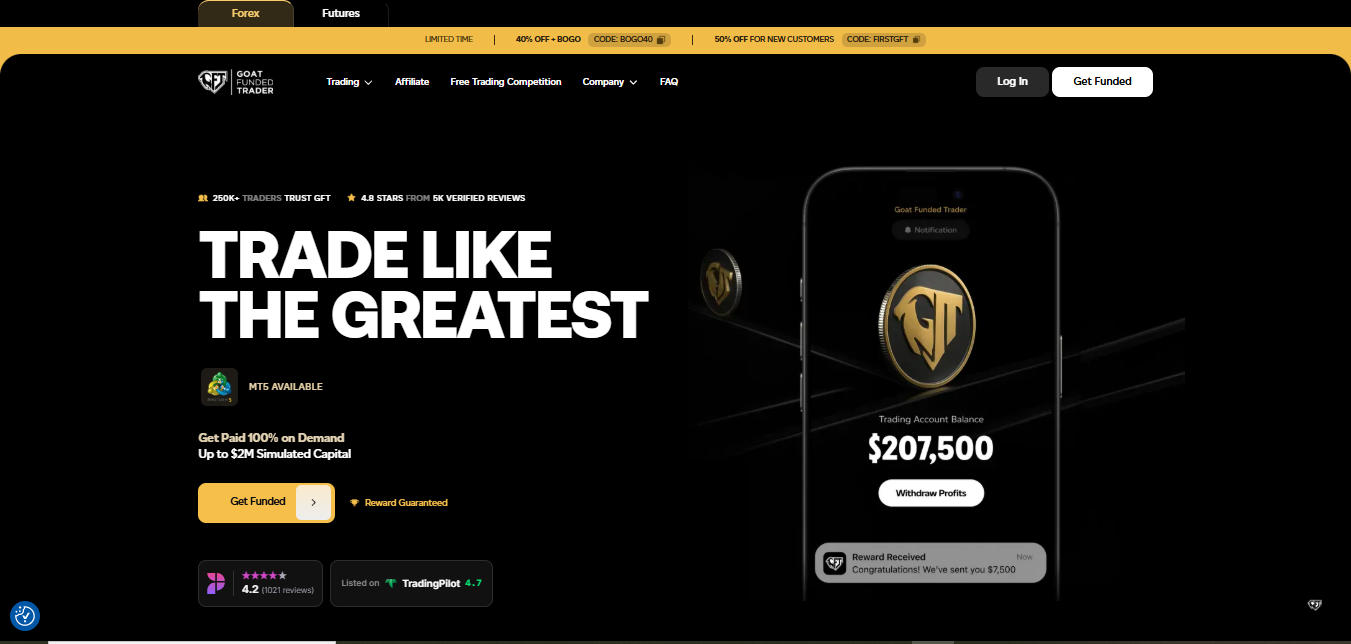
Goat Funded Trader ranks first due to fit. Egyptian traders need a prop firm with multiple model choices, clear funded-stage rules, and payout methods suited to a market where card payments and currency conversion need planning.
Account sizes run from $5,000 up to $400,000, with scaling available to $2,000,000 through a four-level plan tied to sustained performance on a funded account. Six funding routes sit across three structures.
- The 1-Step model runs a single evaluation phase.
- The 2-Step model comes in Standard and Goat variants.
- Instant Funding skips evaluation entirely and arrives in HERO, GOAT, and PREMIUM sub-tiers.
Check out Goat Funded Trader’s funding models here.
Profit targets and minimum trading-day requirements apply and vary by model, so the specifics matter.
-
The 1-Step carries a 10% profit target, a 4% daily drawdown limit (3% drawdown limit for accounts purchased from August 1, 2026). 6% static maximum loss and a 3-day minimum trading requirement are applied also.
-
The 2-Step Standard splits its targets across phases at 10% and 5%, with a 5% daily drawdown and a 10% static maximum loss.
Static drawdown on the evaluation models means the loss floor stays fixed from starting balance and never moves, which gives a trader a clear number to trade against. Instant Funding switches to a trailing structure, where the maximum loss limit follows equity upward and resets after each payout, paired with a tighter 3% daily limit and a floating-loss rule.
None of the evaluation models carry a time limit, so a trader can work toward a target at their own pace without a countdown clock forcing trades.
The profit split starts at 80%, with 100% available as a paid add-on at checkout. An On-Demand First Reward add-on unlocks a 40% split after just 3 days of trading on a funded account for traders wanting quicker access to a first withdrawal.
Payouts run bi-weekly on a 14-day cycle or on demand, and the firm backs its 2-business-day payout window with $1,000 in compensation if the window gets missed.
Trading runs across four platforms, MT5, cTrader, MatchTrader, and TradeLocker. They cover forex, crypto, indices, metals, commodities, and stocks.
The honest tradeoff:
The base 80% split sits below FTMO's 90% on its 1-Step Challenge, and reaching 100% requires paying for the add-on. Funded accounts also carry a $3,000 daily profit cap, with anything above deducted, though it doesn't breach the account.
2. FTMO
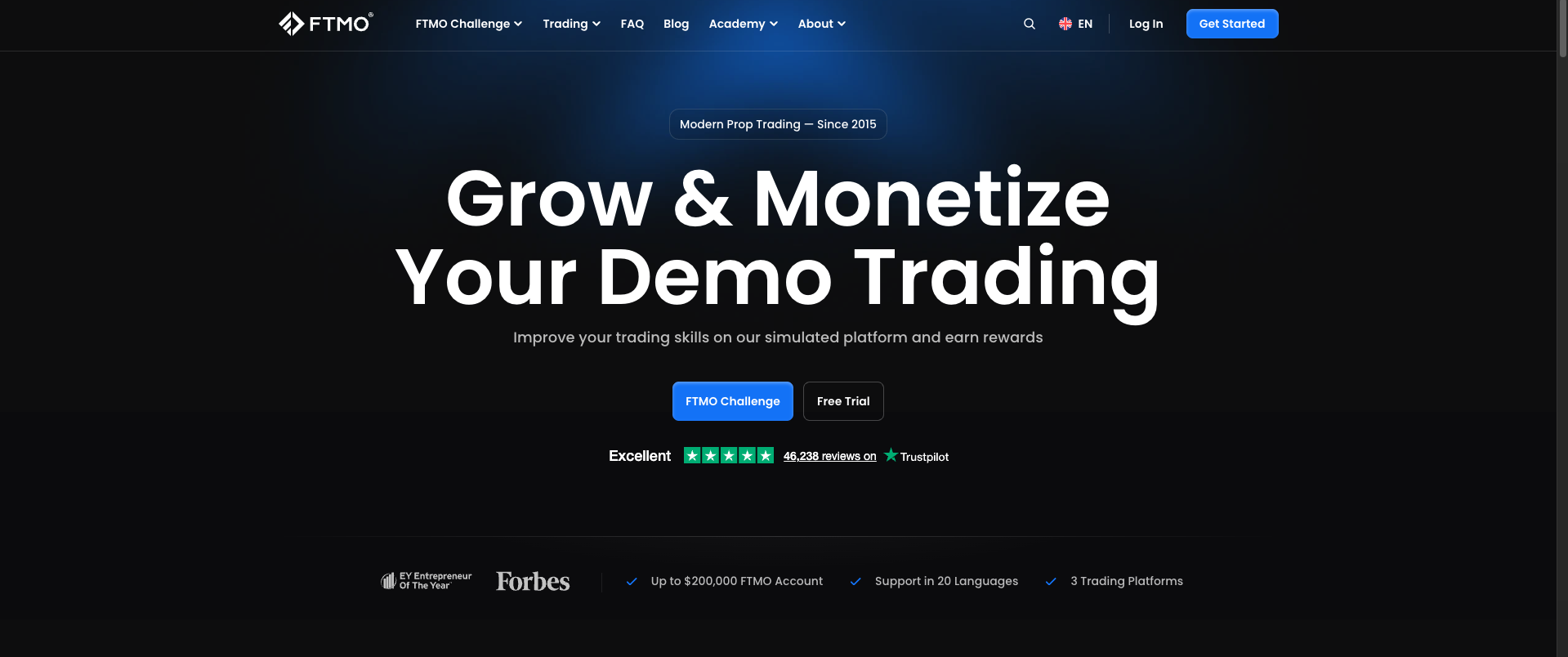
FTMO is among the more internationally recognised names in the space that supports Egypt traders. Accounts run up to $200,000, scalable to $2,000,000 through its Scaling Plan, which adds 25% to the account balance every four months for traders meeting its conditions.
The profit split starts at 80% on the 2-Step Challenge and reaches 90% through the Scaling Plan or Premium Programme, while the newer 1-Step Challenge starts at 90% from the first reward. Payouts run through bank wire or crypto, with a first-reward refund of the initial fee.
The honest drawback:
The 2-Step Challenge runs a two-phase evaluation with defined trading-day and consistency requirements. The 1-Step Challenge includes a Best Day rule capping any single day at 50% of total positive-day profit. Clearing it takes longer compared with instant-funding alternatives, and the absence of a direct EGP rail leaves Egyptian traders choosing between an international wire and crypto.
3. FundedNext
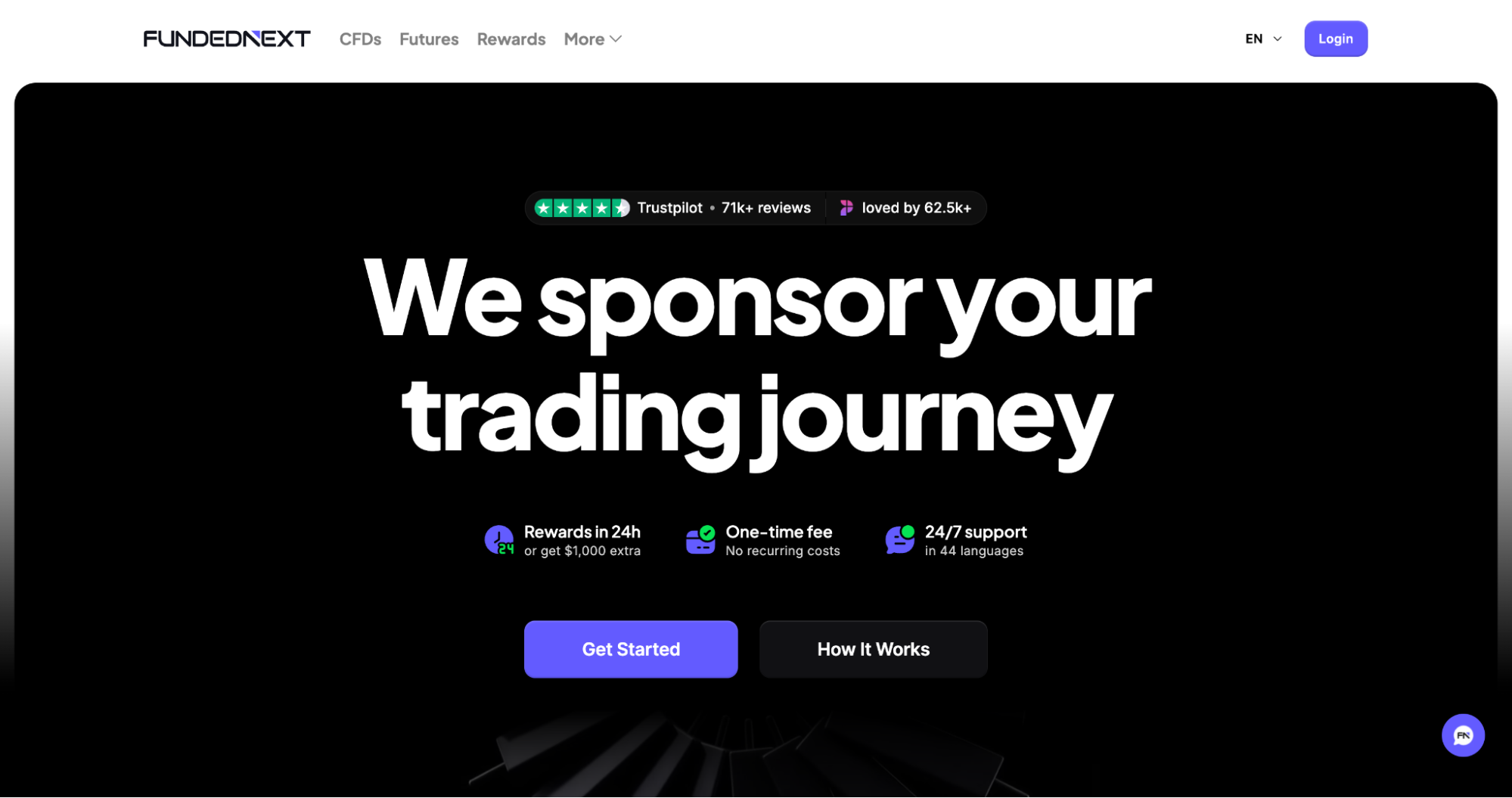
FundedNext accepts Egyptian traders and offers one of the widest payout method lists on this shortlist. Bank transfer, Rise, direct FNmarkets deposit, and crypto through USDT, USDC, and the Confirmo gateway are all supported.
Such breadth suits the flexibility argument made earlier. Account sizes run up to $300,000 on CFDs with scaling to $4,000,000, and the profit split reaches up to 95% with add-ons. Model choice is broad, spanning Stellar 1-Step, Stellar 2-Step, Stellar Lite, and Stellar Instant, the last of which skips evaluation for traders wanting funded access sooner. Payouts carry a stated 24-hour processing commitment.
The honest drawback:
Several of the higher splits and faster reward cycles tie to specific models, add-ons, and purchase dates, so the headline number advertised isn't always the number a given trader qualifies for on day one.
4. The5ers

Similar to FTMO, The5ers has one of the longest continuous track records in the prop firm space, and Egyptian traders qualify broadly. Account sizes range from $2,500 up to $250,000 with scaling toward $4,000,000, and profit splits sit between 50% and 100% depending on the program chosen.
Its main routes are Hyper Growth, a single-phase model, High Stakes, a two-phase evaluation, and Bootcamp, a three-stage structure built around gradual scaling. News trading and weekend holding are permitted across account types. Payouts run through bank transfer and crypto on a bi-weekly cycle.
The honest drawback:
Reaching the top-tier split requires clearing multiple scaling milestones across months, and the starting split on several programs sits at the lower end of the published range. It suits a trader building a long-term relationship with one firm more compared with someone wanting the highest split immediately.
5. FundingPips
FundingPips rounds out the list with five evaluation routes, including 1 Step Flex, 2 Step Standard, 2 Step Flex, 2 Step Pro, and a no-evaluation Zero account. Its published restricted-country list excludes Egypt.
Profit splits reach up to 100% depending on the model and reward cycle selected, with the cycle locked permanently before the first trade. Payouts run through card, Rise, bank transfer, and crypto (USDT/USDC), processed within one to three working days, and its Pay to Card route can land within 30 minutes of approval where a bank supports it. Evaluation phases carry no time limit beyond a 30-day inactivity rule.
The honest drawback:
Rules like the Striking System, Risk Per Trade Idea caps, and consistency-score thresholds vary between models. So if you assume rules carry over from one model to another, losses can happen even without breaching a loss limit.
How to Get Started as a Trader in Egypt
The top prop firms for Egyptian traders are not always the brands with the loudest social proof. A better decision starts with verification, then moves through model fit, payment planning, payout realism, and rule simplicity.
Here is a practical buying framework to help choose the best prop firms in Egypt:
1. Verify Egypt Access at the Source
Egyptian availability should be confirmed directly with the prop firm, not assumed from a third-party comparison page. The firm’s restricted-country list, legal terms, help centre, and account dashboard should be checked first.
Three separate checks should be made:
- Can an Egyptian resident open and verify an account?
- Can the challenge fee be paid using a card or payment method available in Egypt?
- After KYC is completed, can rewards actually be withdrawn through a method available to that same trader?
2. Compare Rules Before Fees
Cheap access can become expensive when the rules do not fit the trader. Check profit target, daily loss, max loss, minimum trading days, consistency rule, news rule, holding rules, payout cap, and reward-cycle timing. Goat Funded Trader stands out here due to model spread. You can compare a static-drawdown evaluation with instant-style alternatives inside one brand. This creates flexibility without jumping across multiple firms.
3. Pick a Payout Route Before Passing
Payout planning should happen before a challenge begins. Waiting until the funded stage can expose preventable issues around KYC, wallet details, bank transfer eligibility, reward-method lock, and currency conversion. For Egypt, bank transfer should not be dismissed. GFT’s reward page lists bank transfer as available in Egypt, which gives traders a non-crypto option in a country where the CBE has issued warnings on cryptocurrency activity.
4. Start With One Account and One Strategy
Egyptian traders may be tempted to split fees across several firms to increase the chance of passing somewhere. A cleaner approach is to begin with one firm, one account size, and one repeatable strategy, then scale after the first payout confirms the process.
A free test route can help here. GFT’s free trading competition gives traders a way to test discipline and execution before paying for a challenge.
5. Keep Records From Checkout to Payout
Save fee receipts, bank messages, card statements, KYC confirmation, payout requests, reward screenshots, wallet transaction IDs, exchange-rate notes, and support conversations. These records help with support tickets, personal accounting, tax review, and dispute resolution. With a clean record, you can explain what happened if a bank, processor, wallet, or firm support team asks for proof.
Trade with a Prop Firm That Actually Works From Egypt
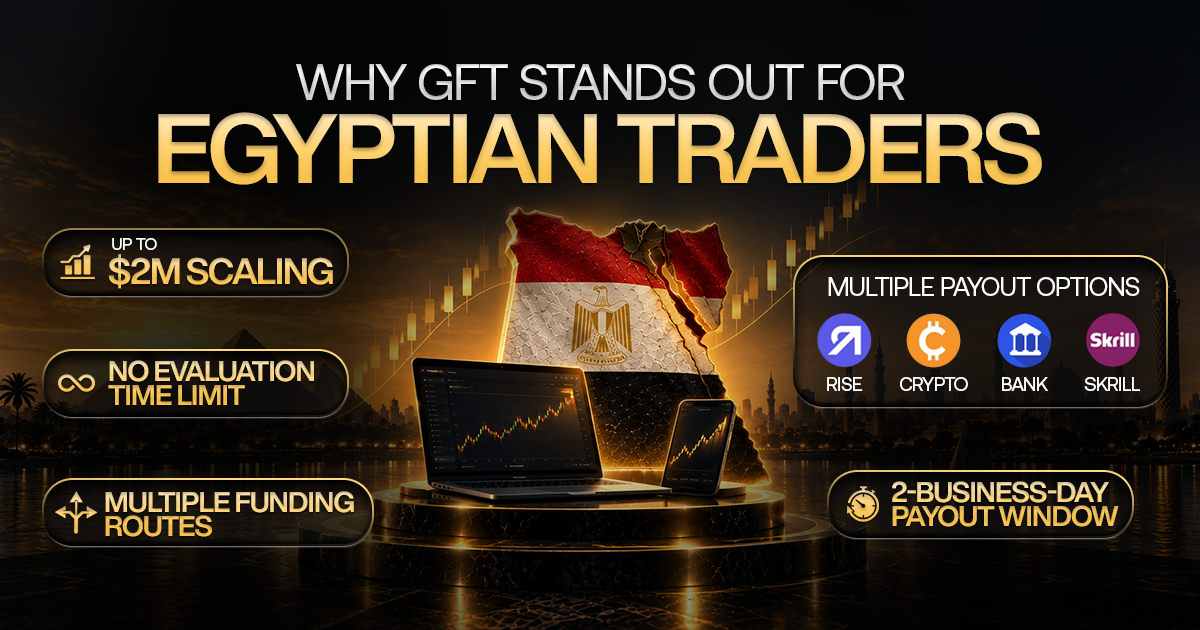
For Egyptian traders, a prop firm has to work beyond the challenge page. Access from Egypt, payment practicality, account rules, scaling potential, and reward withdrawals all need to hold up once trading actually begins.
This is where Goat Funded Trader stands out. Egyptian traders can choose from multiple CFD account models, evaluation accounts use static drawdown, scaling can reach up to $2 million, and Egypt is listed among the supported locations for bank-transfer rewards. Faster reward processing also adds another layer of practicality for traders who do not want payout access to become the weakest part of the experience.
GFT is also structured around flexibility rather than forcing every trader into the same evaluation format. Different challenge models, account sizes, and trading conditions can be compared before an account is selected, making it easier for Egyptian traders to match the structure to their strategy and risk tolerance.
More details can be found across GFT’s trading strategy guides and funding models.
Ready to choose an account built around flexible CFD models and a scaling path of up to $2 million? Get funded with Goat Funded Trader.
Trading from elsewhere on the continent? Read our guides to the best prop firms for African traders, the best prop firms in Kenya, and the best prop firms in Morocco.
Frequently Asked Questions (FAQs)
Can Egyptian traders use Goat Funded Trader?
Yes. Egypt is not included on Goat Funded Trader’s current restricted-country list, so residents can currently sign up and trade. You should still register using accurate personal and residency information, since GFT reserves the right to conduct due diligence and verify compliance with its terms.
Do Egyptian traders pay tax on GFT rewards?
GFT does not determine the Egyptian tax treatment of rewards paid to traders. Its funded accounts are simulated, and traders may receive compensation after meeting the applicable account and reward requirements. Any Egyptian tax liability will depend on local tax rules and the trader’s individual circumstances, so professional tax advice should be obtained where necessary.
How long does a GFT payout take for an Egyptian trader?
Rewards are received within two business days after a valid request is submitted. For a first payout, however, the two-business-day window begins only after KYC has been completed. Egyptian traders can currently receive rewards through bank transfer, as well as Rise, crypto, and Skrill, subject to the limits attached to each method.
Can Egyptian traders receive GFT rewards by bank transfer?
Yes. Egypt is specifically listed as one of the countries where bank-transfer rewards are available. Bank-transfer payouts are capped at $10,000 per payout, while Rise currently has no stated per-payout maximum. Crypto and Skrill are also available, with separate limits.
What happens if GFT later stops accepting traders from Egypt?
GFT currently accepts Egyptian traders, but its terms allow the company to modify its agreement or terminate access to its services. No specific public policy guarantees that existing Egyptian accounts would automatically remain unaffected after a future jurisdictional change. For this reason, the restricted-country list and current terms should be checked before purchasing a new account.
Do Egyptian traders need to complete KYC before receiving a GFT payout?
Yes. GFT requires identity verification and the signing of its Trader Agreement before the first reward can be processed. KYC is completed when the first payout is requested rather than when the funded account is initially issued. Crypto, Skrill, and bank-transfer requests are normally verified through Veriff, while Rise payouts use verification through Rise.
Be Great and get the App