





Top 7 Prop Firms for African Traders
Explore the top prop firms for African traders, including country-specific restrictions, payout methods, and fees, so you can pick a firm that works for you.

Can a prop firm be a strong choice if traders in your country cannot open an account, pay for a challenge, or receive payouts without friction?
Global prop firm rankings often overlook the realities African traders face. A firm can rank highly worldwide yet restrict sign-ups from Nigeria, South Africa, Kenya, Ghana, Egypt, or other key markets. Payment access, payout options, challenge fees, and account rules can also vary sharply by country.
This guide takes a practical approach to the best prop firms for African traders. The top 7 are reviewed against each other, based on country access, usable payment and payout methods, pricing, trading conditions, and overall value.
What to Check Before Choosing From the Prop Firms in Africa
The biggest account or lowest challenge fee does not automatically make a prop firm the right choice for an African trader. Access comes first. Payout options, local restrictions, verification requirements, and trading connectivity can all change the experience.
These four checks provide a better way to judge the firms in our ranking instead of relying on headline prices or funding limits alone.
1. Check Your Country Before Paying
Prop firms set their own country restrictions, and access can differ across Africa. A firm may accept traders from Nigeria and South Africa while restricting registrations from several other African countries.
This makes country eligibility one of the first things to check before buying an evaluation.
Go directly to the firm's restricted-country or eligibility page and confirm that your country is supported. Do not rely on an old review, a social media comment, or another trader's experience. Restrictions can change, and access may also differ between products offered by the same company.
While checks take only a few minutes, they can prevent paying for an evaluation that cannot progress to verification or a funded account.
2. Look at Payout Methods, Not Just the Profit Split
A 90% profit split means less if receiving the payout creates unnecessary cost or delay.
Cross-border bank transfers can pass through intermediary banks before reaching an African bank account. This can increase processing time and introduce additional fees. The final experience depends on the sending bank, receiving bank, currency, and payment route.
Crypto payouts can provide another option. USDT and USDC are useful because stablecoins can be transferred across borders without relying on the traditional correspondent-banking chain. Blockchain settlement itself can be fast, although the prop firm's internal payout approval time still applies.
Crypto access and regulation also differ across African markets. The IMF has documented substantial differences in the way African jurisdictions approach digital assets, with regulatory frameworks continuing to develop across the continent.
Some top prop firms also provide e-wallets or third-party payout platforms. Having several withdrawal options is valuable because it gives traders another route if one method is expensive, slow, or unavailable locally. Before purchasing an account, check the available payout methods, processing times, minimum withdrawal amounts, fees, and supported currencies.
3. Understand What “Regulated” Means
Prop firms are evaluation-based trading businesses, so they do not always fall under the same licensing framework as traditional retail brokers. This difference is important. A firm operating without a broker licence does not automatically mean it is operating illegally.
Regulatory requirements also differ across African markets. Some countries have more developed financial-services frameworks, while others apply broader commercial, payment, or digital-asset rules rather than prop-firm-specific licensing.
South Africa, for example, has the FSCA overseeing parts of the financial-services sector. However, that does not mean every prop firm serving South African traders must be regulated in the same way as a broker.
Instead of treating a regulatory badge as the main test, look at how the firm operates. Clear trading rules, transparent payout terms, accessible company information, and an established operating history give a better picture of credibility.
4. Prepare Your Connection and Verification Documents
Internet stability deserves consideration before trading a funded account.
A virtual private server (VPN) keeps a trading platform running on a remote server instead of relying entirely on a local internet connection. This can be useful for traders dealing with unstable connectivity. It is especially relevant for automated strategies, EAs, or trading setups that need continuous platform access.
Verification should also be prepared in advance. Keep a valid passport or national ID available, alongside recent proof of address. A bank statement, utility bill, or another accepted document may be required depending on the firm's KYC process.
If an English-language proof of address is requested, prepare one before reaching verification or obtain an accepted translation. Document formats, age limits, and language requirements can differ between firms, so check the KYC rules early.
Four Checks Before Choosing a Prop Firm
-
Country access: Confirm that traders from your country are currently accepted.
-
Payouts: Check available withdrawal methods, fees, limits, currencies, and processing times.
-
Regulatory claims: Understand which entity is regulated and what the licence actually covers.
-
Trading setup: Prepare a stable connection, consider a VPS if needed, and have valid KYC documents ready.
Top Prop Firms for African Traders, Ranked
These are the best prop firms in Africa by the three tests set out above. Each entry below covers African country access, account sizes and evaluation structure, profit split and scaling, drawdown and daily loss rules, payout methods, and one honest drawback.
1. Goat Funded Trader
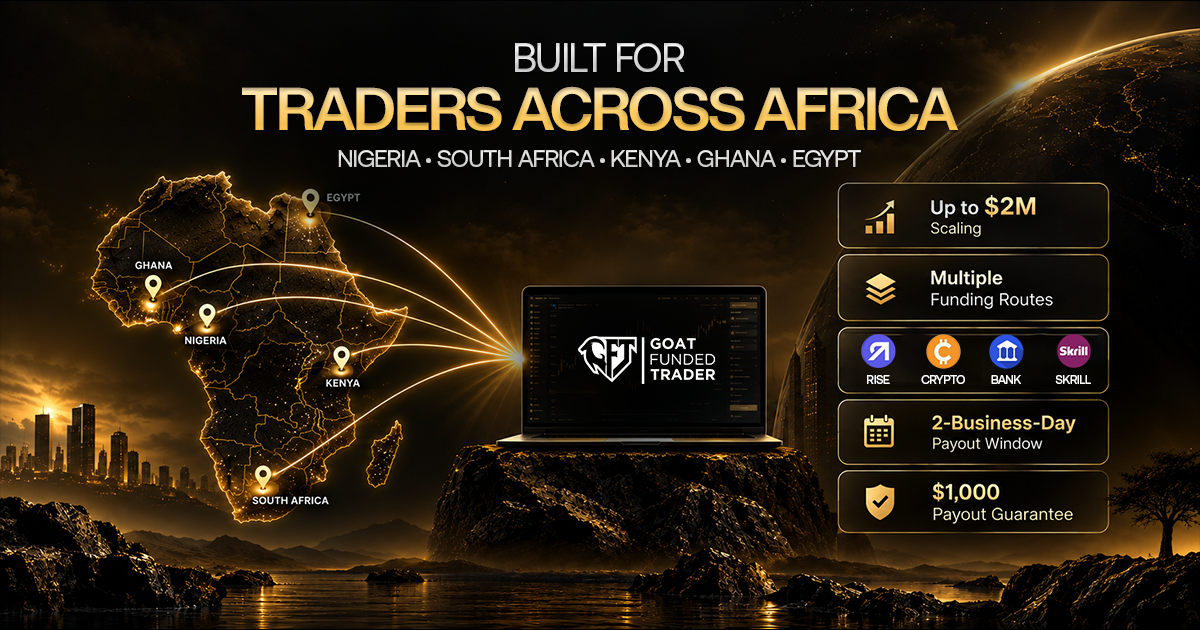
Goat Funded Trader accepts traders from major African markets, including Nigeria, South Africa, Kenya, Ghana, and Egypt. Its current restricted list covers 10 African countries: the Central African Republic, Democratic Republic of the Congo, Mali, Senegal, Somalia, South Sudan, Sudan, Togo, Libya, and Zimbabwe. Sanctioned jurisdictions in other regions are also restricted.
GFT therefore offers broad access across Africa’s largest trading markets.
Five funding routes are available. Two use an evaluation structure: 1-Step and 2-Step
(Standard and GOAT). The other three provide instant funding: Instant HERO, Instant GOAT, and Instant PREMIUM. Account sizes range from $5,000 to $400,000, with scaling available up to $2 million.
Rules depend on the selected route. The 1-Step model has a 10% profit target, 3% daily drawdown limit, 6% static maximum loss, and a three-day minimum trading requirement. The 2-Step Standard sets targets of 10% in Phase 1 and 5% in Phase 2, alongside a 5% daily drawdown and 10% static maximum loss.
With static drawdown, the maximum-loss floor stays fixed from the starting balance. Traders therefore have a clear level to manage throughout the evaluation. Instant accounts use trailing drawdown instead, with tighter limits in exchange for skipping the evaluation stage.
None of the routes has a time limit, so traders can progress through an evaluation without being forced to meet a target within a fixed number of days.
The reward split starts at 80% across for most routes (Instant HERO has a 90% profit split), with a 100% split available through a paid checkout add-on. Payouts can be requested on a 14-day cycle or on demand, depending on the account setup. Available withdrawal methods include Rise, cryptocurrency, Skrill, and bank transfer.
GFT also backs its 2-business-day payout window with $1,000 in compensation if an eligible payout is delayed beyond the stated period. Reset options are available after a breach, including on funded accounts, provided the reset is requested within 14 days.
Full conditions for each route are published on the Goat Funded Trader model page.
2. FTMO
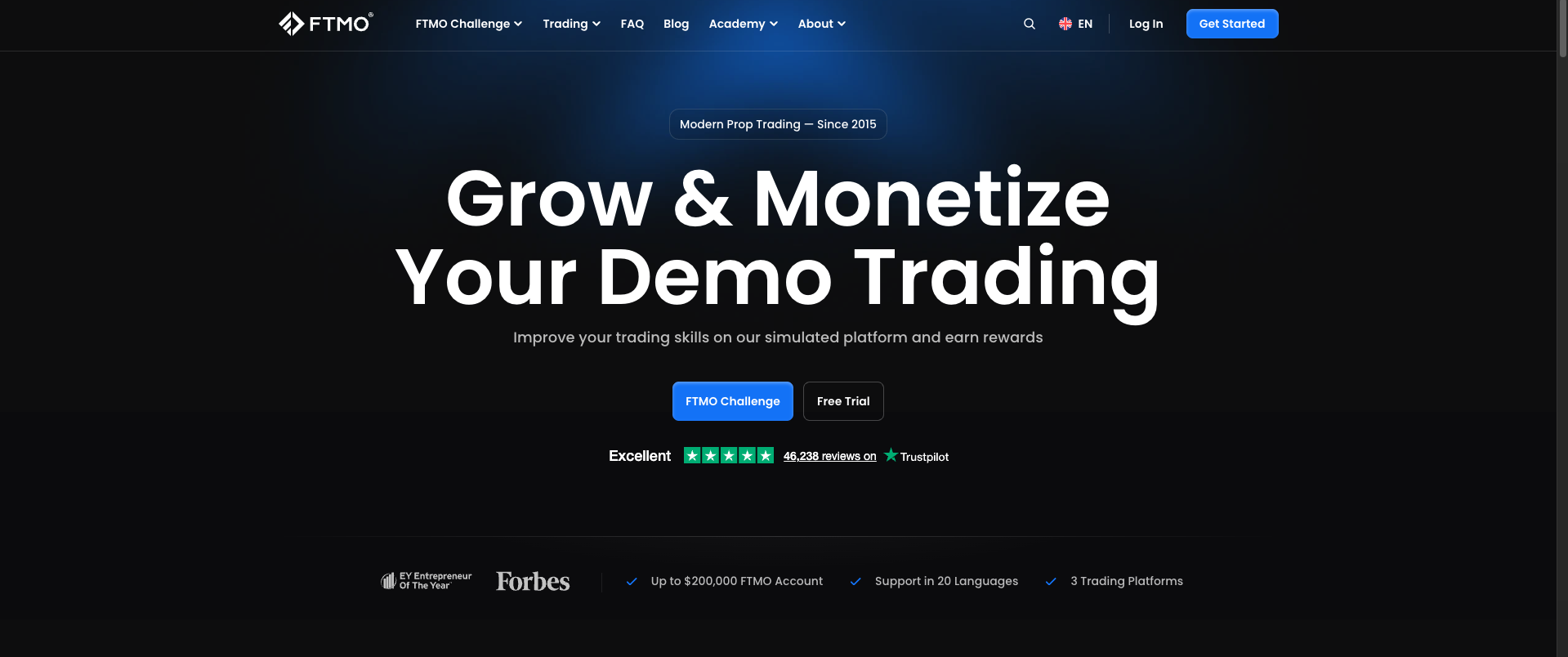
Nigeria, South Africa, Kenya, Ghana, and Egypt are all accepted. Roughly 27 African countries are restricted, including Sudan, Somalia, Mali, Sierra Leone, and Eritrea, so traders outside the five largest markets should check carefully.
Accounts run up to $200,000, scaling to $2,000,000 through the Scaling Plan, which adds 25% to the balance every four months for qualifying traders. The 2-Step Challenge sets a 10% target in Phase 1 and 5% in Phase 2, against a 5% daily loss limit and a 10% maximum loss.
A 1-Step Challenge is also offered, starting traders at a 90% split from the first reward. The standard split begins at 80% and reaches 90% through scaling or the Premium Programme. Payouts run through bank wire or crypto, with the initial fee refunded on the first reward.
However, a Best Day rule caps any single day at 50% of total positive-day profit on the major Challenge, which penalises traders whose edge produces occasional outsized sessions. The two-phase structure also takes longer to clear compared with instant alternatives. See our Goat Funded Trader vs FTMO guide for depth comparison.
3. FundedNext
Nigeria, South Africa, Kenya, Ghana, and Egypt are all accepted, with one of the shorter restricted lists among the larger firms.
Account sizes reach $300,000 on CFDs, with scaling to $4,000,000. Four models are offered: Stellar 1-Step, Stellar 2-Step, Stellar Lite, and Stellar Instant, the last removing evaluation entirely. The profit split reaches up to 95% with add-ons. Drawdown and daily loss rules vary by model, with the 1-Step and 2-Step running on published static limits and the Instant route applying its own structure.
Payout coverage is the standout here for African traders. Bank transfer, Rise, direct FN Markets deposit, and crypto through USDT, USDC, and the Confirmo gateway are all supported, with a stated 24-hour processing commitment. Few firms give a trader in Nairobi or Lagos this many working routes.
The honest drawback is that the advertised 95% split ties to specific models, add-ons and purchase conditions. Check out the Goat Funded Trader vs FundedNext side-by-side comparison.
4. FundingPips
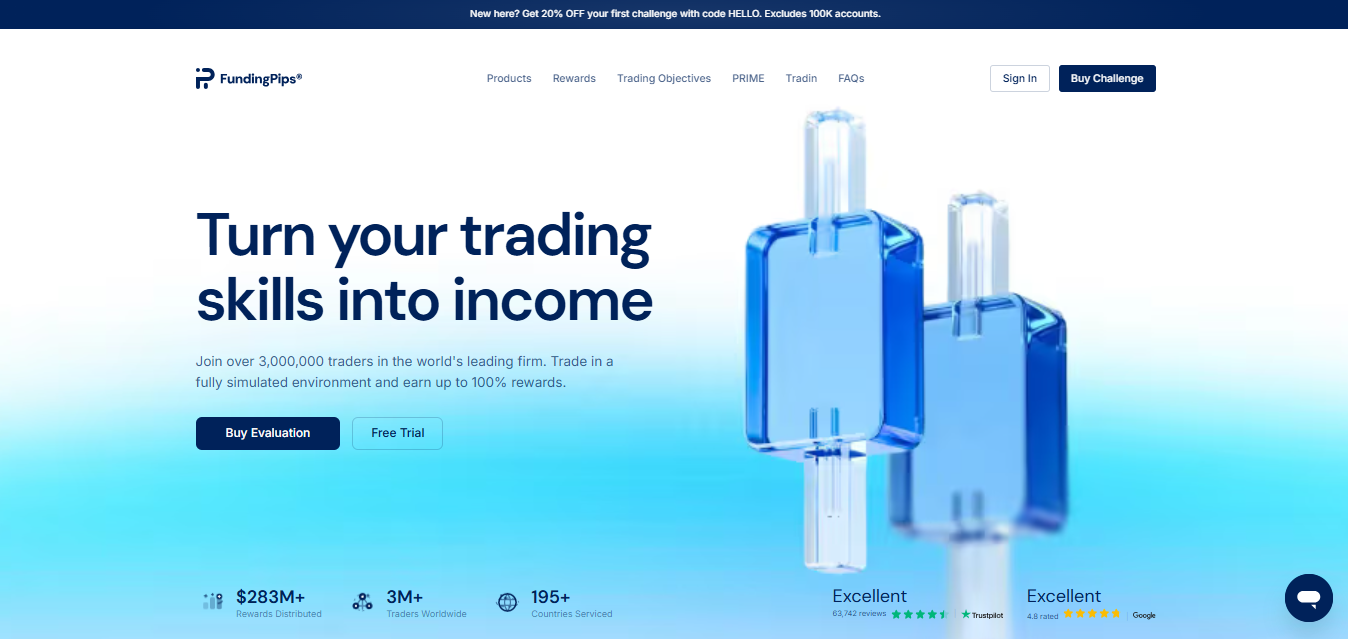
FundingPips publishes one of the shortest restricted lists in the industry, naming Iran, Vietnam and the UAE, plus a minimum age of 18. Every major African market is therefore open, and the firm explicitly lists Nigeria and South Africa among countries supported for bank transfer and Pay to Card payouts.
Five evaluation routes are offered, including 1 Step Flex, 2 Step Standard, 2 Step Flex, 2 Step Pro, and a no-evaluation Zero account, with sizes up to $200,000. Profit splits reach up to 100% depending on the model and the reward cycle chosen, with the cycle locked permanently before the first trade. Drawdown and daily loss limits vary meaningfully by model. Evaluation phases carry no time limit beyond a 30-day inactivity rule.
Payouts run through card, Rise, bank transfer, and crypto in USDT or USDC, processed within one to three working days plus one to two days to reach a wallet or bank. Pay to Card can land within 30 minutes of approval where a bank supports it, which is unusually fast for a Nigerian or South African account.
Rule complexity can be a flaw. The Striking System, Risk Per Trade Idea caps, and consistency-score thresholds differ between models, and VPN or VPS use is not permitted, which matters for traders relying on a VPS for connection stability.
5. Funded Trading Plus
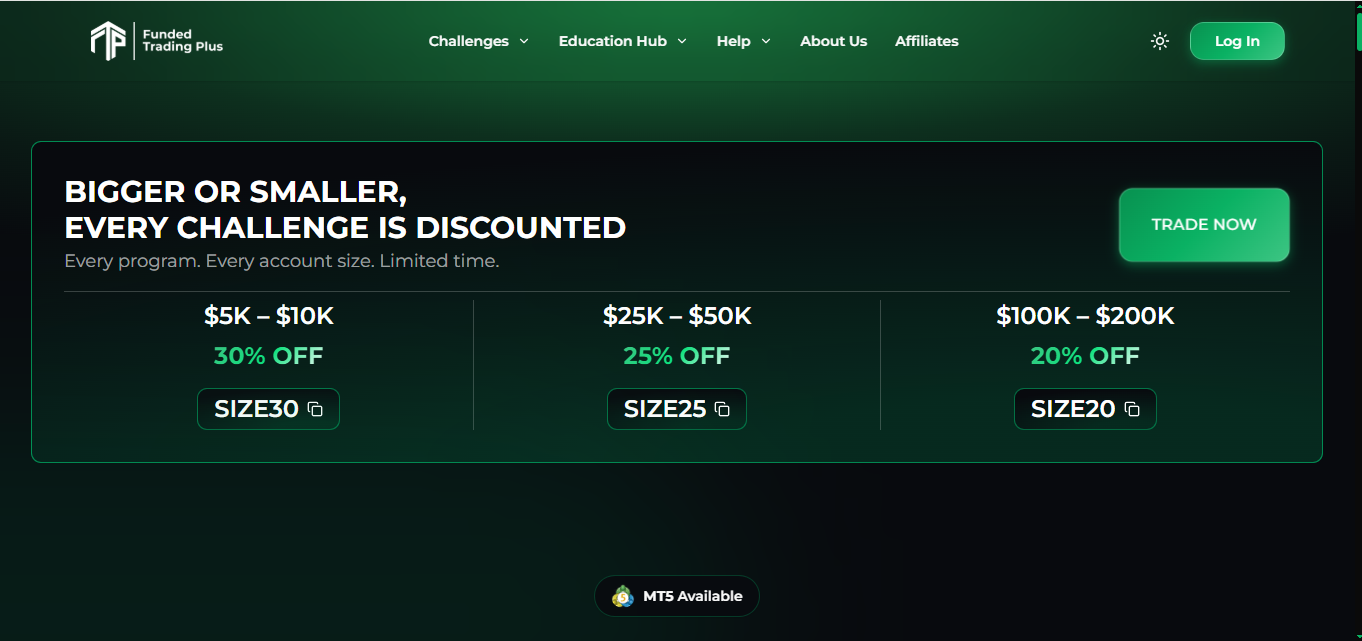
Operating across 165-plus countries with no published African restrictions, Funded Trading Plus is open across the continent's major markets. Account sizes run from $5,000 to $200,000, with scaling to $2,500,000.
Three programs are offered following its 2026 relaunch: Instant Funding, 1-Step Express, and 2-Step Classic. The profit split starts at 80% and can be lifted toward 100% through a paid add-on at purchase or through scaling milestones, with the instant route capping at 90%. No time limits apply.
Payout terms are among the strongest on this list for African traders. A first withdrawal is available from day one after a first profitable trade and identity verification, then weekly thereafter, with a $50 minimum and no platform withdrawal fees.
Methods cover bank transfer and crypto, with the bulk of processing reported to take 24 to 48 hours. However, withdrawal methods are limited to bank transfer and crypto, with no e-wallet option. Copy trading, arbitrage, grid trading, and tick scalping are all prohibited, so strategy fit should be checked before purchase.
6. The5ers

Nigeria, South Africa, Kenya, Ghana, and Egypt are all accepted. Around 12 African countries are restricted, including Burundi, Congo Republic, Democratic Republic of Congo, Eritrea, Guinea, Guinea-Bissau, Liberia, Libya, South Sudan, Sudan and Somalia.
The5ers has one of the longest continuous operating records in the sector. Four CFD programs are run: Hyper Growth over one step, Pro Growth over one step, High Stakes over two steps, and Bootcamp over three. Account sizes run from $2,500 to $250,000, with Hyper Growth and Bootcamp scaling toward $4,000,000 and the other two capping at $500,000.
Drawdown rules differ sharply between programs. Hyper Growth applies a 3% daily pause, suspending the session without ending the account. Pro Growth treats the same 3% as a termination. High Stakes terminates on a 5% daily loss. Bootcamp requires a mandatory stop-loss on every position at 1:30 leverage.
Starting splits range from 50% on Hyper Growth and Bootcamp to 80% on High Stakes, scaling toward 100% through milestones. Payouts run bi-weekly through Rise, crypto, bank transfer, or Hub Credits, with a $150 minimum.
Drawback stands at a 3.5% commission applied to Rise, crypto, and bank transfer payouts. On a $2,000 withdrawal, the commission takes $70 before the money moves.
7. Crypto Fund Trader
Crypto Fund Trader publishes no African country restrictions and serves traders across 165-plus countries. The firm is crypto-first while still covering forex, indices, stocks, and commodities, with roughly 125 crypto instruments alongside 39 forex pairs. Account sizes run from $5,000 to $200,000 on the purchase widget, with a stated funded ceiling of $300,000.
Instant Funding, 1-Phase, and 2-Phase routes are offered. The drawdown model varies by program, with the 2-Phase and 3-Phase evaluations running static limits and the 1-Phase and Break models trailing, so the applicable structure should be confirmed before purchase.
The profit split starts at 80%, with 90% available through a paid add-on. Payouts are processed in 8 to 24 hours through crypto stablecoins or bank transfer.
The con is the profit split structure. The split scales by tier, not starting at the top; the drawdown model differs by program in ways easy to misread, and traders wanting a single uniform rulebook will find the variation frustrating.
Top Prop Firms in Africa at a Glance
Scan this table first to shortlist, then read the fuller entries above for the detail behind each row.
| Firm | Account Size | Profit Split | African Restrictions | Payment Methods | Crypto Payout |
|---|---|---|---|---|---|
| Goat Funded Trader | $5,000 to $400,000, scaling to $2,000,000 | 80%, up to 100% add-on | 10 countries; all 5 major markets open | Rise, crypto, Skrill, bank transfer | Yes |
| FTMO | Up to $200,000, scaling to $2,000,000 | 80% to 90% | Approx. 27 countries; all 5 major markets open | Bank wire, crypto | Yes |
| FundedNext | Up to $300,000, scaling to $4,000,000 | Up to 95% | Short list; all 5 major markets open | Bank transfer, Rise, FN Markets, crypto | Yes |
| FundingPips | Up to $200,000 | 80% to 100% | None in Africa | Card, Rise, bank transfer, crypto | Yes |
| Funded Trading Plus | $5,000 to $200,000, scaling to $2,500,00 | 80% to 100% | None published | Bank transfer, crypto | Yes |
| The5ers | $2,500 to $250,000, scaling to $4,000,000 | 50% to 100% | Approx. 12 countries; all 5 major markets open | Rise, crypto, bank transfer, Hub Credits | Yes |
| Crypto Fund Trader | $5,000 to $200,000 | 80%, 90% add-on | None published | Crypto, bank transfer | Yes |
Evaluation pricing changes constantly across every firm listed, so confirm current fees at checkout.
Four Regional Considerations for African Traders
Choosing between the best prop firms in Africa goes beyond account size, profit split, and challenge price. Payment costs, internet stability, verification requirements, and local financial rules can all shape the trading experience.
These regional factors are worth understanding before comparing firms side by side.
1. Financial Rules Differ Across African Markets
Prop firms operate as evaluation-based trading businesses and are structured differently from traditional retail brokers. As a result, the same broker licensing requirements do not automatically apply to every prop firm.
Financial regulation also differs from one African country to another. South Africa has a well-established financial-services framework through the Financial Sector Conduct Authority, while other countries apply their own rules around financial services, payments, and digital assets.
For traders, the focus should remain on how clearly a firm operates. Published trading rules, transparent payout terms, accessible company information, a proven operating history, and responsive support all provide useful indicators when comparing providers.
2. Currency Conversion and Payment Costs
Evaluation fees are commonly priced in US dollars, which means traders paying in Naira, Rand, Kenyan Shillings, Cedis, or other local currencies may face conversion costs at checkout.
Card providers and banks can also apply foreign-transaction or exchange-rate charges. The final amount paid may therefore be slightly higher than the advertised USD price.
Planning around the dollar price from the beginning makes challenge costs easier to compare. Crypto options such as USDT and USDC can also provide a practical alternative for traders with access to supported payment services.
Firms offering several payment and payout methods provide more flexibility. Traders can compare the available routes and select the option that works best for their location and costs.
3. Internet Connectivity and Trading Infrastructure
Reliable internet matters when positions need to be monitored, or trading software needs to remain connected. A virtual private server (VPN) can help traders dealing with inconsistent local connectivity. The trading platform runs remotely, so automated strategies and EAs can remain active even if the trader's home connection drops.
African time zones can also work well for forex traders. The London session falls comfortably within daytime hours across much of West and East Africa. Traders in cities such as Lagos, Accra, Johannesburg, and Nairobi can therefore access one of the market's busiest sessions without having to trade overnight.
4. Verification and Documentation
KYC is a standard part of moving from an evaluation into a funded account or receiving payouts. Common requirements include a government-issued passport or national ID together with recent proof of address.
Depending on the firm, accepted documents may include bank statements, utility bills, government correspondence, or similar records. Preparing these documents early can make verification smoother.
If local documents use a different language or format, an accepted English translation or internationally recognised document may also be useful.
How to Get Started with Prop Firms in Africa
Getting started comes down to 4 practical steps:
-
First, confirm your country is supported. Check the firm's official restricted-countries page before paying for an evaluation. Access rules can change, so direct confirmation from the firm is more reliable than an older third-party review.
-
Next, choose an account size that fits your budget. A $5,000 or $10,000 account can be a practical way to learn the rules, test the platform, and understand the payout process before moving to a larger allocation.
-
Then, confirm the payout methods available in your country. Crypto, bank transfer, e-wallets, and third-party payout platforms may not be offered equally across every market.
-
Finally, focus on one firm and one tested strategy. GFT's free trading competition gives traders a way to test their approach before paying for an evaluation. You can also explore more trading tips before getting started.
Find a Prop Firm Built to Accept You
For an African trader, the right prop firm starts with access. Country eligibility and reliable payouts matter before profit splits, account size, or marketing claims. Any list of the top prop firms should answer those practical questions first.
Goat Funded Trader is built around broad international access. Traders from Nigeria, South Africa, Kenya, Ghana, and Egypt can join, while payouts are available through several methods, including Rise, crypto, and Skrill.
Eligible payouts are processed within 2-business days, backed by $1,000 in compensation if the stated window is missed. Reset options also give traders a route back after a breach.
Read how GFT works, review the reward terms, or get funded with Goat Funded Trader.
For country-level detail, read our guides to the best prop firms in Kenya, Egypt, and Morocco.
Frequently Asked Questions (FAQs)
Which prop firms accept traders from Nigeria and South Africa?
Goat Funded Trader accepts traders from both Nigeria and South Africa, along with other major African markets such as Kenya, Ghana, and Egypt. GFT maintains a restricted-country list, so traders should still confirm current eligibility before purchasing an account.
Is prop trading legal in Africa?
Yes. Prop trading operates legally across African markets through evaluation-based and simulated funded account models. Goat Funded Trader provides trading accounts under clearly defined rules rather than operating as a retail broker taking client deposits. Local financial, payment, and cryptocurrency rules can still differ by country, so traders should remain familiar with the requirements that apply in their location.
How do African traders receive GFT payouts?
Goat Funded Trader supports several payout methods, giving African traders flexibility when withdrawing rewards. Available options include Rise, cryptocurrency, Skrill, and bank transfer. Eligible payout requests are processed within two business days, and GFT backs the stated window with $1,000 in compensation if it is missed.
What is the cheapest way to start prop trading from Africa?
Starting with one of GFT's smaller account sizes can keep the initial cost lower while giving traders access to the same core trading environment and rules. GFT pricing starts from $17, with several evaluation and instant funding routes available. Starting small also gives traders room to learn the platform and account rules before moving to a larger allocation.
Does Goat Funded Trader accept African traders?
Yes. GFT provides broad access across Africa, including Nigeria, South Africa, Kenya, Ghana, and Egypt. Country restrictions mainly apply to a smaller group of markets affected by GFT's eligibility and compliance policies. Traders can check the latest restricted-country list before purchasing an account.
Be Great and get the App