






How to Stay Consistent in Trading: 20 Daily Habits to Learn
How to Stay Consistent in Trading: Master 20 proven daily habits from Goat Funded Trader that build discipline and boost profits.


Every trader knows the gap between a winning strategy and actual profits. That gap is consistency. In Capital Growth Trading, where account size directly determines earning potential, staying disciplined with your trading plan separates those who grow their capital steadily from those who watch it evaporate through emotional decisions and abandoned routines. Practical methods exist to build steady trading habits through daily actions and mindset shifts that transform sporadic wins into reliable performance.
Developing consistency requires the right environment to practice without risking personal capital. Trading with substantial capital while refining routines and tracking performance metrics proves the ability to execute strategies day after day. The accountability built into structured evaluation processes naturally reinforces the disciplined approach needed for steady trading habits, creating a framework where focus shifts from hoping for big wins to executing reliably through a prop firm.
Summary
- Trading consistency requires executing identical processes across hundreds of setups regardless of recent outcomes. Research tracking 1,551 Brazilian day traders who persisted for over 300 days found that 97% lost money net of fees, with only 1.1% earning more than the minimum wage and just 0.5% earning more than a bank teller's salary. These weren't casual participants but committed traders who showed up daily, proving that dedication without structured, repeatable processes cannot overcome the psychological chaos markets create.
- Emotional decision-making destroys more accounts than poor strategy selection. Terrance Odean's 1998 study of 10,000 brokerage accounts revealed that investors realized gains at much higher rates than losses, selling winners 1.5 times more often than losers due to loss aversion and the disposition effect. This behavioral pattern locks in smaller profits while letting losses grow, directly sabotaging account growth and creating the inconsistent performance that prevents traders from scaling their capital.
- Habit formation follows a predictable timeline that most traders abandon too early. University College London research shows that it takes an average of 66 days to form a new habit, with the critical resistance window occurring between days 20 and 50, when novelty fades, but automatic behavior hasn't yet solidified. Traders who quit during this period restart the cycle repeatedly, never reaching the point where discipline becomes effortless, and execution happens without conscious willpower.
- Daily routines compound into systematic advantages that separate professionals from the 95% who fail. Small actions like reviewing trading rules each morning, maintaining uniform position sizing on every trade, and conducting 10-minute performance debriefs create objective feedback loops that turn experiences into data. These boring, unglamorous habits feel trivial compared to finding perfect entry signals, but their accumulation over months builds the foundation that makes consistent execution automatic rather than a test of willpower.
- Capital pressure from trading personal savings creates psychological traps that override even the strongest processes. When money is on the line, the survival instinct hijacks logical execution, triggering hesitation toward valid setups or revenge trading to recover losses. This emotional weight sabotages the discipline that traders spend months developing through daily habits, creating a cycle where knowledge and behavior remain permanently disconnected.
- Goat Funded Trader addresses this by providing simulated capital up to $2 million with real profit splits, removing personal financial risk so traders can focus purely on executing their proven processes under the same strict risk parameters they've already mastered.
What Is Consistency in Trading and Why Is It Important?
Consistency in trading means executing the same process for every setup: identical entry rules, exit criteria, position sizing, and risk management, regardless of recent wins or losses. Each trade is one data point in a statistical sample where your edge plays out over hundreds of decisions rather than a handful of bets. When your process stays fixed, outcomes become predictable across time, and you stop riding the emotional rollercoaster that destroys accounts.

🎯 Key Point: Trading consistency isn't about winning every trade—it's about applying the exact same methodology to every market opportunity, whether you're on a winning streak or recovering from losses.
"Successful trading is about process consistency, not outcome prediction. When traders maintain identical decision-making frameworks, their edge emerges through statistical repetition." — Trading Psychology Research

💡 Example: A consistent trader uses the same 2% position size, stop-loss placement, and profit targets on trade #1 and trade #100, regardless of whether the previous 5 trades were winners or losers.

Why Consistent Execution Builds Long-Term Profitability
Markets reward repeatability because small, controlled gains compound without major losses. One huge winning day followed by careless revenge trades wipes out weeks of progress faster than steady 1-2% daily returns. Traders who master consistency turn a strategy with a positive edge into reliable profits by letting probability work over time rather than gambling on isolated outcomes.
How Consistency Eliminates Emotional Decision-Making
Fear and greed lead to impulsive trades that break your rules and amplify losses. A consistent approach eliminates these problems by turning trading into a mechanical process based on predetermined rules. You enter and exit based on logic, not emotion, which keeps your results steady through market volatility. Over weeks and months, repeating the same approach proves your method works across different conditions, replacing doubt with calm execution.
Why Discipline Protects Your Capital
Being disciplined and consistent enforces strict risk management through fixed position sizing and predefined stop-losses. This prevents revenge trading after losses or greed-driven increases after wins. By capping downside on each trade, you survive losing streaks that destroy inconsistent traders. Capital preservation becomes automatic, giving your edge time to generate net profits instead of fighting constant recovery. Without discipline, traders experience a rollercoaster: feeling unstoppable one day, then second-guessing every setup the next, breaking their own rules, and leaving accounts stagnant or worse.
How Consistency Unlocks Access to Greater Capital and Rewards
Consistent execution separates you from the 87% of traders who fail to maintain profitability beyond six months. This track record unlocks opportunities unavailable to inconsistent traders. Platforms like Goat Funded Trader provide simulated trading capital up to $2M for traders who demonstrate disciplined, repeatable performance. Consistent traders earn profit splits up to 100% and access on-demand payouts, enabling steady execution to generate sustainable earnings that compound far beyond personal capital alone.
Why does accurate performance measurement require consistency in trading
When you trade the same way every time, you can accurately track metrics like win rate, risk-reward ratio, and drawdown under similar conditions. This data reveals your true strengths and weaknesses, enabling you to improve your plan effectively rather than guessing. Trading inconsistently muddies analysis, while steady behavior transforms each period into feedback that sharpens your edge. Studies show that only 13% of day traders maintain consistent profits over six months, and only 1% achieve it over five years. This shows how rare steady execution is and why those who master it stand out dramatically from the majority who quit due to erratic results.
How to stay consistent in trading when real money is at stake
But knowing what consistency looks like doesn't explain why so many traders struggle to maintain it when real money is on the line.
Related Reading
- How Is Margin Interest Calculated
- What Is A Prop Firm Forex
- Why Is Schwab Margin Rate So High
- Why Are Fidelity Margin Rates So High
- No Consistency Rule Prop Firm
- How Much Margin Does Fidelity Offer
- Can You Make A Living Day Trading
- How To Compare Brokers By Margin Interest Rates
- Options Trading Cash Flow Strategies Explained
- Financing Stock Options
- How Does Margin Work On Robinhood
- How Does Margin Interest Work
- How Much Do Day Traders Make Per Month
- How Does Margin Work at Interactive Brokers
What Causes Traders to Become Inconsistent?
Inconsistency stems from emotional reactions, poor risk habits, and flawed thinking that compound small mistakes into significant account losses. The market isn't the problem; trader execution is.
🎯 Key Point: The root cause of trading inconsistency lies in psychological factors and risk management failures, not market conditions themselves.

"Emotional trading decisions account for the majority of retail trader losses, with poor risk management being the primary factor in account blowouts." — Trading Psychology Research, 2023
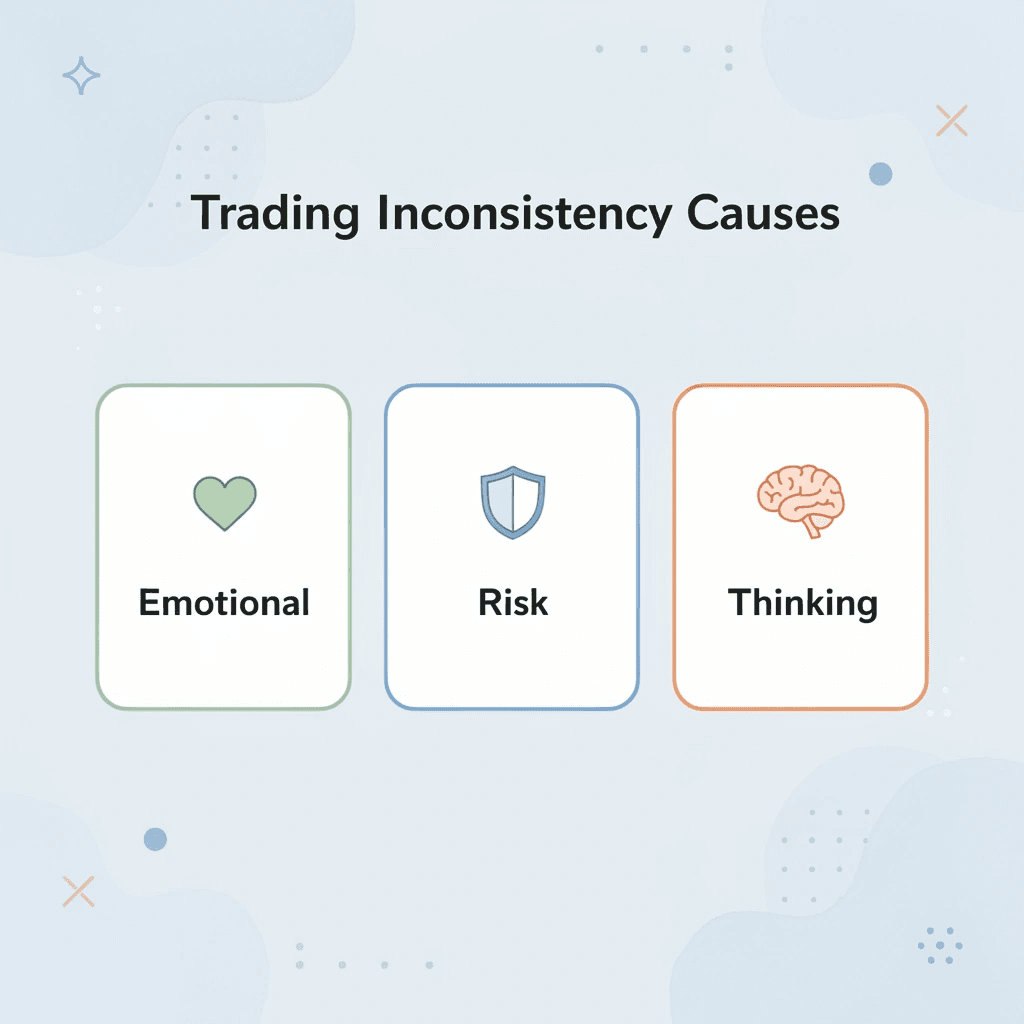
⚠️ Warning: Most traders focus on finding better setups when the real issue is execution consistency and emotional control during live market conditions.
Emotional Reactions Override Your Rules
Fear and greed hijack your thinking during live market action. Fear prevents you from taking valid setups or causes early exits from winning trades to lock in small profits. Greed after wins leads to oversized positions or chasing momentum without confirmation. One emotional decision cascades into bigger mistakes, destroying steady execution and progress.
Lack of a Complete Trading Plan
Traders without detailed plans for entries, exits, risk limits, and trade management make decisions on the fly. They lack clear answers for handling news events, drawdowns, or position sizing, leaving every session open to interpretation. Without this structure, uncertainty breeds doubt, and traders improvise based on feelings rather than proven criteria, producing erratic results.
Poor Risk Management Practices
Not sizing positions consistently or ignoring stop-loss rules puts accounts at risk of catastrophic losses on single trades. Traders often risk more money after winning trades due to overconfidence or after losing trades to quickly recover losses. This revenge trading creates sharp account declines that can erase previous gains. Using strict, uniform risk rules on every trade protects your capital and lets probability work in your favor. When you break these rules, trading becomes gambling rather than strategy.
Loss Aversion and the Disposition Effect
Traders feel losses more acutely than equivalent gains, causing them to hold losing positions too long while selling winners prematurely. Research from Terrance Odean's 1998 study of 10,000 brokerage accounts confirmed this pattern: investors sold gains at a much higher rate than losses, selling winners 1.5 times more often than losers. This behavior locks in smaller profits while letting losses grow, directly harming account growth. According to BetterTrader.co's analysis, 90% of day traders lose money, largely because these emotional patterns override technical skill.
No Trading Journal or Feedback Loop
Without reviewing every trade against your rules, traders repeat the same errors without knowing it. They forget specific mistakes during stressful moments and miss patterns in their behavior. A journal provides objective data on what works and what fails, enabling targeted improvements.
Can You Stay Consistent in Trading Without a Strategy?
No. Doing the same thing over and over without a plan is not realistic. You cannot repeat something you never clearly defined. Traders who depend on gut feelings, watching screens, or intuition make a different decision for every trade. This means they never build the repeatable advantage that separates traders who make money from those who lose their capital quickly. A strategy locks in the conditions, risk rules, and execution steps that turn trading into a process instead of emotional reactions.
🎯 Key Point: Without a clearly defined strategy, you're not being consistent—you're making random decisions that feel similar.
⚠️ Warning: Traders who rely on gut feelings typically lose 80-90% of their capital within the first year due to a lack of repeatable processes.
"A strategy locks in the conditions, risk rules, and execution steps that turn trading into a process instead of emotional reactions." — Trading Psychology Research

The Illusion of Experience-Based Consistency
Traders watch successful discretionary traders post wins and assume rules are optional. They believe enough hours staring at charts will naturally build consistency through pattern recognition. This ignores how the brain processes uncertainty. Without set criteria, every setup triggers fresh analysis loaded with recent bias, fear from the last loss, or overconfidence from the last win. The same chart pattern yields different actions depending on whether you slept well, how your morning went, or what happened in your last three trades. That variance destroys any edge before it can compound.
Why Discretion Without Structure Fails at Scale
Research from the University of São Paulo and FGV School of Economics tracked 1,551 Brazilian day traders over 300+ days: 97% lost money after paying fees, only 1.1% earned more than minimum wage, and 0.5% made more than a bank teller's salary. These traders failed because hard work without a plan cannot overcome the emotional chaos markets create. Winning days tempt traders to break their rules; losing days push them toward revenge trades. This cycle produces volatile results instead of steady improvement.
High Early Attrition Without Structure
Studies show that 40% of day traders quit within the first month due to inconsistent results and frustration from trading without a plan. Without objective methods to measure progress or learn from mistakes, traders deplete their capital and lose confidence before developing any edge.
Random vs. Structured Approaches
Research shows that purely random or discretionary strategies underperform disciplined ones because they lack edge validation and uniform execution. Without a tested plan, traders cannot separate signal from noise, making decisions driven by cognitive biases rather than probability. Structured strategies enable statistical validation; unstructured ones do not.
What does a proper trading strategy define?
A good strategy defines exact entry conditions, position size as a percentage of capital, stop-loss placement, profit targets, and market environments for trading versus stepping aside. This removes personal choice from live moments. You execute the same process whether you feel confident or terrified, whether you won yesterday or lost.
That uniformity allows the law of large numbers to work. Over hundreds of trades, a small edge compounds into consistent returns. Without it, you cannot separate luck from skill, which means you cannot improve—only hope.
How to stay consistent in trading for institutional funding?
The path to trading at scale starts with proving you can execute the same process repeatedly. At Goat Funded Trader, we provide simulated capital up to $2M to traders who demonstrate consistent execution of a tested strategy, because consistency is the only reliable predictor of performance under pressure. We don't fund traders who rely on gut feelings; we fund those who show disciplined, repeatable execution. The traders who access the largest accounts and receive the best profit-sharing terms treat every trade as one data point in a long series, not as a standalone event shaped by mood.
The Mechanism Behind Strategy-Driven Consistency
Markets create constant stimuli. Dopamine floods your brain after wins. Cortisol spikes after losses. Without an external strategy as an anchor, these chemicals dictate your trade size, holding period, and whether you take the setup.
A strategy interrupts that cycle by providing a checklist that exists outside your nervous system. You review performance against rules, not feelings, which builds genuine confidence rooted in evidence rather than recent outcomes. That shift from reactive to systematic is the only path to lasting consistency.
How do you build a strategy that works under pressure?
Knowing you need a strategy and building one that works under stress are two different challenges.
Related Reading
- Sbloc Vs Margin Loan
- Lowest Margin Rates Brokers
- Best Crypto Prop Firm
- Is Issuing Common Stock A Financing Activity
- How Do You Profit From Day Trading Stocks
- How Do You Take Profit In Crypto Trading
- How To Day Trade Without 25k
- Best Prop Firm For Stocks
- How To Borrow Against Stocks
- Prop Trading Firms' Profit-Sharing Models
- Can I Borrow Against My Stocks
- Position Sizing Day Trading
- How To Become A Trader From Home
- Position Sizing In Trading
20 Daily Habits to Learn to Stay Consistent in Trading
Being consistent in trading comes from doing the same things every day. These habits help you stay disciplined, follow your process, and stay in control. These 20 habits change the way you act so that following your plan happens automatically. They cover getting ready, doing the work, looking back at what you did, and taking care of yourself. This approach delivers consistent good results over time.
🎯 Key Point: Consistency in trading isn't about perfect trades—it's about perfect habits that compound into long-term success.

"Successful trading is about developing a systematic approach that removes emotional decision-making from the equation." — Trading Psychology Research
💡 Tip: Start with just 3-5 habits from the list below and gradually add more as they become automatic behaviors in your daily routine.

Habit 1: Wake Up at the Same Time Every Day
Set a fixed wake-up time regardless of the previous day's events. This steadies your body's natural sleep rhythm, sharpens your thinking, and eliminates the stress of an irregular schedule. Traders who maintain this habit bring consistent focus to the charts each morning.
Habit 2: Complete a Short Physical Exercise Session
Spend 20 to 45 minutes walking, running, or strength training before reviewing charts. Physical activity increases blood flow to your brain, lowers stress hormones, and helps you handle market changes without emotional reactions.
Habit 3: Review Your Trading Rules Every Morning
Read your complete set of trading rules aloud or in writing before market analysis. This daily practice keeps entry, exit, and risk criteria fresh in your mind and prevents the temptation to improvise rules on the fly. Repeating your rules makes them instinctive, allowing you to follow them automatically even under pressure.
Habit 4 Conduct Pre-Market Market Analysis
Spend a fixed block of time reviewing overnight price action, key levels, economic events, and your watchlist. This establishes a clear daily bias and prepares you with specific setups rather than forcing reactive trading.
Habit 5: Define Your Daily Risk Limit in Advance
Figure out and write down the maximum amount you are willing to risk each day in dollars or as a percentage. This fixed limit prevents impulsive decisions and ensures you size your positions correctly from your first trade.
Habit 6: Maintain a Detailed Trading Journal
Write down every trade right after you exit it, including your entry and exit reasons, the risk you took, how you felt, and whether you followed your rules. This creates a clear record of your behavior patterns over time, helping you identify recurring mistakes and reinforce what you do well.
Habit 7: Practice 10 Minutes of Mindfulness or Meditation
Sit quietly and focus on your breath or use a guided session before trading. This trains your mind to notice emotions without reacting, creating mental space between market changes and your actions. Daily mindfulness strengthens impulse control, helping you respond to price action according to your plan rather than emotional impulses.
Habit 8: Set Process-Based Daily Goals
Write down three to five specific process goals, such as "execute only A+ setups" or "cut every trade at the predefined stop." These goals focus on controllable actions rather than profit targets, shifting attention from outcomes to execution quality and rewarding discipline on losing days.
Habit 9: Take Scheduled Breaks from the Screen
Take a break from charts for at least 10 minutes every hour when actively trading. Use this time to stretch, drink water, or clear your mind. Regular breaks prevent decision fatigue and emotional buildup that lead to careless trades, keeping your mind sharp and preventing small mistakes from accumulating into major rule violations.
Habit 10: Review and Visualize Your Key Setups
Study charts of your highest-probability setups from previous sessions or historical examples. Mentally practice how you'll handle them in line with your rules. This daily visualization strengthens pattern recognition and builds confidence in your process, enabling you to execute valid trades without hesitation.
Habit 1: Stick Strictly to Your Predefined Watchlist
Limit your analysis and trading to a fixed list of 5 to 10 instruments or setups you have thoroughly studied and backtested. This removes the distraction of chasing random tickers or hot-news names, deepens your understanding of their behavior, reduces decision fatigue, and improves the accuracy of your rule-based executions.
Habit 12 Enforce Uniform Position Sizing on Every Trade
Figure out how much to trade based on your fixed daily risk limit and stop-loss distance before entering any trade. Never change your size based on setup strength or recent trade outcomes. Using the same size for every trade keeps your risk steady, protects your account, and lets your edge grow over hundreds of trades.
Habit 13: Track Your Win Rate and Risk-Reward Metrics Daily
Log your key statistics daily: win rate, average winner versus average loser, and expectancy. This converts raw trading data into quick feedback, showing whether your process stays on target and highlighting small drifts before they become major problems. Adjustments based on facts rather than feelings prevent minor issues from escalating.
Habit 14: Eliminate All Non-Trading Distractions During Market Hours
Turn off notifications, close unrelated tabs, and create a dedicated workspace free from social media or personal tasks while markets are open. Sustained concentration lets you observe price action deeply and respond only to your predefined criteria instead of reacting to every alert or headline.
Habit 15: End Each Day with a Brief Performance Debrief
Spend 10 to 15 minutes reviewing the day's trades against your rules. Write down what you did well and where you deviated from your plan. Identify one specific thing to improve in the next session. Regular debriefs accelerate your progress and prevent repeated mistakes.
Habit 16: Follow a Consistent Pre-Trade Nutrition Routine
Eat a balanced meal with plenty of protein and drink enough water at the same time each day before trading. Stable blood sugar prevents energy crashes that lead to impulsive decisions or reduced focus during market hours.
Habit 17: Dedicate Time to Continuous Strategy Education
Spend 20 to 30 minutes daily studying your specific strategy through backtesting, chart review, or targeted learning. This deepens your understanding of why your rules work and strengthens your confidence during uncertain periods, converting knowledge into ingrained behavior that's easier to trust under live pressure.
Habit 18: Protect Your Sleep and Wind-Down Routine
Follow a fixed evening schedule: shut off screens at least one hour before bed and maintain the same bedtime each night. Quality sleep directly improves emotional regulation and cognitive function, ensuring you arrive at the market refreshed and disciplined rather than tired and prone to breaking your rules.
Habit 19: Build a Supportive Trading Community Connection
Connect daily with a small group of like-minded traders through a forum, chat, or accountability partner for quick check-ins about following your process. This provides an outside perspective, keeps you motivated, and strengthens your commitment to your rules. Sharing your experiences without soliciting tips maintains focus on your discipline and prevents the isolation that leads to inconsistency.
Habit 20: Leverage Prop Firm Funding to Scale Your Discipline
Once your habits are deeply ingrained and automatic, apply them to a prop firm challenge and transition to trading capital once funded. Our Goat Funded Trader funding removes the pressure of risking your own capital, letting you focus on process and scale your proven edge with larger positions while maintaining the strict rules that built your consistency.
How long does habit formation actually take in trading
According to a study by University College London, it takes an average of 66 days to form a new habit. Traders often abandon new routines after a week or two without seeing quick results. You will face resistance during the first month, particularly when markets test your discipline with unexpected moves or losses.
What happens during the critical habit formation window
The critical window occurs between day 20 and day 50, when the new feeling fades but the habit hasn't solidified. Traders who persist through this period without skipping days develop routines that endure during difficult times. Those who quit early restart the cycle, never reaching the point where doing the right thing becomes automatic.
The Compounding Effect of Small Daily Actions
Each habit seems simple in isolation. Waking up at the same time or taking a 10-minute break sounds easy compared to finding the perfect entry signal. But consistency comes from doing small, boring actions repeatedly without missing, not from big gestures or occasional bursts of discipline.
How do small daily actions create trading consistency?
One trader writes in a journal for 10 minutes every evening, while another skips it when tired. After 100 trading days, the first trader has 100 detailed records showing behavioral patterns; the second has scattered notes and unclear memories. The trader who uses fixed wake times, pre-market analysis, uniform position sizing, and daily debriefs operates from a fundamentally different foundation than one who trades reactively based on mood and market noise.
How Habits Protect You from Yourself
The failure point in most trading careers is not a lack of market knowledge, but the moment when you know the right action yet take the wrong one. You know your stop-loss should be at a specific level, but you move it lower to avoid the loss. You know you should walk away after hitting your daily limit, but you take one more trade to "get even." These moments destroy accounts.
How do habits help you stay consistent in trading decisions?
Habits break that cycle by removing the choice entirely. After reviewing your rules every morning for 60 days, breaking them requires consciously overriding a deeply ingrained pattern. After taking a 10-minute break every hour for three months, stepping away becomes automatic rather than a test of willpower. The behavior happens before your emotional brain can take over. Getting there requires the patience to keep showing up when nothing dramatic is happening.
How Goat Funded Trader Supports Consistency in Trading
The greatest traders trade with less fear, not more confidence. When your personal savings are at risk, emotional weight sabotages execution. Prop firms like Goat Funded Trader eliminate this pressure by providing simulated capital with real profit splits, letting you focus on executing your edge without survival instinct hijacking your process.

🎯 Key Point: Emotional detachment from personal capital is the single most important factor in consistent trading performance. When you're trading with firm capital, your decision-making becomes purely analytical rather than emotionally driven.
"Trading psychology accounts for 80% of trading success, while technical skills represent only 20% of the equation." — Trading Psychology Institute, 2023

💡 Best Practice: Goat Funded Trader's evaluation process trains you to maintain disciplined risk management while building confidence in your trading system. This dual benefit creates sustainable trading habits that translate directly into long-term profitability.
The Capital Pressure Problem
Trading with your own money creates a psychological trap. You know your strategy works over 100 trades, but when trade number 23 goes against you, and that's rent money disappearing, your instincts take over. The next valid setup appears, and instead of executing, you hesitate. Or worse, you overtrade to recover losses, breaking position-sizing rules because the emotional need to "get back to even" overrides logic. One trader described it perfectly: after losing personal capital on revenge trades, the fear of one more loss made him freeze on setups he had backtested for months.
Structure That Enforces Discipline
Most traders lack boundaries that hold firm when emotions intensify. Our risk management rules at Goat Funded Trader build consistency through clear boundaries: a 3% maximum daily loss, a 6% overall drawdown limit, and clear profit targets for each evaluation phase. These rules force you to stop trading when you hit your daily limit, eliminating the internal debate that leads to poor trading sessions. According to Goat Funded Trader, traders keep an 80% profit split on accounts that grow to up to $2 million, meaning discipline directly translates into income without additional personal risk.
Fast Feedback Loops Build Confidence
Waiting three weeks for a payout creates doubt about whether the system works, tempting traders to abandon proven methods right before they compound. Goat Funded Trader compresses this cycle with on-demand withdrawals processed within 24 hours, backed by a $1,000 guarantee if we miss that window. Money hitting your account after executing your plan correctly rewires your brain. The positive reinforcement becomes automatic, shifting focus from questioning consistency to refining execution.
Scaling Without Additional Risk
Small accounts trap disciplined traders. A 3% monthly return on $5,000 yields only $150; meaningful income requires either reckless position sizing or years of compounding. Prop funding solves this by giving proven traders access to capital matching their skill. With Goat Funded Trader, you can scale from $100K to larger allocations while maintaining the same risk parameters, turning 3% monthly into life-changing income without risking personal savings. But here's what most traders miss: access to capital means nothing if you can't execute when it counts.
Related Reading
- How To Become A Full-Time Trader
- How To Trade Forex With A Prop Firm
- Best Forex Prop Firm
- Best Trading Strategies For Consistent Profits
- How To Get Profit In Option Trading
- Options Trading Strategies For Consistent Income
- Day Trading Strategies For Consistent Profits
- Margin Loan vs. Securities-Based Lending
- Forex Trading Strategies For Consistent Profits
- How Does A Margin Loan Work
- Recommended Prop Trading Firms With Growth Plans
- Best Margin Rates Brokers
- Trading Cash Flow
Get 25-30% off Today - Sign up to Get Access to Up to $800K Today
You already built the habits: waking at the same time, reviewing your rules, journaling every trade, and protecting your focus. Yet one wrong move with your own capital still triggers hesitation, revenge trades, or oversized risks that erase weeks of progress.
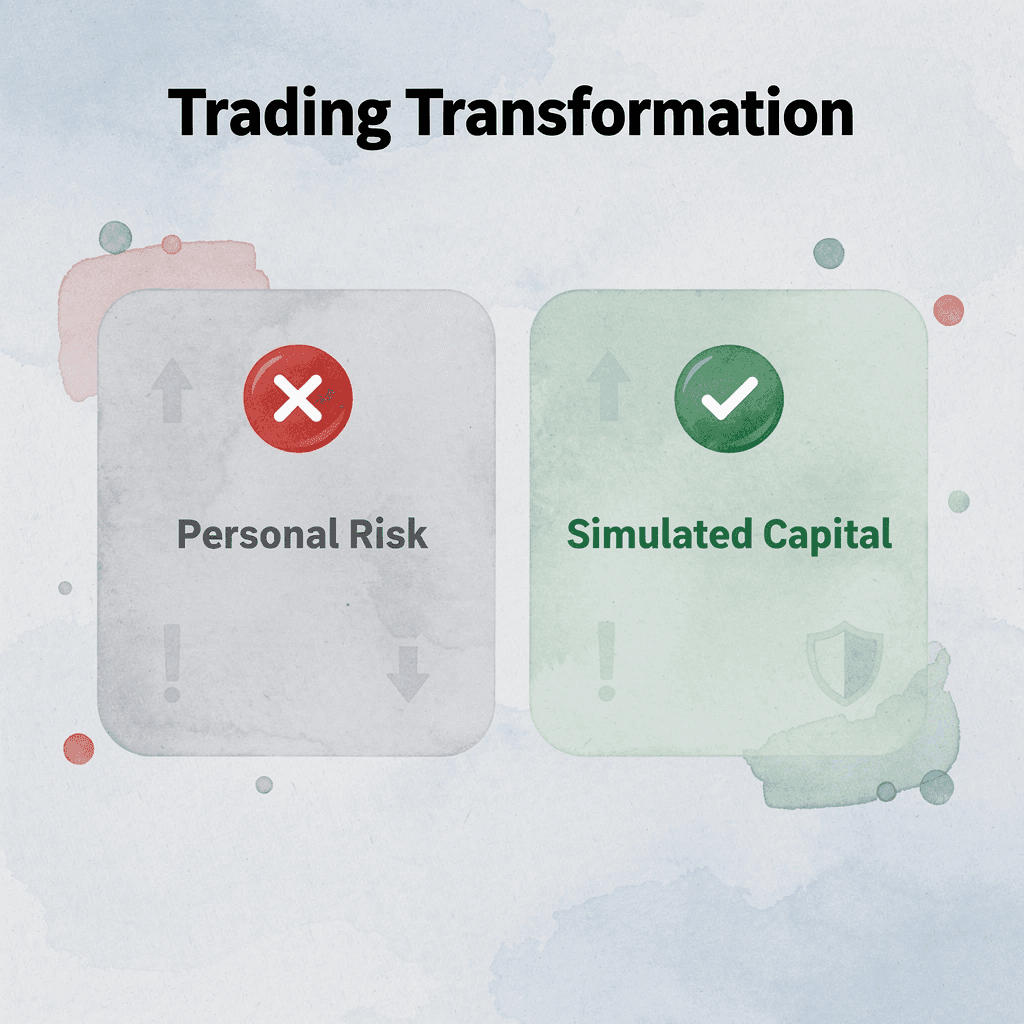
Goat Funded Trader ends this struggle. Our platform gives you up to $2 million in simulated capital after a straightforward evaluation, letting you execute your proven habits with zero personal financial risk. You trade our capital, keep 80 to 100% of the profits, and withdraw on demand within 24 hours, or we pay you an extra $1,000. No hidden rules, no time limits, news trading, and weekend holding are allowed.
Traders who follow your daily process scale to six and seven-figure payouts at Goat Funded Trader. Over $20 million has been paid to more than 250,000 traders worldwide, with many hitting consistent $8,000 to $16,000 monthly rewards at 100% profit split.

Use code FIRSTGFT for 50% off your first account. The fee is 100% refundable on payout. No credit card required to explore the dashboard. Turn your consistency habits into a professional trading business.
Be Great and get the App