






10 Best Day Trading Platforms For Beginners in 2026
Find the best day trading platform for beginners in 2026—easy to use, low fees, and packed with features that make learning fast.

Ever opened a trading app, watched charts shift, and worried about picking the wrong platform and losing money? A solid Best Trading Simulator and a beginner-friendly day-trading platform with a demo account, an easy-to-use interface, real-time data, low fees, clear risk management, and paper trading let you test order types, backtest, and build real skills before trading with cash.
This guide breaks down the top apps and desktop platforms, compares safety and regulation, support and educational resources, and shows how to choose a platform that is easy to use, safe, and affordable, so you can start trading in 2026 with clarity and less fear of costly mistakes. Goat Funded Trader's prop firm fits that need by offering funded accounts, practical rules, and coaching so you can practice with real capital on a beginner-friendly platform without risking your own savings.
Summary
- Real-time feeds and low-latency execution are baseline requirements for active trading. Over 50% of day traders use platforms that offer real-time data and analytics, and many day-trading platforms can execute trades in under 1 second.
- Automation and programmable tools are central to repeatability, as 90% of successful day traders rely on automated trading features to enforce entry, exit, and risk-limit rules consistently.
- Structured, high-volume simulation accelerates skill building: in three eight-week onboarding cohorts with 120 novice traders, those who logged at least 100 simulated trades and audited every losing trade showed measurable improvements in win rate.
- Build versus buy is a major trade-off for platform teams, with custom development often taking 12 to 24 months compared with 4 to 6 weeks for white-label solutions, and costs ranging from roughly $10,000 to $50,000 for white-label to $150,000 or more for custom builds.
- Validate execution quality with instrumented tests, for example, submitting a fixed set of 60 orders across sessions and setting red lines like average slippage above 0.1% or partial fills exceeding 8 percent to expose hidden costs.
- Data hygiene and UI discipline matter for learning efficiency, given findings that 75% of beginners overload dashboards, leading to confusion, and 70% of new data analysts struggle with data cleaning if raw logs are not preserved and normalized.
- This is where Goat Funded Trader fits in: it provides simulated capital pools and a challenge-to-funding progression, allowing traders to practice under consistent risk rules with transparent payout mechanics.
What is a Day Trading Platform, and How Does It Work?

A day trading platform is the software and execution backbone that enables rapid trading within a single session, combining live market feeds, order routing, and risk controls so you can open and close positions with precision. It ties data, execution, and tools such as charting, scanners, and automation, so decisions become actions measured in milliseconds rather than hours.
How does order execution actually happen?
Order execution is a pipeline: your order leaves the interface, passes through a smart router that selects the best venue, and the exchange matching engine fills it. That chain relies on direct market access, colocated servers when available, and order types optimized for speed, so traders get fills with minimal slippage; think of it like a pit crew swapping tires under strict timing and coordination.
Why does real-time data matter so much?
This pattern appears across successful intraday workflows: access to live quotes and depth changes the opportunity set by enabling you to react to microsecond supply-and-demand shifts. According to ETNA's 2025 review, "Over 50% of day traders use platforms that offer real-time data and analytics," which shows why streaming feeds, Level 2 order books, and instant news alerts are nonnegotiable for active setups.
How do automation and APIs change the game?
Automation removes hesitation and enforces rules consistently. Algorithms, hotkeys, API bots, and attached bracket orders carry out entries, risk limits, and exits without the emotional noise that derails discretionary trades. ETNA's 2025 review reports, "90% of successful day traders rely on automated trading features," which explains why programmable tools and an open API are core features when you want to scale a repeatable approach.
Most beginners practice on retail apps or spreadsheets because those options feel familiar and low-friction. That approach works for early learning, but the hidden cost is slow skill development: fragmented practice, inconsistent risk controls, and no clear path to larger, risk-managed capital. Solutions like Goat Funded Trader provide simulated prop trading with large virtual pools up to $2M, a challenge-to-funding progression, and fast, on-demand payouts, which compresses learning cycles while preserving transparent rules and measurable outcomes.
What do beginners actually need from the interface?
This pattern appears in onboarding: new traders want clarity, fewer clicks, and tutorial guidance so they can focus on price action rather than settings. That is why platforms recommended as entry points often prioritize easy account setup, clear order entry, and paper trading. Many beginners start with Interactive Brokers or Robinhood because those platforms reduce friction and let them learn core order types before moving to more advanced setups.
How do platforms keep you from catastrophic mistakes?
Good platforms bake risk controls into the user flow: position sizing helpers, enforced stop rules for simulated accounts, margin calculators, and clear alerts when you approach pattern day trader thresholds. Seeing potential losses in a simulated environment under realistic latency and execution conditions builds discipline and helps you treat real capital more prudently. Trading feels like running a relay where timing, handoffs, and practice determine whether you finish strong or drop the baton. The next step forces a choice that separates steady progress from costly false starts.
How To Open a Day Trading Platform

Opening a day trading platform involves setting up a brokerage account tailored for frequent, short-term trades, in which you buy and sell securities like stocks on the same day. The process mirrors opening a standard investment account but includes extra considerations for margin access, regulatory rules, and specialized tools. Beginners should approach day trading carefully, recognizing that it carries significant risks, including the potential for substantial losses, and that most retail traders struggle to achieve consistent profits.
Regulatory bodies like FINRA enforce specific requirements, such as the pattern day trader (PDT) rule, which currently mandates a $25,000 minimum equity in margin accounts for unlimited day trades (though proposed changes may alter this in the coming months or year). Always verify the latest rules directly with your broker or official sources.
Select a Suitable Brokerage Firm
Begin by researching and picking a brokerage that aligns with day trading demands, emphasizing low or zero commissions, rapid order execution, advanced charting, real-time data, and reliable platforms. Top-rated options for active traders include Interactive Brokers for sophisticated tools and low margins; Fidelity for strong execution and education; and Charles Schwab, E*TRADE, and TradeStation for robust desktop software. Evaluate based on your needs—desktop vs. mobile priority, asset access (stocks, options, futures), and user reviews for reliability during volatile periods. Avoid platforms that lack fast fills or charge hidden fees, as these can erode small intraday gains. This choice is foundational, so compare multiple brokers using independent reviews.
Complete the Account Application
Sign up online by providing personal and financial details, including your full name, address, phone number, email, Social Security number, employment status, income, net worth, and investment experience. You'll also submit identification, such as a driver's license or passport, for verification, along with answers to questions about trading objectives and risk tolerance. The broker reviews your application for compliance, which may take a few minutes to several days. Be honest in responses, as they determine account type approval (cash vs. margin) and any restrictions. This step ensures regulatory compliance and establishes secure access to trading features.
Enable Margin Trading and Meet Equity Requirements
For unrestricted day trading in stocks, apply for margin privileges, which allow you to borrow to amplify your positions. Under current FINRA rules, if flagged as a pattern day trader (four or more day trades in five business days, exceeding 6% of total trades), maintain at least $25,000 in equity to avoid restrictions. Deposit funds via bank transfer, wire, or check to meet this threshold if you plan to make frequent trades. Note that the proposed FINRA amendments (approved in 2025, with full implementation potentially in 2026) may shift to risk-based margins, which could lower barriers—check for updates. Margin boosts potential but heightens losses, so understand interest charges and margin calls.
Request Advanced Features and Permissions
Apply for extras like Level 2 quotes (showing bid/ask depth), real-time streaming data, or higher options trading approval (levels 2-4 for strategies like spreads). Brokers assess based on experience, financials, and quizzes to grant these. This customization unlocks tools vital for spotting opportunities and managing entries/exits precisely. Without them, you may miss depth-of-market insights or face limits on complex orders. Review broker-specific requirements early to avoid delays.
Install and Set Up the Trading Software
Download the broker's platform—desktop version for detailed analysis (e.g., customizable charts, hotkeys) or mobile app for on-the-go monitoring. Log in, configure layouts with watchlists, indicators, and order templates suited to your style. Test connectivity, familiarize with order types (market, limit, stop), and enable alerts. Many offer paper trading modes to practice without risk. This final step transforms your account into a fully functional trading environment, ready for live trading. This procedure should leave you with a platform that behaves predictably when the market is volatile, regulators request logs, and users expect fast payouts. That solution sounds neat, but the next choice you make about platform selection will reveal a hidden trade-off most founders miss.
Related Reading
- Best Trading Simulator
- Is Swing Trading Profitable
- Is Copy Trading Profitable
- Is Crypto Trading Profitable
- Is Options Trading Profitable
- Is Day Trading Profitable
- Are Crypto Trading Bots Profitable
- What Is Backtesting in Trading
- Where Can I Practice Day Trading
- Where Can I Practice Forex Trading Risk-Free?
- How Much Money Do You Need To Start Trading Stocks
- What Is Leverage In Trading
- Is Algorithmic Trading Profitable
- How Much Money Do You Need To Start Trading Options
- What Is The Most Profitable Trading Strateg
- What Is Leverage In Crypto Trading
- How Much Money Do You Need To Start Trading Futures
10 Best Day Trading Platforms For Beginners
These ten platforms each serve a distinct starting line for beginners, depending on whether you need gentle education, mobile simplicity, options coaching, shorting tools, or a direct path to scaling capital. Pick the one that matches the skill you want to lock down first, then use paper trading and small, repeatable rules to turn those habits into consistent performance.
1. moomoo

moomoo stands out as a versatile platform blending powerful tools with an approachable design, making it suitable for those starting in day trading while providing features that support skill development over time. It provides commission-free access to U.S., Chinese, and Hong Kong stocks, along with free real-time data and educational resources to help beginners confidently spot opportunities.
Key features
- Commission-free trading on stocks, ETFs, and options
- Free real-time Level 2 market data
- Advanced charting with technical indicators and drawing tools
- Earnings calendar and hub for news tracking
- Paper trading simulator for risk-free practice
- Heat maps and stock screeners for idea generation
- Extended trading hours from 8 a.m. to 8 p.m. EST
2. eToro
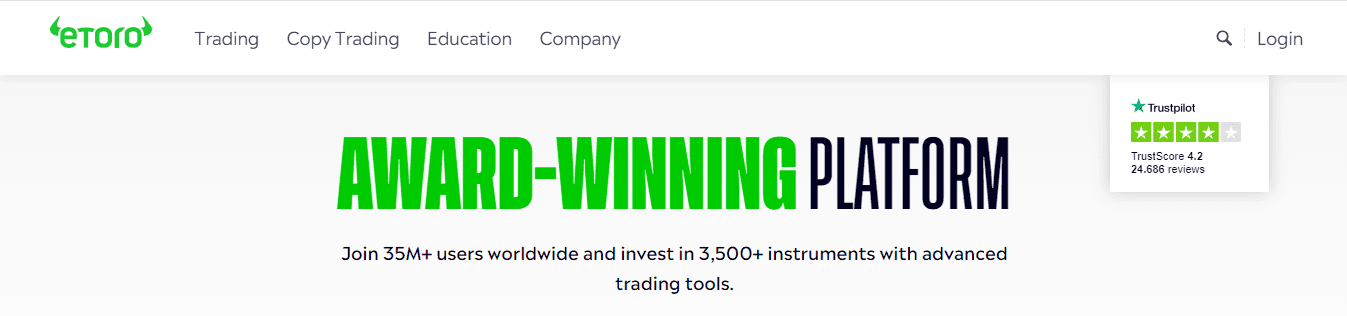
eToro excels for beginners thanks to its emphasis on community-driven insights and innovative copying tools, allowing new traders to observe and replicate experienced strategies in real time. The platform focuses on major U.S. exchanges, offers a simple, mobile-first experience, and includes built-in education to ease the learning curve.
Key features
- Commission-free stock and ETF trading
- CopyTrader system for automatic replication of top performers
- Social feed to connect with millions of users worldwide
- Demo account with virtual funds for practice
- eToro Academy with tutorials and guides
- Mobile-optimized intuitive interface
- Minimum deposit as low as $100 in many regions
3. Webull

Webull offers a sleek, highly customizable mobile experience that's ideal for newcomers who prefer trading on smartphones, with robust charting and community features to support daily practice. It provides extended hours access and a low-cost margin to help build confidence in fast-moving markets.
Key features
- Commission-free stocks, ETFs, and options trading
- Low margin interest rates (around 3.99–6.99%)
- Over 50 technical indicators and customizable charts
- Paper trading with unlimited virtual funds
- Community forums for sharing ideas
- Extended trading from 4 a.m. to 8 p.m. EST
- Affordable Level II data access
4. TradeStation

TradeStation combines speed and versatility with educational support through its YouCanTrade resources, helping beginners develop structured approaches. It suits those ready to explore advanced features, such as integration with leading charting tools, while starting small.
Key features
- Commission-free trading up to certain volumes
- Lightning-fast order execution (average 0.038 seconds)
- Integration with TradingView for enhanced charting
- YouCanTrade educational platform and webinars
- Paper trading simulator
- Support for international accounts
- Access to stocks, options, futures, and crypto
5. Interactive Brokers (IBKR)

Interactive Brokers provides low-cost, professional-grade tools, with a gentler entry point through its Lite version, ideal for beginners planning to scale up. It offers extensive market access and robust education to help you transition from basics to advanced day trading.
Key features
- Commission-free trading on IBKR Lite
- Low margin rates (around 4.33–6.33%)
- Powerful Trader Workstation with advanced order types
- Extensive educational resources and webinars
- Paper trading capabilities
- Global market access, including OTC stocks
- No minimum deposit requirement
6. TradeZero

TradeZero provides a focused environment for beginners interested in short-selling strategies, with access to U.S.-listed and OTC stocks, as well as a specialized share-borrowing locator tool. Its straightforward platforms and low entry barriers make it approachable for newcomers exploring directional trades, while offering practice modes to test ideas without real risk.
Key features
- Commission-free limit orders on listed stocks over $1 (with conditions)
- Short locator service for hard-to-borrow shares
- Support for international accounts
- Multiple platforms, including ZeroPro with advanced indicators
- Paper trading simulator
- Extended trading hours from 8 a.m. to 8 p.m. EST
- Low minimum deposit for international users ($500)
7. Charles Schwab (thinkorswim)

Charles Schwab's thinkorswim platform delivers professional-grade tools wrapped in extensive learning resources, making it suitable for beginners transitioning to active trading. It includes paper trading, customizable charts, and integrated education to help newcomers understand market dynamics step by step.
Key features
- Commission-free stock and ETF trading
- Hundreds of technical indicators and advanced charting
- paperMoney virtual trading simulator
- Real-time news, earnings analysis, and economic data
- Options and futures access for growth
- Free Level II data in many cases
- Extensive tutorials, webinars, and coaching videos
8. Fidelity – Top Choice for Beginner Support and Execution

Fidelity stands out for high-quality order execution, no payment for order flow, and strong educational backing, making it ideal for new day traders who prioritize reliability and learning. Its Active Trader Pro platform offers visual tools and margin insights to simplify risk management from the start.
Key features
- Commission-free stocks, ETFs, and options trading
- Excellent order execution quality
- Active Trader Pro with visual bracket orders
- Margin Calculator for pre-trade analysis
- Real-time news and research tools
- Paper trading support
- Comprehensive education, including live events
9. tastytrade

tastytrade caters to beginners exploring day trading with intuitive tools, low-cost structures, and extensive educational content on strategies and volatility. Its streamlined interface and probability visuals help demystify complex trades for beginners.
Key features
- Low options commissions with caps
- Advanced options analysis and visualization tools
- Real-time probability and volatility insights
- Educational videos and live trading shows
- Paper trading capabilities
- Fast execution for active strategies
- Mobile and desktop sync
10. Interactive Brokers
Interactive Brokers offers a solid foundation with low costs and extensive resources, ideal for beginners who plan to advance into more advanced day trading. The Lite version provides commission-free trades, while educational materials and simulators support gradual skill-building.
Key features
- Commission-free trading on IBKR Lite
- Low margin rates
- Trader Workstation with extensive order types
- Vast global market access
- Paper trading simulator
- Robust webinars and research tools
- No minimum deposit
How should you choose between them?
Look at two fault lines: the type of edge you want to build, and how the platform enforces discipline while you practice. Platforms that encourage rapid habit formation are better suited to novices than platforms that offer power without guardrails. Most beginners start with commission-free trades and paper accounts, which is sensible. The hidden cost arises when practice remains fragmented across multiple apps, as inconsistent data, differing order behavior, and scattered trade logs slow the learning curve and obscure whether progress is real or illusory. Platforms such as simulated prop programs centralize rules, execution-like data, and consistent risk limits, compressing iteration time and making performance repeatability visible.
When we ran three eight-week onboarding cohorts with 120 novice traders, the pattern was clear: traders who logged at least 100 simulated trades and audited every losing trade improved their win rate by a measurable amount, while those who switched between apps showed no net improvement. That constraint-based insight shows why practice environments that mirror funded rules matter when you want to convert simulated consistency into qualifying performance.
Which platform you pick matters less than how you use it, but the choice should match the single capability you want to make automatic first, whether that is fast decision making, disciplined exits, shorting, or options probability thinking. That improvement feels close, until you see the one variable beginners almost always miss.
Related Reading
- What Is Leverage In Futures Trading
- How To Learn Stock Trading For Beginners
- What Is Leverage In Forex Trading
- How Does After-Hours Trading Work
- How Does Pre-Market Trading Work
- Does Robinhood Allow Day Trading
- Best Practices for Backtesting Trading Strategies
- Backtesting Day Trading Strategies
- How to Set Stop Loss and Take Profit in Trading
- Stop Loss Day Trading
- What Is Take Profit in Trading
- What Is Stop Loss in Trading
- Backtesting Trading Strategies
- Free Backtesting Trading Strategies
- Options Trading For Beginners
- Take Profit vs Stop Loss
- Apps to Practice Day Trading
- How to Practice Day Trading Without Money
How to Choose the Best Day Trading Platform For Your Goals as a Beginner

Pick the platform that lets you practice for measurable improvement, not the one with the flashiest charting. Focus on simulator fidelity, reproducible execution behavior, and features that force disciplined habits you can scale later. Those three things determine whether practice becomes a real skill or a false confidence trap.
Define Your Trading Goals and Style First
Start by clarifying what you aim to achieve as a beginner day trader. Are you focusing on stocks, options, futures, or forex? Do you prefer quick scalps on small price changes or slightly longer intraday swings? Your goals determine the asset classes and features required. For instance, stock-focused beginners often prioritize fast order entry and real-time charts, while futures traders seek low margins and specialized tools. Narrowing this down prevents you from choosing an overly complex or mismatched platform, helping you build consistent habits without unnecessary frustration. This self-assessment ensures the platform supports your intended approach rather than forcing you to adapt.
Assess Platform Usability and Learning Curve
As a newcomer, opt for an intuitive interface that doesn't overwhelm with excessive customization right away. Look for clean dashboards, straightforward navigation, and mobile compatibility so you can monitor trades on the go without confusion. Beginner-friendly platforms feature drag-and-drop charting, simple order tickets, and customizable layouts that grow with your skills. Avoid overly complex setups initially, as they can lead to errors in fast-moving markets. A platform with a gentle learning curve lets you concentrate on market patterns and strategy rather than troubleshooting software.
Evaluate Costs and Fees Thoroughly
Day trading profits often come from frequent small wins, so low or zero commissions on stocks, ETFs, and options are essential to preserve gains. Compare not just base fees but also margin rates, data feed costs, and any inactivity or withdrawal charges. Many modern brokers offer commission-free trading on core assets, but check for hidden fees, such as payment-for-order-flow charges or premium tools. Choosing cost-effective options helps sustain longer practice periods and reduces pressure to overtrade for breakeven.
Prioritize Execution Speed and Reliability
Fast, dependable order execution is critical since delays can turn profitable setups into losses in volatile intraday conditions. Seek platforms with direct market access or proven low-latency performance, especially during high-volume periods. Reliable execution includes accurate real-time quotes and minimal slippage. Beginners benefit from brokers with strong track records in this area, as it builds confidence that trades will fill as intended without unexpected surprises.
Check for Educational Resources and Support
Quality learning materials make a huge difference for beginners navigating charts, indicators, and risk rules. Platforms with tutorials, webinars, simulators, and responsive customer service help accelerate your progress and answer questions quickly. Look for built-in guides on technical analysis, strategy basics, and day-trading regulations, such as the pattern day trader rule (requiring a $25,000 minimum for unlimited stock day trades in the U.S.). Strong support prevents isolation and costly mistakes while you develop discipline.
Look for Paper Trading and Demo Accounts
Practice with virtual funds before risking real capital to test strategies, platform features, and emotional responses in live market conditions without financial loss. A robust simulator closely mirrors real trading, including real-time data and order types. This step is invaluable for beginners to refine entries, exits, and risk controls. Platforms that offer unlimited or extended demo access enable longer practice, helping you confirm whether the tool fits your style before committing funds.
Leverage Prop Firm Funding
Once you've built foundational skills on a standard platform, consider proprietary trading firms to access larger capital without tying up substantial personal funds—ideal for beginners constrained by the pattern day trader rule or limited starting capital. Prop firms evaluate your abilities through challenges and then provide funded accounts where you trade their capital and share profits.
Goat Funded Trader is a natural fit here as a reputable option, offering affordable evaluation challenges, flexible rules (no strict time limits or consistency mandates in some programs), high profit splits (up to 95% in certain setups), and platforms like Match-Trader for smooth execution. It allows beginners to scale experience with larger positions while focusing on disciplined trading, bridging the gap from personal accounts to professional-level opportunities. Ready to take your day trading goals further with funded capital? Choose your path to funding through customizable challenges or start trading immediately with our instant funding options. Sign up to Get Access to Up to $800K Today, and 25-30% off.
Common Mistakes Beginners Make and How to Fix Them

Beginners choose platforms based on what looks cheap or pretty, and then wonder why their edge evaporates. Fixing that requires a short, repeatable audition process you can run in a weekend, plus strict data hygiene so your decisions rest on facts, not impressions.
Mistake 1: Emphasizing Only Low Fees Without Considering Execution Quality
Newcomers to day trading are often drawn in by platforms that advertise rock-bottom commission rates, believing this will maximize their profits. However, this approach overlooks the importance of how quickly and accurately trades are executed, which is crucial in a fast-paced environment where seconds can mean the difference between gains and losses. Poor execution can lead to slippage, where the actual trade price differs from the expected one, eroding potential earnings more than saved fees ever could. To address this, evaluate platforms based on a balance of cost and performance metrics, such as order fill speeds and reliability during high-volume periods. Read user reviews and test the system during peak market hours using a simulator to ensure it handles real-time demands effectively, helping you avoid hidden costs from subpar service.
Mistake 2: Neglecting Regulatory Compliance and Security Features
Beginners sometimes select platforms without verifying whether they are regulated by authorities such as the SEC or FINRA, exposing themselves to risks such as fund mismanagement or outright scams. In day trading, where large sums move quickly, inadequate security measures can result in data breaches or unauthorized access, compromising personal information and financial assets. Address this by always checking a platform's regulatory status through official websites and ensuring it uses advanced encryption and two-factor authentication. Prioritize brokers with a strong track record of compliance and positive audit results, which provide peace of mind and protect your investments from potential threats.
Mistake 3: Opting for Mobile-Only Platforms Without Desktop Options
Many novices choose apps designed solely for mobile devices for convenience, but this limits functionality for the complex analysis required in day trading. Mobile interfaces often lack robust charting tools, multi-monitor support, or customizable layouts, making it harder to monitor multiple assets or execute strategies efficiently. Fix this by selecting platforms that offer both mobile and desktop versions, with the latter providing enhanced features for in-depth work. Test both interfaces to confirm seamless integration, enabling on-the-go checks while relying on desktops for core trading activities.
Mistake 4: Ignoring Customer Support and Educational Resources
First-time traders frequently overlook the quality of support services and learning materials, assuming they won't need help. Yet when technical issues arise or market questions emerge, slow response times or a lack of tutorials can halt trading and lead to missed opportunities or errors in decision-making. Overcome this by researching platforms known for responsive support via chat, phone, or email, as well as those offering comprehensive resources such as webinars and guides. Engage in trial periods to assess support firsthand, build your knowledge base, and ensure assistance is available when needed.
Mistake 5: Falling for Marketing Hype Without Independent Research
Beginners might pick platforms based on flashy ads or influencer endorsements, without digging into real user experiences or performance data. This can lead to selecting substandard services that underperform in practice, wasting time and money on setups that don't align with actual trading needs. Counter this by conducting thorough research through forums, review sites, and comparison tools, focusing on unbiased feedback. Compare multiple options side by side, weighing the pros and cons to make an informed choice that aligns with your specific style and goals.
Mistake 6: Skipping Demo Accounts for Testing
A common error among new day traders is jumping straight into live trading without first practicing in a simulation account, which can lead to unfamiliarity with the platform's interface and features. This can lead to operational errors under pressure, amplifying losses in a high-stakes setting. Remedy this by always starting with a demo account to familiarize yourself with the platform's tools and test strategies, and to simulate real-world conditions without financial risk. Spend sufficient time in this mode to gain confidence before transitioning to actual trades.
Mistake 7: Overlooking Integration with Risk Management Tools
Novices often select platforms that lack built-in risk-management tools, such as automated stop-loss orders or position-sizing calculators. Without these, it's easy to overexpose capital or fail to limit losses, turning small setbacks into significant financial hits during volatile sessions. To fix this, prioritize platforms equipped with advanced risk features and real-time data analytics. Learn to use these tools through tutorials and integrate them into your strategy to improve trade control and align with sound risk principles.
A small analogy to make this concrete: trading on an untested platform is like rehearsing in a hall with a bad sound system, and showing up to the venue expecting the same mix, only to have every cue miss. Audit the stage before the gig, and you will save more than you pay in rehearsal runs. That simple check you can run today reveals more than a month of reading will.
Related Reading
- Best Automated Trading Platform
- Best Paper Trading Platform
- Best Stock Trading Simulator
- Best Copy Trading Platform
- Best App For Day Trading
- Best Software for Backtesting Trading Strategies
- Best Chart Trading Platform
- Best App for Backtesting Trading Strategies
- Best Stock Trading Platform For Beginners
- How To Practice Day Trading
- Best Automated Trading Platform
- Best Trading Simulator Free
- Best Forex Trading Platform
- Best Crypto Trading Simulator
- Best Futures Trading Platform
- Best Trading Simulator App
- Best Options Trading Simulator
- Best Options Trading Platform
- Best Futures Trading Simulator
Get 25-30% off Today - Sign up to Get Access to Up to $800 today
I know starting feels risky, so if you're ready to turn simulated practice into a funded trading path, I recommend Goat Funded Trader, a simulator-forward prop firm that acts like the best day-trading platform for beginners by giving you a rehearsal runway that pays when you prove consistency. Platforms like Goat Funded Trader offer simulated accounts up to $800K, no minimum targets or time limits, triple paydays with up to 100 percent profit split, customizable challenges or instant funding, a two-day payment guarantee with a $500 penalty for delays, and a 25 to 30 percent signup discount so you can get access today.
Be Great and get the App