







9 Best Prop Firms in the UAE for All Traders in 2026
Compare the 9 Best Prop Firms in the UAE for 2026. Review funding, rules, fees, and platforms to find the right fit for traders.


The UAE has become a trading hub where ambitious traders face a common hurdle: limited capital. What is a funded account? It's the solution that bridges this gap, allowing traders to access substantial capital from proprietary trading firms without risking their own money. This guide cuts through the noise to help you pick and join a top UAE prop firm, unlocking funded accounts and rapid profit growth for traders of all levels in 2026.
Goat Funded Trader stands out as a prop firm that removes traditional barriers between skilled traders and capital. Whether you're starting your trading journey or scaling existing strategies, their funding programs provide the resources and support structure you need to trade forex, indices, and commodities with confidence. By offering competitive profit splits and flexible evaluation processes tailored to the UAE market, they create a clear path to pick and join a top UAE prop firm, unlocking funded accounts and rapid profit growth for traders of all levels in 2026.
Key Takeaways
- The UAE's zero personal income tax structure allows traders to retain 90% of profits, compared with just 63% in jurisdictions with a 30% personal income tax rate. This tax efficiency compounds dramatically over time as accounts scale from $50,000 to $200,000 or more, creating wealth-accumulation advantages that dwarf differences in headline profit-split percentages between competing firms.
- Most prop firms profit primarily from evaluation fees rather than trader success, with industry data showing 90% of participants fail their challenges. This business model creates misaligned incentives, where firms benefit more from high failure rates than from supporting long-term trader profitability, making operational signals such as payout speed and platform stability more important than promotional discount offers.
- Payout processing speed more accurately reflects firm sustainability than profit split percentages. Firms that process withdrawals in under 48 hours demonstrate strong banking relationships and adequate capital reserves, while those that require weeks or months for payments often lack the infrastructure to support trader success beyond collecting evaluation fees.
- Two-phase evaluation structures filter for consistency over luck by requiring traders to hit profit targets twice under identical risk parameters. This approach produces lower initial pass rates but dramatically reduces funded trader failure rates because only participants with a genuine edge and discipline reach funded status, creating more sustainable long-term partnerships.
- Proprietary trading technology outperforms white-label platforms during volatile market conditions when execution quality matters most. Firms that control their entire technology stack maintain platform stability and order-fill quality during high-impact news events, while those that depend on third-party solutions experience outages and slippage precisely when traders are positioned to profit from volatility.
- Regulatory oversight in the UAE enhances accountability through compliance standards and legal recourse, which offshore operations lack. 80% of global prop firms operate in unregulated jurisdictions that pose sustainability risks. Licensed firms demonstrate commitment to long-term operations through transparent reporting requirements and capital adequacy standards that protect both firm stability and trader interests.
- Goat Funded Trader addresses these sustainability signals through on-demand payouts processed in under nine hours, proprietary technology built for reliability during market stress, and scaling programs that increase accounts to $2 million without additional fees, creating infrastructure where firm profitability depends on supporting long-term trader success.
What is a Prop Firm, and How Does It Work?

A prop firm funds your trading with its capital, not yours. You trade financial markets using their money, demonstrate consistent profitability within strict risk limits, and keep a substantial share of the profits—often 80% or more. The firm absorbs the downside risk beyond your initial evaluation fee, while you gain access to accounts ranging from tens of thousands to millions of dollars without tying up personal savings. This model upends traditional retail trading. Instead of slowly building your own account from limited capital, you prove your skill through a performance-based evaluation, then scale rapidly with firm resources. The barrier to entry isn't wealth—it's discipline and a repeatable strategy.
The Evaluation Phase
Most modern prop firms start traders in a challenging environment. You pay a one-time fee, typically a few hundred dollars, for access to a simulated account that mirrors live market conditions. Your goal is straightforward: hit a profit target, usually 8-10% of the account balance, while staying within tight risk parameters. Those parameters define the game. Daily loss limits typically range from 5% to 10% of your starting balance. Overall drawdown caps sit near 10%. Violate either, and the evaluation ends immediately. These rules aren't arbitrary—they filter for traders who can manage risk under pressure, the exact skill that protects firm capital once you're funded.
Evaluation formats vary. One-step challenges compress everything into a single phase, prioritizing speed. Two-step models add a verification round to confirm consistency, not just a lucky streak. Instant funding options skip the challenge entirely but come with higher fees and tighter constraints. Each structure tests the same core abilities: can you stay profitable without blowing up your account? The economics are transparent. 90% of traders fail their prop firm challenges. Firms profit heavily from evaluation fees paid by participants who never reach the funded stage. This isn't hidden—it's the business model. The challenge isn't designed to be easy. It's designed to identify the traders who already have their risk management dialed in.
From Funded Account to Profit Split
Pass the evaluation, and you transition to a funded account. The firm allocates real or simulated capital—often $25,000 to $200,000 initially, with scaling opportunities reaching $2 million or more for consistent performers. You execute trades within the same risk framework that governed your challenge, but now the profits matter. Profit splits favor the trader. An 80% profit split is standard across the industry, with elite firms offering up to 100% on initial payouts to reward top performers. The firm takes its cut, you withdraw the rest, and the cycle continues as long as you stay within risk limits. If losses exceed predefined thresholds, the account terminates. But here's the critical distinction: you face no personal liability beyond your original evaluation fee. The firm's capital is at risk, not yours. This asymmetric payoff structure—unlimited upside, capped downside—is what makes the model attractive to skilled traders who lack starting capital.
The Skill Filter
Prop firms don't teach you to trade. They assume you already know how. The evaluation exists to separate profitable strategies from hopeful guessing. Traders who rely on luck, emotional decisions, or inconsistent risk management wash out quickly. Those who survive demonstrate repeatable edge: a proven system, disciplined execution, and the emotional control to follow their plan when markets turn volatile.
Many traders underestimate the psychological weight of trading someone else's capital under strict rules. The pressure to hit profit targets while avoiding drawdown limits creates a different mental game than trading your own account. You can't revenge trade after a loss. You can't hold a losing position hoping it reverses. One emotional decision can end your funded status.
This is why community support and educational resources matter, even for experienced traders. The best prop firms recognize that passing the challenge is only the beginning. Staying funded long-term requires adapting your strategy to the firm's risk framework, managing the psychological pressure of performance targets, and continuously refining your edge as market conditions shift.
What Separates Legitimate Firms from Simulated Environments
Not all prop firms operate identically, and this distinction matters more than most traders realize. Some firms trade your positions in live markets using actual capital. Others use simulated environments where your trades never touch real liquidity, and payouts come from the pool of evaluation fees collected from failed participants. Both models can work, but they create different incentives. Firms trading live capital have skin in the game—they profit when you profit, aligning interests. Simulated firms profit primarily from evaluation fees, which can create pressure to design challenges that are passable enough to attract participants but difficult enough to maintain high failure rates.
The transparency gap shows up in payout speed, platform reliability, and long-term sustainability. Firms with proprietary technology and in-house infrastructure can process withdrawals in hours, not weeks. They scale traders aggressively because consistent profitability directly benefits their bottom line. Firms dependent on evaluation fee revenue may throttle payouts, impose arbitrary rule changes, or collapse when market conditions shift, and new participant flow slows.
Traders who treat prop firms as long-term partnerships rather than one-off challenges look for signals of sustainability: fast payout cycles, transparent scaling programs, and technology that doesn't break during volatile market sessions. These aren't luxury features—they're indicators that the firm is built to support serious traders, not just collect evaluation fees. Platforms like prop firm differentiate themselves by processing on-demand payouts in under nine hours and by using proprietary systems designed for reliability, creating an infrastructure that rewards consistency rather than penalizes it through delays or technical failures.
Why This Model Exists
Prop firms solve a capital allocation problem. Talented traders without significant savings can't access the position sizes needed to generate meaningful income. Traditional paths—slowly compounding a small account, seeking investor backing, or joining institutional desks—take years and often require connections most retail traders don't have. The prop firm model compresses that timeline. Prove your skill in weeks, not years. Scale to six-figure accounts without six-figure capital. Keep the majority of profits while the firm handles infrastructure, technology, and regulatory complexity. For traders with a genuine edge, it's the fastest route from strategy to income.
For firms, the model enables scalable talent discovery. Instead of hiring traders on a salary and hoping they perform, they let the market decide. Traders self-select into evaluations, pay for the opportunity to prove themselves, and only access firm capital after demonstrating profitability. The firm's risk is managed through automated systems that enforce drawdown limits, while successful traders become long-term profit centers. But here's where most traders misread the opportunity: the prop firm isn't trying to make you rich. It's about determining whether you can already make yourself rich, then providing the capital to do so faster. The evaluation doesn't teach discipline—it reveals whether you already have it. The funded account doesn't create your edge—it amplifies the edge you've already built.
That realization changes how you approach the entire process. You're not buying access to a shortcut. You're paying for a high-stakes audition where the only thing that matters is whether your strategy works under pressure. And once you understand that, the question shifts from "Can I pass this challenge?" to something far more interesting: what happens when you actually do? But passing the challenge is only half the equation—choosing *where* to pass it changes everything that comes after.
Why Choose a Prop Firm in the UAE?

The UAE offers traders something rare: a legal framework that lets you keep more of what you earn while operating in a jurisdiction that takes financial oversight seriously. Zero personal income tax means profit splits translate directly into take-home income without the erosion most traders face elsewhere. Corporate tax structures in designated free zones can drop to 0% on qualifying activities, and even outside those zones, the 9% federal rate applies only to profits exceeding AED 375,000, with the first portion often exempt. For traders building sustainable income streams through prop firms, this translates to dramatically higher net returns than in jurisdictions where tax authorities withhold 20-40% before any payout.
The regulatory environment balances oversight with flexibility. Authorities such as Dubai's VARA, alongside frameworks from the DFSA and ADGM, create transparent operating conditions without the bureaucratic burden that slows innovation elsewhere. Prop firms can establish operations, scale infrastructure, and serve traders under clear rules that prioritize stability over restriction. This matters more than most traders realize. A firm operating under recognized regulatory oversight signals sustainability. It means compliance standards are in place, reporting requirements are met, and the operation isn't built on regulatory arbitrage that evaporates when rules tighten.
Access to Capital Without Geographic Barriers
The UAE's position as a global financial hub provides traders with valuable access to international markets without the friction of operating from less-connected regions. Dubai and Abu Dhabi bridge time zones spanning Europe, Asia, and Africa, offering liquidity windows that cover major market sessions. Infrastructure supports this connectivity through reliable banking systems, low-latency technology, and capital flows that move efficiently across borders.
Prop firms based in, or accessible through, UAE operations can offer traders exposure to diverse instruments—forex pairs, indices, commodities, and cryptocurrencies—without the limitations imposed by operating in markets with restricted access or currency controls. The business environment encourages foreign capital and talent, leading more firms to establish regional operations and creating more opportunities for funded accounts and more competitive terms. Over 1,000,000 individuals now participate in prop trading globally, and the UAE's concentration of firms attracts a disproportionate share of serious traders. The reason isn't just tax policy. It's the combination of financial infrastructure, regulatory clarity, and a business culture that prioritizes efficiency over bureaucracy.
Profit Splits That Reward Performance
Most UAE-accessible prop firms structure compensation to favor the trader. Standard splits hover around 80%, but competitive pressure pushes many firms to higher levels. Top-tier programs now offer a 90% profit split, with some providing 100% on initial payouts to retain consistent performers. This isn't generosity. It's recognition that skilled traders have options, and firms compete on terms that matter: payout speed, scaling programs, and the percentage you keep.
The economics shift when you factor in tax treatment. A 90% split in a zero-tax jurisdiction means you retain 90% of gross profits. The same split in a country with a 30% income tax rate reduces your effective tax rate to 63%. Over time, that difference compounds into significant wealth accumulation or the lack of it. Traders building long-term careers calculate net income after all deductions, and the UAE's structure consistently delivers higher retention.
Scaling opportunities amplify this advantage. Firms offering aggressive scaling programs—where consistent profitability unlocks progressively larger accounts—create exponential income potential. You start with a $50,000 account, prove consistency over months, and scale to $200,000 or more. Each step up increases absolute profit potential while maintaining the same percentage split. In a tax-efficient environment, this progression builds wealth faster than almost any alternative path available to retail traders.
Reduced Personal Risk with Firm Capital
The prop firm model limits downside exposure to evaluation fees, typically a few hundred dollars, while granting access to trading capital that often reaches six figures. In the UAE's competitive landscape, firms push account sizes higher to attract talent. You're trading with substantial leverage and position sizing that would require hundreds of thousands in personal capital to replicate independently. This asymmetry matters psychologically as much as financially. Trading your own savings creates emotional pressure that distorts decision-making. Every loss feels personal. Every drawdown triggers fear. Prop firm capital removes that emotional weight. You follow risk parameters, execute your strategy, and if things go wrong, you're out the evaluation fee, not your life savings. The mental freedom to trade without existential financial pressure often improves performance more than traders expect.
Firms in the UAE often structure evaluations with realistic targets and flexible timeframes. Some remove time limits entirely, allowing traders to complete challenges at their own pace without the artificial urgency that can drive overtrading. Others offer instant funding with higher fees but tighter ongoing constraints. The variety allows traders to match the evaluation framework to their strategy and risk tolerance.
Platform Reliability and Payout Speed
The difference between a prop firm built for scale and one that extracts evaluation fees shows up in its infrastructure. Firms with proprietary technology process payouts in hours, not weeks. They maintain platform stability during volatile sessions when retail brokers experience "technical difficulties." They aggressively scale traders because consistent profitability directly benefits their bottom line.
Many traders cycle through multiple firms before recognizing these signals. Delayed payouts, platform outages during high-impact news events, or arbitrary rule changes mid-contract all indicate a firm prioritizing fee collection over trader success. In contrast, operations with in-house systems and transparent scaling programs create infrastructure designed for long-term partnerships.
Platforms like prop firm differentiate by processing on-demand payouts in under nine hours and by using proprietary systems built for reliability, rather than licensed white-label solutions prone to failure under load. This isn't a luxury feature for serious traders. It's a fundamental requirement. When you hit profit targets, payout speed determines whether you're building a sustainable income stream or waiting on promises that may or may not materialize.
The Competitive Landscape Drives Innovation
The concentration of prop firms in the UAE creates competitive pressure that benefits traders. Firms can't rely on regulatory moats or geographic monopolies. They compete on terms that directly impact trader experience: profit splits, evaluation difficulty, payout reliability, and scaling speed. This drives continuous improvement that benefits the trader more than the firm.
You see this in evaluation structures. Early prop firms imposed rigid time limits and unrealistic profit targets that filtered for luck as much as skill. Competitive pressure pushed firms toward more reasonable parameters: longer evaluation windows, lower profit targets, and risk limits that allow for normal trading variance. The best firms now design challenges that test discipline and consistency rather than forcing traders into high-risk behavior to meet artificial deadlines.
The same dynamic drives transparency. Firms that hide terms, delay payouts, or impose surprise restrictions lose traders to competitors offering clearer conditions. In a market where reputation spreads quickly through trading communities, operational integrity becomes a competitive advantage. Traders gravitate toward firms with track records of reliable payouts, stable platforms, and scaling programs that deliver on promised account growth.
Why Location Still Matters for Remote Trading
You don't need to be based in Dubai to access UAE-based property firms, but the jurisdiction's regulatory framework shapes how those firms operate globally. A firm registered and regulated in the UAE operates under oversight that creates accountability. It means that financial reporting, compliance standards, and legal recourse are available if disputes arise. This matters more than traders often consider when comparing firms based solely on profit splits or evaluation fees.
The alternative—firms operating from jurisdictions with minimal oversight—creates risk that only becomes apparent when problems emerge. Payout delays, frozen accounts, or sudden rule changes happen more frequently with firms lacking regulatory accountability. The UAE's framework doesn't eliminate these risks entirely, but it significantly reduces them by imposing operating standards that protect both firms and traders.
For traders building careers rather than chasing quick payouts, this distinction separates sustainable opportunities from temporary arbitrage. The question isn't just "Can I pass this challenge?" but "Will this firm still exist and honor its commitments two years from now?" The UAE's regulatory environment and business infrastructure create conditions that enable long-term partnerships. But regulatory clarity only matters if the rules actually permit what you're trying to do.
Related Reading
- What Is a Funded Account
- What Is A Prop Firm Account
- What is Scalping in Trading
- Perpetual Futures Example
- Cfd Leverage
- What is Arbitrage Trading
- Prop Firm Regulation
- How To Read Candlesticks
- Hanging Man Candlestick
- What Is Drawdown In Trading
- What Is Fomo In Trading
- What Is Tp In Trading
- MT4 vs MT5
- One Step Prop Firm Challenge
Is Prop Trading Legal in the UAE?

Yes, prop trading operates legally in the UAE under clearly defined regulatory frameworks. The jurisdiction permits firms to trade proprietary capital across forex, equities, commodities, and cryptocurrencies without the licensing burden that comes with managing client funds. This distinction matters because it enables prop firms to establish operations quickly while maintaining compliance with anti-money laundering standards and financial reporting requirements.
The regulatory structure varies by emirate and free zone. Dubai's VARA oversees virtual asset activities, while DFSA in the Dubai International Financial Centre handles traditional securities. DMCC provides proprietary trading licenses designed for firms that use their own capital. Each authority imposes different requirements, but the common thread is transparency. Firms must demonstrate legitimate business operations, maintain proper accounting, and comply with KYC protocols to prevent illicit activity.
This isn't regulatory theater. The UAE built its financial reputation by creating oversight that protects market integrity without stifling innovation. Prop firms benefit from this balance because it attracts serious capital and talent while filtering out operations built on regulatory arbitrage. 80% of global prop firms operate in unregulated jurisdictions, creating sustainability risk as enforcement tightens or market conditions shift. The UAE's approach offers a middle ground between heavy-handed restrictions and the Wild West environments in which most firms currently operate.
How Licensing Works in Practice
Establishing a prop trading operation in the UAE typically starts with selecting the appropriate free zone. DMCC remains the most popular choice for firms trading traditional instruments because the licensing process is straightforward and the authority understands proprietary trading models. You submit a business plan detailing your trading strategy, capital structure, and risk management framework. The authority reviews your operations for AML compliance and verifies that they do not involve client funds, which would trigger additional licensing requirements.
For crypto-focused prop firms, VARA's framework introduces a different layer. Full licensing applies to firms that provide custody services or manage client assets. Pure proprietary trading often qualifies for a No Objection Certificate, confirming that the activity falls outside VARA's direct oversight because no client relationship exists. This distinction reduces compliance costs while maintaining legal clarity about what the firm can and cannot do.
The process takes weeks, not months. Firms can secure preliminary approvals and begin operational setup while final documentation processes are in progress. This speed matters in a competitive market where delays translate to lost opportunities. Compare this to jurisdictions where licensing timelines stretch into years or requirements remain ambiguous until regulators decide to enforce rules retroactively.
What Compliance Actually Requires
Once licensed, prop firms face ongoing obligations that separate legitimate operations from fly-by-night setups. Financial reporting happens quarterly or annually, depending on the authority. Firms must maintain adequate capital reserves relative to their trading volume, though exact thresholds vary by license type and jurisdiction. Risk management systems need documentation showing how the firm monitors exposure, enforces position limits, and prevents catastrophic losses.
AML and KYC protocols extend beyond initial registration. Firms verify the identity of employees, contractors, and any partners involved in trading operations. Transaction monitoring systems flag unusual patterns that might indicate money laundering or sanctions violations. These aren't optional extras. Authorities conduct audits, and firms that fail compliance checks face license suspension or revocation.
The cost of compliance creates a natural filter. Firms serious about building sustainable operations invest in proper systems from the start. Those treating prop trading as a short-term cash grab through evaluation fees often skip these investments, which shows up in platform reliability, payout delays, and sudden closures when regulatory scrutiny increases.
Why Regulatory Clarity Attracts Serious Capital
The UAE's transparent framework solves a problem that plagues prop trading globally: uncertainty about whether the firm will exist next year. Traders who pass evaluations and build consistent track records need assurance that payouts will arrive and that scaling programs will honor commitments. Regulatory oversight provides that assurance by imposing operating standards that prevent firms from disappearing overnight.
This stability attracts institutional interest. Larger capital providers willing to fund proprietary trading operations prefer jurisdictions with robust dispute-resolution mechanisms. The UAE's court systems and commercial arbitration frameworks create accountability that doesn't exist in offshore havens where many prop firms currently operate. This institutional capital flow increases the pool of firms offering competitive terms, benefiting traders by improving profit splits and enabling larger account sizes.
The competitive pressure also drives innovation in areas that matter to traders. Firms operating under regulatory oversight can't rely on opacity or arbitrary rule changes to maximize evaluation fee revenue. They compete on measurable factors like payout speed, platform uptime, and scaling transparency. Platforms like prop firm leverage this environment by offering on-demand payouts processed in under nine hours and proprietary technology built for reliability, creating infrastructure that aligns firm success with trader success rather than extracting value through delays or technical failures.
What Changes as Regulations Evolve
The UAE's regulatory environment isn't static. Authorities adapt frameworks as markets evolve and new risks emerge. VARA introduced its virtual asset rules in 2023, creating clarity where none existed previously. DFSA periodically updates requirements for financial services firms operating in DIFC. These changes typically move toward greater transparency and stronger consumer protection rather than arbitrary restriction.
For prop firms, this evolution means compliance requirements will likely tighten over time. Capital adequacy standards might increase. Reporting obligations could expand to include more granular trading data. Risk management systems may face stricter audit requirements. Firms built with a robust compliance infrastructure from the start adapt easily. Those operating on minimal systems face expensive retrofits or exit from the market.
Traders benefit from this evolutionary pressure because it filters for firms committed to long-term operations. A firm investing in compliance systems, legal counsel, and proper infrastructure signals intent to operate sustainably. One cutting corners on compliance to maximize short-term profits signals the opposite. The UAE's regulatory trajectory favors the former, which creates a more reliable environment for traders building careers rather than chasing one-off payouts.
The Competitive Advantage of Legal Operations
Operating legally in the UAE creates advantages that extend beyond avoiding regulatory trouble. Banks in the region work with licensed firms, enabling efficient payment processing and multi-currency operations that support international trader bases. Technology providers offer better terms and support to regulated entities because the relationship carries less reputational risk. Talent acquisition improves when skilled traders and developers prefer to work with firms that won't face sudden shutdowns.
These operational advantages compound over time. A firm with solid banking relationships processes payouts faster and more reliably. One with quality technology partnerships maintains platform stability during volatile market conditions. Another with access to top talent builds better risk management systems and trading infrastructure. All of these factors trace back to the foundation of operating under recognized regulatory oversight.
The alternative is that firms operating in jurisdictions chosen purely for tax minimization or regulatory avoidance face the opposite dynamic. Banks hesitate to work with them. Technology providers charge premium rates or refuse service entirely. Talent questions long-term viability. These friction points don't kill firms immediately, but they compound disadvantages that show up in traders' experience through delayed payouts, platform outages, and limited scaling opportunities. But knowing prop trading is legal only matters if you know which firms actually deliver on their promises.
Related Reading
- Pass Ftmo Challenge
- Prop Firms That Use Mt5
- Best Prop Firms For Forex
- Proprietary Trading Firms In India
- Best Prop Firms In Nigeria
- Halal Prop Firm
- Best Prop Firms In South Africa
- Best Prop Firms In Uganda
- Best Prop Firms For Futures Trading
- Best Prop Firms For Options Trading
- Best Prop Trading Firms Malaysia
- Prop Trading Firms Singapore
9 Best Prop Firms in the UAE for All Traders in 2026
The UAE's prop trading ecosystem in 2026 offers traders access to simulated capital, competitive profit splits, and scaling programs that reward consistency without requiring personal financial risk beyond evaluation fees. These firms operate under regulatory frameworks that prioritize accountability while maintaining the flexibility traders need to execute diverse strategies across forex, equities, commodities, and crypto markets. The distinction between firms built for long-term trader success and those extracting evaluation fees shows up in payout speed, platform stability during volatile sessions, and scaling programs that actually deliver promised account increases. Traders building careers rather than chasing one-off payouts evaluate firms through metrics that matter over years, not weeks: withdrawal processing times, technology reliability, and whether profit splits remain consistent as accounts grow.
1. Goat Funded Trader

Goat Funded Trader positions itself as a forward-thinking prop firm, allowing UAE traders access to substantial simulated funds, up to $2 million, across forex, equities, exchange-traded funds, and digital currencies. Launched with a focus on innovation, it caters to international participants, including those in the UAE, by providing smooth entry through evaluation phases or direct funding routes. This setup aligns perfectly with local traders' needs for low-barrier, high-potential opportunities in a region buzzing with economic growth and regulatory support for fintech.
Key Features
- Extensive Funding Potential: Participants can manage simulated balances of up to $2 million, with built-in growth mechanisms that reward consistent results, making it ideal for UAE traders eyeing long-term portfolio expansion.
- Generous Earnings Distribution: Standard allocations let traders retain 80% of gains, scalable to full 100% via optional enhancements, ensuring maximum returns on skillful trades without upfront capital exposure.
- Flexible Leverage Options: Ratios up to 1:100 on select accounts provide the edge needed for volatile markets, while adhering to prudent risk frameworks that suit the UAE's fast-paced trading environment.
- Broad Trading Liberties: Permissions include navigating news events and maintaining positions over weekends, freeing UAE users from restrictive policies that could hinder opportunistic strategies.
- Streamlined Reward Timing: Options for payouts every two weeks, on request, or within 10-day cycles, with assurances of delivery in under two working days—or a $500 bonus if delayed—streamlining cash flow for local professionals.
- Risk Safeguards: Daily loss caps between 2% and 5%, paired with overall limits of 4% to 10%, promote disciplined approaches without the fear of personal liability in simulated scenarios.
- User-Friendly Access Points: Compatibility across iOS, Android apps, web interfaces, and a dedicated analytics portal, making it convenient for UAE traders balancing mobile lifestyles and desktop precision.
- Transparent Entry Costs: Single upfront payments, fully reimbursable upon success, eliminate ongoing fees and hidden catches, fostering trust among cost-conscious regional users.
Why Traders Choose It
UAE traders gravitate toward Goat Funded Trader for its blend of reduced exposure and amplified upside, allowing them to focus on strategy rather than solvency concerns in simulated environments. The absence of temporal constraints on evaluations, combined with allowance for high-impact trading during global announcements, resonates with those capitalizing on the Emirates' time zone advantages. Moreover, the firm's track record, distributing over $15 million to more than 250,000 global participants, builds confidence, especially with rapid reward processing that outpaces many rivals.
Loyalty perks, such as boosting retention rates to 95%, further entice committed users seeking sustainable partnerships in 2026's competitive landscape. Testimonials underscore the supportive ecosystem, from quick funding approvals to reliable long-haul viability, making it a staple for both novices and experts in Dubai's thriving trade circles.
2. AquaFutures

AquaFutures is a dedicated proprietary trading firm specializing in futures, providing traders with access to simulated capital for real rewards through flexible funding options. It offers instant funding options that bypass evaluations, alongside challenge-based programs, enabling skilled futures traders to manage substantial accounts while keeping a significant portion of their profits.
Key Features
- Instant funding to skip challenges entirely and start trading immediately
- Funding access up to $450,000 in simulated capital
- 100% profit split on the first $15,000 earned, followed by 90% thereafter
- Account sizes ranging from $25,000 to $150,000 across various plans
- One-step challenges with no time limits for completion
- Multiple account types, including Standard, Pro, and Beginner (subscription-based) options
- No daily loss limits on many Pro and some Standard accounts
3. Prop Number One
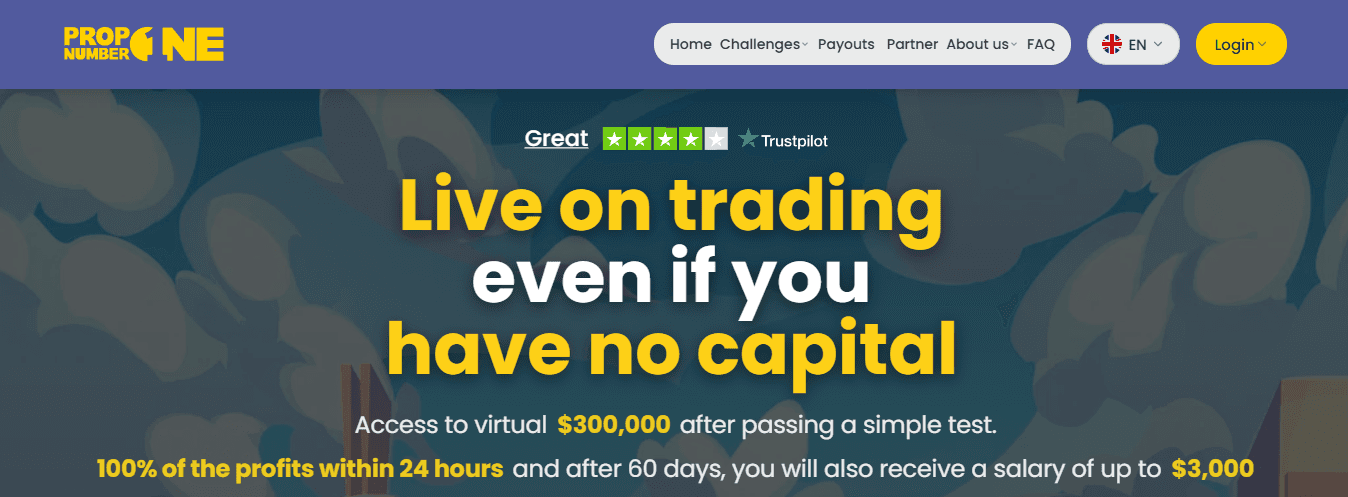
Prop Number One is a relatively new entrant in the prop trading space, headquartered in the UAE with additional offices in key global cities. Launched in 2024, it emphasizes generous rewards for successful traders, including high profit retention and additional incentives like guaranteed monthly earnings for qualified participants.
Key Features
- Up to 100% profit split for funded traders
- Potential monthly salary guarantee reaching $3,000 for eligible performers
- Account sizes starting from $7,000, scalable to $300,000
- Low entry fees beginning at $47, with refunds upon first payout
- Support for multiple platforms including MT4, MT5, cTrader, and DxTrade
- Permission for news trading without restrictions
- Allowance for Expert Advisors (EAs) and custom indicators with personalization required
4. Blue Guardian
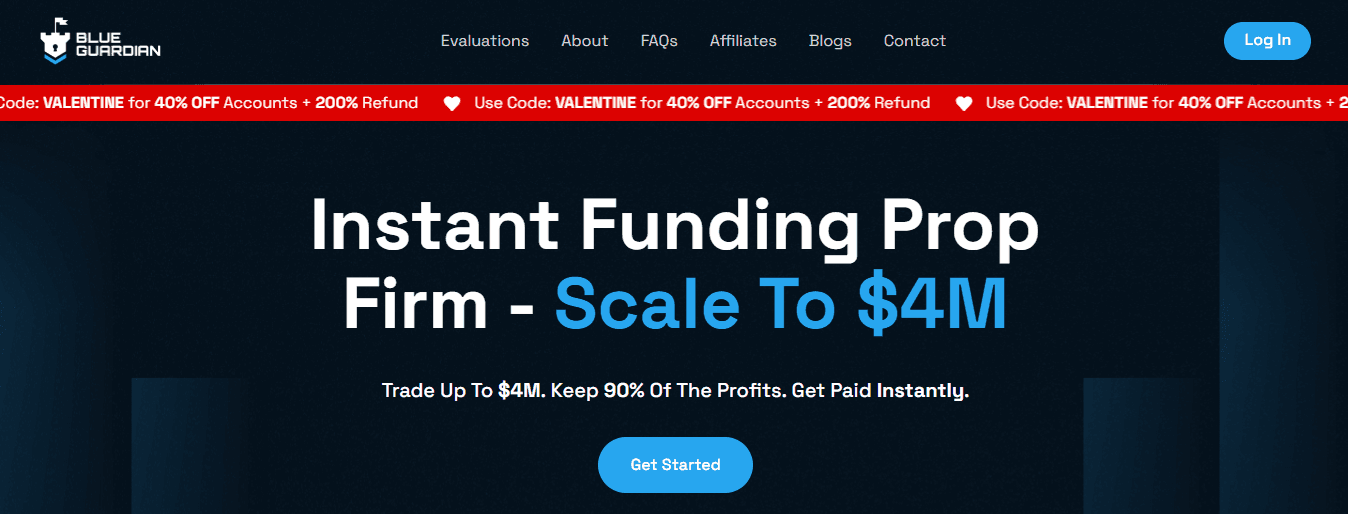
Blue Guardian has built a solid reputation since transitioning to proprietary trading in 2021 and is based in Dubai. It focuses on accessible evaluations and trader protection tools, offering a range of challenge types to suit different experience levels and prioritizing quick, reliable payouts.
Key Features
- Profit splits up to 85%, above many industry averages
- One-step (10% target) and two-step (8% then 4%) evaluation options
- Account sizes from $10,000 to $200,000, scalable to $2,000,000
- Platforms including MT4, MT5, TradeLocker, and Match Trader
- Leverage varies from 1:50 to 1:100 depending on the package
- Equity protector for automatic trade closure at loss limits
- 24/7 support plus permission for EAs, copy trading, and limited news trading windows
5. SurgeTrader

SurgeTrader previously provided traders with straightforward access to funded capital through a single-phase assessment that focused on skill demonstration and imposed few restrictions. However, the firm ceased operations in 2024 due to platform licensing issues and has not resumed, making it unavailable to new participants.
Key Features
- One-step evaluation requiring 10% profit target
- Daily drawdown capped at 4% and overall at 5%
- Profit split of 75% for funded traders
- Access to forex, indices, commodities, and cryptocurrencies
- Account sizes ranging from $10,000 to $1,000,000 initially
- Competitive entry fees for challenges
- Emphasis on reduced personal risk via firm-provided capital
6. FTMO

FTMO, though based in the Czech Republic, remains highly popular among UAE traders for its established reputation, educational support, and generous scaling potential. Since 2015, it has offered a structured two-phase process that rewards consistency and discipline while providing substantial funded accounts.
Key Features
- Up to 90% profit split on funded accounts
- Two-phase evaluation: FTMO Challenge followed by Verification
- Account sizes scaling up to $2,000,000
- Wide range of instruments, including forex, indices, metals, commodities, stocks, and cryptocurrencies
- Support for MT4, MT5, cTrader, and DxTrade platforms
- Comprehensive educational resources, analytics, and webinars
- Global acceptance, including UAE residents, with reliable payouts
7. Funding Pips
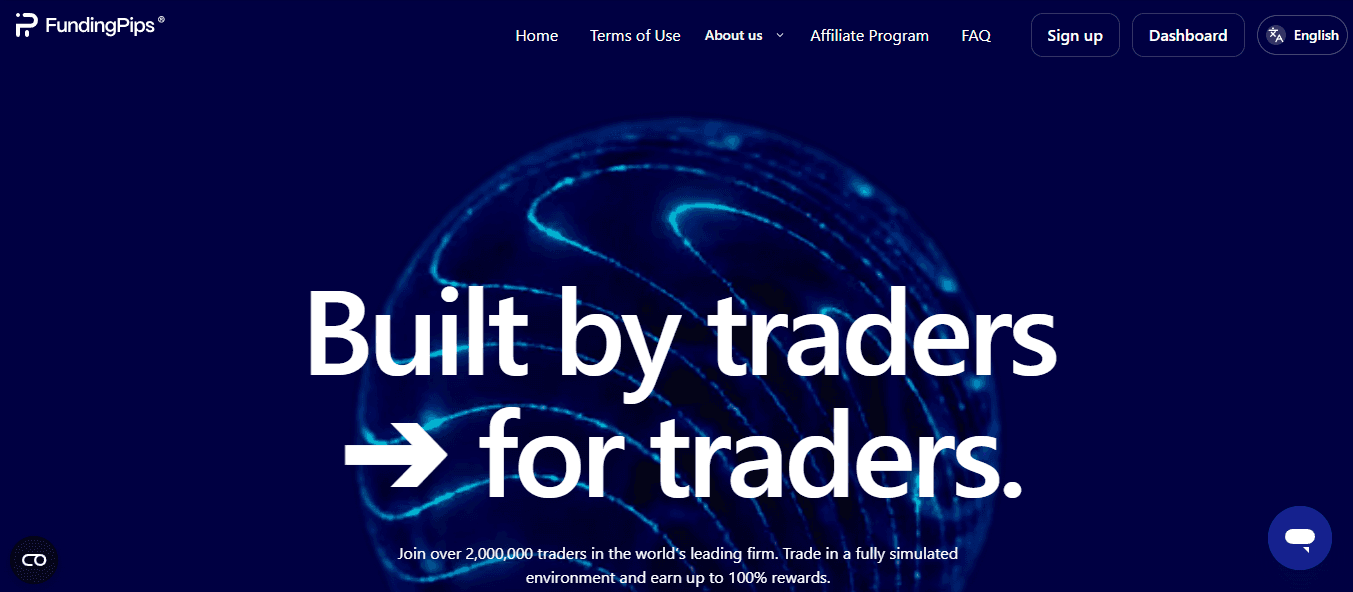
Funding Pips, headquartered in Dubai since its 2022 launch, has grown into a prominent UAE-based prop firm by prioritizing fast payouts, transparent rules, and trader progression paths that reward consistency with increasing profit shares. It appeals to a broad range of traders through modern evaluation models and substantial scaling potential.
Key Features
- Up to 100% profit split in elite reward stages
- Multiple evaluation types, including one-step and instant funding options
- Account sizes starting from smaller tiers up to $100,000+ initially, with scaling to higher limits
- Platforms supporting MT5, cTrader, and MatchTrader
- Leverage options around 1:100 for many programs
- Zero reward denial policy and over $200 million in verified payouts
- Permission for various strategies with flexible drawdown rules (e.g., 4-6% daily/total limits in evaluations)
8. The5ers

The5ers, an established player operating since 2016, attracts many UAE traders with its long-term scaling focus, tight spreads, and emphasis on sustainable trading careers rather than short-term challenges. Its programs cater to diverse styles, including scalping and swing trading, across multiple assets.
Key Features
- Profit splits up to 100% in advanced funded stages
- Various programs, including high-stakes options with fast scaling
- Maximum allocations reaching $622,500 or more through consistent performance
- Support for forex, metals, indices, and other instruments
- Platforms, including MT5 and proprietary tools
- Educational resources and performance analytics for trader growth
- Reliable, timely payouts with a strong track record of trader success
9. FundedNext

FundedNext, headquartered in the UAE since 2022, excels at providing versatile funding options, including instant access and futures trading extensions, making it a go-to for traders seeking quick entry and long-term scaling. Its community-driven approach, large base of rewarded traders, and multi-office support enhance its appeal in the region.
Key Features
- Profit splits starting at 60-80% with performance-based increases
- Various models, including Stellar Instant, for immediate funded access
- Scaling potential up to $2,000,000 or higher allocations
- Platforms like MT4/MT5, cTrader, plus futures-specific tools (Tradovate, NinjaTrader)
- Broad asset coverage across forex, futures, commodities, and more
- Over $264 million in total rewards distributed to thousands of traders
- 24/7 support and educational resources for sustained growth
But choosing between nine solid options requires a framework that goes beyond comparing profit splits and evaluation fees.
How to Choose the Right Prop Firm for Trading in the UAE

Start with metrics that reveal a firm's sustainability, not promotional offers that attract attention. Payout processing speed indicates whether a firm maintains sound banking relationships and adequate capital reserves. Platform stability during volatile sessions signals an investment in proprietary infrastructure rather than reliance on white-label systems that crack under load. Scaling transparency indicates whether the firm profits from your long-term success or primarily from evaluation-fee churn. These indicators distinguish partnerships built to last from operations designed to maximize revenue before inevitable collapse.
The UAE's zero-tax environment and regulatory clarity create ideal conditions for prop trading careers, but only if you choose firms with infrastructure matching your ambitions. Funding ranging from $6,000 to $4 million means account size matters less than whether the firm can reliably deliver that capital when you qualify. The difference between accessing $100,000 in simulated funds versus actually trading it comes down to operational capacity, which most traders overlook until withdrawal requests sit pending for weeks.
Match Evaluation Structure to Your Trading Rhythm
Single-phase challenges compress qualification into a single performance period, testing whether you can meet profit targets while adhering to risk limits without extended verification. This speed appeals to traders with proven strategies who view evaluations as administrative hurdles rather than as opportunities for skill development. Two-phase models add verification rounds to confirm consistency over luck and filter for repeatable edges that persist beyond initial success. Instant funding eliminates challenges entirely but typically imposes tighter ongoing constraints and higher entry costs.
The structure you choose should reflect an honest assessment of your current skill level and psychological makeup. Traders who consistently profit in personal accounts but struggle with evaluation pressure often benefit from no-time-limit challenges that remove artificial urgency. Those with discipline to execute plans under deadlines may prefer faster routes that minimize time between decision and funded status. The wrong structure doesn't just delay funding. It creates failure patterns that erode confidence and drain capital through repeated evaluation fees.
Decode Profit Splits Beyond Surface Percentages
An 80% split with bi-weekly payouts processed in 48 hours delivers more take-home income than a 90% split with monthly cycles and week-long processing delays. The percentage matters less than withdrawal friction and whether the firm actually honors stated terms when you request funds. Some firms offer up to 100% profit sharing in competitive programs, but these elite tiers often require extended track records.
Look for progression clarity. Does the split increase with account size or tenure? Do performance milestones unlock better terms, or does the initial percentage remain fixed regardless of how much profit you generate? Firms confident in their trader-retention offers are improving splits because they profit more from long-term relationships than from retaining larger percentages of smaller accounts. Those maximizing short-term extraction maintain static splits and add fees that erode effective take-home rates below advertised figures.
Test Risk Parameters Against Your Strategy Requirements
Daily loss limits between 2% and 5% accommodate different trading styles, from conservative position sizing to more aggressive approaches requiring wider stops. Overall, drawdown caps around 10% provide room for normal strategy variance without forcing constant position monitoring that distracts from execution quality. The best parameters feel invisible during profitable periods but prevent catastrophic losses during inevitable drawdowns.
Trailing drawdowns create moving targets that tighten as accounts grow, protecting firm capital while potentially restricting strategies that require larger temporary losses before eventual profitability. Static drawdowns maintain fixed thresholds regardless of account growth, offering predictability at the cost of less dynamic risk management. Neither approach is inherently superior. What matters is whether the structure allows your specific strategy to operate without constant rule-triggered terminations that have nothing to do with actual trading skill.
Weekend holding permissions and news trading allowances signal whether the firm trusts its risk systems or hides operational weaknesses behind arbitrary restrictions. Firms banning these activities often lack the execution infrastructure to handle volatility spikes, not because of legitimate concerns about strategic risk. When you can't trade major economic announcements or hold positions through weekend gaps, you're not being protected. You're compensating for the firm's technology limitations.
Evaluate Technology Through Execution Quality
Platform compatibility across mobile, web, and desktop matters less than whether orders fill at displayed prices during volatile sessions. Slippage patterns reveal execution quality that marketing materials never mention. A firm claiming institutional-grade infrastructure should demonstrate it through consistent fills during high-impact news events, not just during quiet Asian session hours when any platform works adequately.
Most traders discover execution problems only after funding, when real capital and emotional investment make switching firms painful. Test platforms during evaluation phases by executing trades during major announcements. Note whether stops trigger at the intended levels or slip multiple points beyond them. Check whether limit orders fill at the specified prices or require follow-up. These patterns predict what you'll experience at scale as position sizes multiply and slippage costs compound, leading to significant profit erosion.
In-house proprietary systems typically outperform white-label solutions during peak periods because the firm controls the entire technology stack rather than relying on third-party providers serving hundreds of clients simultaneously. This distinction shows up in uptime statistics, order rejection rates, and whether the platform mysteriously develops issues during periods when traders are most likely to profit from volatility.
Scrutinize Support Quality Beyond Availability Claims
Twenty-four-hour support is meaningless if response times exceed useful timeframes or representatives lack the authority to resolve actual problems. Test support during evaluation by asking specific questions about rule interpretations, payout procedures, and scaling timelines. The quality of answers indicates whether the firm invests in knowledgeable staff or outsources to call centers that read from scripts that don't address real trader concerns.
Community presence matters more than most traders expect when building long-term careers. Access to other funded traders creates informal knowledge networks that help you navigate firm-specific quirks, optimize strategies for evaluation parameters, and learn from others' scaling experiences. Firms fostering active communities signal confidence that trader success stories attract better talent than marketing campaigns. Those discouraging trader interactions often stem from a lack of transparency about payout delays, inconsistent rule enforcement, or other operational issues that become apparent when traders compare experiences.
Calculate True Cost Beyond Entry Fees
Evaluation fees get refunded upon first payout at most competitive firms, converting them from sunk costs into refundable deposits against future profit sharing. But hidden charges appear in platform fees, inactivity penalties, monthly subscriptions, or withdrawal minimums that drain profitability regardless of trading results. A $200 evaluation with full refund and zero ongoing costs beats a $100 challenge with $50 monthly platform fees that accumulate whether you trade or not.
Scaling costs matter as accounts grow. Some firms charge additional fees when moving from $50,000 to $100,000 allocations, effectively taxing success through administrative overhead. Others scale freely based solely on performance metrics, recognizing that larger, successful accounts benefit the firm by increasing profit share volume. The cost structure reveals whether the firm views scaling as a mutual opportunity or a revenue extraction point.
Promotional discounts create urgency but often mask unfavorable base terms. A 40% discount on a $300 evaluation sounds attractive until you compare the $180 net cost against competitors offering $150 standard pricing with better profit splits and faster payouts. Evaluate total economics across the full relationship lifecycle, not just entry-point pricing optimized to trigger impulse decisions.
Verify Sustainability Through Track Record Evidence
Years in operation matter less than verified payout history and trader testimonials describing actual withdrawal experiences. A firm operating since 2015, with consistent payout documentation, demonstrates business model sustainability across multiple market cycles. One launched six months ago, making aggressive claims, lacks evidence that its operations will withstand the first major market stress or increased regulatory scrutiny.
Regulatory status provides accountability that informal operations lack. Firms registered in recognized jurisdictions operate under oversight, creating legal recourse if disputes arise. Those choosing offshore havens purely for regulatory avoidance signal a priority of minimizing accountability rather than building long-term trader relationships. The UAE's framework strikes a balance between heavy-handed restrictions and a complete absence of oversight, attracting firms committed to sustainable operations.
Most traders cycle through multiple firms before recognizing that the familiar approach of choosing based on profit splits and evaluation difficulty creates hidden costs that compound over time. As accounts scale and trading becomes the primary source of income, payout delays can range from minor inconveniences to cash-flow crises. Platform outages during volatile sessions transform from frustrating to financially devastating. Arbitrary rule enforcement converts months of profitable trading into account terminations that force restarting evaluation processes elsewhere.
Platforms like prop firm address these sustainability signals through on-demand payouts processed in under nine hours, proprietary technology built for reliability during market stress, and scaling programs that reward consistency with account increases to $2 million without additional fees. This infrastructure creates alignment in which firm profitability depends on supporting long-term trader success rather than maximizing evaluation-fee revenue from constant participant churn.
The real question isn't which firm offers the best promotional discount this month, but which one you'll still trust with your trading career two years from now when you're managing six-figure accounts and depending on reliable payouts to cover living expenses. That calculation requires looking beyond marketing claims to operational evidence to determine whether the firm is built to grow with you or to extract maximum value before moving to the next cohort of hopeful traders. But even the right firm means nothing if you don't know how to actually access the capital and start trading.
Related Reading
- My Forex Funds Vs Ftmo
- Prop Firms In Ghana
- Balance-Based Drawdown Prop Firms
- Topstep Vs Apex
- Best Prop Trading Firms For Stocks
- Bulenox Vs Apex
- Prop Trading Firms Toronto
- Ftmo Vs Topstep
- Take Profit Trader Vs Topstep
- Prop Firms That Allow Ea
- Surgetrader Vs Ftmo
Get 25-30% off Today - Sign up to Get Access to up to $800K Today
You've seen the options, compared the terms, and identified what separates sustainable partnerships from evaluation fee traps. Now the question shifts from analysis to action. Goat Funded Trader removes the friction points that slow progress at other firms: no minimum trading days forcing artificial activity, no time limits creating pressure to overtrade weak setups, and triple monthly paydays with up to 100% profit split once you prove consistency. Over 98,000 traders have already collected more than $9.1 million through a system built around your success, not your failure.
The difference shows up in the details most firms bury in fine print. Our 2-day payment guarantee isn't marketing language. It's a contractual commitment with a $500 penalty for missing the deadline. That speed comes from proprietary infrastructure and banking relationships that handle withdrawal volume without the delays that plague firms dependent on third-party processors. When you request a payout, the system processes it within hours because our business model depends on retaining profitable traders, not collecting fees from participants who never reach funded status.
Account access scales to $800K with potential for higher allocations in select programs, giving you position sizing that transforms strategy profitability from supplemental income to primary career. The path there offers flexibility other firms don't: choose 1-step challenges for speed, 2-step verification for consistency, or 3-step programs that reward patience with better terms. Instant funding options are available to traders willing to pay higher entry costs in exchange for immediate capital access. Each structure serves different trading styles and risk tolerances without forcing everyone through identical qualification processes.
The UAE's zero-tax environment means your 100% profit split translates directly into take-home income, with no erosion by tax authorities. You can trade news events when volatility creates opportunity, hold positions through weekends when your strategy requires it, and scale accounts based purely on performance metrics without administrative fees taxing your success. This freedom exists because our risk management systems handle downside protection, allowing you to focus on execution rather than navigating arbitrary rules designed to address operational weaknesses.
Sign up today to access up to $800K in simulated capital and claim 25-30% off your challenge fee. The discount reduces entry cost, but the real value shows up after funding when payout speed, platform reliability during volatile sessions, and scaling transparency determine whether you're building a career or just passing another evaluation. Most traders realize these distinctions only after cycling through multiple firms and losing months to delayed withdrawals or account terminations over technicalities. Starting with infrastructure built for long-term partnerships skips that expensive education.
Be Great and get the App