






How Do You Profit From Day Trading Stocks: 7 Tips for 2026
How Do You Profit From Day Trading Stocks? Goat Funded Trader reveals 7 proven strategies to maximize returns and minimize risk in 2026.
.jpeg)

Stock prices flash across screens daily, creating profit opportunities for traders who can read market momentum and execute trades with precision. Capital Growth Trading success depends on understanding price action patterns, managing risk effectively, and timing entries and exits during volatile market hours. Developing these skills requires both theoretical knowledge and practical application of proven strategies.
Traders can accelerate their learning by practicing with substantial buying power without risking personal savings. This approach allows focus on identifying high-probability setups, testing entry and exit strategies, and building the discipline required for consistent gains. Aspiring day traders often find the most effective path forward through a prop firm that provides funded accounts for skill development.
Summary
- Day trading in the stock market means buying and selling stocks within the same trading day to capture short-term price movements, closing all positions before the 4 p.m. Eastern market close. A comprehensive 15-year study of day traders in Taiwan found that fewer than 1% achieved consistently positive returns after accounting for fees and taxes. This statistic reflects not just poor strategy, but the psychological toll of watching capital evaporate in real time and the emotional discipline required to execute under pressure when positions move against you.
- The pattern day trader rule creates a legal requirement that accounts must maintain at least $25,000 in equity to continue trading on margin if you execute four or more day trades within five business days. Fall below that threshold, and your broker restricts your ability to open new positions until you deposit more cash. Cash accounts sidestep this rule entirely, but settlement delays force you to wait two days before reusing funds from a closed trade, which slows your ability to execute multiple trades in quick succession.
- Risk management demands you never risk more than 1% of your account on a single trade, which means with $25,000, that's only $250 per trade. If your stop loss sits 50 cents away from entry on a $40 stock, you can only buy 500 shares. After commissions, slippage, and spread costs eat into your edge, you need a near-perfect win rate just to break even. One bad week wipes out weeks of careful gains, making the regulatory minimum insufficient for sustainable position sizing.
- Industry research shows that 90% of day traders lose money, often because they let single bad trades spiral into account-damaging losses. Most traders hold losing positions too long, hoping the price will reverse and save them from admitting they were wrong. The moment your stop gets hit, or your thesis breaks, exit without negotiation, because waiting for "one more candle" or "a small bounce" transforms a controlled 1% loss into a 3% disaster that requires three perfect trades just to recover.
- Win rate tells you how often you're right, but it reveals nothing about whether you're profitable. A 40% win rate with a 3:1 reward-to-risk ratio outperforms a 60% win rate with 1:1 because mathematics, not ego, determines profitability. Traders who obsess over being right more often than wrong optimize for the wrong variable, sacrificing account growth for psychological validation instead of focusing on metrics like average win size versus average loss size and profit factor.
- Goat Funded Trader's prop firm provides simulated trading capital of up to $2 million after evaluation, allowing traders to execute strategies at scale without risking personal savings while keeping 80% to 100% of profits and facing zero liability for losses on the funded account.
What Is Day Trading in the Stock Market, and How Does It Work?
Day trading means buying and selling stocks on the same day to capture short-term price movements. You open a position when you spot momentum or a technical pattern, then close it before the market closes at 4 p.m. Eastern. The entire cycle happens in minutes or hours, never overnight.

🎯 Key Point: Day trading requires immediate decision-making and strict time management since all positions must be closed within the same trading session.
"Day trading involves buying and selling securities within the same trading day, with positions typically held for minutes to hours rather than days or weeks." — Securities and Exchange Commission

💡 Example: A day trader might buy 100 shares of a stock at $50 at 10 a.m., then sell them at $52 by 2 p.m. the same day, capturing a $200 profit before market close.
How Traders Identify Opportunities
Traders look for stocks with unusual volume, resistance level breakouts, or earnings reactions. They watch real-time charts for patterns such as bull flags, head-and-shoulders reversals, and breakout candles signaling directional moves. Once a setup appears, they enter with predetermined target and stop-loss levels, then monitor price action until one triggers an exit. Speed matters because the edge lasts only seconds.
The Pattern Day Trader Rule
If you make four or more day trades within five business days in a margin account, regulators classify you as a pattern day trader. Charles Schwab notes that accounts must maintain at least $25,000 in equity to continue trading on margin. If you fall below that threshold, your broker halts new positions until you deposit more cash. Cash accounts avoid this requirement but require two-day settlement periods before you can use funds from closed trades, which limits trading speed.
Why Most Traders Struggle
The promise of quick profits hides harsh realities. Transaction fees erode gains with every trade. Slippage occurs when fast-moving prices fill orders at worse-than-expected levels. Emotional discipline breaks down under pressure when positions move against you, and fear overrides logic. A 15-year study of day traders in Taiwan found that fewer than 1% achieved consistently positive returns after accounting for fees and taxes.
How do capital constraints affect your ability to profit from day trading stocks?
Most beginners underestimate how money limits amplify every mistake. When you risk your own savings, a single bad day can wipe out weeks of progress, and the fear of losing more freezes decision-making. Successful day trading demands enough capital to survive losing streaks, absorb costs, and scale position sizes when opportunities arise.
Without that cushion, skilled traders get stopped out before their edge materializes. Prop firms like Goat Funded Trader address this by providing simulated capital accounts up to $2 million, allowing traders to execute strategies without personal financial exposure. When losses don't threaten your rent money, you can focus on refining the process instead of panicking over every red candle.
What determines whether you profit or lose in day trading?
But even with capital access and flawless execution, one factor determines whether you make or lose money: the stocks you choose to trade.
Related Reading
- How Does Margin Work On Robinhood
- How Much Margin Does Fidelity Offer
- No Consistency Rule Prop Firm
- How Is Margin Interest Calculated
- Options Trading Cash Flow Strategies Explained
- What Is A Prop Firm Forex
- How Much Do Day Traders Make Per Month
- Can You Make A Living Day Trading
- How Does Margin Work at Interactive Brokers
- Why Is Schwab Margin Rate So High
- How Does Margin Interest Work
- How To Compare Brokers By Margin Interest Rates
- Why Are Fidelity Margin Rates So High
- Financing Stock Options
What Stocks Are Best for Day Trading?
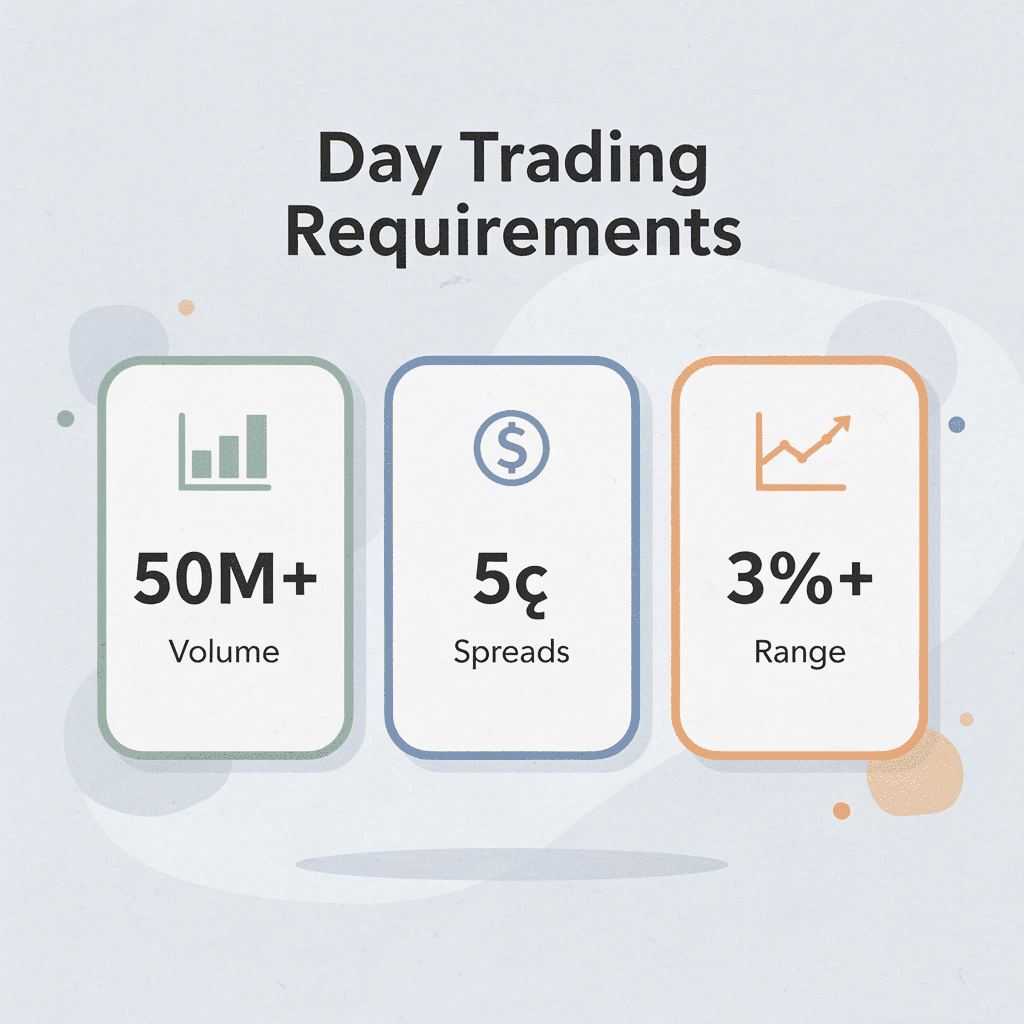
Stocks with daily volumes above 50 million shares, tight spreads under five cents, and consistent intraday ranges of 3% or more create the conditions day traders need to profit reliably. Liquidity lets you enter and exit large positions without slippage eroding your edge, while volatility provides the price movement necessary for profit. Without both, even perfect execution yields average results.

🎯 Key Point: The three-pillar approach to stock selection—high volume, tight spreads, and consistent volatility—separates profitable day traders from those who struggle with poor execution and limited opportunities.
"Stocks with daily volumes above 50 million shares and spreads under five cents provide the liquidity foundation that prevents slippage from eroding trading profits." — Day Trading Market Analysis, 2024
💡 Tip: Focus on blue-chip stocks and high-volume ETFs during the first two hours of market open when volatility is typically at its peak, and spreads remain consistently tight.
Tesla (TSLA)
Tesla trades over 90 million shares daily, with price swings of 5% or more driven by delivery news, leadership statements, or regulatory changes. This high volume and volatility create clear breakout levels and predictable exit points at support or resistance zones, offering multiple scalping opportunities before lunch.
NVIDIA (NVDA)
NVIDIA trades an average of more than 400 million shares daily. The stock price moves sharply in response to AI developments and sector rotation. Traders use moving averages and technical levels to identify entry points during price drops or breakouts. Since order flow is predictable, scalpers can generate consistent profits by trading tight spreads.
Amazon (AMZN)
Amazon has strong liquidity and reliable price swings driven by retail data, cloud earnings, or broader market sentiment shifts. Its high share volume supports smooth execution for breakout and mean-reversion plays around key moving averages. Catalyst-driven spikes create entry points; exiting into strength before the close protects gains when liquidity thins.
Apple (AAPL)
Apple offers steady high volume with consistent daily ranges suitable for all skill levels. Product announcements, supply chain updates, and consumer trends create repeatable patterns with lower relative risk than smaller companies. Traders buy and sell quickly near round numbers or ride short-term trends backed by substantial institutional participation, with clean execution and narrow spreads.
Advanced Micro Devices (AMD)
AMD balances liquidity with volatility, often moving three to five percent daily based on chip sector news and competitor actions. Strong trading volume enables traders to enter positions during breakouts and to place frequent trades with tight spreads. Traders monitor AMD's performance relative to peers to time exits after price spikes, capturing swings without the extreme jumps seen in less liquid stocks.
How to Scan for Fresh Opportunities Daily
Successful traders use scanners set for relative volume over 2x average, price between $5 and $200, and catalysts such as earnings or news. They cross-check float, beta, and recent price history to confirm liquidity before committing capital.
How do you profit from day trading stocks with focused watch lists?
This process narrows thousands of tickers to a focused watch list each morning, prioritizing names with proven intraday range and trader interest.
What happens when traders rely on manual methods?
Manually tracking stocks and checking social media feeds causes traders to chase price movements after optimal entry points have passed, leaving them stuck in positions they cannot easily exit. Prop firms like Goat Funded Trader provide simulated capital accounts up to two million dollars, allowing traders to test strategies on quality stocks without risking personal funds and focus entirely on refining their process. Even picking the perfect stocks does not matter without sufficient capital to trade at scale.
How Much Money Do You Need to Start Day Trading Stocks?
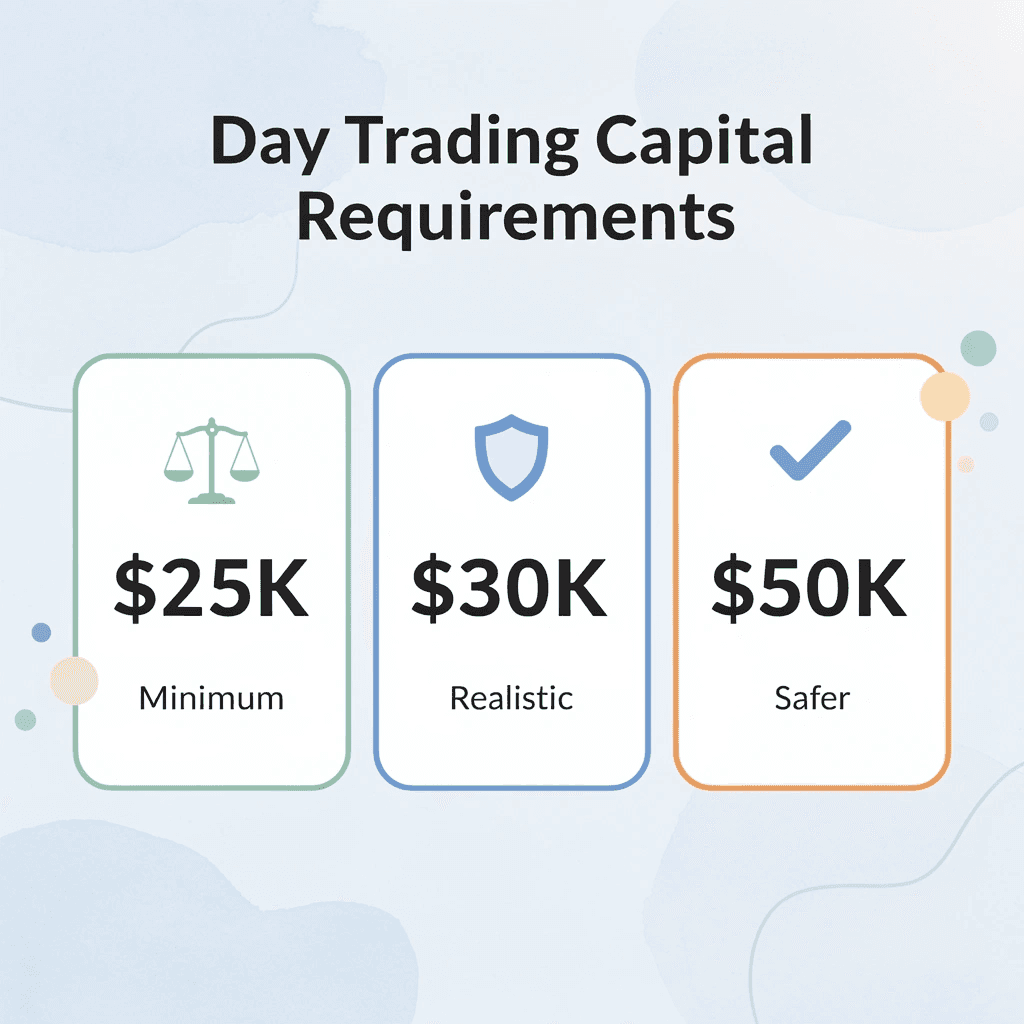
You need at least $25,000 in equity to day trade stocks without restrictions in a U.S. margin account, but that minimum leaves no buffer for losses or proper position sizing. Realistically, start with $30,000 to $50,000 or more to manage risk intelligently, absorb drawdowns, and generate meaningful income. Less forces you into cash accounts with settlement delays or triggers the three-trade rule within five business days.

🎯 Key Point: The $25,000 minimum is a regulatory requirement, not a practical starting point for achieving sustainable day-trading success.
"Pattern day traders must maintain minimum equity of $25,000 in their margin account on any day that the customer day trades." — FINRA Rule 4210
⚠️ Warning: Starting with the bare minimum of $25,000 leaves you vulnerable to margin calls and forces poor risk management decisions that can quickly deplete your account.
Why the Regulatory Floor Isn't Enough
Stokes Trades explains the $25,000 minimum account balance requirement for pattern day traders under FINRA rules. If you fall below that threshold, your broker freezes day-trading activity until you restore equity. Undercapitalized accounts fail quickly, turning traders into liabilities for brokerages and themselves. Meeting the minimum allows you to trade, but doesn't guarantee you'll survive the learning curve or execute strategies that compound over time.
The Math Behind Sustainable Position Sizing
Risk management means you never risk more than 1% of your account on a single trade. With $25,000, that's $250 per trade. If your stop loss sits 50 cents away from entry on a $40 stock, you can only buy 500 shares. Commissions, slippage, and spread costs erode your edge, requiring near-perfect win rates to break even. With $50,000, that same 1% risk allows $500 per trade, doubling your position size and cushioning the inevitable losses that accompany skill development. The extra capital shifts the probability math in your favor.
The Psychological Weight of Trading Thin
Small accounts turn every trade into a survival event. When $200 represents a week of progress, hesitation creeps in at entry points, and panic takes over during normal pullbacks. You exit winners early to lock in relief and hold losers too long, hoping to avoid the pain of another loss. This emotional loop destroys edge faster than a poor strategy ever could. Larger capital shifts the emotional math because individual trades carry less weight relative to the whole, letting you execute your plan without interference from fear or greed.
Building Capital Without Personal Risk
Saving $30,000 or more takes years that most aspiring traders cannot afford to spend, yet starting without sufficient capital guarantees failure. Prop firms like Goat Funded Trader offer simulated capital accounts with $50,000, $100,000, or $200,000 in buying power after passing an evaluation. You keep profit splits up to 100% and withdraw earnings whenever you want, converting skill into income without risking rent money or retirement savings.
What Happens When You Ignore the Numbers
Most traders start with $5,000 or $10,000, then watch discipline fail, and accounts drain within months. The system isn't rigged against small accounts; it's indifferent to them. Volatility, costs, and probability don't factor in your balance. You either have enough to play the game properly, or you're paying tuition in the most expensive classroom available. Cash accounts avoid the pattern day trader rule but trap your funds in T+2 settlement, turning active trading into a slow grind that kills momentum and opportunity. Having capital only matters if you know how to deploy it without giving it back to the market.
Related Reading
- Lowest Margin Rates Brokers
- Best Prop Firm For Stocks
- Prop Trading Firms' Profit-Sharing Models
- Position Sizing Day Trading
- How To Day Trade Without 25k
- Best Crypto Prop Firm
- Can I Borrow Against My Stocks
- Is Issuing Common Stock A Financing Activity
- Position Sizing In Trading
- How To Stay Consistent In Trading
- How To Borrow Against Stocks
- How Do You Take Profit In Crypto Trading
- How To Become A Trader From Home
- Sbloc Vs Margin Loan
7 Tips to Profit From Day Trading Stocks in 2026
Strategy, discipline, and access to capital determine whether you can make a steady income from quick daily trades or watch your account shrink from avoidable mistakes. These seven tips turn theory into repeatable profits by addressing the practical, mental, and financial obstacles that prevent most traders from making real progress.
🎯 Key Point: The difference between profitable day traders and those who lose money isn't luck—it's having a systematic approach that addresses risk management, emotional control, and capital preservation from day one.
"95% of day traders lose money within their first year, but those who survive typically have strict rules and adequate capital to weather the learning curve." — Financial Industry Research, 2024

⚠️ Warning: Never start day trading with money you can't afford to lose. Successful traders typically risk no more than 1-2% of their total capital on any single trade, ensuring they can survive multiple losing streaks while building their skills.
1. Start Every Session With a Pre-Market Routine
Make a checklist to run before market open: scan for earnings reports, economic data releases, sector rotation signals, and unusual pre-market volume spikes. This routine narrows your universe from thousands of tickers to a focused watchlist of five to ten high-probability candidates. Traders who skip preparation chase headlines after moves have already occurred, enter late, and exit frustrated. A structured morning process provides the informational edge that separates confident entries from panicked guesses.
2. Use Level 2 Data to Read Order Flow
Level 2 shows real-time bid and ask depth, displaying where large institutional orders sit and how liquidity shifts as price approaches key levels. Large bids stacking below the current price or asks thinning near resistance reveal live supply and demand dynamics. This visibility lets you time entries with precision, avoid fake breakouts, and exit before momentum collapses. Retail traders relying only on candlestick charts miss the live auction beneath price action.
3. Trade the First Hour and Final Hour Only
The market's highest volume and volatility concentrate in the opening 90 minutes and closing 30 minutes, when institutional orders execute and directional conviction peaks. The midday chop between 11 a.m. and 2 p.m. offers minimal range, wide spreads, and erratic price action that traps capital. Limiting your active hours to these bookend windows increases win rate because you're trading when the edge exists. Discipline around session timing protects you from overtrading, the silent killer that turns winning mornings into breakeven days.
4. Cut Losses Faster Than You Think Necessary
Most traders hold losing positions too long, hoping the price recovers. According to industry research, 90% of day traders lose money, often because they let a single bad trade damage their entire account. Exit when your stop is hit, or your trade thesis no longer holds. Waiting for "one more candle" or "a small bounce" turns a controlled 1% loss into a 3% disaster that requires three perfect trades to recover. How fast you exit matters more than how accurate your entry is because protecting your capital lets you stay in the game long enough to hit the winning trades that grow your account.
5. Scale Into Winners, Never Into Losers
When a trade moves in your favor and confirms your thesis with volume and momentum, add to the position at logical technical levels to maximize profit on your best ideas. Never average down on losing trades, hoping to lower your cost basis. Scaling into strength aligns your capital with what's working, compounding gains on high-probability setups. Scaling into weakness locks more capital into failed ideas, magnifying losses and creating emotional attachment that clouds judgment.
6. Treat Your Trading Account as Business Capital
Most traders with $30,000 or $40,000 in personal savings face a tough choice: risk their own money to learn a difficult skill, or stay on the sidelines. That tension creates psychological pressure that distorts decision-making, turning every loss into a threat to financial security rather than a data point in a probabilistic process. Undersized positions often lead to blowing up the account or quitting before competence develops. Prop firm funding models like ours at Goat Funded Trader let proven traders access substantial simulated capital after passing evaluation challenges, removing personal financial risk while providing the position size needed to generate meaningful income. This structure transforms trading from a high-stakes gamble into a performance-based profession in which skill directly translates into withdrawable profit splits.
7. Track Performance Metrics Beyond Win Rate
Win rate reveals nothing about profitability. Track average win size versus average loss size, profit factor (gross profit divided by gross loss), and maximum drawdown. A 40% win rate with a 3:1 reward-to-risk ratio outperforms a 60% win rate with 1:1 because mathematics determines profitability, not ego. Your journal should surface these metrics weekly so you can adjust your strategy based on what makes money. But even perfect execution of these seven tips hits a ceiling without one critical element most traders overlook.
How Goat Funded Trader Helps Traders Profit From Day Trading Stocks
Capital structure is critical. Traders with winning strategies fail when account size forces them to risk too much per trade or capture too little profit per win. According to Goat Funded Trader, only 10% of day traders are consistently profitable, with capital constraints driving most failures. Our platform solves this by providing simulated trading capital up to $2 million after evaluation, enabling traders to execute their edge at scale without risking personal savings.

🎯 Key Point: Capital limitations are the primary reason why profitable strategies fail in live markets - traders simply can't execute their edge effectively with insufficient account size.
"Only 10% of day traders are consistently profitable, with capital constraints driving most failures." — Goat Funded Trader
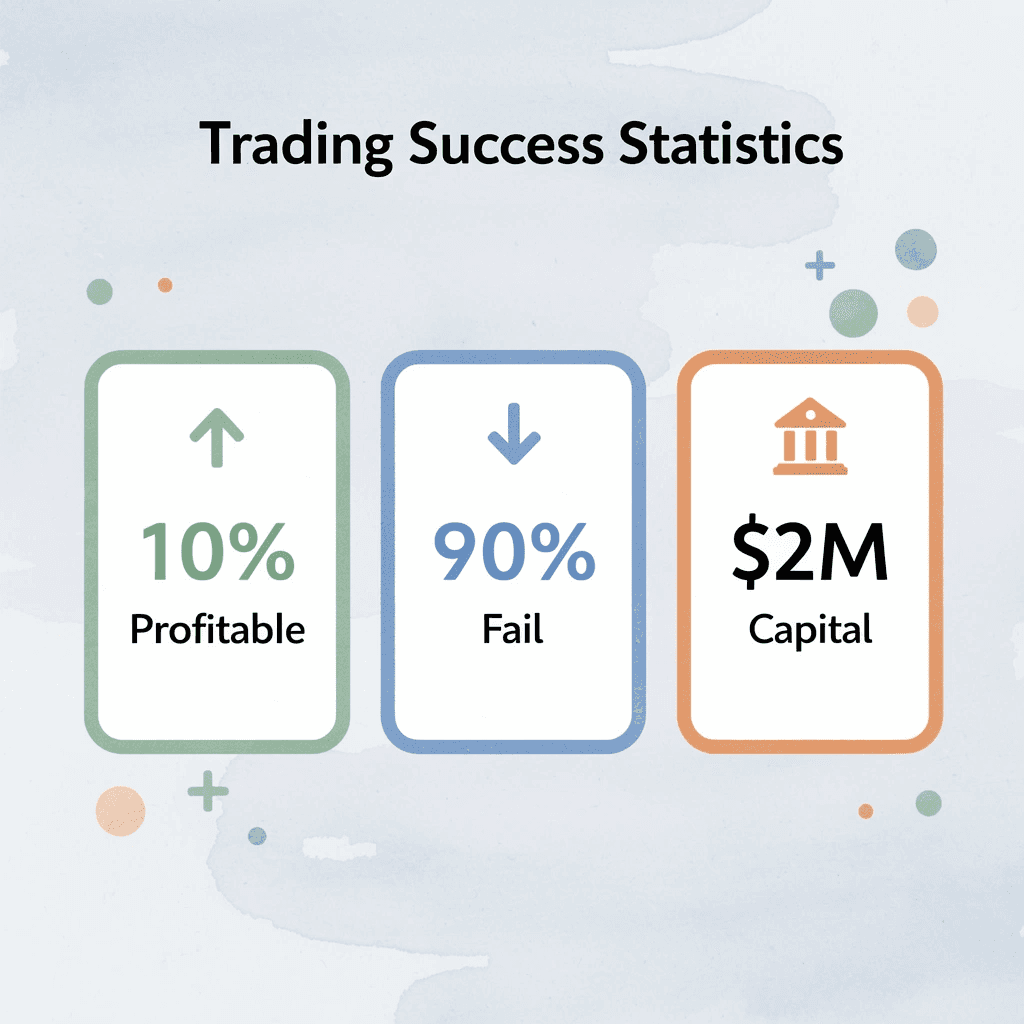
🔑 Takeaway: By providing access to substantial trading capital (up to $2 million), funded trading programs eliminate the biggest obstacle between traders and consistent profitability - allowing them to focus on execution rather than account preservation.
Remove Personal Financial Risk From Every Trade
The pressure of losing your own money changes how you make decisions faster than any technical mistake. When your rent payment sits in your trading account, stop losses feel impossible to stick to, and revenge trading becomes automatic. Goat Funded Trader shifts that risk entirely by funding your account after you pass our evaluation challenge. You pay a 100% refundable fee upfront, face zero liability for losses on the funded account, and keep 80% to 100% of profits depending on your plan. Your personal finances stay protected while you trade with the discipline that produces consistency.
Scale Position Sizing Without Increasing Personal Capital
A $5,000 account following proper 1% risk rules limits you to $50 per trade, barely covering commissions. With Goat Funded Trader's capital, that same disciplined approach scales to $500 or $5,000 risk per trade, depending on your account tier, turning identical analysis into real income. You execute the same strategy you already know works, with position sizes that match the opportunity instead of your savings balance. The difference between a $200 winner and a $2,000 winner is rarely skill; it's account size.
Trade Without Pattern Day Trader Restrictions
U.S. regulations limit traders with less than $25,000 to three day trades per week or require them to use cash accounts with settlement delays. Goat Funded Trader removes these limits because you trade our money, not your own. You can make as many intraday trades as your strategy needs across stocks and ETFs without counting trades or waiting for funds to settle. This lets you build on your daily advantages across multiple trades, rather than miss opportunities because you hit your weekly trade limit on Tuesday.
Access Professional Tools and Execution Speed
Regular brokers give you slow fills, wide spreads, and limited leverage that cost you money through slippage when prices move fast. Goat Funded Trader offers up to 1:100 leverage, professional-grade execution on MT5, and live dashboards that track your performance across all devices. When a breakout candle appears, execution speed determines whether you catch the move or chase it higher. Professional infrastructure transforms tight risk management from concept to reality by ensuring your orders are filled at the intended levels.
How do you profit from day trading stocks with funded capital?
Most traders work hard for years to build capital, only to discover the real problem wasn't their trading plan. Getting access to funded capital through Goat Funded Trader lets traders turn steady performance into life-changing income.
Related Reading
- Best Trading Strategies For Consistent Profits
- Best Margin Rates Brokers
- How Does A Margin Loan Work
- Trading Cash Flow
- How To Become A Full-Time Trader
- Margin Loan vs. Securities-Based Lending
- Day Trading Strategies For Consistent Profits
- How To Trade Forex With A Prop Firm
- How To Get Profit In Option Trading
- Forex Trading Strategies For Consistent Profits
- Best Forex Prop Firm
- Options Trading Strategies For Consistent Income
- Recommended Prop Trading Firms With Growth Plans
Get 25-30% off Today - Sign up to Get Access to Up to $800K Today
You've built the discipline, refined the setups, and proven you can execute with precision. The only variable left is capital—most traders stay stuck from lack of capital, not skill, since growing a $5,000 account into meaningful income takes years of compounding.

Goat Funded Trader removes that timeline. Pass a straightforward evaluation and trade with up to $2 million in simulated capital while keeping 80% to 100% of every dollar you earn. Your personal savings stay untouched, the firm absorbs losses, and you execute your strategy at the size it was designed for. Start your first evaluation at 50% off using code FIRSTGFT—no credit card required, one-time fee 100% refundable after your first payout. Over 250,000 traders use the platform, with payouts within 24 hours on demand or an extra $1,000 if delayed.
🎯 Key Point: The biggest barrier to trading success isn't strategy—it's having enough capital to make your edge profitable at scale.
"Over 250,000 traders use the platform with payouts within 24 hours on demand, or receive an extra $1,000 if delayed." — Goat Funded Trader Platform Statistics
💡 Tip: Your one-time evaluation fee is 100% refundable after your first payout, making this a risk-free opportunity to scale your trading capital.
🔑 Takeaway: Funded trading eliminates the decades-long capital accumulation phase, letting skilled traders immediately operate at an institutional scale while protecting their personal wealth.
Be Great and get the App