






How to Day Trade Without 25K and Avoid PDT Limits in 2026
How to Day Trade Without 25K: Goat Funded Trader reveals 7 proven strategies to bypass PDT rules and start trading with less capital in 2026.


The Pattern Day Trader rule creates a significant barrier for aspiring day traders with accounts below $25,000, limiting them to just three day trades per rolling five-day period. This restriction forces traders to choose between tying up substantial capital and severely limiting their trading opportunities. Capital Growth Trading becomes nearly impossible under these constraints, especially for those looking to build their skills through active market participation.
Funded trading accounts offer a practical solution by providing access to larger capital pools without the $25,000 minimum deposit requirement. These arrangements allow traders to focus on strategy execution and skill development rather than meeting arbitrary balance thresholds. For traders seeking to overcome PDT limitations while maintaining active trading schedules, partnering with a prop firm removes the capital barrier that prevents most beginners from pursuing their trading goals.
Key Takeaways
- The Pattern Day Trader rule limits traders with accounts under $25,000 to just three day trades per rolling five-day period in margin accounts. FINRA flags your account the moment you execute four or more day trades within that window, and once flagged, you need $25,000 in equity at all times to continue. Drop that threshold below, and your broker freezes day trading until you rebuild capital or stop the activity long enough to reset the designation.
- Regulatory data shows 72% of day traders ended 2020 with net financial losses, according to FINRA's analysis of retail brokerage activity. The $25,000 minimum is not a skill test but a financial reality check, ensuring traders maintain adequate equity to absorb losses without triggering margin calls that could cascade into broker liability. The rule protects undercapitalized participants from amplified risks tied to margin and high-frequency trading, though critics argue it disproportionately blocks talented traders who lack inherited wealth or disposable income.
- Futures, forex, and cryptocurrency markets operate outside FINRA's jurisdiction, so the PDT rule does not apply. Futures trade under CFTC rules, with accounts starting at a few hundred dollars; forex operates 24 hours with no pattern limits under CFTC oversight; and spot crypto markets trade on platforms outside traditional securities regulation. These markets allow unlimited intraday trading because they fall under different regulatory frameworks or operate in decentralized structures, thereby removing the $25,000 barrier entirely.
- According to FINRA's June 2026 regulatory notice, the Pattern Day Trader rule will shift from a fixed equity minimum to real-time intraday margin calculations. Margin accounts with as little as $2,000 can access day trading under the new system, which tracks positions dynamically and adjusts limits based on actual exposure rather than enforcing rigid equity floors. This removes the arbitrary threshold that locked out skilled traders who simply lacked five-figure balances, though the discipline required for consistent profitability remains unchanged.
- Risk management determines long-term survival regardless of account size or market access. Successful traders risk 1% of account equity per trade, set stops before entry, and never move them wider when positions go against them. Track every trade in a journal with entry price, exit price, and reasoning, then review weekly to identify patterns in winners and losers. Most traders fail not from lacking a system but from abandoning their rules after consecutive losses or doubling position size after wins.
- Goat Funded Trader addresses the $25,000 barrier by providing simulated trading capital through a straightforward evaluation process, offering funded accounts from $10,000 to $2 million without tying up personal savings and eliminating PDT restrictions while traders keep 80% to 100% of profits generated.
What is Day Trading, and How Does It Work?
Day trading means buying and selling financial instruments within a single trading session to capture short-term price movements before the market closes. Positions are opened based on intraday momentum and closed before the bell; never held overnight. Unlike traditional investing, which measures success in quarters or years, day trading measures it in minutes or hours. It relies on speed, precision, and disciplined execution to extract gains from temporary market imbalances.

💡 Key Point: Day trading is fundamentally different from long-term investing—it's about capitalizing on immediate market volatility rather than waiting for gradual appreciation over time.
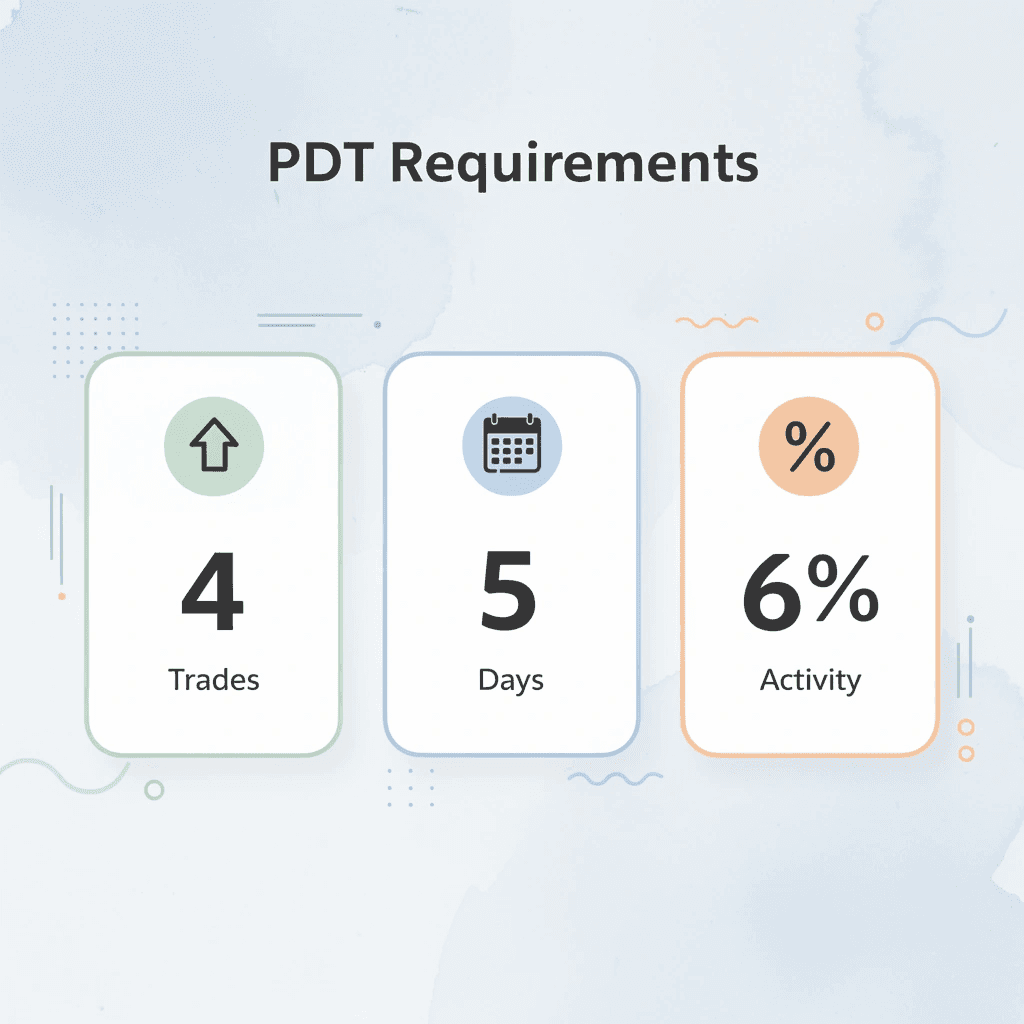
"Day traders typically complete 4 or more trades within a 5-day period, with day-trading activities representing more than 6% of total trading activity during that period." — FINRA Pattern Day Trader Rules

Day Trading vs Traditional Investing
- Holding period
- Day trading: Minutes to hours
- Traditional investing: Months to years
- Strategy focus
- Day trading: Intraday momentum focus
- Traditional investing: Long-term growth focus
- Profit expectations
- Day trading: Daily profit targets
- Traditional investing: Annual returns
- Execution style
- Day trading: High-frequency execution
- Traditional investing: Buy and hold strategy
⚠️ Warning: Day trading requires significant capital, advanced market knowledge, and the ability to make split-second decisions under pressure—it's not suitable for beginners or those without substantial trading experience.

How Day Trades Actually Get Executed
You identify a liquid asset moving in a clear direction, enter at a specific price point, and set strict exit targets for profit and loss. The position closes before the session ends, eliminating exposure to after-hours gaps or overnight news events. Profits come from small percentage moves amplified by position size and sometimes leverage, repeated across multiple trades throughout the day. Only about 1% of day traders consistently make money over time, demonstrating how demanding this approach becomes when repeated daily.
The Tools That Make It Possible
High-speed internet, a strong trading platform with real-time data feeds, and direct market access form the foundation. Level II quotes show order book depth, technical indicators like moving averages or RSI signal entry points, and news scanners alert you to catalysts driving volatility. Multi-monitor setups let traders track multiple assets simultaneously, enabling fast execution and preventing slippage. Without these tools, you're reacting to price moves that already happened rather than participating as they unfold.
Core Strategies Day Traders Deploy
Momentum trading capitalizes on strong price moves driven by news or volume spikes. Scalping targets small profits from bid-ask spreads throughout the day. Breakout trading occurs when the price breaks through key resistance or support levels, with high volume confirming the move. Each strategy relies on technical patterns and defined entry and exit rules rather than company fundamentals, since intraday price action reflects crowd psychology and order flow more than balance sheets. The challenge isn't understanding how these methods work—it's executing them repeatedly under pressure while managing the one limit most beginners never anticipate until it stops them cold.
Why Do You Need $25K to Day Trade?
FINRA flags your account as a pattern day trader when you make four or more day trades within five rolling business days if those trades represent more than 6% of your total trading activity in a margin account. Once flagged, you must maintain $25,000 in equity at all times. If you fall below that threshold, your broker will freeze day trading until you rebuild capital or stop trading long enough to reset the designation.

🔑 Key Point: The $25,000 minimum isn't just a suggestion—it's a federal requirement that can instantly freeze your trading account if violated.
"Pattern day traders must maintain $25,000 in equity at all times to continue day trading activities." — FINRA Regulations
⚠️ Warning: Falling below the $25,000 threshold even for one day will trigger an immediate trading restriction until you restore the minimum balance.
Why did regulators create the $25,000 minimum requirement?
Regulators built this barrier after the dot-com crash, when retail traders with small accounts suffered huge losses by borrowing money. The rule protects traders lacking sufficient capital from the amplified risks associated with margin and high-frequency trading. Without sufficient equity, rapid losses trigger margin calls that traders cannot cover, forcing brokers to liquidate positions at the worst possible times and creating systemic exposure across the market. The $25,000 buffer enables traders to absorb setbacks without incurring debt they cannot repay.
How does this rule affect traders learning how to day trade without 25K?
The rule feels like gatekeeping because it is. Regulators decided that frequent intraday trading with leverage requires a financial cushion most beginners lack, and enforcement is permanent once your account crosses the threshold.
What happens when your account dips below $25,000?
Your broker prevents you from placing additional day trades once your equity falls below the minimum. You must switch to cash settlement rules or face limited buying power. You often must wait two full business days for your money to clear before entering new positions.
How does this freeze affect your trading momentum?
This freeze stops momentum when the market presents setups, turning potential profits into missed opportunities. Traders with accounts hovering near $25,000 face constant anxiety. One losing streak drops equity below the line, triggers restrictions, and restarts the slow rebuild with less room for error. You watch setups happen while your account sits idle, locked out by a rule designed to protect you from yourself.
How the Rule Reshapes Buying Power and Leverage
With $25,000 or more, pattern day traders access up to four times day-trading buying power based on the previous day's closing balance. Below that threshold, leverage drops sharply, limiting position sizes to a fraction of what strategies require. Smaller capital forces tiny trades that barely cover commissions and slippage, making consistent gains nearly impossible. A $5,000 account restricted to cash settlement uses that $5,000 once per two-day cycle. A $25,000 account provides $100,000 in intraday buying power, allowing multiple positions across different setups without waiting for settlement. The difference is operational freedom.
What happens when traders hit the weekly limit?
Traders with smaller accounts hit the three-trade weekly cap early, then sit idle while the market moves. They chase setups in cash accounts and face settlement delays that lock capital for two days per trade. One loss sequence wipes out the buffer, triggers restrictions, and forces a choice between stopping entirely or finding workarounds that introduce new risks.
How do capital requirements create barriers for new traders?
The same frustration appears across forums and trading communities. New traders face capital requirements that create barriers to entry. High upfront costs trigger debt cycles, forcing traders to finance their accounts to maintain access when income levels prevent them from quickly accumulating the required capital. Traders must choose between basic expenses and professional requirements, watching opportunities pass while locked out by an arbitrary threshold.
The Performance Data That Justifies the Rule
FINRA data from 2020 shows 72% of day traders ended the year with net financial losses. Undercapitalized traders face higher failure rates because they lack the resources to weather normal market swings, which forces them to exit positions prematurely or to make risky recovery attempts.
The rule separates prepared traders from those likely to face quick losses. Regulators view the $25,000 minimum as a financial reality check: if you cannot maintain that balance amid normal market fluctuations, you should not be trading with leverage more than once per day.
What are the main alternatives to the PDT rule?
Swing trading avoids the pattern day trader label by keeping positions open overnight, which sidesteps the rule triggered by four trades in five days. Cash accounts permit unlimited trades but require two-day settlement periods between trading cycles. Futures and forex markets have different rules and require less capital to start trading, though each carries distinct risks.
How do paper trading and offshore brokers compare?
Paper trading helps you build skills without risking real money. Some traders use offshore brokers to circumvent U.S. rules, but this approach creates significant problems: counterparty risk, limited legal recourse if something goes wrong, and tax complications.
How to day trade without 25K using funded accounts?
Saving money slowly while trading with restrictions delays learning and growth. Market conditions change faster than your capital accumulates. Platforms like Goat Funded Trader provide practice accounts with simulated funds, circumventing the $25,000 PDT rule entirely. This allows traders to demonstrate their skills with substantial buying power and earn real money from profits without risking personal capital or waiting years to meet regulatory requirements.
Why the Rule Stays Despite Criticism
Critics argue the $25,000 threshold unfairly blocks talented traders without inherited wealth or spare capital, creating a financial barrier unrelated to skill or discipline. Defenders contend that day trading with insufficient capital is statistically likely to fail, and the rule prevents brokers from enabling behavior likely to lead to debt and lawsuits. Regulatory momentum favors caution over access.
The rule will not change soon. FINRA views pattern day trading as an inherently risky activity that requires financial resilience most small accounts cannot sustain. Data support higher failure rates among undercapitalized traders, and regulators prioritize systemic stability over individual opportunity.
What the Minimum Really Measures
The $25,000 requirement does not measure trading skill, market knowledge, or discipline. It measures financial capacity to absorb losses without triggering margin issues that cascade into broker liability. You can be a brilliant technical analyst with flawless risk management, but if your account cannot weather a 10% drawdown without falling below the minimum, the system treats you as too risky to continue.
How does this reframe your approach to day trading without 25K?
This distinction matters because it changes how you think about the barrier. The rule is not saying you are unqualified—it is saying the system cannot afford your failure when you trade with borrowed funds on a thin cushion. Respect the capital threshold, focus on proven processes, and treat day trading as a skill that rewards adequate resources rather than shortcuts.
What if the best opportunities exist elsewhere?
But what if the whole idea is wrong, and the best chances to make money exist in markets where the rule never applies?
Related Reading
- Financing Stock Options
- How Is Margin Interest Calculated
- How Does Margin Work at Interactive Brokers
- How Does Margin Interest Work
- Why Is Schwab Margin Rate So High
- How Much Margin Does Fidelity Offer
- Why Are Fidelity Margin Rates So High
- Can You Make A Living Day Trading
- How Much Do Day Traders Make Per Month
- Options Trading Cash Flow Strategies Explained
- What Is A Prop Firm Forex
- How To Compare Brokers By Margin Interest Rates
- No Consistency Rule Prop Firm
- How Does Margin Work On Robinhood
Which Markets Allow You to Day Trade Without the PDT Rule?
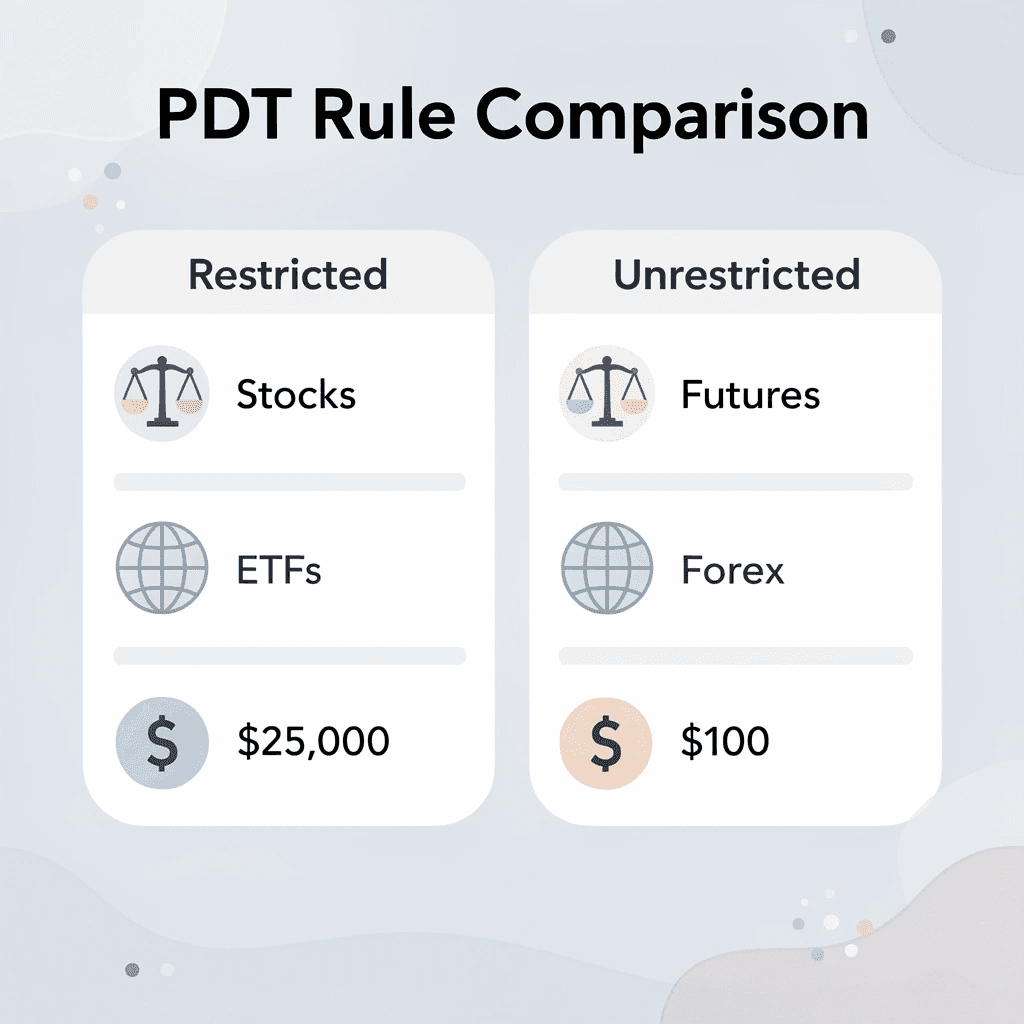
Futures, forex, and cryptocurrency markets operate outside FINRA's jurisdiction, so the PDT rule does not apply. You can execute unlimited intraday trades with accounts starting at a few hundred dollars because these markets fall under CFTC oversight or exist in decentralized structures.

🎯 Key Point: These alternative markets offer complete freedom from the $25,000 minimum that restricts stock day traders, making them ideal for smaller accounts.
"Futures and forex markets operate under 24-hour trading cycles with no pattern day trading restrictions, providing unlimited opportunities for active traders." — CFTC Guidelines

Market Types & Key Rules
- Stocks / ETFs
- Regulatory body: FINRA
- PDT rule: Applies
- Minimum account: $25,000
- Futures
- Regulatory body: CFTC
- PDT rule: Does not apply
- Minimum account: $500–$1,000
- Forex
- Regulatory bodies: CFTC / NFA
- PDT rule: Does not apply
- Minimum account: $100–$500
- Cryptocurrency
- Regulatory body: Unregulated (varies by region)
- PDT rule: Does not apply
- Minimum account: $10–$100
⚠️ Warning: While these markets avoid the PDT rule, they come with higher volatility and different risk profiles that require specialized knowledge and risk management strategies.
Futures Contracts Deliver Leverage Without Equity Restrictions
Futures trade on exchanges like CME and ICE under CFTC rules, not FINRA's equity framework. You can open and close positions in E-mini S&P 500, crude oil, or gold dozens of times per day without triggering pattern flags. Micro contracts require as little as $300 in margin, with intraday requirements well below the equity day-trading buying-power thresholds. Positions close before settlement to avoid physical delivery, so you focus on price movement alone. This structure provides direct exposure to major indices and commodities with built-in leverage that resets each session, allowing disciplined traders to practice and scale without artificial trade caps.
Forex Operates Around the Clock With No Pattern Limits
The foreign exchange market runs 24 hours across global financial centers and is overseen by the CFTC for US retail participants. Currency pairs like EUR/USD or GBP/JPY allow unlimited entries and exits with no settlement delays or trade counters. Brokers offer leverage ratios of 50:1 or higher on small account sizes. You can focus on technical levels, economic releases, and order flow without waiting for funds to clear, since currency transactions settle instantly in the global interbank system, avoiding the 90-day account freeze that cash accounts face when violating freeriding rules.
Cryptocurrency Sidesteps Traditional Securities Regulation
Spot crypto markets and many crypto derivatives trade on platforms outside traditional securities oversight. You can execute rapid buys and sells of Bitcoin, Ethereum, or altcoins around the clock with no PDT enforcement. Volatility runs at extremes, and some platforms add their own risk controls, but the structure supports true day trading with modest capital. Always verify the specific exchange's margin and funding rules, as counterparty risk varies widely across venues. Wide spreads and missing data bars trigger late trades, turning profitable strategies into break-even propositions as execution costs accumulate.
How do prop firms help you day trade without 25K in capital?
Most traders think they need $25,000 or unregulated offshore brokers to circumvent PDT limits. Platforms like Goat Funded Trader offer an alternative: prove your strategy in a simulated environment and access up to $2 million in trading capital without risking your own money. You trade with professional-grade tools, keep up to 100% of profits, and withdraw whenever you want. This eliminates the equity requirement while letting you focus on execution, psychology, and risk control.
What markets let you focus on skill instead of capital requirements
The PDT rule creates an artificial gate in equities, but the real barrier sits in execution, psychology, and risk control. Futures, forex, and crypto remove the equity restriction so you focus on building a genuine edge instead of fighting broker limits. Master one market completely, trade small while proving consistency, and treat every position with professional discipline. But access to PDT-free markets solves only half the problem if your strategy still bleeds capital through hidden costs and structural traps.
How to Day Trade Without 25K and Avoid PDT Limits in 2026
The $25,000 barrier is being replaced with real-time intraday margin calculations. According to FINRA's June 2026 regulatory notice, margin accounts with as little as $2,000 can access day trading, while cash accounts, futures, forex, crypto, and prop firms offer unrestricted paths for smaller capital.

"Margin accounts with as little as $2,000 can access day trading under the new real-time intraday margin calculations." — FINRA Regulatory Notice, 2026
This removes the arbitrary floor that locked out skilled traders lacking five-figure balances. You no longer have to choose between sitting on the sidelines or using offshore platforms with withdrawal issues. The regulatory gates have lowered, but the discipline required remains unchanged: master one market, prove consistency, enforce strict risk rules, and scale only after sustained profitability.
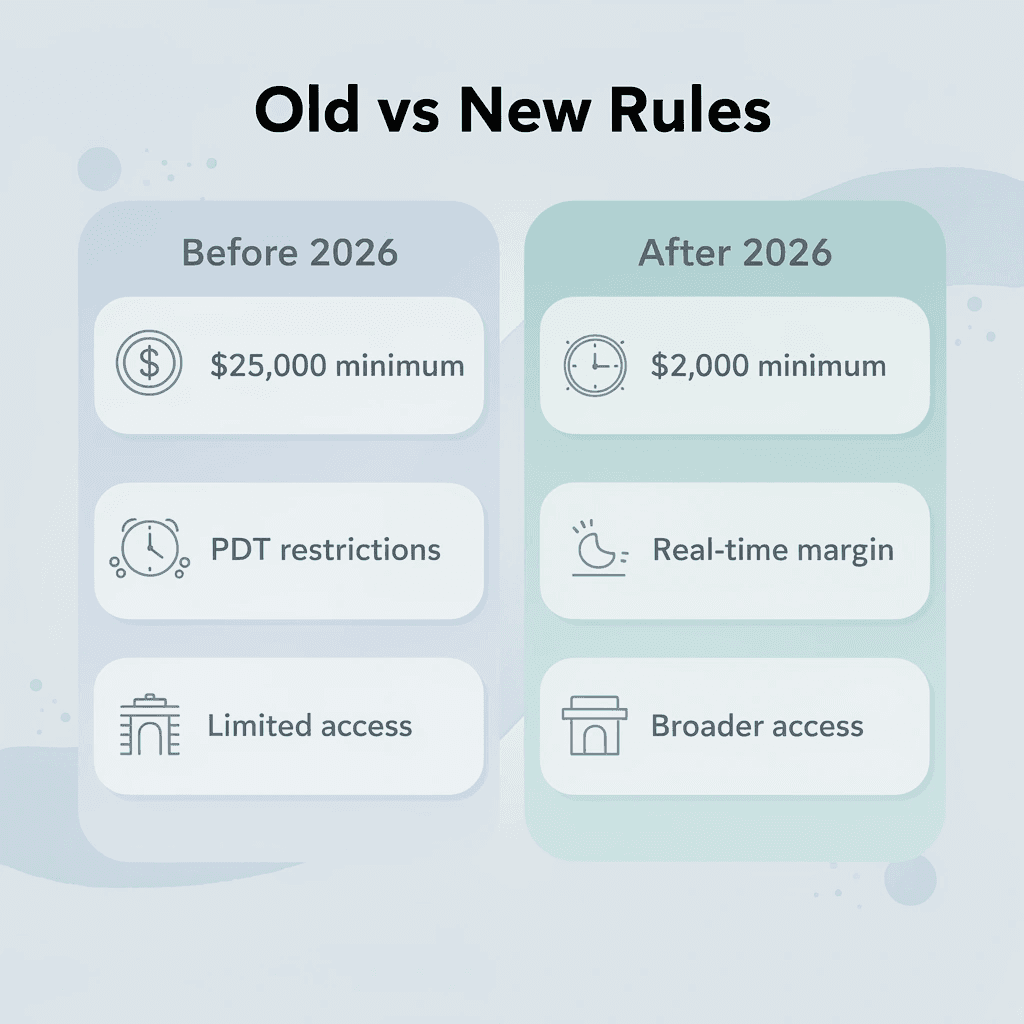
🎯 Key Point: The new $2,000 minimum for margin accounts opens day trading to significantly more traders while maintaining essential risk management requirements.
⚠️ Warning: Lower capital requirements don't mean lower risk—strict discipline and proven strategies are more critical than ever with smaller account buffers.

Margin Accounts Under the New Rules
Open a margin account with $2,000, and brokers will calculate your buying power immediately instead of enforcing strict equity minimums. The system continuously monitors your positions, adjusting limits based on your holdings and price volatility, replacing the fixed $25,000 limit with a risk-matched approach.
What trading strategies work best with limited margin?
Focus on liquid names with tight spreads: large-cap stocks, heavily traded ETFs, and options with deep order books. Set stops at 1% of account equity per trade, monitor margin requirements throughout the session, and close positions before market close to avoid overnight risk. Brokers will liquidate holdings if you exceed intraday limits, so treat margin as a tool for execution speed, not leverage to amplify bets.
Cash Accounts Remain Completely PDT-Free
Cash accounts have never had PDT restrictions because they use only settled funds. Under T+1 settlement rules, money clears the next business day, allowing you to trade daily by switching between different capital pools or holding positions long enough to avoid breaking unsettled fund rules. This works well for swing traders who buy on Monday, sell on Wednesday, and reinvest on Friday. It removes regulatory obstacles: you can trade without margin, broker approval, or the risk of forced liquidation. However, it doesn't support fast scalping.
Futures Markets Deliver Unlimited Intraday Trades
Futures contracts are regulated by the CFTC, not FINRA, so they bypass PDT rules entirely. You can trade micro E-mini S&P 500, Nasdaq, crude oil, or gold futures with accounts starting at a few hundred dollars. Day margins remain low—often $50 to $500 per contract—and leverage resets daily when you close positions before settlement.
What makes futures ideal for unlimited day trading?
This market provides exposure to indices and commodities with professional-grade liquidity. A single micro contract on the S&P 500 moves $5 per point, so a 10-point move generates $50 in profit or loss. You can enter and exit dozens of times per session without trade-count limits, making it ideal for technical traders who rely on volume and volatility. Leverage cuts both ways: risk 1% per trade and never hold overnight unless your strategy explicitly accounts for gap risk.
Forex and Crypto Operate Around the Clock
Forex pairs trade 24 hours a day under CFTC oversight, with no PDT restrictions. Leverage reaches 50:1 or higher, allowing a $500 account to control $25,000 in notional exposure. Major pairs like EUR/USD and GBP/USD offer tight spreads and deep liquidity during London and New York sessions.
What makes cryptocurrency markets ideal for small account trading
Cryptocurrency spot and derivatives markets operate around the clock on compliant platforms, allowing for quick entry and exit without equity thresholds. Bitcoin, Ethereum, and other large-cap coins trade continuously, enabling real-time responses to global events and volatility spikes. Both markets suit technical traders monitoring price action and news flow, but require the same 1% risk discipline that protects equity traders from catastrophic drawdowns.
Proprietary Trading Firms Fund Your Activity
Proprietary firms test your skills through challenges, then provide funded accounts with buying power ranging from $5,000 to hundreds of thousands of dollars. You pay a one-time evaluation fee, trade using their money while following set risk rules, and keep a share of the profits—usually 70% to 100% depending on the firm and account size. This approach lets you trade without risking your own capital.
How do prop firms help you day trade without 25K?
Prop firms bridge the gap between proving your edge and the lack of capital to deploy it. You demonstrate consistency on a simulator or small live account, pass the evaluation, and suddenly you're trading $50,000 without risking your rent money. Platforms like Goat Funded Trader offer simulated capital accounts up to $2 million with profit splits reaching 100% and on-demand withdrawals, transforming the "day trading without 25K" challenge into an opportunity to trade without personal financial exposure.
What should you review before choosing a prop firm?
Check the payout terms, drawdown policies, and whether the firm allows your preferred instruments—some focus on futures, others on forex or equities. The evaluation fee is your only upfront cost, but the profit split and withdrawal speed determine whether the arrangement pays.
Multiple Brokers and Offshore Platforms Expand Options
Split activity across several US brokers or use cash accounts at each to stay PDT-free. This works if you trade different instruments or timeframes at each firm, but it adds complexity to tax reporting and reconciliation. Track every trade across all accounts, consolidate statements monthly, and ensure you're not accidentally triggering PDT rules by aggregating activity.
What are the risks of offshore trading platforms?
Offshore brokers, not subject to FINRA rules, offer higher leverage and fewer restrictions, but they introduce risks to fund safety and regulatory oversight. Compare execution quality, commissions, and withdrawal reliability before committing real money. They bypass the $25,000 minimum account balance requirement at the cost of weaker investor protections and potential legal ambiguity.
Tax Treatment Varies by Market
Stock and options traders pay short-term capital gains on profits held less than a year, taxed as ordinary income. Futures traders benefit from the 60/40 rule: 60% of gains are taxed at the lower long-term rate and 40% at the short-term rate, regardless of the holding period. This structural advantage applies to all futures contracts and benefits active traders who buy and sell positions daily.
What are the tax implications for forex and crypto trading?
Forex spot transactions fall under Section 988, taxed as ordinary income unless you elect Section 1256 treatment for the 60/40 split. Crypto remains a capital asset, so every trade triggers a taxable event with short-term or long-term rates depending on the holding period. Consult a tax professional who understands trader tax status and mark-to-market elections, particularly if trading full-time and deducting expenses like software, data feeds, and home office costs.
Risk Management Remains Non-Negotiable
Day trading without the $25,000 barrier requires the same discipline as always. Risk 1% of your account per trade, set stops before entering a position, and never widen them when a position moves against you. A $5,000 account risks $50 per trade, so if your stop is 10 points away on a futures contract worth $5 per point, you trade one contract. If the stop is 50 points away, you cannot take the trade without breaking your risk rule.
How should you track performance when day trading without 25K?
Keep track of every trade in a journal, noting the entry price, exit price, your reasoning, and lessons learned. Review your journal weekly to identify patterns in winning and losing trades. Most traders fail not because they lack a sound system, but because they abandon their rules after three consecutive losses or increase their position size after three consecutive wins.
Prove Your Edge Before Scaling
Master one market completely before adding a second. If you're trading micro futures, focus on one contract—E-mini S&P 500 or crude oil—until you can generate 20 consecutive weeks of positive expectancy. That means your average winner exceeds your average loser, and your win rate keeps you profitable after commissions.
What position size should you use while proving consistency?
Trade small while proving consistency. A $2,000 account trading one micro contract per signal can grow at 2% per week and double in a year without risking more than $20 per trade. Once you've proven the edge, add capital or request a funded account from a prop firm like Goat Funded Trader. Grow the process, not the position size.
Related Reading
- Best Prop Firm For Stocks
- Position Sizing Day Trading
- How To Borrow Against Stocks
- How To Stay Consistent In Trading
- How Do You Take Profit In Crypto Trading
- Can I Borrow Against My Stocks
- How To Day Trade Without 25k
- How To Become A Trader From Home
- Sbloc Vs Margin Loan
- Best Crypto Prop Firm
- Is Issuing Common Stock A Financing Activity
- How Do You Profit From Day Trading Stocks
- Lowest Margin Rates Brokers
- Prop Trading Firms' Profit-Sharing Models
- Position Sizing In Trading
How Goat Funded Trader Helps Traders Avoid the 25K Requirement
Goat Funded Trader removes the $25,000 barrier by providing simulated trading capital through an innovative evaluation process. You pay a one-time refundable fee, pass performance phases, and receive access to funded accounts ranging from $10,000 to $2 million without risking your own capital. This eliminates PDT restrictions while letting you keep 80% to 100% of profits.

🎯 Key Point: The evaluation process typically costs between $99 to $590, depending on account size, making it significantly more accessible than raising $25,000 in personal capital.
"Funded trading programs eliminate the $25,000 PDT requirement while allowing traders to keep 80-100% of profits from accounts up to $2 million." — Proprietary Trading Industry Analysis, 2024

🔑 Takeaway: This model transforms day trading from a capital-intensive barrier into a skill-based opportunity, where performance matters more than personal wealth.
Trading Capital Without Personal Risk
The traditional path requires $25,000 to start day trading. Goat Funded Trader changes that: show your skills by passing our evaluation challenge, and we provide the capital. You don't need to deplete your savings or take out margin loans. Our firm assumes all risk with practice money while you focus on making profitable trades. Traders access substantial capital without the $25,000 minimum requirement that keeps most regular traders from participating. The evaluation fee is refunded after your first payout, making the starting cost temporary rather than permanent.
Unlimited Day Trades From Day One
PDT rules lock your account after three round-trip flights in five days. This restriction disappears when trading through a prop firm structure. Goat Funded Trader operates outside FINRA's equity account framework, so trade frequency never triggers restrictions. Execute ten trades or fifty in a single session if your strategy demands it. The firm enforces daily drawdown limits of 3% and total account drawdown of 6%, giving you complete freedom to capture opportunities throughout the trading day without monitoring a trade counter.
Clear Risk Parameters Replace Margin Stress
Small personal accounts face constant margin-call worries: one bad position can wipe out months of progress. Our structure at Goat Funded Trader keeps losses within simulated capital using strict but achievable rules. You stay liable only for the evaluation fee, so catastrophic drawdowns never touch your personal finances. The 3% daily loss limit and 6% maximum drawdown create clear boundaries that improve decision-making. You know exactly where the line sits: no surprise margin calls at 2 AM, no broker liquidations during volatile sessions, no personal bankruptcy risk from overleveraged positions.
Fast Payouts Turn Performance Into Income
Traditional brokers delay withdrawals through settlement periods and minimum balance requirements. Goat Funded Trader pays 80% to 100% profit splits on demand, with guaranteed payment within two business days or extra compensation. First rewards arrive quickly after meeting the initial targets, with withdrawal options including bank transfers, cryptocurrencies, or local payment systems. Traders report receiving thousands monthly from consistent performance. Speed matters because it creates an income stream rather than paper gains locked behind withdrawal restrictions. You trade on Monday, hit targets by Friday, request a payout on Saturday, and funds arrive by Tuesday.
Scaling Path Without Adding Capital
Most traders hit a limit where their personal account size prevents proper position sizing. Our scaling program grows your funded capital up to $2 million based on your performance. Hit profit targets consistently, and we will increase your account size while maintaining the same favorable split and risk rules. This creates a professional career path without personal capital investment. Start with a $10,000 evaluation, prove consistency, and scale to $50,000, then $100,000, eventually reaching seven-figure capital—each increase earned through demonstrated skill.
No Time Pressure, No Hidden Rules
Many prop firm evaluations impose tight deadlines that force rushed decisions. Goat Funded Trader offers unlimited trading periods: take three weeks or three months to pass your evaluation. Our platform allows news trading and weekend holding, and provides tight spreads with zero commissions on key instruments via MT5 access.
Flexibility extends to strategy choice. Scalp one-minute charts, swing trade daily patterns, or hold positions overnight. Our evaluation judges results, not methods, removing the artificial pressure that causes traders to overtrade or force setups to meet arbitrary deadlines.
Real Alternative to Personal Capital Accumulation
The old way required years of saving while trading small positions under PDT restrictions. Goat Funded Trader compresses that timeline: skilled traders can access professional-level capital within weeks of starting their evaluation, eliminating years of capital accumulation. Most traders using Goat Funded Trader find the evaluation structure straightforward. The rules remain consistent between the evaluation and funded phases, so strategies that work during assessment continue to work with live capital. But getting capital solves only the first problem: the real question becomes how to make that opportunity pay off consistently.
Related Reading
- Best Forex Prop Firm
- Best Margin Rates Brokers
- Margin Loan vs. Securities-Based Lending
- How Does A Margin Loan Work
- How to Become a Full Time Trader
- How To Trade Forex With A Prop Firm
- Forex Trading Strategies For Consistent Profits
- Options Trading Strategies For Consistent Income
- How To Get Profit In Option Trading
- Day Trading Strategies For Consistent Profits
- Trading Cash Flow
- Recommended Prop Trading Firms With Growth Plans
- Best Trading Strategies For Consistent Profits
Get 25-30% off Today - Sign up to Get Access to Up to $800K Today
You face tiny positions, settlement delays, and the fear of blowing limited capital on every trade. Without real size and freedom, consistent profits remain out of reach while others scale.

Goat Funded Trader ends that struggle. Pay a one-time, 100% refundable fee, pass straightforward challenges, and trade our simulated capital up to $2 million with no personal $25,000 required and zero PDT restrictions. Rules: 3% daily loss limit and 6% maximum drawdown. You keep 80% to 100% of profits and aren't liable for losses.
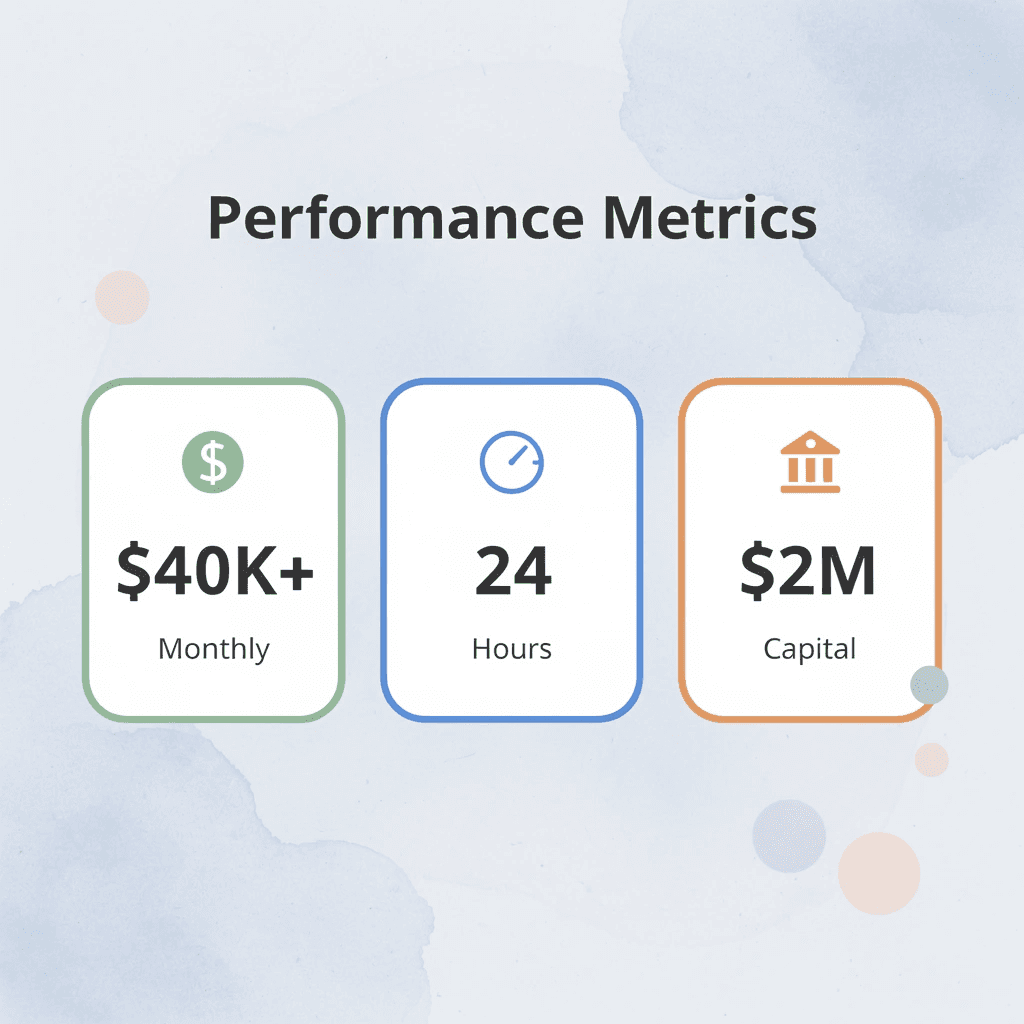
"Many traders pull $9,000 to $40,000+ monthly once funded and scaled with professional capital and zero personal risk." — Goat Funded Trader Performance Data
Traders receive payouts on demand within 24 hours, or a Goat Funded Trader adds an extra $1,000. Many withdraw $9,000 to $40,000+ monthly once funded and scaled. Trade stocks, forex, ETFs, indices, and crypto on MT5 with no time limits, news trading allowed, and weekend holding permitted.
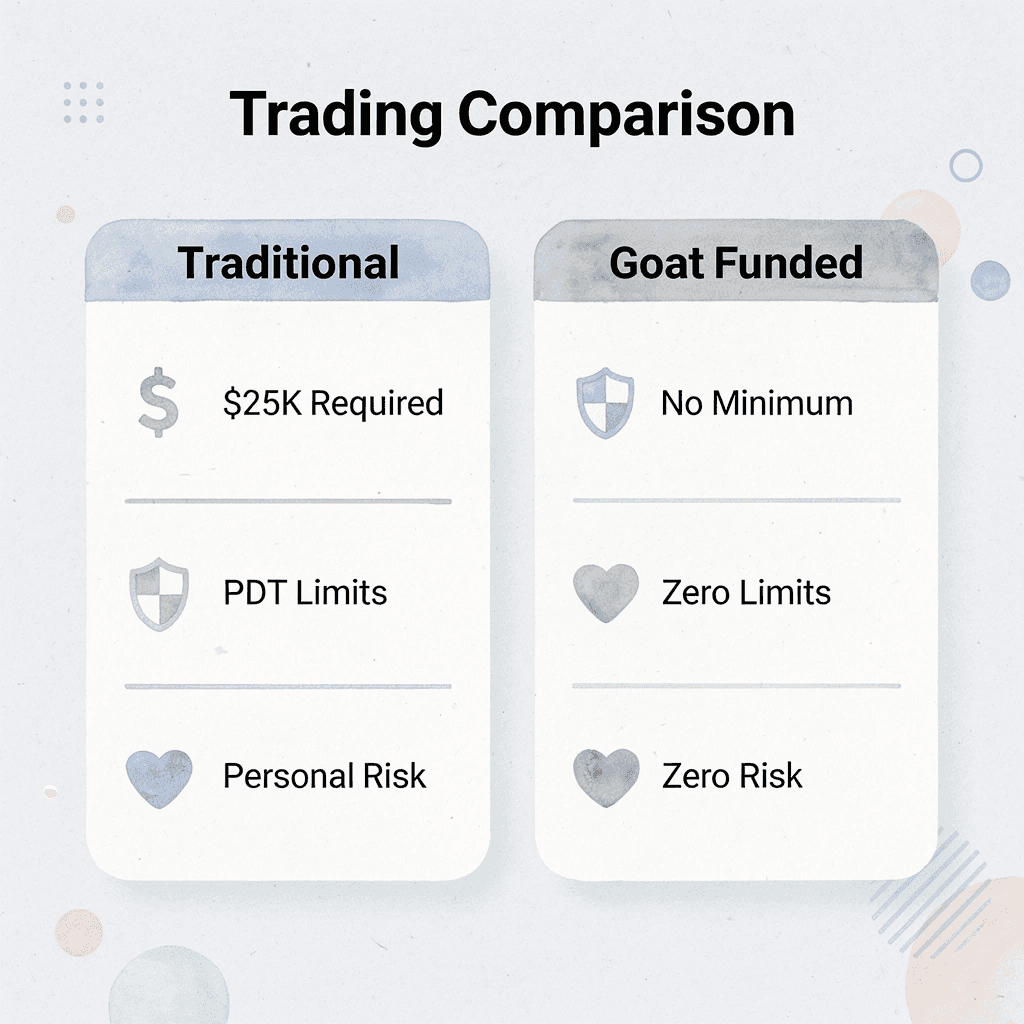
Traditional Trading vs Goat Funded Trader
- Capital requirement
- Traditional trading: $25,000 minimum for day trading
- Goat Funded Trader: No minimum personal capital required
- PDT rules
- Traditional trading: PDT restrictions apply
- Goat Funded Trader: Zero PDT limits
- Risk exposure
- Traditional trading: 100% personal risk
- Goat Funded Trader: No liability for personal losses
- Position sizing
- Traditional trading: Limited by account size
- Goat Funded Trader: Access up to $2M in capital
- Payout speed
- Traditional trading: Subject to settlement delays
- Goat Funded Trader: 24-hour payouts on demand
🎯 Key Point: If you do nothing, the cycle continues with small accounts and missed opportunities. Goat Funded Trader gives you professional capital, full trading freedom, and fast real-money rewards starting today.
🔑 Takeaway: Use code FIRSTGFT for 50% off your first account. No credit card is needed to start, and your fee is fully refundable when funded. Click below, choose your account size, and begin trading risk-free with our capital.
Be Great and get the App