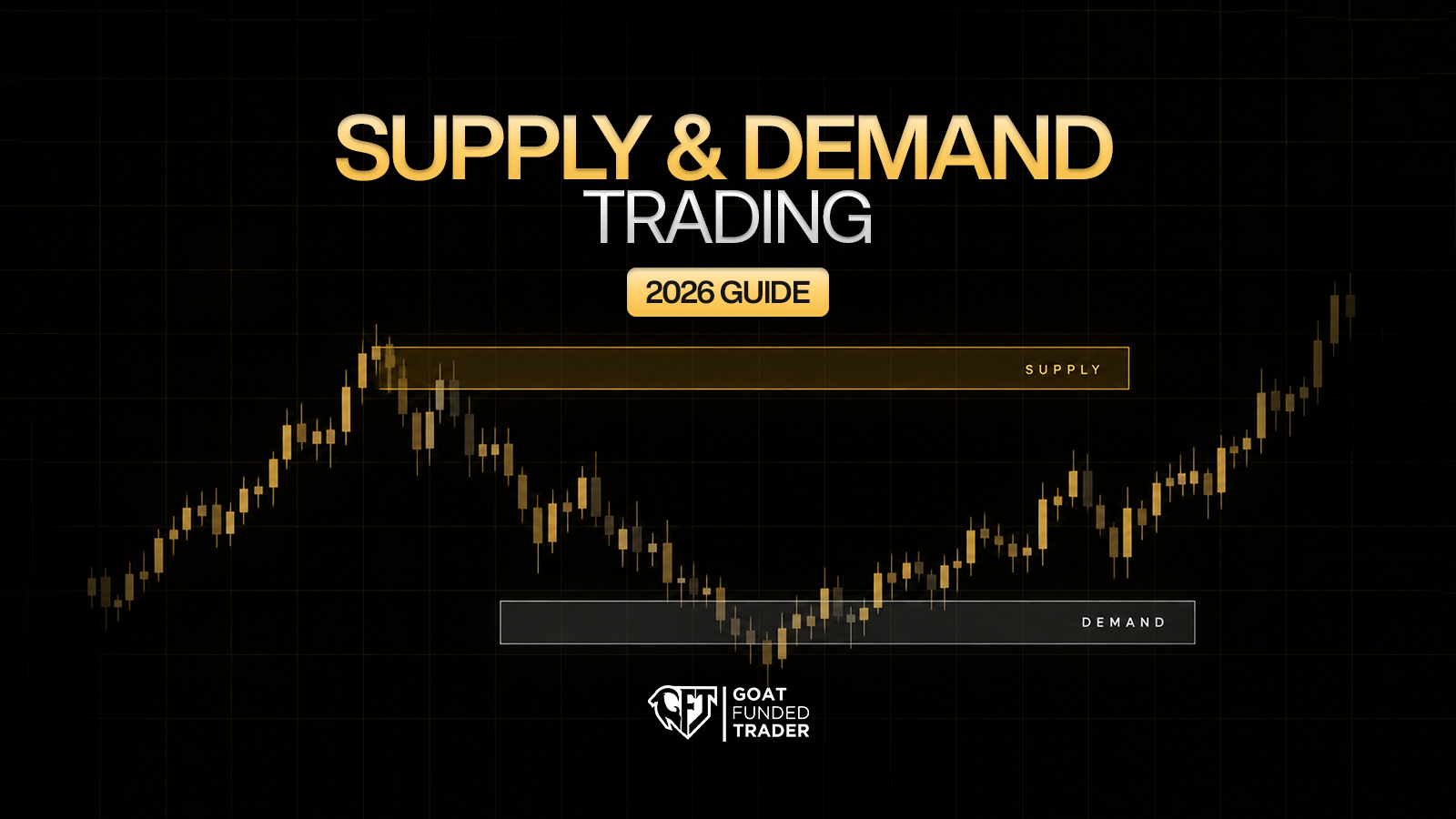



How to Use the Supply And Demand Trading Strategy in 2026
Master the Supply and Demand Trading Strategy with Goat Funded Trader's proven 2026 guide. Boost profits using key zones and smart entries.

Supply and demand zones reveal where institutional money waits to enter the market, creating high-probability trading opportunities that retail traders often miss. These zones form when large players accumulate or distribute positions, leaving behind price imbalances that smart traders can exploit. Mastering this strategy requires understanding how to identify fresh zones, read order flow, and time entries with precision. Day trading margin requirements make capital efficiency crucial, so recognizing the strongest setups becomes even more important.
Professional traders know that practice makes perfect when developing zone identification skills and disciplined execution habits. Rather than risking personal capital while learning to spot these institutional footprints, traders can refine their supply-and-demand techniques using firm capital. This approach allows for larger position sizes and more realistic market exposure while building the skills needed to read price action like a professional. Consider starting your journey with a prop firm to access the capital and structure needed to master these powerful trading concepts.
Table of Contents
- What is the Supply And Demand Trading Strategy?
- How Do Supply and Demand Zones Differ From Support and Resistance Levels?
- What is the Best Time Frame for Trading Supply and Demand Zones?
- How to Identify Supply and Demand Trading Zones
- How to Use the Supply And Demand Trading Strategy
- Get 25-30% off Today - Sign up to Get Access to up to $800K Today
Summary
- Supply and demand zones capture institutional order flow at specific price levels where aggressive buying or selling created lasting imbalances, not just psychological barriers where retail traders drew lines. Research from TrendSpider in 2024 found that zones producing moves exceeding 3% within five candles had a 68% probability of holding on to the first retest across forex and equity markets. The critical difference is that zones identify the launch points of explosive moves where unfilled institutional orders remain stacked, while traditional support and resistance mark spots where price simply paused in the past.
- Fresh zones on four-hour and daily timeframes achieve significantly higher success rates than shorter intervals, which are cluttered with retail noise. An analysis published by Forex Bee in 2024 revealed that zones marked on timeframes below one hour showed failure rates exceeding 60% on the first retest, compared to just 32% for four-hour zones across major currency pairs. Higher timeframes filter out temporary volatility and capture genuine institutional positioning, the moves that matter when large players commit serious capital over hours or days rather than minutes.
- Explosive departures from tight consolidation separate tradeable zones from random price clusters that collapse on retest. Zones producing moves exceeding 5% within three candles showed 72% hold rates compared to 41% for zones with gradual departures, according to PriceActionNinja's 2024 research. The violence of the move proves that an institutional imbalance exists deep enough to influence future behavior, not just a temporary order flow hiccup that leaves no lasting structural mark.
- Volume confirmation during base formation or the initial breakout reveals whether real capital was deployed at that level, or if the move simply gapped through thin liquidity. Zones producing confirmation candles with volume exceeding 150% of the twenty-period average showed hold rates of 71%, compared to 48% for low-volume reactions, according to TrendSpider's 2024 data. Combining volume analysis with price structure transforms zone selection from guesswork into measurable institutional footprint identification.
- Entry timing depends on confirmation patterns inside the zone, not blind entries when the price first touches the marked area. Waiting for engulfing candles, rejection wicks, or strong closes back inside the zone after brief penetration separates zones where institutional interest remains active from ones that already filled their orders. This patience prevents unnecessary losses when zones break because the underlying order stack is depleted before your entry trigger.
- Goat Funded Trader addresses the capital pressure that forces traders into lower-quality setups by providing simulated accounts up to $2M with profit splits reaching 100%, allowing traders to wait exclusively for fresh four-hour demand zones instead of chasing every support bounce on compressed timeframes.
What is the Supply And Demand Trading Strategy?

The supply and demand trading strategy identifies price zones where institutional buying or selling created imbalances, then waits for the price to return to those levels for high-probability entries. You're reading the market's memory, spotting areas where large players left unfilled orders that still pull on future price action.
🎯 Key Point: This strategy focuses on identifying institutional footprints in the market rather than relying on traditional technical indicators.
"Supply and demand zones represent areas where significant price imbalances occurred, creating future support and resistance levels with higher probability setups." — Trading Psychology Research, 2023
💡 Example: When you see a sharp price move away from a consolidation area, that zone becomes a potential supply or demand level where institutional orders may still be waiting to be filled.
How do demand zones form in the Supply and Demand Trading Strategy?
A demand zone forms after quiet consolidation, followed by an explosive upward surge—a vertical move signalling that institutional buyers are overwhelmed by available sellers, leaving unfilled buy orders stacked at that level. This creates a magnetic effect when the price drifts back down. The zone isn't traditional support; it's the footprint of capital deployment, the exact price range where smart money committed serious size.
Why do demand zones create predictable market reactions?
When price returns to that demand zone weeks or months later, institutional participants often add positions or defend earlier entries, creating predictable bounces or reversals. The power lies in asymmetry: you're working with the players who move markets, not reacting to moves after they occur.
How do supply zones create resistance in trading
Supply zones work oppositely. Price stabilizes, then drops sharply as sellers seeking quick sales overwhelm buyers. This leaves unfilled sell orders that act as resistance when the price rises again. These structural ceilings mark where the balance of power shifted decisively: big institutions sold positions or bet on price declines. The sharp move away from the stable price signals an imbalance strong enough to affect future price movement.
Why does the Supply and Demand Trading Strategy work better than chasing moves?
Traders who chase moves often enter as institutional players finish positioning, buying tops or selling bottoms. Waiting for price to return to the origin of the move—the zone where the imbalance formed—flips that dynamic. You enter where institutions entered, not where they're exiting.
According to TrendSpider research in 2024, zones producing moves exceeding 3% within five candles had a 68% probability of holding on to the first retest across forex and equity markets. This edge compounds when filtering for fresh zones on higher timeframes that haven't been tested and still carry full institutional interest.
Why do traders struggle with Supply and Demand Trading Strategy execution?
The pattern is simple to understand but difficult to execute because it requires patience, which most traders lack. Traders identify a demand zone, mark it on the chart, then watch price drift away for days or weeks while other opportunities emerge.
When price finally returns, doubt surfaces: Has the zone expired? Did institutions already exist? The temptation to chase the current hot stock instead of waiting for your setup is where most fail—not in identifying zones, but in trusting them long enough for the trade to materialize.
How can funded trading accounts improve your patience?
Platforms like Goat Funded Trader eliminate the pressure that drives impatience. Our platform lets you trade with simulated capital and earn profit splits up to 100%, removing the emotional stress of risking your own money.
You can let ten stocks pass while waiting for the price to return to your marked demand zone, because patience costs nothing and discipline pays returns. That change in risk structure turns supply and demand trading from a theoretical edge into a practical, repeatable system.
But knowing where these zones form is only half the equation; most traders confuse them with something far more common and far less reliable.
Related Reading
- How To Start Swing Trading
- How To Pass Prop Firm Evaluation
- What Is Compound Trading
- Carry Trade Forex
- Is Stock Trading Profitable
- How Does Margin Trading Work
- Can I Borrow Money To Invest In Stocks
- How To Get Investors For Trading
- How Much Money Do You Need To Trade Full-time
- Can You Day Trade With A Cash Account
- How Much Money Is Required For Commodity Trading
How Do Supply and Demand Zones Differ From Support and Resistance Levels?

Support and resistance mark spots where the price stopped or turned around in the past, acting as psychological barriers. Supply and demand zones identify the actual starting points of big institutional moves: tight ranges where aggressive buying or selling created imbalances strong enough to push prices violently away. The first relies on crowd behaviour, while the second relies on order flow mechanics and real capital deployment.
Why do traditional lines create trading frustration?
Support and resistance lines require entry at exact price levels. Price moves toward your line, reverses three pips short, and you miss the trade. Or it penetrates by five pips, stops you out, then reverses as predicted. Markets move in ranges, not at points, making rigid levels a source of frustration and near-misses.
How does the Supply and Demand Trading Strategy solve execution problems?
Supply and demand zones use rectangular areas covering a small price range. They typically form during consolidation before a strong impulse move. This format allows for natural volatility, wicks, and minor overshoots without invalidating your thesis. You can enter anywhere inside the zone once confirmation appears. That flexibility transforms execution from a precision game into a probability game, where you're right about direction without predicting the exact tick.
How do support levels differ from institutional positioning
Support and resistance levels strengthen with repeated tests. The more times the price bounces off a level, the more traders place orders at that level. Everyone sees the same historical high or low and places stops and limits around it, reinforcing the level through crowd participation. These barriers hold until they break suddenly, trapping enough participants on the wrong side.
Why does the Supply and Demand Trading Strategy show higher success rates?
Supply and demand zones show where large market participants deploy capital to control price. According to an analysis published by PriceActionNinja in 2024, new demand zones that caused price moves exceeding 5% held their value 72% more often when price initially returned to them than support levels tested three or more times. This advantage exists because zones capture unfilled institutional orders rather than merely reflecting regular trader sentiment. When price returns to a demand zone, you align with the players who move markets through large trades.
Why do fresh zones outperform tested levels in supply and demand trading strategy?
Supply and demand zones lose power each time they are tested, as institutional players fill contracts and the zone's magnetic pull weakens. Untouched zones on higher timeframes offer the cleanest setups, with institutional interest remaining strong and price reactions quick and clear.
How do well-tested levels differ from fresh supply and demand zones?
Support and resistance levels tested multiple times build trust through repeated bounces, though this often signals retail traders rather than experienced investors. When a level breaks after holding strong for five consecutive days, the move tends to be sudden and sharp because grouped stop-losses are triggered simultaneously. New zones position you at the source of price imbalance, rather than in the crowd waiting at a well-known barrier.
What advantages do prop firms offer for the supply and demand trading strategy?
Platforms like Goat Funded Trader remove the pressure to have substantial capital upfront, which often leads traders to make poor decisions. With practice accounts up to $2M and keeping up to 100% of profits, you can wait for fresh supply and demand zones on daily or four-hour charts instead of chasing every support bounce on a five-minute timeframe. This patience lets you trade like institutions rather than react like retail traders.
Identifying the right zones means nothing if you're marking them on the wrong timeframe.
What is the Best Time Frame for Trading Supply and Demand Zones?

Four-hour and daily charts create the strongest supply and demand zones because they filter out retail noise and capture genuine institutional positioning. Shorter charts, such as five-minute or fifteen-minute intervals, generate too many false zones due to random volatility, trapping traders in setups that break immediately because no real institutional interest exists at those levels.
🎯 Key Point: Higher timeframes like 4-hour and daily charts provide the most reliable supply and demand zones by focusing on institutional activity rather than retail market noise.
"Four-hour and daily charts filter out the noise and reveal where real institutional money is positioned, creating the strongest supply and demand zones for traders."
💡 Trading Tip: Avoid using timeframes below 1-hour for identifying supply and demand zones, as these shorter intervals often produce false signals that lead to failed trades and unnecessary losses.
Why do short timeframes create false supply and demand signals?
Five-minute and fifteen-minute charts turn every small price increase into what appears to be a supply or demand zone. Price jumps from a single news headline or group of retail stop-losses create the illusion of institutional activity where none exists. Traders who mark these zones enter setups that collapse within hours because the underlying imbalance was never real.
According to an analysis published by Forex Bee in 2024, zones marked on timeframes below one hour showed failure rates exceeding 60% on the first retest, compared to 32% for four-hour zones across major currency pairs.
How does constant chart watching sabotage your Supply and Demand Trading Strategy?
The constant screen time these short charts demand causes overtrading and emotional exhaustion. You're watching every candle, reacting to every small movement, and making decisions under pressure when the chart screams urgency but offers no real advantage.
Beginners, especially, struggle to distinguish genuine institutional footprints from temporary retail panic, which can appear identical on compressed timeframes.
How do daily and four-hour charts reveal institutional activity?
Daily and four-hour charts reveal what big traders are doing. Big traders build orders over hours or days, creating bases before large price moves that expose real imbalances in the market. These zones persist because the money behind them exceeded the other side, leaving unfilled orders stacked at that level. When prices return weeks later, those same traders often protect their positions or add to them, creating reliable reactions that supply and demand trading depends on.
Why do higher timeframes improve Supply and Demand Trading Strategy results?
Fewer candles mean cleaner analysis. The best setups stand out immediately: wide bases followed by vertical moves that leave no doubt about where the imbalance occurred. Traders prioritizing higher timeframes report better win rates and larger average gains because they align with the real market structure rather than reacting to noise.
How do you combine timeframes without overcomplicating execution?
Start on a daily or four-hour chart to mark fresh zones where institutional activity is clear. Then drop to a one-hour or fifteen-minute chart for entry timing, watching for confirmation signals such as engulfing candles or rejection wicks within the zone before committing capital.
This layered approach keeps your analysis grounded in institutional reality while giving you precision on entries and tightening stops just beyond the zone boundary, without sacrificing the big-picture edge. The common mistake is trying to do everything in one timeframe: analysing on five-minute charts and missing the forest for the trees, or entering blindly on daily charts without confirmation and suffering wide stops that kill risk-reward ratios.
Why does proper funding change your Supply and Demand Trading Strategy approach?
Platforms like Goat Funded Trader reduce pressure, pushing traders toward lower timeframes. Managing simulated capital up to $2M with profit splits reaching 100% eliminates the need to scalp five-minute charts chasing quick wins.
You can afford to wait days for a four-hour demand zone to trigger, knowing the setup quality justifies the patience and the payout structure rewards discipline over activity. That shift in risk dynamics transforms timeframe selection from a compromise driven by account size into a strategic choice driven by edge.
But even perfect timeframe selection means nothing if you can't spot the actual zones when they form—a skill that separates profitable traders from those who merely mark pretty boxes on charts.
Related Reading
- Day Trading Minimum Balance
- Options vs Margin Trading
- Leverage Trading Stocks
- Margin Trading Strategies
- Instant Funding Prop Firm Rules
- Margin Account Requirements
- Futures Trading Margin Requirements
- Ea To Pass Prop Firm Challenge
- Carry Trade Strategy
- How To Make Money Trading Stocks
- How To Become A Funded Trader
- How Do Funded Trading Accounts Work
How to Identify Supply and Demand Trading Zones

Finding a real zone requires three things in sequence: tight consolidation, where price compresses into a narrow range; explosive departure, which produces tall candles or big moves; and minimal retesting, which confirms the zone remains fresh. You're identifying the moment when one side of the market overwhelmed the other so completely that the imbalance left a structural mark. The consolidation serves as the loading phase where institutional orders accumulated quietly, and the departure demonstrates those orders executed with sufficient force to create a lasting impact.
🎯 Key Point: The three-step identification process ensures you're trading real institutional zones, not random price levels that lack structural significance.
"The consolidation works as the loading phase where institutional orders built up quietly, and the departure proves those orders executed with enough force to create lasting impact."
⚠️ Warning: Avoid zones that have been heavily retested - multiple touches indicate the zone has already been exhausted and lacks the institutional backing needed for reliable trades.
What makes sharp rejections so important in supply and demand trading strategies?
Strong zones produce violent reactions when price returns: sharp moves within one to three candles with long lower wicks or engulfing patterns showing aggressive buyer or seller participation. According to research published by PriceActionNinja in 2024, zones that produced moves exceeding 5% within three candles of retest showed a 72% hold rate, compared to 41% for zones with gradual departures.
This difference exists because sharp moves reflect actual order flow, while slow reactions suggest the zone has absorbed most of its institutional interest.
How do you filter out weak zones from your supply and demand trading strategy?
Traders often mark zones around consolidations, then any move, filling charts with boxes that never produce reliable setups. The critical filter is violence. If the departure doesn't grab your attention when scrolling through charts, the zone probably lacks institutional weight worth trading.
Fresh zones on four-hour or daily timeframes that produce explosive reactions become your highest-probability candidates, where unfilled orders stack deep enough to defend the level on first return.
How does volume confirmation improve Supply and Demand Trading Strategy accuracy?
Higher volume during consolidation or initial breakout separates institutional zones from retail noise. Volume spikes to twice or three times the average during these phases signal large players committing serious size at that level. Low-volume moves lack this confirmation, suggesting temporary order flow rather than deliberate positioning.
Volume reveals whether the move had real participation or gapped through thin liquidity, a distinction many traders miss by focusing solely on price structure.
What makes volume analysis essential for zone selection?
When you combine volume analysis with price structure, you can identify zones more accurately. A tight base followed by a strong move becomes tradeable when volume confirms it.
Platforms that display volume directly on price charts let you identify zones with genuine institutional activity instead of guessing.
What makes baseline patterns reliable for a supply and demand trading strategy
The most reliable zones form from compact bases lasting three to eight candles before the explosive leg. These brief consolidations preserve full intensity because opposing orders never accumulate, weakening the zone's power. Prolonged bases spanning twenty or thirty candles allow excessive two-sided activity, weakening directional bias and increasing the risk of failure on retest. Tight candle clusters hugging the same price range, followed by vertical departure mark institutional execution with urgency.
How does selective zone marking improve trading discipline
Traders using simulated capital through platforms like Goat Funded Trader can wait for high-quality baseline patterns instead of forcing mediocre trades. Managing accounts up to $2M, with profit splits reaching 100%, removes the pressure to trade every decent setup.
Mark only zones meeting strict criteria: tight bases, explosive departures, and volume confirmation. Ignore everything else. This selectivity transforms zone identification into precision discipline, where quality setups compound into consistent payouts because you enter only when institutional footprints are unmistakable.
Marking perfect zones on your chart means nothing if you don't know how to enter, manage, and exit when the price returns.
How to Use the Supply And Demand Trading Strategy

Wait for the price to return to your marked zone, then watch for confirmation before putting in your money. The entry isn't the zone itself; it's the reaction inside the zone that shows buyers or sellers still defend that level with force. Look for a specific candle pattern within the first three periods after price touches the zone: an engulfing candle, a pin bar with a long wick rejecting the opposite direction, or a strong close back inside the zone after a brief penetration. This confirmation separates zones where institutional interest remains active from those that have already filled their orders and lost their magnetic pull.
🎯 Key Point: The zone itself is not your entry signal - wait for price reaction confirmation within the first 3 candles to validate that institutional players are still defending the level.
⚠️ Warning: Entering immediately when the price touches a zone without waiting for confirmation signals is one of the most common mistakes that leads to false breakouts and stopped-out trades.
"The entry isn't the zone itself, it's the reaction inside the zone that shows buyers or sellers still defend that level with force." — Supply and Demand Trading Principle
How do confirmation patterns filter out failed zones in the supply and demand trading strategy?
A bullish engulfing candle in a demand zone, where the body completely swallows the prior candle and closes near its high, signals that buyers stepped in aggressively to reverse momentum. Bearish pins at supply zones, with long upper wicks showing sellers rejected higher prices, confirm the zone still holds power.
Traders who enter when the price touches the zone suffer unnecessary losses when the level breaks because the underlying order stack has already depleted.
Why does volume validation matter for confirmation patterns
Volume during the confirmation candle adds another layer of validation. If the engulfing pattern or rejection wick is accompanied by volume spiking above recent averages, it signals real participation rather than a temporary squeeze.
According to data from TrendSpider published in 2024, zones producing confirmation candles with volume exceeding 150% of the twenty-period average showed hold rates of 71% compared to 48% for low-volume reactions. Volume reveals whether the zone attracted genuine capital or triggered scattered limit orders.
How should you position stops in Supply and Demand Trading Strategy zones?
Place your stop just beyond the far edge of the zone, typically five to ten pips past the lowest wick in a demand zone or the highest wick in a supply zone. This allows the trade room to move through minor fluctuations while cancelling the setup if the price breaks through.
Stops placed too tight inside the zone get hit by normal price swings before the zone proves itself, while stops placed too far away hurt your risk-reward ratio. The zone's width determines your risk, so focus on compact zones on higher timeframes where the base was tight, and stop distance remains manageable.
Why does proper position sizing matter for risk management?
Risking more than 2% of capital per trade turns normal losses into account damage that's hard to recover from. When trading simulated capital through platforms like Goat Funded Trader, proper position sizing becomes easier to maintain because you're not watching your personal savings disappear with each losing trade.
Managing accounts up to $2M with profit splits reaching 100% lets you focus on stop placement without the emotional pressure that causes traders to widen stops, hoping a bad trade will turn around. This structural advantage makes risk management a mechanical process you execute consistently.
How does target selection affect Supply and Demand Trading Strategy profitability?
Target the opposing zone on your chart: supply overhead when long from demand, or demand below when short from supply. This aligns exits with natural market structure rather than random risk multiples. If no clear opposing zone exists nearby, target the previous swing highs or lows.
Scaling out half your position at one-to-one reward locks in breakeven if the remainder stops out, while letting the other half run toward the full target captures the big moves that make supply-and-demand trading profitable.
How should you manage stops to protect gains?
Trailing stops protect open gains without cutting winners short. Once the price moves beyond a one-to-one reward, shift your stop to breakeven.
After it reaches two-to-one, trail the stop behind each new higher low in an uptrend or lower high in a downtrend, locking in profits while allowing the move to continue.
Why does capital management matter for setup quality?
Knowing how to enter trades, set stops, and target exits won't help without sufficient capital. Capital constraints force you into lower-quality setups to stay active. Our Goat Funded Trader program provides the capital you need to execute your trading strategy without compromising your positions.
Related Reading
- Cheapest Funded Trader Program
- How To Backtest A Trading Strategy
- Best Leverage Trading Platforms
- Compound Trading For Beginners
- Best Option Trading Strategy
- Best Funded Trading Programs
- Pros And Cons Of Margin Trading
- Prop Firm Instant Funding No Consistency Rule
Get 25-30% off Today - Sign up to Get Access to up to $800K Today
Mastering supply and demand zones requires patience, which most traders cannot afford when risking personal capital. The challenge isn't identifying zones or understanding how they work—it's maintaining discipline through waiting periods, drawdowns, and psychological pressure while watching setups unfold weeks after you marked them.
🎯 Key Point: The biggest obstacle in supply and demand trading isn't technical knowledge—it's the emotional toll of waiting for setups with your own money at risk.
Goat Funded Trader removes that pressure by giving you access to simulated capital up to $800K with profit splits reaching 100%. You trade with the same discipline and strategy, but without the emotional weight of personal risk. Our platform offers no minimum profit targets or time limits, so you can wait days or weeks for the price to return to your marked demand zone without worrying about arbitrary benchmarks. This transforms supply and demand trading from a test of emotional endurance into pure execution of edge.
💡 Tip: With no time pressure or profit targets, you can let high-probability supply and demand zones develop naturally instead of forcing trades.
Over 240,000 traders have collected more than $14 million in payouts through Goat Funded Trader, backed by a 2-day payment guarantee with a $500 penalty for delays. You receive triple paydays monthly, and flexible rules allow strong supply and demand zones to develop naturally without forcing lower-quality setups. Choose customizable challenges to prove your edge or instant funding to begin immediately. Sign up today for 25-30% off your challenge and access up to $800K in simulated capital, trading like institutions without risking your own money.
"Over 240,000 traders have collected more than $14 million in payouts through Goat Funded Trader, backed by a 2-day payment guarantee." — Goat Funded Trader Platform Data
🔑 Takeaway: With $800K in simulated capital and zero emotional pressure, you can execute supply and demand strategies with the patience and discipline they require for maximum profitability.
Be Great and get the App


.webp)