






How Much Do Day Traders Make per Month on Average?
How much do day traders make per month? Goat Funded Trader reveals real earnings data, profit ranges, and proven strategies to maximize your trading income.

Every day, a trader asks the same question: how much money can I actually make? The truth about monthly earnings in Capital Growth Trading isn't what most beginners expect. Income varies wildly based on account size, risk management, trading strategy, and market conditions. Real numbers range from beginners scraping by to experienced traders pulling five-figure monthly profits, with success depending on skill development and capital preservation.
Understanding realistic profit potential is just the start. The biggest barrier to earning a consistent income remains limited capital. Rather than risking personal savings while developing profitable strategies, traders can access firm capital, keep a significant share of profits, and focus on building skills through a prop firm.
Summary
- Trading with accounts under $25,000 forces you into pattern day trading restrictions and settlement delays that choke momentum strategies before they can compound. Industry research shows that 90% of retail day traders lose money, often because limited capital prevents proper position sizing and creates psychological pressure that undermines execution discipline. Even skilled traders with proven edges struggle to generate meaningful monthly income when risking 1% of $5,000 accounts translates to just $50 per trade.
- The capital barrier determines income potential more than strategy or screen time. A disciplined trader generating consistent 2% monthly returns needs $500,000 in capital to reach $10,000 monthly income while respecting safe risk limits. Most retail traders never accumulate that capital because they're forced to risk personal savings during the years-long learning curve, and a single bad month can erase progress that took quarters to build.
- Strict risk management separates the 1% who achieve predictable positive returns from everyone else, yet the discipline required becomes nearly impossible when every losing trade hits your actual bank account. Professional traders limit exposure to 1% per trade and enforce 2-3% daily loss caps, but maintaining that discipline while watching small accounts barely move on winning days creates the emotional cycle that leads to oversized bets and blown accounts.
- Scaling income requires proving multi-month consistency before increasing position sizes, but traditional retail trading locks you into a timeline spanning three to five years of focused practice before reaching four-figure monthly income. The traders who succeed treat execution as a business with defined processes, detailed journaling of every trade, and acceptance that most months will be grinders rather than home runs.
- Access to larger capital changes the equation entirely by removing the constraint that traps skilled traders in small-account purgatory. Goat Funded Trader provides simulated capital accounts up to $2 million after traders pass evaluation challenges, allowing proven strategies to scale to meaningful position sizes without risking personal savings, while keeping 90-100% of profits and offering 24-hour payout processing.
What is Day Trading, and How Does It Work?
Day trading means opening and closing positions within a single trading session, capturing profit from short-term price movements. You read momentum, volume spikes, and technical patterns that play out in minutes or hours, then exit before the market closes. Every trade settles that same day, eliminating overnight risk but demanding constant focus and quick decision-making.

🎯 Key Point: Day traders never hold positions overnight, eliminating gap risk but requiring intense concentration during market hours.
"Day trading requires traders to close all positions before the market closes, typically within 6.5 hours of the trading session." — Securities and Exchange Commission

Day Trading Characteristics and Description
Time Frame
Minutes to hours within one session
Risk Exposure
Zero overnight risk
Capital Requirements
$25,000 minimum for pattern day traders
Focus Level
Constant monitoring required
💡 Example: A day trader might buy 100 shares of a stock at $50.25 at 10:30 AM, then sell at $51.15 by 2:15 PM the same day, capturing $90 profit before market close.

The Core Mechanics of Intraday Trading
You start each morning scanning for stocks or forex pairs with unusual volume or reacting to news catalysts. During market hours, you monitor live price action across multiple timeframes, watching for setups like breakouts above resistance, volume surges confirming momentum, or reversal signals at key support levels.
When your entry criteria align, you execute the trade, set a profit target based on the pattern's measured move, and place a hard stop-loss to cap downside. Level 2 quotes show real-time bid-ask depth, while time-and-sales data reveals whether buyers or sellers control the market. You exit before 4 p.m. ET, locking in gains or cutting losses. No position carries overnight, so you avoid gap risk but forfeit any after-hours gains.
Why Most Beginners Lose Money Quickly
90% of retail day traders lose money because of predictable mistakes: poor position sizing, risking more than their account can handle per trade, and letting emotions override their plan. Most treat stops as suggestions rather than rules, chase peaked momentum, revenge-trade after losses, or hold losers hoping for a reversal. Without a tested strategy, written playbook, and strict risk controls, accounts deplete within weeks.
The Infrastructure You Actually Need
Success demands more than a laptop and free charting software. You need a fast computer with at least 16GB of RAM to run real-time scanners, multiple chart windows, and order-entry platforms without lag. Multiple monitors let you track different timeframes, watch Level 2 quotes, and monitor news feeds simultaneously. Ultra-reliable high-speed internet prevents execution delays that turn winning setups into losses.
Direct-access brokers offering hotkey execution and sub-second fills matter more than low commissions: a few cents of slippage across 100 trades erases your edge. Stock scanners filter thousands of tickers based on criteria such as relative volume above 2x average, price movement over 3%, and tight bid-ask spreads. Without this infrastructure, flawless analysis fails when your order arrives too late or your platform freezes during a volatile move.
What are the minimum capital requirements for day trading?
According to FINRA rules, you're considered a pattern day trader if you make four or more day trades within five business days, provided those trades exceed 6% of your total activity in a margin account. Pattern day traders must maintain a minimum equity of $25,000, a requirement that prevents many new traders without sufficient capital from participating.
How do settlement delays affect how much day traders make per month?
Cash accounts avoid this rule but face T+1 settlement delays, preventing you from reusing sale proceeds until the next business day and limiting trade execution with smaller accounts. The capital barrier becomes the silent filter: one that has nothing to do with skill or discipline but everything to do with upfront commitment.
How Much Do Day Traders Make per Month on Average?
The amount of money you start with determines how much you make each month more than skill or strategy. Independent traders with $25,000 to $50,000 typically make $1,500 to $4,000 monthly using disciplined risk management and high-probability setups. Six-figure accounts can reach $8,000 to $15,000 through larger position sizes. Beginners with accounts under $10,000 often see $200 to $800 in profitable months or lose money after fees and commissions.
🎯 Key Point: Your starting capital is the single biggest factor determining your monthly earnings potential - not your trading experience or strategy sophistication.

"The reality is that 80% of day traders lose money in their first year, with account size being a critical factor in determining who survives." — Financial Industry Regulatory Authority (FINRA)
💡 Tip: Focus on consistent percentage gains rather than absolute dollar amounts when starting out - 2-3% monthly returns compound significantly over time.

Account Size
Under $10,000
Monthly Earnings Range
$200 - $800 (or losses)
Success Factors
High fees impact, limited position sizing
Account Size
$25,000 - $50,000
Monthly Earnings Range
$1,500 - $4,000
Success Factors
Disciplined risk management required
Account Size
$100,000+
Monthly Earnings Range
$8,000 - $15,000
Success Factors
Larger positions, better risk-reward ratios
The Industry Average Masks Reality
According to ZipRecruiter, the average yearly income for day traders in the United States is $96,774 as of 2026, or roughly $8,064 per month. This figure includes professionals at prop firms, successful independent traders with substantial capital, and retail traders who remained profitable long enough to report earnings. It excludes most traders who quit after losing their accounts or fail to achieve consistent profits. Retail traders without institutional support face significantly lower results after accounting for platform fees, data subscriptions, slippage, and revenge trades that eliminate weeks of gains.
Why Small Accounts Stay Small
Your account size turns every percentage edge into actual dollars. A disciplined 2% gain on $100,000 delivers $2,000, while the same percentage on $5,000 yields only $100. Pattern day trading rules limit accounts below $25,000 to three trades per rolling five-day period, restricting momentum strategies that require multiple entries. Settlement delays trap capital overnight, preventing reinvestment of proceeds until the next session. Over-leveraging amplifies losses faster than gains, turning one bad read into a margin call that forces exits at the worst possible moment.
How Top Performers Scale Monthly Income
A momentum trader watching large-cap stocks waits for confirmed breakouts after economic releases, sizes positions at 1% risk with stop-losses below key support, and rides 3% to 5% moves through the morning session. With $75,000 in capital, this approach compounds into $5,000 to $9,000 monthly with strict pre-market preparation and post-trade reviews. Scalpers working liquid names like NVDA or TSLA enter on volume surges with tight 0.5% stops, exit for 1% to 1.5% gains multiple times per day, and make $400 to $1,200 daily on $60,000 accounts after fees. These setups repeat because the trader respects the edge, honors stop-losses, and avoids chasing exhausted momentum.
The Pattern Most Traders Recognize
Three good days build confidence, then an oversized position on a weak setup wipes out the week's profit. Many traders stay flat waiting for proper setups, catch a clean move, then immediately increase risk or abandon stop-losses.
Frustration builds as bills pile up while accounts barely grow or shrink month after month. Without a tested plan and emotional discipline, months end in the red despite hours spent monitoring multiple screens.
How do prop firms change how much day traders make per month?
Prop firms like Goat Funded Trader provide traders with simulated capital accounts up to $2 million. The platform removes capital constraints while protecting you from personal losses. Traders retain profit splits up to 100% and can withdraw earnings on demand. A 2% monthly gain on $200,000 in funded capital, for instance, yields $4,000 in take-home pay without risking your own money.
Can average traders realistically target $10,000 monthly earnings?
But with more money to invest and better chances to make a profit, can you realistically aim for $10,000 per month, or does that number belong only to the top 1% of performers?
Related Reading
- How Does Margin Work On Robinhood
- Can You Make A Living Day Trading
- How Much Margin Does Fidelity Offer
- How To Compare Brokers By Margin Interest Rates
- How Is Margin Interest Calculated
- How Does Margin Interest Work
- No Consistency Rule Prop Firm
- Options Trading Cash Flow Strategies Explained
- Financing Stock Options
- Why Are Fidelity Margin Rates So High
- How Does Margin Work at Interactive Brokers
- Why Is Schwab Margin Rate So High
- What Is A Prop Firm Forex
Can You Make $10,000 a Month as a Day Trader?
Yes, you can make $10,000 a month as a day trader, but only if you have enough capital to invest, follow strict risk management rules, and maintain realistic expectations. Most traders fail before reaching this goal.

🎯 Key Point: To generate $10,000 monthly, you typically need a trading account of $100,000-$500,000, depending on your win rate and risk management strategy.
"Studies show that 80-90% of day traders lose money over the long term, with only 1-20% achieving consistent profitability." — Financial Industry Research, 2023

$100,000
- Capital Required
- Monthly Return Needed
- Risk Level
- 10%
- Very High
$250,000
- Capital Required
- Monthly Return Needed
- Risk Level
- 4%
- High
$500,000
- Capital Required
- Monthly Return Needed
- Risk Level
- 2%
- Moderate
⚠️ Warning: The majority of traders underestimate the substantial capital requirements and emotional discipline needed to consistently generate five-figure monthly returns from day trading.

Why Capital Size Dictates Your Ceiling
Safe risk management means limiting exposure to 1% or less per trade. A string of losses will destroy your account before recovery becomes possible. To generate $10,000 monthly while respecting that constraint, you need substantial equity.
How much capital do day traders need for a consistent monthly income?
A trader targeting 2% monthly net returns needs $500,000 in capital to reach $10,000. At 3% monthly (which few sustain), you need roughly $333,000. Smaller accounts force a choice: accept income far below $10,000, or break risk rules and risk substantial losses.
Why do smaller accounts struggle to generate significant monthly returns?
A $50,000 account with a 1% per-trade limit means you risk $500 per position. Even with strong win rates and disciplined execution, it takes years of consistent performance to grow those gains into four-figure monthly income without major setbacks.
The Execution Reality Behind Consistent Gains
Reaching $10,000 monthly requires perfect daily execution: scanning pre-market movers for catalysts, identifying high-probability setups with clear volume and price action, entering with precise stop-losses, and exiting within the session for 1:2 or better reward ratios. Repeating this across 15 to 20 trades daily with a 55-60% win rate reaches the target income only when every element executes without deviation.
Why do psychological factors limit how much day traders make per month?
One emotional decision, one revenge trade after a loss, one oversized position during a drawdown, and the entire month's progress disappears. The psychological pressure to achieve near-perfect accuracy across thousands of trades breaks most traders before their accounts do.
What the Data Reveals About Who Actually Succeeds
According to StocksToTrade, 90% of day traders lose money due to the zero-sum nature of short-term trading, transaction costs, slippage, and structural advantages institutions hold over retail participants. The bid-ask spread alone erodes small edges before they become reliable income.
How much do day traders make per month in real studies?
A comprehensive study of Brazilian day traders active for more than 300 days found that 97% lost money overall, with only 1.1% earning more than the local minimum wage after costs: a few hundred dollars monthly.
Research analyzing 15 years of complete trading records in the Taiwan stock market found that less than 1% of day traders achieved predictable, positive abnormal returns after fees. Retail traders face information and execution disadvantages that they cannot overcome through pattern recognition alone.
Why Most Traders Never Reach the Target
The biggest obstacle is not finding a winning strategy. Traders enter with unrealistic expectations, poor risk management, and no understanding of how professional trading income works.
What role does social media play in trader expectations?
Social media makes this worse by showing only the success stories while ignoring the real work of executing trades, paying fees, and controlling emotions: all things that destroy accounts.
Brokers and courses sell the dream that anyone with a laptop can earn $10,000 per month by spotting patterns and riding momentum. The data consistently shows the opposite outcome for nearly everyone who tries.
Why do smaller accounts struggle with how much day traders make per month?
Accounts get blown up because of unrealistic expectations and poor risk management. Smaller accounts force oversized bets that amplify losses during inevitable losing periods.
The mathematical drag of high win rates needed to break even after spreads and commissions makes consistent profits statistically rare.
How Capital Access Changes the Equation
The traditional path requires building a six-figure account through years of small gains while managing the stress of risking your own money on every trade. Most traders quit before accumulating enough capital to generate meaningful income.
How do prop firms change how much day traders make per month?
Prop firms like Goat Funded Trader remove the capital constraint by providing simulated trading accounts up to $2 million. With Goat Funded Trader, traders keep profit splits up to 100% and withdraw earnings on demand: a 2% monthly gain on $200,000 in funded capital translates to $4,000 in take-home pay without risking personal savings. This structure shifts focus from capital accumulation to skill development and consistent execution.
What challenges remain for funded traders?
With $20 million paid to over 250,000 traders, the model proves that skilled traders can earn substantial monthly income with sufficient capital. The real challenge lies in executing trades well, controlling emotions, and demonstrating that your strategy profits across different market conditions without risking your house while learning.
The Path for Those Who Actually Succeed
Traders who make $10,000 every month build their success through years of backtesting, live practice with smaller amounts, detailed trade notes, and strict daily loss limits. They increase capital only after demonstrating consistent profitability across different market conditions and volatility levels.
What does the business approach to trading look like?
They treat trading as a business with clear processes, not a path to quick wealth. Survival comes first, then small consistent advantages, then scaling up. Most months involve hard work rather than big wins, and following a plan matters more than confidence.
How much do day traders make per month after years of practice?
It takes three to five years of hard work and practice before most people can earn a steady four-figure monthly income. Most never reach this point because market conditions work against them from the start. Those who succeed persist until they achieve their goal.
Even if you have sufficient funds and stick to your plan, your monthly earnings will fluctuate based on factors most traders overlook until experiencing them firsthand.
Related Reading
- Position Sizing In Trading
- How Do You Profit From Day Trading Stocks
- Best Prop Firm For Stocks
- How To Stay Consistent In Trading
- Position Sizing Day Trading
- Prop Trading Firms' Profit-Sharing Models
- How To Become A Trader From Home
- Best Crypto Prop Firm
- Lowest Margin Rates Brokers
- How Do You Take Profit In Crypto Trading
- Sbloc Vs Margin Loan
- How To Borrow Against Stocks
- Is Issuing Common Stock A Financing Activity
- How To Day Trade Without 25k
- Can I Borrow Against My Stocks
Factors That Affect a Day Trader’s Monthly Income
A day trader's monthly income depends on discipline, market conditions, capital size, and risk management. Two traders using the same strategy can end the month with vastly different results because these factors affect income far more than most beginners realize.

🎯 Key Point: Your trading capital directly determines your earning potential - a trader with $10,000 will have fundamentally different income limits than someone starting with $100,000, even with identical percentage returns.
"Risk management and emotional discipline separate profitable traders from those who blow up their accounts - technical analysis skills alone aren't enough." — Professional Trading Research, 2024
Income Factor
- Capital Size
Impact Level
High
Trader Control
Medium - Risk Management
Impact Level
Very High
Trader Control
Full - Market Conditions
Impact Level
High
Trader Control
None - Trading Discipline
Impact Level
Very High
Trader Control
Full - Strategy Consistency
Impact Level
Medium
Trader Control
Full
⚠️ Warning: Many new traders focus obsessively on finding the perfect strategy while ignoring the psychological and capital management factors that actually determine their monthly earnings.

Trading Capital and Account Size
Your trading account size directly affects your monthly earnings because it multiplies the dollar value of every percentage gain or loss. A trader with $100,000 can risk $1,000 per trade under the 1% rule and capture meaningful profits from small intraday moves, while someone with $5,000 risks only $50 and needs near-perfect execution to generate a livable income.
How does account size affect how much day traders make per month?
Larger accounts let you weather losing periods, diversify across trading setups, and grow without breaching risk or pattern-day-trader rules. Smaller accounts demand tighter stops and create pressure that often leads to overtrading or premature exits, limiting profits.
What are prop firms, and how do they help traders?
This capital constraint explains why skilled traders often turn to prop firm programs like Goat Funded Trader that provide access to accounts ranging from $25,000 to $2 million. Traders prove their edge through evaluation challenges, then trade firm capital with profit splits up to 100%, removing the income ceiling imposed by small account sizes while protecting personal funds from catastrophic losses.
Risk Management Discipline
Strong risk management rules help traders survive and profit by protecting capital during losing periods. Professional day traders limit risk to 1% or less of their total account per trade, set daily loss limits at 2–3%, and use planned stop-loss levels based on technical analysis rather than emotions. This preserves capital for winning trades to compound, while poor risk practices amplify losses through oversized positions, ignored stop-losses, or revenge trading.
Trading Strategy and Edge
Your chosen strategy and its statistical edge determine how often you capture profits compared to losses in different market environments. Scalping high-volume stocks for 0.5–1% moves multiple times daily requires different execution than momentum plays on breakouts with 1:2 risk-reward targets. A validated system with a win rate of 55%+ and a favorable reward-to-risk ratio produces consistent results. Backtesting over thousands of trades, forward-testing in live conditions, and refining based on detailed journals separate strategies that deliver steady monthly gains from those that fail under real slippage and commissions.
Experience and Psychological Control
Time spent actively trading helps you recognize patterns and make faster decisions, which is important for earning more money each month. However, controlling your emotions separates traders who earn money consistently from those whose results fluctuate due to fear, greed, or frustration.
New traders typically lose money in the first 6-12 months as they learn to read order flow, manage emotions, and adapt to changing market conditions. Experienced traders, by contrast, execute trades with precision and recover faster from setbacks.
What psychological factors affect how much day traders make per month?
Mental weaknesses like FOMO during strong moves or revenge trading after losing sessions destroy money faster than any market factor. Building routines for preparation, breaks, and journaling strengthens the mindset required for sustained profitability.
Even perfect discipline and years of experience won't save you when the market refuses to cooperate with your setup.
How to Improve Your Monthly Trading Earnings as a Day Trader
To increase how much money you make from trading each month, treat your trading like a professional business with systems you can measure. You need strict rules for managing risk, a consistent strategy, and the discipline to track every decision. Most traders stop improving because they repeat the same mistakes without creating feedback loops that force them to get better.

🎯 Key Point: The difference between profitable and struggling traders isn't talent—it's treating trading as a systematic business rather than gambling with gut feelings.
"Successful traders focus on process over profits, building repeatable systems that compound gains over time." — Trading Psychology Research, 2023

⚠️ Warning: Without proper risk management rules and consistent strategy execution, even winning trades can lead to long-term losses when emotions drive decision-making.
Implement Position Sizing That Protects Your Capital
Figure out your position size before every trade by calculating the distance between your entry point and stop-loss. Ensure no single trade risks more than 0.5–1% of your total account. With a $50,000 account and a 50-cent stop, you can trade 500–1,000 shares depending on whether you risk $250 or $500. Set daily loss limits at 2–3% of your account and stop trading once you hit that limit, regardless of how promising the next setup appears. This prevents losing streaks from erasing weeks of progress, the primary reason 90% of day traders fail.
Trade One Strategy Until It Becomes Automatic
Pick one high-probability setup like momentum breakouts on stocks gapping above VWAP with volume confirmation, then execute only that pattern for at least three months while tracking every entry, exit, and outcome. Backtest the setup across 100+ historical examples to understand how it performs during different market conditions, and define exact entry criteria: minimum volume, price level, and time of day before you risk real capital. Switching between scalping, swing setups, and news-driven plays destroys consistency because each approach requires different skills and risk parameters. Traders who steadily grow their monthly income master one edge completely before adding complexity.
Journal Every Trade to Eliminate Recurring Mistakes
Write down screenshots, why you entered a trade, how you felt, your profit goal, when you exited, and what you would do differently for every position. Review your journal each weekend to find patterns: selling winners too early when the price drops slightly, or adding money to losing trades because you won't admit you were wrong. This reveals the gap between what you planned and what you did—where most people lose money monthly. After three months of detailed records, you'll identify whether your edge comes from trading at certain times of day, during peak market activity, or with specific stocks, so you can focus your effort where you win more often and earn better returns relative to your risk.
Scale Only After Proving Multi-Month Consistency
Only increase your trading volume or add funds to your account after proving profitability for at least three consecutive months. Document detailed metrics that demonstrate your strategy's effectiveness and controlled losses. Track your average winning trade versus average losing trade, total trade count, win percentage, and maximum consecutive losses before making these changes. This matters because a lucky streak driven by favorable market conditions will collapse when volatility increases.
How does capital access affect how much day traders make per month?
Trading income is limited by available capital. Traders with $5,000 accounts face pattern day trading restrictions and can only generate small dollar returns, even with good percentage gains. Traders with $100,000+ accounts can deploy the same strategy on positions ten times larger. Prop firms like Goat Funded Trader provide funded accounts from $25,000 to $2 million after traders pass evaluation challenges. Our funded accounts enable skilled traders to deploy proven strategies with larger capital while retaining 90-100% of profits and risking only the challenge fee rather than their own money.
Why do psychological foundations matter for scaling capital?
Getting access to more money doesn't matter if you haven't built the mental strength that separates real traders from people who gamble and lose funded accounts in weeks.
Related Reading
- Margin Loan vs. Securities-Based Lending
- How To Become A Full-Time Trader
- Trading Cash Flow
- How To Get Profit In Option Trading
- How To Trade Forex With A Prop Firm
- Recommended Prop Trading Firms With Growth Plans
- Best Margin Rates Brokers
- How Does A Margin Loan Work
- Best Trading Strategies For Consistent Profits
- Forex Trading Strategies For Consistent Profits
- Day Trading Strategies For Consistent Profits
- Options Trading Strategies For Consistent Income
- Best Forex Prop Firm
How Goat Funded Trader Helps Day Traders Scale Faster and Improve Profit Potential
Skilled traders often fail not because they lack an edge, but because small personal accounts trap them in a cycle where winning trades barely help and losing streaks erase weeks of progress. The psychological weight of risking personal savings creates decision paralysis that prevents proper execution. Prop firms like Goat Funded Trader remove that constraint by providing simulated capital accounts that let traders apply their edge to meaningful position sizes without exposing their own money to market risk. Our platform helps you focus on execution rather than account preservation, letting your trading strategy perform at its full potential.

🎯 Key Point: The biggest barrier to trading success isn't lack of skill—it's the psychological pressure of trading with personal capital that forces traders into defensive positions instead of executing their proven strategies.
"Prop trading removes the emotional burden of personal risk, allowing traders to focus purely on strategy execution and consistent performance." — Trading Psychology Institute, 2024

💡 Tip: When you trade with funded capital, you can take appropriate position sizes that match your risk management rules without worrying about paying rent if a trade goes against you—this is the psychological freedom that separates profitable traders from those stuck in the small account trap.
Access to Larger Capital Without Personal Risk
Trading a $5,000 personal account with a 1% risk per-trade limit limits exposure to $50 per position. A 3% weekly gain yields $150—barely covering software costs. Our Goat Funded Trader program offers simulated accounts up to $2,000,000 in capital, turning that same 3% weekly performance into $60,000 in monthly profit potential before splits. Our firm assumes all drawdown risk while traders keep 90-100% of profits depending on account tier, enabling life-changing income without the stress of protecting personal savings.
Structured Scaling That Rewards Consistency
Most traders wait years to grow small gains into meaningful money. Goat Funded Trader accelerates this timeline through step-by-step scaling tied to performance milestones rather than slow capital buildup. Traders who maintain discipline and hit profit targets can scale from initial funded amounts to six-figure accounts within months, compressing years into quarters while maintaining strict risk parameters.
Flexible Rules That Match Real Trading Conditions
Strict broker rules about news events, holding periods, and session times force traders to abandon working strategies or miss trading opportunities. Goat Funded Trader allows news trading, weekend holding, and unlimited challenge duration with realistic risk boundaries (4% daily loss limit, 6% overall drawdown). Our platform lets traders execute their actual edge without artificial constraints that protect brokers. The 1:100 leverage, raw spreads from 0.1 pips, and zero commissions on indices and crypto create execution conditions that mirror institutional access rather than retail limitations.
Profit Splits and Payout Speed That Respect Performance
Delayed payouts and low profit splits force traders into survival mode. Goat Funded Trader offers up to 100% profit retention on scaled accounts with paid-on-demand withdrawals processed within 24 hours, backed by a $1,000 guarantee if payout exceeds that window.
Over $20 million paid to 250,000+ traders proves the model works at scale. Traders convert weekly performance directly into accessible income, maintaining psychological stability by knowing that profits translate into real financial progress.
But none of this matters if you're still trying to prove your edge on a $3,000 account that can't generate enough profit to justify staying in the game.
Get 25-30% off Today - Sign up to Get Access to Up to $800K Today
Tired of seeing average monthly earnings stuck in the low thousands while account limits cap your winning days? Goat Funded Trader gives you access to up to $2 million in simulated capital so you can trade at the scale that matches your skill.
🎯 Key Point: Transform your trading potential with institutional-level capital access

Pass through straightforward evaluation phases and trade on the firm's capital rather than your limited savings. Turn high-probability setups into $8,000–$16,000+ monthly rewards on larger funded balances. You keep up to 100% of profits with paid-on-demand options and receive payment within 24 hours or an extra $1,000.
"You keep up to 100% of profits with paid-on-demand options and get paid within 24 hours or receive an extra $1,000." — Goat Funded Trader Benefits
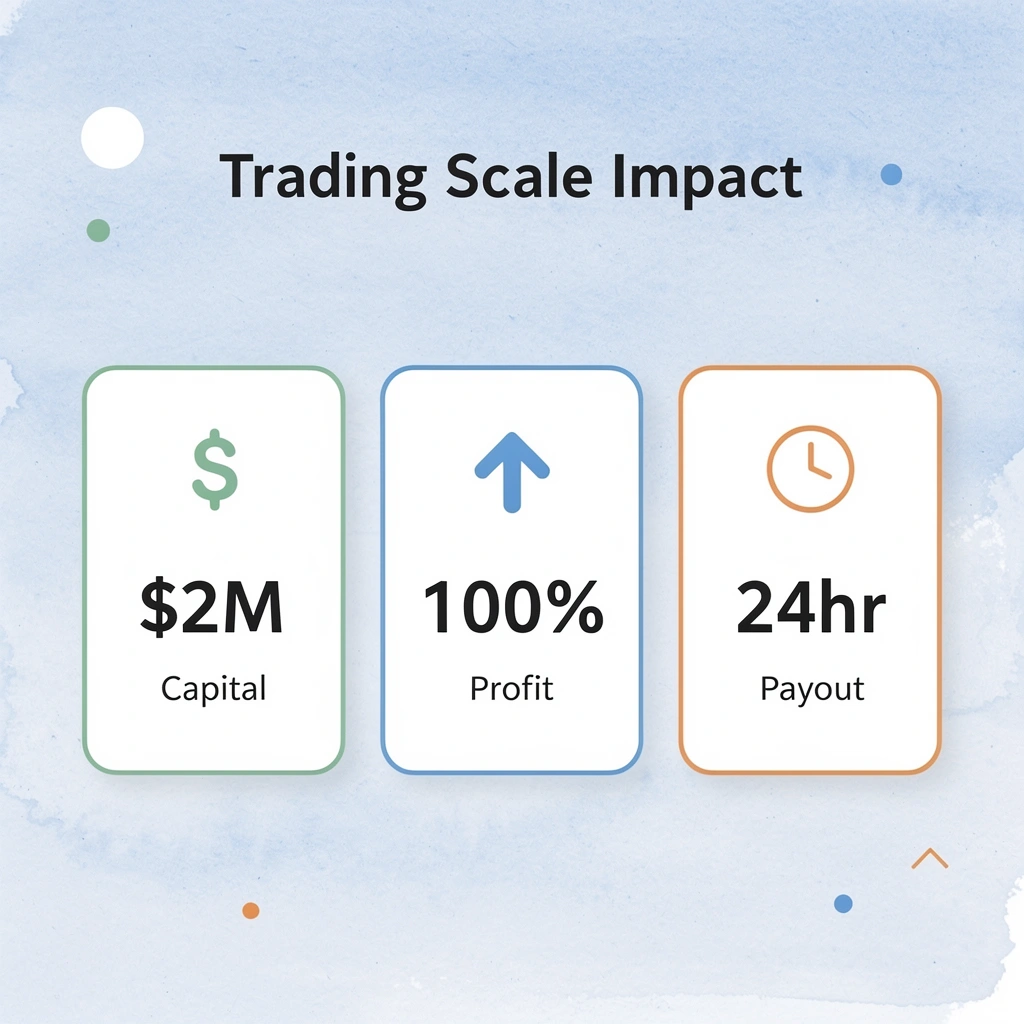
You face zero liability for losses: drawdowns no longer drain your personal savings. The firm's 4% daily and 6% overall drawdown rules provide realistic room to focus on execution.
Account Feature
Up to $2M Capital
- Scale beyond personal limits
100% Profit Split
- Keep all your earnings
24-Hour Payouts
- Fast access to profits
Zero Liability
- No personal loss risk

Scaling becomes automatic as you grow your funded account up to $2 million based on performance. Traders achieving consistent 8% months on a $200,000 account earn $16,000 monthly at 100% split.
⚠️ Limited Time: 50% off expires soon - secure your funded account today

Use code FIRSTGFT for 50% off your first account. No credit card required, and your one-time fee is 100% refundable. Join 250,000+ traders who trust Goat Funded Trader and get funded today.
Be Great and get the App