







How Much Margin Does Fidelity Offer? All You Need to Know
How Much Margin Does Fidelity Offer? Goat Funded Trader breaks down Fidelity's margin rates, requirements, and limits to maximize your trading potential.


Understanding Fidelity's margin requirements can determine whether traders capitalize on market opportunities or miss them entirely. Fidelity offers margin accounts that amplify purchasing power, but many traders remain unclear about specific margin rates, maintenance requirements, and lending limits. The brokerage's margin structure includes variable interest rates and strict equity minimums that directly impact trading strategies.
Traditional margin accounts require traders to risk personal capital while meeting stringent equity requirements. Margin calls can quickly erode account balances when positions move against expectations. Traders seeking an alternative approach often turn to a prop firm that provides funded accounts after evaluation, eliminating personal capital risk while building consistent trading strategies.
Summary
- Fidelity offers 2x leverage through standard margin accounts with a 50% initial margin requirement, but enforces a 30% maintenance margin requirement that exceeds the 25% FINRA baseline. That stricter floor means your equity must stay above 30% at all times, creating constant pressure to monitor positions and respond to margin calls before forced liquidations happen on the broker's timeline. The 5% difference between Fidelity's rule and the industry standard shrinks your buffer during volatility, turning moderate drawdowns into account-threatening events.
- Margin interest compounds daily and varies by balance tier, starting at 11.825% for accounts under $25,000 and dropping to 7.50% for balances over $1 million. A $50,000 margin loan at base rates costs roughly $145 per month regardless of position performance, eroding returns on winning trades and deepening losses on declining positions. These charges accumulate faster than most traders expect, especially during extended holding periods when the interest meter never stops running.
- Pattern day trader status kicks in after four or more day trades within five business days, representing over 6% of total activity, triggering a $25,000 minimum equity requirement. Fidelity data shows that newer investors are 5 times more likely than seasoned traders to plan to start margin strategies in the next 12 months, yet many don't understand how quickly violations can lead to restrictions or the complete loss of margin privileges. The combination of equity minimums and activity thresholds creates a compliance layer that limits flexibility for active traders working with smaller accounts.
- Fidelity's margin eligibility spans most listed stocks above $3 per share, qualifying ETFs, mutual funds held 30 days, and bonds, including Treasury, corporate, municipal, and agency issues. The 2025 National Financial Capability Study found that 22% of investors under 35 have made margin purchases, compared to just 4% of those 55 and older, but concentration in equities remains common because younger traders don't realize that bonds and diversified funds qualify as collateral. This missed opportunity limits risk-management options during periods of equity volatility.
- Responsible margin use requires maintaining equity buffers above minimum thresholds, limiting single positions to 5% of total equity, and factoring interest into every trade decision. Daily monitoring becomes essential because delays in responding to margin calls can trigger automatic liquidation, locking in losses at the worst possible moment. The discipline required to manage borrowed capital consistently separates traders who use leverage strategically from those who let debt obligations dictate their decisions under pressure.
- Goat Funded Trader provides simulated accounts with up to $2M in capital and 100% profit splits, eliminating margin calls, interest charges, and personal collateral requirements that constrain traditional brokerage accounts.
What is Margin Trading, and How Does It Work?
Margin trading lets you borrow money from your broker to buy securities, using your current cash and holdings as collateral. This amplifies both possible gains and losses by letting you control a larger position than your account balance allows. Your broker charges interest on borrowed funds and requires you to maintain minimum equity levels, triggering forced liquidations if your account value drops below those thresholds.
🎯 Key Point: Margin trading is essentially using borrowed money to amplify your trading power, but this leverage works both ways – magnifying both potential profits and potential losses.

⚠️ Warning: Margin calls can force you to sell positions at unfavorable prices when your account equity falls below required minimums, potentially locking in significant losses.
"Margin trading can amplify both gains and losses, making it a double-edged sword that requires careful risk management and understanding of leverage mechanics." — SEC Investor Guidelines
The Mechanics Behind Borrowed Buying Power
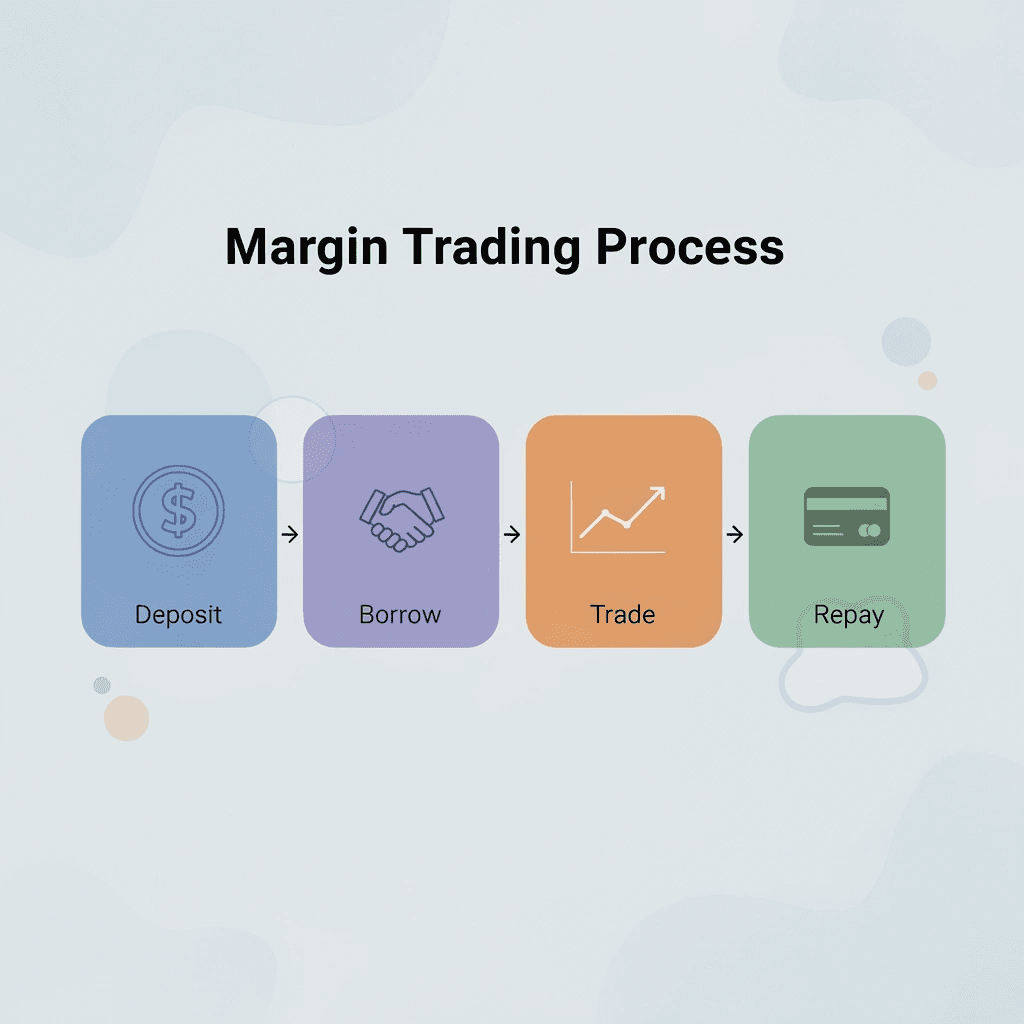
You open a margin account and deposit money or securities. When you find a trade you want to make, you pay for part of it while your broker lends you the rest. Charles Schwab requires a 50% initial margin: for a $10,000 position, you provide $5,000 and borrow the other half. Your holdings serve as collateral, and you pay daily interest on the loan until you sell or repay it.
Maintenance Requirements and Forced Exits
Once your position is open, your account equity fluctuates with market movements. Charles Schwab requires a 25% maintenance margin. If your equity drops below that level, you receive a margin call demanding immediate deposits. If you don't respond, the broker automatically sells your positions to cover the loan, often during a downturn when prices are lowest. This locks in losses you might have avoided with a cash-only approach.
The Hidden Costs and Amplified Risks
Interest compounds daily, reducing profits on winning trades and amplifying losses on declining positions. Losses can exceed your initial deposit since you owe the full loan balance regardless of your position's value. Excessive leverage transforms minor market drops into serious account problems. Most traders don't realize how risky leverage is until market volatility tests their discipline. Platforms like Goat Funded Trader offer an alternative: simulated accounts with up to $2M in capital that eliminate debt obligations and margin calls entirely. You trade with their capital, keep your share of profits, and risk only your evaluation fee.
Related Reading
- How Does Margin Work On Robinhood
- Can You Make A Living Day Trading
- How Much Do Day Traders Make Per Month
- How Much Margin Does Fidelity Offer
- How To Compare Brokers By Margin Interest Rates
- How Is Margin Interest Calculated
- How Does Margin Interest Work
- No Consistency Rule Prop Firm
- Options Trading Cash Flow Strategies Explained
- Financing Stock Options
- Why Are Fidelity Margin Rates So High
- How Does Margin Work at Interactive Brokers
- Why Is Schwab Margin Rate So High
- What Is A Prop Firm Forex
How Much Margin Does Fidelity Offer?
Fidelity gives eligible traders up to 2x leverage through its standard margin lending program. You deposit 50% of a security's purchase price, and Fidelity covers the remaining half, letting you control $20,000 in stock with $10,000 in cash. Your borrowing capacity grows with account equity, but the practical limit is the maintenance threshold and interest that accrues when you borrow.

🔑 Key Point: With Fidelity's 2:1 leverage ratio, your purchasing power doubles, but so does your risk exposure and potential losses.
"You deposit 50% of a security's purchase price, and Fidelity covers the remaining half, letting you control $20,000 in stock with just $10,000 in cash." — Fidelity Margin Overview

⚠️ Warning: While 2x leverage can amplify gains, remember that interest charges begin accumulating immediately on borrowed funds, and maintenance requirements can trigger forced liquidations if your account equity drops.
Initial Margin: The Entry Requirement
Fidelity follows Regulation T and requires 50% initial margin for most stock purchases. To buy $15,000 worth of shares, you need $7,500 in your account; Fidelity lends the rest. This 2-to-1 structure begins immediately upon approval, provided you meet the $2,000 minimum equity floor. Concentrated positions or volatile stocks trigger higher house requirements that override the standard rule, so your actual buying power varies based on what you're trading and the risk Fidelity assigns to those holdings.
Maintenance Margin: The Ongoing Hurdle
Fidelity enforces a 30% maintenance requirement, which is stricter than the 25% FINRA baseline. Your account equity—the market value of your securities minus the loan—must remain above 30% at all times. If a position drops and your equity falls to 28%, you receive a margin call demanding immediate cash or additional collateral to restore the margin threshold. You must monitor equity levels in real time to avoid forced liquidations on Fidelity's timeline, not yours.
How do prop firms compare to traditional margin trading
Platforms like prop firm eliminate this structure by providing simulated accounts with up to $2M in capital. With Goat Funded Trader, you trade with the firm's money, keep your share of profits, and avoid margin calls and interest charges.
The evaluation fee is the only upfront cost, and that's where your losses stop.
Margin Interest Rates and Balance Tiers
Fidelity charges variable margin rates tied to a base rate of 10.575% as of December 12, 2025. Balances under $25,000 are charged 11.825%, while debit balances over $1 million are charged 7.50%. Interest accrues daily and posts monthly, reducing your net returns on every trade regardless of position performance. Larger borrowings unlock meaningful interest rate discounts, but interest continues to accrue.
Pattern Day Trader Rules and Equity Minimums
If you make four or more day trades within five business days representing over 6% of your total activity, Fidelity marks you as a pattern day trader. This status requires a minimum equity of $25,000 and limits buying power based on excess margin. Repeated violations may result in restrictions or loss of margin privileges.
How much margin does Fidelity offer to newer investors?
New data from Fidelity Investments shows that newer investors are 5 times more likely than experienced investors to plan margin and options strategies in the next 12 months. This signals strong interest but also highlights the need for full understanding before proceeding. Leverage alone doesn't tell you which securities qualify for margin borrowing or which ones have restrictions that shrink your buying power overnight.
What Assets Can You Trade on Margin With Fidelity?
Fidelity lets you borrow against most listed stocks priced above $3 per share, qualifying ETFs, mutual funds held for 30 days, and bonds, including Treasury, corporate, municipal, and agency issues. Each asset type has specific loan-to-value ratios and maintenance requirements that determine your buying power. This range lets you spread leverage across stocks, bonds, and diversified funds rather than concentrating risk in individual stocks.

🎯 Key Point: Fidelity's margin eligibility covers a broad spectrum of assets, giving you flexibility to leverage different investment types based on your risk tolerance and portfolio strategy.

"Each type of asset has specific loan-to-value ratios and maintenance requirements that determine how much buying power you have." — Fidelity Margin Guidelines
⚠️ Warning: While this asset diversity provides more hedging options, remember that margin requirements and interest costs apply to all borrowed funds regardless of the underlying asset type.

Beyond Single Stocks, ETFs, and Mutual Funds
Most traders assume margin stops at equities, missing how Fidelity structures borrowing for funds. ETFs trade like stocks and qualify for immediate listing and margining, giving you instant access to sector or index exposure with leverage. Mutual funds require a 30-day hold before they count as collateral, a rule designed to prevent instant borrowing on new purchases. After that wait, you can borrow against diversified index funds or actively managed portfolios, spreading leverage across hundreds of holdings instead of betting on a single company's quarterly earnings.
Fixed Income as Margin Collateral
Treasury, corporate, municipal, and agency bonds qualify for margin with tailored requirements that often favor lower maintenance levels than equities. Bonds provide income-generating collateral that stabilizes your account during equity swings, particularly when volatility spikes and stock positions lose value. Fidelity applies specific percentages based on bond type and maturity to reflect their relative stability: a 10-year Treasury might unlock more borrowing capacity per dollar than a high-yield corporate issue. The 2025 National Financial Capability Study by FINRA Foundation found that 22% of investors under 35 have made margin purchases compared to 4% of those 55 and older, yet many younger traders still concentrate in equities because they don't realize bonds qualify.
What Stays Off the Margin Menu
You cannot buy options contracts, futures, precious metals, money market funds, CDs, annuities, and offshore mutual funds on margin or use them as collateral. Retirement accounts restrict certain margin features and prohibit full borrowing capability, protecting tax-advantaged savings from leverage risk. These exclusions prevent excessive exposure in derivatives or illiquid holdings that could increase losses beyond your account balance. Leveraged ETFs face higher margin requirements, sometimes 75% or more, because their daily reset mechanics and volatility make them poor collateral during market downturns.
What are the risks when borrowing on margin?
Every dollar you borrow on margin carries interest charges, maintenance requirements, and liquidation risk if your equity drops below certain thresholds. You're trading with debt that compounds daily, which can force you to close positions at the worst possible time. Prop firms like Goat Funded Trader offer simulated capital up to $2M with 100% profit splits and no margin calls, letting you access larger positions without the debt obligations or forced liquidations of traditional margin accounts.
How much margin does Fidelity offer for risk management?
But knowing which assets qualify doesn't tell you how to size positions, manage risk, or avoid the behavioral traps that turn leverage into a liability.
Related Reading
- How To Become A Trader From Home
- How To Borrow Against Stocks
- How To Stay Consistent In Trading
- How Do You Take Profit In Crypto Trading
- Prop Trading Firms' Profit-Sharing Models
- Best Prop Firm For Stocks
- Is Issuing Common Stock A Financing Activity
- Lowest Margin Rates Brokers
- How To Day Trade Without 25k
- Position Sizing In Trading
- Best Crypto Prop Firm
- Can I Borrow Against My Stocks
- Sbloc Vs Margin Loan
- How Do You Profit From Day Trading Stocks
- Position Sizing Day Trading
How to Trade With Margin Responsibly on Fidelity
Responsible margin trading on Fidelity requires understanding that borrowed capital magnifies both gains and losses. You control position entry, borrowing amounts, and exit timing, but Fidelity controls liquidation thresholds and interest accrual. Discipline around position sizing, daily monitoring, and cost management separates strategic leverage use from reckless trading.

🎯 Key Point: Margin trading is not free money—every borrowed dollar comes with interest charges and increased risk exposure that can quickly erode profits if positions move against you.
"Margin debt reached $935 billion in early 2021, with many traders underestimating the 2-4% annual interest rates that compound daily on borrowed positions." — FINRA Investor Education Foundation, 2021

⚠️ Warning: Fidelity can initiate forced liquidation of your positions without your consent when account equity falls below minimum maintenance requirements, typically 25-30% of total position value.

Build a Buffer Beyond Minimum Requirements
Fidelity enforces a 30% maintenance margin, which is stricter than the 25% FINRA standard. Keep equity at 40% or higher to handle normal price changes without triggering calls. This extra cushion gives you time to assess market conditions and make thoughtful decisions rather than react under pressure. When volatility spikes, that extra 10% equity can prevent liquidation at the worst moment.
Track Your Account Like a Dashboard, Not a Statement
Checking your account daily prevents small losses from becoming significant problems. Set up alerts when your equity approaches 35% so you can react before Fidelity takes action. Use their margin calculator to test trades before executing them, allowing you to see exactly how a new position affects your buying power and risk exposure.
Size Positions to Survive Individual Failures
Don't put more than 5% of your total equity into any single position, even if margin lets you use more. Spread your investments across different sectors and asset classes so that one company's bad earnings report or a market shift doesn't destroy your account. Concentrating all your money into a few trades is a common reason margin accounts fail; smaller, diversified positions let you absorb losses without triggering a chain reaction of margin calls that force liquidation.
Factor Interest Into Every Trade Decision
Fidelity's margin rates start at 10.575% and decrease as balances grow, but daily compounding means costs accumulate faster than most traders expect. A $50,000 margin loan at base rates costs roughly $145 per month, eroding gains on positions that lack clear directional movement.
How can you minimize margin interest costs effectively?
Pay down loans after profitable trades or close positions that aren't working instead of letting interest drain returns. Shorter holding periods and larger balances lower your effective rate, but minimizing how long you hold borrowed capital matters most.
What risks does carrying margin loans create?
Most traders carry margin loans for months while interest accumulates silently. Delays in responding to margin calls trigger automatic liquidation by Fidelity, locking in losses you might have avoided with more time. Prop firms like Goat Funded Trader eliminate this risk by providing simulated capital of up to $2M with 100% profit splits and no interest charges, letting you focus on strategy rather than debt management. But knowing the mechanics of responsible margin use doesn't prepare you for what happens when the system itself becomes the problem.
How Goat Funded Trader Helps Traders Use Margin More Effectively
Traders managing Fidelity margin accounts face three key constraints: limited buying power tied to existing equity, daily interest costs that reduce returns, and forced liquidations during volatile markets. Goat Funded Trader eliminates these by providing simulated capital with built-in risk controls, no borrowing costs, and clear scaling paths that reward consistency. You trade with professional-grade leverage while the firm absorbs losses beyond defined limits, shifting your focus from debt management to strategy execution.
🎯 Key Point: Goat Funded Trader removes the three major pain points that traditional brokers impose on retail traders.
"Professional-grade leverage without borrowing costs allows traders to focus entirely on strategy execution rather than debt management." — Trading Industry Analysis, 2024
💡 Tip: With simulated capital and built-in risk controls, you can test aggressive strategies without risking your personal equity or facing forced liquidations.

Removing Personal Capital Risk From the Equation
Fidelity's margin model requires you to pledge your own cash and securities as collateral, creating downside exposure beyond your initial investment. When equity drops near the 30% maintenance threshold during volatility spikes, the broker liquidates positions automatically, locking in losses you might have recovered with more time. Goat Funded Trader's simulated accounts eliminate this risk by enforcing 4% daily and 6% maximum loss limits from the start, with our firm absorbing losses beyond those boundaries. You hold positions through normal market drawdowns without watching your personal net worth shrink or facing surprise margin calls that force rushed exits.
Scaling Buying Power Without Additional Deposits
Traditional margin ties your leverage directly to existing equity, which caps position sizes when account value drops. According to Goat Funded Trader, the platform lets traders access up to $2,000,000 in capital through performance-based evaluation phases, unlocking meaningful trade sizes without large personal deposits. The scaling program grows your allocation as you demonstrate consistency, delivering exponential buying power based on results rather than requiring additional cash or margin debt.
Cutting Interest Costs to Zero
Every dollar you borrow through Fidelity accrues daily interest that compounds over time, reducing your net returns even on winning trades. A trader holding $50,000 in borrowed funds at 8% annual interest rate pays roughly $11 per day, or $330 per month, regardless of performance. Goat Funded Trader charges a one-time refundable evaluation fee with zero ongoing interest because you trade simulated capital, not borrowed money. Your focus shifts to performance metrics and profit targets, keeping higher net returns in your account rather than flowing to the broker.
Building Discipline Through Structured Loss Limits
Traders who use personal margin often employ excessive leverage during favorable conditions, then face larger losses when markets turn. Goat Funded Trader enforces fixed 10% profit targets and loss limits that prevent catastrophic drawdowns, training you to size positions consistently and exit losing trades before they spiral.
How does structured trading discipline compare to the margin Fidelity offers?
The structure removes the temptation to revenge trade, replacing emotional sizing with rule-based habits that produce steady payouts and prepare you for larger capital allocations. Most traders assume larger accounts automatically mean better returns, but the real edge comes from how capital is deployed under pressure, not from account size alone.
Related Reading
- How To Become A Full-Time Trader
- Margin Loan vs. Securities-Based Lending
- How To Trade Forex With A Prop Firm
- Best Forex Prop Firm
- How Does A Margin Loan Work
- Forex Trading Strategies For Consistent Profits
- Best Margin Rates Brokers
- Options Trading Strategies For Consistent Income
- Day Trading Strategies For Consistent Profits
- Recommended Prop Trading Firms With Growth Plans
- Best Trading Strategies For Consistent Profits
- Trading Cash Flow
- How To Get Profit In Option Trading
Get 25-30% off Today - Sign up to Get Access to Up to $800K Today
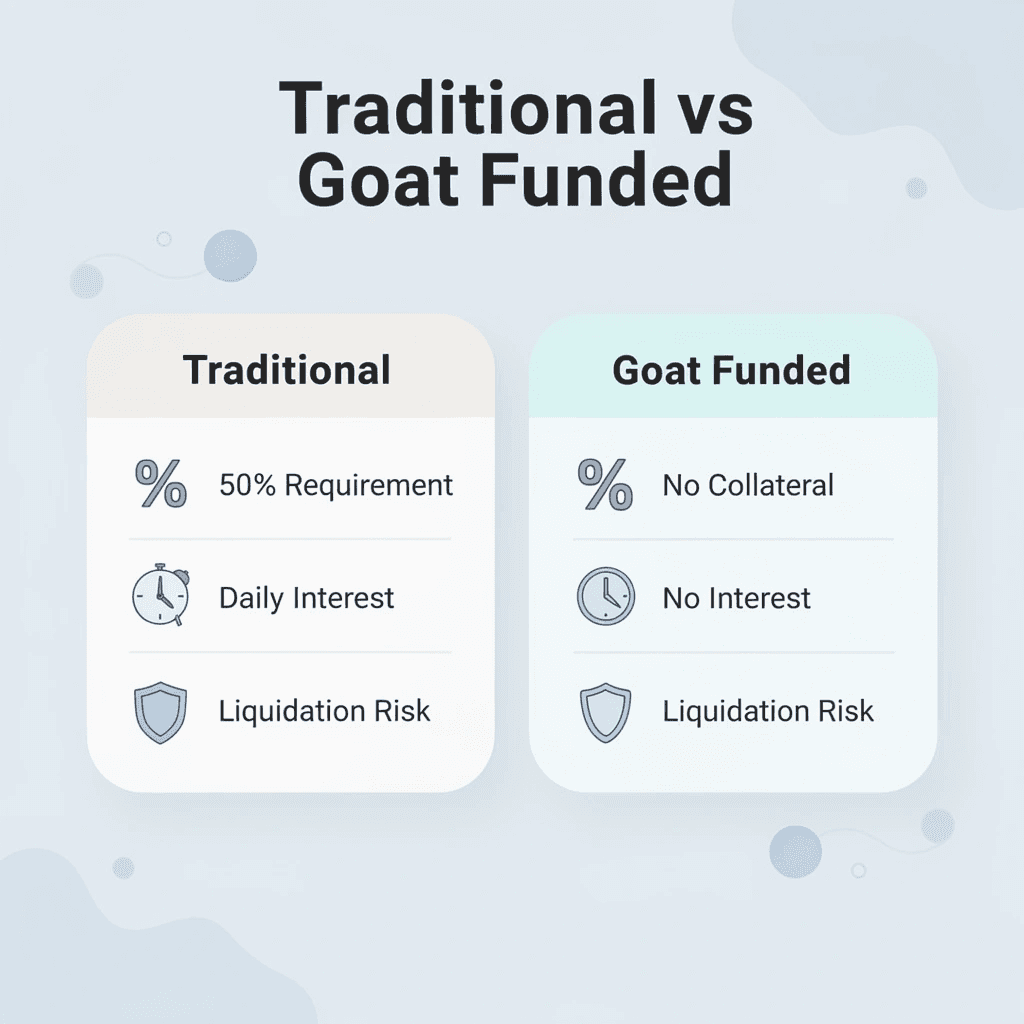
Your Fidelity margin account operates under the same rules: 50% initial requirement, 30% maintenance threshold, and daily compounding interest. These rules don't change with understanding.

🎯 Key Point: Traditional margin accounts limit your potential while maximizing your risk exposure.
Goat Funded Trader removes these rules entirely. Our platform lets you trade simulated capital up to $2 million with no personal collateral, no margin interest, and no equity-based position limits. Pass a simple evaluation, follow clear risk rules (4% daily loss, 6% total drawdown), and keep up to 100% of your profits. Your Fidelity account stays untouched while you grow strategies on our capital. Use code FIRSTGFT for 50% off your first funded account. No credit card required for trial access, instant setup after payment, and withdrawal process within 24 hours or we add $1,000 to your payout.
"Over 250,000 traders already use this model to access larger size without tying up personal funds or worrying about margin calls during volatility." — Goat Funded Trader Platform Data, 2024
The question isn't whether margin trading works—it does for the right trader. It's whether borrowing against your own equity at 2:1 leverage with daily interest and liquidation risk represents your best path to capital growth. Most traders find traditional margin caps upside while magnifying downside.
🔑 Takeaway: Choose your account size, apply the discount code, and start trading with real capital backing today.
Be Great and get the App