






9 Best Prop Firms in Nigeria for All Traders in 2026
Explore the Best Prop Firms in Nigeria for 2026. Compare features, funding options, and requirements for all traders.


Nigerian traders know the frustration of watching profitable strategies sit idle because capital is out of reach. You might have the skills, discipline, and market knowledge, but without substantial capital, your trading potential remains locked. What Is a Funded Account? It's your gateway to trading with firm capital instead of your own money, allowing you to keep a significant share of the profits while the prop firm absorbs the losses. This guide reveals the top proprietary trading firms operating in Nigeria right now, showing you exactly how to access funded accounts, bypass the capital barrier, and build serious wealth through performance-based trading in 2026.
Goat Funded Trader stands out as a prop firm designed specifically for traders ready to prove their edge and scale rapidly. Their evaluation process provides Nigerian traders with a clear path to manage accounts worth thousands of dollars, with profit splits that reward consistency and risk management. Whether you're trading forex, indices, or commodities from Lagos or anywhere across the country, their platform removes geographical limitations and connects your skill directly to capital that can multiply your earning potential without risking your savings.
Summary
- Nigerian traders face capital barriers that make prop firms particularly valuable, with currency depreciation and forex restrictions creating conditions where accumulating $50,000 in personal trading funds becomes prohibitively expensive. Prop firms eliminate this conversion trap by providing dollar-denominated accounts after a one-time evaluation fee of $100 to $500, allowing traders to access $25,000 to $200,000 in capital without converting millions of naira at unfavorable rates. This structure protects earnings from local inflation while removing the biggest friction point between skill and income.
- Evaluation processes filter traders through rigorous discipline tests, with 90% failing the challenge phases, according to industry data. The requirements aren't arbitrary. Profit targets of 8-10%, paired with maximum daily losses of around 5% and total drawdown limits of near 10%, force the exact risk-management behaviors that separate long-term survivors from account destroyers. Firms profit from evaluation fees paid by inconsistent traders while rewarding the minority who demonstrate repeatable edge under pressure.
- No Nigerian law prohibits participation in international prop firm programs, as the Central Bank and the Securities and Exchange Commission focus their oversight on domestic entities that collect client deposits or manage investment portfolios. Prop firms structure their offerings as performance-based assessments rather than brokerage services, which fall outside regulatory frameworks designed for traditional financial institutions. Traders face no personal liability beyond evaluation fees and can verify firm legitimacy by checking SEC warning lists and confirming broker partnerships with regulated entities holding FCA, ASIC, or CySEC licenses.
- Profit split structures reveal firms' priorities more clearly than marketing promises, with a standard 80% split serving as a baseline for comparison across reputable platforms. Dynamic structures that improve to 90%, 95%, or 100% through performance milestones align firm incentives with trader success, creating a partnership rather than extraction. The split percentage matters most when combined with withdrawal frequency: an 80% split paid daily compounds faster than a 90% split paid monthly with three-week processing delays.
- Platform quality and broker partnerships determine whether trading edge translates into actual profits or gets eroded by slippage and execution delays. Firms partnering with regulated brokers provide accountability absent in offshore arrangements, while raw spreads starting at 0.1 pips versus 1.5 pip markups create meaningful profit differences across hundreds of trades. Mobile functionality becomes critical in Nigeria, where power outages make desktop-only platforms operationally risky during volatile market sessions.
- Goat Funded Trader addresses these challenges with proprietary technology that enables instant account activation post-challenge, two-business-day payout guarantees with $500 in compensation for delays, and scaling programs that reach $2 million in simulated capital, with profit splits up to 100%.
What is a Prop Firm, and How Does It Work?

A prop firm supplies you with trading capital instead of requiring you to risk your own savings. You trade with the firm's capital, demonstrate profitability within defined risk limits, and keep a substantial share of profits—often 80% or more. The firm absorbs losses beyond your initial evaluation fee, so your downside remains contained while your earning potential scales with performance, not personal wealth.
This model upends traditional trading. Instead of needing tens of thousands of dollars to generate meaningful returns, you pay a one-time assessment fee (typically between $100 and $500), prove your edge in a simulated environment, and gain access to accounts worth $10,000 to $200,000 or more. For Nigerian traders navigating currency restrictions or limited access to large trading capital, this structure removes the biggest barrier: the need for substantial upfront funds.
The Evaluation Process That Separates Skill from Luck
Most contemporary prop firms start you in a challenge phase. You receive a demo account that mirrors live market conditions, with clear profit targets and strict risk parameters. Common requirements include achieving an 8-10% profit target while maintaining a maximum daily loss of approximately 5% and a total drawdown limit of approximately 10%. These aren't arbitrary numbers. They force discipline, consistency, and risk management—the exact behaviors that separate traders who survive from those who blow accounts. 90% of traders fail the evaluation phase. That statistic isn't meant to discourage you. It reveals the filtering mechanism at work. Firms profit from evaluation fees paid by participants who lack consistency, while rewarding the minority who demonstrate repeatable edge. If you pass, you're not just getting capital. You're joining a group that proved they can manage risk under pressure.
Evaluations come in different formats. One-step challenges consolidate the assessment into a single phase, with tighter rules and shorter timelines. Two-step models add a verification round to confirm your initial success wasn't luck. Instant funding options skip the challenge entirely but charge higher fees and impose stricter ongoing rules. Each structure tests the same core competencies: can you follow a plan, manage drawdown, and generate consistent returns without emotional decision-making?
The cautious optimism many traders feel when considering these tools makes sense. You're investing in an unproven system with limited independent validation, hoping it provides the discipline and detachment you struggle to maintain manually. That leap of faith becomes easier when you understand the evaluation isn't just a hurdle. It's a mirror showing whether your strategy actually works when money and rules create real consequences.
From Simulated Success to Funded Accounts
Pass the evaluation, and you transition to a funded account. This is where the model gets interesting. Some firms provide live capital, placing your trades directly into the market. Others use simulated environments with payouts funded by evaluation fee revenue and profit-sharing from successful traders. Both approaches can work, but transparency matters. You need to know whether your trades impact real liquidity or exist within a closed system.
Funded accounts range from $25,000 to $200,000 or more, depending on the firm and evaluation tier you completed. You execute trades in accordance with the same risk rules from your challenge, keeping 80% of profits. The firm retains the remainder as compensation for capital provision and risk absorption. If you exceed your loss limits, the account terminates, and you incur no personal liability beyond your original fee. This asymmetric risk profile—capped downside, theoretically unlimited upside—explains why the model appeals to skilled traders without deep pockets.
The profit split structure rewards consistency over aggression. Firms want traders who compound small, repeatable gains rather than gamblers chasing home runs. Many offer scaling programs that increase your account size and profit share as you demonstrate sustained performance. Start with $50,000 at 80%, prove yourself over months, and you might access $200,000 at 90% or higher. This progression mirrors how traditional prop desks promote traders, except you control the timeline through results rather than office politics.
Why This Model Works for Both Sides
Prop firms reduce the barrier to professional-scale trading without tying up personal capital. You access position sizes that would require six figures of personal savings, all while keeping losses contained within firm-defined limits. The educational resources and community support that many firms provide add value beyond capital, though the quality and substance vary widely.
For firms, the business model scales efficiently. Evaluation fees from the majority who don't pass fund operations and payouts to successful traders. The minority who consistently profit become long-term partners generating shared revenue. This creates alignment: firms succeed when traders succeed, but only if those traders demonstrate genuine skill rather than temporary luck.
The challenge lies in distinguishing legitimate firms from those that optimize for evaluation-fee revenue without a genuine interest in trader success. Not all prop firms function identically. Some impose hidden rules or subjectively delay payouts. Others provide transparent terms, fast withdrawals, and genuine support. The difference between these experiences determines whether the model allows your growth or simply extracts fees while dangling inaccessible promises. But knowing how prop firms work only gets you halfway to making a smart decision.
Why Choose a Prop Firm for Trading in Nigeria?

Nigerian traders face a unique set of barriers that make prop firms particularly valuable. Limited access to large trading capital, currency depreciation that erodes local savings, and restricted foreign exchange access create conditions where traditional self-funded trading becomes prohibitively expensive or slow to scale. Prop firms bypass these obstacles by providing dollar-denominated accounts, eliminating the need to accumulate tens of thousands in personal capital, and offering payout structures that preserve value outside the naira.
Capital Access Without Currency Conversion Headaches
Building a $50,000 trading account funded through personal savings in Nigeria means converting millions of naira at unfavorable exchange rates, navigating foreign exchange restrictions, and watching inflation erode your gains. The math doesn't favor patience. By the time you accumulate enough naira to fund a meaningful account, the purchasing power has shifted. Prop firms eliminate this conversion trap entirely. You pay a one-time evaluation fee (typically $100 to $500), prove your strategy works under defined risk parameters, and gain access to accounts worth $25,000 to $200,000 or more. The capital is never converted from naira. You trade in dollars, manage positions sized for serious profit potential, and keep 80% or more of what you earn. For Nigerian traders, this structure removes the single biggest friction point between skill and income.
Earning in Stable Currency While Operating Locally
Most prop firms base their accounts and payouts in USD, EUR, or GBP. This isn't just a convenience. It's a hedge. When you generate profits in hard currency, you protect your earnings from local inflation and exchange rate volatility. A $5,000 payout retains its value regardless of whether the naira strengthens or weakens. You control when and how you convert, rather than watching your account balance lose ground to macroeconomic forces beyond your control. For traders in Lagos, Abuja, or Port Harcourt, this feature transforms trading from a speculative side activity into a viable income stream with global purchasing power. You're not just making money. You're earning in a currency that travels, saves, and invests better than most local alternatives. That stability matters when planning beyond the next trade.
Reduced Personal Risk in Volatile Markets
Trading with personal funds in a volatile market creates constant tension. One bad week can wipe out months of gains. One emotional decision during a drawdown can destroy your account. The psychological weight of risking your own savings makes discipline harder, not easier. Fear and greed amplify when the money at stake determines whether you pay rent next month. Prop firms shift that risk to the firm itself once you pass the evaluation. If you violate risk rules or exceed drawdown limits, you lose access to your account, not your personal savings beyond the initial fee. This structure doesn't eliminate the need for discipline. It removes the existential dread that turns rational traders into reactive gamblers. You can focus on executing your strategy without the constant fear of financial ruin looming over every decision.
Professional Resources and Community Support
Many reputable firms provide educational content, performance analytics, trading tools, and community access that would cost thousands to assemble independently. For Nigerian traders who lack local institutional training or advanced access to platforms, these resources bridge critical knowledge gaps. You're not just getting capital. You're joining an ecosystem designed to improve consistency and refine edge.
The quality of these offerings varies dramatically between firms. Some provide genuine mentorship, detailed performance breakdowns, and active communities where traders share strategies and troubleshoot challenges. Others offer generic webinars and outdated guides that add little value. The difference between these experiences determines whether the firm accelerates your growth or simply collects your evaluation fee while providing minimal support.
Scaling Potential Without Additional Capital Injection
Consistent performance unlocks scaling programs at most prop firms. Start with a $50,000 account, demonstrate steady profits over several months, and you might be able to access $100,000 or $200,000 with improved profit splits. Some firms offer up to weekly payouts, compressing the feedback loop between performance and reward. This progression mirrors how traditional trading desks promote talent, except you control the timeline through results rather than office politics or seniority.
For ambitious Nigerian traders, this scaling path offers something rare: the ability to grow earning potential without needing to inject more personal capital or wait years for promotions. Your edge compounds through larger position sizes and better splits, not through slow accumulation of savings. That acceleration matters when you're building a trading career in a market where capital access remains constrained.
Flexibility Across Markets and Strategies
Prop firms enable diverse approaches across forex, indices, commodities, and, in some cases, crypto. You're not locked into a single market or forced to trade a specific style. Whether you prefer scalping EUR/USD during the London open, swing trading indices, or capturing commodity breakouts, the structure accommodates different edges as long as you adhere to risk parameters.
This flexibility suits the Nigerian trading community, where individuals come from varied backgrounds and develop different specializations. Some thrive on high-frequency strategies. Others build an edge through patient position trading. The model rewards consistency and risk management, not conformity to a single approach. That openness creates room for personal style while maintaining the discipline required for long-term success. The real question isn't whether prop firms offer advantages. It's whether they operate legally and sustainably within Nigeria's regulatory environment.
Related Reading
- What Is a Funded Account
- What Is A Prop Firm Account
- What is Scalping in Trading
- Perpetual Futures Example
- Cfd Leverage
- What is Arbitrage Trading
- Prop Firm Regulation
- How To Read Candlesticks
- Hanging Man Candlestick
- What Is Drawdown In Trading
- What Is Fomo In Trading
- What Is Tp In Trading
- MT4 vs MT5
- One Step Prop Firm Challenge
Are Prop Firms Legal in Nigeria?

No Nigerian law prohibits residents from participating in prop firm evaluation programs or trading with funded accounts provided by international platforms. The Central Bank of Nigeria and the Securities and Exchange Commission have not issued regulations that ban individuals from paying challenge fees, passing assessments, or receiving payouts from overseas prop trading companies. This creates a permissible environment where skilled traders can access capital through legitimate international firms without violating local financial regulations.
The confusion around legality stems from Nigeria's strict stance on domestic retail forex brokers, which cannot obtain local licenses to operate client funds. That restriction applies to companies seeking to establish brokerage operations in Nigeria, not to individuals participating in evaluation programs held abroad. The distinction matters. You're not opening a brokerage account with a Nigerian entity. You're proving your trading skill to an international firm that provides capital after you demonstrate consistency under defined risk parameters.
Understanding the Unregulated but Legal Status
Prop firms operate in a space Nigerian regulators haven't directly addressed. The SEC and CBN focus their oversight on entities that collect client deposits, manage investment portfolios, or offer securities trading within Nigeria's borders. Modern prop firms structure their offerings as performance-based educational challenges rather than traditional brokerage services. You pay an evaluation fee, trade a simulated account, and earn the right to manage firm capital if you meet profit targets while respecting drawdown limits.
This business model falls outside the regulatory frameworks designed for brokers, asset managers, or deposit-taking institutions. No license requirement exists because no client funds are held, no investment advice is provided, and no securities are issued. The firm assesses your trading ability, provides capital if you succeed, and shares profits based on performance. That structure doesn't trigger the licensing requirements that apply to conventional financial services.
The absence of regulation doesn't create legal risk for participants. It simply means prop firms aren't subject to local supervision in the same way banks or licensed brokers are. Your responsibility is to select firms with transparent terms, verifiable track records, and no history of regulatory warnings from international authorities. The SEC maintains a public list of entities flagged for fraudulent activities or impersonation schemes. Cross-referencing that list before committing to any platform protects you from known bad actors while staying within legal boundaries.
Verifying Firm Legitimacy and Partner Brokers
The brokers who partner with prop firms determine where your trades execute. Some platforms route orders through regulated entities licensed by credible international authorities such as the UK's Financial Conduct Authority, Australia's ASIC, or Cyprus's CySEC. Others use less transparent arrangements or offshore brokers with minimal oversight. The difference affects execution quality, withdrawal reliability, and overall trustworthiness.
Before joining any prop firm, verify three details. First, confirm the firm's registration status in its home jurisdiction. Legitimate companies openly share incorporation documents, regulatory compliance information, and physical business addresses. Second, identify the broker handling trade execution and check its regulatory standing. If the firm refuses to disclose this information or partners with entities on SEC warning lists, walk away. Third, review community feedback from Nigerian traders who have received payouts. Consistent withdrawal processing and transparent communication signal operational integrity.
The SEC website provides a searchable database of cautioned entities and fraudulent schemes. Spending ten minutes cross-referencing a firm against that list prevents costly mistakes. Reputable platforms welcome scrutiny and provide clear documentation. Those operating questionable models avoid transparency and pressure you to commit quickly. That urgency is a warning sign, not an opportunity.
Practical Advantages Within Nigeria's Economic Context
The legal clarity around prop firm participation creates meaningful opportunities for Nigerian traders navigating currency depreciation, limited forex access, and capital accumulation challenges. You bypass the need to convert millions of naira into dollars at unfavorable rates or wait years to build a self-funded account large enough to generate high income. Instead, you pay a modest evaluation fee, prove your edge, and access dollar-denominated capital that protects your earnings from local inflation.
Multiple Nigerian trading communities and financial analysts highlight this advantage in 2025 and 2026 assessments. The model thrives precisely because it addresses barriers specific to emerging markets, where access to personal capital remains constrained. You're not working around regulations or exploiting loopholes. You're using a legal pathway that international firms have established to identify and fund skilled traders regardless of their geographic location or personal wealth.
Platforms like prop firm accept Nigerian participants and process payouts reliably, demonstrating that legitimate operations view the market as viable and compliant. These firms structure their programs to reward consistency through scaling opportunities and improved profit splits, aligning their success with yours. Transparency around terms, withdrawal processes, and risk rules distinguishes credible platforms from those that collect evaluation fees without a genuine interest in trader development.
What This Means for Your Trading Career
The absence of legal barriers removes the primary excuse holding back capable traders. You can't blame regulations for preventing access to capital. The path exists. The question becomes whether you have the discipline to pass evaluations designed to filter out inconsistent performers and emotional decision-makers. Ninety percent of participants fail not because the rules are unfair, but because most traders lack the risk management and psychological control required to survive in the long term.
For those who do possess a genuine edge, the legal environment in Nigeria creates an asymmetric opportunity. You face no personal liability beyond evaluation fees, earn in stable currencies that preserve purchasing power, and scale through performance rather than capital accumulation. That structure favors skill over wealth in ways traditional self-funded trading never could. The firms that honor this model transparently and pay reliably become partners in your growth, not obstacles to navigate.
The critical insight here is simple. Legality isn't your constraint. Skill, discipline, and firm selection determine outcomes. Choose platforms with verified track records, transparent terms, and consistent payout histories. Avoid entities that obscure broker relationships, impose arbitrary withdrawal restrictions, or appear on regulatory warning lists. That diligence keeps you within legal boundaries while maximizing the probability of long-term success. But knowing the rules doesn't tell you which firms actually deliver on their promises.
9 Best Prop Firms in Nigeria for All Traders in 2026
Nigerian traders in 2026 face no shortage of options when selecting a prop firm, but the strongest platforms share common traits: transparent payout processes, flexible evaluation structures, substantial scalability, and no geographic restrictions. The firms below earned their positions through verified user feedback, competitive terms, and consistent performance in processing withdrawals for international participants, including those in Lagos, Abuja, and Port Harcourt. Each offers distinct advantages depending on your trading style, capital targets, and platform preferences.
1. Goat Funded Trader

Goat Funded Trader stands out as a leading proprietary trading firm in 2026, particularly appealing to Nigerian traders seeking funded opportunities in volatile markets. Operating on its own in-house technology and with a trader-first focus, the firm offers simulated capital of up to $2 million across various challenge types and instant funding plans. It enables skilled individuals to trade forex pairs, stocks, ETFs, and crypto pairs with minimal personal risk, fast payouts, and flexible rules that support consistent performance.
Key Features of Goat Funded Trader
- Up to $2 million in simulated capital available through scaling programs.
- Multiple challenge options, including 1-step, 2-step, 3-step, and Blitz accounts, plus instant funding plans.
- Profit splits starting at 80% for traders, with add-ons reaching up to 100% on demand.
- Account sizes ranging from $2.5k to $400k, with potential to scale higher.
- Trading on platforms such as mobile apps (iOS/Android), PC web terminals, and custom trader dashboards.
- Instruments include forex pairs, stocks, ETFs, and crypto pairs, with raw spreads starting at 0.1 pips and $0 commissions on select assets.
- Flexible rules allowing news trading, weekend holding, no time limits in most plans, and leverage up to 1:100 depending on the account.
- Payouts are available on demand, biweekly, or every 10 days, with a reward guarantee processed within 2 business days or an additional $500 in compensation.
- 100% refundable one-time fees on challenges.
- Over $15 million in real payouts have been distributed to more than 250,000 traders worldwide.
- 24/7 support and a custom dashboard for tracking stats, performance, and top trades.
- Current promotions including 45% off all accounts with code GFT45, and other limited-time discounts.
Why Nigerian Traders Choose It
Nigerian traders gravitate toward Goat Funded Trader for its unrestricted access for participants from the country, combined with features that address local challenges such as currency volatility and limited personal capital. The firm's global payout system in stable currencies, rapid on-demand withdrawals, and high profit shares help preserve earnings against naira fluctuations, while generous promotions and refundable fees lower entry barriers for aspiring traders in Lagos and beyond. Strong community engagement, evidenced by Nigerians quickly filling promotional slots in past offers, along with mobile-friendly tools and no hidden restrictions, makes it a practical choice for building a sustainable trading career without heavy upfront investment.
2. Tradeify

Tradeify ranks highly among futures-focused prop firms accessible to Nigerians in 2026, thanks to its strong user ratings, streamlined processes, and emphasis on trader-friendly conditions that support consistent performance without excessive barriers.
Key Features
- Supports popular platforms including Tradovate, NinjaTrader, TradingView, and Quantower
- Offers maximum funding allocation up to $750,000
- Provides a 40% discount on challenges with promo codes
- Features no activation fee on select plans for easier entry
- Allows flexible payout options, including daily eligibility in certain programs
3. Top One Futures

Top One Futures appeals to ambitious Nigerian traders seeking substantial scaling potential, with its impressive maximum capital and competitive promotions making it a standout choice for those aiming to aggressively grow their accounts.
Key Features
- Compatible with key platforms like Tradovate, NinjaTrader, and TradingView
- Delivers one of the highest max allocations at up to $1.8 million
- Features generous 60% off promotions on evaluations
- Focuses on futures markets with straightforward evaluation rules
- Supports high-volume trading suitable for experienced futures specialists
4. FundedNext Futures

FundedNext Futures provides a balanced option for Nigerian participants, combining reliable performance metrics with accessible tools and moderate scaling limits that suit a wide range of trading styles.
Key Features
- Integrates well with Tradovate, NinjaTrader, and TradingView platforms
- Allows maximum funding up to $700,000
- Offers 10% discounts via specific promo codes
- Emphasizes fair challenge structures for futures trading
- Includes supportive resources for consistent trader development
5. AquaFutures
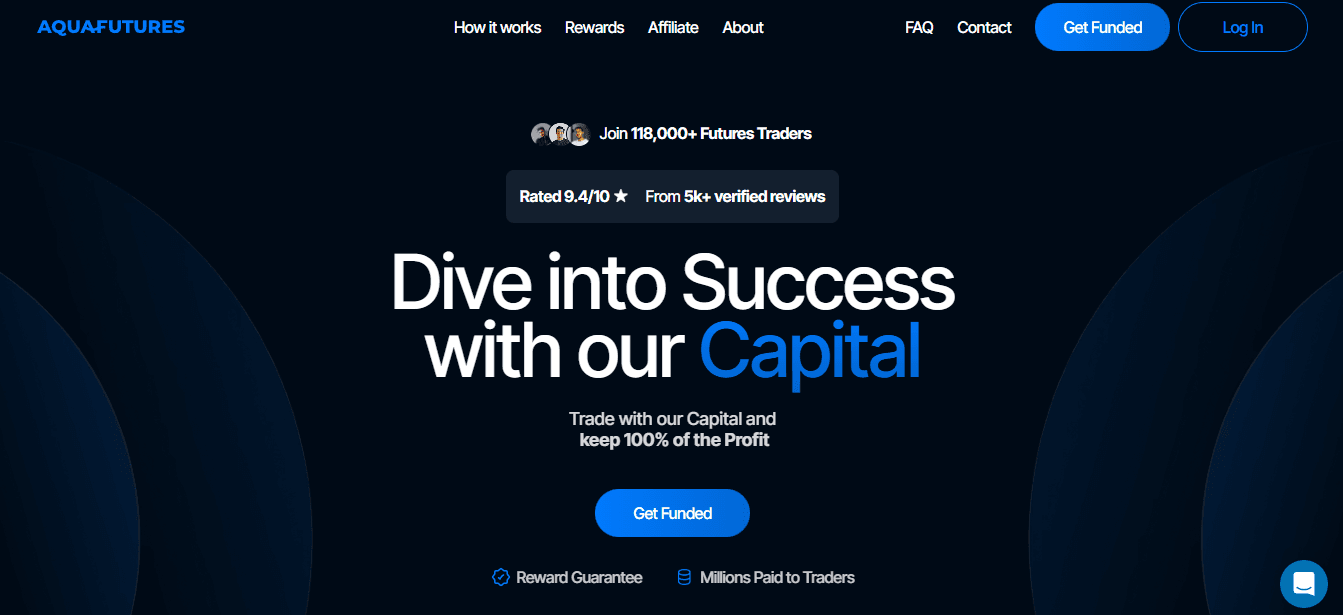
AquaFutures is a solid entry- to mid-tier option for Nigerian futures traders, prioritizing specialized tools and attractive cost reductions to help build funded accounts efficiently.
Key Features
- Primarily uses the Volumetrica Trading platform
- Provides max allocation reaching $450,000
- Delivers strong 60% off promotions for new challenges
- Caters to traders interested in detailed market analysis tools
- Maintains transparent rules aligned with futures trading needs
6. Blueberry Futures

Blueberry Futures is a contender for Nigerian traders, with limited but promising early feedback and highly competitive discounts that lower the entry cost of testing strategies.
Key Features
- Supports its proprietary or partnered platform setup
- Offers maximum funding up to $450,000
- Features one of the highest discounts at 65% off
- Aims at cost-conscious traders starting in prop futures
- Provides a straightforward path to funded status
7. FuturesElite

FuturesElite stands out as a promising futures prop firm for Nigerian traders in 2026, offering advanced analytical tools and substantial funding limits that appeal to those who prioritize order flow and detailed market insights in their strategies.
Key Features
- Supports specialized platforms such as Quantower, Volumetrica Trading, ATAS Orderflow Trading, and Tradovate
- Delivers maximum allocation up to $1.5 million
- Provides 40% discounts on evaluation challenges
- Emphasizes news trading flexibility and clear account rules
- Features fast account activation and supportive customer service
8. The Trading Pit Futures

The Trading Pit Futures provides Nigerian traders with extensive platform choices and robust scaling options, ideal for those who value multi-asset futures access combined with straightforward evaluation.
Key Features
- Integrates advanced tools including Jigsaw Daytradr, Tradovate, MotiveWave, Quantower, ATAS Orderflow Trading, Volumetrica, NinjaTrader, R Trader Pro, Volsys, Sierra Chart, and TradingView
- Offers maximum funding, reaching $1.25 million
- Includes 10% off promotions for challenges
- Allows flexible payout structures and fewer restrictive rules
- Supports trading on major futures exchanges with an efficient setup
9. Traders Launch

Traders Launch attracts Nigerian futures traders with its trader-centric policies, such as daily payouts and no hidden fees once funded, creating an environment that rewards consistency without unnecessary restrictions.
Key Features
- Compatible with Volumetrica Trading, Quantower, NinjaTrader, and Interactive Brokers
- Provides max allocation up to $900,000
- Offers 15% discounts via promo codes
- Features no consistency rules on funded accounts and uncapped potential
- Includes daily payout eligibility with zero activation fees post-challenge
Most traders spend weeks comparing features and discounts, but the real differentiator lies in how firms handle the inevitable challenges that arise after you pass the evaluation.
Related Reading
- Pass Ftmo Challenge
- Prop Firms That Use Mt5
- Best Prop Firms For Forex
- Best Prop Firms In Uae
- Proprietary Trading Firms In India
- Halal Prop Firm
- Best Prop Firms In South Africa
- Best Prop Firms In Uganda
- Best Prop Firms For Futures Trading
- Best Prop Firms For Options Trading
- Best Prop Trading Firms Malaysia
- Prop Trading Firms Singapore
How to Choose the Best Prop Firm as a Trader in Nigeria

Choosing the right prop firm requires evaluating five core dimensions: payout reliability, evaluation fairness, scaling transparency, platform quality, and support responsiveness. These factors determine whether you're joining a firm that views your success as its business model or one that extracts evaluation fees from traders who never reach funded status. The difference shows up not in marketing promises but in withdrawal processing speed, rule clarity, and how firms handle the gray areas where discretion replaces automation.
Start by verifying payout history through community feedback from Nigerian traders who've actually received funds. Screenshots of withdrawal confirmations, timeline discussions in trading forums, and patterns in complaint frequency reveal more than promotional materials ever will. A firm processing payments within 48 hours consistently demonstrates operational integrity. One citing "business days" without defining the number or imposing undisclosed verification steps signals potential friction ahead.
Profit Split Structures That Scale With Performance
Some firms offer up to 90% profit splits, but the split percentage alone does not tell the full story. The real question is how that percentage evolves as you demonstrate consistency. Static splits cap your earning potential regardless of performance. Dynamic structures that reward sustained profitability with improved terms align firm incentives with yours, creating a partnership rather than extraction.
80% profit splits are standard across reputable platforms and serve as your baseline for comparison. Firms offering less without compensating advantages in scaling, payout speed, or capital size deserve skepticism. Those providing paths to 90%, 95%, or 100% through performance milestones or add-ons demonstrate confidence in long-term trader retention over short-term fee collection. The split matters most when combined with withdrawal frequency. An 80% split paid daily or on demand generates faster compounding than 90% paid monthly with three-week processing delays. Calculate effective returns by multiplying the split percentage by payout velocity. That product reveals which firms actually maximize your earnings versus those hiding slow processing behind attractive percentages.
Evaluation Rules That Test Skill Without Arbitrary Traps
Challenge structures separate legitimate assessment from revenue optimization disguised as testing. Reasonable profit targets (8-10% in phase one, 5% in verification) paired with proportional drawdown limits (5% daily, 10% total) create achievable benchmarks for disciplined traders. Targets exceeding 12% or drawdown limits below 4% daily shift odds toward firm profitability through repeated evaluation fees rather than trader funding. Time limits introduce artificial pressure unrelated to trading skill. Markets don't care whether you hit targets in 30 days or 90. Firms imposing strict deadlines optimize for impatience and emotional decision-making, the exact behaviors that destroy accounts post-funding. No time limit or generous windows (60+ days) let you execute your strategy based on market conditions rather than calendar anxiety.
Hidden consistency rules create the worst friction. Some firms require minimum trading days, specific profit distribution patterns, or subjective "trading behavior" assessments that are never disclosed in the initial terms. These clauses give firms discretionary power to deny payouts or terminate accounts based on criteria you can't predict or control. Transparent firms publish every rule upfront, define terms precisely, and automate compliance tracking so you know your standing in real time.
Platform Reliability and Execution Quality
The broker handling your trades determines whether your edge translates into profits or gets eroded by slippage, requotes, and execution delays. Firms partnering with regulated entities holding FCA, ASIC, or CySEC licenses provide accountability and oversight absent in offshore arrangements. Verify the broker's identity, independently check regulatory status, and confirm the firm doesn't obscure this information behind vague "liquidity provider" language.
Spread quality matters more than most traders realize until they're funded. Raw spreads starting at 0.1 pips on major pairs versus 1.5 pip markups create meaningful profit differences across hundreds of trades. Commission structures (fixed per lot versus percentage of trade size) affect strategy viability, particularly for scalpers executing high-frequency setups. Zero commissions on indices and crypto, as offered by some platforms, expand profitable strategy options without additional cost layers.
Platform diversity accommodates different analytical approaches. Traders seeking to build an edge through order flow need access to tools such as Volumetrica or ATAS. Those relying on custom indicators require NinjaTrader or TradingView compatibility. Mobile functionality becomes critical in Nigeria, where power and connectivity challenges make desktop-only platforms operationally risky. Firms that support multiple platforms and device types reduce the technical barriers that hinder consistent execution.
Scaling Programs That Reward Consistency
Account growth potential determines long-term earning capacity. Starting at $50,000 with no scaling path caps your income regardless of skill. Firms that offer progression to $200,000, $500,000, or higher based on performance milestones create compounding opportunities that mirror traditional prop desk advancement without geographic or institutional barriers. Most traders focus on evaluation fees and profit splits while ignoring how firms manage the transition from passing challenges to receiving capital. Some impose activation fees, require additional documentation, or delay account access through unexplained verification periods. Others activate accounts within hours of passing, process first withdrawals immediately to establish trust, and provide clear timelines for every operational step. That operational transparency predicts how firms handle the inevitable edge cases where rules meet real-world complexity.
Prop firm demonstrates this approach through instant account activation post-challenge, two-business-day payout guarantees with $500 in compensation for delays, and scaling programs that reach $2 million in simulated capital. These operational commitments, backed by proprietary technology rather than third-party infrastructure, remove the friction points that cause traders to question whether firms actually want them to succeed.
Support Responsiveness When Problems Arise
Customer service quality reveals firm priorities. Platforms staffing 24/7 support with knowledgeable representatives who resolve issues within hours, and treat traders as partners. Routing inquiries through ticket systems with multi-day response times or generic responses that ignore specific questions is viewed as a cost center rather than a retention tool.
Test responsiveness before committing funds. Ask specific technical questions about platform compatibility, withdrawal processes, or rule interpretations. Firms providing detailed, accurate answers quickly demonstrate operational competence. Those who offer vague responses, contradict their own documentation, or pressure you to initiate challenges without answering questions signal trouble ahead.
Community presence matters. Firms maintaining active Discord servers, Telegram groups, or forums where traders share experiences and staff engage directly create transparency that isolated operations can't match. You see real withdrawal confirmations, learn how others navigate challenges, and identify patterns in firm behavior that marketing materials never reveal.
Cost Structure and Promotional Transparency
Evaluation fees ranging from $100 to $500 represent your risk capital. Refundable structures (100% back on first payout) reduce effective cost to zero for successful traders, making the fee a deposit rather than an expense. Non-refundable fees shift economics toward firm profitability through volume rather than trader success, particularly when combined with high failure rates. Promotional discounts (25-65% off) make evaluation accessible but require verification. Some firms rotate offers continuously, suggesting inflated base pricing. Others provide targeted discounts during specific periods while maintaining consistent standard rates. Transparency around pricing, clear expiration dates, and no-pressure tactics indicate that firms are confident in their value proposition rather than optimizing for impulse purchases.
Hidden fees destroy trust faster than any other factor. Activation charges, monthly platform fees, withdrawal processing costs, or currency conversion markups that are never disclosed upfront turn attractive terms into mediocre deals. Firms that publish complete fee schedules, including all potential charges and when each applies, demonstrate respect for informed decision-making. The firms that survive long-term understand a simple truth: your success funds their growth, your failures fund their operations. The ratio between these determines whether they're building a sustainable business or extracting maximum value before reputation catches up. Choose accordingly. But knowing what to look for only matters if you can actually access these opportunities at a price that makes economic sense.
Get 25-30% off Today - Sign up to Get Access to Up to $800K Today
Finding the best prop firm in Nigeria means securing access to capital that arrives when promised, rules that don't shift after you pass evaluations, and growth paths that reward your consistency instead of resetting you to square one. Most firms talk about trader success while designing systems that profit more from your failures than your wins. The gap between marketing promises and operational reality determines whether you're building a trading career or funding someone else's business model through repeated evaluation fees.
Goat Funded Trader removes the friction points that most frustrate Nigerian traders. You access simulated accounts scaling to $800,000 through performance-based progression, not arbitrary timelines or hidden requirements. The firm guarantees payouts within two business days or adds $500 to your withdrawal, eliminating the uncertainty that makes international platforms feel risky. No minimum profit targets on funded accounts means you can trade your strategy without artificial pressure to hit monthly benchmarks that lead to overtrading. No time limits on challenges let you execute based on market conditions rather than calendar anxiety.
Over 98,000 traders have collected more than $9.1 million in verified payouts, demonstrating operational scale beyond promotional claims. The platform offers multiple entry paths. Choose customizable evaluation challenges to demonstrate consistency under defined parameters. Select instant funding options if you prefer immediate capital access with stricter ongoing rules. Triple payout schedules in select programs, with profit splits reaching 100%, compress the feedback loop between performance and reward, allowing you to compound gains faster than monthly withdrawal structures.
Current promotions offer 45% off evaluation fees, lowering the barrier for Nigerian traders navigating currency-conversion challenges and limited local capital access. If you're tired of firms that delay withdrawals through unexplained verification processes, impose consistency rules never mentioned in initial terms, or cap your growth despite sustained profitability, Goat Funded Trader delivers the transparency and reliability that separate legitimate partnerships from fee extraction models. Sign up today to claim your discount and start your path to funded trading with a firm that treats your success as their business model, not a marketing slogan.
Related Reading
• Ftmo Vs Topstep
• My Forex Funds Vs Ftmo
• Surgetrader Vs Ftmo
• Topstep Vs Apex
• Bulenox Vs Apex
• Balance-Based Drawdown Prop Firms
• Best Prop Trading Firms For Stocks
• Prop Firms That Allow Ea
• Prop Firms In Ghana
• Take Profit Trader Vs Topstep
• Prop Trading Firms Toronto
Be Great and get the App