


Trading Tips

12 Best Prop Firms for Futures Trading in 2026

Discover the best prop firms for futures trading in 2026. Goat Funded Trader reviews top firms with competitive funding and profit splits.

Traders can access substantial capital without risking personal savings through funded accounts, which provide professional backing for futures trading across markets such as the E-mini S&P 500, crude oil, and gold. These arrangements allow skilled traders to demonstrate their abilities while following strict risk management protocols. Understanding what a funded account is is crucial for traders seeking to build consistent profits without risking their own finances.

Successful funded trading requires choosing firms that offer transparent evaluation processes and flexible account structures suited to different experience levels. The best programs focus on a trader's ability to follow risk management rules and maintain consistent performance rather than creating unnecessary barriers to entry. Traders seeking access to professional capital and support structures should carefully evaluate each prop firm to find the right fit for their trading style and goals.

Summary

  • Futures prop firms eliminate the capital barrier by funding traders who can demonstrate consistent performance within strict risk parameters. The model works because it aligns incentives: firms profit only when traders succeed, creating genuine support structures rather than superficial resources designed solely to collect evaluation fees.
  • Evaluation pass rates hover between 5% and 15% according to industry data, not because the challenges are impossibly difficult, but because most traders attempt them without adequate preparation. Those who spend months in simulation, tracking every trade and refining their approach under identical rule constraints, pass at significantly higher rates than those rushing in after a few weeks of demo trading.
  • Drawdown structures determine how much breathing room you have during volatile periods, with static limits measuring from the starting balance, while trailing versions adjust upward as accounts grow. A 5% trailing drawdown on a $100,000 account means your floor rises to $104,500 after reaching $110,000, rewarding progress while punishing backsliding in ways that reshape risk management habits.
  • Profit splits advertised at 80% to 90% can drop to 75% or lower once firms deduct platform fees, data costs, and monthly charges from your share. Calculating net retention by working backward from hypothetical payouts reveals the actual economics, where a seemingly minor 2.5% difference costs you $500 on a $20,000 withdrawal.
  • Single-step evaluations compress the proving period into one phase, demanding immediate consistency, while two-step formats separate aggressive profit targets from sustained performance requirements. Scalpers and day traders who close all positions before market close often prefer compressed timelines, but swing traders holding overnight need multi-step formats that accommodate slower profit accumulation and larger drawdowns inherent to their timeframe.
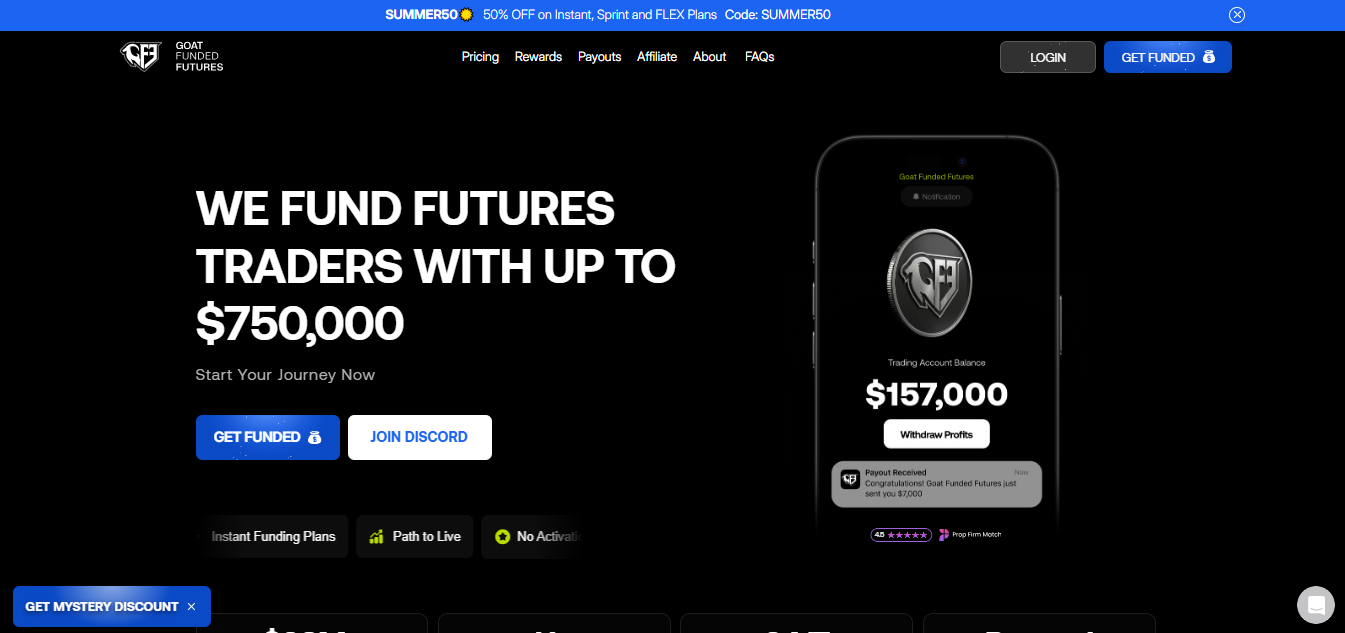
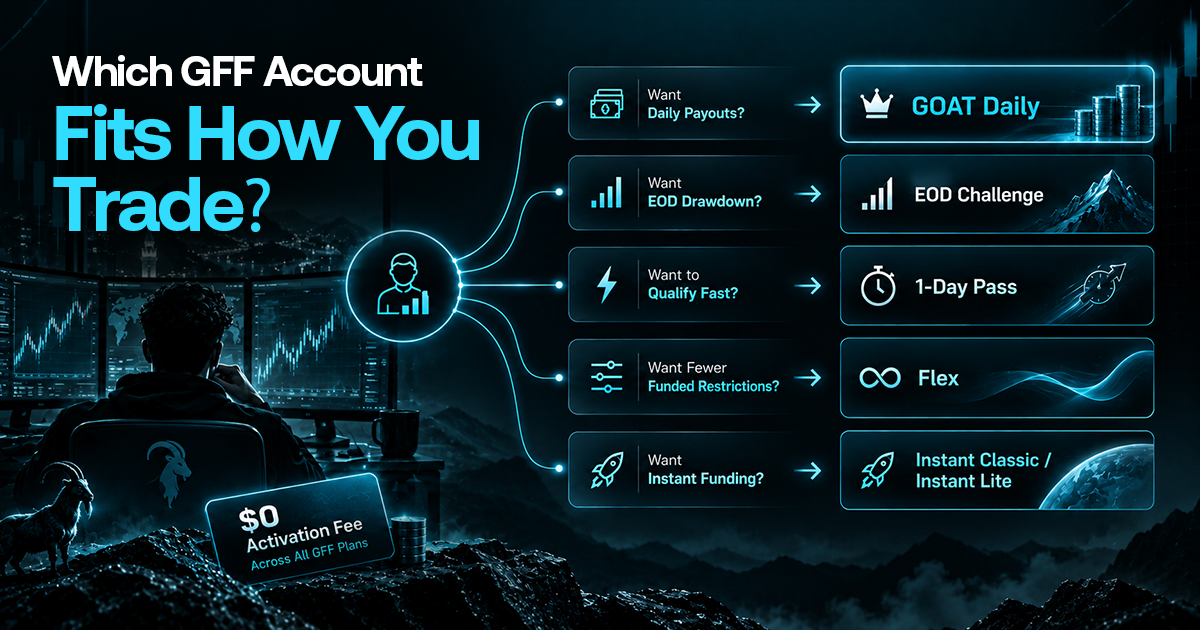
  • Goat Funded Trader addresses capital access challenges by offering evaluation structures ranging from one-step challenges to instant funded accounts that bypass assessments entirely, with scaling paths up to $2 million and profit splits reaching 100% through add-ons that give traders control over retention versus evaluation flexibility.

What are Futures Prop Firms, and How Do They Work?

Futures prop firms provide traders with capital to trade futures contracts without personal financial risk. The firm takes a share of profits while absorbing potential losses up to defined limits, transforming trading from an individual financial venture into a performance-based partnership where discipline and consistency are key.

Key Point: This partnership model eliminates the biggest barrier to futures trading - the need for substantial personal capital while maintaining strong incentives for disciplined trading.

Balance scale showing trader's skill and prop firm's capital as equal partners

This model aligns incentives perfectly: traders gain leverage and opportunity, while firms access skilled individuals who generate returns using company resources. Both sides benefit when the trader adheres to rules, manages risk intelligently, and delivers consistent results. "Prop trading represents a fundamental shift from individual risk-taking to performance-based partnerships, where skill and discipline matter more than personal wealth." — Trading Industry Analysis, 2024

Central hub showing connections between trader, capital, opportunities, and returns

Takeaway: Futures prop firms create a win-win scenario where talented traders can access institutional capital while firms diversify their trading strategies through multiple skilled performers.

How does the funding model eliminate capital barriers?

Traditional brokerage accounts require personal money, while futures prop firms fund your account after proving your skills. You trade with their money under real-time performance tracking, with risk controls protecting their capital. Payouts depend on net profits after meeting specific requirements. This model eliminates the capital barrier most traders face. Instead of slowly building a personal account, traders can access up to $150K in Goat Funded Trader funding, enabling larger position sizes and profit potential that would otherwise take years to achieve.

What accountability measures do the best prop firms for futures trading enforce?

The trade-off is strict accountability. Companies enforce guidelines around daily loss limits, maximum drawdowns, and position sizing. Breaking a rule results in account closure, but consistent performance allows traders to request payouts within days while continuing to trade and scale.

The Evaluation Phase

Before capital is allocated, companies need proof of responsible trading through an evaluation phase. This simulated trading environment tests traders using virtual funds, typically requiring a 6-10% return over a set period and a minimum number oftrading days to ensure genuine skill, not chance.

What are the costs and risks during evaluation?

Traders pay an upfront fee of $100-$500 to enter this phase, which covers simulation costs and serves as their sole financial risk. Passing enables progression to a funded account; failing permits resetting and reattempting for an additional charge.

How do the best prop firms for futures trading assess performance?

The evaluation reflects trading pressure without risking real money. Traders experience live market conditions and emotional challenges while companies check strategy consistency. A single lucky trade won't work; steady, reliable performance across multiple sessions is crucial.

Transitioning to a Funded Account

After passing the evaluation, Goat Funded Trader assigns trading capital to your account. These accounts start as practice accounts that trade against real market data using virtual money. Your earnings can be converted to cash when you meet specific withdrawal requirements, such as a minimum number of winning days or profit thresholds.

How do the best prop firms for futures trading monitor performance?

Goat Funded Trader tracks every trading position, monitors rule compliance, and calculates net profits after fees. As performance improves, some firms offer scaling plans that increase buying power, rewarding consistent results with access to larger positions. This progression encourages disciplined growth over risky, quick-win strategies.

What psychological challenges come with funded status?

Achieving funded status can create substantial psychological stress. One trader shared how they abandoned careful risk management after passing the evaluation, revealing a common challenge. The same discipline that earned funding must maintain it.

How do profit splits work in funded trading accounts?

Profit sharing typically favors the trader, with most firms offering 80-90% splits in the trader's favor. The remaining percentage compensates the company for providing capital, technology, and support. This high retention rate attracts confident traders willing to work within defined boundaries.

What are the payout requirements for the best futures trading prop firms?

Payouts begin once a minimum amount ($100-$500) is reached, preventing traders from making small, frequent withdrawals. Traders often discover that non-trading days or missed losses can delay profit withdrawals. Patience is crucial in this process.

How do prop firms generate revenue from funded accounts?

Goat Funded Trader generates revenue from evaluation fees, reset charges, and profit shares. This business model succeeds only when traders generate consistent gains, indicating that reputable firms prioritize traders' long-term performance, not justupfront fees.

Risk Management and Rule Enforcement

Daily loss limits set a cap on how much money you can lose in one trading session, typically 2-5% of your total account balance 2-5% of your account balance. Trailing drawdowns adjust as your account increases, helping to secure gains while protecting overall capital. These strategies help traders focus on long-term success instead of chasing quick profits.

How do consistency rules protect the best prop firms for futures trading?

Consistency rules require profits to be distributed over multiple days to avoid situations where a single large win masks an unstable trading approach. Position sizing limits control risk exposure for each trade, with automated systems tracking compliance in real time. Breaking a rule, even once, results in the account being closed.

Why does structured risk management benefit long-term trading success?

This framework might seem limiting at first, especially for traders accustomed to trading without clear guidelines. However, the structure compels you to develop habits that distinguish successful traders from those who ultimately lose their capital. Cutting risk by half when moving from evaluation to funded status recognizes that protecting capital is more important than pursuing aggressive profits.

Challenges Traders Face

The failure rate during evaluations is high. Strict rules can disqualify even skilled traders for small mistakes, leading to repeated reset fees. This creates significant emotional stress for traders as they try to balance performance expectations with tight constraints. During unprofitable periods, income isn't guaranteed, and long stretches without meeting withdrawal requirements can test a trader's patience.

How do simulated environments affect trading performance?

Simulated trading doesn't mirror real market execution. Differences in slippage, latency, and order fill rates can create false confidence or mask problems that only emerge when real money is at stake. Choosing a trustworthy trading platform is crucial, as some firms design their rules to prioritize account resets over helping traders succeed.

What market risks do the best prop firms for futures trading present?

Market volatility remains a significant challenge. Futures contracts can shift quickly, and focused traders may reach loss limits during sudden price changes. Without a guaranteed income, traders must build financial stability outside of trading to support themselves during their learning journey.

How can traders overcome these obstacles?

Traders who work through these challenges often find that the structure helps clarify their approach: building small, consistent profits rather than pursuing high-risk trades becomes the primary goal. Discipline, patience, and consistency are core values. The prop firm model doesn't simplify trading, but it enables responsible traders to access capital. Understanding how funding works is part of the picture: the rules that govern each trade determine whether you keep that capital or lose it.

Related Reading

What Are The Rules For Trading Futures At Prop Firms?

Trading futures at proprietary trading firms follows specific guidelines that protect investment capital and help identify skilled traders. These rules govern daily loss limits, permitted trading methods, and performance standards, prioritizing steady results over unpredictable, large profits. At Goat Funded Trader, our proprietary firm model helps traders demonstrate consistent performance while maintaining strict risk-management protocols. The system helps firms recognize professional traders and distinguish them from high-risk speculators.

Shield representing risk management and capital protection in prop trading

Key Point: Prop firms prioritize consistent profitability over aggressive trading strategies that could jeopardize firm capital. "Successful prop traders maintain strict risk management with typical daily loss limits ranging from 3-5% of their allocated capital." — Industry Analysis, 2024

Central hub showing connected trading management elements

Essential Rules: Most prop firms enforce maximum daily drawdown limits, specify trading hours, and mandate position-sizing requirements to ensure responsible capital management.

How do profit targets demonstrate strategic thinking ability?

Reaching specific profit targets demonstrates the ability to generate returns without risky trading. Most companies require gains of 6% to 10% on the account balance during the evaluation or funded phases, with adjustments based on account size and futures contracts. A $50,000 account might require $3,000 in profits before qualifying for payouts, encouraging traders to build small, consistent gains rather than pursue large, one-time wins.

Why do the best prop firms for futures trading test market adaptability?

These targets reveal how your strategy performs across diverse market conditions. Energy futures behave differently from stock market indexes, and a trader who navigates both demonstrates critical flexibility. The need to spread profits across multiple trading sessions prevents situations in which a single big win masks an unpredictable approach. You get rewarded for carefully building consistent wins, not getting lucky once.

How do drawdown limits function as protective mechanisms?

Drawdown restrictions limit how much an account can decline from its highest value, serving as an automatic safety mechanism when losses escalate. Static drawdowns track declines from the original balance, while trailing versions move up with profits, protecting gains and raising the safety limit. If the account exceeds any preset loss limit, it closes immediately, with no opportunity to continue trading.

Why do the best prop firms for futures trading emphasize trailing drawdowns?

In futures trading, where leverage amplifies market movements, these limits separate traders who cut losses quickly from those who hold on to hope. A 5% trailing drawdown on a $100,000 account stops you from losing more than $5,000 from the highest point. If you earn $8,000 in profits, your new limit goes up to $103,000, not back to the original $95,000. This approach rewards progress while protecting your money, making capital preservation a key trading strategy.

How does approaching a drawdown limit change trading behavior?

The psychological effects of approaching a trading account's drawdown limit can alter traders' decision-making. One trader explained that when nearing their account's performance threshold, they reduced trade size and avoided risky setups: actions they should have taken earlier but only implemented when facing potential account disqualification. This uncomfortable pressure helps develop crucial trading discipline.

Daily Loss Caps That Prevent Spirals

Daily loss limits set a strict stop on single-session losses, usually capping declines at 1% to 2% of your account. When you hit that number, you stop trading for the day. This rule prevents emotional trading cycles that begin with a bad decision and escalate into revenge trades and a stubborn refusal to accept reality.

Why do the best prop firms for futures trading enforce daily caps?

Futures markets change quickly. Sudden news or sharp market shifts can cause losses that escalate as you attempt recovery. The daily limit requires you to pause trading, step back, and return with a fresh perspective rather than keep losing money. This rule prevents wiping out your entire trading account in one session.

How do you implement daily loss limits effectively?

Implementing this requires setting a predefined risk amount for each trade, calculated before entering any position. If your daily loss limit is $1,000 and you're willing to risk $200 per trade, you'll know exactly how many trading attempts you can make before hitting your boundary. This approach transforms risk management from an abstract concept into a concrete, actionable plan.

Consistency Rules That Expose Gamblers

Consistency rules show that profits stem from reliable skills, not random luck. Some companies limit total earnings on any single day or trade to 30-40%, preventing situations where a single big win could mask ongoing losses.

How do the best prop firms for futures trading verify trader skill?

The rule requires traders to demonstrate that their strategy works across multiple trading opportunities, not only in ideal situations. Traders often fail evaluations because their profits are concentrated in high-risk trades rather than being consistent. Companies want traders who can reproduce results when market conditions change, volatility shifts, or preferred trading approaches are unavailable.

What trading approach do consistency requirements create?

This requirement changes how traders approach strategy: focus on smaller, consistent advantages that compound over time. It's like the difference between hitting one big home run and getting steady base hits across several innings, showing you're a reliable player who can consistently perform in the game.

Why do minimum trading days prevent rushed evaluation?

Minimum trading days, ranging from 5 to 10 sessions, help traders evaluate their strategy across different market conditions rather than rushing through a single strong week. This approach prevents traders from timing the market or selecting only the best setups. It requires traders to demonstrate the consistency of their strategy across various market states. A trading strategy's reliability cannot be proven in just a few days.

How do maximum-day limits create urgency for the best prop firms in futures trading?

Maximum day trading limits, typically between 30 and 60 sessions, create urgency without allowing traders to delay indefinitely. This approach prevents hasty decisions and delays action, while establishing a focused period during which traders must work efficiently and adapt to current market conditions, particularly for futures traders.

What makes the evaluation window reveal genuine trading skill

The mix of minimum and maximum trading days creates a precise evaluation zone where trading skill becomes clear. With too few days, luck controls the results; with too many days, traders might game the system. This window forces traders to show the true performance of their strategy, not an ideal simulated scenario.

How do leverage caps prevent catastrophic losses?

Leverage caps limit trade amplification and are typically set at ratios of 1:10 or lower. This prevents financial disasters in volatile futures markets. A 1% move in crude oil can swing an account by 10% at 10x leverage, and companies recognize that excessive amplification can turn manageable losses into account-ending events.

What position sizing rules do the best prop firms for futures trading enforce?

Position sizing rules are closely linked to leverage, which limits contract holdings based on account equity and investment volatility. For high-volatility products such as natural gas, you may be limited to one contract per $10,000 in your account balance. This approach requires scaling trades proportionally as your account grows, supporting sustainable investment strategies while preventing risky, all-in trades.

How do you consistently calculate proper position sizes?

Calculating the right trade sizes requires understanding average true range, contract details, and personal risk tolerance. While software tools can help automate these calculations, consistently following trading rules distinguishes successful funded traders from those who struggle. The math is simple; the real challenge is applying these principles during high-stress trading moments.

News Trading Restrictions That Manage Chaos

Many companies prohibit trading during significant economic announcements, such as non-farm payrolls, Federal Open Market Committee (FOMC) decisions, and GDP releases. These rules require traders to have flat accounts before scheduled events. The restrictions help prevent news-driven market volatility that can lead to unpredictable price gaps, slippage, and execution issues.

Why do the best prop firms for futures trading implement news restrictions?

A trading position during a sudden interest rate increase can quickly trigger daily loss limits, account drawdown thresholds, and margin calls in seconds. The rule requires you to pause trading when market outcomes appear conclusive, and price movements no longer align with your technical analysis strategies. Rather than betting on market direction, you wait for clear post-event information, then trade emerging trends with balanced risk and reward. The goal is to avoid situations in which trading skill becomes meaningless, and chance determines financial survival.

How can traders adapt to news trading restrictions effectively?

Adapting requires tracking the economic calendar and planning around major announcements, treating them as times to avoid trading. This helps build patience, turning potential risks into planned breaks that let you approach markets when strategy matters more than timing.

Prohibited Strategies That Enforce Ethics

Certain trading approaches are prohibited to prevent manipulation and excessive risk. Martingale systems, which double position sizes after losses, guarantee eventual account destruction. High-frequency automation that exploits platform delays or creates artificial volume gets flagged and disqualified. Copy trading tools that replicate others' positions without independent analysis do not meet the requirement to demonstrate personal skill.

Why do the best prop firms for futures trading emphasize genuine expertise?

These restrictions exist because companies want traders who can think critically, not systems that exploit rules. Manual trading or rule-based methods that prioritize careful analysis over automated processes align with this approach, rewarding genuine skill over technical tricks. The goal is to ensure funded trading accounts go to people who understand what they're doing.

How do scaling plans reward trader progress?

Account growth occurs through scaling programs that increase capital allocation once specific milestones are met. A trader who reaches 10% returns without violations might unlock access to a larger account, doubling their buying power and profit potential. At Goat Funded Trader, this progression rewards steady performance, creating a path to meaningful income.

What payout structures do the best futures trading prop firms offer?

Payout schedules typically occur biweekly, with profit splits ranging from 80% to 90% after traders meet the minimum net gain requirement of $100 to $500. These arrangements ensure success for both traders and trading firms, providing traders with consistent income while maintaining financial stability. The combination of performance scaling and regular payouts transforms funded trading from a single opportunity into a potential professional career for dedicated traders.

How do firms handle virtual funds and real payouts?

Most companies manage this through practice accounts on the back end, executing trades against real market data using virtual money until earnings convert profits into cash. If you follow the rules and generate consistent gains, the money becomes real regardless of the technical system's setup.

Inactivity Policies That Demand Commitment

Inactivity rules require at least one trade every 30 days to keep your Goat Funded Trader account active and prevent unused funds from sitting idle. This policy ensures traders stay engaged and maintain their trading skills. If you don't trade regularly, your Goat Funded Trader account may be closed, underscoring the importance of consistent trading participation.

How do the best prop firms for futures trading handle slow market periods?

For traders, this means staying connected to markets during slow periods and taking smaller positions to meet activity requirements when ideal setups aren't available. It's a forcing function that prevents market disconnection and ensures funded accounts remain with active participants. But even the clearest rules mean nothing if you aren't ready to follow them.

Are Futures Prop Firms Suitable for Beginners in Trading?

Contrary to popular belief, futures trading isn't for wealthy, experienced traders only. Proprietary trading companies like Goat Funded Trader are changing the industry by offering funded accounts and support systems that help newcomers trade real markets without personal financial risk.

Shield protecting and enabling new traders in futures markets

The futures prop trading sector, worth $6.7 billion in 2020, is expected to grow at a 4.2% annual rate through 2028, revealing opportunities for new traders to enter and learn the market.

Key Point: Prop firms are democratizing futures trading by removing the capital barrier that traditionally kept beginners out of the market.

Upward arrow showing futures trading market growth from $6.7 billion in 2020

"The futures prop trading sector, worth $6.7 billion in 2020, is expected to grow at a 4.2% annual rate through 2028." — Investing.com Analysis, 2025

Takeaway: This steady growth indicates that prop firms are successfully creating sustainable pathways for new traders, making futures trading more accessible than ever before.

Funnel transforming traditional trading barriers into accessible trading opportunities

Why do traditional futures accounts limit most traders?

Traditional futures trading demands substantial personal capital. A $5,000 account trading micro contracts might earn $200 per week, while full contracts require $25,000 in regulatory minimums and another $10,000 in potential losses. Most beginners lack this extra cash, forcing them to trade with limited funds, where losses feel devastating, or preventing them from trading altogether.

How do the best prop firms for futures trading change this model?

Prop trading firms are transforming the investment landscape. By paying $150 to $500 for an evaluation, traders can access $50,000 in buying power. This leverage allows traders to work with standard contracts from the start, providing experience with real market conditions without years of saving. The psychological impact is profound: managing company funds compels traders to think like professionals rather than amateurs hoping for a lucky break. At Goat Funded Trader, our evaluation program helps traders transition to a professional role smoothly.

What opportunities does this create for working professionals?

This method makes futures trading more accessible by shifting the focus from wealth to skill. Now, someone with a full-time job can practice trading strategies during free time, pass an evaluation with Goat Funded Trader, and start earning money without risking personal savings or leaving their current career.

The Evaluation as Training Ground

The combine phase helps traders in two key ways: it screens out unprepared traders and teaches risk management in a safe setting. During this stage, you'll trade using live market data and virtual money, experiencing real market changes without risking actual funds. If you hit a daily loss limit, your trading session stops. If you exceed a specific drawdown limit, you must reset your account. These rules protect traders from making financial mistakes that could destroy a personal trading account.

What do the best prop firms for futures trading actually look for?

Beginners often misunderstand evaluations as demanding aggressive profit-making. In truth, companies seek steady, consistent gains across multiple trading sessions, not a single large win followed by unpredictable losses. This requirement pushes traders to develop a consistent strategy that works regardless of market conditions: whether the market is trending, choppy, or gapping overnight. You can't trick the evaluation by waiting for favorable markets; you must trade your actual strategy regardless of the conditions.

How do consistency rules separate successful traders from gamblers?

One trader learned this lesson at a high cost: they quickly moved through their first Goat Funded Trader evaluation, reaching profit goals in three days, but then failed by breaking consistency rules after 80% of gains came from one trade. The $200 account reset and the month of practice showed them that trading firms want traders who can repeat results under changing conditions, not gamblers who get lucky once.

Education Without the Tuition

Most prop trading firms include training resources in their packages because trader success directly affects their profits. Webinars on risk management, strategy guides for futures contracts, and online community forums where funded traders share insights become available after you join. These firms make money when traders succeed, so they have a strong incentive to help traders learn beyond the evaluation fees they charge.

How do the best prop firms for futures trading accelerate learning?

For beginners, this ecosystem accelerates learning beyond solo trading. You're not figuring out position sizing through trial and error, but following frameworks developed by experienced traders. You're accessing research that breaks down contract-specific behaviors and optimal entry conditions. Available mentorship provides feedback loops that turn abstract concepts into actionable adjustments.

How does this compare to traditional brokerage accounts?

Compare this to traditional brokerage accounts, where you're given a platform and expected to learn on your own. Educational materials are available, but they're often generic and designed to generate sales commissions. At Goat Funded Trader, prop trading firms succeed only when their traders succeed, so they build substantive support systems rather than shallow resources.

Where Beginners Actually Struggle

The failure rate stems from preparation, not intelligence or dedication. Most traders sign up for evaluations after minimal demo trading, believing they've mastered the basics. They lack critical risk management skills, tested strategies, and experience with the emotional pressure of potential drawdowns. The Goat Funded Trader evaluation quickly reveals these fundamental gaps.

Why do the best prop firms for futures trading have such low pass rates?

The 10% pass rate indicates that traders are not preparing well, rather than that the test is hard. Traders who track and improve their skills in practice tests are more likely to succeed. Those who jump in with basic knowledge from online videos typically fail. The key difference is careful, patient preparation, not natural skill.

How does psychological pressure affect evaluation performance?

Mental stress deeply affects traders. The potential for a single bad decision to end a trading evaluation creates intense psychological pressure that practice accounts cannot simulate. Traders constantly doubt entry points, delay exit strategies, and overanalyze market positions. At Goat Funded Trader, our professional mentorship programs help turn this pressure into a learnable skill, separating successful traders from those who break down under professional scrutiny.

How should you prepare before choosing the best prop firms for futures trading?

Start with three months of simulation trading, tracking every position in a journal. Write down your entry logic, exit reasoning, and emotional state to reveal hidden patterns like overtrading after losses or cutting winners too early. Use the same risk parameters as your evaluation conditions (2% daily loss limits, 5% trailing drawdowns) to ensure realistic practice. Research firms through independent reviews that analyze rule structures, payout timelines, and support quality. Don't choose based solely on evaluation cost: a $100 challenge with predatory rules can be more expensive than a $300 evaluation from a reputable firm. Read trader testimonials, verify payout proof, and confirm that the firm's success depends on your trading performance.

What risk management strategies work during evaluations?

During evaluation, cut your typical risk by half. If you typically risk 1% per trade, reduce it to 0.5% to create a psychological buffer and prevent limit breaches. Prioritize consistency over maximum profits: achieving a 6% target over ten days is more valuable than chasing an 8% target in three sessions through a single lucky trade. Programs like a prop firm offer evaluation structures that protect beginners while rewarding steady performance. Many traders find that starting with smaller account sizes during evaluation reduces pressure and builds confidence before scaling to larger capital allocations.

The Reality of Funded Trading

Passing the evaluation doesn't guarantee income. You still need to generate consistent profits within the boundaries that earned your Goat Funded Trader funding. Many beginners assume the hard part is over, only to discover that maintaining discipline over months is more challenging than a two-week evaluation.

What psychological challenges do funded traders face?

Being overconfident after initial success, discouraged by minor setbacks, and frustrated during slow periods can jeopardize your Goat Funded Trader investment status.

How do payout requirements work with the best prop firms for futures trading?

Payouts with Goat Funded Trader require meeting minimum thresholds, typically $100 to $500 in net gains and a specified number of winning trading days. This means traders can't withdraw money after a single profitable session. Instead, they must demonstrate sustained performance, encouraging focus on results over weeks and months rather than on individual trades. Some beginners find this approach frustrating, as they initially expect instant access to their profits.

Why do prop firms require regular trading activity?

Inactivity policies require at least one trade every 30 days to prevent funded accounts from becoming idle. This requirement keeps traders connected to market conditions and enables them to adapt to shifts in volatility and contract behavior. It ensures capital goes to active traders rather than those who passed an evaluation and stopped participating.

When do prop firms make sense for traders?

If you have a proven strategy and can follow rules consistently, prop firms like Goat Funded Trader speed up your path to meaningful capital. You're trading standard contracts within months instead of years, building a track record that proves competence without risking personal savings. The structure encourages good habits, and the potential earnings make the effort worthwhile. If you're hoping to learn to trade from scratch, prop firms can be costly and frustrating. The evaluation isn't a tutorial, but a filter. You need foundational skills before attempting it: months of simulation, strategy development, and emotional conditioning. Skipping that preparation guarantees failure and repeated reset fees.

Are the best prop firms for futures trading suitable for beginners?

For serious beginners, prop firms offer the most accessible path into professional futures trading. The model isn't perfect, but it's better than spending years self-funding small accounts with slow progress. You're either committed to developing real skills, or you're not. The evaluation makes that distinction clear faster than any other method. But understanding that the model works only for prepared beginners matters only if you can identify which firms deliver on their promises.

12 Best Prop Firms for Futures Trading in 2026

The professional trading market has become a competitive environment where companies differentiate themselves through evaluation methods, profit-sharing, platform adaptability, and growth opportunities. Selecting the right firm means understanding which operational details align with your trading approach, risk tolerance, and income objectives. Some companies now offer 200% refunds on evaluation fees after traders become funded, highlighting the intense competition for skilled traders. This overview explores 12 leading firms in 2026, each offering unique benefits.

Key Point: The futures prop trading landscape has become increasingly competitive, with firms offering unprecedented incentives, such as 200% refunds of evaluation fees, to attract top talent. "Some companies now offer 200% refunds on evaluation fees after traders become funded, showing how intense the competition is for skilled traders." — Market Analysis, 2026

Warning: With so many attractive offers available, it's critical to look beyond flashy incentives and focus on long-term sustainability, platform reliability, and actual profit-sharing structures when choosing your prop firm.

Top 3 prop firms ranked on trading platform performance

1. Goat Funded Trader

Goat Funded Trader

Goat Funded Trader supports futures traders by offering access to substantial simulated capital up to $2 million through flexible evaluation programs and instant funding options. While primarily enabling trading in forex pairs, stocks, ETFs, and crypto pairs, it actively engages the futures community through dedicated educational content on futures strategies, leverage, swing trading, platforms, and capital requirements.

This approach helps futures traders build skills, test risk management, and scale performance in a low-risk environment before transitioning to dedicated futures prop setups or live markets. With features such as on-demand payouts and up to 100% profit share, no time limits on challenges, and flexible rules for news and weekend holding, Goat Funded Trader appeals to futures-oriented traders seeking supportive prop structures to hone consistency in high-leverage, volatile conditions.

Key Features

  • Simulated capital scaling to $2M through consistent performance
  • Multiple program types: one-step challenges, two-step challenges, multi-step variants, and instant funded accounts
  • Account sizes range from $2.5K to $400K, with potential for scaling higher
  • Profit splits start at 80%, with add-ons available up to 100%
  • Supports trading on forex pairs, stocks, ETFs, and cryptocurrencies
  • Lightning-fast execution with raw spreads from 0.1 pips and zero commissions
  • Allows news trading and weekend holding
  • Bi-weekly payouts with on-demand add-ons
  • 100% refundable challenge fees
  • No time limits on trading periods
  • 24/7 support and no hidden rules

Futures traders are drawn to Goat Funded Trader for its trader-friendly structure, which aligns well with the volatility of high-volatility markets. Flexible evaluation models with no time limits, realistic profit targets, and permissive rules mirror the needs of futures day or swing traders. High profit retention, on-demand payouts, and significant capital scaling help traders compound gains without personal risk exposure.

2. TradeDay

TradeDay

TradeDay, launched in 2023 in the United States, stands out for its trader-focused approach, quick payouts, and supportive environment created by experienced professionals. It emphasizes skill building while offering competitive terms for funded futures trading.

Key Features

  • Funded accounts from $50,000 to $150,000
  • Single-step evaluation challenge
  • Supports NinjaTrader, Tradovate, TradingView, Jigsaw
  • Profit splits from 80% to 95%
  • Trading on up to 6 accounts at the same time
  • No activation fee to move to funded status
  • Daily payout options

3. DayTraders

DayTraders

DayTraders, established in 2023 and based in the United States, targets confident traders seeking high profit retention and flexible entry methods, including direct funding opportunities.

Key Features

  • Funded accounts from $25,000 to $300,000
  • One-step challenge or direct-to-funded option
  • ONYX trading platform
  • 100% profit share on funded accounts
  • Up to 5 simultaneous accounts
  • $130 activation fee for funded account access
  • Clear and simple futures day trading rules

4. Earn2Trade

Earn2Trade

Earn2Trade is a futures proprietary trading company founded in 2016 in the United States. They provide robust educational resources and offer opportunities for traders to scale their trading accounts.

Key Features

  • Funded trading accounts from $25,000 to $200,000
  • Simple one-step evaluation process
  • Compatible with R|Trader, NinjaTrader, and Finamark trading platforms
  • Offers an 80% profit split for traders
  • Limits traders to a maximum of 3 concurrent accounts
  • Requires a $139 activation fee
  • Provides comprehensive educational support

5. Topstep

Topstep

Topstep has been a reliable name in trading since 2010, specializing in risk management training and creating platforms for focused traders.

Key Features

  • Funded accounts from $50,000 to $150,000
  • Simple one-step challenge process
  • TopstepX platform
  • Profit splits between 50% and 90%
  • Up to 5 Express Funded accounts
  • Activation fees from $0 to $129
  • Strong focus on coaching and performance analytics

6. Apex Trader Funding

Apex Trader Funding

Apex Trader Funding, launched in 2021, stands out for its high scalability and generous profit retention for motivated traders.

Key Features

  • Funded accounts from $25,000 to $300,000
  • Single-step evaluation process
  • Compatible with NinjaTrader and Tradovate platforms
  • Profit splits from 90% to 100%
  • Allows up to 20 concurrent accounts
  • Monthly activation fees between $85 and $105
  • Recognized for significant trader payouts

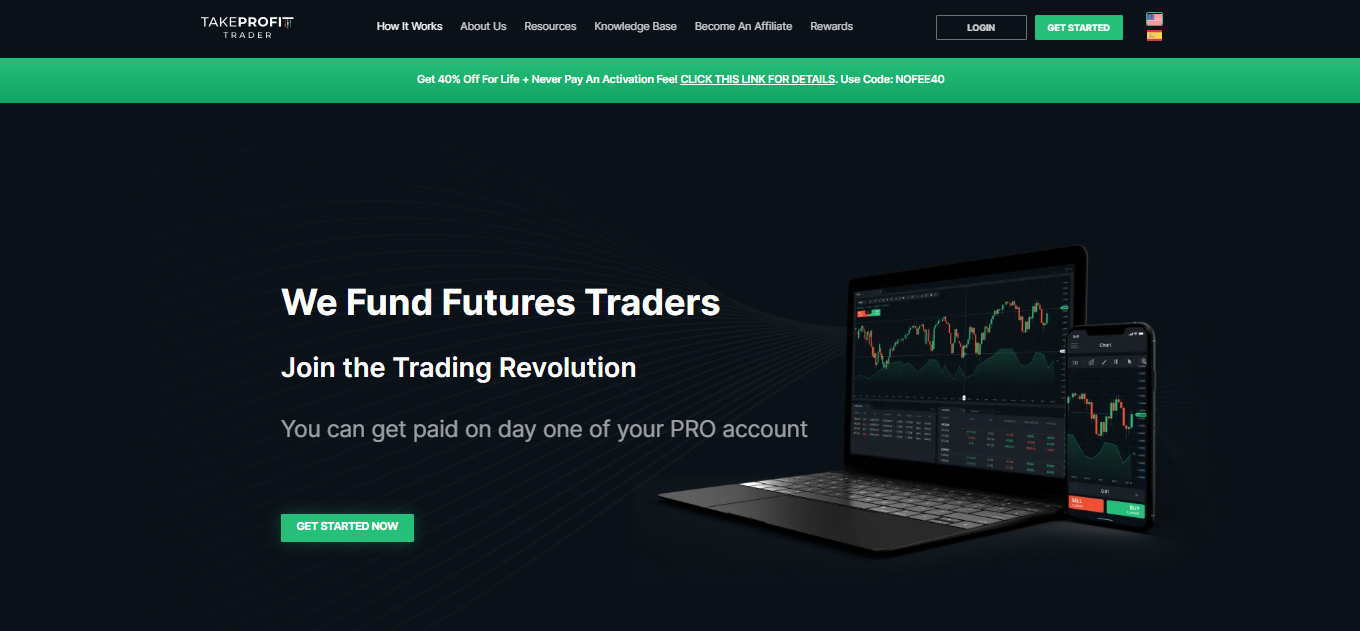
7. Take Profit Trader

Take Profit Trader

Take Profit Trader offers swift profit opportunities with straightforward rules for active day traders.

Key Features

  • Funded accounts from $25,000 to $150,000
  • Easy one-step evaluation process
  • NinjaTrader platform
  • Profit splits between 80% and 90%
  • Ability to have up to 5 concurrent accounts
  • $130 activation fee
  • Immediate payout eligibility on the first day

8. UProfit

UProfit

UProfit offers smart drawdown strategies and affordable ways to start flexible futures trading.

Key Features

  • Funded accounts ranging from $9,000 to $200,000
  • Single-step evaluation process
  • NinjaTrader and R|Trader trading platforms
  • 80% profit split for traders
  • Up to 20 concurrent trading accounts
  • $150 activation fee
  • End-of-day drawdown management options

9. Elite Trader Funding

Elite Trader Funding

Elite Trader offers multiple evaluation paths for traders and provides high initial profit percentages for successful participants.

Key Features

  • Funded trading accounts from $50,000 to $300,000
  • Simple one-step challenge process
  • Compatible with NinjaTrader and TradingView platforms
  • Generous profit splits from 90% to 100%
  • Ability to manage up to 5 concurrent trading accounts
  • Monthly activation fees between $47 and $80
  • Flexible and diverse evaluation models

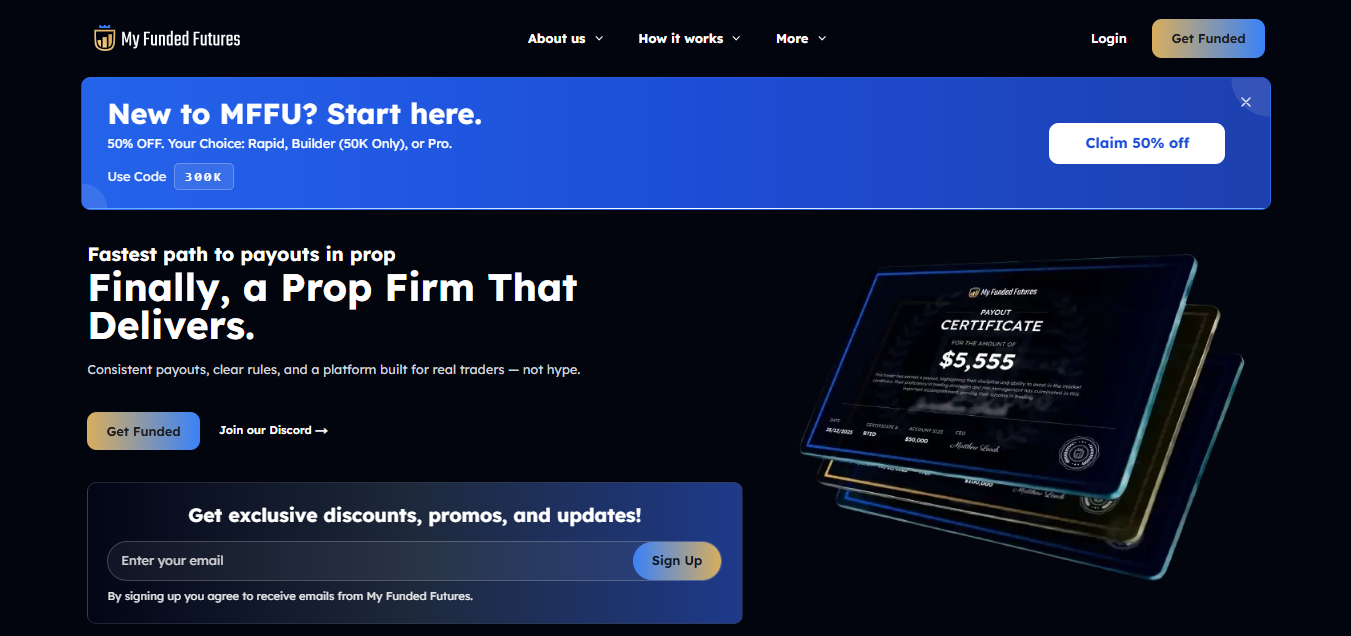
10. My Funded Futures

My Funded Futures

My Funded Trader provides affordable, straightforward guidelines with rapid processing.

Key Features

  • Funded accounts from $50,000 to $150,000
  • Single-step evaluation process
  • NinjaTrader platform support
  • Profit splits from 90% to 100%
  • Ability to manage up to 10 concurrent accounts
  • No activation fees required
  • Fast payouts with clear, transparent rules

11. FundedNext

FundedNext

FundedNext provides a global trading platform with competitive account scaling and supportive trading conditions.

Key Features

  • Funded trading accounts from $25,000 to $100,000
  • Simple one-step challenge process
  • Compatible with Tradovate, NinjaTrader, and TradingView platforms
  • Profit sharing from 60% to 95%
  • Ability to manage up to 5 concurrent trading accounts
  • No activation fees required
  • Excellent scaling potential for traders

12. OneUp Trader

OneUp Trader

OneUp Trader offers a clear, dependable method for skilled futures traders.

Key Features

  • Funded accounts from $25,000 to $250,000
  • Single-step evaluation process
  • NinjaTrader platform
  • Offers profit splits ranging from 90% to 100% (typically 100% for initial profits).
  • Allows up to 3 active accounts simultaneously.
  • Charges a monthly activation fees from $65 to $75 after funding.
  • Provides free market data and evaluation tools.

But knowing which firms exist only matters if you understand what actually separates a good choice from a costly mistake.

Related Reading

How to Choose the Best Prop Firm for Futures Trading

Choosing a futures prop firm means aligning operational details with your trading behavior, not wishful thinking. Choose a firm whose evaluation structure, risk parameters, and payout mechanics match your proven trading methods. The right choice removes obstacles, allowing you to focus on trading rather than navigating arbitrary rules that don't reflect market conditions.

Checklist of important factors when choosing a prop trading firm

Only 5-10% pass prop firm challenges, demonstrating traders' struggle to meet firm requirements. Traders who carefully review specific rule structures before signing up pass at higher rates than those who choose based on marketing claims or evaluation cost alone. The decision requires examining details most people overlook, which determine whether you'll succeed or repeatedly restart.

Key Point: Your trading style must align with the firm's evaluation criteria and ongoing rules, not the other way around.

Funnel showing only 5-10% of traders passing prop firm challenges

Warning: Don't choose a prop firm based solely on low evaluation fees or aggressive marketing - focus on rule compatibility with your proven trading approach. "Only 5-10% of traders pass prop firm challenges, with most failures stemming from mismatched expectations rather than poor trading skills." — Trader Dale, 2024

Balance scale comparing trader's approach with firm's evaluation criteria

Match Evaluation Structure to Your Trading Pace

Single-step challenges compress the proving period into a single phase, requiring immediate, steady performance. Two-step formats split aggressive profit goals from sustained performance needs, allowing traders to demonstrate quick gains first, then prove long-term discipline. Three-step models assess whether a trading approach can withstand different market cycles and volatility levels.

How do you choose the right evaluation format for your strategy?

Your choice depends on how quickly your trading strategy shows results. Scalpers and day traders often prefer single-step evaluations because their trading advantage becomes clear immediately in controlled settings. Swing traders who hold positions overnight need multi-step formats that are better suited to slower profit growth and greater potential losses. Choosing the wrong evaluation format creates unnecessary stress: a swing trader rushing a single-step challenge will end up changing their trading method to meet tight deadlines, only to find it hard to repeat that approach when they get funded.

What are instant funded options, and who should consider them?

Instantly funded trading accounts provide immediate capital, bypassing standard evaluation processes. These options start with smaller investment amounts that can grow based on trading performance. This approach suits experienced traders with proven track records who need quick access to trading funds. The trade-off involves a smaller initial capital allocation and stricter ongoing performance requirements, reflecting the higher risk the trading firm takes by skipping traditional screening methods.

Verify Profit Split Structures Beyond the Headline Number

Most companies advertise 80%-90% profit splits, but the actual amount you keep depends on additional fees, scaling tiers, and whether splits apply to gross or net profits. Some firms calculate your share after removing platform fees, data costs, or monthly charges. Others calculate their percentage of total gains, then subtract operational expenses from that portion. The difference can add up quickly across multiple payouts.

How do the best prop firms for futures trading structure profit scaling?

A 90% profit split has become the competitive standard in 2025, with top companies like Goat Funded Trader offering paths to 100% retention through performance milestones or paid upgrades. That progression matters more than the starting percentage. A company offering 80% initially, scaling to 95% after six months of consistent performance, outperforms one locked at 85% indefinitely.

What hidden fees affect your actual profit retention?

Calculate net retention by working backward from a hypothetical payout. If you generate $5,000 in profits with an 80% split, you'll receive $4,000. But if the firm charges a $75 monthly platform fee and $50 for data, your actual take becomes $3,875, or 77.5%. That 2.5% difference may seem small until you're withdrawing $20,000, when it costs you an extra $500. Firms with transparent fee structures publish these details upfront.

Analyze Drawdown Rules for Hidden Restrictions

Static drawdowns create a fixed starting balance limit that you can't go below. Trailing drawdowns increase as your account grows, protecting your gains. For example, with a 5% static drawdown on a $100,000 account, you can't drop below $95,000. A 5% trailing drawdown works differently: you can initially fall to $95,000, but if your account grows to $110,000, your new protected floor becomes $104,500.

Which drawdown structure works better for futures traders?

Trailing structures encourage progress while penalizing backward movement, which works well for traders with steady upward investment performance. Static limits help those with more irregular results. Futures traders handling overnight market shifts often prefer static drawdown limits because they don't automatically adjust after lucky streaks that might not reflect true trading skill.

How do daily loss caps affect your trading strategy?

Daily loss limits add another layer of protection on top of maximum drawdowns, creating a second safety boundary. With a 2% daily cap on a $100,000 account, you'll stop trading once losses reach $2,000, even if above your trailing drawdown threshold. Traders underestimate how quickly repeated daily losses can accumulate toward the maximum threshold.

How do scaling paths work for realistic account progression?

Account growth with Goat Funded Trader happens through milestone-based increases, not automatic doubling. You might start with $50,000, scale to $100,000 after hitting 10% returns without violations, then move to $150,000 after another 10% on the larger balance. Each step requires proving you can manage increased position sizes without proportionally increasing risk.

What math considerations affect scaling timelines?

The math is important. Making 10% on $50,000 means $5,000 in profits. Making 10% on $100,000 requires $10,000. If your strategy consistently generates $1,000 per week, the first milestone is in five weeks and the second in ten. Companies advertising "scale to $2 million" rarely explain that reaching that level demands months or years of flawless performance.

How do account limits impact trading flexibility with the best prop firms for futures trading?

Some companies limit the number of simultaneous accounts, restricting investment diversification. At Goat Funded Trader, managing five $50,000 accounts offers more flexibility than a single $250,000 allocation: you can test different strategies, trade multiple contract types, or separate day and swing trading approaches without cross-contamination.

Assess Platform Compatibility and Execution Quality

NinjaTrader leads futures prop trading by connecting directly with brokers that offer CME, CBOT, and NYMEX contracts. TradingView offers clearer charting but fewer order-management tools. Tradovate offers web-based access without software installation. The platform you choose will impact available indicators, order types, and execution speed.

How do spreads and execution affect the best prop firms for futures trading performance?

Raw spreads significantly affect fast-moving contracts, where a few price points determine profit. Companies advertising "tight spreads" without precise numbers often add charges beyond basic exchange rates. Some might offer 80% off evaluations, but such discounts mean little if trading execution costs more due to price slippage. Check whether your trading orders go directly to exchanges or pass through middle-tier liquidity providers, which may slow your transaction speed.

What commission structures should traders expect from prop firms?

Commission structures differ widely. Some companies charge per contract, others per side, with some combining costs into evaluation fees. A $0.50 per-contract fee can quickly become $50 per day or $1,000 per month when trading 100 round-trip contracts, growing faster than most traders expect. Most firms manage futures through simulated accounts using real market data and virtual funds. Our prop firm infrastructure offers mobile apps, web terminals, and dashboards that track performance metrics in real time, shortening review cycles and maintaining complete audit trails.

Review Payout Frequency and Processing Speed

Bi-weekly payment cycles remain the standard, with on-demand options priced at $50 to $100 per month for 24-48-hour access. The choice depends on whether you need a steady cash flow or can tolerate delayed profit withdrawals. Minimum withdrawal thresholds, such as $500, discourage frequent small transactions, potentially delaying access for traders who generate $50 to $100 per week. Lower $100 minimums process more transactions, which may cause delays during high-volume periods. Processing guarantees matter more than advertised timelines. Companies offering $500 bonuses for missed deadlines create financial incentives to maintain on-time delivery, turning marketing promises into enforceable accountability.

Evaluate Rule Flexibility Around Real Trading Scenarios

News trading restrictions eliminate strategies designed for market volatility around key economic announcements, such as Federal Reserve meetings or company earnings reports. Some financial firms allow skilled traders to profit from these events with controlled risk, while others prohibit news-based trading, viewing it as speculative gambling. The trading strategy you use will determine the significance of these restrictions for your approach.

How do weekend holding policies affect futures trading strategies?

Weekend holding policies significantly impact swing traders by preventing multi-day positions that track trend continuation. Companies that allow weekend holds support trading strategies that require more development time, but they typically set stricter position-sizing limits to offset the increased risk.

Why do the best prop firms for futures trading require consistency?

Consistency rules limit single-day profit contributions to prevent a single lucky trade from masking poor performance. A guideline capping any single day at 40% of total gains means you need at least three profitable trading sessions to prove your trading strategy works consistently, not just under perfect conditions. Understanding which rules matter is helpful only if you know where to find firms that enforce them fairly.

Get 25-30% off Today - Sign up to Get Access to up to $800K Today

Many prop trading firms in 2026 impose challenging evaluations, daily loss limits, and profit splits that limit traders' potential. Finding a firm that offers substantial simulated capital, flexible conditions, and real incentives for consistent performance can transform your trading strategy.

Balance scale showing restrictive traditional prop trading firms on one side and flexible Goat Funded Trader on the other

Goat Funded Trader provides exceptional solutions for futures traders. Our platform offers simulated accounts up to $800K, with unique benefits: no minimum profit targets, no time limits, and profit splits up to 100%. Over 98,000 traders have collected $9.1 million in rewards, backed by a 2-day payment guarantee. Traders can choose customizable challenges or instant funding options for indices, commodities, and energy markets.

Key Point: Unlike traditional prop firms, Goat Funded Trader eliminates restrictive profit targets and time pressures that cause trader failure. "Over 98,000 traders have collected $9.1 million in rewards with a 2-day payment guarantee." — Goat Funded Trader, 2026

Ready to get funded on better terms? Visit Goat Funded Trader today, grab 25-30% off your challenge, and unlock up to $800K in simulated capital with trader-first rules.

Takeaway: This limited-time discount makes premium funding conditions more accessible for serious traders ready to scale their performance.

Upward arrow showing growth from small to large trading account sizes

Related Reading

  • Bulenox Vs Apex
  • Best Prop Trading Firms For Stocks
  • Prop Firms That Allow Ea
  • Ftmo Vs Topstep
  • Take Profit Trader Vs Topstep
  • My Forex Funds Vs Ftmo
  • Prop Trading Firms Toronto
  • Balance-Based Drawdown Prop Firms
  • Surgetrader Vs Ftmo
  • Topstep Vs Apex
  • Prop Firms In Ghana

Join the

Greatest

Traders

Sign up now for exclusive giveaways, discounts & promotions.
Thank you! Your submission has been received!
Oops! Something went wrong while submitting the form.
Goat Traders Community
Join Discord