


Ugandan traders can access substantial trading capital without risking personal funds through funded trading programs. Understanding what a funded account is reveals opportunities that connect skilled traders with professional-level resources, allowing them to demonstrate their abilities while building profitable careers with institutional backing.
These programs evaluate traders through structured assessments before providing access to significant capital and competitive profit-sharing arrangements. Ambitious traders across Uganda can leverage these platforms to accelerate their trading careers and scale their success through a trusted prop firm.
Summary
- Proprietary trading firms operate on a performance-based model, providing capital to traders who pass evaluations, eliminating the need to risk personal savings. Only about 10% of traders successfully pass these challenges on their first attempt, reflecting the demanding standards and the importance of understanding the rule parameters before committing to evaluation fees. The model works because firms deploy their own capital through proven traders rather than managing client portfolios, thereby creating aligned incentives around actual trading performance rather than commission structures.
- Profit splits typically favor traders at 70% to 90% of earnings, with some firms offering up to 100% after hitting performance milestones. On a $100,000 account generating 10% monthly returns, you'd keep $7,000 to $9,500 per month at standard splits, income that exceeds most professional salaries in Uganda and provides capital for reinvestment into property, education, or business ventures. Benzinga reports that firms typically retain 10% to 50% of each trader's profits, meaning your take-home percentage directly impacts long-term earnings potential across different platforms.
- Entry fees for evaluations represent your primary financial risk, and multiple failed attempts compound quickly when you're testing strategies under pressure. Traders often change their behavior once firm capital enters the picture, even though risk parameters remain unchanged, with the psychological tension between confidence and caution shifting decision-making in ways that can trigger rule violations and force costly restarts. Realistic budgeting accounts for two to three attempts before passing if you're testing new strategies or transitioning from demo to evaluation pressure.
- Withdrawal speed matters more than the maximum account size when converting earnings to shillings, given volatile exchange rates. Firms processing withdrawals within 48 hours preserve purchasing power and provide liquidity when timing matters, while 45-day payout cycles can expose you to currency depreciation that erodes 8% or more of your dollar profits before you can access them. Currency conversion mechanics through local banks can consume 3% to 5% of each withdrawal through fees and unfavorable rates, making net retention after all conversion costs the real metric to evaluate.
- Scaling programs determine whether you're building a sustainable trading career or hitting a ceiling after initial success. Firms scaling to $2 million based on consistent performance offer long-term partnership potential that compounds earnings power over the years, with automatic progression based on profit thresholds, creating clear advancement paths. Account growth from $25,000 to $100,000 or more within a year proportionally increases profit potential without requiring additional evaluation fees or capital contributions, leveraging that traditional employment simply can't match.
- Goat Funded Trader offers simulated capital up to $2 million with profit splits reaching 100%, processing payouts within two business days, and providing flexible challenge structures that accommodate different trading styles without forcing artificial restrictions that contradict how profitable traders actually operate.
What are Prop Firms, and How Do They Work?

Proprietary trading firms, commonly known as prop firms, are specialized financial entities that provide traders with access to substantial capital to execute trades across markets such as stocks, futures, forex, and derivatives. These firms enable individuals to amplify their trading potential without using their own funds, in exchange for a share of the earnings. By focusing on talent recruitment and risk management, prop firms create lucrative opportunities for proficient traders while generating revenue through profit splits.
π‘ Key Point: Prop firms act as financial accelerators, providing traders with capital they couldn't access independently while maintaining strict risk controls to protect their investments.
"Proprietary trading firms bridge the gap between individual talent and institutional capital, creating a symbiotic relationship that benefits both skilled traders and capital providers." β Financial Trading Industry Analysis
β οΈ Important: Success with prop firms requires consistent profitability and adherence to strict risk management rules - firms will quickly terminate traders who exceed loss limits or violate trading parameters.
What Is a Proprietary Trading Firm?
A proprietary trading firm is an organization that uses its own money to conduct trades aimed at direct profit, rather than handling client investments or earning fees from brokerage services. These firms employ or partner with traders who leverage the provided capital to engage in speculative activities across financial instruments, focusing on strategies that capitalize on market opportunities. This setup differs from traditional banks or hedge funds by emphasizing internal gains without external investor involvement.
How do the best prop firms in Uganda operate their trading systems?
In operation, prop firms maintain dedicated teams or remote traders who follow strict guidelines to minimize losses, ensuring the firm's capital is protected while pursuing high returns. They often integrate advanced technology and data analysis to support decision-making, enabling diverse approaches such as arbitrage and high-frequency trading. This model fosters a performance-driven environment where success benefits both the trader and the firm through shared outcomes.
What are the main categories of prop firms?
Prop firms generally fall into two categories: independent firms that use their own resources solely for trading, with no client interactions, and those integrated within brokerage structures that may draw insights from market flows while keeping operations separate. Independent firms focus exclusively on internal strategies, bearing all risks and rewards themselves, which allows for greater flexibility in speculative pursuits.
How do brokerage-affiliated desks differ from independent firms?
Brokerage-affiliated desks, on the other hand, operate as specialized units that can benefit from broader market data, potentially enhancing their trading edge. Both types engage in similar markets but differ in scale and support systems, with independents often emphasizing remote access and broker-integrated ones providing more institutional backing. This distinction influences how they allocate capital and manage trader relationships.
How do traders initially apply for funding
To secure funding, traders typically start by applying to a prop firm and undergoing an initial screening, which may involve submitting a performance history or paying a fee for access to an evaluation program. Once accepted, they receive a simulated or demo account with predefined capital limits, where they must demonstrate consistent profitability and adherence to risk rules over a set period.
What happens after a successful evaluation with the best prop firms in Uganda
Upon successful completion, the firm allocates real capital through a funded account, often scaling up based on ongoing results. This process ensures only capable individuals advance, protecting the firm's assets while offering traders a pathway to larger positions. Funding levels can range from thousands to hundreds of thousands of dollars, depending on the firm and trader's track record.
What happens during the evaluation challenge phase?
The evaluation phase, often called a challenge or combine, requires traders to meet specific profit goals while staying within maximum loss thresholds in a simulated environment. For example, they might need to achieve a certain return percentage without exceeding daily or overall drawdowns, testing their discipline and strategy under pressure.
How do the best prop firms in Uganda handle evaluation outcomes?
This step simulates real trading conditions without actual financial risk to the trader beyond entry fees, allowing resets if rules are broken. Firms use it to filter talent, providing feedback and resources to improve. Success here leads to funding, but failure means retrying or seeking alternatives, emphasizing the need for preparation and consistency.
Profit Sharing and Payouts
Profit sharing in prop firms involves dividing earnings between the trader and the firm, typically with the trader retaining a majority, such as 70-90%, after reaching milestones. Initial payouts might allow full retention up to a threshold, transitioning to splits that reward sustained performance while compensating the firm for capital provision. Payouts are processed regularly, often after a minimum number of profitable days, ensuring quick access to earnings via methods like bank transfers. This structure motivates traders to focus on long-term success, with scaling options increasing capital and potential returns as milestones are met, fostering a mutually beneficial partnership.
Risks and Challenges
Despite its advantages, prop trading carries risks, such as failing evaluations, which can result in lost fees and time, or breaching rules, which can lead to account suspension. Market volatility amplifies potential losses, even with firm capital, and pressure to perform consistently can cause stress or poor decisions. Challenges include strict drawdown limits restricting strategies and the lack of guaranteed success, as simulated results may not translate to live trading. Traders must navigate firm-specific restrictions on instruments or hours, and underperformance can end participation quickly, highlighting the need for robust risk management.
Regulations in Prop Trading
Regulations like the Volcker Rule restrict large banks from speculative prop trading with their capital to prevent systemic risk after the financial crisis. This limits certain institutions but allows independent firms more freedom, provided they comply with general financial oversight.
How do recent regulatory changes affect prop firm transparency?
Firms must adhere to market rules, avoiding manipulative practices, and recent scrutiny has targeted fee-based models, pushing toward transparent, live-account structures. Traders benefit from this by ensuring fairer access, but it underscores the evolving landscape requiring awareness of jurisdictional requirements.
What should traders consider when choosing the best prop firms in Uganda?
The question is whether this model fits your specific situation as a trader in Uganda, where market access and local conditions add another layer of complexity.
Related Reading
- What Is a Funded Account
- What Is A Prop Firm Account
- What is Scalping in Trading
- Perpetual Futures Example
- Cfd Leverage
- What is Arbitrage Trading
- Prop Firm Regulation
- How To Read Candlesticks
- Hanging Man Candlestick
- What Is Drawdown In Trading
- What Is Fomo In Trading
- What Is Tp In Trading
- MT4 vs MT5
- One Step Prop Firm Challenge
Why Choose a Prop Firm for Trading in Uganda?

Ugandan traders turn to prop firms because they offer a shortcut around the country's most stubborn financial barriers: limited personal capital, restricted access to international markets, and scarce professional training infrastructure. Instead of spending years accumulating enough savings to trade meaningfully or navigating complex offshore account setups alone, you pass an evaluation and immediately access substantial capital with structured support. This model transforms trading from an expensive hobby requiring wealth into a performance-based opportunity accessible to anyone with skill and discipline.
π― Key Point: Prop firms eliminate the traditional barriers that have kept Ugandan traders out of international markets for decades, replacing capital requirements with skill-based evaluations.
"Prop trading democratizes access to global financial markets by shifting focus from personal wealth to trading performance and risk management skills." β Financial Markets Research, 2024
β οΈ Warning: While prop firms remove capital barriers, they still require proven trading skills and strict risk management - this isn't a get-rich-quick scheme but a professional opportunity for serious traders.
Traditional Trading
- Capital: Requires high personal capital to get started.
- Market Access: Often limited to specific markets or restricted by your own liquidity.
- Risk: You are responsible for 100% of your losses (self-funded).
- Support: Generally provides no professional support or mentorship.
- Barrier to Entry: Entry is primarily wealth-dependent.
Prop Firm Trading
- Capital: No personal capital is needed; you trade the firm's funds.
- Market Access: Provides broad, global market access.
- Risk: The firm absorbs the losses, protecting your personal savings.
- Support: Offers structured training, proprietary tools, and professional support.
- Barrier to Entry: Entry is skill-based (usually requiring passing an evaluation).
Capital Access Without Personal Risk
The average Ugandan household income makes building a trading account of even $5,000 a multi-year effort, assuming no emergencies derail savings. Prop firms eliminate this timeline by providing accounts ranging from $10,000 to $200,000 after you demonstrate consistent profitability through their challenge. You're trading positions that could generate meaningful income without liquidating assets or taking loans that carry local interest rates often exceeding 20% annually.
How do the best prop firms in Uganda protect household finances?
This matters acutely in Uganda's economic context, where currency volatility and inflation erode purchasing power. Tying up personal funds in a trading account means accepting opportunity cost when those same shillings could cover school fees, medical expenses, or business inventory. Firm capital insulates your household finances from market losses while letting you pursue returns that actually move the needle on your quality of life.
What makes this different from traditional wealth building?
The structure flips the traditional wealth-building sequence. Instead of needing money to make money, you need skill to access money. That shift opens doors for talented traders who lack inherited wealth or access to traditional investment capital, creating a merit-based pathway that sidesteps Uganda's limited venture capital and small-business loan infrastructure.
How do the best prop firms in Uganda solve technology barriers?
Ugandan traders working independently face platform costs, data feed subscriptions, and charting software expenses that quickly exceed $200 monthly before placing a single trade. Prop firms bundle these tools into their offering, giving you institutional-grade technology that would otherwise require significant upfront investment. You get real-time market data, advanced order execution, and risk management dashboards that level the playing field against better-capitalized competitors.
Why does internet infrastructure matter for trading success?
Internet reliability remains inconsistent across much of Uganda outside major urban centers, creating latency issues that can turn winning trades into losses. Many firms offer virtual private servers or cloud-based platforms that reduce execution delays, addressing a technical constraint that can't be easily solved with local infrastructure. This becomes critical when trading fast-moving currency pairs where milliseconds determine profitability.
What educational advantages do prop firms provide?
Beyond hardware, firms offer structured education that fills gaps left by Uganda's limited formal finance training. You're learning from traders who've navigated the same markets you're entering, gaining pattern recognition and risk management frameworks through mentorship rather than expensive trial and error. This knowledge transfer accelerates your development curve in ways self-study can't replicate, particularly when local forex communities remain small and fragmented.
How do prop firms provide regulatory protection in Uganda's trading environment?
Uganda's financial regulatory framework focuses primarily on traditional banking and microfinance, leaving online forex trading in a gray area with minimal consumer protection. When you trade through a prop firm, you operate under their risk parameters and compliance standards, which often exceed what individual traders impose on themselves. Daily loss limits, maximum drawdown rules, and position sizing requirements prevent the catastrophic account blowups common among self-directed traders who lack institutional discipline.
Why does external structure matter for trading discipline?
This external structure compensates for the psychological challenges of solo trading. You can't overtrade to recover losses or ignore your risk plan when emotions run high, because rule violations immediately end your funding. The firm's capital is at stake, creating accountability that protects you from your own worst impulses during volatile market conditions.
How do the best prop firms in Uganda simplify payout processes?
Payout processes through established firms also provide clearer recourse than dealing with offshore brokers directly. You're withdrawing profits from a company with reputation incentives and operational transparency rather than navigating unregulated platforms that might complicate fund repatriation. This matters when converting earnings back to Ugandan shillings through local banking channels, where transaction documentation and source verification affect processing speed.
How do the best prop firms in Uganda address limited career opportunities?
Uganda's formal employment sector offers limited opportunities for high-earning career paths outside medicine, law, or senior corporate positions that require years of credentialing. Prop trading creates an alternative income stream where your earnings scale with skill rather than seniority, educational pedigree, or professional networks. A trader who consistently generates returns can earn more in a month than many professionals earn annually, without needing university degrees or expatriate employment.
Why does trading flexibility suit Uganda's economic reality?
The flexibility suits Uganda's economic reality, where many talented individuals juggle multiple income sources to achieve financial stability. You can trade around other commitments, test strategies during evaluation phases while maintaining existing work, and transition to full-time trading once you secure funding. This reduces the all-or-nothing risk of abandoning a stable income to pursue trading as a career.
What profit potential do the best prop firms in Uganda offer?
Profit splits typically favor traders at 70% to 90% of earnings, with some firms offering up to 95% after hitting performance milestones. On a $100,000 account generating 10% monthly returns, you'd keep $7,000 to $9,500 per month at standard splits. That income level transforms household economics in Uganda, where it exceeds most professional salaries and provides capital for reinvestment into property, education, or business ventures that compound wealth across generations.
How do scaling programs increase your capital allocation?
Successful traders don't stay at their starting account size. Firms implement scaling programs that increase your capital allocation as you demonstrate consistent profitability, often doubling account sizes every few months of solid performance. What begins as a $25,000 account can grow to $100,000 or more within a year, proportionally increasing your profit potential without requiring additional evaluation fees or capital contributions.
Why do the best prop firms in Uganda offer better growth than traditional careers?
This growth trajectory doesn't exist in traditional employment, where salary increases follow rigid schedules and promotion timelines. Your earning ceiling is determined by your trading skill and risk management, rather than organizational hierarchy or budget constraints. For ambitious Ugandans seeking rapid wealth accumulation, this performance leverage offers a path that traditional careers simply can't match.
How can you diversify across multiple firm accounts?
The model also allows portfolio diversification across multiple firm accounts simultaneously. Once you've mastered one firm's evaluation, you can replicate that success with others, effectively multiplying your capital access and spreading risk across different funding sources. Traders working with three firms at $50,000 each control $150,000 in combined capital, with profit potential that scales accordingly.
Community Access in an Isolated Market
Trading alone in Uganda means limited peer feedback, no benchmark for competitive performance, and few resources when you encounter unfamiliar market conditions. Prop firms connect you to global trading communities through Discord channels, member forums, and live trading rooms where thousands of funded traders share insights in real time. You're suddenly part of a network that spans time zones and markets, learning from traders in London, New York, and Singapore who've navigated scenarios you haven't yet faced.
How does community support accelerate trader development?
This community dimension addresses the isolation that stalls the development of many Ugandan traders. When you hit a losing streak, you can discuss it with others who've experienced similar drawdowns and recovered. When you discover a promising strategy, you can stress-test it against traders using different approaches. The collective knowledge pool accelerates pattern recognition and helps you avoid common pitfalls that might otherwise take years to identify on your own.
Why do the best prop firms in Uganda provide social validation?
Many traders in Uganda face skepticism from family and friends who view forex trading as gambling rather than a legitimate profession. Being part of a firm's community provides social validation and proof that others are succeeding with the same model, making it easier to justify the time investment and maintain motivation through inevitable rough patches. You're not explaining your career choice to people who don't understand markets. You're surrounded by peers who share the same goals and challenges. Most Ugandan traders pursuing prop firm funding assume the model operates within a clear legal framework, but in reality, it involves more ambiguity than you'd expect, given that local regulations haven't kept pace with global fintech innovation.
Are Prop Firms Legal in Uganda?

Yes, prop firms are legal for Ugandan traders to join and use. No national legislation prohibits citizens from registering for evaluations, passing challenges, or trading funded accounts provided by international firms. Uganda's Capital Markets Authority regulates traditional securities markets but doesn't govern retail forex trading or offshore prop firm participation, leaving these activities outside its restrictive oversight.
π― Key Point: Ugandan traders can freely participate in international prop firm programs without violating local financial regulations.
"Uganda's Capital Markets Authority regulates traditional securities markets but doesn't govern retail forex trading or offshore prop firm participation." β CMA Uganda Official Website
β οΈ Warning: While prop firm participation is legal, traders should still ensure they understand tax obligations on any trading profits earned through funded accounts.
Why do the best prop firms in Uganda operate outside regulatory oversight?
The regulatory gap exists because prop firms don't operate as financial intermediaries holding client deposits. They provide simulated evaluations and partner with external brokers for live trading, positioning themselves as performance platforms rather than investment custodians. This structure keeps them outside Uganda's securities licensing requirements, which apply to entities that manage public offerings or client portfolios. You're engaging with an educational service model that measures trading skill, not a regulated financial institution requiring local authorization.
What Uganda's Financial Oversight Actually Covers
The Capital Markets Authority Act focuses on licensed entities dealing in stocks, bonds, and collective investment schemes within Uganda's borders. The CMA's mandate centers on protecting investors in domestic securities markets, ensuring proper disclosure for public offerings, and supervising licensed intermediaries, such as stockbrokers and fund managers. Retail forex trading through international platforms falls entirely outside this scope, as does the practice of Ugandans opening accounts with offshore brokers without CMA approval.
How does Uganda's regulatory structure affect the best prop firms in Uganda?
This regulatory structure mirrors most African jurisdictions, where forex oversight remains underdeveloped compared to traditional banking supervision. The Bank of Uganda governs currency exchange and financial institutions, but doesn't extend authority to speculative trading activities conducted through foreign platforms. As long as you're not soliciting investments from other Ugandans or operating an unlicensed brokerage, your participation in prop firm challenges is not prohibited by law.
What tax obligations apply to prop firm profits?
Tax obligations represent your primary regulatory responsibility. The Uganda Revenue Authority requires residents to declare foreign-sourced income, including profits from a prop firm. Withdrawals converting to Ugandan shillings through local banks create documentation trails that tax authorities can review, making proper reporting essential even when the trading activity itself remains unregulated. Failure to declare earnings creates exposure to penalties unrelated to the legality of prop trading itself.
What causes payment processing challenges for Ugandan traders?
Individual prop firms sometimes exclude Uganda from accepted countries, but these restrictions stem from operational decisions rather than legal barriers. Payment processing challenges top the list, as international wire transfers and digital payment platforms vary in reliability across African banking systems. Firms avoiding transaction complications or currency conversion friction may limit participation to regions with simpler financial infrastructure.
How do broker partnerships affect access to the best prop firms in Uganda?
Broker partnerships create another constraint. Prop firms route live trades through specific brokers, which may restrict trades to certain jurisdictions due to their own compliance policies or risk assessments. If a firm's broker partner doesn't accept Ugandan clients, the prop firm inherits that limitation regardless of Uganda's legal stance. Futures-focused firms encounter more geographic restrictions than forex-oriented ones because futures exchanges impose stricter residency requirements tied to regulatory frameworks in major financial centers.
Why do internal risk management policies exclude certain countries?
Internal risk management also drives country exclusions. Firms analyzing payout histories, fraud patterns, or challenge completion rates across regions may adjust their geographic footprint based on profitability metrics. These business decisions have nothing to do with Ugandan law, but they still affect your access. Checking each firm's terms during registration prevents wasting evaluation fees on platforms that block your participation after payment.
How to Verify Firm Legitimacy Before Committing Funds
Reputation research protects you from predatory platforms disguised as legitimate prop firms. Start with user-review aggregators that track payout histories, where traders document withdrawal experiences and flag firms that delay payments or impose arbitrary rule changes. Look for consistent feedback spanning months rather than isolated testimonials, since authentic track records accumulate gradually through sustained operations.
What transparency indicators reveal legitimate operations?
Transparency in rules and fee structures signals operational maturity. Legitimate firms publish detailed challenge parameters, profit-split terms, and scaling criteria upfront, without burying restrictions in dense legal text. Vague language around payouts or frequent rule modifications indicates platforms prioritizing evaluation fee revenue over trader success. Compare multiple firms' terms to identify industry standards, making outliers easier to spot.
How does community presence indicate firm reliability?
Community presence matters more than marketing polish. Firms with active Discord servers, responsive support teams, and visible funded trader communities demonstrate ongoing operational commitment. You can verify payout claims by connecting with actual funded traders rather than relying on promotional material. Platforms that invest in trader education, host webinars, and maintain detailed knowledge bases typically operate on longer time horizons than quick-cash schemes targeting desperate beginners.
Why do the best prop firms in Uganda offer lower entry barriers?
Most traders in Uganda face the familiar challenge of slowly saving up for evaluation fees while market opportunities pass. They assume building capital first makes sense, delaying participation until finances feel more secure. That approach costs time when firms like Goat Funded Trader offer entry points starting at $17, compressing the timeline from months of saving to immediate skill testing. Lower barriers mean you're proving your ability now rather than postponing development until perfect financial conditions that rarely arrive.
What tax obligations do the best prop firms in Uganda create?
Prop firm profits constitute taxable income under Uganda's tax code once you withdraw funds. The Uganda Revenue Authority expects residents to declare foreign earnings in annual returns, with tax rates following standard income brackets regardless of how you generated the money. Treating prop trading as untaxed side income creates audit exposure when banks report large incoming transfers from overseas, prompting questions about the origins of the funds.
How should you properly document prop trading income?
Documentation becomes your protection mechanism. Maintain records of evaluation payments, challenge completion dates, funded account agreements, and withdrawal confirmations. These establish legitimate trading activity rather than unexplained foreign deposits that could raise concerns about money laundering. Accountants familiar with forex taxation can structure your reporting to maximize allowable deductions for platform fees, internet costs, and education expenses against gross trading income.
Why does currency conversion timing affect your taxes?
Currency conversion timing affects your actual tax burden. Profits earned in dollars, converted to shillings at varying exchange rates, create gains or losses independent of trading performance. The shilling's depreciation against major currencies means your dollar-denominated earnings buy more locally over time, but tax calculations use conversion rates at withdrawal dates. Planning withdrawal timing around exchange rate movements and tax year boundaries optimizes your net retention.
Starting Your First Challenge Without Legal Worry
Selecting firms with proven Ugandan participation eliminates geographic uncertainty. Resources that track prop firm policies by country identify platforms that explicitly accept Ugandan traders, so you don't have to discover restrictions after payment. Prioritize firms with documented African trader success stories and payment methods accessible through Ugandan banks or widely available digital wallets like Skrill or Neteller.
How can demo practice reduce your financial risk?
Demo practice before paid challenges reduces financial risk while you learn the platform mechanics and nuances of the rules. Many firms offer free trial accounts that mirror real-world challenge conditions, letting you test strategies against their specific parameters without incurring evaluation fees. This preparation phase identifies whether a firm's rules suit your trading style before committing money, preventing costly mismatches between your approach and their requirements.
Why does understanding rule enforcement prevent violations?
Understanding rule enforcement prevents avoidable violations. Daily loss limits, maximum drawdown thresholds, and minimum trading day requirements vary significantly across firms. What feels like conservative risk management at one firm might breach another's parameters, ending your challenge prematurely. Study the rule documentation thoroughly, then practice within those constraints until compliance becomes automatic rather than requiring constant monitoring during live trading. But knowing the rules and finding accepting firms only gets you to the starting line, not across it.
Related Reading
- Pass Ftmo Challenge
- Prop Firms That Use Mt5
- Best Prop Firms For Forex
- Best Prop Firms In Uae
- Proprietary Trading Firms In India
- Best Prop Firms In Nigeriaβ
- Halal Prop Firm
- βBest Prop Firms In South Africa
- Best Prop Firms For Futures Trading
- Best Prop Firms For Options Trading
- Best Prop Trading Firms Malaysia
- Prop Trading Firms Singapore
11 Best Prop Firms in Uganda for All Traders in 2026

International proprietary trading companies welcome Ugandan participants who can demonstrate consistent profitability through structured evaluations, regardless of geographic location or initial capital. These firms provide capital allocations ranging from $10,000 to over $2 million once you pass their challenges, with profit splits favoring traders at 70% to 100% depending on the specific program and performance tier.
π― Key Point: The capital scaling potential from $10,000 to $2+ million represents a 2,000% increase in trading power for successful Ugandan traders who consistently pass evaluations.
"Capital allocations ranging from $10,000 to over $2 million with profit splits favoring traders at 70% to 100% depending on the program and performance tier." β International Prop Trading Analysis, 2024
The firms below accept Ugandan traders, process payouts reliably via accessible methods, and maintain transparent fee structures that don't change after you've paid the evaluation fee. Selection criteria prioritized documented payout histories, clarity in drawdown parameters, and community feedback spanning multiple months rather than promotional claims.
π Takeaway: Reliable payout processing and transparent rules are non-negotiable factors when selecting prop firms, as evaluation fees can range from $100 to $500+ per attempt.
1. Goat Funded Trader

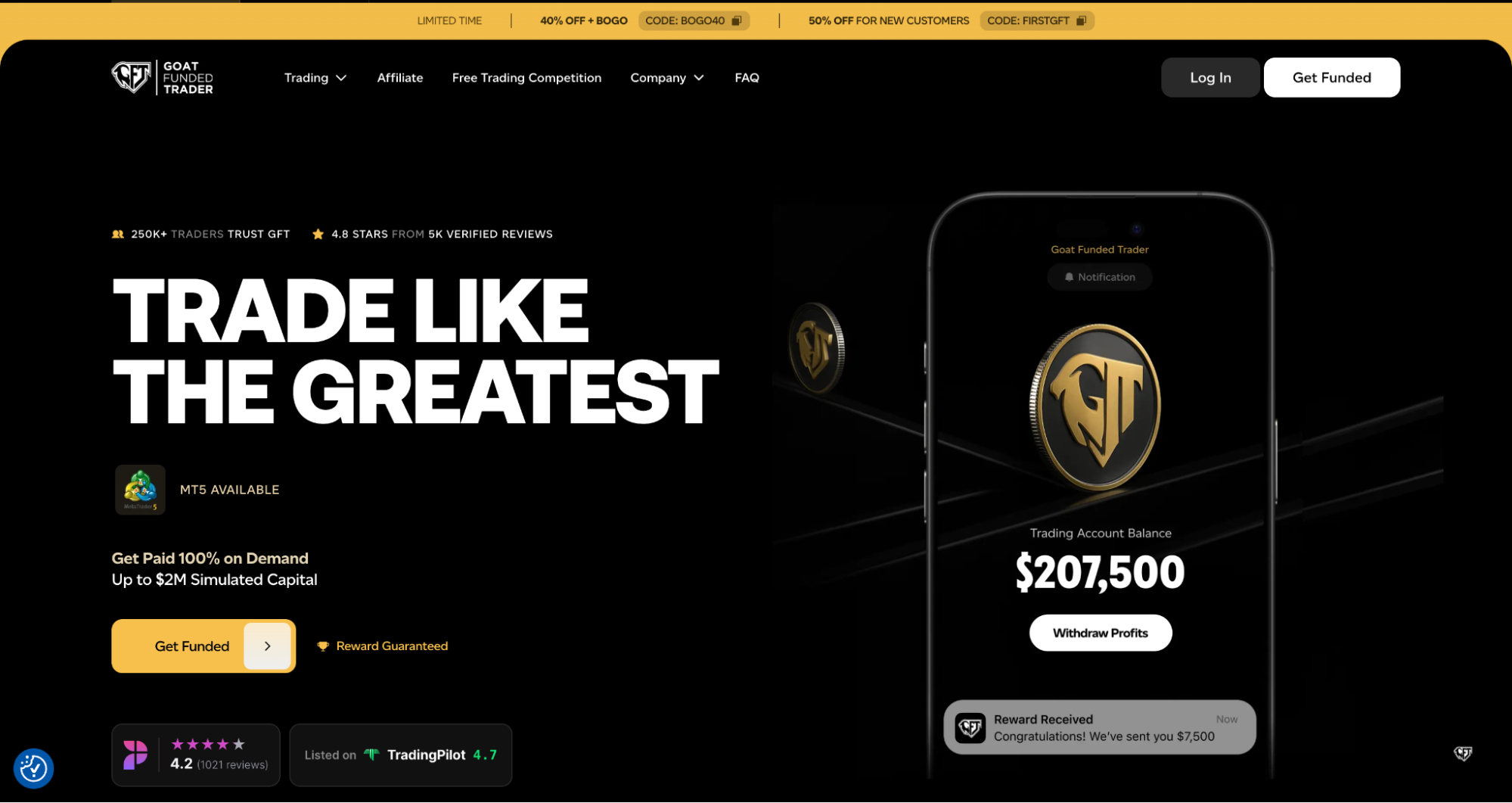
Goat Funded Trader is a leading proprietary trading company that equips skilled individuals with simulated funds reaching up to $2 million, enabling them to execute strategies across various markets and collect actual earnings from successful trades. Tailored for global participants, including those in Uganda facing capital constraints, it features diverse evaluation programs and direct funding routes, backed by proprietary systems for dependable performance. With a commitment to trader success through flexible guidelines and rapid compensation, this firm supports over a quarter of a million users worldwide, making it an appealing option for Ugandans aiming to leverage international opportunities without personal financial exposure.
Key Features
- Account Options: Various sizes available, starting from $2,500 up to $400,000 for challenges and funded setups.
- Profit Sharing: Begins at 80% for traders, with enhancements possible to reach 100%; select programs include escalating splits from 65% to 95%.
- Evaluation Models: Includes single-step, two-step, three-step challenges, plus accelerated accounts; alternatives for immediate access without trials.
- Entry Costs: Single payment that's fully reimbursable; current deals offer up to 50% reductions for newcomers and 35% off with triple refunds via specific codes.
- Compensation Methods: Immediate access to full earnings, fortnightly distributions, or every 10 days; initial payout available anytime, processed in two business days, or with a bonus assurance.
- Special Perks: Virtual capital for practice with tangible rewards; unrestricted rules detailed in resources; permission for event-based trading and position holds over weekends; expansion to $2 million; no required goals on certain live accounts; potential for $800,000 in allocations.
- Market Access: Covers currency exchanges, individual shares, exchange-traded funds, and virtual asset pairs.
- Risk Parameters: Leverage ratios up to 1:100; variable daily loss caps from none to 5%; overall loss limits from 4% to 10%.
- Trading Timeline: Mostly without deadlines; endless durations on some; minimal active days, like five, for specific evaluations.
- Performance Goals: Targets range from 3% to 10%, depending on the setup; no mandatory objectives once funding is secured.
- Execution Environment: Mobile apps for iOS and Android, browser-based terminals for desktops, personalized tracking panels; ultra-quick order fulfillment, minimal spreads from 0.1 pips, zero fees on certain assets like benchmarks and digital coins.
- Assistance Services: Round-the-clock help; in-house infrastructure for stability.
- Growth Incentives: Attractive progression schemes; rewards for steady performance, such as 95% returns.
Why Traders in Uganda Choose Goat Funded Trader
Ugandan traders often choose Goat Funded Trader for its global reach, enabling smooth participation without geographic barriers, which is crucial in regions with limited local funding options. The refundable entry fees and promotional discounts make it accessible for those managing tight budgets, while the absence of personal loss liability reduces financial risks in an economy where capital preservation is key. Flexible rules, such as allowing news events and weekend positions, align with diverse schedules, including those balancing trading with other commitments. Rapid, guaranteed payouts within days enhance reliability for users who need quick liquidity, and scaling to substantial amounts like $2 million offers growth potential beyond typical domestic opportunities. Backed by robust technology and constant support, it fosters a trustworthy environment, as evidenced by community praise for swift rewards and helpful leadership, appealing to Ugandans seeking sustainable trading paths.
2. FTMO

FTMO is a prominent proprietary trading company headquartered in Prague, Czech Republic, launched in 2015. It primarily caters to forex enthusiasts but also extends to various asset classes, requiring traders to complete a performance test before granting them a funded account. Known for its structured approach and supportive resources, FTMO has built a strong reputation among global traders, including those in Uganda, by emphasizing risk management and consistent profitability.
Key Features
- Location: Prague, Czech Republic
- Established: 2015
- Tradable Assets: Currency pairs, market indices, precious metals, raw materials, equities, digital currencies
- Highest Account Size: Up to $2,000,000
- Earnings Division: As high as 90%
- Entry Fee: Beginning at β¬155
- Supported Software: MetaTrader 4, MetaTrader 5, cTrader, DXtrade
3. FundedNext

FundedNext is a dynamic proprietary trading entity based in Ajman, United Arab Emirates, founded in 2022. It provides opportunities in forex and beyond, with a focus on flexible evaluation models that suit different trading styles. This firm appeals to Ugandan traders seeking quick scaling and competitive terms, backed by positive feedback on its payout reliability and educational tools.
Key Features
- Location: Ajman, United Arab Emirates
- Established: 2022
- Tradable Assets: Currency pairs, market indices, precious metals, raw materials, digital currencies
- Highest Account Size: Up to $4,000,000
- Earnings Division: As high as 90%
- Entry Fee: Starting from $32
- Supported Software: MetaTrader 4, MetaTrader 5, cTrader
4. Funded Trading Plus

Funded Trading Plus is a respected proprietary trading outfit located in London, United Kingdom, founded in 2021. Specializing in forex with extensions to other markets, it offers straightforward challenge processes and high potential rewards. Ugandan traders appreciate its emphasis on trader autonomy and scalable funding, making it a solid choice for those aiming for long-term partnerships.
Key Features
- Location: London, United Kingdom
- Established: 2021
- Tradable Assets: Currency pairs, market indices, precious metals, raw materials, digital currencies
- Highest Account Size: Up to $2,500,000
- Earnings Division: Up to 100%
- Entry Fee: From $119
- Supported Software: cTrader, MatchTrader, DXtrade
5. The 5ers

The 5ers is a well-established proprietary trading company based in London, United Kingdom, established in 2016. It supports a range of markets, including forex, with programs designed for disciplined traders through rigorous evaluation. Popular among Ugandan participants for its growth-oriented scaling plans and community support, it prioritizes sustainable trading practices.
Key Features
- Location: London, United Kingdom
- Established: 2016
- Tradable Assets: Digital currencies, energy products, currency pairs, market indices, precious metals
- Highest Account Size: Up to $250,000
- Earnings Division: Up to 100%
- Entry Fee: From $22 to $850
- Supported Software: cTrader, MetaTrader 5
6. Moneta Funded

Moneta Funded is a fresh proprietary trading firm based in Rodney Bay, Saint Lucia, established in 2026. It covers a wide range of assets, including forex, and offers attractive introductory offers for new traders. This company attracts Ugandan traders seeking innovative terms and broad market access, though, as a newcomer, it's gaining traction through competitive features.
Key Features
- Location: Rodney Bay, Saint Lucia
- Established: 2026
- Tradable Assets: Digital currencies, energy products, equities, currency pairs, futures contracts, market indices, precious metals, agricultural commodities
- Highest Account Size: Up to $100,000
- Earnings Division: 88%
- Entry Fee: From $49 to $1,150 (with 30% discount available)
- Supported Software: MatchTrader, MetaTrader 5
7. E8 Markets

E8 Markets serves as a flexible proprietary trading provider with a strong emphasis on trader-friendly rules and broad market access. Operating globally and welcoming participants from Uganda, it offers multiple evaluation paths that enable customized funding approaches. This firm gains popularity for its scaling potential and supportive environment, helping disciplined traders build toward larger capital allocations over time.
Key Features
- Location: United States
- Established: Around 2022 (with ongoing growth into 2026)
- Tradable Assets: Forex pairs, indices, precious metals, energy products, cryptocurrencies
- Highest Account Size: Up to $2,800,000 through scaling
- Earnings Division: Up to 80-90% (varies by model)
- Entry Fee: Competitive starting levels with frequent promotions
- Supported Software: MetaTrader 5, other modern platforms
8. FundingPips

FundingPips stands out as a modern proprietary firm focused on consistency and accessibility for forex and multi-asset traders. It accepts Ugandan participants and offers straightforward challenges with emphasis on realistic risk parameters. Traders value its quick processing and community-driven updates, making it a go-to for those seeking reliable payouts without excessive restrictions.
Key Features
- Location: United Arab Emirates
- Established: Recent years (active and highly rated in 2026)
- Tradable Assets: Currency pairs, market indices, precious metals, energy, digital currencies
- Highest Account Size: Up to $300,000+ with expansion options
- Earnings Division: Up to 80-90%
- Entry Fee: Affordable entry points often with discounts
- Supported Software: MetaTrader platforms, cTrader
9. Hola Prime

Hola Prime has emerged as a trader-centric proprietary company known for rapid payouts and transparent operations across forex and futures. It extends services to Ugandan traders, prioritizing speed and clarity in funding models. This firm appeals to active participants who value fast access to rewards and a performance-focused approach without unnecessary hurdles.
Key Features
- Location: Global operations (strong presence in multiple regions)
- Established: Recent entrant with strong 2026 momentum
- Tradable Assets: Forex, futures contracts, additional markets
- Highest Account Size: Varies by program, with solid scaling
- Earnings Division: Up to 90%
- Entry Fee: Starting from low thresholds
- Supported Software: Multiple, including proprietary and standard options
10. City Traders Imperium (CTI)

City Traders Imperium provides structured proprietary funding with an emphasis on education and long-term trader development. Accessible to Ugandan traders, it offers innovative models, including options for quicker starts. Known for its supportive resources and disciplined growth paths, it suits those aiming for sustainable progress in proprietary trading.
Key Features
- Location: United Kingdom / Global
- Established: Established presence (highly regarded in 2026 lists)
- Tradable Assets: Forex, indices, commodities, cryptocurrencies
- Highest Account Size: Scalable to significant levels
- Earnings Division: Up to 100% in select programs
- Entry Fee: Reasonable challenge costs
- Supported Software: MetaTrader 5, cTrader
11. DNA Funded

DNA Funded focuses on innovative platforms and trader tools, making it a fresh yet credible choice for forex and beyond. It welcomes Ugandan traders and highlights advanced interfaces alongside competitive terms. This firm attracts attention for its modern approach and positive early reviews on execution and support.
Key Features
- Location: Global (with strong platform focus)
- Established: Newer but highly rated in 2026 comparisons
- Tradable Assets: Forex pairs, indices, metals, crypto, others
- Highest Account Size: Up to mid-six figures with potential growth
- Earnings Division: Up to 90%
- Entry Fee: From accessible starting amounts
- Supported Software: TradeLocker and additional options
Most traders in Uganda select firms based on entry costs or profit-split percentages, missing the factors that actually determine whether they'll receive payouts or face account termination due to technicalities nobody explains upfront.
How to Choose the Best Prop Firm as a Trader in Uganda

Choosing the right prop firm means matching your trading style, financial constraints, and risk appetite to a platform's evaluation structure, payout terms, and operational reliability. The decision hinges on factors beyond advertised profit splits: withdrawal speed matters when converting earnings to shillings through volatile exchange rates, rule flexibility determines whether your strategy survives evaluation, and platform stability affects execution quality during high-volatility sessions that define profitability.
π― Key Point: The cheapest evaluation isn't always the most cost-effective option for Ugandan traders dealing with currency conversion fees and withdrawal delays.
Withdrawal Speed
- Why It Matters: In Uganda, local currency (UGX) fluctuations mean that delays in conversion can erode your actual take-home profit.
- What to Look For: * 24β48 hour processing: Firms like FundedNext offer a 24-hour payout guarantee.
- Local Methods: Look for firms supporting Crypto (USDT/LTC) or RiseWorks, which allow you to off-ramp to Mobile Money (MTN/Airtel) via P2P exchanges like Lopeer or Binance.
Rule Flexibility
- Why It Matters: Restrictive rules (like "no news trading" or "no weekend holding") are the #1 cause of account breaches for part-time traders.
- What to Look For: * Drawdown Types: Seek Static or End-of-Day (EOD) drawdowns (found in firms like Phidias or Elite Trader Funding) rather than "Intraday Trailing" drawdowns, which are much harder to manage.
- News Trading: Ensure the firm allows trading during high-impact news (e.g., NFP) if your strategy depends on volatility.
Platform Stability
- Why It Matters: Poor execution or "slippage" during volatile sessions (like the NY Open) can trigger a daily loss limit breach even if your trade was technically correct.
- What to Look For: * Server Quality: Look for firms with their own dedicated servers (e.g., Blue Guardian's MT5 server) to ensure 99%+ uptime and fast execution.
- Platform Options: Access to TradingView (via TradeLocker or DXTrade) is often more stable for modern technical analysis than older MT4 setups.
Entry Cost
- Why It Matters: Most traders fail their first 1-2 attempts. High reset fees can lead to a "debt trap" before you ever reach a payout.
- What to Look For: * Balance Cost & Risk: Look for low-cost entry points ($49β$99 for $10k accounts) and firms that offer "Free Retries" if you end the challenge in profit without breaking rules.
- Discounts: Many firms offer 20β40% discounts specifically for emerging markets; always check for active promo codes before purchasing.
"Traders who prioritize entry cost alone often discover that cheap evaluations with restrictive rules cost more through repeated failures than higher-priced challenges with realistic parameters."
β οΈ Warning: Many Ugandan traders fall into the trap of choosing low-cost evaluations with unrealistic drawdown limits or profit targets, leading to multiple failed attempts that cost more than a single, well-designed challenge.
π‘ Pro Tip: Calculate the total cost, including potential retries and currency conversion fees, not just the initial evaluation price, to find the most cost-effective prop firm for your situation.
1. Assess the Firm's Reputation and Payout Reliability
A trustworthy proprietary trading firm builds confidence through consistent, timely payouts and positive community feedback. For Ugandan traders, where international transfers and currency conversions add complexity, firms with proven track records of honoring withdrawals reduce uncertainty and support steady income flow. Goat Funded Trader demonstrates strong reliability with over $15 million in payouts distributed to more than 250,000 traders worldwide, including a reward guarantee that ensures payment within two business days or an additional $500 bonus. This commitment to fast, secure rewards, combined with on-demand payouts in select plans, makes it particularly appealing to Ugandans seeking dependable access to earnings without delays.
2. Evaluate Profit Splits and Payout Flexibility
Profit-sharing arrangements determine how much of your gains you retain, directly affecting long-term earnings potential. Look for high splits, ideally 80% or more, along with clear conditions for withdrawals, such as frequency and minimum thresholds, to ensure the setup supports your financial needs. Goat Funded Trader offers profit splits starting at 80%, with options to reach 100% or escalate from 65% to 95% in certain funded programs. Traders benefit from flexible payout schedules, including bi-weekly distributions, every-10-day distributions in some cases, and on-demand first rewards, providing Ugandan participants with adaptable liquidity to match local economic demands.
3. Review Evaluation Processes and Challenge Rules
The path to funded trading, whether through one-step, multi-step challenges, or instant funding, should match your discipline and style. Favorable rules include realistic profit targets, reasonable drawdown limits, and no excessive time pressures to allow natural strategy execution. Goat Funded Trader offers diverse evaluation models, including single-step, two-step, and three-step challenges, as well as instant funded accounts that skip trials. With no time limits on most trading periods, minimum active days of 5 in select setups, and variable targets ranging from 3% to 10%, it accommodates different paces, helping Ugandan traders prove their skills without artificial constraints.
4. Consider Entry Fees, Refunds, and Cost Transparency
Challenge fees represent upfront investment, so prioritize firms with affordable, transparent pricing and refund mechanisms upon passing or meeting conditions. Promotions and full refunds lower barriers, especially valuable in Uganda, where budgeting for such opportunities matters. Goat Funded Trader features one-time, 100% refundable fees for challenges, with current promotions such as 50% off for new users with code FIRSTGFT or 35% off plus a 300% refund with code GFT35. This cost-effective structure, with no ongoing commissions on assets such as indices and cryptocurrencies, eases entry for Ugandan traders managing limited resources.
5. Examine Trading Conditions, Instruments, and Flexibility
Optimal conditions include suitable leverage, allowed strategies (news trading, weekend holds), broad asset access, and low spreads/commissions to preserve the edge. Firms supporting your preferred markets and rules enhance performance consistency. Goat Funded Trader grants access to forex pairs, stocks, ETFs, and crypto pairs, with leverage up to 1:100 in many accounts, raw spreads from 0.1 pips, and zero commissions on indices/cryptos. It permits news trading and weekend position holding, with daily drawdowns ranging from 0% to 5% and overall drawdowns of 4% to 10%, offering Ugandan traders the freedom to apply diverse strategies effectively.
6. Check Scaling Plans and Long-Term Growth Potential
Scalable accounts reward consistency by increasing capital allocation over time, turning successful performance into larger opportunities. Strong scaling to high limits supports ambitious goals. Goat Funded Trader includes a scaling program that grows accounts up to $2 million, rewarding sustained results with higher allocations and potential 95% profit retention in advanced stages. This progression path provides Ugandan traders with substantial expansion possibilities beyond initial funding.
7. Prioritize Platform Quality, Support, and Additional Perks
Reliable platforms ensure smooth execution, while responsive support and extras, such as educational tools or guarantees, add value. For Ugandans, 24/7 availability and mobile access improve usability across time zones.
How do the best prop firms in Uganda deliver superior platform quality?
Goat Funded Trader delivers in-house technology with mobile apps for iOS/Android, web terminals, and a custom dashboard for stats tracking, plus lightning-fast execution and 24/7 support. Perks include no hidden rules, simulated capital with real rewards, and no loss liability, creating a supportive environment tailored to global traders, including those in Uganda.
What overlooked factor determines long-term trading success?
The most overlooked factor in firm selection isn't listed in comparison charts or promotional materials, but it determines whether you'll still be trading profitably six months after getting funded.
Related Reading
- Balance-Based Drawdown Prop Firms
- Surgetrader Vs Ftmo
- My Forex Funds Vs Ftmo
- Prop Firms In Ghana
- Take Profit Trader Vs Topstep
- Ftmo Vs Topstep
- Bulenox Vs Apex
- Topstep Vs Apex
- Prop Trading Firms Toronto
- Prop Firms That Allow Ea
- Best Prop Trading Firms For Stocks
Get 25-30% off Today - Sign up to Get Access to Up to $800K Today
The hurdles Ugandan traders face when choosing prop firms come down to three persistent barriers: finding platforms that process payouts reliably across international banking systems, accessing capital without prohibitive evaluation costs that require months of saving, and securing terms that don't penalize your trading style through arbitrary restrictions. Goat Funded Trader addresses these friction points directly through simulated capital scaling to $2 million, profit splits reaching 100%, and payout processing guaranteed within two business days, or you receive an additional $500 for delays. The platform serves over 250,000 traders globally, distributing more than $15 millionin verified rewards, backed by flexible challenge structures that accommodate different skill levels and strategies without forcing you into evaluation models that contradict how you actually trade.
π― Key Point: Goat Funded Trader eliminates the three main barriers that prevent Ugandan traders from accessing reliable prop firm funding.
Entry costs start at accessible levels with current promotions offering 35% off plus 300% refund using code GFT35, or 50% off for new users with FIRSTGFT, compressing the financial barrier between deciding to pursue funding and actually testing your skills. You choose between single-step, two-step, or three-step challenges based on how you prefer to demonstrate consistency, or bypass evaluation entirely through instant funding options that grant immediate market access.
Features like no time limits on most challenges, no minimum profit targets once funded in many plans, and triple payout frequency options give you control over progression speed rather than forcing artificial timelines that create pressure to overtrade. News trading permission, weekend position holds, leverage up to 1:100 in select accounts, and access to forex, stocks, ETFs, and crypto pairs mean your existing strategies transfer without modification to satisfy platform restrictions that don't actually improve risk management.
"The platform serves over 250,000 traders globally with more than $15 million distributed in verified rewards, with payout processing guaranteed within two business days." β Goat Funded Trader, 2024
π‘ Tip: Use code GFT35 for maximum savings or FIRSTGFT if you're a new user to reduce your entry barrier by up to 50%. Ready to overcome the common barriers Ugandan traders encounter and secure funding with terms that support sustainable profitability in 2026? Sign up with Goat Funded Trader today to access simulated capital up to $2 million, take advantage of current promotional pricing that reduces entry costs while maintaining full refund eligibility, and start building toward consistent rewards through a platform designed around trader success rather than evaluation fee revenue.
π Takeaway: With guaranteed payouts within two business days, capital scaling to $2 million, and 35-50% off promotional pricing, Goat Funded Trader removes the traditional barriers that have limited Ugandan traders' access to prop firm funding.
β
.avif)


.avif)