






Does Fidelity Have a Trading Simulator? All You Need to Know
Does Fidelity have a trading simulator? Goat Funded Trader reveals Fidelity's paper trading options and better alternatives for risk-free practice.


Testing trading strategies without risking personal capital is essential to developing profitable skills, yet many traders wonder whether Fidelity offers paper trading. While Fidelity provides some basic simulation tools, their platform lacks the comprehensive features found in dedicated trading simulators. Understanding how to paper trade on Thinkorswim reveals why many traders prefer TD Ameritrade's robust simulator for practicing complex strategies. The right practice environment can accelerate learning and prevent costly mistakes when transitioning to live markets.
Traditional paper trading simulators offer valuable practice, but they don't provide pathways to real profits during the learning process. Advanced traders often seek opportunities that combine skill development with genuine earning potential while maintaining risk protection. Many successful traders have discovered that working with a prop firm offers the ideal solution: it provides funded accounts to trade with institutional capital after demonstrating consistent performance through evaluation programs.
Summary
Key Takeaways
- Trading simulators recreate live market conditions using virtual capital, allowing traders to practice order execution, position management, and strategy testing without financial risk. These platforms connect to real-time market data feeds and model slippage, commissions, and order fill dynamics that mirror actual trading environments. 90% of traders who use simulators report improved confidence, a direct result of practicing platform tools and execution mechanics repeatedly until they become automatic.
- Fidelity does not offer a dedicated trading simulator or paper trading account, forcing traders to choose between risking real money prematurely or seeking external platforms for practice. While Fidelity provides powerful analytical tools through Active Trader Pro, including options calculators and strategy evaluators, these remain static calculators rather than dynamic environments where traders can execute orders and track performance across changing market conditions. This absence lengthens the learning curve and increases exposure to costly beginner errors that arise when theory meets live execution without adequate repetition.
- One study of technical education students who used stock market simulators over 60 days found that 78 percent maintained profitable investment portfolios, demonstrating strong practical skill development. The platform becomes a laboratory for deliberate iteration, allowing professionals to prototype modifications to proven systems or to trial unfamiliar strategies under realistic conditions that mirror slippage, latency, and order-fill dynamics without eroding capital during the learning curve.
- The critical difference between useful simulation and wasted time lies in how closely a platform mirrors live market behavior, particularly in replicating bid-ask spreads during volatile sessions, modeling partial fills on large orders, and applying realistic commission structures. Platforms that execute every order instantly at the displayed price create dangerous habits, conditioning traders to expect fills that never materialize when real capital is at stake. Thinkorswim PaperMoney and Interactive Brokers Paper Trader simulate order-queue dynamics and price impact, showing traders when market orders push prices against them or when limit orders remain unfilled as markets run past entry points.
- Most simulators cap virtual balances at $50,000 to $100,000, teaching position-sizing habits that don't carry over to managing larger accounts, while offering no pathway from consistent virtual performance to actual income. Friction kills habit formation, making platform accessibility critical: minimal signup requirements, no mandatory funding, and cross-device compatibility support daily practice during market hours or evening review sessions. Standalone simulators offer infinite trades but zero progression to real rewards, leaving skilled traders stuck in a loop where consistency means nothing beyond virtual numbers.
- Goat Funded Trader addresses this gap by providing funded accounts of up to $2M after traders pass structured evaluations, allowing them to keep 80-100% of profits and withdraw real money without risking personal savings, all while continuing to trade in a protected environment.
What Is a Trading Simulator, and How Does It Work?
A trading simulator is software that replicates live market conditions using virtual money instead of real money. You place orders, track positions, and watch your portfolio grow or shrink based on actual price movements. The platform mirrors order execution and commission costs, creating a safe environment where mistakes become lessons rather than financial disasters.

🎯 Key Point: Trading simulators provide risk-free practice by replicating real market conditions without the financial consequences of actual trading.
"Paper trading allows investors to practice trading strategies without risking real capital, making it an essential tool for skill development and strategy testing." — Securities and Exchange Commission
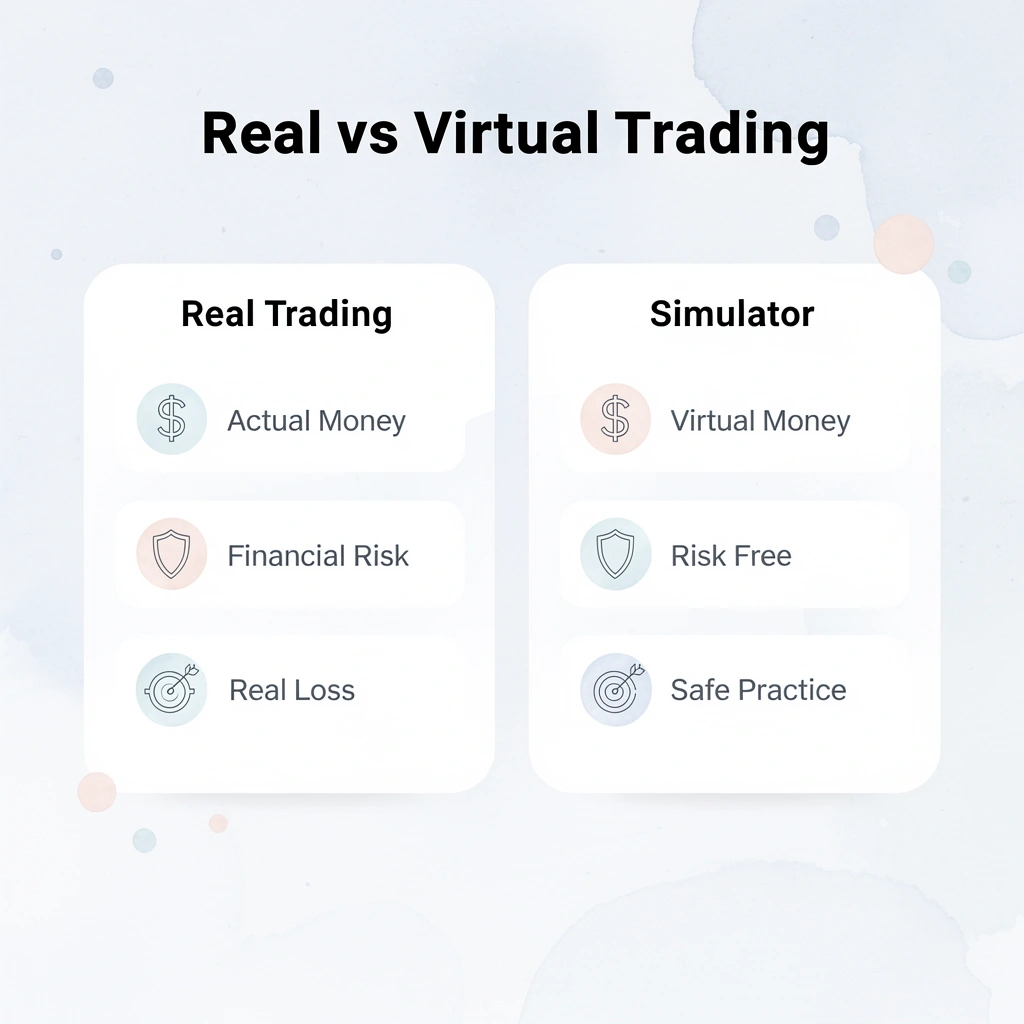
💡 Example: When you buy 100 shares of a stock at $50 in a simulator, you'll see the same price fluctuations as real traders, but your $5,000 investment is purely virtual - perfect for learning market dynamics without actual financial risk.
How Simulators Recreate Market Reality
The software connects to real-time or delayed market data feeds, pulling in the same price information professional traders see. When you buy 100 shares of a stock at $50, the simulator records that position and updates its value as the market price changes. You start with a virtual balance (often $100,000 or more) and execute trades exactly as you would through a brokerage platform. The system models slippage: the small price difference between when you click "buy" and when your order fills, plus trading commissions that eat into profits. Some platforms even simulate corporate actions like dividend payments or stock splits, exposing you to the full complexity of real markets without financial risk.
Core Features That Build Trading Competence
Modern simulators include charting tools with technical indicators like moving averages, RSI, and Bollinger Bands, plus Level 2 market data showing order depth and time-and-sales feeds displaying every transaction. Order types include stop-loss, limit, and bracket orders, which automatically set profit targets and exits. 90% of traders who use simulators report improved confidence through repeated practice. Advanced platforms offer replay modes that let you step through historical market sessions, tick by tick, and review decisions without time pressure or emotion.
Why Virtual Practice Builds Real Skills
Simulators eliminate the psychological warfare that destroys beginner accounts. You learn platform navigation, practice position sizing formulas, and test stop-loss placement without the fear that turns small mistakes into account-draining disasters. This lets you focus on process, building habits around risk management and trade documentation that become automatic before risking actual capital.
Experienced traders use simulators to validate new strategies across different market conditions, refining entry and exit timing until the approach proves consistent. One academic study on equity trading simulations found that 66 percent of participating students rated the tool as effective for increasing their investment knowledge, while 86 percent reported greater interest in financial markets.
What happens when simulator practice becomes too comfortable?
Most traders treat simulator time as casual experimentation, clicking buttons without the discipline real money demands. Losses disappear with a reset button, creating no lasting consequences. As your skills develop and you see consistent virtual profits, that safety becomes a trap: you've proven you can execute strategies in a risk-free environment, but the gap between simulation and live trading widens with every month you delay.
Prop firms like Goat Funded Trader bridge this divide by providing funded accounts where you trade real capital after passing an evaluation. You keep significant profit splits while the firm absorbs losses, converting simulator practice into actual income without risking personal savings.
Moving from Practice to Performance
Write down every simulated trade with your entry and exit reasons, plus how you felt. Track your performance across hundreds of trades by calculating your win rate, average profit per winning trade, and maximum drawdown. Once results remain consistent amid changing market conditions and align with your risk tolerance, move to small live positions while keeping the simulator active to test new ideas. Review weekly, adjust based on how real money affects your decisions, and grow positions slowly as confidence builds.
Related Reading
Does Fidelity Have a Trading Simulator?
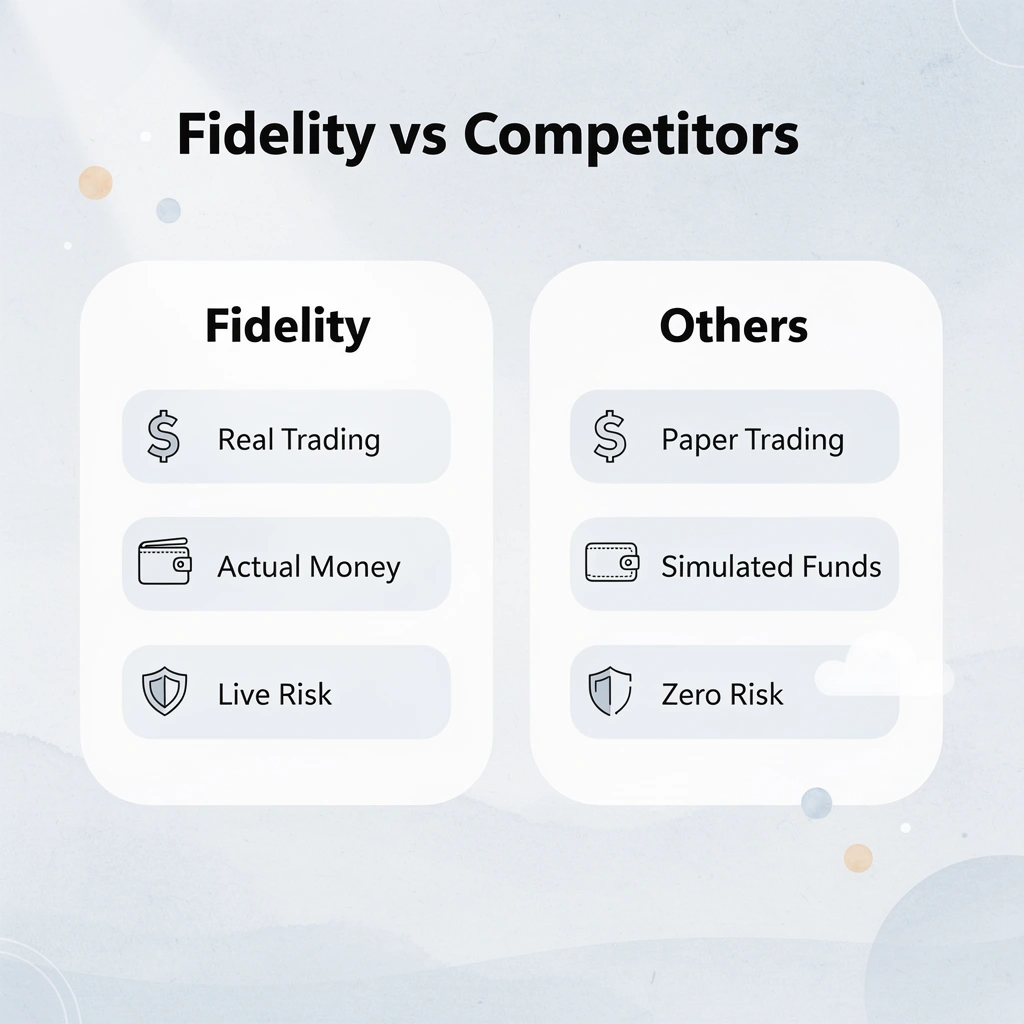
Fidelity does not offer a dedicated trading simulator or paper trading account. You cannot practice with simulated capital in a live market environment, so you must choose between risking real money and using outside platforms for practice.

🎯 Key Point: Unlike many competitors, Fidelity focuses on real trading rather than providing simulation tools for beginners to practice their strategies.
"Paper trading allows new investors to practice without financial risk, but not all brokers offer this feature." — Investment Education Research, 2024

⚠️ Warning: Without a built-in simulator, new traders must either start with actual money at risk or seek third-party platforms to develop their skills before trading live.
Trading Practice Options
Paper Trading
❌ Not Available
Use external simulators
Demo Account
❌ Not Available
Third-party platforms
Practice Portfolio
❌ Not Available
Start with small real amounts
What analytical tools does Fidelity provide instead of a simulator?
Fidelity offers powerful analysis tools through Active Trader Pro and its web platform, including streaming quotes, customizable charting, options profit calculators, and strategy evaluators. These tools display potential gains, losses, and breakeven points for complex multi-leg options trades. However, they are static calculators rather than dynamic environments where you can place orders, manage positions, and track performance as market conditions change.
How do Fidelity's educational resources compare to hands-on practice?
The Learning Center offers interactive modules, virtual classrooms, and beginner-focused activities that introduce order types, asset classes, and basic strategy concepts. These resources cannot replicate the emotional pressure of watching a position move against you in real time or the discipline required to cut losses when your original thesis breaks down. You learn theory without the repetition that builds instinct.
What happens when traders lack access to simulators?
Without a persistent simulator, you miss the chance to repeat things without real consequences. These repetitions turn knowledge into automatic reactions. You cannot test how much money to risk across volatile sessions, refine entry timing during earnings announcements, or practice scaling out of winners without fear distorting your decisions.
This gap extends your learning curve and increases your exposure to expensive beginner errors: moving stop-losses, overtrading after wins, or abandoning strategies after a single losing day.
Why does fidelity have a trading simulator become crucial for skill development?
Many traders try to compensate by opening small real money positions to "learn with real money," but this conflates skill development with financial risk. Early mistakes cost more than tuition because they deplete both capital and confidence.
Traders who hesitate on entries, second-guess exits, or abandon tested strategies after one bad trade often lack the muscle memory from executing hundreds of simulated trades first.
Why do traders look beyond Fidelity's basic tools?
Platforms like prop firm fill this gap by combining realistic practice with actual money backing. Rather than choosing between risk-free practice and live trading that punishes learning mistakes, funded accounts let you trade where your skills determine profit without risking your own money.
This closes the gap that Fidelity leaves open, allowing you to trade with real money once simulator practice demonstrates consistent, successful results.
What does research show about simulation effectiveness?
Trading skill develops through volume, not wishful thinking. Academic research from StockTrak's 2024 analysis shows 66 percent of simulation participants report improved investment knowledge, with 86 percent noting increased market interest.
These gains stem from repeated decision-making under realistic conditions, an environment Fidelity's static tools cannot provide.
Do experienced traders still benefit from simulators?
But knowing that Fidelity lacks a simulator raises the next question: do experienced traders benefit from returning to simulated environments?
Can Experienced Traders Benefit From Trading Simulators?
Veterans do not outgrow simulators. While beginners learn order types and chart patterns, experienced traders use simulation to stress-test strategies, explore instruments, and recalibrate psychologically after drawdowns. The platform becomes a laboratory for deliberate iteration.

🎯 Key Point: Experienced traders leverage simulators as advanced testing environments rather than basic learning tools, using them to refine strategies and explore new markets without financial risk.
"Simulation becomes a laboratory for deliberate iteration - allowing veterans to stress-test strategies and recalibrate psychology after drawdowns."

💡 Pro Tip: Advanced traders can use simulators to test new instruments, validate strategy modifications, and rebuild confidence after losing streaks - making them essential tools for continuous improvement rather than just beginner education.
The Overconfidence Trap That Derails Professionals
Traders who survive their first few years often mistake longevity for protection from losses. They assume that patterns learned during bull markets will work identically in every future situation. Markets change faster than people can adapt: new investments emerge, correlations shift, and regulatory changes can alter trading mechanics overnight. Experience alone cannot prepare you for every situation; your advantages disappear when conditions change.
How do simulators prevent costly overconfidence mistakes?
Simulators show this gap without cost. You can test whether your momentum strategy works during low-trading periods or if your options spreads perform well when implied volatility spikes unexpectedly. One study of technical education students who used stock market simulators over 60 days found that 78 percent maintained profitable investment portfolios. Simulation lets traders identify why their systems fail under pressure without forcing them to exit the market prematurely.
Rebuilding Rhythm After Setbacks
Drawdowns shake execution discipline in ways spreadsheets cannot capture. After losses, traders hesitate on valid setups or overtrade to recover quickly, both rooted in emotional disruption rather than strategy. Simulators restore rhythm by removing the financial consequences from practice. You execute your process repeatedly until hesitation fades and decision clarity returns, rebuilding confidence through repetition instead of waiting for live markets to cooperate during recovery.
Strategy Prototyping Without Drawdown Risk
Most experienced traders change their approaches only after their live trading performance deteriorates. Simulators flip this around by letting you test changes to working systems or try new strategies—such as switching from stocks to futures or adding algorithmic entries—in realistic conditions that replicate slippage, latency, and order-fill dynamics.
How do simulators accelerate strategy development cycles?
The iteration cycle accelerates from months of careful live testing to weeks of focused simulation, enabling faster adaptation without sacrificing financial stability or confidence.
Does Fidelity offer a trading simulator to scale proven strategies?
Once traders improve their edge through simulation, securing sufficient capital to grow becomes the next challenge. Platforms like Goat Funded Trader close this gap by offering funded accounts of up to $2M, allowing verified traders to deploy simulator-tested strategies with real-money backing and keep up to 100% of profits. This enables traders to generate real results without risking personal capital.
Ongoing Discipline and Performance Auditing
Simulators serve as objective mirrors for reviewing whether you followed your rules and for identifying behavioral problems you might miss during live trading. Replay your trades to check whether your entries matched your criteria or your exits reflected your plan rather than panic. This careful review uncovers recurring inefficiencies—taking profits too early, placing stop-losses inconsistently—that weaken your edge over time. Research in the Journal of Behavioral Finance found that active simulator users who performed well were more likely to open live accounts, though proper evaluation is needed to avoid overconfidence.
Selecting the right simulator matters as much as committing to the practice itself.
5 Best Alternative Trading Simulators You Can Use
Finding the right trading simulator helps you develop skills and build confidence faster. While Fidelity's simulator works for some people, many traders seek other options offering greater market access, better charting tools, more realistic trading, mobile apps, or practice for different trading styles. Several trusted simulators provide these features and let you practice without risking real money.
🎯 Key Point: The best trading simulators combine realistic market conditions with comprehensive tools to give you an authentic trading experience without financial risk.

"Practice trading with virtual money allows traders to test strategies and build confidence before committing real capital to the markets." — Trading Education Research, 2024
Below are some of the best trading simulators available. Each is specifically designed to help traders test strategies, learn how markets work, and gain real experience before trading with actual money.

TradingSim
Key Strength
Real market data
Best For
Day trading practice
Investopedia Simulator
Key Strength
Educational resources
Best For
Beginner learning
TD Ameritrade thinkorswim
Key Strength
Advanced charting
Best For
Technical analysis
MarketWatch Virtual Stock Exchange
Key Strength
Portfolio competitions
Best For
Long-term investing
TradeStation Simulator
Key Strength
Strategy testing
Best For
Algorithmic trading
💡 Tip: Choose a simulator that matches your trading style and offers the specific market access you need for your investment goals.
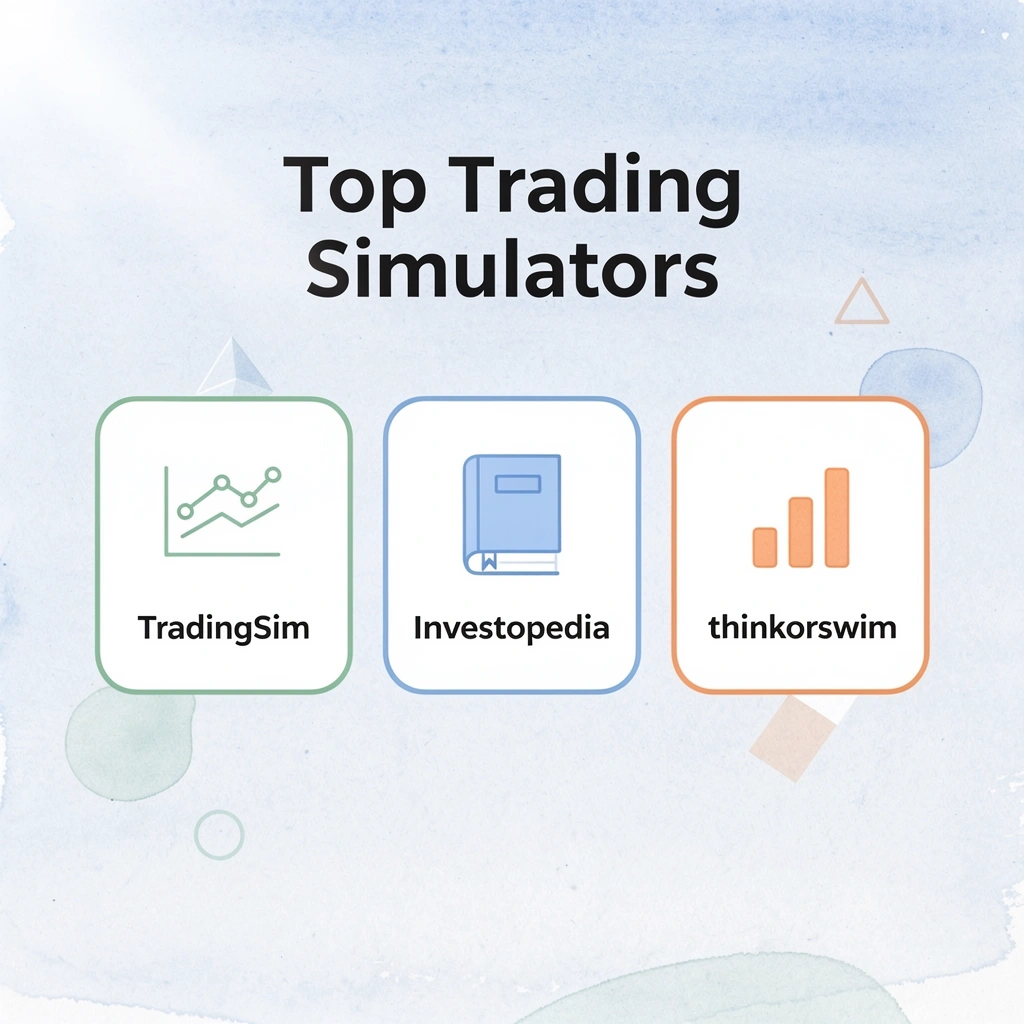
1. Thinkorswim PaperMoney by Charles Schwab
Thinkorswim PaperMoney is one of the best trading simulators available. It replicates professional-grade trading conditions with real-time data across stocks, options, and futures, giving traders the exact interface and tools used in live accounts to practice without financial risk.
Key Features
- Real-time market data and streaming quotes
- Advanced charting with hundreds of technical indicators and studies
- Full options trading simulation including complex strategies
- Futures and forex practice capabilities
- Customizable workspaces and layouts
- Profit and loss tracking with detailed performance analytics
- Strategy backtesting and evaluation tools
- Order types including limits, stops, brackets, and more
- Replay mode for historical market scenarios
- Account reset with customizable virtual capital (typically $100,000)
Best For
Active traders and options/futures enthusiasts seeking professional tools.
Pros
Comprehensive feature set; mirrors live Schwab environment perfectly; excellent for strategy refinement and platform mastery.
Cons
Steeper learning curve due to the advanced interface; requires a Schwab account for full access.
Accessibility
Available via desktop, web, and mobile apps after opening a free Schwab account at no additional cost.
2. Webull Paper Trading
Webull's paper trading simulator provides unlimited virtual money and real-time market data for stocks, options, and ETFs. It lets you execute trades, track performance, and refine strategies without financial risk, helping you practice repeatedly, build confidence, and avoid costly mistakes when trading with real money.
Key Features
- Unlimited virtual capital for extended practice sessions
- Real-time streaming quotes and market data
- Advanced charting with numerous technical indicators
- Options trading simulation including multi-leg strategies
- Customizable watchlists and screeners
- Detailed profit and loss tracking with performance metrics
- Mobile and desktop platform synchronization
- Extended hours trading simulation
- News feeds and fundamental analysis tools
- Easy account reset to restart with fresh virtual funds
Best For
Beginners and mobile-first traders seeking an easy-to-use interface with strong options capabilities.
Pros
Highly accessible with no account funding required; sleek design that mimics live trading; excellent for building consistency through high-volume practice.
Cons
More limited asset classes than professional platforms; occasional differences in simulation execution relative to live markets.
Accessibility
Free via web, desktop app, and mobile apps. Sign up with your email for immediate access.
3. Interactive Brokers Paper Trader
Interactive Brokers Paper Trader provides a professional-grade practice environment with $1 million in virtual money for practicing across stocks, options, futures, forex, crypto, and more under realistic conditions. It addresses Fidelity's shortcomings by offering sustained, high-quality practice that sharpens execution, tests complex strategies, and builds discipline to prevent repeated real-money losses.
Key Features
- $1 million virtual capital for unrestricted practice
- Access to over 150 global markets and extensive asset classes
- Real-time market data and streaming quotes
- Advanced charting with sophisticated technical analysis tools
- Full options trading, including complex multi-leg strategies
- Futures, forex, and cryptocurrency simulation
- Algorithmic trading and advanced order types
- Comprehensive risk management and portfolio analytics
- Detailed performance tracking and reporting
- Seamless integration with Trader Workstation (TWS) desktop platform
Best For
Experienced and professional traders who need global reach and institutional-level tools.
Pros
Exceptional depth for multi-asset and international trading; highly realistic execution modeling; excellent for testing advanced strategies.
Cons
Steep learning curve for beginners; requires opening a live account to access paper trading features.
Accessibility
Available through IBKR Desktop (TWS), web, and mobile apps after setting up a free paper trading account linked to an IBKR profile. The simulator itself costs nothing.
4. TradingView Paper Trading
TradingView Paper Trading offers a chart-focused simulation environment for technical analysis and strategy testing. It combines paper trading with real-time data, charting tools, and community insights, providing risk-free practice to master entry and exit points and emotional control.
Key Features
- Integrated paper trading panel on advanced charts
- Real-time and historical market data across multiple asset classes
- Hundreds of technical indicators and drawing tools
- Customizable virtual capital and multiple paper accounts
- Strategy tester for backtesting ideas
- Replay mode for historical scenario practice
- Social community ideas and scripts integration
- Multi-chart layouts and workspace saving
- Alert system for simulated conditions
- Broker integration options for a smooth live transition
Best For
Technical traders and chart enthusiasts who prioritize analysis and community-driven insights.
Pros
Superior charting capabilities unmatched by most brokers; highly intuitive for visual learners; free access with robust functionality that builds pattern recognition and discipline.
Cons
Order execution simulation is less comprehensive than full broker platforms; advanced features may require a paid subscription.
Accessibility
Available instantly via web browser or mobile/desktop apps with a free TradingView account, with no brokerage account required to start.
5. NinjaTrader Simulator
NinjaTrader Simulator provides a high-performance space for futures, options, and advanced strategy testing with realistic tick-by-tick market replay, customizable virtual accounts, and professional tools. It lets you practice precise execution, manage emotions during market swings, and test strategies without risking real money.
Key Features
- Tick-by-tick historical market replay with play, pause, and rewind
- Customizable simulated account balances and commission settings
- Advanced charting with over 100 technical indicators
- Market depth (DOM) and order flow tools
- Strategy Builder for no-code automated trading tests
- Real-time and simulated data feed options
- Comprehensive performance and trade analytics
- Multi-monitor workspace customization
- Futures and options simulation with realistic fills
- Seamless transition from sim to live trading
Best For
Futures and active day traders focused on technical analysis and automation.
Pros
Outstanding for replaying specific market scenarios; powerful strategy development tools; highly realistic simulation that builds solid execution habits.
Cons
A stronger focus on futures may not suit pure stock traders; advanced features require a funded account.
Accessibility
Free simulator access via desktop download. 14-day free trial with real-time data; unlimited SIM with approved/funded account. Windows-based with mobile and web support.
Comparison Table of the 5 Best Alternative Trading Simulators
Simulator:
thinkorswim paperMoney
- Best For: Active options/futures traders
- Virtual Capital: $100,000+
- Key Strength: Professional-grade tools
- Asset Classes: Stocks, Options, Futures
- Accessibility: Desktop/Web/Mobile (Schwab acct)
- Learning Curve: High
Webull Paper Trading
- Best For: Beginners & mobile traders
- Virtual Capital: Unlimited
- Key Strength: Intuitive modern interface
- Asset Classes: Stocks, Options, ETFs
- Accessibility: Web/Desktop/Mobile (Free signup)
- Learning Curve: Low
Interactive Brokers Paper
- Best For: Professional/global traders
- Virtual Capital: $1,000,000
- Key Strength: Broad market access
- Asset Classes: Global Stocks, Futures, Forex, Crypto
- Accessibility: Desktop/Web/Mobile (IBKR acct)
- Learning Curve: High
TradingView Paper Trading
- Best For: Technical & chart-focused traders
- Virtual Capital: Customizable
- Key Strength: Superior charting & community
- Asset Classes: Multi-asset
- Accessibility: Web/Mobile/Desktop (Free acct)
- Learning Curve: Medium
NinjaTrader Simulator
- Best For: Futures & strategy automation
- Virtual Capital: Customizable
- Key Strength: Market replay & order flow
- Asset Classes: Futures, Options, Stocks
- Accessibility: Desktop (Free trial/simu)
- Learning Curve: Medium-High
These simulators let you practice trading safely, building skills, discipline, and consistency before risking real money.
Related Reading
- TradingView Paper Trading Simulator: How To Use
- How To Paper Trade On Webull
- Why Would I Want To Use Warrior Trading Simulators
How We Chose the Best Simulators for Paper Trading
We evaluated platforms based on how well they work, feature breadth, ease of use, asset coverage, and performance tracking. The simulators we selected passed tests for realistic slippage modeling, all necessary order types, and clear analytics comparable to professional trading environments.

🎯 Key Point: Our selection process prioritized real-world accuracy over flashy features - these simulators actually prepare you for live trading conditions.
"The best paper trading platforms mirror real market conditions so closely that the transition to live trading feels seamless." — Trading Education Research, 2024

💡 Tip: Look for simulators that include realistic delays, market impact modeling, and comprehensive order types - these details make all the difference in your trading education.
How does execution fidelity separate practice from fantasy?
The difference between a useful simulation and wasted time comes down to how closely a platform copies real market behavior. We tested each simulator for its ability to model bid-ask spreads during volatile sessions, partial fills on large orders, and realistic commission structures.
Platforms that fill every order instantly at the displayed price create bad habits by training traders to expect fills that never happen when real money is on the line.
Does Fidelity have a trading simulator that models realistic order dynamics?
Thinkorswim PaperMoney and Interactive Brokers PaperTrader stand out because they simulate order queue dynamics and price impact, showing when your 500-share market order moves the price against you or when your limit order sits unfilled as the market runs past your entry.
This realism prevents the shock when a backtested strategy fails due to slippage you never practiced managing.
Why do complex trading strategies require advanced simulation tools?
We chose platforms that offer professional-quality charting, the ability to analyze multiple time periods, and advanced order types because complex strategies require complex tools. A simulator with only basic candlestick charts and simple market orders cannot prepare you for bracket orders, trailing stops, or conditional exits that protect your capital during unexpected price moves.
The five platforms we selected provide layered features that grow with your skills, from beginner-friendly interfaces to professional-level customization.
How does deliberate practice transform simulation into skill building?
NinjaTrader's market replay feature lets you repeatedly practice the same volatile session, refining your response to specific price patterns until execution becomes instinctive. TradingView complements this with over 100 technical indicators and multi-chart layouts that support correlation analysis across sectors or asset classes.
These capabilities transform simulation into deliberate skill-building, bridging the gap between theoretical knowledge and execution under pressure.
How does platform accessibility remove barriers to consistent practice
Friction kills habit formation. We examined how quickly traders could access each platform, prioritizing low signup requirements, no mandatory funding, and cross-device compatibility for practice during market hours and evening review.
Platforms that require brokerage account approval or large deposits create delays that discourage the daily practice needed to develop disciplined execution.
Does Fidelity have a trading simulator with instant access like competitors?
Webull's quick email signup and TradingView's easy browser access make getting started simple, while thinkorswim, Interactive Brokers, and NinjaTrader offer free practice trading without requiring an initial deposit.
The difference between knowing you need practice and beginning often determines whether traders gain skills before using real money. Most traders on these practice platforms build steady habits in their first week, but they start later when obstacles arise.
Asset Coverage Validates Real Trading Intentions
Testing a stock strategy when you plan to trade options, or practicing forex when your live account will focus on futures, creates false confidence that collapses under real conditions. Each platform supports the specific instruments traders intend to use, including options chains with Greeks, futures contracts with proper margin requirements, and forex pairs with realistic spreads. This alignment ensures skills transfer directly when transitioning to live trading.
How do different platforms compare for asset coverage?
Interactive Brokers leads in global multi-asset access across 150 markets, while thinkorswim and NinjaTrader excel at derivatives simulation, with accurate margin calculations and expiration modeling. Webull focuses on U.S. equities and options with strong mobile functionality, and TradingView provides comprehensive charting across all major asset classes. These options cover the spectrum of trading styles without forcing compromises that undermine the quality of practice.
Does Fidelity have a trading simulator for capital scaling?
The question isn't whether these simulators work, but what happens when you've mastered them and need money that matches your skill.
How Goat Funded Trader Helps Traders Scale Beyond Trading Simulators
Practice on a simulator builds skills but doesn't generate money or demonstrate your ability to manage professional trading capital. Goat Funded Trader bridges this gap with structured tests leading to funded accounts offering up to $2M in simulated trading capital, where traders keep 80-100% of profits and withdraw real money without risking their own savings. Traders progress through defined phases with clear rules, then manage substantial capital backed by the firm while earning actual payouts.
🎯 Key Point: The transition from simulator to funded trader eliminates the capital barrier preventing most traders from scaling their skills into real profits.
"Traders keep 80-100% of profits and withdraw real money without risking their own savings." — Goat Funded Trader Program Structure
🔑 Takeaway: Goat Funded Trader converts theoretical trading skills into real income potential by providing the capital backing and profit-sharing structure that simulators cannot offer.

Meaningful Capital That Matches Professional Environments
Most simulators cap virtual balances at $50,000 or $100,000, teaching position sizing that doesn't transfer to larger accounts. Goat Funded Trader scales from initial evaluations through a 100% profit split program reaching $2 million, letting you practice with position sizes that mirror institutional trading. A trader hesitant with $10,000 personal capital learns to manage six-figure positions confidently because losses stay with the firm, not their savings. This removes the psychological barrier between knowing what to do and executing under pressure.
Clear Progression From Practice to Payouts
Standalone simulators offer unlimited trades but no way to earn real rewards, leaving skilled traders unable to monetize consistency. Goat Funded Trader structures evaluations with clear rules: no profit target in Phase 1, 10% in Phases 2 and 3, 3% daily loss limit, and 6% maximum loss. Pass those phases and receive capital funding, with every profitable trade converting into withdrawable income via bi-weekly or on-demand payouts. One trader described the relief of seeing simulator discipline translate to actual deposits.
Flexible Rules That Support Real Strategy Development
Strict simulator environments often prohibit news trading or weekend holding, forcing traders to abandon strategies that work in real markets. Goat Funded Trader allows news trading, weekend holding, and unlimited trading periods across FX pairs, stocks, ETFs, and crypto, enabling traders to refine complete systems in realistic conditions. A trader profiting from earnings announcements or gap-up patterns won't need to unlearn those strategies when moving to funded performance because our rules align with how professional traders operate.
Scaling Program That Grows With Performance
Basic simulators limit progress by capping fake accounts with no scaling options for growing traders. Platforms like Goat Funded Trader solve this through scaling programs that allow high-performing traders to grow from starter accounts to $2 million in capital, featuring 100% refundable fees, loyalty rewards, super-fast MT5 execution, raw spreads, and custom dashboards. Traders apply the same disciplined approach from simulators when accessing larger capital, enabling steady income growth rather than hitting artificial ceilings.
Related Reading
- How To Unlock Trading In Bee Swarm Simulator
- How To Start Simulated Trading
- Dextools Trading Simulator: How To Use
Get 25-30% off Today - Sign up to Get Access to Up to $800K Today
Fidelity does not offer a dedicated trading simulator, forcing a choice between risky real-money trades and incomplete practice tools. Without risk-free practice at scale, small personal accounts lead to repeated losses, shattered confidence, and stagnant skills.

🎯 Key Point: Goat Funded Trader gives you up to $2 million in simulated capital through straightforward evaluations, so you can practice with professional-sized positions on MT5 without risking your own money. Trade FX pairs, stocks, ETFs, and crypto with flexible rules like news trading, weekend holding, and no time limits—directly solving Fidelity's gaps by delivering realistic conditions that build execution precision and emotional discipline.
"Pass the phases with clear targets and keep 80-100% of profits, with $20 million+ already paid out to traders." — Goat Funded Trader Performance Data
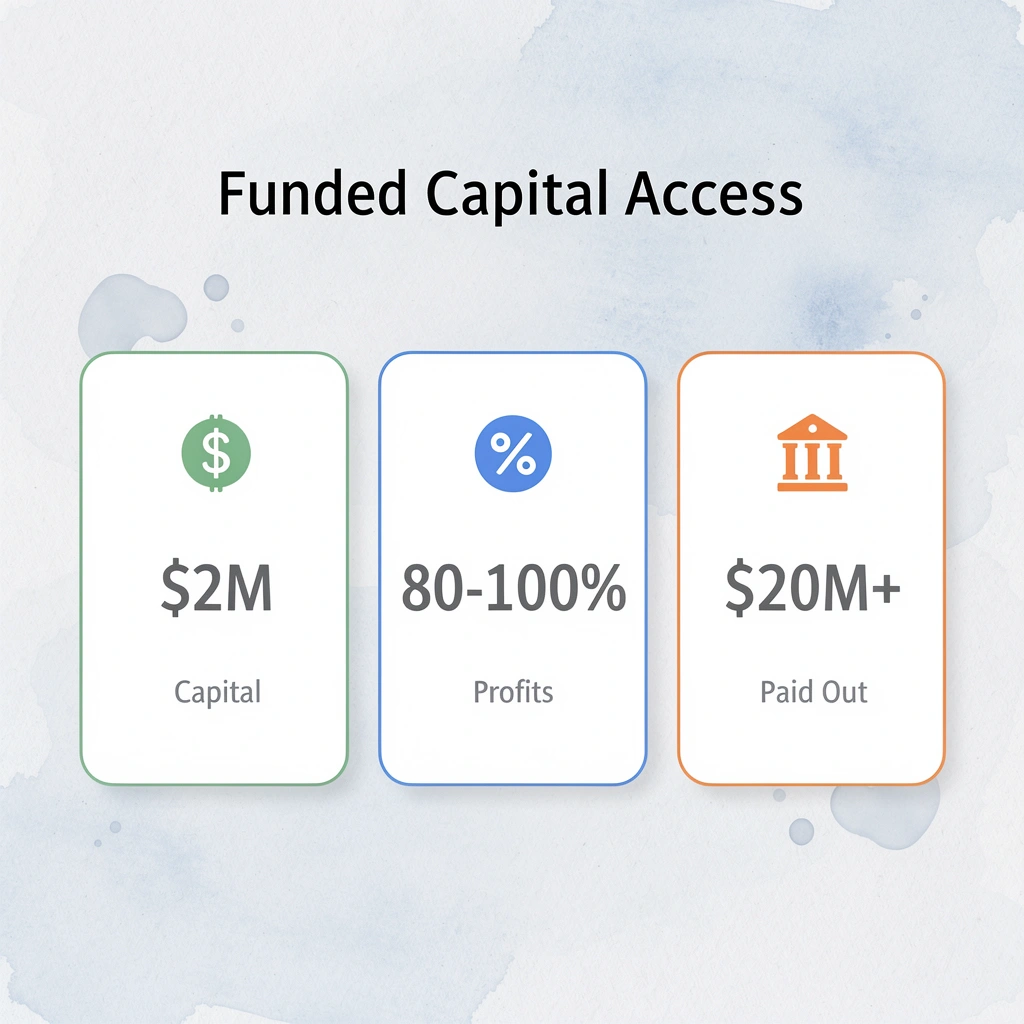
Pass the phases with clear targets (none in Phase 1, 10% in Phases 2 and 3), a 3% daily loss limit, and a 6% max loss. Manage the firm's capital and keep 80-100% of profits, with $20 million+ paid out to traders. Execute confidently, request payouts on demand (within 24 hours or we add $1,000), and grow your account while we absorb losses.
Evaluation Phase
Phase 1
- Profit Target: 0%
- Daily Loss Limit: 3%
- Max Loss: 6%
Phase 2
- Profit Target: 10%
- Daily Loss Limit: 3%
- Max Loss: 6%
Phase 3
- Profit Target: 10%
- Daily Loss Limit: 3%
- Max Loss: 6%
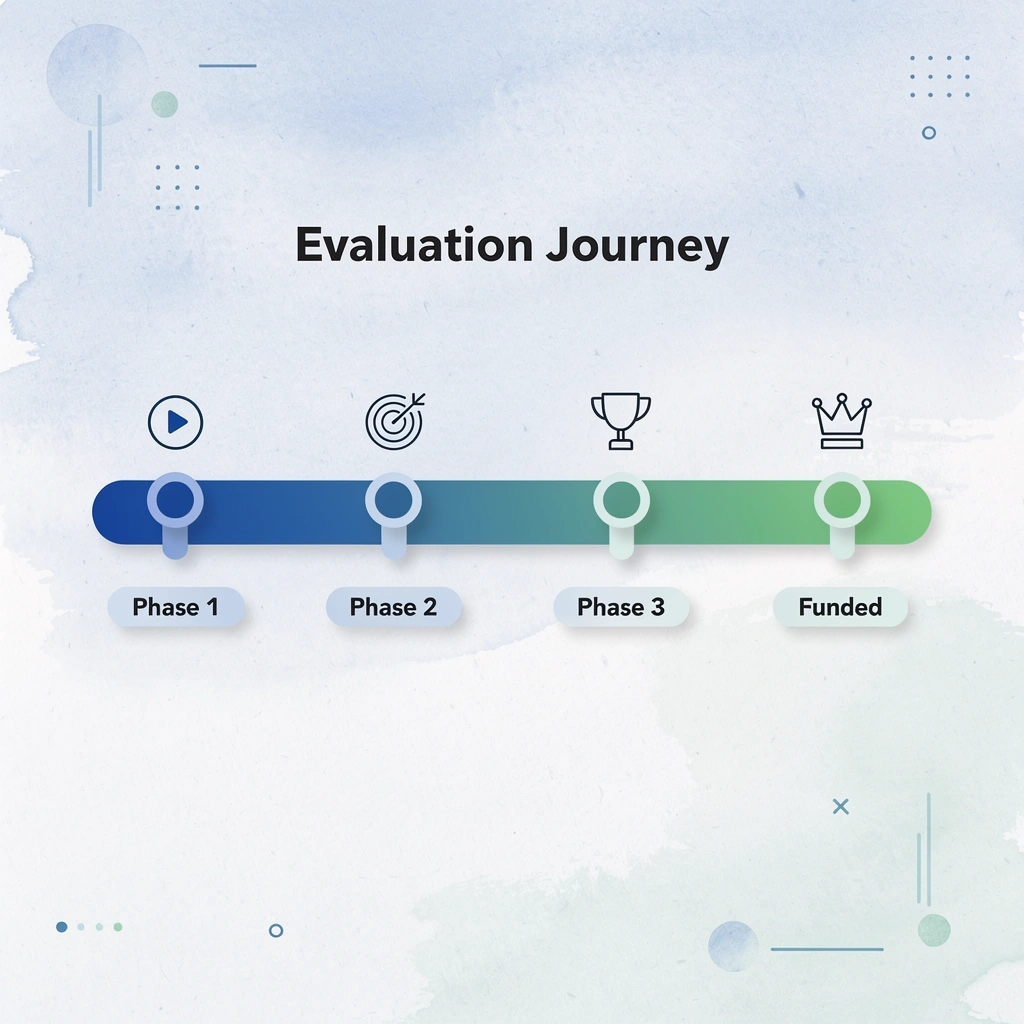
⚠️ Warning: Start your Goat Funded Trader journey today with no credit card required. Choose your account size, apply the 50% OFF code FIRSTGFT for new customers, complete the evaluation phases, and unlock funded capital with real rewards. Get instant access to the platform and dashboard, plus 24/7 support used by 250,000+ traders worldwide.
🔑 Takeaway: Visit https://www.goatfundedtrader.com/ now and get funded.

Be Great and get the App