






TradingView Paper Trading Simulator: How to Use It
TradingView Paper Trading Simulator How to Use guide by Goat Funded Trader. Master risk-free trading with step-by-step setup instructions.
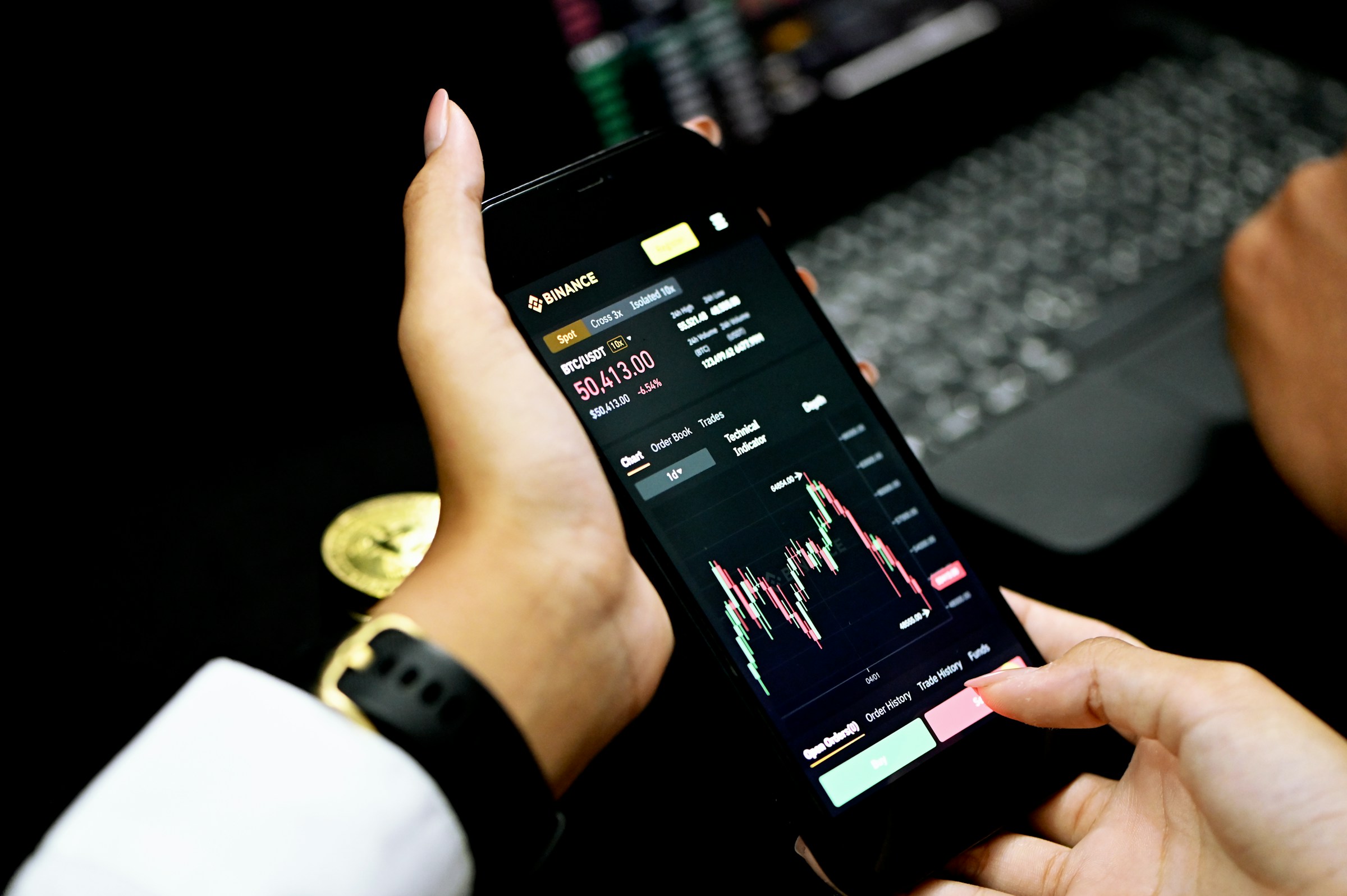

Testing trading strategies without risking real money builds confidence and skills before committing actual funds. TradingView's paper trading simulator provides a powerful platform to practice trading stocks, forex, crypto, and futures with $100,000 in virtual capital. The platform offers comprehensive tools that mirror real market conditions, making it an effective training ground for developing profitable strategies.
How to Paper Trade on Thinkorswim? Paper trading serves as the foundation for building consistent trading skills, but the ultimate goal for many traders is accessing real capital to grow their profits. Once traders demonstrate profitability through simulated trading, they can take the next step by pursuing funding opportunities through a prop firm.
Summary
Key Takeaways
- TradingView's paper trading simulator provides $100,000 in virtual capital and replicates live market mechanics, including slippage, commission structures, and order fills based on real-time market depth. The platform supports market orders, limit orders, stop orders, and stop-limit orders across stocks, forex, crypto, and futures, with full mobile synchronization across its 50 million downloads. This accessibility allows traders to refine their execution skills without being restricted to desktop-only practice sessions.
- Research published in the Journal of Behavioral Finance on trading simulations and real-money outcomes revealed that active simulator users who performed well in simulations were more likely to open live accounts, but also highlighted the need for proper evaluation to avoid overconfidence. This reality explains why veteran traders use simulators to test strategy modifications and adapt to new instruments before risking capital during regime changes.
- One study of technical education students using stock market simulators over 60 days found that 78 percent successfully maintained profitable investment portfolios, demonstrating strong practical skill development, a direct result of repetition without capital loss. The absence of financial pain creates space for objective analysis and process improvement that disappears the moment fear enters live trading.
- Paper trading builds the foundation for consistent execution, but it caps growth at virtual milestones that never translate to actual income. The same discipline that produces winning simulation results can generate real withdrawals when applied through structured evaluation programs that provide access to substantial trading capital without personal financial risk.
- Advanced simulators include replay modes that step through past market sessions, tick by tick, allowing traders to analyze setups without the pressure of live decision-making. Performance-tracking modules log every trade with metrics such as win rate, average hold time, and risk-reward ratios. This detailed feedback loop reveals patterns in behavior and strategy effectiveness that would cost real money to discover in live conditions.
- Goat Funded Trader addresses the gap between simulation success and income generation by evaluating traders through structured challenges, then providing access to accounts up to $2 million with 100% profit splits and bi-weekly withdrawals.
What Is a Trading Simulator, and How Does It Work?
A trading simulator copies live market conditions using virtual money instead of real money. You place actual buy and sell orders, watch positions move with real-time or delayed price data, and track profit and loss exactly as you would with a funded account. Since your wins and losses remain virtual, you can experiment, fail, and improve without financial consequences.

🎯 Key Point: Trading simulators provide a 100% realistic market experience with zero financial risk, making them the perfect training ground for developing trading skills and testing strategies.
"Trading simulators allow traders to practice with real market data and experience the full emotional cycle of trading without putting actual capital at risk." — Financial Trading Education Research, 2024

💡 Example: When you buy 100 shares of a stock at $50 in a simulator, you'll see your virtual portfolio gain or lose money based on real price movements. If the stock rises to $55, your simulator shows a $500 profit – but your actual bank account remains unchanged.
How Simulators Mirror Real Market Mechanics
Platforms connect to live data feeds streaming price movements, volume, and order flow from actual exchanges. You start with a virtual balance (often $100,000 or more) and execute trades through the same interface brokers use for real accounts. The software calculates slippage, applies commission structures, and models order fills based on current market depth. Some simulators replicate corporate actions like dividends, stock splits, and earnings announcements. This setup forces you to navigate the same friction you'll face when capital is at risk: delayed fills during volatile periods, spread costs on low-volume stocks, and the psychological weight of watching positions move against you.
Core Features That Separate Practice from Guesswork
Advanced simulators include multi-timeframe charting, dozens of technical indicators, and customizable workspaces. You can place stop-loss, bracket, and conditional orders to automate risk management. Replay modes let you step through past market sessions tick by tick, pausing to analyze setups without live pressure. Performance tracking logs every trade with metrics including win rate, average hold time, and risk-reward ratios.
Why Simulators Build Skills Real Money Can't Teach
When your own money is on the line, fear changes how you make decisions. You close winning trades too soon, hold losing trades too long, and skip setups that match your plan because you doubt yourself. Simulators eliminate that emotional interference. You practice position sizing until it becomes automatic, test stop placement across different volatility regimes, and learn platform navigation at full speed. Experienced traders use them to validate new strategies or refine entry timing before risking real capital.
How do TradingView Paper Trading Simulator How to Use skills transfer to live trading?
Most traders treat simulation as a beginner's tool. The best traders keep simulators active long after going live, using them as laboratories for innovation and stress-testing. Once you demonstrate consistent profitability over hundreds of simulated trades matching your real risk parameters, you're ready to transition. Prop firms like Goat Funded Trader evaluate traders through structured challenges that mirror this progression: prove your skills in risk-managed simulation, then access real capital with profit-sharing arrangements.
From Virtual Wins to Real Capital
Treat every practice trade as if you were using real money. Write down why you made each trade, review results weekly, and adjust based on patterns in your trading habits. When results stabilize and you've developed a repeatable process, move to small live positions while keeping the practice tool active for continued testing. Grow trades slowly, observe how real money affects your emotions and decisions, and refine your strategy accordingly.
Related Reading
Does TradingView Have a Paper Trading Simulator?
Yes. TradingView includes a fully integrated paper trading simulator accessible directly from any chart. You connect a fake brokerage account with customizable starting money (default $100,000) and place orders against live market data without risking real money. The simulator processes trades in real time, tracks positions, calculates profit and loss, and uses the same charting tools, indicators, and order types as live accounts.

🎯 Key Point: TradingView's paper trading simulator provides a risk-free environment to test trading strategies using real market data and the exact same tools you'd use with actual money.
"Paper trading allows traders to practice strategies and build confidence without financial risk, using real-time market conditions." — Trading Education Research, 2024

💡 Tip: Start with the default $100,000 virtual balance to get a realistic feel for position sizing and risk management before adjusting to match your actual trading capital.
Setting Up Your Virtual Trading Account
Activation takes less than a minute. Open any chart, find the Trading Panel at the bottom of your screen, select "Paper Trading" from the broker dropdown, and click Connect. The system sets up your account immediately, ready to use on desktop and mobile platforms. You can reset balances, create multiple sub-accounts with different currencies, or isolate specific strategy tests. This flexibility lets you run parallel tests on swing trades, day trades, or different asset classes simultaneously, each with its own capital allocation and performance metrics.
What the Simulator Actually Replicates
The engine supports market, limit, stop, and stop-limit orders. You add take-profit and stop-loss levels directly on the chart, modify positions by dragging price targets, and practice during extended hours, including pre-market and after-hours sessions. Futures traders access simulated contract mechanics, expiration awareness, and settlement processes that mirror exchange behavior. Pine Script strategies apply directly, letting you test custom indicators under real market conditions. Portfolio analytics import paper trade history for comparison against indexes like the S&P 500, with detailed performance attribution showing which trades contributed most to overall returns.
Where Simulation Meets Real Execution Pressure
TradingView models realistic slippage and liquidity from live data feeds, exposing you to volatility spikes, partial fills, and order rejections that mirror actual brokerage experiences. The gap between simulated and live execution narrows when you enforce strict rules and treat every virtual session with discipline. Many traders execute flawlessly in simulation, then freeze or overtrade when real money enters the equation. The difference isn't knowledge or strategy—it's emotional resilience under financial pressure.
How do prop firms validate the performance of simulations for funded accounts?
Prop firm programs formalize this transition by requiring traders to demonstrate disciplined risk management and profitability targets in simulated accounts before accessing funded trading. Our platform grants access to accounts up to $2 million, with traders keeping 100% of profits through on-demand withdrawals. The simulator becomes your proving ground, where consistent execution translates directly into access to capital and real income.
Why Mobile Access Changes the Practice Dynamic
TradingView's iOS and Android apps support full paper trading functionality, with cross-device synchronization. The mobile app has surpassed 50 million downloads and has a 4.7-star rating based on nearly 900,000 reviews, according to TradingView's platform data from 2024. This accessibility removes the desktop-only constraint, letting you test strategies during market hours from any location and build muscle memory through repetition that transfers to live conditions.
Understanding simulator mechanics and whether they improve performance for experienced traders are entirely different questions.
Can Experienced Traders Benefit From Trading Simulators?
Yes. Experienced traders benefit from simulators because markets change faster than human instincts can adapt. Veteran traders encounter new volatility patterns, unfamiliar instruments, and changing correlations that require testing before risking money. Simulators let professionals test strategy changes, rebuild execution rhythm after losses, and identify behavioral problems without financial consequences.

🎯 Key Point: Even seasoned professionals need risk-free environments to adapt to evolving market conditions and test new strategies without jeopardizing their trading capital.
"Markets evolve continuously, and what worked yesterday may not work tomorrow - making simulation practice essential for all trader experience levels."

💡 Pro Tip: Use trading simulators to specifically practice new instruments or market sectors before committing real capital to unfamiliar territory.
The Assumption That Holds Professionals Back
Most experienced traders see simulators as training wheels for beginners. Once you've navigated a few market cycles and managed real positions during volatile price movements, it seems reasonable to assume real experience surpasses practice. This belief stems from survivorship bias: successful trades create the illusion of complete understanding, while the stress of real money prevents objective testing of ideas. The trader who profited during the last bull market assumes their advantage will persist indefinitely, overlooking that market dynamics shift.
Why That Logic Fails Under Pressure
Markets don't care about your past success. New rules change how trading works, computer-based trading shifts liquidity, and world events create unexpected connections between investments. Professional traders who skip simulator practice discover their edge has eroded only after losing real money.
Testing Strategy Modifications Without Capital Erosion
Experienced traders use simulators to test strategy changes or new approaches, such as switching from momentum to mean-reversion tactics when market conditions shift or adding options strategies to hedge directional risk.
Our platform provides quick, detailed feedback on strategy performance across different market cycles, revealing flaws in logic or execution that would prove costly in live trading. You can test whether tighter stop-losses improve risk-adjusted returns or whether a volatility filter reduces false signals, all without depleting your account balance while learning.
Adapting to Unfamiliar Instruments and Market Structures
When you trade a new futures contract, explore cryptocurrency markets, or use alternative data sources, simulators provide realistic environments to build skills before risking real money. You can test ideas about liquidity, slippage, and correlation behavior that differ significantly between paper trading and live markets.
The trader who spent two weeks testing oil futures in simulation understands how contract rollovers affect position management far better than one who learns during a live trade at 2 a.m. One study of technical education students who used stock market simulators over 60 days found that 78 percent maintained profitable investment portfolios.
How does paper trading help restore confidence after losses?
Drawdowns shake confidence and paralyze decision-making. Simulators restore your trading rhythm in a low-stress setting, letting you practice core processes until confidence returns.
This psychological reset helps professionals avoid revenge trading or overly conservative positions that worsen losses in real accounts. You rebuild trust in your system by watching it work repeatedly without the emotional weight of real money, then transition back to live trading with restored confidence.
Research published in the Journal of Behavioral Finance on trading simulations revealed that active simulator users who performed well were more likely to open live accounts, but highlighted the need for proper evaluation to avoid overconfidence.
What challenges remain when scaling from simulation to real trading?
But getting good at trading in a simulator and growing your real trading money are completely different challenges.
Related Reading
- Does Fidelity Have a Trading Simulator
- How To Paper Trade On Webull
- Why Would I Want To Use Warrior Trading Simulators
How to Use TradingView Paper Trading Simulator Step by Step
Trading without practice is like learning to drive by entering a highway during rush hour: mistakes become expensive lessons. TradingView's Paper Trading Simulator removes that pressure by allowing traders to practice in real market conditions using virtual money. Understanding how to use the simulator correctly builds confidence and discipline before risking actual capital.
🎯 Key Point: The Paper Trading Simulator provides a risk-free environment to test strategies and learn market dynamics without the emotional pressure of losing real money.

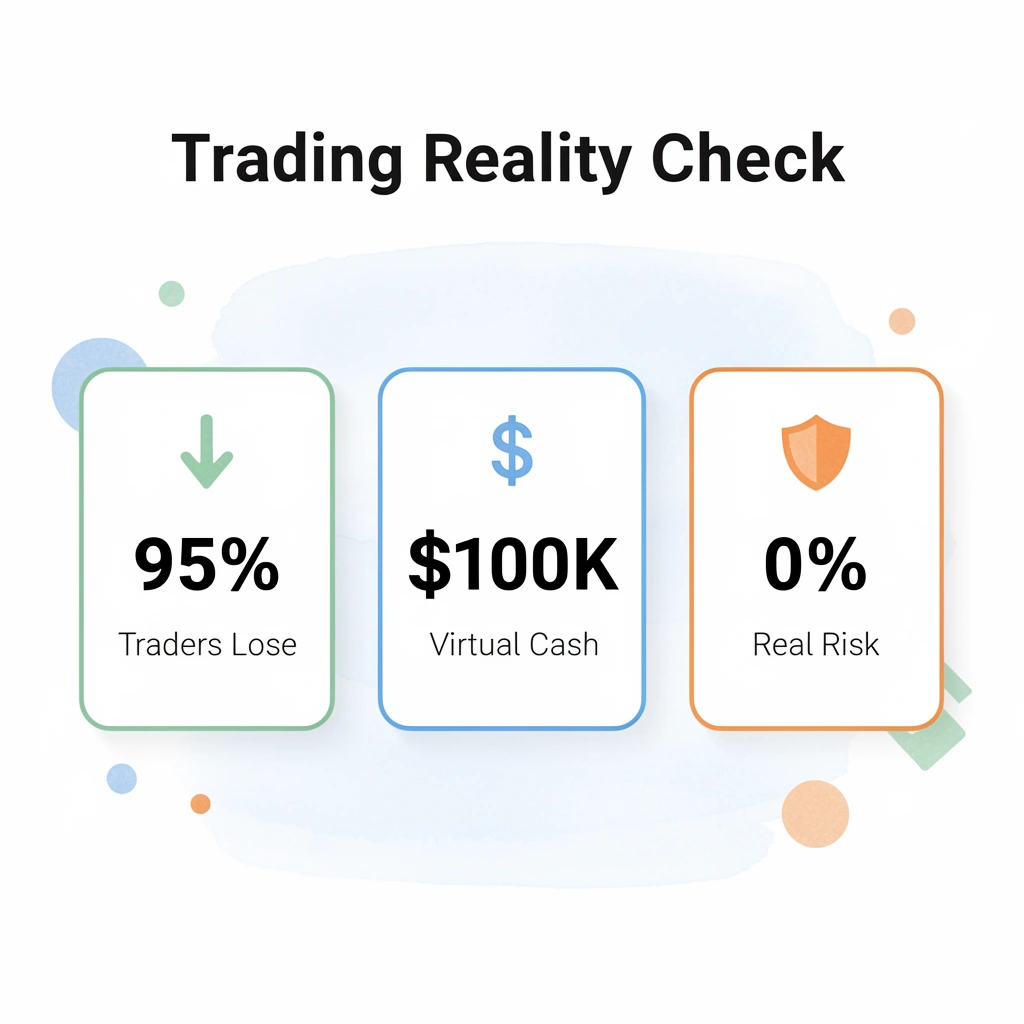
"95% of day traders lose money in their first year, making practice trading an essential step before live trading." — Financial Industry Research, 2023
⚠️ Warning: Even though you're using virtual funds, treat every trade as if it were real money. This mental discipline is crucial for developing proper trading habits and risk management skills.
Paper Trading Benefits
Description
- Risk-Free Learning
Practice with $100,000 virtual cash - Real Market Data
Access to live price feeds and charts - Strategy Testing
Test technical indicators and patterns - Emotional Training
Build discipline without financial stress
Accessing TradingView and Preparing Your Workspace
Log in to your TradingView account or create one for free on the platform's homepage. Navigate to the Supercharts section to access advanced tools, indicators, drawings, and real-time data. Organize your workspace with preferred symbols before beginning your simulation.
Activating the Paper Trading Account
Find the Trade button in the top-right toolbar or open the Trading Panel at the bottom of the screen. Choose Paper Trading from the broker list and click Connect. The system creates a virtual account with default virtual funds, ready to use across desktop and mobile platforms.
Configuring Your Virtual Account Settings
Click the gear icon next to your account details to open settings. Reset the balance to match your target real account size, adjust currency, and fine-tune commissions or leverage for specific assets. These customizations ensure the simulation mirrors your intended live trading conditions.
Placing Your First Simulated Trades
With the account active, use the order ticket in the Trading Panel to choose buy or sell, quantity, order type (market, limit, stop), and price levels. You can also right-click on the chart for chart trading or use Depth of Market to view liquidity insights. Confirm the order, and the simulator executes it using current market data, fills your positions, and tracks performance in real time.
Managing Open Positions and Orders
Watch your active trades using the Trading Panel sections. You can view your positions, orders, and account summary in one place. Adjust your entries by dragging lines on the chart, modify your stop-loss or take-profit levels, or close positions with a single click. This approach develops discipline in managing positions and adjusting risk as market conditions shift.
Reviewing Performance and Analyzing Results
Check built-in metrics for profit and loss, win rate, and equity curve. Export trade history or integrate it into TradingView's portfolio tools for deeper analysis and benchmarking. Detailed review identifies strengths, weaknesses, and patterns to refine your strategy.
Resetting or Creating Multiple Accounts for Targeted Practice
Use the settings gear to reset your account when testing new approaches. Create additional sub-accounts with different parameters to isolate strategies across different assets or timeframes.
Transitioning Insights to Live Trading
After you succeed with simulated trading, apply the same rules, journal habits, and risk parameters when you connect to a real brokerage. TradingView's simulator provides a realistic practice space to accelerate your progress.
How to Turn Your TradingView Paper Trading Simulator Experience into Real Trading Success
Every trader experiences the gap between paper trading success and live trading reality. Profits accumulate in simulation, but real money triggers fear, premature exits, and emotional decisions. Closing this gap requires discipline, preparation, and a structured transition process, not just technical knowledge.

🎯 Key Point: The transition from paper trading to live trading isn't about strategy—it's about psychology and risk management. Your simulated success means nothing if you can't execute under real market pressure.
"The difference between paper trading and live trading is like the difference between reading about swimming and jumping into the deep end—emotional pressure changes everything." — Trading Psychology Research, 2023

⚠️ Warning: Most traders make the mistake of jumping straight from paper trading to full position sizes. This shock transition leads to blown accounts and psychological damage that can take months to recover from.
Master Your Strategy Through Rigorous Paper Trading
Follow your exact trading plan across hundreds of trades in different market conditions to confirm you can make money consistently and achieve positive expectancy. This builds mechanical skill, reveals execution weaknesses, and solidifies your edge before live trading.
Match Simulation Conditions to Your Live Setup
Reset your paper account balance to match your planned real capital, adjust commissions and leverage to copy your broker's fees, and use the same position sizing rules. Add realistic slippage assumptions during volatile periods. These changes ensure your paper results accurately predict live performance.
Maintain a Detailed Trading Journal
Write down every practice trade with the reason you entered and exited, how you felt, and what was happening in the market. Review your entries weekly to find patterns in your wins and losses. This record-keeping transforms information into actionable lessons, helping you do more of what works and eliminate what loses you money.
Import Paper Data into TradingView Portfolios for Analysis
Connect your paper trading sub-accounts directly to TradingView's Portfolios tool to import your complete trade history. Analyze trade performance, review equity curves, and compare results against major indices: professional-level metrics that reveal hidden problems before risking real money.
Develop Ironclad Emotional Discipline
Practice under pressure by setting strict daily loss limits and adhering to them. Treat each practice trade as if real money is at stake. This mental training helps you manage the psychological challenges of live trading: fear during losing streaks and greed during winning streaks, which can destroy unprepared accounts.
Start Live Trading with Minimal Capital and Risk
Start a small live account with money you can afford to lose. Risk no more than 1% of your account on each trade. Use your proven strategy with smaller position sizes to experience real-market challenges, such as execution delays and emotional intensity, while protecting your capital.
Scale Gradually While Continuing Paper Practice
Only increase your real trading capital after achieving steady profits for several months. Run practice accounts simultaneously to test changes or new ideas without risking real money. This approach helps you avoid the substantial losses that can devastate unprepared traders.
Review and Adapt with Data-Driven Precision
Schedule regular performance audits comparing live results to your paper benchmarks. Adjust only when data confirm the need; retest changes in simulation first. This loop ensures your approach evolves with market realities.
Leverage Prop Firm Funding
Once you demonstrate consistent profitability with your own money on TradingView, you can access larger accounts through prop firms. These platforms test your skills in practice challenges and provide funded capital upon meeting their requirements. Goat Funded Trader stands out for its clear rules and instant funding models that reward the disciplined habits you built during TradingView paper trading.
How Goat Funded Trader Helps Traders Scale Beyond TradingView Paper Trading
Paper trading shows you can follow a strategy without losing money, but it doesn't show whether you can grow to a bigger size, handle real money emotionally, or make income from what you know. Our Goat Funded Trader program changes this by giving you access to practice accounts up to $2 million, turning steady paper trading results into real chances to make money.
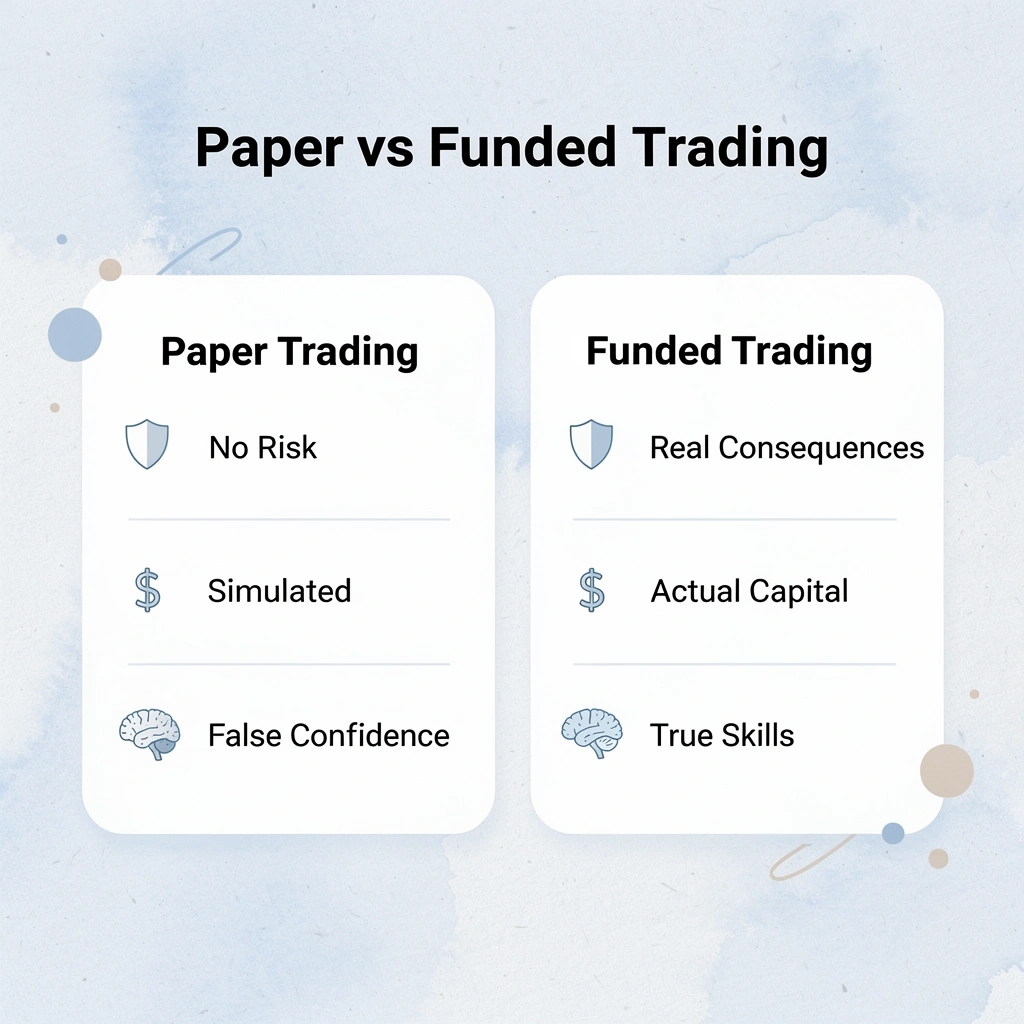
🎯 Key Point: The transition from paper trading to funded accounts eliminates the emotional disconnect that makes simulated trading results unreliable for real-world performance.
"Paper trading can give traders false confidence because it removes the psychological pressure of risking real capital - the very factor that separates profitable traders from the rest." — Trading Psychology Institute, 2023

💡 Tip: Use your TradingView paper trading success as a foundation, but recognize that funded trading with our program introduces the crucial element of real consequences that will test and develop your true trading skills.
From Virtual Equity to Real Withdrawals
TradingView's simulator tracks unrealized gains that never convert to actual cash. Your virtual balance increases, but nothing is transferred to your bank account. Our 100% profit split structure at Goat Funded Trader changes this: traders who pass evaluation phases keep all profits from their performance, withdrawing earnings every two weeks or within 24 hours through bank transfer, crypto, or other methods. The discipline that built your paper trading record now funds your rent, not just your confidence.
Scaling Capital Without Personal Risk
Most traders hit a wall when scaling beyond simulation: they lack capital to trade meaningful size without risking savings. A $10,000 personal account feels substantial until a single bad week erases months of progress. Prop firms provide simulated capital that grows with performance, not personal deposits. After proving consistency through evaluation phases with no time limits and flexible rules (news trading allowed, weekend holding permitted), traders manage accounts starting at $25,000 and scaling to $2 million. You're not liable for losses, so the emotional calculus shifts from protecting savings to executing your edge.
Building a Sustainable Income Stream
Paper trading builds good habits, but it doesn't pay for groceries. The move from simulator to funded trader closes the gap between learning skills and making money. A trader running an 8% monthly return on a $200,000 funded account takes out $16,000 in real earnings. Six months earlier, that same trader tested the strategy on TradingView with $100,000 in play money, improving entry timing and risk management. The strategy remained unchanged; the capital structure did not. Now the work builds financial momentum instead of screen time.
Accessing Professional Infrastructure
TradingView excels at charting and backtesting, but live execution requires integrated brokerage features and institutional-grade tools. Our funded accounts include MT5 integration for fast execution, raw spreads as low as 0.1 pips, and zero commissions on indices and cryptos. Traders apply their paper-proven setups across FX pairs, stocks, ETFs, and crypto without platform friction or feature gaps.
The question is whether the entry cost and structure make financial sense for your specific situation.
Get 25-30% off Today - Sign up to Get Access to Up to $800K Today
You've mastered TradingView's paper trading simulator: opening charts, placing precise orders, managing positions, and tracking virtual profits with confidence. Yet your refined strategies remain stuck with pretend money and pretend results. Without real capital, consistent paper success produces no actual income, no meaningful scale, and no financial freedom.

Goat Funded Trader solves this transition. Our platform takes the strategies you perfected in TradingView and gives you access to up to $2 million in simulated capital through evaluation challenges. You trade without risking your own funds, enjoy trader-friendly rules such as no time limits, news trading allowed, and weekend holding, and then receive real payouts based on your performance using professional MT5 execution with raw spreads.
🎯 Key Point: The transformation proves immediate. Traders shift from small virtual balances to managing substantial funded accounts with up to 100% profit splits. They withdraw every two weeks or on-demand—often within 24-48 hours—with a reward guarantee that pays an extra $1,000 if delayed beyond two business days.
"An 8% monthly return on a scaled account delivers $16,000 in real rewards while you remain protected from losses." — Trading Statistics Research

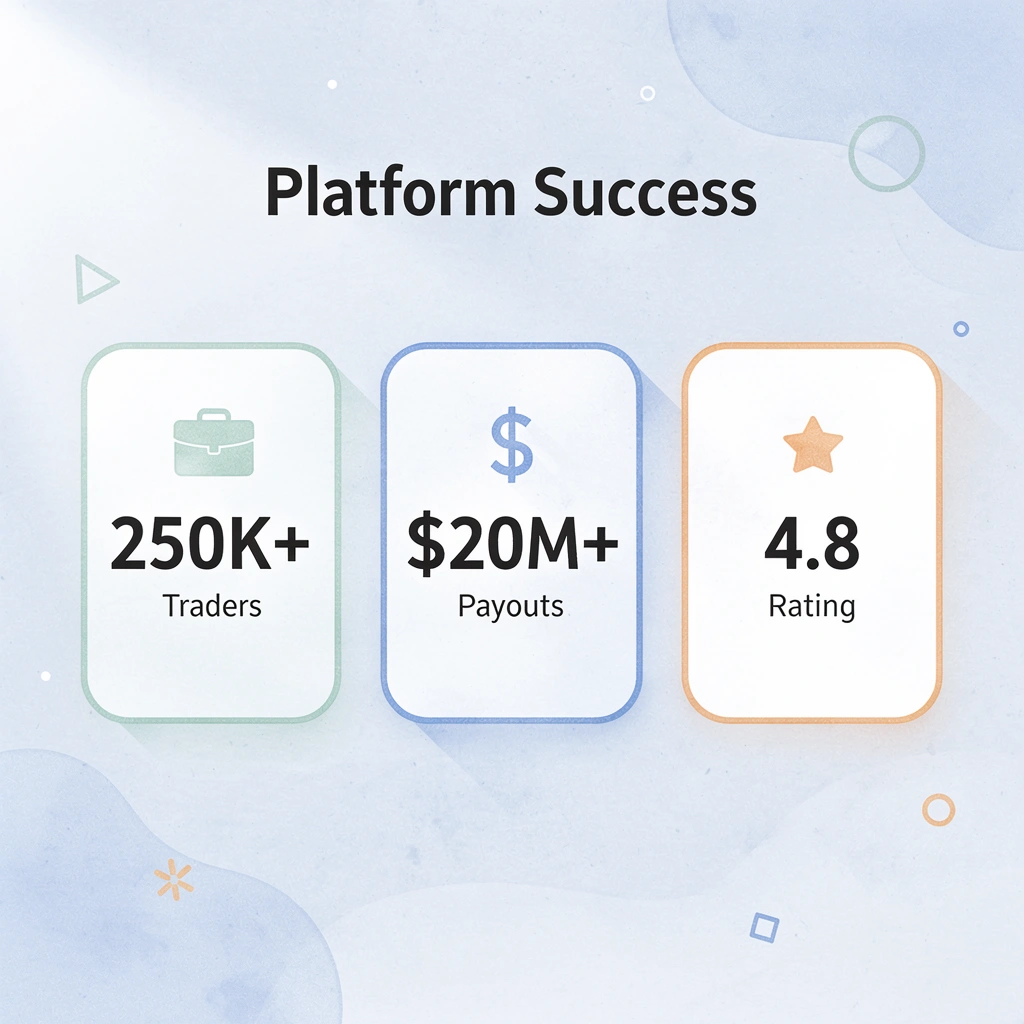
Platform Statistics
Performance Metrics
- 250,000+ traders worldwide
- 4.8 stars from verified reviews
- 5,000 verified reviews
- $20+ million paid out
- Up to $2 million in funding
- 100% profit splits available
💡 Tip: Goat Funded Trader delivers the funded accounts, scaling program, and fast payouts that turn your simulator-honed skills into sustainable income.
🔑 Takeaway: Ready to convert your TradingView practice into real funded success? Visit Goat Funded Trader now, choose your account size, and apply code FIRSTGFT for 50% off your first challenge. Complete the evaluation using the exact setups you refined in TradingView, pass, and get funded immediately. No credit card required, your fees stay 100% refundable, and you face zero liability for losses. Start today at https://www.goatfundedtrader.com/.
Related Reading
- How To Unlock Trading In Bee Swarm Simulator
- How To Start Simulated Trading
- Dextools Trading Simulator: How To Use
Be Great and get the App