
What Are Crypto Trading Signals? A Beginner's Guide
Crypto trading signals explained for beginners: what they are, how to read one, and how to judge every idea with your own analysis before you trade.
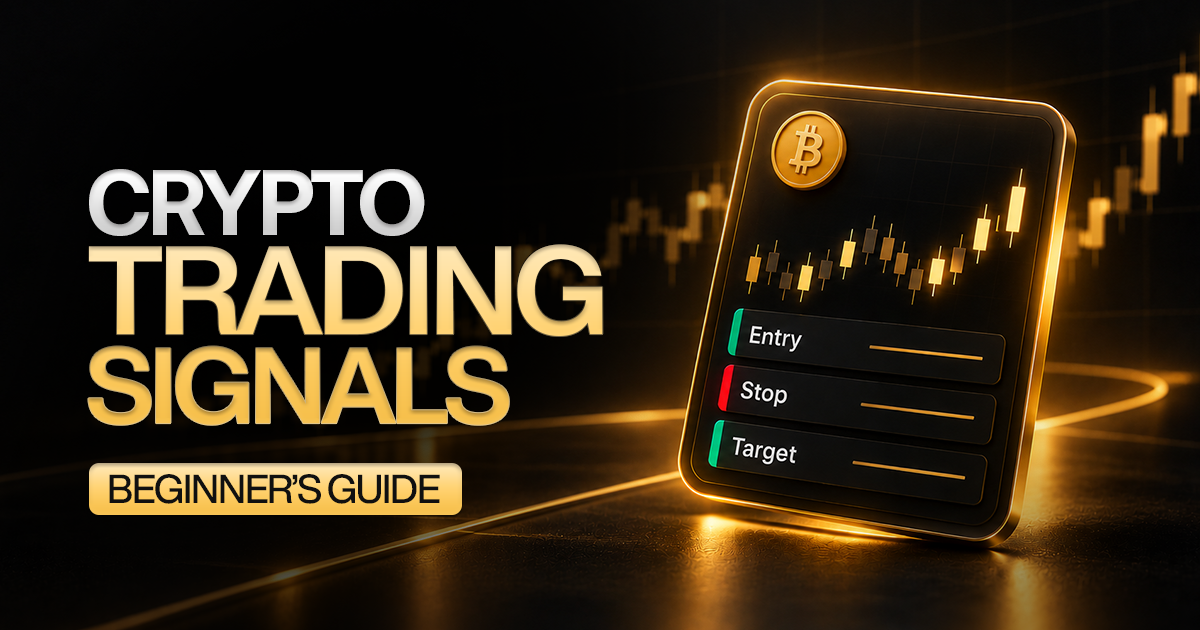

Have you ever joined a chat group and seen a message like "BTC/USD: buy at 60,000, stop-loss 58,500, take-profit 64,000"? Maybe you wondered who sends these, how they come up with the numbers, and if following them could make you money.
Those messages are crypto trading signals, and they have become one of the first things beginners run into when exploring the market. Signals look simple, which is exactly why they attract so much attention, and also why so many beginners misuse them.
The truth sits in the middle. A well-built signal can save you hours of chart work and teach you how experienced analysts think. A poor one can push you into a trade at the wrong price with no plan for the exit.
Below, we explain how to read and use crypto trading signals without handing control of your money to a stranger. You will also see how to build your own trading record on a funded simulated account, with every trade based on your own analysis.
What Are Crypto Trading Signals? A Simple Explanation
Think of a signal as directions from a navigation app. The app does not drive the car, and it can suggest a route blocked by roadworks. It simply tells you where to turn based on the information available.
A signal does the same for a trade: it suggests where to enter, where to exit if the idea is wrong, and where to take profit if the idea works.
They come from analysis of price charts, trading volume, and sometimes news. Someone, or something, studies the market, spots a setup, and packages it into a short message. You receive the message, then decide for yourself if you will act.
It is always important to remember that a signal is an opinion about probability, not a promise of profit. You stay responsible for every trade you place, so the quality of your own checks counts as much as the signal itself.
Where Do Crypto Trading Signals Come From?
Every signal starts with a source:
-
Human analysts: Experienced traders read charts and post setups, usually with a short explanation. You can learn from the reasoning, though quality varies widely between people.
-
Automated systems: Software scans many coins and fires an alert when set conditions are met. They run around the clock, yet they follow rules blindly, so a sudden news event can break them.
-
Indicator alerts: Charting platforms let you create alerts from tools such as moving averages or the relative strength index (RSI). These are the simplest signals, and you control every rule.
-
Community and social feeds: Chat groups and social posts hand out free crypto signals by the dozen. They also spread hype and paid promotion, so this source needs extra caution.
Are Crypto Signals Worth It? An Honest Look
Crypto signals can save time and point traders toward setups they may have missed. The value, however, depends on the quality of the provider and how much independent judgment goes into each trade.
Where signals can help:
-
A good service can reduce the time spent scanning multiple charts.
-
Entry, stop-loss, and target levels can show beginners how experienced traders structure a setup.
-
Signals can introduce trading ideas across coins or pairs you may not monitor regularly.
Where signals can fall short:
-
A late entry can turn a strong setup into a poor trade by weakening the reward-to-risk ratio.
-
Published win rates may leave out losing calls, skipped setups, or unfavorable periods.
-
Following every alert without understanding the reasoning makes it difficult to react when the market changes.
-
Paid subscriptions add another cost, so the service needs to provide enough value to justify the expense.
In practice, are crypto signals worth it? For some traders, yes. Beginners should use alerts to support analysis, compare setups, and improve decision-making.
Free Crypto Signals vs Paid Services: What You Actually Get
Free crypto signals are easy to find in public chats and social feeds. They cost nothing, which makes them a good starting point for studying how setups are written. The trade-off: free channels frequently exist to sell something later, so check the business model.
Paid services add structure. This includes consistent formatting, support, and sometimes educational content. A price tag does not prove quality, though, and the cost has to be recovered by your trading profits before you reach breakeven.
Begin with free sources, track their results, and only pay once a provider has earned trust with a documented record.
How to Use Crypto Signals Step by Step
Here is a safe routine for how to use crypto signals as a beginner:
-
Open the chart yourself: Confirm price is still near the suggested entry and the setup makes sense visually.
-
Check the risk-to-reward: Skip any call whose reward falls below its risk.
-
Size your position: Risk no more than 1% of your account, and use the distance between entry and stop-loss to work out the position size.
-
Place the stop-loss first: Enter the stop at the same time as the order, so protection exists from the first second.
-
Skip stale calls: If price has already run a long way from the entry, wait for the next one.
-
Log the result: Record the signal, your entry, the outcome, and how you felt. Honest notes show if the source helps or hurts.
-
Practice first: Run the routine on a simulator before using real money. The guide to practicing crypto trading with fake money shows how.
Build Your Own Trading Record With Goat Funded Trader
A crypto signal can look convincing on a screenshot. The real test is how well it performs across dozens of trades, different market conditions, and periods of both profit and drawdown.
Goat Funded Trader gives you a structured way to build that record. You can choose an evaluation route if you want to prove your approach first, or an Instant funding model if you are ready to begin from the simulated funded stage. Account sizes go up to $400,000 in simulated capital.
The process is simple. Treat any signal as a trade idea, not an instruction. Check the setup against your own strategy: entry price, stop-loss, target, market conditions, and position size. Only take a trade your own analysis supports, then record the result. Over time, you can compare win rate, average profit, average loss, drawdown, and how often an idea still made sense by the time you received it.
This gives you something more useful than an advertised success rate: your own data.
Once you reach the funded stage, eligible profits can earn monetary rewards. Profit splits depend on the account model, with some routes offering 80% or 90% and optional structures that can reach 100%. Reward schedules also vary by model.
The goal is to learn which kinds of setups fit your strategy, which are worth taking, and which should be ignored.
Get funded with Goat Funded Trader today and start judging trade ideas by your own trading record, not someone else’s screenshots.
Frequently Asked Questions
Can signals guarantee profit?
No. No crypto signal can guarantee a profitable outcome because price can change quickly after an alert is issued. At Goat Funded Trader, traders are expected to make their own decisions and manage risk independently. A signal may highlight an idea, but position size, stop-loss placement, and account rules still determine how much is at risk.
How many signals should I follow?
For Goat Funded Trader accounts, third-party signal services should not be followed as trade instructions. The firm requires traders to make decisions independently, and copying trades from signal providers or trading groups is prohibited. If you use market commentary for research, keep your watchlist small and judge every setup against your own strategy before entering.
Do signals work for every timeframe?
Signals can be built around different timeframes, from short intraday setups to trades lasting several days. However, timing affects how useful an alert remains. A delayed entry can completely change the reward-to-risk profile. On Goat Funded Trader, any trade you take must still come from your own analysis rather than copying an external signal provider.
Are automated bots the same as signals?
No. A signal provides a trade idea, while an automated bot or Expert Advisor can place or manage trades based on programmed rules. Goat Funded Trader allows Expert Advisors when they comply with its trading rules, but certain third-party strategies, high-frequency systems, and prohibited methods are restricted. Always check the current rules before using automation.
Is signal trading legal?
Legality depends on your country and how the signal service operates, so local requirements should always be checked. Goat Funded Trader also has separate account rules: copying trades from signal providers, trading groups, third-party services, or other traders is prohibited. Trades placed on your account must come from your own analysis and independent trading decisions.
Be Great and get the App