






Fear of Missing Out in Trading: 5 Key Steps to Overcome It
Fear of Missing Out and Trading got you making bad decisions? Goat Funded Trader reveals 5 proven steps to overcome FOMO and trade smarter.


Market spikes trigger emotional buying decisions that destroy more portfolios than any crash ever could. Fear of missing out drives traders to abandon their strategies and chase pumps, turning potential profits into devastating losses. How to Use AI for Crypto Trading? Technology can help identify patterns and opportunities, but it cannot replace the discipline needed to execute trades without emotional interference.
Structured trading environments force discipline by removing the temptation to risk personal capital on impulsive decisions. Professional evaluation processes teach traders to recognize FOMO patterns before they become costly mistakes. Many successful traders develop this crucial self-control by starting with a prop firm that provides capital and accountability frameworks.
Summary
- FOMO-driven traders underperform the market by an average of 3-5% annually, according to Magnifi's 2024 research. This gap compounds into career-ending losses over time because the pattern repeats consistently rather than occurring as isolated mistakes. The structural underperformance stems from buying strength after moves have exhausted and selling weakness after optimal exits have passed.
- Approximately 90% of traders experience FOMO, according to the NinjaTrader Blog, yet most continue trading without addressing the psychological triggers. This constant activity dilutes focus while accumulating commissions and slippage with each impulsive entry. The volume of mediocre trades collectively underperforms passive approaches, turning what should be selective execution into costly overtrading.
- FOMO entries win only 28-35% of the time compared to 55-65% for planned setups. Your brain prioritizes speed over accuracy when emotion drives the trigger, skipping the checklist that separates structured trades from gambling. This gap doesn't improve with experience because the mechanism bypasses learning, activating the same impulsive circuits regardless of how many times you've seen the pattern fail.
- Magnifi's research reveals that 78% of retail investors admit to making impulsive investment decisions driven by FOMO, often triggered by social media posts showcasing others' wins. This comparison mechanism hijacks rational evaluation, replacing disciplined trade selection with reactive chasing based on what's trending in your feed. You stop trading your edge and start trading other people's highlights, which represent survivorship bias rather than a repeatable strategy.
- Loss aversion makes your brain process the pain of missing a profitable move almost identically to an actual financial loss. This asymmetry amplifies the emotional cost of inaction far beyond the discomfort of a controlled risk, so you abandon waiting for proper setups to avoid the torment of watching price advance without you. The sting of watching a setup you identified move 3% without you feels worse than taking a 1% stop loss on a planned trade.
- Trading with simulated capital through Goat Funded Trader removes the scarcity mindset that drives impulsive overtrading by providing up to $2M in funded accounts where losses don't touch personal savings.
What Is Fear of Missing Out (FOMO) and How Does It Impact Trading Performance?
FOMO in trading is the emotional urge to enter positions because watching others make money feels unbearable, rather than because your strategy signals opportunity. It replaces rational analysis with urgency, turning disciplined traders into reactive ones who chase price movements after the best entries have passed.

🎯 Key Point: FOMO-driven trades are emotional decisions disguised as trading opportunities - they happen when you see others profiting and feel the urgent need to participate, regardless of your actual trading plan.
"Fear of Missing Out transforms rational traders into impulsive market participants who prioritize speed over strategy." — Trading Psychology Research, 2024
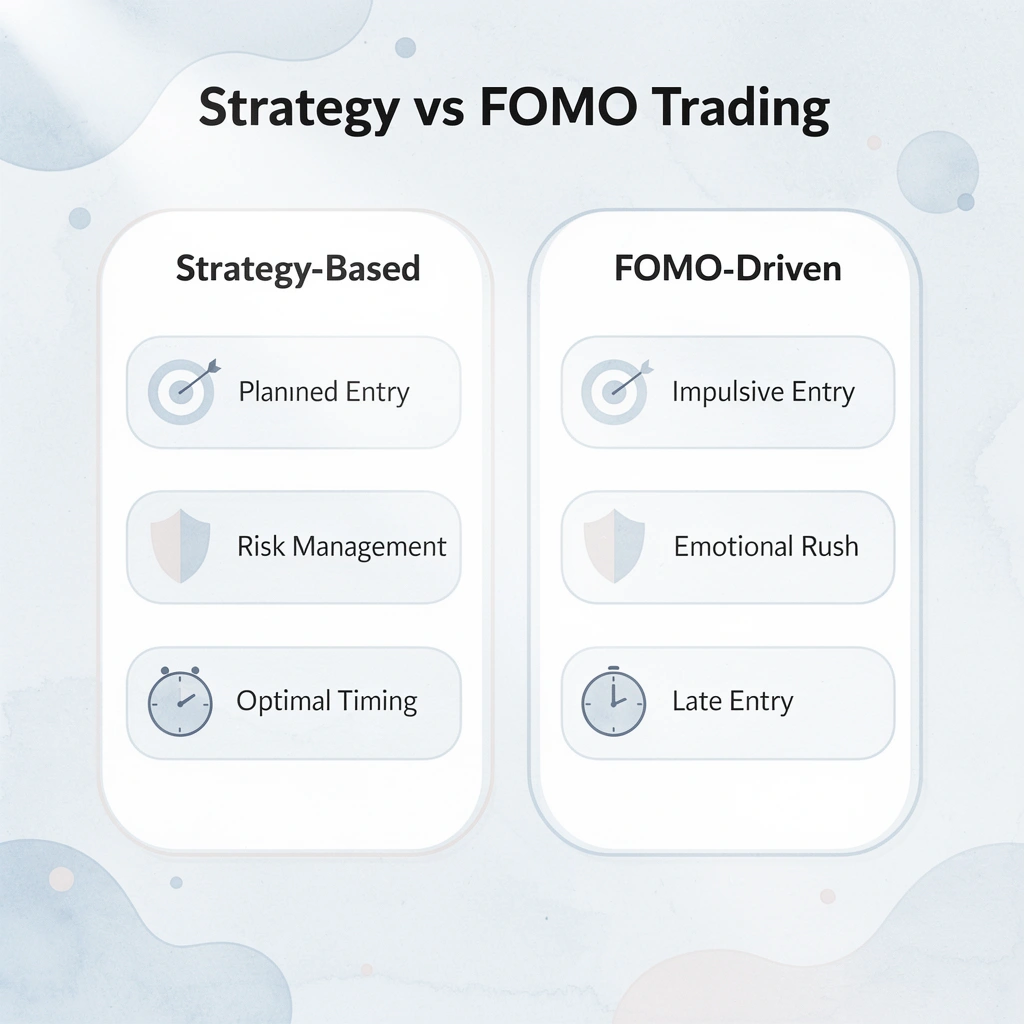
⚠️ Warning: FOMO trading typically occurs after the optimal entry points have passed, meaning you're entering positions at higher risk with lower profit potential - the exact opposite of successful trading principles.
FOMO Triggers Impulsive Entries at the Worst Moments
You watch a cryptocurrency surge 15% in an hour while social media fills with profit screenshots. Your trading plan requires specific confirmation signals before entry, but FOMO whispers that waiting means missing the entire move. You buy near the peak without proper setup validation. The market reverses within minutes, and you're holding a losing position that never matched your risk parameters. This pattern repeats because the fear of being left behind overrides the discipline separating profitable traders from gamblers.
Leads to Oversized Positions and Broken Risk Rules
When FOMO strikes, position sizing logic collapses. Your standard 1% account risk suddenly feels insufficient because the opportunity appears too significant to approach cautiously. You allocate 5% or more to a single trade, rationalizing that this setup is different or more certain. Research from TradesViz found that FOMO-driven decisions frequently involve risk violations that amplify losses beyond manageable levels. A single failed trade at 5% risk creates a drawdown requiring multiple winning trades to recover, while emotional damage compounds the mathematical setback.
Causes Poor Exits and Emotional Trade Management
Without a strong thesis, normal 3% pullbacks trigger panic selling because you entered based on emotion rather than analysis. You exit winning trades early, fearing profits will vanish. This emotional whipsaw converts potentially profitable trades into break-even confusion or losses, eroding both capital and confidence.
How does Fear of Missing Out fuel overtrading behavior?
FOMO keeps you scanning for the next hot opportunity rather than waiting for high-probability setups that match your strategy. You jump between stocks, crypto, and forex, chasing momentum while accumulating commissions and slippage with each impulsive entry.
According to the NinjaTrader Blog, approximately 90% of traders experience FOMO. This constant activity dilutes focus while increasing costs that erode long-term returns.
What separates disciplined traders from FOMO-driven ones?
The greatest traders wait for setups that match tested strategies, managing money with the discipline that turns small edges into substantial gains over time. A prop firm like Goat Funded Trader changes this by letting you trade firm money under structured evaluation rules that enforce discipline into your routine.
The evaluation process itself becomes training that teaches pattern recognition, turning emotional urgency into measured responses aligned with professional standards. But knowing FOMO destroys performance doesn't stop it from happening when you're staring at a chart that's moving without you.
Why Does Fear of Missing Out Happen in Trading?
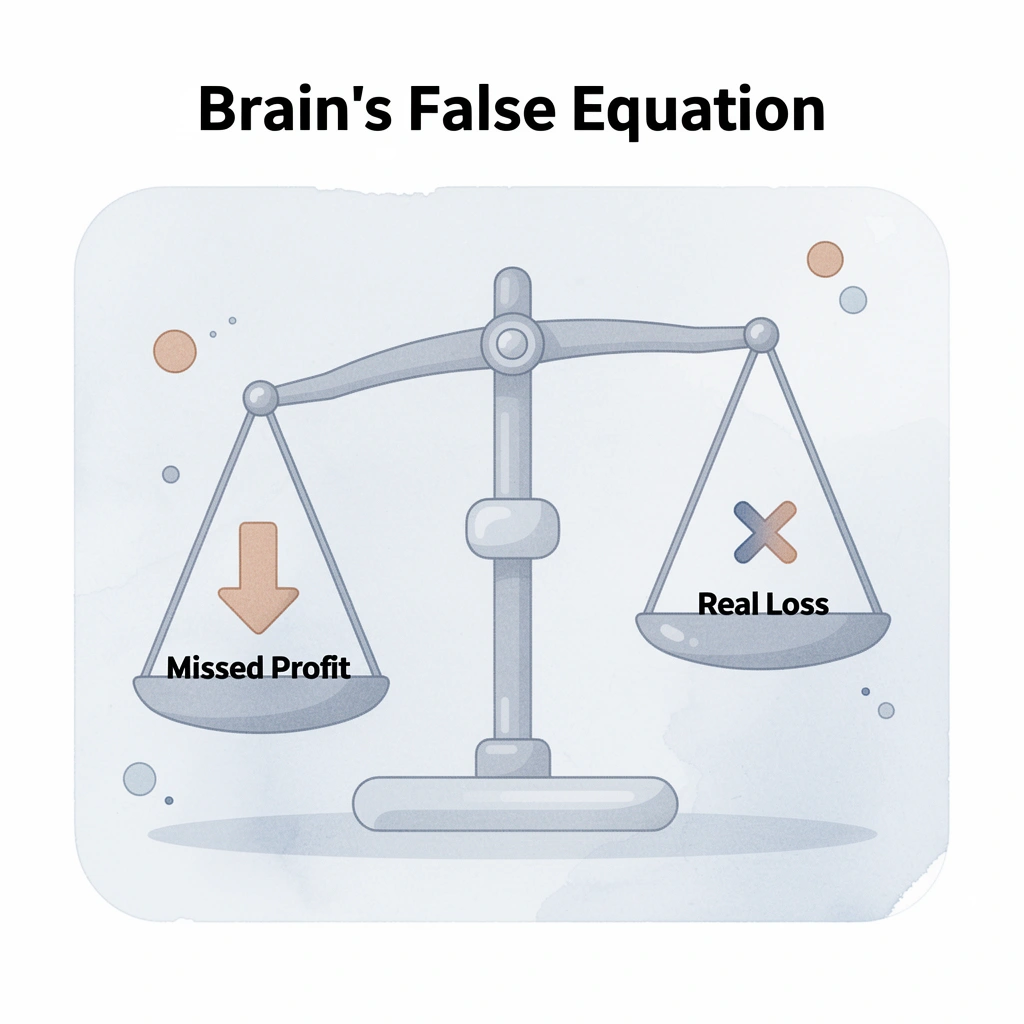
Your brain treats missed profit the same as actual loss, driving impulsive action instead of waiting for your edge. Social feeds amplify this by flooding you with win screenshots, making sitting out feel like failure. These triggers follow predictable psychological patterns shaped by how your mind processes regret, comparison, and reward.

🎯 Key Point: FOMO in trading stems from your brain's inability to distinguish between missed opportunities and real losses - both trigger the same stress response that leads to poor decision-making.
"The fear of missing out creates a psychological state where traders perceive missed profits as equivalent to actual losses, leading to impulsive and often detrimental trading behaviors." — Frontiers in Psychology, 2021
⚠️ Warning: Social media trading content is specifically designed to trigger FOMO responses - those profit screenshots you see represent the tiny percentage of winning trades, not the full trading reality.
Loss Aversion Makes Missed Gains Feel Like Real Losses
Your brain processes the pain of missing a profitable move almost the same way it processes an actual financial loss, creating intense regret that pushes you into impulsive action. This imbalance, rooted in prospect theory, makes the emotional cost of inaction greater than the discomfort of a controlled risk. In volatile markets like futures or stocks, this leads directly to entering trades late at poor prices because the perceived regret of missing out drives behavior more forcefully than logical risk assessment. The sting of watching a setup you identified move 3% without you feels worse than taking a 1% stop loss on a planned trade.
Social Media and Herd Mentality Fuel Constant Comparison
Social media feeds filled with screenshots of huge wins from other traders create constant pressure, triggering herd instincts and making isolation from apparent group success feel like a status threat. This drives you to jump into trending assets without proper due diligence. According to research published in the World Journal of Clinical Cases, while "fear of missing out" was introduced in 2004, social media has transformed it from occasional anxiety into a constant psychological force shaping daily financial decision-making.
Recency Bias Distorts Your View of Ongoing Moves
Strong recent price action dominates your perception, leading you to extrapolate short-term surges as endless trends. Your mind fixates on the last few bars or sessions of upward movement, ignoring broader context or probabilities, because fresh information feels more predictive than historical patterns. This transforms normal market noise into urgent opportunities, overriding patience and strategy.
Scarcity Mindset and Impatience Create Artificial Urgency
A deep belief that profitable setups are rare and don't last long convinces you that waiting equals losing wealth-building chances forever. Past experiences of missed opportunities or high expectations for quick results make this pressure worse. You act quickly because money sitting idle feels like wasted potential rather than smart positioning. Trading with a Goat Funded Trader removes the pressure of risking your own savings on every decision, allowing you to focus on quality setups rather than feeling forced to trade often to justify your account activity or to recover your capital.
Brain Chemistry and Dopamine Reward Anticipation Over Process
Thinking about joining a popular trade releases dopamine, focusing your attention on potential gains while ignoring risks. This makes quick trades feel rewarding immediately. This brain response hijacks your decision-making circuits, prioritizing the excitement of action over planning or rule-following. Fast feedback loops in trading amplify this effect, turning emotional highs into habits that override your system.
Understanding why FOMO happens doesn't answer what matters most: how much damage does it do when you let it control your choices?
Related Reading
- How to Use AI for Crypto Trading
- What Are Crypto Trading Signals
- How Long Does It Take To Learn Forex Trading
- What Is Spot Trading in Crypto
- Is Paper Trading Real Money
- Emotional Trading Mistakes
- Common Mistakes in Stock Trading
- Crypto Trading Mistakes
- Forward Testing Trading
- Paper Trading Vs Live Trading
- Risk Reward Ratio Trading
Can FOMO Cause Traders to Lose Money?
FOMO systematically drains trading accounts through poor entries, oversized positions, and panic exits that turn manageable losses into catastrophic drawdowns. Magnifi's 2024 research reveals that FOMO-driven traders underperform the market by an average of 3-5% annually, a gap that compounds into career-ending losses over time. This underperformance stems from buying strength after moves exhaust and selling weakness after optimal exit points have passed.

"FOMO-driven traders underperform the market by an average of 3-5% annually, creating a compounding gap that leads to career-ending losses over time." — Magnifi Research, 2024
🔑 Takeaway: The 3-5% annual underperformance may seem small, but it represents the difference between wealth building and wealth destruction when compounded over a trading career.
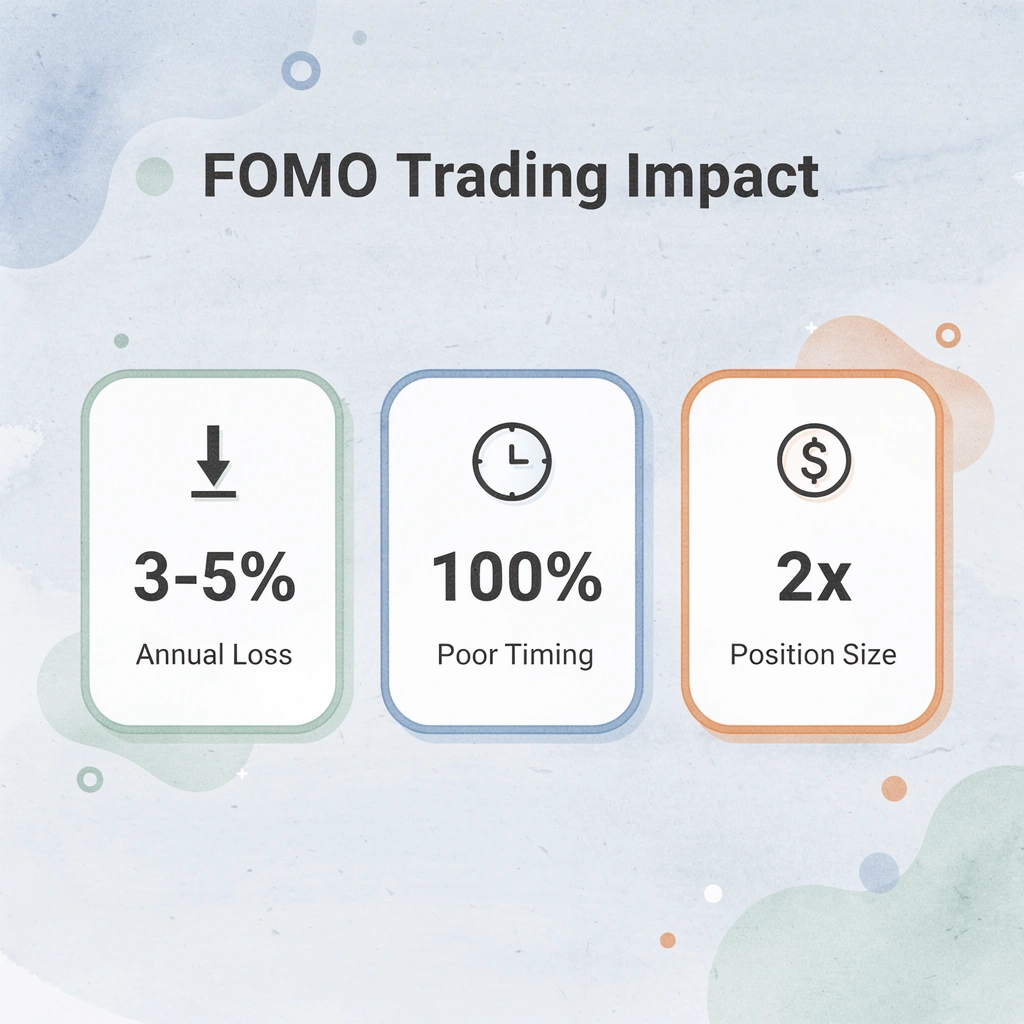
⚠️ Warning: FOMO trading creates a vicious cycle where poor timing leads to larger position sizes as traders attempt to "make up" for losses, amplifying the financial damage.
Late Entries Guarantee Poor Risk-Reward Ratios
FOMO pushes you into trades after the crowd has already moved, placing entries near local peaks where reversal risk spikes. You're buying after a 10% surge when the initial edge existed at the breakout, leaving minimal upside and maximum exposure to a pullback. This urgency overrides confirmation requirements, turning what could have been a 3:1 reward-to-risk setup into a coin flip. When the position moves against you immediately, the lack of conviction from a planned entry makes holding through normal volatility impossible, triggering exits at the worst possible moment.
Win Rates Collapse Under Emotional Decision-Making
Keep track of any series of FOMO trades, and the pattern becomes clear. Entries lack the technical confluence that defines high-probability setups because the decision was driven by anxiety rather than analysis. Your brain prioritizes speed over accuracy, skipping the checklist that separates structured trades from gambling. FOMO entries win 28-35% of the time compared to 55-65% for planned setups: roughly twice as many losses when emotion drives the trigger. This gap doesn't improve with experience because the mechanism bypasses learning, activating the same impulsive circuits regardless of how many times you've seen the pattern fail.
How does position sizing amplify Fear of Missing Out and Trading mistakes?
FOMO doesn't just lead to bad entries—it also causes position sizes to grow beyond risk management rules because the fear of missing the move feels more urgent than protecting capital. You might allocate 3% or 5% of your account when your system says to risk only 1%, which can multiply losses if the trade goes wrong. The combination of a poor entry, oversized risk, and weak conviction creates a perfect storm where small mistakes become losses that threaten your entire account. One bad week of FOMO trading can erase months of disciplined gains.
Why does trading personal capital increase the fear of missing out and Trading pressure?
Most traders using their own money feel constant pressure to make every dollar count, triggering FOMO as missed opportunities feel like wasted resources. Prop firms like Goat Funded Trader change this by providing practice accounts with substantial capital, removing the scarcity mindset that drives impulsive overtrading. When you're trading $100,000 in funded capital rather than your last $5,000, the urgency to chase every move disappears. This psychological shift allows you to focus on quality setups that align with your strategy rather than panic entries.
Social Comparison Drives Volume Over Quality
According to Magnifi's research, 78% of retail investors admit to making impulsive investment decisions driven by FOMO, often triggered by social media posts showing others' wins. This comparison mechanism replaces disciplined trade selection with reactive chasing of trending content.
The volume of losing trades increases dramatically because each post, notification, or forum thread creates a new trigger for emotional action. You stop trading your edge and start trading other people's highlights, which represent survivorship bias rather than a repeatable strategy.
The real cost of FOMO isn't individual losing trades; it's the compounding effect on your psychology that makes recovery nearly impossible without structural intervention.
Related Reading
- Crypto Trading For Beginners
- Discipline In Trading
- Common Forex Trading Mistakes Beginners
- Trading Risk Management 1% Rule Explained
- Risk Management Day Trading
- Crypto Trading Risk Management
- ICT Trading Strategy For Beginners Step By Step
- Trading Risk Management Strategies
- Algorithmic Trading Risk Management
7 Signs You Are Trading With FOMO
You don't always realize you're trading with FOMO while it's happening—it feels active and decisive in the moment. Recognizing these warning signs early helps you identify when emotions are taking control before they become costly mistakes.

🎯 Key Point: FOMO trading often disguises itself as confident decision-making, making it harder to detect until significant losses have already occurred.
"Emotional trading accounts for up to 80% of retail trader losses, with FOMO-driven decisions being the leading cause of poor market timing." — Trading Psychology Institute, 2023

⚠️ Warning: The most dangerous aspect of FOMO trading is that it feels rational and urgent in the moment, creating a false sense of market opportunity that leads to impulsive decisions.
1. You Enter Trades After the Move Has Already Happened
You see a sharp rally and jump in late, ignoring your strategy's confirmation levels. This puts you at higher prices, where reversal risk spikes, turning a missed opportunity into an immediate loss. Urgency blinds you to proper timing, so you pay premium prices for momentum that often fades right after entry.
2. You Abandon Your Predefined Trading Rules
Your rules outline valid setups, yet you override them to chase hot moves, convincing yourself this time feels different. This eliminates your edge because trades lack the structural advantage your plan provides, resulting in random outcomes rather than consistent results. The deeper issue is the belief that hesitation equals permanent loss, which erodes the process separating profitable traders from those who struggle.
3. You Increase Position Sizes Beyond Your Normal Limits
A trending asset triggers an urge to buy more than your risk rules allow, breaking your capital-preservation framework. One bad trade now risks outsized damage to your account. The emotional drive to catch up amplifies losses on failed setups that would stay manageable under standard sizing.
4. You Trade Instruments or Setups Outside Your Expertise
You normally focus on specific markets or strategies, but FOMO pulls you into unfamiliar assets or styles. Without deep knowledge or tested criteria, these positions become guesses rather than calculated risks, exposing you to hidden pitfalls and unmanageable volatility.
5. You Constantly Monitor Markets and Feel Anxious When Idle
Your screen time grows as you refresh feeds and scan for movement, unable to step away because sitting out feels unbearable. This constant watching drains mental energy and leads to tired decisions, while rest periods feel like missed chances. The anxiety stems from viewing inactivity as failure, which prevents the patience needed for high-quality setups.
6. You Ignore or Widen Stop-Losses on Emotional Trades
Once you're in a position driven by FOMO (fear of missing out), you might move or remove your stop loss because admitting failure feels worse than the potential loss. This removes your protection against bad moves, turning small, controlled exits into larger drawdowns that damage both your capital and confidence.
7. You Experience Regret and Overtrade to Recover
After missing or leaving a move poorly, you hunt the next opportunity with heightened aggression, creating reactive trades that lack quality. This revenge-like behavior accumulates commissions, slippage, and emotional exhaustion whilst lowering your win rate. The pattern reinforces itself through short-term dopamine from action, keeping you trapped instead of reviewing and resetting.
7 Key Steps to Overcome FOMO in Trading
Recognizing FOMO isn't enough—you must interrupt the pattern before emotions take control. Overcoming FOMO means building habits and systems that prevent fear from dictating your trading decisions.

🎯 Key Point: The goal isn't to become fearless, but to develop systematic responses that override emotional impulses when market opportunities appear.
"Successful traders don't eliminate emotions—they create systems stronger than their feelings." — Trading Psychology Research, 2023
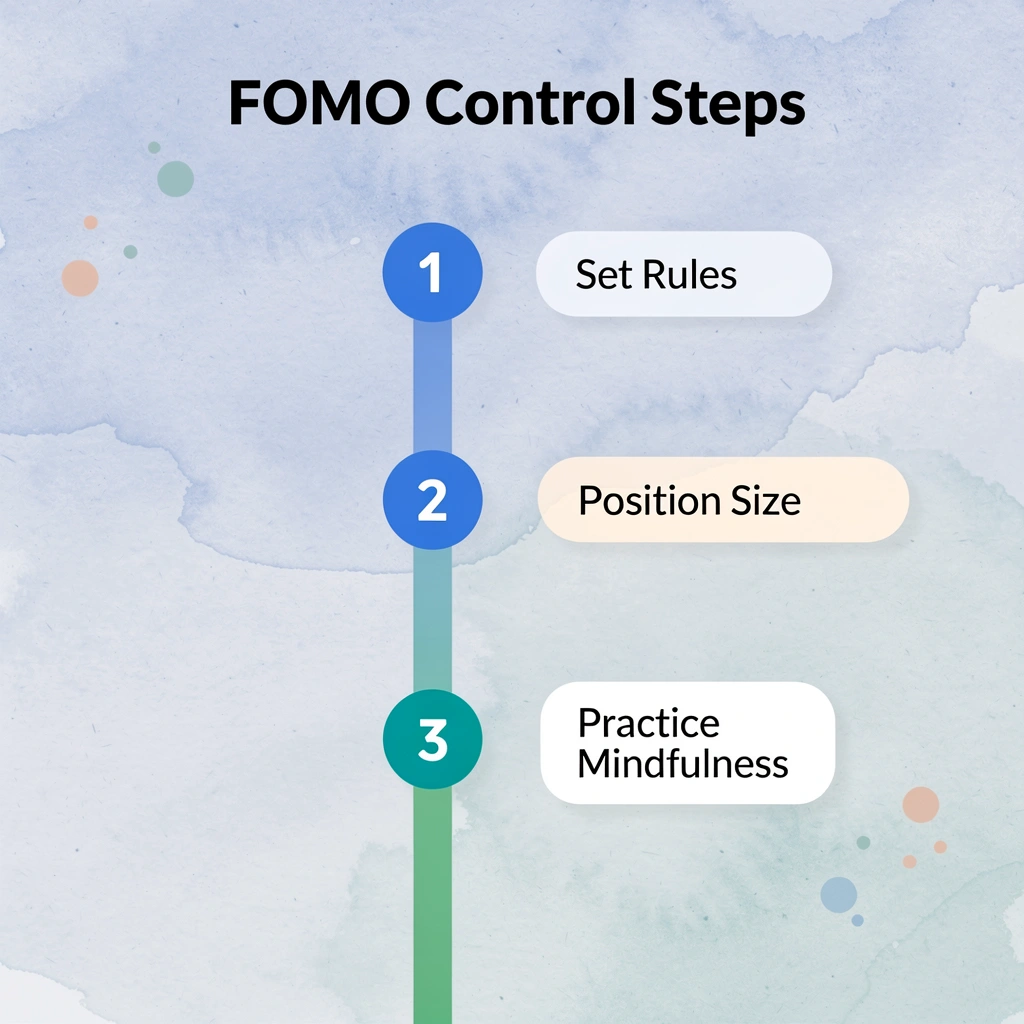
1. Set Clear Rules
- Define entry/exit criteria before trading
- Removes emotional decision-making
2. Use Position Sizing
- Risk only 1-2% per trade
- Limits fear-driven mistakes
3. Practice Mindfulness
- Take 3 deep breaths before executing
- Creates mental space between impulse and action
4. Keep a Trading Journal
- Document emotions and outcomes
- Identifies FOMO patterns
5. Set Daily Limits
- Maximum 3 trades per session
- Prevents overtrading
6. Use Alerts, Not Charts
- Set price notifications instead of watching
- Reduces constant monitoring
7. Review Weekly
- Analyze wins and losses objectively
- Builds long-term perspective
⚠️ Warning: The most dangerous FOMO moments happen during high-volatility periods when emotions run hottest—this is exactly when your systematic approach matters most.
1. Accept That FOMO Exists and Normalize It
Recognize FOMO as a normal human reaction that everyone experiences, not a personal flaw. This acceptance removes the shame that leads to secrecy and escalation, allowing you to observe the urge from a distance rather than surrender to it. When you see it as a predictable signal rather than an emergency, you give your mind space to consider whether the setup matches your rules, breaking the automatic chase response that ruins accounts.
2. Develop and Commit to a Written Trading Plan
Create a detailed trading plan with exact entry criteria, position sizing, risk parameters, and exit rules. Review it daily before sessions so it becomes your default decision framework. This document overrides emotional impulses, ensuring every trade is driven by a tested edge rather than by fleeting market noise. Traders who follow predefined plans consistently outperform those who deviate under pressure.
3. Maintain a Detailed Trading Journal with FOMO Tags
Write down every trade immediately, including how you felt and whether fear of missing out influenced the decision. Review your performance weekly and mark entries where fear of missing out played a role to demonstrate its impact on your results. This self-check provides clear evidence that chasing opportunities harms your results, builds greater awareness, and turns past mistakes into patterns you can actively avoid.
4. Limit Exposure to Social Media and Market Noise
Set strict boundaries on checking feeds, notifications, and hype discussions by designating specific times or using app blockers during trading hours. Removing constant comparison eliminates external triggers that amplify urgency and false scarcity, enabling you to focus on independent analysis and high-probability setups.
5. Master Risk Management and Leverage Prop Firm Funding
Follow strict risk rules like 1% account risk per trade and daily loss limits to prevent emotional decisions from causing significant losses. Our funded accounts at Goat Funded Trader let you trade larger practice capital with built-in guardrails that build discipline without risking your own money. We provide access to funded accounts with clear rules and profit splits that reward consistency through payouts.
6. Practice Patience with Predefined Waiting Rules
Use rules like waiting for candle closes, requiring pullbacks before entry, or using limit orders at planned levels. These delays confirm real setups and train your mind to value quality over speed. Over time, this builds confidence that opportunities recur and disciplined waiting protects your capital better than reactive participation.
7. Focus on Long-Term Process and Continuous Review
Focus on your overall process and monthly performance metrics rather than individual trades. Review your journal regularly and adjust your plan to remind yourself that consistent execution, not catching every move, generates returns. This approach strengthens your resolve against FOMO and sustains motivation as you progress steadily.
Start using these steps one at a time beginning today, and track your progress in your journal. Traders who stick with them stop reacting impulsively and start executing reliably, which builds lasting success.
How Goat Funded Trader Helps You Overcome FOMO in Trading
Making changes to how you set up your trading space works better than using willpower to fight FOMO. Removing your personal money risk, setting firm limits on losses, and eliminating fake time pressure stops the feelings that trigger quick decisions without thinking. The right system transforms you from chasing trades mindlessly into waiting patiently to execute trades by blocking how FOMO infiltrates your process.

🎯 Key Point: Goat Funded Trader eliminates the three main FOMO triggers - personal financial risk, unlimited loss potential, and artificial urgency - creating a controlled environment where rational decision-making can flourish.
"Environmental design beats willpower every time. When you remove the triggers that cause impulsive behavior, you naturally make better decisions without relying on self-control." — Trading Psychology Research, 2024

⚠️ Warning: Relying on willpower alone to combat FOMO is a losing strategy. The most successful traders create systematic barriers that make impulsive trading physically harder to execute.
Trading Without Personal Capital Exposure
FOMO worsens when you miss trades and feel money slipping away, pushing you into late entries with poor setups. Goat Funded Trader addresses this by providing up to $2M in simulated capital where losses don't affect your own money. Trading under clear performance rules removes the stress that causes bad entries. Instead of chasing a breakout after it has already moved 8% to recover yesterday's missed profit, you wait for the next good setup, knowing your account isn't losing money with each passing hour.
Hard Risk Limits That Prevent Emotional Overexposure
The urge to take on oversized positions to "make up for" missed trades destroys more accounts than any single strategy flaw. FOMO whispers that doubling your usual risk will catch you back up, turning disciplined 1% allocations into reckless 5% bets that wipe out weeks of gains in minutes. Prop firms enforce maximum daily loss limits (typically 3%) and overall drawdown thresholds (often 6%) that act as circuit breakers against emotional escalation. Our risk management framework at Goat Funded Trader includes these structural boundaries that stop trading when your behavior signals a loss of control. They're not suggestions to override when frustration peaks, but safeguards designed to protect your account.
Removing Deadline Pressure From Trade Decisions
Artificial urgency breaks down decision quality because you skip the checklist that defines whether a trade matches your edge. Most evaluation phases have no time limits and allow unlimited trading periods, requiring only modest profit targets (often 10%) to advance. You wait days for proper alignment between price structure, volume confirmation, and risk-reward ratio without worrying that the clock will expire. This patience converts FOMO-driven overtrading into selective execution: taking 6 high-conviction setups that match your plan, rather than forcing 15 mediocre trades weekly to hit arbitrary activity quotas.
Scaling Through Consistency Rather Than Home Runs
The fear of limited opportunities drives traders to chase big wins on every trade, guaranteeing inconsistent results and emotional exhaustion. According to Goat Funded Trader, 90% of traders fail due to emotional decisions that prioritize short-term excitement over repeatable processes. Our funded programs reward steady performance with account scaling that grows capital allocation as you prove consistency. Hit your targets without violating risk rules, and your next account might double in size with profit splits reaching 80-100%. This structure makes disciplined trading more profitable than gambling.
How do fast payouts break Fear of Missing Out and Trading cycles?
Missing a trade and watching it work can make you feel regretful. This regret can push you to make hasty trades that aren't sound decisions, creating a repeating cycle. Some accounts let you withdraw money every two weeks or within 24 hours. This reinforces that following your trading plan generates real money.
When you regularly receive money from trading carefully and sticking to your plan, the fear of missing out weakens. You see that patience works rather than considering it in theory. This shifts your mindset from "I need to make this trade now" to "my next good trade will come, and I'll be ready for it."
Why does commitment matter more than understanding structure?
Knowing that the structure exists and deciding to commit to it are two different things.
Related Reading
- How To Make Money Trading Crypto
- How To Read Crypto Charts For Day Trading
- Best Trading Apps For Beginners
- Best Day Trading App For Beginners
- How To Learn Crypto Trading
- Best Demo Trading Account
- Risk Management In Stock Trading
- Best Stock Trading App For Beginners
- Best Crypto Trading App
- How Do You Manage Risk In Futures Trading
Get 25-30% off Today - Sign up to Get Access to Up to $800K Today
Closing the gap between knowing what to do and doing it requires removing the barriers that sustain emotional trading. You've seen how FOMO operates, why it persists, and what structural changes interrupt the cycle. The question is whether you'll continue trading with capital constraints and emotional triggers that fuel impulsive decisions, or shift to an environment designed to reinforce discipline when urgency pulls hardest.

🎯 Key Point: The difference between profitable and losing traders isn't knowledge—it's creating systems that automatically prevent emotional mistakes when market pressure is highest.
"Up to $2 million in simulated capital with no personal financial risk removes the emotional weight that turns small losses into account-destroying revenge trades." — Goat Funded Trader Risk Management Framework

Goat Funded Trader gives you up to $2 million in simulated capital with no personal financial risk, enforced loss limits that block oversized positions, and flexible rules that let you wait for proper setups instead of chasing. Use code FIRSTGFT for 50% off your first account and get funded instantly with no credit card required.
🔑 Takeaway: When your own money isn't at risk and position sizes are automatically controlled, the emotional drivers behind FOMO trading lose their power to override your trading plan.

Be Great and get the App