






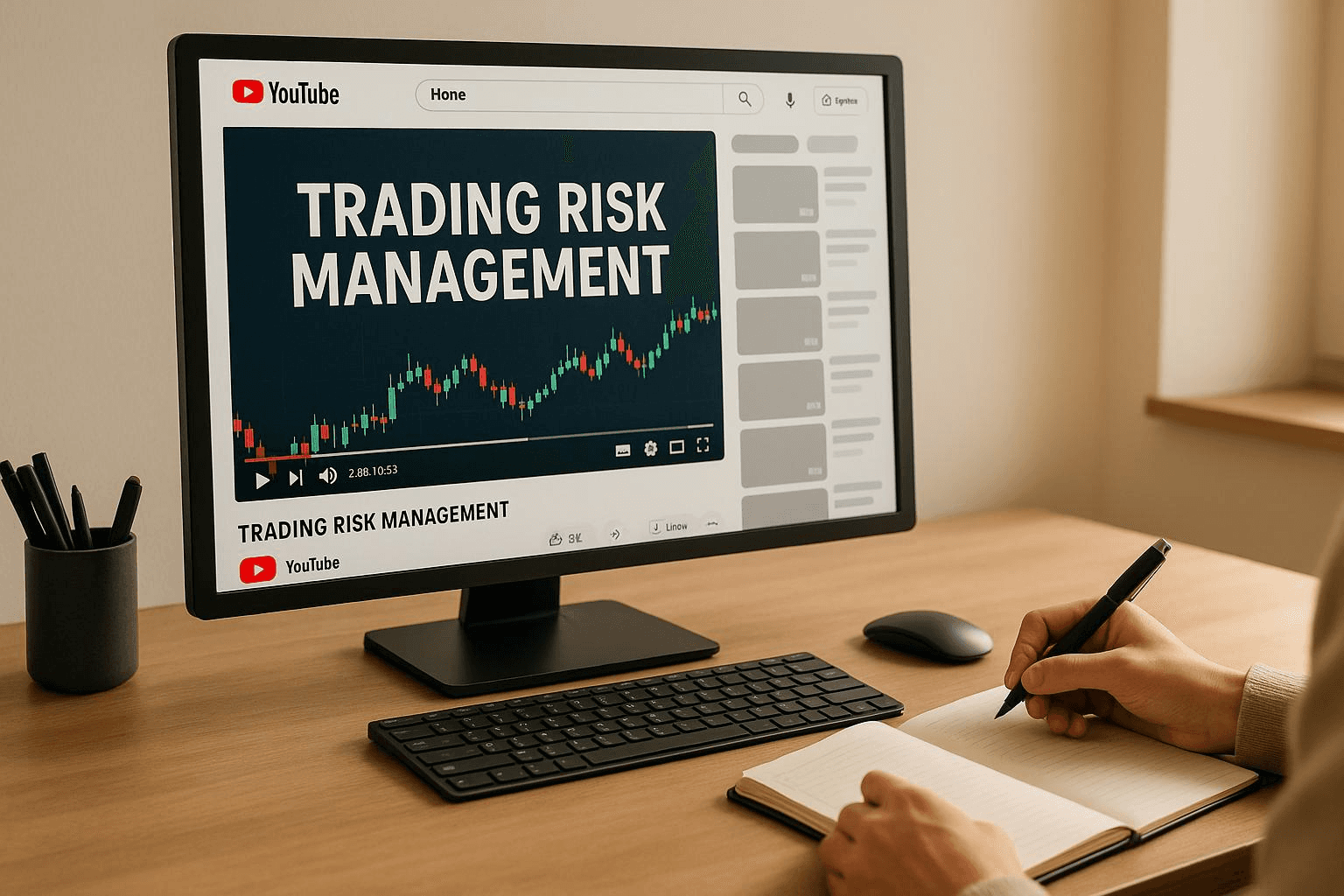
Trading Risk Management 1% Rule Explained
This article breaks down how the 1% rule works, why it matters, and how applying it consistently can protect your capital even during losing streaks.

Many traders learning how to use AI for crypto trading quickly discover that smart tools alone won't protect them from blowing up their account. The real foundation is knowing how much to risk on each trade, and that's exactly where the 1% rule becomes your most reliable guide. This article breaks down how the 1% rule works, why it matters, and how applying it consistently can protect your capital even during losing streaks.
If you want to put this knowledge to work in a real trading environment, Goat Funded Trader gives you access to funded accounts where disciplined risk management is not just encouraged but built into the structure. Instead of risking your own savings while you practice position sizing and loss limits, you trade with their capital and keep a share of the profits. It's a practical way to apply the 1% rule under real market conditions without the pressure of losing everything you have.
Table of Contents
- What Is the 1% Rule in Trading Risk Management?
- Why Is the 1% Rule Important for Long-Term Trading Success?
- Can Professional Traders Risk More Than 1% Per Trade?
- How to Apply the 1% Risk Rule Effectively When Trading
- Common Mistakes Traders Make When Using the 1% Rule, and How to Overcome Them
- How Goat Funded Trader Help Risk-Conscious Traders Scale Faster
- Get 25-30% off Today - Sign up to Get Access to Up to $800K Today
Summary
- • Traders who apply the 1% rule cap their maximum loss on any single trade at 1% of total account equity. On a $10,000 account, that means no more than $100 at risk per position. The rule does not limit trade frequency or profit targets. It controls only how much damage a single bad trade can do to the overall account.
- • The math behind losing streaks is more punishing than most traders anticipate. Losing 50% of an account does not require a 50% gain to recover. It requires a 100% gain. A trader risking 10% per trade can lose half their account in just five consecutive losing trades. That asymmetry is what makes oversized positions so destructive during normal drawdown periods.
- • Position sizing and stop-loss placement are connected in a specific order that most traders get backwards. The correct sequence is to start with the 1% dollar limit, measure the distance to the stop-loss, and then calculate position size from there. Traders who reverse this process frequently end up risking 4% to 5% per trade without realizing it until the damage is already accumulating.
- • Professional traders can exceed 1% risk per trade, but the upper limits are exceptions tied to specific conditions rather than a general standard. Professionals may risk up to 2% per trade, with some reaching 5% on high-conviction setups. Most traders who blow accounts are doing so by risking more than 1 to 2% per trade, meaning the failure typically comes from correct strategies applied at the wrong size.
- • Fractional Kelly sizing, the framework many experienced traders use in practice, typically lands between 1% and 2% per trade after accounting for estimation error, slippage, and sequence risk. Full Kelly maximizes geometric growth in theory but assumes perfect knowledge of an edge that no trader actually has. The professionals who last are the ones making the most precise bets, not the largest ones.
- • Access to larger capital changes the practical output of disciplined risk management without changing the underlying math. A trader risking 1% on a $5,000 account caps each loss at $50. The same discipline applied to a $200,000 account makes that 1% worth $2,000 per equivalent move. Goat Funded Trader addresses the capital constraint directly by offering funded account sizes from $5,000 up to $400,000, with profit splits reaching 100%, so traders who have already demonstrated repeatable risk discipline can scale their results without scaling their personal financial exposure.
What Is the 1% Rule in Trading Risk Management?
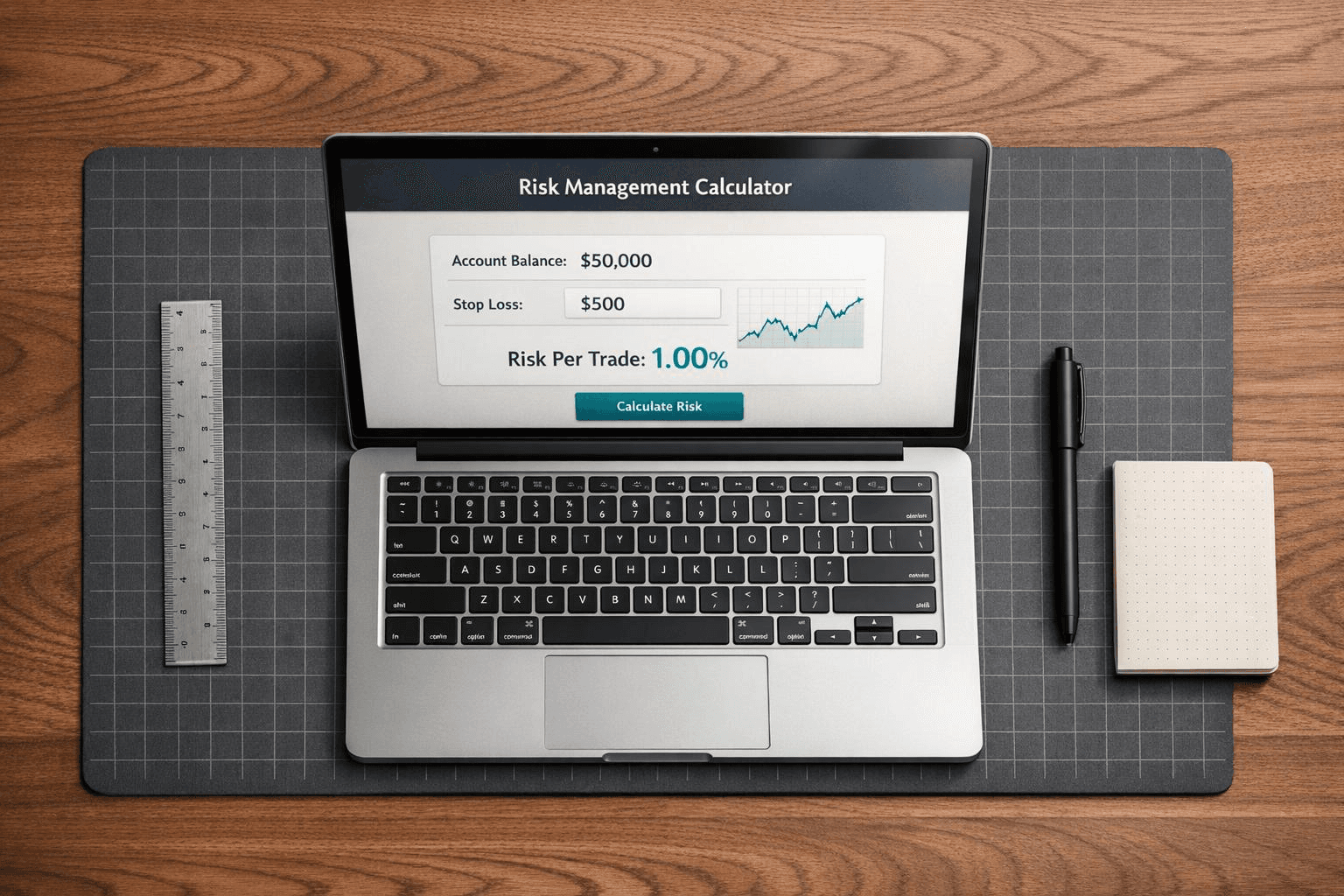
The 1% rule is a position sizing principle that caps your maximum loss on any single trade at 1% of your total account equity. It does not limit how many trades you take or how ambitious your targets are. It controls only one thing: how much damage any single bad trade can do. Risk no more than 1% of account capital on a single trade. On a $10,000 account, that is $100 at risk per trade. On a $100,000 account, it is $1,000. The number scales with your equity, which means your risk management automatically tightens when you are losing and expands when you are winning.
How position size and stop-loss work together
The failure point is usually this: traders set a stop-loss without calculating whether the resulting position size actually keeps their risk inside 1%. They pick a share count that feels right, place a stop somewhere logical on the chart, and only afterward realize the math puts 4% or 5% of their account at risk. The correct order is reversed. Start with your 1% dollar limit, measure the distance to your stop, then divide to find the position size. The chart tells you where the stop belongs. The math tells you how large to trade.
Most traders who blow accounts do not lose on one catastrophic trade. They lose across a sequence of oversized positions during a drawdown period, each one slightly too large, each one compressing their equity until recovery becomes mathematically improbable. The 1% maximum risk per trade of total account capital is the structural limit that prevents exactly this kind of slow-motion account destruction. Keeping losses small is not timid trading. It is the only way to stay in the game long enough for your edge to play out.
The familiar pattern for many traders is managing risk loosely, adjusting position sizes based on conviction rather than calculation, and treating stop-loss levels as suggestions rather than hard limits. That approach feels flexible and intuitive until a losing streak arrives. When it does, oversized positions accelerate the damage faster than most traders expect, turning a manageable drawdown into a full account reset. Traders who apply the 1% rule with a [prop firm](https://www.goatfundedtrader.com/) like Goat Funded Trader operate inside a structure where risk discipline is not optional, allowing them to practice this precision with institutional capital rather than their own savings while keeping a share of the profits.
Pair the 1% rule with a minimum 1:2 risk-to-reward ratio and the math starts working in your favor. If you risk $500 to make $1,000, you only need to win four out of ten trades to stay profitable. That is a forgiving standard. Most traders who fail are not failing because their win rate is too low. They are failing because their losses are too large relative to their wins, turning a workable edge into a losing system through poor sizing alone. But knowing the rule and understanding why it matters across months and years of trading are two very different things.
Related Reading
- How to Use AI for Crypto Trading
- What Are Crypto Trading Signals
- How Long Does It Take To Learn Forex Trading
- What Is Spot Trading in Crypto
- Is Paper Trading Real Money
- Emotional Trading Mistakes
- Common Mistakes in Stock Trading
- Crypto Trading Mistakes
- Forward Testing Trading
- Paper Trading Vs Live Trading
- Risk Reward Ratio Trading
Why Is the 1% Rule Important for Long-Term Trading Success?
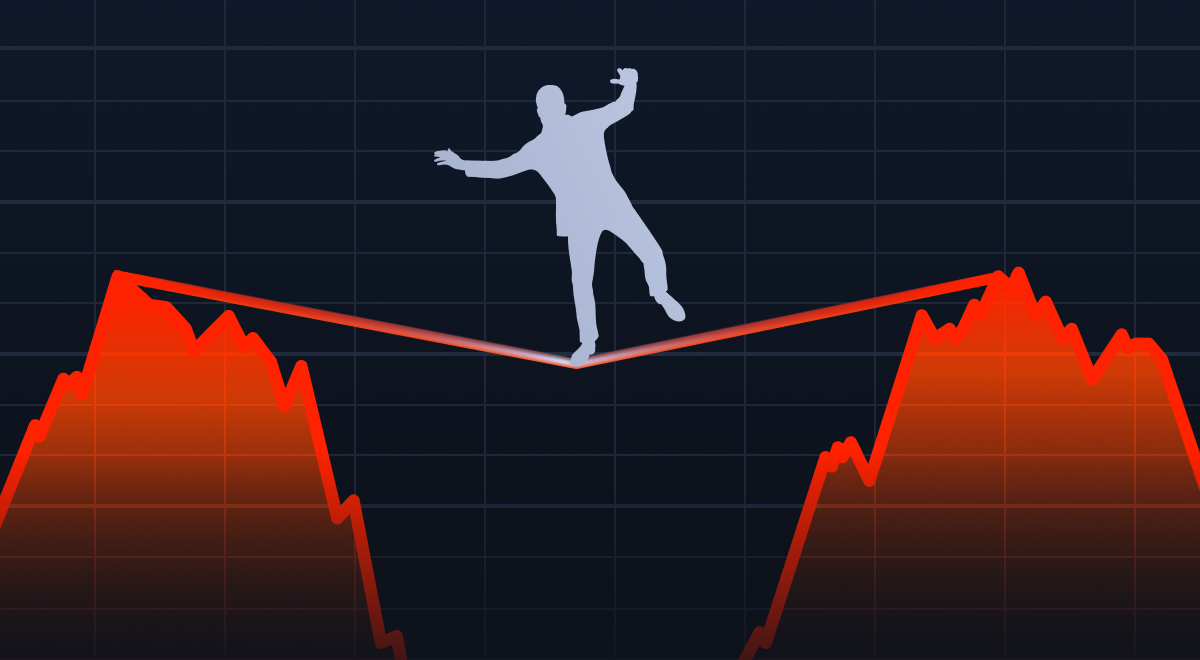
The math behind a losing streak is more unforgiving than most traders expect. When you lose 10% of your capital, recovering feels manageable. But as [TradingView's HexaTrades analysis](https://www.tradingview.com/chart/BTCUSD/qiNlQQ2t-The-1-Rule-A-Key-to-Long-Term-Trading-Success/) makes clear, losing 50% of your account doesn't require a 50% gain to recover. It requires a 100% gain. That asymmetry is the silent killer of trading accounts everywhere.
Why small losses protect your compounding engine
The failure point is usually not a single catastrophic trade. It's a sequence of moderately oversized losses that compound downward faster than wins can reverse them. A trader risking 10% per trade, according to [Zaye Capital Markets](https://zayecapitalmarkets.com/what-is-the-1-risk-rule-in-trading/), can lose half their account in just five losing trades. Five trades. That's not a rare event. That's a bad Tuesday.
Keeping each loss capped at 1% of equity means your compounding base stays largely intact through rough patches. Modest, consistent wins accumulate on a stable foundation rather than trying to claw back ground that should never have been lost. The difference between a trader who survives a 20-trade losing streak and one who doesn't is rarely strategy. It's position sizing.
What discipline actually looks like under pressure
A common pattern surfaces among traders who blow accounts after their first profitable month: the early win creates confidence, confidence creates larger position sizes, and larger position sizes turn the next normal losing streak into a crisis. It's not greed exactly. It's the absence of a rule that holds when emotions push back.
Most traders handle this by relying on feel, adjusting size based on how recent trades went rather than a fixed percentage of equity. That approach works until it doesn't, and when it breaks, it breaks fast. Traders who treat the 1% limit as non-negotiable, regardless of recent results, remove that failure mode entirely. A [prop firm](https://www.goatfundedtrader.com/) that evaluates traders on their capacity to follow structured risk guidelines isn't adding bureaucracy. It's selecting for the exact discipline that separates traders who consistently get paid from those who wash out after a strong start.
The rule earns its value over hundreds of trades, not dozens
Position sizing discipline compounds the same way capital does. Every time you honor the 1% limit on a trade you were tempted to size up, you're protecting not just that trade's downside but the integrity of every trade that follows it. The rule doesn't make individual trades more profitable. It keeps you in the game long enough for your edge to express itself across a large enough sample to matter. But knowing how to apply the rule consistently is one thing. Whether the same standard applies when you're trading with significantly more capital is a question that changes the answer in ways most traders don't anticipate.
Sources:
https://www.quantifiedstrategies.com/day-trading-statistics/
https://www.gettogetherfinance.com/blog/risk-management/
Can Professional Traders Risk More Than 1% Per Trade?
Professional traders can exceed 1% risk per trade, but the ones who do it consistently and survive are far rarer than the stories suggest. Professional traders may risk up to 2% per trade, with some reaching 5% on high-conviction setups, but these are exceptions tied to specific conditions, not a general operating standard. The traders who treat those upper limits as their baseline are usually the ones who don't last long enough to talk about it.
Why the 5% Exception Gets Misread
The failure point is usually selective memory. Traders hear about the 5% bet that tripled a position and quietly ignore the three 5% losses that preceded it. A sequence of four losses at 5% risk each erases roughly 19% of your account before a single recovery trade gets the chance to work. That's not a drawdown you manage through discipline alone. That's a psychological event that rewires how you make decisions under pressure, and the decisions you make from that state are rarely your best ones.
Most traders handle this by scaling up risk during hot streaks, trusting momentum to carry them through. The hidden cost is that markets don't reward confidence, they reward consistency. When the streak ends, and it always does, the oversized positions accelerate the reversal into something the account can't absorb cleanly. Platforms like [Goat Funded Trader](https://www.goatfundedtrader.com/) build their risk limitation policy around exactly this reality, capping exposure so that traders operate within the same professional boundaries that separate sustainable performance from lucky runs.
What the Data Actually Shows
The math behind professional risk sizing isn't about being conservative for its own sake. It's about protecting the conditions that let your edge work. Most traders blow accounts by risking more than 1 to 2% per trade, which means the failure isn't coming from bad strategies. It's coming from correct strategies applied at the wrong size, at the wrong moment, with no margin for the randomness that markets always deliver. Funded trading programs like Goat Funded Trader recommend a maximum of 1% to 1.5% risk per trade idea for their traders. This mirrors real professional environments where exceeding these levels triggers monitoring or account restrictions, demonstrating that even experienced participants thrive only when they respect tight risk boundaries.
Fractional Kelly sizing, which experienced traders apply in practice, typically lands between 1% and 2% per trade after accounting for estimation error, slippage, and sequence risk. Full Kelly looks attractive in theory because it maximizes geometric growth. In practice, it assumes perfect knowledge of your edge, and no trader has that. The professionals who endure aren't the ones making the biggest bets. They're the ones making the most precise ones.
The Skill That Scales
The critical difference between a trader who occasionally risks 2% and one who does it recklessly is that the former has a position sizing framework that justifies the deviation before the trade is placed, not after. They know their win rate, their average reward-to-risk ratio, and exactly how many consecutive losses their account can absorb without forcing a behavioral change. That's not aggression. That's arithmetic applied with discipline.
The traders who consistently get paid aren't the ones chasing larger percentages. They're the ones who've made tight risk management so automatic that scaling up capital doesn't change how they think, only how much they earn per pip. That distinction matters more than most people expect.
Related Reading
- Crypto Trading For Beginners
- Fear Of Missing Out And Trading
- Discipline In Trading
- Common Forex Trading Mistakes Beginners
- Risk Management Day Trading
- Crypto Trading Risk Management
- ICT Trading Strategy For Beginners Step By Step
- Trading Risk Management Strategies
- Algorithmic Trading Risk Management
How to Apply the 1% Risk Rule Effectively When Trading

The 1% rule sounds simple: never risk more than 1% of your account on a single trade. Yet most traders struggle to apply it correctly. They know the rule exists, but they skip the calculations, guess their position sizes, or place stop losses based on emotion instead of strategy. The result is inconsistent risk, larger drawdowns, and unnecessary account damage. Applying the 1% rule effectively requires a structured process that starts before every trade.
Determine Your Maximum Risk Per Trade
Begin every trade by calculating exactly 1% of your current account balance to establish the absolute dollar amount you can afford to lose. For a $60,000 account, this sets a firm $600 limit per trade. This step anchors every decision in your actual capital rather than arbitrary position sizes, creating a consistent safeguard that scales automatically with your equity.
Identify Your Stop-Loss Distance First
Analyze the chart and place your stop-loss based on technical levels, support zones, or volatility before determining how many shares or contracts to trade. Measure the exact price difference between your planned entry and this stop level in dollars per unit. This trade-specific risk distance becomes the foundation for precise sizing and prevents emotional adjustments later.
Calculate Position Size with the Formula
Divide your maximum dollar risk by the per-unit risk from entry to stop-loss to find the exact number of shares, lots, or contracts you can take. On a $60,000 account risking $600 with a $2 per-share risk, you trade 300 shares. This formula keeps exposure locked at 1% regardless of the setup's volatility or your conviction level.
Execute with Hard Stop-Loss Orders
Enter a hard stop-loss order into your broker platform immediately upon opening the position rather than relying on mental stops. This automation enforces the calculated risk limit even during fast market moves or when emotions run high. Professionals treat this as non-negotiable to eliminate second-guessing and slippage surprises.
Update Calculations for Changing Account Size
Recalculate your 1% risk limit before every new trade using your updated account equity after wins, losses, or deposits. This dynamic adjustment maintains proportional protection as your capital grows or contracts, preventing oversized risks during drawdowns and allowing controlled scaling during winning periods.
Maintain a Trading Journal for Verification
Record every trade detail, including account size, risk calculation, stop distance, position size, and actual outcome in a dedicated journal. Review entries weekly to confirm strict adherence and identify any deviations. This tracking builds accountability and refines your process for even greater precision over hundreds of trades.
Common Mistakes Traders Make When Using the 1% Rule, and How to Overcome Them
The 1% rule is one of the most widely recommended risk management principles in trading. Yet simply knowing the rule does not guarantee success. Traders frequently make mistakes in how they apply it, which defeats its purpose and exposes their accounts to unnecessary risk. Understanding these mistakes—and knowing how to correct them—helps traders protect capital, improve consistency, and build a stronger foundation for long-term performance.
Miscalculating Position Size
Many traders confuse the 1% risk limit with simply allocating 1% of their capital to the position value instead of calculating the actual dollar exposure from entry to stop-loss. This error leads to oversized trades that turn small adverse moves into major account hits. To overcome it, always divide your maximum 1% dollar risk by the precise per-unit distance to your stop before entering any trade.
Moving Stop-Loss Orders
Traders often shift their stop-loss further away when a position moves against them in hopes of giving the trade more room to recover. This completely defeats the purpose of the 1% Rule by turning a controlled risk into an unlimited one driven by emotion. Fix this by setting hard stop-loss orders in your platform at the time of entry and committing to never adjust them based on price action alone.
Failing to Adjust for Changing Account Equity
Some traders base their 1% calculation on their starting balance and forget to update it after wins, losses, or withdrawals. This causes risk levels to drift higher during drawdowns or become too conservative during growth periods. Recalculate your exact 1% limit using current equity before every new trade to keep protection proportional and effective.
Ignoring Overall Daily or Weekly Risk Limits
Even when individual trades stay at 1%, traders sometimes accumulate excessive exposure across multiple positions or the same day, leading to outsized drawdowns. Enforce additional layers such as a 3-4% daily loss limit to complement the per-trade rule. Prop firm funding programs excel here by providing structured environments with built-in daily and maximum loss rules that reinforce the 1% discipline while you practice.
Letting Emotions Override the Rule
Revenge trading after a loss or overconfidence on a "sure thing" pushes traders to exceed 1% on the next setup. This stems from the psychological pressure to recover quickly rather than sticking to the process. Combat it with a written trading plan and predefined rules that remove discretion. Goat Funded Trader offers an excellent solution by giving traders access to larger simulated capital under strict risk parameters, allowing them to build habits with real accountability and profit-sharing potential without risking personal funds.
Skipping Trade Journaling and Review
Without documentation, traders repeat the same calculation or execution errors because they fail to spot patterns in their adherence. Maintain a detailed journal of every trade's risk parameters, entry rationale, and outcome, then review it weekly to reinforce correct habits and catch deviations early.
How Goat Funded Trader Help Risk-Conscious Traders Scale Faster
Discipline earns you survival. Capital earns you scale. The frustrating truth is that most risk-conscious traders have the first ingredient but not the second, and no amount of perfect execution changes what a small account can produce in absolute dollar terms. The failure point is usually structural, not behavioral. A trader running a $5,000 account who risks 1% per trade is capping each loss at $50. That same discipline applied to a $200,000 account turns $50 into $2,000 per pip-equivalent move. The math is identical. The outcome is not. This is why access to larger simulated capital is not a shortcut for undisciplined traders; it is the natural next step for traders who have already proven they can manage risk precisely. According to [Goat Funded Trader](https://www.goatfundedtrader.com/blog/how-goat-funded-trader-helps-you-scale-fast-and-trade-freely), funded account sizes range from $5,000 up to $400,000, which means disciplined traders are not forced to compress their entire career into a single small balance.
What changes when personal capital is no longer the ceiling?
The psychological shift is significant and often underestimated. When traders operate on personal savings, every drawdown carries a cost beyond the trade itself: rent, time, opportunity. That pressure warps decision-making in ways that are nearly invisible until a trader removes it entirely. Trading simulated capital through a structured [prop firm](https://www.goatfundedtrader.com/) like Goat Funded Trader separates the emotional weight of personal loss from the mechanical execution of a trading plan, which is exactly the condition under which the 1% rule performs best. Clean process requires a clean mental environment, and personal financial exposure quietly poisons that environment over time.
Most traders handle this problem by simply trying harder, tightening their mindset, journaling more, reviewing losses more carefully. Those habits help, but they treat a structural problem as a behavioral one. The hidden cost is that even a trader with exceptional discipline will eventually face a losing streak that feels different when personal savings are on the line versus simulated capital. Goat Funded Trader's model removes that variable entirely, with predefined daily and maximum loss limits that mirror conservative risk frameworks, so the structure enforces what willpower alone cannot sustain indefinitely.
How do payouts and scaling interact with risk discipline?
Slow withdrawal cycles and rigid payout structures quietly punish the traders who earn them least. When a disciplined trader hits a profit target and waits weeks to access earnings, compounding stalls and motivation erodes. According to [Goat Funded Trader](https://www.goatfundedtrader.com/), up to $2,000,000 in simulated trading capital is available across their program tiers, and that access is paired with profit split options reaching 100%, which means the traders who manage risk most carefully are also the ones positioned to extract the most value from each funded tier. The combination of large capital access and fast payout mechanics is not incidental; it is the mechanism that turns a repeatable edge into meaningful monthly income.
The traders who benefit most from this model are not the ones chasing the highest account tier from day one. They are the ones who treat each evaluation phase as a controlled demonstration of the same 1% discipline they already practice, then advance systematically through the scaling structure. That progression rewards exactly what funded trading should reward: not boldness, but repeatability. And that distinction, between traders who are bold and traders who are repeatable, turns out to matter far more than most people expect when real capital is finally on the table.
Get 25-30% off Today - Sign up to Get Access to Up to $800K Today
Repeatability is the real edge. If you have built the discipline to size positions correctly, honor stop-losses without hesitation, and treat each trade as one data point in a long sequence, then the only thing still working against you is the size of the account underneath that discipline. Small capital does not reward small risk. It punishes it.
[Goat Funded Trader](https://www.goatfundedtrader.com/) gives disciplined traders access to up to $2 million in simulated capital, with daily and maximum loss limits that mirror the exact risk boundaries you already follow. Use code FIRSTGFT for 50% off your first account, with the fee fully refundable upon passing. The process is straightforward, the rules are transparent, and the capital constraint that has been quietly limiting your results does not have to follow you any further.
Related Reading
• How To Make Money Trading Crypto
• Risk Management In Stock Trading
• Best Stock Trading App For Beginners
• Best Trading Apps For Beginners
• Best Crypto Trading App
• Best Demo Trading Account
• How Do You Manage Risk In Futures Trading
• Best Day Trading App For Beginners
• How To Learn Crypto Trading
• How To Read Crypto Charts For Day Trading
Be Great and get the App