






10 Crypto Trading Risk Management Rules to Protect Capital
Crypto trading risk management rules that protect your capital. Goat Funded Trader shares 10 proven strategies to limit losses and trade smarter.


Crypto markets move fast and punish hesitation. A single ignored stop-loss can erase weeks of gains in minutes, which is why learning how to use AI for crypto trading has become a practical edge for traders seeking more discipline and consistency. The 10 risk management rules covered here are designed to help traders protect their capital and make clearer decisions under pressure.
Knowing the rules matters, but having the capital to apply them matters just as much. Goat Funded Trader operates as a prop firm that provides traders with access to funded accounts, making it easier to practice sound position sizing and manage drawdowns without risking personal capital at full risk.
Summary
- Crypto markets have no closing bell, no circuit breakers, and no institutional floor to catch falling prices. The 2022 bear market erased over $2 trillion in value, wiping out years of gains for traders who had no protective structure in place. That kind of loss is not an anomaly but a predictable outcome when traders enter with a thesis about upside and no plan for downside.
- The 1% rule is the professional standard for single-trade risk, and the math behind it is arithmetic rather than caution. A trader risking 1% per trade can absorb ten consecutive losses and still retain roughly 90% of their capital. A trader risking 10% per trade hits that same losing streak with almost nothing left to work with.
- Position sizing is what makes the 1% rule concrete rather than abstract. Dividing maximum dollar risk by the distance between entry price and stop-loss level produces an exact unit count before any order is placed. Most traders skip this calculation and size by feel, which is where the real damage happens when volatility spikes.
- The asymmetry of losses is one of the most underappreciated facts in trading. A 50% drawdown does not require a 50% gain to recover. It requires a full 100% return just to break even, and that recovery gap widens exponentially as losses deepen. BlackRock's analysis indicates that even a Bitcoin allocation above 2% significantly increases portfolio risk, which signals that even institutional frameworks treat crypto exposure as something measured in precise, bounded increments.
- Professional traders take on slightly more than 1% risk per trade in specific circumstances, but the ceiling is lower than most assume. Most professionals keep risk between 1% and 2%, and the 2% figure applies only when a trader has a verified, repeatable edge with a documented performance history. The difference between 1% and 2% is not confidence. It is evidence.
- The failure mode that ends most trading careers is not a single catastrophic loss but a sequence of above-average-risk trades during a drawdown period, when the temptation to recover losses quickly overrides the sizing rules that were working before. Kelly Criterion simulations show that even a mathematically sound edge can produce catastrophic drawdowns exceeding 50% when position sizes are scaled aggressively, whereas a fixed 2% risk cap on the same edge yields strong returns with drawdowns that remain survivable.
- Goat Funded Trader addresses the gap between disciplined risk management and limited personal capital by giving traders access to simulated funded accounts with up to $2 million in capital, separating personal financial pressure from trade execution so that position sizing stays a math problem rather than an emotional one.
What Is Risk Management, and Why Is It Important in Crypto Trading?
Risk management is the organized way traders control capital exposure to any single trade or market event. In crypto, it is the difference between staying active through multiple market cycles and being forced out after one bad week.
💡 Definition: Risk management is the foundational structure that determines whether a trader survives long enough to become consistently profitable.

"The crypto market lost over $2 trillion in value during the 2022 bear market, erasing years of gains for traders without protective structure." — Amberdata Blog
The crypto market lost over $2 trillion in value during the 2022 bear market, erasing years of gains for traders without protective structure. According to the Amberdata Blog, this reflects what happens when a market with no closing bell, no circuit breakers, and no institutional floor meets traders who have not defined their exit before entering.
⚠️ Warning: Entering any crypto trade without a predefined exit strategy is not bold trading — it is unmanaged risk exposure that the 2022 collapse proved can wipe out years of gains in a matter of weeks.
Market Feature
- Traditional Markets
- Trading Hours: Set open/close times
- Circuit Breakers: Yes — halts extreme moves
- Institutional Floor: Central banks, regulators
- Volatility Level: Moderate
- Crypto Markets
- Trading Hours: 24/7 — no closing bell
- Circuit Breakers: None
- Institutional Floor: No guaranteed support
- Volatility Level: Extreme
🔑 Takeaway: The unique structure of crypto — always-on, unregulated, and highly volatile — makes risk management far more critical here than in any traditional asset class.
What failure patterns make crypto trading risk management essential?
The failure pattern is consistent: traders enter with an upside thesis and no downside plan. Beginners mistake a 2% gain for confirmation, then panic-sell at a 5% drop, locking in losses. Risk management makes losses predictable, bounded, and survivable rather than eliminating them.
For Traders report that crypto markets can experience price swings of 20 to 30% within a single day. Traders relying on instinct cannot react fast enough when volatility spikes. They need rules that execute automatically, not decisions made under pressure. Our prop firm at Goat Funded Trader lets traders practice and apply those rules at scale through simulated funded accounts, eliminating the personal financial exposure that turns every drawdown into a crisis.
How does crypto trading risk management make results repeatable and sustainable?
Risk management transforms individual trades into a sustainable process with measurable outcomes. Position sizing, stop-loss discipline, drawdown limits, and risk-reward ratios form the operating system that makes trading repeatable. Without this system, even a trader with genuine market insight will eventually encounter a loss they cannot recover from.
How Much Risk Should You Take on a Single Crypto Trade?
Risk on a single crypto trade should be limited to 1% of your total trading capital. This single rule separates traders who survive long drawdown periods from those who lose all their money during them.
"Risk on a single crypto trade should be limited to 1% of your total trading capital — the rule that separates survivors from those wiped out during drawdowns."
Risk Per Trade: 1%
- Trades to Blow Account: 100 losing trades
- Survival Likelihood: Very High
Risk Per Trade: 5%
- Trades to Blow Account: 20 losing trades
- Survival Likelihood: Moderate
Risk Per Trade: 10%
- Trades to Blow Account: 10 losing trades
- Survival Likelihood: Very Low
🎯 Key Point: The 1% rule is not a suggestion — it's the minimum standard for any trader serious about long-term survival in volatile crypto markets.
⚠️ Warning: Risking more than 1–2% per trade dramatically accelerates account drawdown, leaving you with no capital to recover when the market turns in your favor.
Why 1% feels small but works at scale
The math is unforgiving in both directions. Risking no more than 1-2% of your total trading capital on a single trade is the professional standard because of math, not caution. A trader risking 1% per trade can absorb ten consecutive losses and still retain roughly 90% of their capital, enough to stay active, rational, and wait for conditions to improve. A trader risking 10% per trade faces that same losing streak with almost nothing left.
How does position sizing make crypto trading risk management concrete?
Position sizing makes the 1% rule concrete and actionable. You divide your maximum dollar risk by the distance between your entry price and your stop-loss level to determine exactly how many units to buy. On a $10,000 account risking $100 per trade with a stop placed 5% below entry, you size the position so a full stop-out costs exactly $100. This converts an abstract rule into a specific number before you place the order.
What happens when traders skip the calculation entirely?
Most traders handle sizing by feel, which is where real damage happens. They estimate a "reasonable" amount and enter without calculating actual exposure. As volatility spikes and the position moves against them, that unquantified risk becomes quantified fast. Our evaluation process at Goat Funded Trader is built around this discipline: traders who access simulated capital of up to $2M must demonstrate consistent position sizing and risk control, as adherence to structured guidelines determines who gets funded.
What recovery math reveals about oversizing
The asymmetry of losses is the most underappreciated fact in trading. A 50% drawdown requires a full 100% return to break even. This recovery gap widens exponentially as losses deepen, which is why oversized positions restructure the entire probability of long-term success. According to BlackRock's analysis on Nasdaq, a Bitcoin allocation above 2% significantly increases portfolio risk, suggesting that institutional frameworks treat crypto exposure as something to be measured in precise, bounded increments rather than in aggressive concentrations.
How does leverage turn a bad trade into a blown account?
Leverage amplifies this problem in ways that surprise traders. A 10x leveraged position on a 5% move against you produces a 50% loss on the margin used. When that position is also oversized relative to your total account, the combination of amplification and poor sizing can wipe out an account in a single trading session. The real problem is not the market move itself, but the position size that turned a manageable swing into a losing one.
What separates durable traders from those who blow up?
The traders who build strong track records over time are not the ones who find better trades. They are the ones who never let a single trade decide their future.
Related Reading
- How to Use AI for Crypto Trading
- What Are Crypto Trading Signals
- How Long Does It Take To Learn Forex Trading
- What Is Spot Trading in Crypto
- Is Paper Trading Real Money
- Emotional Trading Mistakes
- Common Mistakes in Stock Trading
- Crypto Trading Mistakes
- Forward Testing Trading
- Paper Trading Vs Live Trading
- Risk Reward Ratio Trading
Can Professional Traders Risk More Than 1% Per Trade?
Professional traders risk slightly more than 1% per trade in controlled circumstances, but the ceiling is lower than most people think. Trade That Swing reports that most professionals keep risk at 1%-2% per trade to protect their capital during losing streaks. The 2% upper boundary only applies when you have a verified, repeatable edge and a documented performance history — two conditions most traders have not met. The 2% figure is a ceiling, not a default.
"Most professionals keep risk between 1% and 2% per trade to protect their money during losing streaks — and the 2% figure is a ceiling, not a default." — Trade That Swing / Tradeciety
🚨 Warning: Treating 2% risk per trade as your starting point is one of the most common — and costly — mistakes developing traders make. That number is reserved for traders with proven, documented edges.
Risk Level: 1% per trade
- Who It Applies To: Most traders
- Requirement: Standard baseline
Risk Level: 1%–2% per trade
- Who It Applies To: Professional traders
- Requirement: Verified, repeatable edge
Risk Level: 2% per trade
- Who It Applies To: Elite professionals only
- Requirement: Documented performance history
🔑 Takeaway: Even at the professional level, risk per trade rarely exceeds 2% — and that ceiling only unlocks after you can prove a consistent, repeatable edge with hard data behind it.

Why does the "pros risk more" myth spread so fast
New traders see a professional's outsized returns and assume they came from bigger position sizes, when they actually came from better entry selection, tighter stop placement, and years of drawdown management. Tracking results in dollar terms cause large wins to distort perception of normal performance, making conservative percentage-based sizing feel unnecessarily cautious. Measuring performance in R-multiples rather than dollar amounts removes that bias and reveals whether the edge is real or variance.
What actually separates the 1% from the 2%
The difference between risking 1% and 2% per trade is evidence, not confidence. TradingView analysis notes that professional traders may risk up to 2% per trade in high-conviction setups where technical signals, volume confirmation, and risk-to-reward ratio meet a documented threshold. Outside those conditions, they drop back to 1% or below.
Why does geometric compounding punish inconsistent crypto trading risk management?
Geometric compounding punishes inconsistency: a 2% loss requires a 2.04% gain to recover, but a 20% drawdown requires a 25% gain to break even. Each incremental increase in per-trade risk exponentially increases the recovery burden.
How does separating personal capital improve risk management in crypto trading?
Most traders encounter a structural problem before addressing the 1% versus 2% question: they trade with personal capital, so every drawdown carries financial and psychological weight. When losses threaten rent money, position sizing becomes emotional rather than mathematical. A prop firm like Goat Funded Trader changes this by providing simulated funded accounts with up to $2M in capital, separating personal financial pressure from trade execution. That separation allows disciplined risk management to function as designed.
The geometry of ruin nobody talks about
The failure mode that ends most trading careers is not a single catastrophic loss, but a sequence of above-average-risk trades during drawdowns, when the urge to recover losses quickly overrides sizing rules.
Why does bet size matter more than conviction in crypto trading risk management?
Kelly Criterion simulations show that even a mathematically sound edge can produce catastrophic drawdowns exceeding 50% when position sizes are scaled aggressively, whereas a fixed 2% risk cap on the same edge yields strong returns with survivable drawdowns. The bet size relative to the account determines outcomes; conviction level and setup quality do not alter this dynamic.
Sustainable trading performance rests on one unglamorous truth: traders who stay in the game longest treat risk limits as fixed constraints, not flexible guidelines. The 1% to 2% range exists because it prevents any single trade from becoming a career-defining event. Every percentage point above that range shrinks the margin for error needed to survive inevitable losing streaks.
How does staying funded set the foundation for scaling within crypto trading risk management?
Once you understand what it takes to stay funded and grow within that framework, the real question becomes how to build a structure that rewards you for getting it right.
Related Reading
- Crypto Trading For Beginners
- Fear Of Missing Out And Trading
- Discipline In Trading
- Common Forex Trading Mistakes Beginners
- Trading Risk Management 1% Rule Explained
- Risk Management Day Trading
- ICT Trading Strategy For Beginners Step By Step
- Trading Risk Management Strategies
- Algorithmic Trading Risk Management
10 Crypto Trading Risk Management Rules to Protect Capital
Protecting your money is essential for crypto trading success. Volatile price swings, leverage traps, and emotional decisions destroy accounts without structured rules. These 10 risk management principles help you survive losing streaks, control losses, and achieve long-term profitability.
"The goal of risk management is not to avoid losses entirely — it's to ensure no single loss can end your trading career." — Risk Management Fundamentals
🚨 Warning: The majority of retail crypto traders lose capital not because of bad strategy, but because of zero-risk structure — emotional trades and uncontrolled leverage wipe accounts faster than any market crash.
💡 Tip: Before placing any trade, define your maximum loss threshold, your exit point, and your position size — these three rules alone separate surviving traders from those who blow up their accounts.
Risk Factor: Volatile price swings
- What It Destroys: Account balance
- Rule That Protects You: Stop-loss discipline
Risk Factor: Leverage traps
- What It Destroys: Entire capital base
- Rule That Protects You: Position sizing limits
Risk Factor: Emotional decisions
- What It Destroys: Long-term profitability
- Rule That Protects You: Structured trading rules
Risk Factor: Losing streaks
- What It Destroys: Trader confidence & capital
- Rule That Protects You: Drawdown management

Rule 1: Limit Risk to 1-2% of Your Account Per Trade
Figure out your maximum loss on any single trade as 1-2% of your total account equity before you enter. On a $10,000 account, this caps exposure at $100- $200, calculated by sizing your position based on the distance from entry to your stop-loss level. This approach preserves capital through drawdowns and enables recovery when the market turns in your favor.
Rule 2: Always Use Stop-Loss Orders
Place a stop-loss order at a logical technical level or volatility-based point when opening any position to automatically exit if the trade moves against you. Amid crypto's rapid moves, this enforces discipline, prevents small losses from becoming devastating, and removes the temptation to hold in hopes of a reversal. Consistent use transforms potential account killers into controlled, predictable losses that preserve your overall strategy.
Rule 3: Maintain a Minimum 12 Risk-Reward Ratio
Only enter trades where your potential profit target sits at least twice as far from entry as your stop-loss distance, creating a 1:2 or better risk-reward setup. This structure ensures that winning trades generate sufficient profit to offset losses, builds positive expectancy into your system, and forces higher-quality setups while rewarding patience over frequent low-conviction entries.
Rule 4: Diversify Across Assets and Strategies
Spread your money across different cryptocurrencies, sectors, and uncorrelated trading approaches rather than concentrating on one coin or direction. This reduces the impact of any single asset's collapse, smooths portfolio volatility, and captures upside from multiple opportunities. Proper diversification accounts for correlations so holdings don't move together during broad selloffs.
Rule 5: Avoid Excessive Leverage
Use leverage sparingly, or not at all, recognizing that it magnifies both gains and losses and increases the risk of liquidation during normal pullbacks. In crypto, even moderate leverage turns a 10% adverse move into a total position wipeout. Stick to levels that align with your risk-per-trade limit.
Rule 6: Size Positions Based on Volatility
Lower your position size for volatile assets or during unstable market conditions to keep potential losses within your 1-2% risk limit. Use tools like Average True Range (ATR) to measure typical price movements and adjust your position size accordingly. This flexible approach maintains consistent risk across different market conditions rather than applying a fixed strategy to all situations.
Rule 7: Set and Respect Daily and Weekly Loss Limits
Set firm daily and weekly loss limits, such as 3-5% of your account, and stop trading immediately upon reaching them. These limits prevent emotional trading and protect your capital during downturns. They also force you to step back and return with clarity. Professional traders treat these boundaries as inviolable rules essential for long-term success.
Rule 8: Keep a Trading Journal and Review Regularly
Write down every trade with the reasons you entered and exited, your risk limits, and what happened. Review your journal weekly to find patterns in your winning and losing trades. This reveals execution mistakes and rule violations that backtesting misses, helping you improve and build stronger discipline. Regular trade reviews convert experience into lessons that strengthen your trading strategy.
Rule 9: Use Only Risk Capital You Can Afford to Lose
Put money into your trading account only if you can afford to lose all of it without affecting your basic living costs, bills, or long-term financial goals. Keeping your trading money separate from your essential funds helps you make better decisions and prevents emotional attachment to price fluctuations. This approach lets you stick to your trading rules without pressure.
Rule 10: Continuously Educate Yourself and Adapt Rules
Stay current with market developments, new tools, and lessons from your results, then refine your risk rules as your experience and account size grow. Adaptation keeps your framework relevant amid evolving crypto conditions, but capital protection remains your fixed foundation. Lifelong learning separates traders who survive multiple cycles from those who fade after initial success.
Common Risk Management Mistakes Crypto Traders Make, and How to Overcome Them
Even experienced crypto traders fall into risk management traps that drain accounts and destroy confidence. Recognizing these mistakes early and applying targeted fixes keeps your capital safe and your trading on track for long-term success.
"The difference between traders who survive and those who don't isn't talent — it's risk discipline applied consistently, even when emotions run high." — Trading Psychology Principle
⚠️ Warning: The most dangerous risk management mistakes aren't made by beginners — even seasoned traders fall into these traps, often when overconfidence peaks after a winning streak.
💡 Tip: Identifying your specific risk blind spots is the first and most critical step toward protecting your portfolio. Don't wait for an account to be blown to take risk management seriously.
Common Mistake: No stop-loss orders
- Impact: Unlimited downside exposure
- Fix: Set hard stop-losses on every trade
Common Mistake: Over-leveraging positions
- Impact: Account wipeout risk
- Fix: Limit leverage to a safe multiplier
Common Mistake: Ignoring position sizing
- Impact: Disproportionate losses
- Fix: Risk only 1–2% per trade
Common Mistake: Emotional trading
- Impact: Impulsive decisions
- Fix: Follow a strict trading plan
🔑 Takeaway: Risk management isn't an optional add-on to your strategy — it is the foundation of every successful crypto trading career. Apply targeted fixes early, and protect your capital before the market forces you to learn the hard way.

Ignoring Position Sizing Rules
Traders often risk much more than 1-2% of their total account on a single trade by overestimating confidence or chasing larger rewards after wins. This amplifies losses during pullbacks and creates drawdowns requiring substantial gains to recover from, often triggering emotional spirals and poor decisions. Overcome this by calculating exact position sizes based on the stop-loss distance and account equity before each entry, thereby making risk control a mechanical process.
Failing to Use or Honor Stop-Loss Orders
Many people skip stop-losses or move them farther away when trades go against them, hoping for reversals that rarely happen in crypto's fast conditions. This turns small, controlled losses into catastrophic ones that wipe out large portions of capital in a single session. Set stops at logical levels when you enter and treat them as unbreakable to enforce discipline and remove emotion from exit decisions.
Overleveraging Positions
Traders use high leverage to control large positions with minimal margin, expecting bigger profits. However, small moves against them trigger liquidation and a total loss of capital. Leverage multiplies losses in volatile assets, often stemming from the desire for quick gains. Counter this by limiting or eliminating leverage in most setups and sizing positions to maintain safe margin buffers.
Trading Without a Predefined Plan or Journal
Trading without written rules for entry, risk, and exit leads to inconsistent results and repeated errors. Without records, traders miss patterns in their mistakes and cannot improve their approach. A simple trading plan with clear risk parameters and a detailed trade journal enables accountability and data-driven improvement.
Letting Emotions Override Risk Rules
Fear of missing out or revenge trading after losses pushes traders to break their own sizing limits and chase recovering positions, turning small issues into full wipeouts. This psychological trap thrives in crypto's 24/7 environment where sentiment swings wildly. Overcome it by adhering strictly to predefined rules, taking regular breaks after losses, and focusing on process over short-term outcomes.
Risking Capital You Cannot Afford to Lose
Using rental income, savings, or borrowed funds for trading creates pressure that leads to desperate decisions and rule violations when losses occur. Trade only with true risk capital set aside for this purpose, which frees your mindset to follow your system objectively.
Prop firm funding serves as an excellent bridge, letting you practice professional risk management with simulated capital and strict drawdown rules without risking personal funds. Platforms like Goat Funded Trader offer instant-funding models with clear, trader-friendly rules focused on consistency and capital protection, enabling aspiring traders to build skills and demonstrate profitability without financial stress.
How Goat Funded Trader Helps Risk-Conscious Crypto Traders Scale Faster
Building the right risk structure only matters if it rewards you when you grow, not just protects you from losing money.
"Skill without capital is like a sharp tool without material to cut: discipline alone doesn't build wealth, access to the right resources does." — Goat Funded Trader
🎯 Key Point: A risk framework that doesn't scale with your performance does only half the job.

The big difference between traders who stay stuck with small accounts and those who grow their money meaningfully is having access to capital that matches their discipline. A trader who keeps drawdown within a 3% daily limit, sizes positions correctly, and exits losing trades without hesitation has already done the hardest work. Most are doing it on accounts too small to make meaningful income — skill without capital is like a sharp tool without material to cut.
💡 Tip: If you're consistently hitting your risk targets — staying under daily drawdown limits, managing position sizing, and cutting losses without hesitation — the missing variable isn't skill. It's funded capital.
Disciplined Risk Manager
- Key Behavior: Keeps drawdown under the 3% daily limit
- Outcome Without Capital Access: Skill is underutilized on small accounts
Correct Position Sizer
- Key Behavior: Sizes trades to match account risk
- Outcome Without Capital Access: Profits too small to be meaningful
Clean Exit Executor
- Key Behavior: Exits losing trades without hesitation
- Outcome Without Capital Access: Consistency is unrewarded at a small scale
🔑 Takeaway: The traders who scale fastest aren't necessarily the most talented — they're the most disciplined traders who finally got access to capital that matches their skill level.
How does crypto trading risk management shift when capital is no longer the constraint?
The familiar approach is to save money from your own income and watch it grow slowly while keeping risk small. This creates a limit: even consistent 8% monthly performance generates modest dollar returns that barely justify the time and mental energy required. Goat Funded Trader addresses this directly by allowing traders to access up to $2 million in simulated trading capital once they have cleared structured challenges. Disciplined performance at scale becomes possible without years of slow personal account growth. Risk parameters are built in, enforcement is automatic, and the capital ceiling moves with your results.
Does faster payout delivery strengthen crypto trading risk management habits?
Earning a payout through weeks of disciplined execution, only to wait weeks to receive it, undermines the motivation that good risk management builds. Reward delivery should match the professional standard of the trading itself. Our fast withdrawal process at Goat Funded Trader means payouts are processed within 24 hours, removing the cash-flow anxiety that often pushes traders to make impatient decisions about their next funded cycle.
Why does discipline become the actual product?
Risk habits that protect a small account unlock larger capital in a structured program. A trader who respects a 6% maximum drawdown limit demonstrates the behavioral evidence justifying access to the next capital tier. Risk management becomes the core skill on which the entire scaling path is built. Every rule followed is a credential earned.
How does crypto trading risk management turn good habits into a scalable process?
Traders who learn position sizing, drawdown discipline, and systematic stop-loss placement don't need to relearn those habits when they scale to larger account sizes because our platform enforces them consistently. That speed comes from a framework that turns good habits into a repeatable, scalable process.
Related Reading
- How Do You Manage Risk In Futures Trading
- How To Learn Crypto Trading
- Risk Management In Stock Trading
- Best Trading Apps For Beginners
- Best Day Trading App For Beginners
- Best Crypto Trading App
- Best Demo Trading Account
- How To Read Crypto Charts For Day Trading
- How To Make Money Trading Crypto
- Best Stock Trading App For Beginners
Get 25-30% off Today - Sign up to Get Access to Up to $800K Today
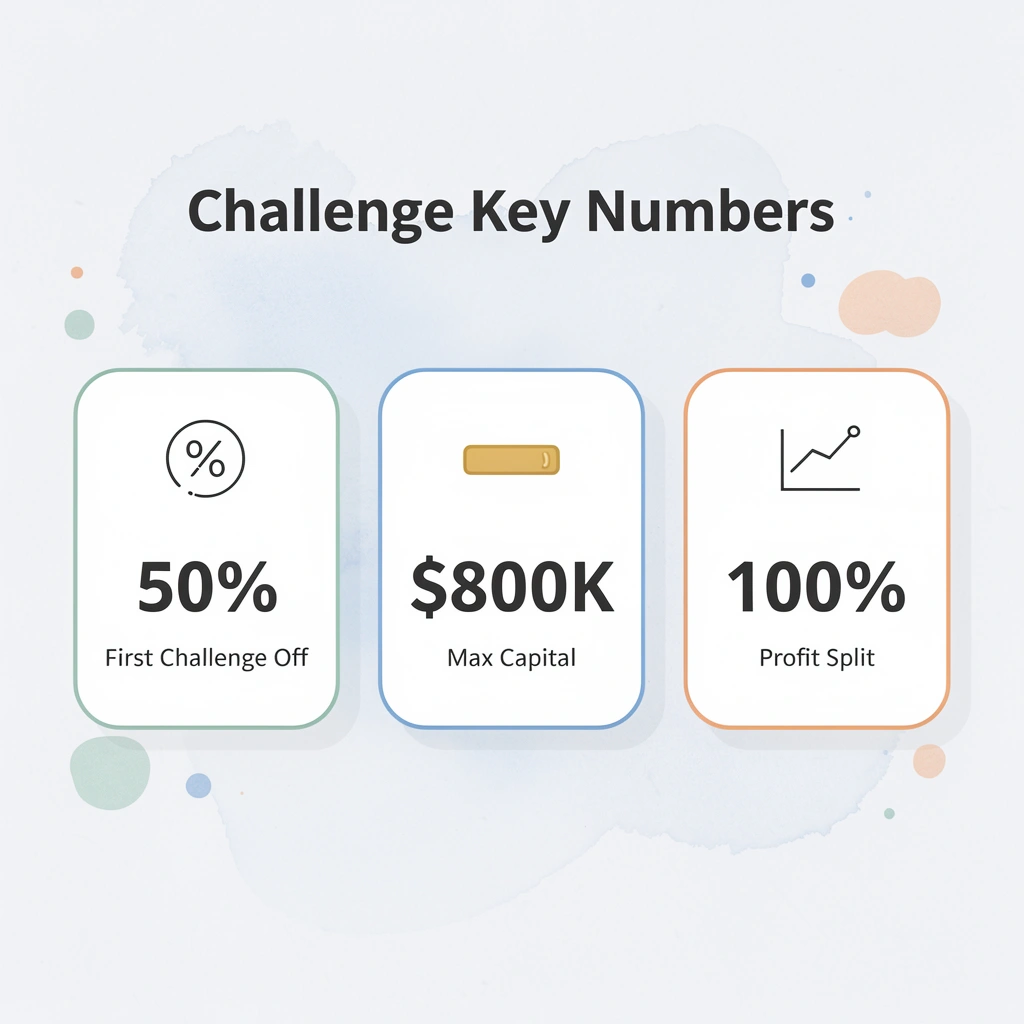
Visit Goat Funded Trader, pick your account size, and use code FIRSTGFT to get 50% off your first challenge. Fees are fully refundable once you reach your targets, with profit splits going up to 100% and payouts processed within two business days.
"Profit splits go up to 100% with payouts processed within two business days — fees are fully refundable once you hit your targets." — Goat Funded Trader
🎯 Key Point: Use code FIRSTGFT at checkout to unlock 50% off your first challenge — one of the most competitive entry discounts available in funded trading today.
Discount Code
- FIRSTGFT — 50% off first challenge
Fee Structure
- Fully refundable upon hitting targets
Profit Split
- Up to 100%
Payout Speed
- Within two business days
The structure and capital are set up. If you treat risk management as a skill worth proving rather than a rule worth breaking, this is where disciplined execution becomes scalable income.
💡 Tip: Traders who scale consistently treat risk management as their primary edge, not an afterthought.
🔑 Takeaway: With refundable fees, 100% profit splits, and two-day payouts, Goat Funded Trader removes the biggest barriers between disciplined traders and real, scalable income.
Be Great and get the App