






12 Best CFD Trading Apps
CFD Trading App insights: Our guide to 12 best CFD trading apps shows how to test execution, margin, and risk with simulations from Goat Funded Trader.


New traders often grapple with margin, spreads, and charts when evaluating mobile trading platforms and CFD brokers. They learn to assess trading apps, use demo accounts, interpret real-time data, and select appropriate order types, thereby building a solid foundation for market entry. Leverage trading for beginners involves applying basic risk management techniques that build confidence before committing to live trades.
Practical experience on a real platform can reveal insights into execution speed and market exposure without risking personal capital. Goat Funded Trader’s prop firm provides funded accounts, straightforward rules, and a supportive community to help refine trading skills and boost performance.
Summary
- Execution and liquidity fragmentation mean that identical rules can produce very different results at scale. CFD trading volume increased by 50% over the last year, multiplying venue and pricing idiosyncrasies you must reconcile.
- Mobile interfaces materially change behavior: over 80% of traders use CFD trading apps for transactions, raising the risk that lower friction increases trade frequency and misuse of leverage.
- Leverage amplifies tail risk, since many CFD platforms offer up to 30:1 leverage; therefore, position sizing and margin buffers must be stricter than on spot markets to avoid catastrophic drawdowns.
- Opaque margin engines create surprise calls, so insist on parity tests and raw execution logs for at least 100 trades to detect rounding, portfolio reweighting, or notification gaps before you scale.
- Targeted stress runs expose hidden costs rapidly, for example, by measuring average execution time and slippage across 20 trades during a volatile window and using the resulting distributions in your sizing model.
- Automation and client differences matter at scale, so run a 500-order automated session to compare API versus GUI fills, and remember that onboarding economics, such as common $100 minimum deposits, shape early leverage behavior.
- This is where Goat Funded Trader's prop firm addresses these issues by documenting margin and risk rules, offering up to $2M in simulated capital, and providing fast, on-demand payouts so traders can surface execution and margin frictions before risking real capital.
12 Best CFD Trading Apps
They represent a practical mix of what I suggest testing on mobile: simple copy‑trade platforms, low‑latency ECN apps, research-heavy user interfaces, and some that focus on risk controls for leveraged CFD positions. Choose the app that fits your trading style, then test it in a real-world simulator before scaling up. Additionally, our prop firm offers flexible funding options that can enhance your trading experience.
1. What is eToro?

eToro is a top mobile platform for CFD traders. It combines social trading features with easy access to multiple markets through user-friendly iOS and Android apps. The design is for both new and experienced users. It enables them to replicate successful strategies when executing direct CFD transactions easily, and it focuses on user-friendly navigation and community-driven insights to help them make on-the-go decisions for assets such as forex pairs and stock indices. eToro is regulated in several jurisdictions and focuses on user-friendly navigation and community-driven insights to help users make decisions on the go.
Key Features
- Copy trading allows users to easily follow the CFD trades of top performers.
- Real-time charts with technical overlays help users quickly scan the market.
- There is a zero-commission structure for many CFD instruments, with a focus on competitive spreads.
- Users can choose from a wide range of assets, including thousands of CFDs on global stocks and commodities.
- Integrated news feeds and sentiment analysis are based on trader activity.
2. What is Plus500?

Plus500 delivers a smooth and fast CFD trading experience through its dedicated apps. It emphasizes risk-management tools and offers a wide range of instruments without requiring complex setups.
Traders appreciate its straightforward interface, which enables them to quickly place CFD orders across cryptocurrencies and major indices, all supported by robust regulatory oversight. The platform's focus on transparent pricing and execution makes it a reliable choice for mobile-first strategies.
Key Features
- Advanced risk tools, such as guaranteed stops, help limit potential losses.
- Customizable watchlists enable tracking CFD positions across different markets.
- Demo mode with virtual funds is available for testing strategies.
- Lightning-fast trade execution is provided, even when the market is very active.
- Comprehensive educational webinars are directly accessible in-app.
3. What is IG Trading?
IG Trading excels at providing high-quality CFD apps with detailed charting features and access to many markets. This is perfect for active traders who want accuracy on their mobile devices. Its platforms integrate well with desktop tools and offer DMA options for those seeking direct market access via CFDs. The award-winning mobile usability enables seamless movement from analysis to action.
Key Features
- ProRealTime integration for advanced charting and backtesting.
- Live signals from reliable providers like Autochartist.
- Custom alerts on price levels for CFD instruments.
- Multi-asset support, including bonds, options, and CFDs.
- Strong security with two-factor authentication.
4. What is Pepperstone?

Pepperstone powers CFD trading with versatile apps that support multiple platforms like MT4 and cTrader. This is great for technical traders who need low latency and very low spreads.
It excels in forex and index CFDs, with apps designed for scalping and fast trades. Global regulation provides users with greater confidence when managing leveraged positions remotely.
Key Features
- You can choose MT5, cTrader, or TradingView for a customized interface.
- Ultra-low spreads start from 0.0 pips on major pairs.
- One-click trading allows for quick CFD entries.
- VPS hosting is well-suited to keeping apps running smoothly.
- You can see a detailed trade history and performance analytics.
5. What is Saxo Bank?
Saxo Bank provides high-quality CFD apps through SaxoTraderGO and PRO. These apps combine top-notch research with mobile trading, making it easier for advanced users to manage their portfolios.
Users benefit from detailed market analysis and automated alerts for CFD strategies across stocks and commodities. The focus on customization works well for traders who are growing their businesses.
Key Features
- Advanced order types, such as trailing stops, for CFD protection.
- Integrated research from top economic calendars.
- Portfolio margining for innovative use of capital.
- High-resolution charts with over 50 indicators.
- Smooth syncing of positions across multiple devices.
6. What is Interactive Brokers?
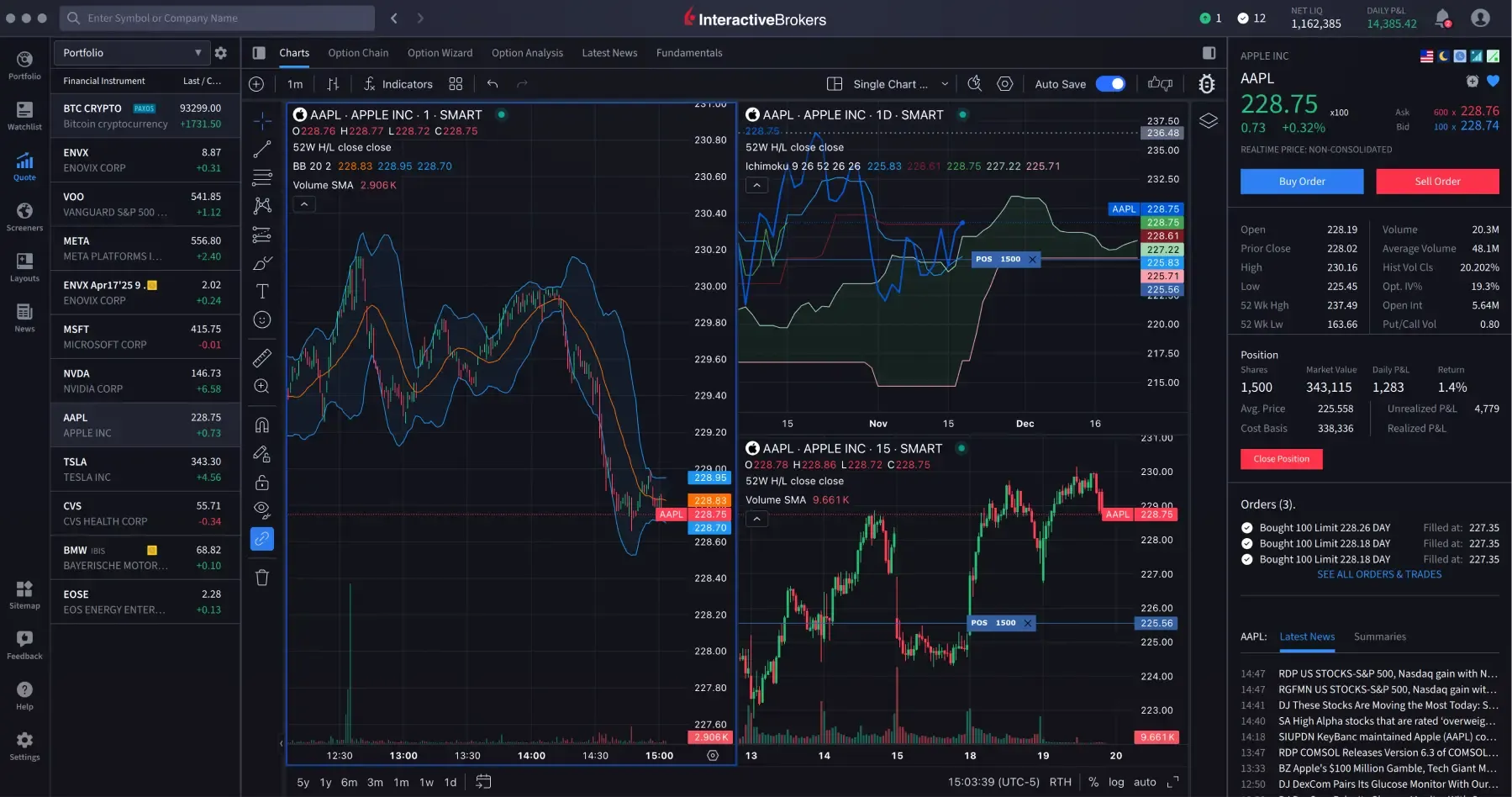
Interactive Brokers offers strong CFD apps through its IBKR Mobile platform. It is designed for advanced traders seeking low-cost access to global markets and robust data analysis tools. The app enables complex strategies through customizable dashboards and direct market access.
This makes it a good choice for people who manage large CFD amounts in stocks and futures. The focus on deep data and reliable execution sets it apart in professional mobile trading.
Key Features
- Low margin requirements for efficient CFD leverage.
- Global market hours coverage with extended sessions.
- Advanced order routing for optimal CFD fills.
- Real-time risk navigator for portfolio monitoring.
- API integration for custom app extensions.
7. What is Capital.com?

Capital.com offers an AI-enhanced CFD trading app that makes it easier to enter the market with predictive insights and a user-friendly design on both iOS and Android. The platform focuses on providing educational support and rapid execution for CFDs across forex, stocks, and crypto, appealing to growing traders who value smart tech overlays. Compliance with regulations ensures it operates securely worldwide.
Key Features
- AI-driven trade ideas based on market patterns.
- Unlimited demo accounts for risk-free practice.
- Personalized news and analysis feeds.
- Touch-based charting with gesture controls.
- Negative balance protection is standard.
8. What is AvaTrade?
AvaTrade stands out with its AvaTradeGO app, which makes trading CFDs on many assets, including indices and commodities, easy through a simple mobile interface. The app combines multiple trading engines for flexibility, with automated trading options that enable easy CFD management. Its user-friendly features make it both accessible and powerful.
Key Features
- DupliTrade and ZuluTrade allow for social CFD copying.
- Spread betting is available alongside CFDs where applicable.
- There is an in-app economic calendar that shows impact ratings.
- You can customize workspaces for multiple chart views.
- A 24/7 multilingual support chat is available.
9. What is XTB?
XTB's xStation 5 app is well-suited for dynamic CFD trading, offering highly responsive tools and competitive pricing across thousands of instruments. It is designed for active users and includes tools for market sentiment and quick deposit options. This helps users make confident mobile decisions even during times of market volatility. The regulation in Poland adds to its trustworthiness.
Key Features
- Ultra-fast order execution with an average time of under 90ms.
- Market sentiment tools based on client positions.
- Free deposits are available via multiple payment methods.
- Analytical videos and daily market outlooks.
- Correlation matrix for understanding CFD inter-market views.
10. What is CMC Markets?
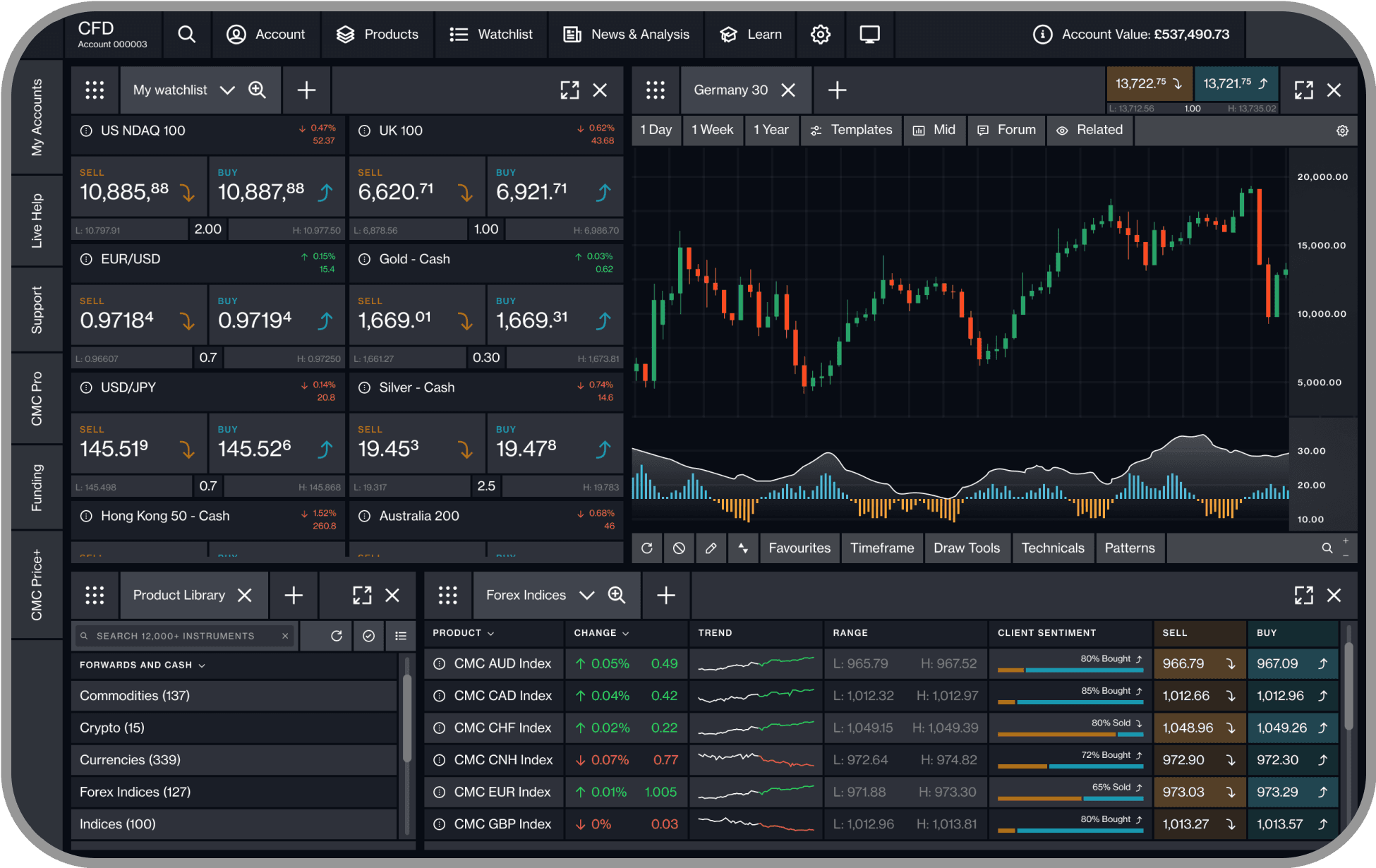
CMC Markets powers CFD trading through Next Generation apps, known for award-winning charts and pattern recognition in forex and share CFDs. The platform focuses on accurate technical analysis tools, enabling traders to identify opportunities on the go quickly. Its long-time presence in the market adds to its reliability.
Key Features
- Reuters news is integrated for real-time updates.
- A pattern recognition scanner supports chart setup.
- There is visibility into market pricing depth.
- Beat the spread contests, test your skills.
- A comprehensive trade ticket comes with advanced options.
11. What is City Index?
City Index offers a smooth CFD trading app on its mobile platform. It focuses on quick access to global markets with competitive spreads on forex, indices, and commodities.
Traders like its advanced charting and risk controls, making it a good choice for trading on the go without losing depth. Supported by robust regulations, it enables easy strategy implementation from anywhere.
Key Features
- Pattern recognition tools for automated chart analysis.
- Customizable alerts across multiple timeframes.
- Low-latency execution for high-volume CFD trades.
- Integrated Reuters news for market-moving events.
- Flexible account types with tiered pricing benefits.
12. What is BlackBull Markets?
BlackBull Markets provides a comprehensive trading solution for fans.
It rounds out the top CFD apps with its ECN-powered mobile interface, offering razor-sharp spreads and high leverage for forex and index traders. The app focuses on speed and depth, making it appealing to scalpers and day traders who need top-notch tools in a small format. Strong global oversight helps ensure better protection for traders.
Key Features include
- ECN pricing with deep liquidity pools.
- Compatibility with MT4 and MT5 on mobile.
- VPS support for 24/7 automated CFD strategies.
- Advanced order types, including limit and stop orders.
- Comprehensive performance reports and trade journaling.
Why should you test multiple apps before committing?
Apps can trade differently when under significant pressure. Factors such as execution, spread behavior, notification reliability, and how an app presents risk can change a rule that once seemed strong. Think of the simulator as a forensic lab: by testing the same trades across two apps, you can identify systematic differences.
What is the cost of familiarity in trading?
Most traders start with brokers they know, which makes sense because it feels comfortable and doesn't require learning new things. However, over time, this comfort can mask a cost. Issues with execution and different risk displays often worsen as position sizes increase. Teams usually find that platforms that look similar at smaller sizes show significant differences when they move to larger, funded amounts.
These differences are precisely what solutions like Goat Funded Trader help fix. They offer up to $2M in simulated capital, a clear scaling program, and fast, on-demand payouts. This allows traders to make improvements without the usual hassle of funding.
What should a testing checklist include?
- Recreate your exact trade, size, and risk settings in the app’s demo.
- Measure the average execution time and slippage across 20 trades during a busy market period.
- Verify that stop orders execute as expected on gap openings, not just during regular trading.
- Confirm that reporting exports and daily PnL match your risk model for checking accuracy.
How does selecting a CFD trading app resemble choosing running shoes?
A short analogy helps explain this idea. Choosing a CFD trading app is like picking a running shoe. You can look at the specs all day, but you really understand how it works only after you run three miles on the exact surface where you plan to race, at race pace.
How can you streamline testing with scripts?
Mapping these apps to specific testing scripts can help create a smooth experience when using a simulator. This approach allows your next funding attempt to scale cleanly.
What defines a CFD trading app's core design?
That common confidence is useful. However, the real decision pressure starts with understanding what really defines a CFD trading app's core design.
Related Reading
- Are Small Caps a Good Investment Now
- Can Forex Trading Make You Rich
- How Much Money Do You Need to Start Trading
- How to Start Trading With No Money
- Black Friday Prop Firm Deals
- How Long Does It Take To Become A Profitable Trader
- Which Trading Is Best For Beginners
- Trading Vs Investing
- How to Trade Forex With $100
- Best Market To Trade For Beginners
- Best Timeframe For Swing Trading
- How to Get Free Stocks
What is a CFD Trading App?
A CFD trading app is the mobile bridge between you and remote market infrastructure. It routes orders, displays risk, and packages execution data, allowing you to act quickly from your phone.
The app does much more than just show charts; it manages liquidity, adheres to margin rules, and often guides behavior through UI defaults and feedback loops. If you're interested in leveraging a funded trading opportunity, our prop firm can be a great option to explore.
How does execution quality change behind the scenes?
Execution has three hidden layers: market data feeds, order routing, and liquidity access. Market data latency creates micro windows where prices can vary.
Order routing determines whether a trade is executed on an exchange, with a market maker, or in an internal match book. Liquidity access determines if a large order affects the price. These differences mean that the same rules can lead to very different results when trading at scale, as slippage and partial fills accumulate over time rather than in a single trade.
How do apps shape risk-taking and trader behavior?
A consistent pattern emerges: convenience, paired with instant feedback, increases trading frequency. Additionally, interfaces that make leverage easier often encourage faster trading.
This convenience also creates a fragile edge: as interface friction decreases, behavioral risks increase. As a result, many traders are taking larger, faster positions without fully understanding the compounded downsides.
What are the safety gaps most traders miss?
Assuming all apps compute margin in the same way is a dangerous bet. Different apps use different methods: some calculate margin for each instrument, while others sum it across the entire portfolio—also, some apps round numbers differently as positions grow.
This problem often appears when a trader adds a related position across two CFDs. If the app’s margin system changes overnight, it could trigger an unexpected margin call.
What questions should you ask before trusting an app with scaled capital?
Start with the app’s transparency. Can it export order route, fill price, and timestamp? Ask whether its margin engine is documented and if margin calls happen early or at the last minute.
Verify whether the session remains active during packet loss, and check whether order confirmations are immediate or delayed. Also, if the app allows one-click changes for leverage or offers gamified rewards, treat them as real challenges that change how strategies are executed, not just as simple conveniences.
How does familiar mobile app usage limit trader growth?
Most traders manage growth by using familiar mobile apps because they are quick and easy to use. While this approach might work for beginners, it creates three common problems as position sizes increase: hidden routing behavior that changes fills, opaque margin math that can lead to unexpected calls, and UI nudges that increase risk.
Platforms like Goat Funded Trader offer an alternative path, providing simulated capital pools of up to $2 million. They have a clear scaling program that rewards careful consistency and fast, on-demand payouts, allowing traders to practice at scale while addressing specific problems before real money is at risk.
What practical checks will quickly expose these hidden frictions?
Run a short, focused stress test that looks at state synchronization, changes in margin, and route transparency, instead of just pure profit and loss. Force-linked exposure changes and watch the app’s margin calculations. Pretend there are moments of lost connection and see how orders are reconciled. Request the original execution logs for at least 30 trades during busy trading periods.
Treat the app like a machine with limits, not a mysterious box that acts the same way when you scale it up.
How should traders perceive their CFD trading apps?
Think of an app like an adjustable bridge; it holds firm while a few cars pass. However, you need precise load specifications, stress-tested supports, and good signage before driving a convoy across.
That first feeling of confidence may seem strong; however, the mechanics underneath can fall apart faster than you think.
How Do CFD Trading Apps Work?

CFD trading apps act like a live control panel. They monitor margins, place orders, calculate costs and swaps, and update unrealized PnL in near-real time as markets change.
This works by using a simple mobile front end, continuous data feeds, a risk engine that ensures margin rules are followed, and an execution ledger that tracks every fill, adjustment, and fee.
How do orders move, and where might additional costs arise?
The trade process on mobile is quick and straightforward. Your ticket checks the size against available margin; the request then goes to a gateway that adds a timestamp and signs the order. It is sent to matching or liquidity providers, and the fill returns a price and an execution timestamp.
That ledger entry then feeds into the margin engine and the PnL calculator, which adjusts your usable equity and margin cushion. These calculations decide if the system raises a margin call or closes your position.
What behavior problems actually break accounts?
This issue shows up in both demo and funded trading. Traders often do not realize how fast leverage can increase small price changes. Because margin mechanics operate automatically, the situation can escalate quickly.
When margin calls arrive, notifications may be delayed. Drops in mobile connection can disrupt confirmations, and stop orders might execute at worse-than-expected prices due to slippage.
Which risk controls in the app are most important for protecting your money?
It is vital to ask how the app calculates margin, how it rounds lot sizes, and whether margin is calculated for each instrument or combined across the portfolio. These differences can significantly affect when and how many margin calls happen.
Check that stop-loss orders provide guaranteed stops where needed, and review the swap and financing formulas used for overnight positions. Also, ensure the platform offers negative balance protection or, at a minimum, liquidation limits. From a trader's view, these are essential features; they can make the difference between a recoverable mistake and losing your entire account.
What challenges do traders face with familiar apps?
Most traders start with the same quick, easy apps because they are fast and straightforward. This familiar path works well until their positions expand. The same user interface quirks that once seemed harmless are now costing money through unclear margin calculations, delayed confirmations, and inconsistent profit-and-loss reporting.
Solutions like the prop firm offer a useful bridge. They provide large simulated capital pools, clear margin rules, and quick payouts on demand. This allows traders to address those exact issues before risking real money.
How should you technically validate an app?
Validating an app before committing to a larger scale requires careful examination. First, request sample execution logs that include timestamps, route identifiers, and fill prices. This enables comparison of mobile and server-side records.
Next, simulate intermittent connectivity to observe how the client reconciles trades during reconnection. It's also essential to inspect the API or WebSocket documentation to confirm heartbeat behavior and reconnect logic.
Additionally, review swap and financing calculation examples for various instruments to gain a solid understanding of overnight carrying costs.
Finally, conduct a controlled experiment on a demo account. Here, you can deliberately stress correlated exposures and observe how the platform reweights margins in real time. The way it recalculates will determine whether you receive a warning or face an automatic close.
What benefits does Goat Funded Trader offer?
Goat Funded Trader lets you use simulated accounts worth up to $800K with the best trader-friendly conditions in the industry. They have no minimum targets, no time limits, and triple paydays with up to 100% profit split. This is from a prop firm designed for quick changes.
Join over 98,000 traders who have already earned more than $9.1 million in rewards. They offer a 2-day payment guarantee and a $500 penalty for delays. Sign up to Get Access to up to $800 today and get 25-30% off.
The following comparison changes how one thinks about risk and reward.
Is CFD Better Than Spot Markets?
CFDs are better when your main goal is capital efficiency, shorting, or tactical, high-frequency work. On the other hand, spot markets are better when you want ownership, simplicity, and to avoid financing and margin mechanics.
Choose by matching the features of the instrument to your time horizon, capital base, and failure modes, not by hype.
How does leverage affect this decision?
Leverage is the primary driver of most CFD demand. It allows traders to open larger positions without increasing their cash balance.
However, leverage changes the math quickly. So, your sizing rules, stop discipline, and margin buffers must be stricter than what you usually use in spot trades.
What hidden execution and cost risks should you think about?
A pattern, but it often loses larger amounts when execution issues and financing problems arise at scale. The two most common complaints were widening spreads and observed stop hunts, both of which signal fragmented liquidity and unclear routing.
Test these costs by pushing the simulator with news-driven volatility, overnight holds, and matched orders across multiple providers. Watch how fills, funding charges, and PnL reporting differ.
Which strategy profiles should each type of trading vehicle use?
If you scalp, do arbitrage, or practice mean reversion on tight timeframes, CFDs are usually the right tools because leverage and two-way pricing help reduce capital friction. On the other hand, if you build core positions for multi-month accumulation, spot ownership is preferable to synthetic exposure, as it avoids daily financing and the constant reweighting inherent in margin mechanics.
A simple rule I use with trainees, proven across many funded auditions, is to limit per-trade exposure so a 3% adverse move does not risk account survival. From there, pick the instrument that lets you follow this rule while maximizing your advantage.
How do you make operational decisions before you scale?
Treat the decision like an engineering test, not a belief. Run identical rule-based trades in the simulator at 1x, 5x, and 10x notional sizes; record slippage, funding, and margin events.
Then project those patterns onto your target scale. The key failure mode to identify is compounding friction, where minor slippage on frequent trades becomes the dominant PnL drag as you grow. Think of it as stress-testing a bridge: add weight slowly until the connection points show hidden weaknesses.
Most traders default to CFDs because they scale quickly and feel more profitable on small stakes, and that approach works early on. But as the position size grows, those same conveniences show execution and margin frictions that quietly hurt performance. Platforms like Goat Funded Trader offer a practical bridge for this exact problem, giving traders significant simulated capital, a clear path to scale that rewards consistency, and rapid payout mechanics, so you can find the exact frictions that break strategies before risking real capital.
Choosing an instrument is like picking a pair of glasses: the right lens brings your edge into focus, while the wrong one blurs it, making minor flaws seem huge.
This choice seems easy until you realize that the app you choose decides which flaws you see and which ones it hides.
Related Reading
- How to Make Money in Forex Without Actually Trading
- How to Stop Overtrading
- How to Become a Successful Day Trader
- Swing Trading Strategy
- Most Profitable Trading Strategies
- How Much Can You Make Day Trading With 100k
- How to Start Day Trading With $500
- Risk Management for Traders
- How Much Money Do I Need to Start Day Trading
- Swing Trading vs Day Trading - Which Is More Profitable
- Best Indices to Trade
- Best Pairs to Trade in Forex
- Trading Risk Management Tools
How to Choose the Best CFD Trading App
Start by ensuring the app performs under the exact conditions you will trade in, not just looks good on a demo screen. Generate exportable, timestamped execution records and document the margin and financing rules.
It's also helpful to have an API or simulator that matches live fills. After setting these parameters, do targeted stress tests that copy your sizing, connectivity, and overnight trading habits.
How transparent is the app’s execution and reporting?
Request raw execution logs that include timestamps, route identifiers, and server-side records for at least 100 trades during a busy time. Compare these entries to the fills shown in the mobile app. If the app can't provide this proof, think that its reporting might change as trading increases. Partial fills, reorders, and route changes add up across multiple entries.
To conduct a solid test, execute 100 identical market buys during a two-hour news event, then plot the fill distribution. Treat the resulting histogram as a cost input for your sizing rules.
What exactly does the margin and financing engine do to carry trades?
Ask the broker for worked examples that show how to calculate margin for related positions, how overnight financing formulas work, and the rounding rules for lot sizes. After that, run a seven-day hold simulation using the same longs and shorts to identify potential asymmetries.
Will the mobile client behave like the desktop or the API under strain?
Run parity checks between the GUI, desktop, and API execution paths. Then, simulate a 30-second network drop followed by a reconnect while placing a stop-limit order. The failure mode to monitor is inconsistent state reconciliation.
For example, the desktop may show an executed stop, while the mobile client displays it as open, or the API might report a different fill price.
Measure how long it takes each client to reconcile server state across 20 forced reconnections.
Use that delay as an upper bound for your alert timing and manual intervention protocol.
How do fees, minimums, and on-ramps affect which app you pick?
Request a sample PnL for a 30-day, 10-trade-per-day plan that includes spreads, commissions, financing, and ticket fees. Then test the same model with longer hold times and weekend carry to see how costs accumulate.
Many platforms require a small upfront payment to start; this should be viewed as part of your onboarding process rather than a guarantee. For context, a minimum deposit of $100 is often required to start trading on many CFD platforms. This minimum indicates that low cash amounts encourage rapid leverage, so you must link additional costs to behavioral incentives before trusting an app with larger quantities.
What hidden costs should you be aware of when choosing an app?
Most traders prefer the familiar app because it is quick and easy, making it a good option for beginners. However, as they increase their position size, they face two hidden costs. These unclear margin calculations can lead to unexpected calls and delays in payouts or reconciliations, slowing the trading process. Platforms like Goat Funded Trader help traders manage these issues. They offer up to $2M in simulated capital, a clear scaling program that rewards consistency, and on-demand, quick-payout technology. This allows traders to identify these specific problems in a controlled environment before they risk real money.
What API and automation constraints will change your strategy at scale?
Start by confirming rate limits, bulk order endpoints, and webhook guarantees. Then, run a 500-order automated session through the broker API and the platform GUI to compare fills and latencies. Pay close attention to queueing behavior, order batching, and whether the API uses different liquidity providers than the GUI.
When your edge relies on repeatable micro profits, the distinction between two providers is crucial. It serves as the margin line that determines whether repeated small wins compound or evaporate.
How solid is the broker’s security and regulatory backbone?
Request the regulator license number, proof of client money segregation, and any independent audit or SOC reports. Insist on strong authentication and encryption both in transit and at rest. Additionally, make sure there is an incident response SLA that clearly defines how quickly trade-level disputes are resolved. If the app cannot provide these items in writing, think of it as an operational risk that must be factored into your position sizing.
What are the key considerations when choosing a trading app?
Choosing an app is like picking the control panel for a small plane rather than just a phone case; clarity, backup systems, and reliable readouts are critical to both safety and financial success.
Just one unclear indicator can change a fixable mistake into an automatic close. It's crucial to design tests that demonstrate those indicators are trustworthy.
What subtle issues should traders look out for?
The subtle problem most traders overlook is that an app’s defaults can change behavior faster than rules can be adjusted. This mismatch can cost real money. Understanding this dynamic is crucial, as a single choice can significantly influence your path to scaling in unexpected ways.
Related Reading
- CFD Trading
- CFD How It Works
- CFD Broker
- CFD Meaning
- CFD Simulation
- CFD Analysis
- CFD Trading Platform
- CFD Account
- CFD Modeling
- CFD Forex
- CFD Online
- Regulated CFD Brokers
Get 25-30% off Today - Sign up to Get Access to Up to $800K Today
To effectively scale your edge without facing unexpected fills or margin reweights, you need a repeatable way to check your rules in a realistic CFD trading app environment. Platforms like Goat Funded Trader let you do these stress tests in an MT5-style simulator, following documented risk rules.
This method helps you access faster funding paths and refine your strategies, much like testing a car on a closed track before taking it onto the highway.
Be Great and get the App