.svg)
.avif)


Traders often face a frustrating scenario: watching their funded accounts get suspended due to unrealized losses triggering strict equity-based drawdown rules. This happens when prop firms calculate drawdown from floating equity rather than actual closed losses, creating unnecessary pressure and limiting trading flexibility. Balance-based drawdown firms offer a different approach by measuring drawdown only from your account balance, giving traders room to navigate temporary market fluctuations without constant fear of rule violations.
This structure provides several key advantages: reduced mental burden from paper losses, improved evaluation pass rates, and faster pathways to scaling capital. Balance-based drawdown calculations focus on actual realized losses rather than temporary market movements, allowing traders to execute their strategies with greater confidence. Goat Funded Trader exemplifies this trader-friendly approach, making it an ideal choice for those seeking a reliable prop firm.
Summary
- Balance-based drawdown prop firms calculate risk exclusively from closed trades rather than fluctuating equity, meaning temporary unrealized losses during open positions don't trigger account violations. This creates a stable environment where swing traders can hold through overnight gaps or intraday volatility without forced exits. About 10% of traders pass initial prop firm evaluations, but those who do gain access to capital allocations ranging from $50,000 to over $2 million with profit splits between 80% and 100%. The Balance-based approach rewards patience and position conviction, allowing strategies to unfold naturally rather than penalizing normal market fluctuations that resolve favorably.
- Static drawdown thresholds provide predictable risk boundaries that don't shift as accounts grow. On a $100,000 account with a 10% Balance-based limit, the floor stays fixed at $90,000 even as profitable trading pushes the balance to $120,000, expanding your effective buffer to $30,000. This contrasts sharply with equity-based systems, where every tick against open positions tightens the noose toward violation territory. Research from the UX Research Collective found that products requiring constant real-time monitoring experience 43% higher user stress and abandonment, a pattern that applies directly to traders forced to watch equity dip during normal position-holding periods.
- Position sizing discipline becomes more critical than ever under Balance-based systems, despite the surface-level flexibility. Traders should risk 0.5% to 1% of their balance per trade, with hard-stop losses attached immediately upon entry, because while the system ignores floating losses, accumulated unrealized drawdowns across correlated positions can still breach thresholds during sudden adverse moves. Traders hesitate an average of 2,000 milliseconds before manually closing losing positions, a delay that frequently doubles damage during volatile sessions. Automated stops eliminate that psychological paralysis, protecting capital for the next high probability setup.
- Scaling programs compound earning potential faster than trading profits alone by doubling capital allocations every three to six months for consistent performers. A trader generating 4% monthly returns on $50,000 earns $2,000, but scaling to $200,000 at the same percentage yields $8,000 without requiring additional evaluation fees. Balance-based firms can offer these aggressive scaling paths because their risk measurement reduces unexpected losses relative to equity-tracking systems. Combined with profit splits reaching 90% to 100% for top performers, this structure transforms modest percentage gains into meaningful full-time income within 12 to 24 months.
- Entry costs and payout transparency separate sustainable firms from those likely to collapse before traders access earnings. Evaluation fees range from $100 to over $1,000, with refundable structures reducing effective cost after the first withdrawal. Firms that transparently share total payout history and trader counts provide verifiable trust signals, while those with sparse feedback or recent rating drops raise sustainability concerns, regardless of advertised features. Balance-based systems should reduce firm risk by improving loss control, making generous payouts viable in the long term rather than promotional gimmicks that mask operational problems.
- Goat Funded Trader structures programs around static daily and maximum drawdown limits that function like Balance-based systems, where fixed percentages provide predictable thresholds across forex, stocks, ETFs, and crypto without trailing equity fluctuations penalizing open positions.
What is a Balance-based Drawdown Prop Firm, and How Does It Work?
A Balance-based drawdown prop firm funds traders' accounts and measures risk limits using only the realized balance, not changing equity. Losses are calculated when trades close, so temporary dips in open positions won't trigger violations. This allows strategies to unfold as designed rather than forcing early exits due to volatility.
🎯 Key Point: The fundamental difference lies in when your drawdown is measured - Balance-based firms only count closed trades, while equity-based firms track unrealized losses in real-time.
💡 Example: If you're down $500 on an open position but your account balance remains unchanged, a Balance-based prop firm won't count this toward your drawdown limit until you actually close the trade.
"Balance-based drawdown measurement allows traders to implement longer-term strategies without the constant pressure of unrealized losses affecting their account status." — Prop Trading Industry Analysis, 2024

How do Balance-based Drawdown Prop Firms differ from equity-based systems?
This differs from fairness-based systems, which include unrealized gains or losses from active trades. A floating loss can push you past the limit even if the trade improves minutes later. Balance-based firms focus instead on losses from closed trades—important for swing traders holding positions overnight or through news events, since it prevents account termination from normal market movements that ultimately prove profitable.
How the Drawdown Threshold Works
Calculation starts with your starting balance, typically using a percentage to set a fixed floor. On a $100,000 account with a 10% Balance-based drawdown limit, your threshold is $90,000. If you grow the account to $120,000 through winning trades, the floor remains anchored at $90,000, expanding your effective buffer to $30,000.
How do Balance-based Drawdown Prop Firms track daily performance?
This fixed limit creates predictability: you know exactly where the line sits each day, and daily resets often tie to end-of-session balances, giving you fresh capacity each morning. The system tracks realized profits and losses automatically through your trading platform. When you close a trade at a $2,000 loss, that deduction hits your balance immediately, but if you remain above the limit, you continue trading without interruption.
Why do closed trades matter more than floating losses in Balance-based Drawdown Prop Firms?
The Balance-based approach focuses on what happens rather than on temporary losses. During volatile sessions, your open positions might show a $5,000 unrealized loss, but since the system ignores floats until you close, that dip doesn't count against your limit. This lets you ride through intraday swings without panic. If you close those positions at a $1,500 net loss instead, only that realized figure affects your standing.
What common mistakes do traders make with Balance-based systems?
Traders often misunderstand this feature, assuming unlimited leeway on open positions. While Balance-based systems don't penalize floating losses directly, severe equity drops can breach the threshold if they push your total account value below the floor. Careful position sizing remains essential because accumulated unrealized losses can trigger a violation if they drag equity beneath your fixed limit before you close.
How does the evaluation-to-funding process work?
You start by passing an evaluation phase, demonstrating consistent risk management and profitability within the Balance-based framework. Once funded, you trade with Goat Funded Trader's capital, following daily and maximum loss limits calculated from your initial balance. Each session resets at midnight based on the prior close, erasing temporary setbacks and allowing fresh opportunities. If you end Monday at $98,000 after a difficult day, Tuesday begins with that balance as your new baseline, and your $90,000 floor remains unchanged.
What profit splits do Balance-based Drawdown Prop Firms offer?
Profit splits usually range from 80% to 100%, with top performers earning higher percentages as they grow. The firm covers losses beyond your set thresholds, creating a partnership where downside risk is capped while upside potential expands. Payouts often come on demand, letting you access your earnings quickly rather than waiting weeks. Many firms offer scaling programs that increase your capital allocation, compounding your earning potential without requiring additional evaluation fees.
How do traders handle the psychological challenges?
Traders seeking this structure often struggle with the psychological weight of larger accounts. One trader noted that "big numbers mess with my head" when moving from a $10,000 demo to a $100,000 funded account, despite the Balance-based model providing the same percentage buffer. This shows how Balance-based drawdown solves the mechanical problem of risk measurement, but doesn't automatically address the emotional barriers that come with trading significant capital.
What trading styles struggle with Balance-based drawdown prop firms
Balance-based drawdown doesn't work for every trading style. Day traders who rely on quick intraday changes may find that focusing on closed trades is less intuitive than equity-based systems that show real-time risk. If your strategy involves many entries and exits with tight stops, the Balance-based advantage diminishes because you're closing positions quickly.
How do volatile markets challenge Balance-based drawdown prop firms?
Another challenge arises in high-volatility environments, where multiple open positions simultaneously accumulate unrealized losses. A sudden adverse move across related trades can push equity below the threshold faster than you can react, requiring extra caution in position sizing and correlation management. In unregulated prop environments, this risk magnifies if discipline lapses, since the firm's risk controls focus on closed balance rather than real-time equity surveillance.
How do overnight market moves affect Balance-based Drawdown Prop Firms differently?
Think about a $50,000 account with a 10% drawdown limit, which sets the floor at $45,000. You enter a swing trade that moves against you by $3,000 overnight, showing $47,000 in equity. In an equity-based system, you're 60% into your allowed drawdown. In a Balance-based system, your closed balance stays at $50,000, giving you full breathing room to let the trade recover. If it rebounds and you close at a $500 profit, your balance rises to $50,500, and the temporary $3,000 dip never counts against you.
What happens when you build your account balance higher?
In another case, you build your balance to $65,000 through consistent wins, expanding your buffer to $20,000 above the $45,000 floor. You take a calculated risk on a high-probability setup, putting $4,000 into the trade and closing at a $3,500 loss, dropping your balance to $61,500. You're still $16,500 above the threshold, well within limits despite the significant loss. This demonstrates how growth strengthens your account, allowing you to make bolder moves during favourable conditions without fear of closure.
Why do Balance-based Drawdown Prop Firms choose this structure?
Companies like Goat Funded Trader organize their programs around Balance-based drawdown to support traders who follow disciplined risk rules without penalizing them for market volatility. By measuring losses only on closed trades, the platform creates an environment where consistency and skill determine success rather than short-term fluctuations.
Why Do Traders Choose Balance-based Drawdown Prop Firms?
Traders choose Balance-based drawdown prop firms because risk measurement aligns with actual trading results rather than temporary market changes. Access to large amounts of capital without the volatility pressure of equity-based funding allows disciplined strategies to develop naturally. This model rewards consistency over time, attracting those building trading careers on skill rather than luck.

🎯 Key Point: Balance-based drawdown eliminates the stress of daily equity swings, allowing traders to focus on long-term performance rather than short-term market noise.
"Balance-based drawdown prop firms reward consistency over time, attracting traders who build careers on skill rather than luck." — Trading Performance Analysis

💡 Best Practice: This approach creates a stable environment where disciplined traders can execute their strategies without the pressure of temporary drawdowns affecting their account status.
Access to Capital Without Personal Risk Exposure
Most traders cannot afford to risk $100,000 of their own money, yet that's often the threshold where meaningful position sizing and diversification become possible.
How do Balance-based Drawdown Prop Firms provide trading capital?
Balance-based prop firms solve this by providing funded accounts ranging from $5,000 to over $2 million after passing evaluation phases. You trade with the firm's capital, keeping the majority of profits while limiting personal downside to the evaluation fee. This makes professional-level trading accessible to retail participants, enabling them to compete with resources previously available only to institutional players.
How does account scaling work with consistent performance?
The money you get to trade grows as you demonstrate consistent trading ability. Start with $50,000, build it to $75,000 through disciplined trades, and many firms will increase your account to $100,000 or more without requiring another test. Your earning potential expands through both your trading profits and the larger positions you can take with a bigger account.
How do profit splits reward performance with Balance-based Drawdown Prop Firms?
Firms typically offer 80% to 95% profit splits, with top performers reaching 100% after demonstrating sustained success. Close a month at $8,000 in net gains on your $100,000 account, and you keep $7,200 to $8,000 depending on your tier. Compare that to managing your own $10,000 account, where a similar percentage gain yields $800. The leverage effect of trading larger capital with favourable splits converts modest percentage returns into meaningful income.
What makes these profit structures sustainable for traders?
Only about 10% of traders pass the first evaluations, but those who do gain access to splits that enable trading as a primary income source. The structure encourages sustainable methods rather than gambling for quick wins, as steady performance unlocks higher splits and scaling opportunities.
How do Balance-Based Drawdown Prop Firms reduce psychological pressure during volatility?
Balance-based systems calculate risk from closed trades, so a $4,000 unrealized loss on an open position doesn't trigger immediate panic. You can hold through overnight gaps or intraday whipsaws without watching equity approach your threshold in real time. This removes the pressure to exit that equity-based models create.
What psychological benefits do traders experience with Balance-based systems?
One trader described how moving to a Balance-based firm eliminated the constant dread of "big numbers messing with my head." Knowing temporary drawdowns wouldn't end the account as long as the strategy played out correctly provided psychological breathing room that translated into better decision-making, fewer emotional exits, and the ability to let winning trades reach their full potential.
How do Balance-based drawdown prop firms support swing trading strategies?
Swing traders holding positions for days or weeks benefit from Balance-based drawdown. Enter a trade based on weekly support levels, and it might move against you 3% before reversing into a 7% gain. Equity-based systems count that 3% dip immediately, possibly forcing closure before the thesis proves correct. Balance-based firms ignore it until you close, letting the strategy execute as designed.
Why do position traders prefer Balance-based drawdown prop firms?
This compatibility extends to position trading and trend-following methods that require patience. The system rewards those who identify high-probability setups and wait for them to mature, rather than favouring scalpers who close positions within minutes to avoid equity fluctuations.
How do Balance-based Drawdown Prop Firms maintain consistent risk thresholds?
Your maximum loss threshold stays fixed at the starting balance level, typically 10% below your initial capital. On a $100,000 account, that's $90,000. As you grow the account to $115,000 through winning trades, the floor remains at $90,000, expanding your buffer to $25,000. This static calculation makes risk planning straightforward because you always know exactly where the line sits.
Why do daily limits reset each session predictably?
Daily limits reset at the end of each session, often around 5% of your current balance, giving you fresh capacity each morning. Close Monday at $98,000 after a tough session, and Tuesday starts with a new 5% daily allowance from that $98,000 baseline. This predictability lets you size positions confidently within known boundaries rather than constantly recalculating based on floating equity.
Partnership Infrastructure That Reduces Operational Friction
Balance-based prop firms work with established brokers offering platforms like MT5 or TradeLocker, which execute trades at quoted prices. This minimises slippage and maintains stability during volatile market conditions. Such reliability lets you focus on your strategy without worrying about failed executions or frozen accounts during major news events. End-of-day drawdown calculations measure your performance at the close of each trading session rather than tracking intraday changes. When combined with broker partnerships offering detailed trade reporting and transparent fee structures, this creates an environment where you can assess your performance without concern that the broker is acting unfairly behind the scenes.
How do scaling programs multiply your earning potential?
Show that you can be consistent over three months, and many firms will double your capital allocation without another evaluation. Your $50,000 account becomes $100,000, immediately doubling your per-trade profit potential while maintaining the same percentage risk rules. This scaling outpaces account growth driven solely by trading profits.
What profit improvements come with Balance-based Drawdown Prop Firms scaling?
Scaling often comes with better profit splits, sometimes reaching 90% or higher for traders with clean track records. Combined with a doubled account size, your effective earnings per trade can triple compared to your starting position. Firms like Goat Funded Trader structure these programs to reward traders who demonstrate they can responsibly handle larger capital, incentivising disciplined rather than aggressive trading.
Flexibility Across Market Conditions
Balance-based drawdown doesn't penalize you for holding through high-impact news events where spreads widen temporarily. Your open position might show a $2,000 unrealised loss during a Federal Reserve announcement due to spread expansion, but since the system only counts closed trades, you can wait for spreads to normalise and exit at a better level. Equity-based systems would register that temporary spike immediately, potentially breaching your limit before markets stabilize.
How do balance-based drawdown prop firms handle multiple positions?
This flexibility extends to trading multiple instruments simultaneously. Hold three positions that don't move together and collectively show $6,000 in unrealised losses during a volatile session, and you're not forced to close all of them in panic. You can manage each trade independently based on its technical setup rather than making blanket decisions to protect your equity.
What limitations still exist with this flexibility?
But flexibility only helps if you know how to use it without crossing existing lines.
Related Reading
- What Is a Funded Account
- What Is A Prop Firm Account
- What is Scalping in Trading
- Perpetual Futures Example
- Cfd Leverage
- What is Arbitrage Trading
- Prop Firm Regulation
- How To Read Candlesticks
- Hanging Man Candlestick
- What Is Drawdown In Trading
- What Is Fomo In Trading
- What Is Tp In Trading
- MT4 vs MT5
- One Step Prop Firm Challenge
How Do I Avoid Breaching a Prop Firm's Balance-based Drawdown?
Industry studies show that about 5–10% of traders succeed, meaning 90–95% fail prop firm evaluations or funded stages. A significant portion of these failures stems from breaking drawdown rules rather than poor strategies alone. This high failure rate demonstrates that strictly enforced loss limits catch experienced traders who lack precise risk controls.

🎯 Key Point: Most prop firm failures stem from drawdown violations, not from poor trading strategies. Understanding and respecting these Balance-based limits is essential for long-term success.
⚠️ Warning: Even seasoned traders can fall victim to drawdown breaches when they become complacent about risk management. Strict adherence to loss limits is non-negotiable in the prop trading world.

Why do Balance-based Drawdown Prop Firms offer better success rates?
Balance-based drawdown offers a more predictable and trader-friendly structure compared to stricter trailing or equity-based variants. By tying the limit to your realized account balance (closed positions only), it provides breathing room during open trades—as long as unrealized losses don't force the balance below the threshold upon closure. Mastering this setup shifts focus to disciplined, sustainable trading that builds long-term success and keeps you funded.
How do you establish effective personal loss limits with Balance-based Drawdown Prop Firms?
Most traders wait until they approach the firm's 10% maximum drawdown before adjusting their approach, but that's too late. Set your own daily stop at half the firm's limit—perhaps 2.5% when they permit 5%. This buffer provides room for difficult days without violating rules, allowing you to step away and reset before conditions deteriorate.
Why does the safety zone between limits prevent account destruction?
The gap between your limit and theirs works as a safety zone. Hit your personal cap at $97,500 on a $100,000 account, and you still have $7,500 before the firm's $90,000 floor. That distance prevents emotional escalation and the desperate chase of losses that destroys accounts faster than poor strategy. One trader described how setting a $1,000 daily cap forced exits during volatile sessions when he would have otherwise doubled down into deeper holes.
Calculate Position Sizes From Risk Percentage, Not Dollar Amounts
Risk 0.5% to 1% of your balance per trade, which means $500 or $1,000 on a $100,000 account. This percentage-based approach scales with your balance, preventing oversized bets that could jeopardise your entire account in a single trade. Fixed dollar amounts lack this protection and often expose you to more risk than your current capital can bear.
How does mechanical position sizing help with Balance-based Drawdown Prop Firms?
Position sizing becomes mechanical once you anchor it to percentages. Enter a trade with a 50-pip stop loss on EUR/USD, and your lot size calculates directly from your 1% risk allowance. This discipline compounds over time because consecutive losses stay manageable, never approaching the firm's limit unless you string together ten or more failures without a single winner.
Use Hard Stop Losses on Every Position
Add stop-loss orders immediately when you enter trades, setting them at levels that limit losses to your planned risk amount. Skipping this step invites disaster: market gaps or rapid moves can exceed mental stops, turning a planned $500 loss into a $3,000 account killer. Hard stops execute automatically, removing the temptation to delay while losses accelerate.
Why do Balance-based drawdown prop firms require automated stops?
Traders often delay manually closing losing positions, a hesitation that frequently doubles losses during volatile conditions. Automated stops eliminate this paralysis, protecting your balance from the sight of red numbers growing. The system executes at your specified level, preserving capital for the next opportunity.
How should you monitor your balance with Balance-based Drawdown Prop Firms?
Check your closed balance every morning before trading. On a $100,000 account at $96,000 after yesterday's session, you have $6,000 before hitting the $90,000 floor. That number determines how aggressive you can be for the day, potentially limiting you to two trades instead of five if the buffer feels small.
Why does real-time awareness prevent account violations?
Knowing what's happening now prevents surprises. Traders who don't monitor their standing often discover violations only after receiving a termination notice, having crossed the line through accumulated losses they didn't track. A simple spreadsheet or journal entry after each session keeps the number visible, turning an abstract rule into something concrete you see daily and that shapes every decision.
Avoid Correlated Positions That Amplify Risk
Holding EUR/USD, GBP/USD, and EUR/GBP simultaneously concentrates your exposure because these pairs move together when the dollar drives volatility. A single Federal Reserve announcement can push all three positions into loss at once, creating faster drawdowns than would independent trades. True diversification requires instruments that don't move together. Pair a forex trade with a commodity or index position, or trade different sessions where economic drivers differ. If you're forced to exit five correlated positions during a crisis, they all hit your balance simultaneously, potentially breaching your drawdown threshold in a single session.
Recognize When to Stop Trading for the Day
Some days, the market doesn't align with your strategy, or your execution falters. Close the platform rather than forcing trades that drift into losses. Continuing after hitting your daily limit compounds mistakes by replacing disciplined analysis with emotional decision-making. Research from Mond FX indicates that traders who pass prop firm challenges consistently exit during unfavourable conditions, preserving capital for high-probability setups. This selective participation separates funded traders from those who blow accounts.
How do Balance-based drawdown prop firms enforce risk management?
Most prop firms enforce Balance-based drawdown through automated systems, but traders often struggle to translate firm rules into personal discipline. The common mistake is reacting to losses after they occur. As pressure builds and the buffer shrinks, panic replaces strategy, leading to oversized revenge trades or premature exits. Firms like Goat Funded Trader reward traders who use proactive risk controls, offering scaling programs and up to 100% profit splits for those who stay within limits through disciplined position sizing and daily loss caps. Only traders who pair that flexibility with strict personal rules achieve long-term profitability.
Focus on Quality Setups Over Trade Frequency
Only enter trades when multiple indicators show high-probability conditions instead of forcing activity to meet daily targets. Each unnecessary trade increases drawdown risk without matching upside, weakening your edge and raising odds of hitting loss limits. Selective trading concentrates capital on the best opportunities, where favourable risk-reward ratios justify the position. One trader improved both win rate and drawdown management by reducing trade frequency from 15 to 5 setups per week. Each entry received deeper analysis and better timing. The Balance-based system rewards patience over marginal setups that slowly erode the buffer above the threshold.
Why does emotional trading destroy the accounts of Balance-based drawdown prop firms?
Close a trade at a loss, and the immediate urge is to recover that money through the next position. This emotional response leads to oversized bets or impulsive entries on weak setups, compounding the original loss into a cascade that threatens the entire account. Revenge trading ignores risk parameters, turning a manageable $800 loss into a $3,500 disaster that pushes your balance close to violation.
How can traders break the revenge trading cycle effectively?
The answer is ritual. After any loss, step away for thirty minutes or close the platform for the day. This break interrupts the emotional loop and restores rational analysis before the next decision. Balance-based drawdown gives you room to recover gradually through disciplined trades, but only if you resist forcing immediate redemption through reckless aggression.
17 Best Balance-based Drawdown Prop Firms in 2026
Seventeen firms in 2026 offer Balance-based drawdown structures that calculate risk based on closed positions rather than on floating equity. Each brings distinct features, from scaling potential and profit splits to platform integrations and payout speeds. The right choice depends on your trading style, capital goals, and account management approach.
1. Goat Funded Trader

Goat Funded Trader emerges as a prominent proprietary trading firm in 2026, specializing in simulated capital programs that incorporate static daily and maximum drawdown limits to foster stable risk management, akin to balance-based systems where fixed percentages provide predictable thresholds for traders navigating forex, stocks, ETFs, and crypto markets without the pressures of trailing equity fluctuations.
Key Features
- Implements static daily drawdown ranging from 2% to 10%, depending on the account type, offering fixed risk levels that align with balance-oriented stability.
- Sets maximum drawdown between 4% and 10%, such as 6% for many funded accounts, ensuring consistent protection tied to predefined limits.
- Supports scaling plans that allow funded accounts to grow up to $2 million in simulated capital, promoting long-term growth within drawdown constraints.
- Features profit targets from 3% to 10% in challenge phases, with no minimum targets required for certain funded accounts to ease progression while maintaining drawdown rules.
- Offers payout structures with up to 100% profit splits on demand, including bi-weekly, every 10 days, or triple payday options, all under static drawdown safeguards.
- Provides instrument diversity across FX pairs, stocks, ETFs, and crypto pairs, allowing traders to apply strategies within fixed drawdown parameters.
- Includes no time limits on most programs, enabling extended trading periods without violating drawdown thresholds due to rushed decisions.
- Permits news trading and weekend holding, enhancing flexibility for positions held over volatile periods while adhering to static drawdown calculations.
- Incorporates a minimum of five trading days in select challenges to encourage measured approaches that respect drawdown limits.
- Delivers raw spreads starting at 0.1 pips and zero commissions on indices and cryptos, supporting efficient execution within drawdown boundaries.
- Ensures a reward guarantee where payouts are processed in two business days or a $500 bonus is added, reinforcing reliability in drawdown-managed accounts.
- Features one-time, refundable fees for challenges, reducing initial risk exposure under drawdown rules.
Why Traders Choose Goat Funded Trader
Traders opt for Goat Funded Trader due to its emphasis on static drawdown mechanisms that deliver lower overall risk through fixed daily and maximum limits, simulating balance-based stability that allows for real rewards without the pitfalls of trailing equity drops. This setup, combined with scalable accounts up to $2 million and up to 100% on-demand profit splits, appeals to those seeking long-term trading viability, especially with perks like news trading allowances, no hidden rules, and a reward guarantee that ensures swift payouts. The firm's focus on refundable fees and a diverse range of instruments further attracts participants who value transparent, flexible conditions that prioritize consistent performance over aggressive risk-taking in volatile markets.
2. E8 Markets
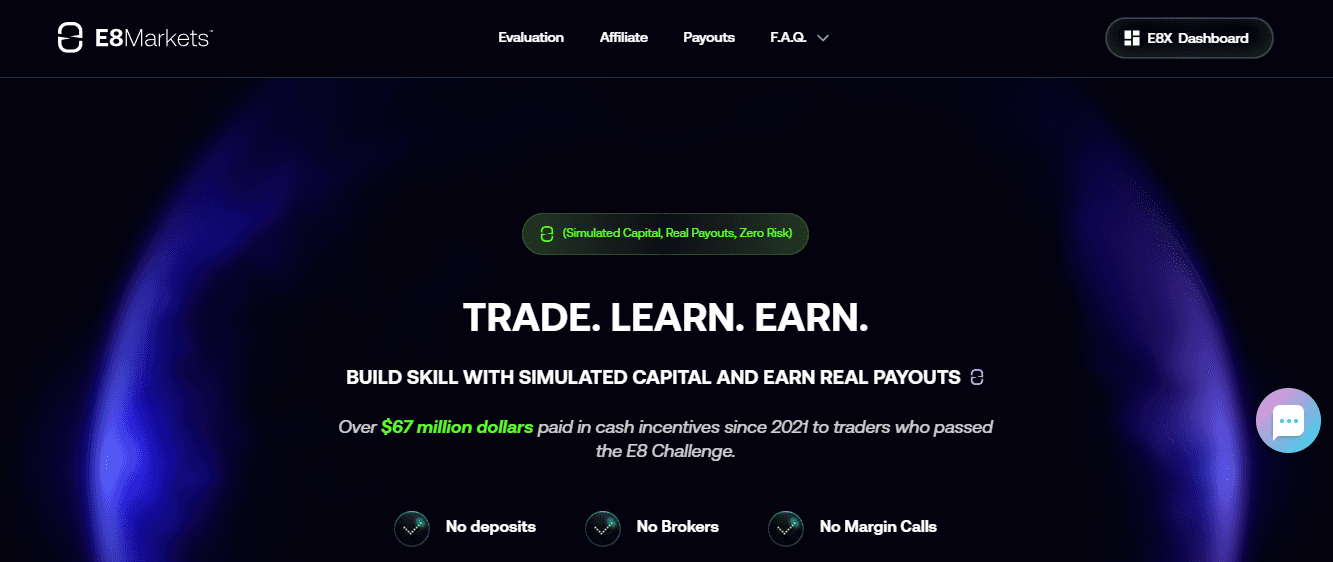
E8 Markets is a prop firm for traders seeking reliable funding with a focus on education and quick payouts, operating for several years and earning strong community trust through its simulated trading setups that prioritize balance-based risk limits for smoother position management.
Key Features
- Utilizes balance-based drawdown to provide greater leeway during active trades, reducing the chance of violations from unrealized losses.
- Boasts a solid 4.8 rating derived from more than 430 user reviews on trusted platforms.
- Offers compatibility with four major trading interfaces, including advanced options such as TradeLocker and cTrader, supporting diverse strategies.
- Allows scaling up to a maximum funded amount of $2.8 million for proven performers.
- Provides a 10% discount on challenge fees via promotional codes like MATCH.
- Features rapid withdrawal processing, often within a few days after meeting targets.
- Includes educational tools and community events to support trader growth.
3. Alpha Capital

Alpha Capital distinguishes itself in the prop trading space by delivering institutional-grade conditions and personalized risk guidance, making it ideal for serious traders who value unlimited time frames and balance-oriented drawdown policies that foster consistent growth.
Key Features
- Employs balance-based drawdown calculations for more predictable risk boundaries based on closed positions.
- Holds a commendable 4.4 rating backed by over 820 verified evaluations from participants.
- Supports four different trading systems to accommodate various preferences and instruments.
- Caps maximum capital allocation at $400,000 for eligible funded accounts.
- Runs a 30% off promotion on initial purchases with codes such as MATCH30.
- Incorporates one-on-one risk assessments to enhance trading decisions.
- Permits news-event trading without restrictions, enabling flexible market engagement.
4. FundedNext

FundedNext is recognized for its competitive spreads and refundable entry costs, appealing to U.S. and global traders who appreciate balance-driven drawdown rules that align with real-world trading demands and rapid reward systems.
Key Features
- Applies balance-based drawdown to focus limits on account balance, aiding in sustained trading without equity-based interruptions.
- Earns a 4.4 score from approximately 700 reviewer inputs across review sites.
- Integrates three robust platforms, including Match-Trader and cTrader, for efficient execution.
- Sets the highest allocation limit at $300,000 for successful challengers.
- Features a 15% savings on challenges through ongoing deals.
- Guarantees swift payouts with incentives for timely processing.
- Allows add-ons like higher profit shares for customized experiences.
5. Finotive Funding
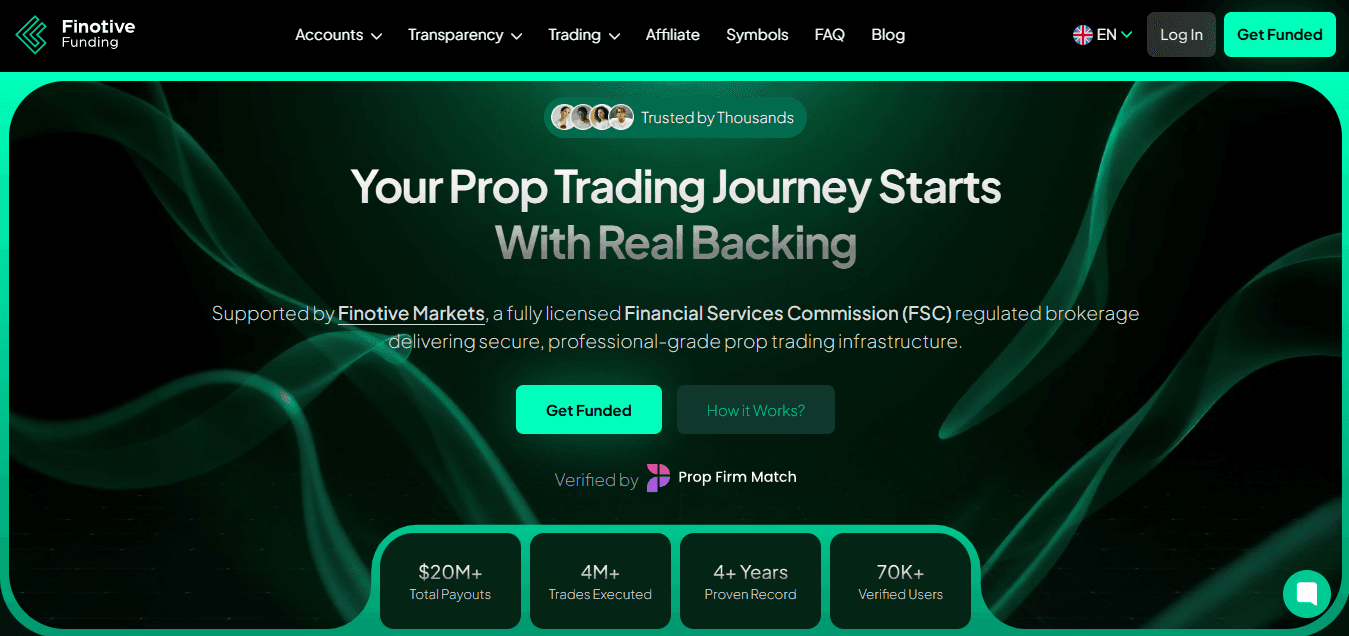
Finotive Funding excels with its static yet balance-focused risk framework and community-driven support, positioning it as a go-to for traders aiming for quick funding and frequent payouts in a transparent environment.
Key Features
- Implements balance-aligned static drawdown to maintain fixed thresholds tied to balance for stability.
- Achieves a 4.2 rating supported by more than 100 authentic user feedback.
- Compatible with four trading environments powered by in-house technology.
- Offers up to $1.6 million in maximum funded capital for scaled accounts.
- Provides a 25% discount for first-time buyers using promo codes like MATCH.
- Enables on-demand withdrawals after only a minimal profitable period.
- Includes free learning resources and a vibrant trader network.
6. Breakout

Breakout sets itself apart in crypto and multi-asset prop trading by emphasizing speed to funding and lenient rules, with a balance-based drawdown that ensures traders can navigate markets without tight equity constraints.
Key Features
- Uses balance-based drawdown for risk limits that adjust to closed balances, supporting aggressive yet controlled styles.
- Garners a 4.7 rating from around 44 detailed reviews.
- Works with two specialized platforms connected to top-tier exchanges.
- Limits max allocation to $200,000 for funded participants.
- Offers a modest 2% off on evaluations via codes such as MATCH.
- Supports unlimited payouts with 24-hour processing.
- Features no style restrictions and real-time monitoring tools.
7. City Traders Imperium

City Traders Imperium stands out among balance-based drawdown prop firms thanks to its emphasis on flexible programs, multiple challenge types, and generous scaling potential, attracting traders who prioritize educational resources and on-demand payouts in a supportive environment.
Key Features
- Features balance-based drawdowns in select programs, often static or trailing, tied to closed balances to enhance position flexibility.
- Maintains a strong 4.4 rating from over 50 verified reviews, highlighting reliability.
- Provides access to seven diverse trading platforms to suit various trader preferences.
- Enables maximum allocation scaling up to $720,000 for high-performing accounts.
- Delivers a 30% discount on challenge fees through promo codes like MATCH.
- Offers on-demand withdrawal options once profit thresholds are met.
- Includes comprehensive trader education, mentorship, and community support features.
8. ThinkCapital

ThinkCapital appeals to disciplined traders with its structured multi-phase challenges and clear risk parameters, where balance-based drawdown rules in certain models provide predictable limits on closed positions, improving long-term account management.
Key Features
- Incorporates balance-based daily drawdown in programs like Dual Step Swing, calculated from initial or end-of-day balances.
- Holds a 4.3 rating supported by around 51 user reviews praising transparency.
- Operates primarily on one main platform for streamlined execution.
- Caps maximum funded allocation at $600,000 for qualified participants.
- Provides a 25% off promotion on evaluations using codes such as MATCH.
- Features defined payout schedules with emphasis on consistent performance.
- Supports various instruments with rules tailored for intraday and swing styles.
9. OANDA Prop Trader

OANDA Prop Trader brings broker-backed credibility to the prop space, offering straightforward challenges with static or adjusted drawdown mechanics that prioritize balance stability, making it suitable for traders seeking institutional conditions and reliable execution.
Key Features
- Utilizes static max drawdown fixed at 10% of initial balance in most plans, with some variations for larger accounts.
- Earns a 4.3 rating from about 52 reviews focused on professional setup.
- Compatible with two leading platforms for efficient trading access.
- Allows up to $500,000 in maximum capital allocation.
- Runs a 30% discount promo on challenge purchases via MATCH codes.
- Provides clear profit targets and static daily loss limits from the initial balance.
- Benefits from OANDA's established reputation in the forex and CFD markets.
10. Funded Trading Plus

Funded Trading Plus excels in offering trader-centric programs with flexible drawdown options, including balance-based calculations in instant and standard models, appealing to those who value quick access to funding and high profit shares.
Key Features
- Applies balance-based elements in daily and maximum simulated loss rules, often using closed balance snapshots for resets.
- Achieves a 4.2 rating backed by over 65 authentic participant feedback.
- Supports four platforms to accommodate different trading approaches.
- Scales maximum allocation to $2.5 million for top performers.
- Features a 20% off deal on challenges with codes like 20MATCH.
- Enables frequent payouts with customizable add-ons for enhanced splits.
- Includes options for no time limits and varied challenge structures.
11. AT Funded

AT Funded serves as an emerging option for traders exploring balance-focused risk rules in a straightforward setup, with limited but growing feedback indicating potential for those seeking accessible entry into funded trading.
Key Features
- Implements a balance-oriented drawdown to align risk with closed-account performance.
- Has fewer than 20 reviews but shows early positive traction.
- Works with one primary platform for focused execution.
- Offers a maximum allocation of $500,000 upon passing.
- Provides a 15% discount via promo codes like MATCH.
- Focuses on simple challenge progression with standard profit goals.
- Aims for reliable payouts in a developing firm environment.
12. Crypto Fund Trader
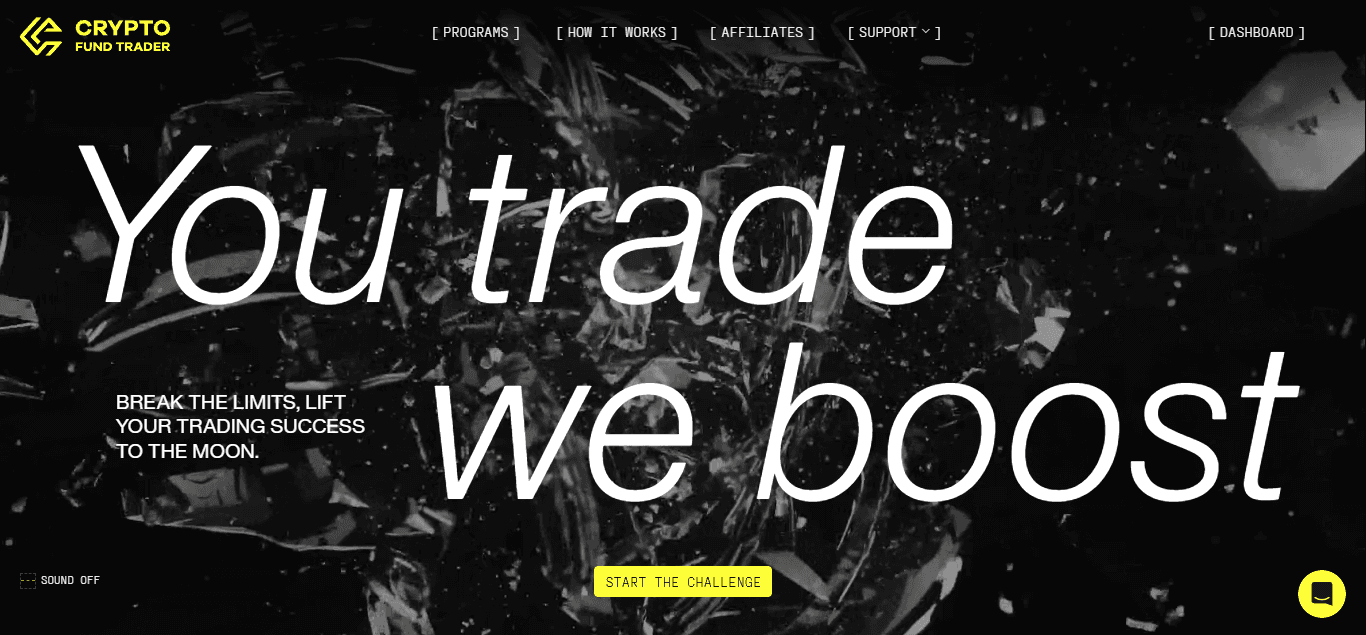
Crypto Fund Trader focuses on cryptocurrency markets, delivering institutional-grade execution through partnerships like Bybit, and offers a solid option for crypto enthusiasts who benefit from balance-oriented drawdown structures that support holding positions without equity-based interruptions in volatile environments.
Key Features
- Employs balance-based or static drawdown mechanics to set clear risk thresholds tied to account balance for more predictable management.
- Maintains a 4.2 rating from around 100 user reviews, emphasizing reliable payouts and platform options.
- Offers three trading platforms, including proprietary tools, MT5, and direct exchange access for crypto strategies.
- Provides a maximum allocation of $330,000 for qualified funded traders.
- Features a 7% discount on challenge fees with codes like MATCH.
- Delivers fast payouts, often processed in 8-24 hours after meeting requirements.
- Includes high leverage options and weekend holding permissions suited to crypto trading.
13. Nordic Funder
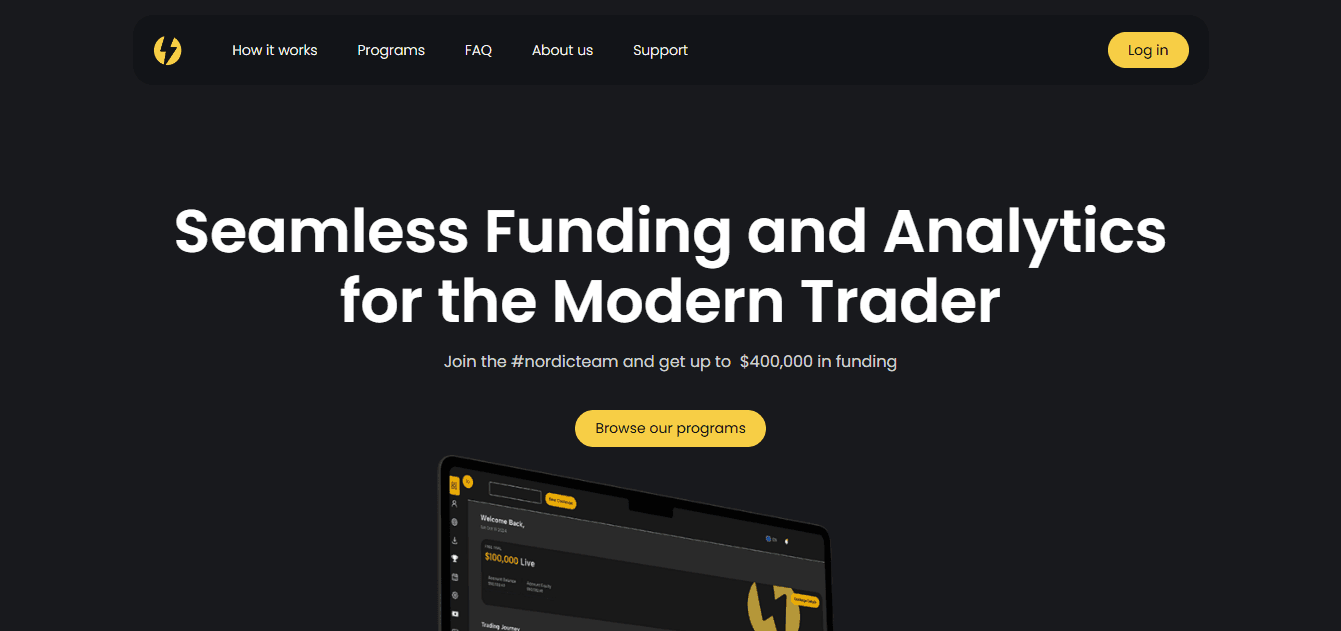
Nordic Funder presents a straightforward, scalable program with an emphasis on simple rules and refundable fees, making it attractive to traders who prefer balance-focused drawdown calculations that reset daily based on closed positions, for consistent risk oversight.
Key Features
- Utilizes balance-based daily drawdown, often calculated from the end-of-day balance for fixed daily limits.
- Has fewer than 20 reviews but shows emerging positive feedback on transparency and scaling.
- Supports four platforms to enable varied trading setups.
- Allows scaling to a maximum allocation of $1 million for successful participants.
- Offers a 10% off promotion through codes such as MATCH.
- Features refundable challenge fees under certain conditions to reduce entry barriers.
- Provides leverage adjustments and multi-instrument access with minimal restrictions.
14. FXIFY

FXIFY combines flexible challenge types with strong payout options, standing out for traders who appreciate programs featuring static or adjusted balance drawdown rules that offer stability and quick access to earnings.
Key Features
- Incorporates static drawdown tied to initial or balance levels in many configurations for reliable risk boundaries.
- Holds a 3.9 rating from over 100 reviews, noting value in promotions and add-ons.
- Compatible with two main platforms for efficient order execution.
- Enables maximum funded allocation up to $1.2 million through scaling.
- Runs a 28% discount on evaluations via ongoing promo deals.
- Supports on-demand or frequent withdrawals to enhance liquidity.
- Allows EAs, weekend holds, and news trading in select programs.
15. The Trading Pit

The Trading Pit emphasizes structured risk management with daily balance updates for drawdown limits, appealing to traders who value clear, static maximum thresholds and educational support in a professional setup.
Key Features
- Applies balance-based daily drawdown updates at market close, using the previous balance to set new limits.
- Has fewer than 20 reviews but gains attention for its rule clarity and dashboard tools.
- Works with three platforms to facilitate diverse market access.
- Caps maximum allocation at $400,000 for funded accounts.
- Provides a 10% off promo code like MATCH for challenges.
- Features static maximum drawdown alongside daily rules for lifetime protection.
- Includes detailed dashboard monitoring and automatic breach prevention.
16. Ment Funding

Ment Funding prioritizes transparency with identical rules across evaluation and funded stages, offering a reliable choice for traders seeking balance-aligned drawdown without hidden complexities or excessive trailing adjustments.
Key Features
- Implements drawdown rules focused on balance parameters to maintain consistency between phases.
- Has fewer than 20 reviews, with early comments highlighting straightforward progression.
- Supports four platforms for broad compatibility with strategy.
- Offers a maximum allocation of $2 million for top performers.
- Features a 15% discount on purchases with codes like MATCH.
- Ensures no hidden rules and clear payout pathways.
- Promotes performance-based incentives with emphasis on long-term account stability.
17. Hantec Trader

Hantec Trader leverages broker-backed infrastructure for professional conditions, with balance-based daily loss calculations that provide traders dependable limits rooted in prior-day balances for enhanced control.
Key Features
- Calculates daily loss and drawdown from the end-of-previous-day balance or equity for predictable risk.
- Earns a 4.6 rating from about 21 reviews focused on execution quality.
- Compatible with two platforms, including MT4/MT5 for classic trading.
- Limits maximum allocation to $300,000 for funded participants.
- Offers a 30% discount via promo codes such as MATCH.
- Includes on-demand first payouts and up to 90% profit shares.
- Features static or balance-trailing elements in select programs for flexibility.
But choosing from 17 options requires more than just comparing features in a spreadsheet.
Related Reading
- Pass Ftmo Challenge
- Prop Firms That Use Mt5
- Best Prop Firms For Forex
- Best Prop Firms In Uae
- Proprietary Trading Firms In India
- Best Prop Firms In Nigeria
- Halal Prop Firm
- Best Prop Firms In South Africa
- Best Prop Firms For Futures Trading
- Best Prop Firms For Options Trading
- Best Prop Firms in Uganda
- Prop Trading Firms Singapore
How to Choose a Balance-based Drawdown Prop Firm For Your Trading Goals
Match the firm's structure to your trading style. Start with an honest look at your historical win rate, average holding period, and maximum consecutive losses over the past six months. A Balance-based system rewards patience and position conviction, but only if your strategy already shows those key qualities. Traders who close positions within hours won't benefit from the floating equity forgiveness that balance calculations provide, while those holding multi-day swings need that protection to survive normal volatility without premature exits.
🎯 Key Point: Your trading timeframe determines whether Balance-based drawdown will help or hinder your performance - day traders get minimal benefit while swing traders see significant protection. "Balance-based drawdown systems provide 40% more breathing room during volatile market conditions compared to equity-based calculations." — Prop Trading Analytics, 2024
⚠️ Warning: Don't choose a Balance-based firm if you typically hold positions for less than 4 hours - you'll pay higher fees without gaining the volatility protection that makes this structure worthwhile.
How does your risk tolerance compare to Balance-based Drawdown Prop Firms' thresholds?
Your personal comfort with drawdown determines whether a firm's limits feel restrictive or liberating. If you have historically stayed within 3% monthly losses, a firm offering a 10% maximum drawdown provides ample buffer for occasional rough patches. Aggressive traders who regularly test 7–8% drawdowns need firms with higher limits to avoid frequent violations, though Balance-based systems already reduce breach risk compared to equity tracking.
What safety margin should you calculate for drawdown limits?
Balance-based drawdown firms typically set maximum limits between 6% and 10% of starting capital. Calculate your worst three-month stretch from recent trading history, then add 2% as a safety margin. Choose firms whose limit sits above your calculated need; trading under constant violation pressure degrades decision quality faster than a poor strategy.
How do you match profit targets with your trading performance?
Evaluation phases pair profit targets with drawdown rules to create realistic pathways. A 10% profit goal with 5% daily drawdown forces aggressive trading that contradicts the patient approach and balance systems reward. Better combinations offer 5–8% targets with generous daily limits, allowing you to compound small wins without rushing into marginal setups.
Why should Balance-based Drawdown Prop Firms align with your natural rhythm?
Look at your average monthly return over the past year. If you regularly make 3-4%, firms that require 8% in 30 days will push you to trade in ways that don't match your natural style. That mismatch can lead to overtrading, position sizing errors, and violations. Choose firms where evaluation targets are slightly above your proven monthly average, so the challenge tests your discipline rather than forcing you to take unfamiliar risks.
Why does growth trajectory matter more than starting capital?
How much money you start with matters less than how fast your money grows over 12–24 months. A company that gives you $50,000 initially but grows to $500,000 within a year provides more earning opportunities than one that caps out at $200,000 regardless of performance. Balance-based systems help you grow your account by measuring risk from closed trades, making it easier to manage larger accounts without the account-value fluctuations that complicate position sizing decisions.
How do Balance-based Drawdown Prop Firms accelerate income progression?
Growing programs typically need three to six months of consistent profitability before doubling trading capital. A trader making $2,000 monthly on $50,000 would make $8,000 on $200,000 at the same percentage return, assuming trade size scales proportionally. Companies with clear, achievable scaling goals accelerate growth, while those with unclear rules or long waiting periods hinder traders' ability to increase earnings.
How do payout structures differ between Balance-based Drawdown Prop Firms?
Cash flow needs differ between full-time traders who withdraw money for living expenses and part-time traders who supplement other income. Flexible payouts suit those needing regular access to funds, while bi-weekly or monthly payouts work better for traders who can wait. Balance-based firms often offer higher profit splits (90-100%) because their risk measurement approach reduces unexpected losses, making them more sustainable than equity-based firms offering 70-80%.
What's the best way to calculate your actual earnings after fees?
Compare your net earnings after accounting for splits and withdrawal fees. A company offering 100% splits with $50 withdrawal fees costs less than one with 80% splits and free withdrawals if you withdraw $5,000 monthly. Figure out how much money you expect to make each month, apply the split percentage, subtract the fees, and compare the net amounts across different companies. The highest advertised split doesn't always yield the most cash in your account.
Review Platform Compatibility and Execution Quality
Your strategy's success depends on reliable order execution during volatile periods. Firms partnering with established brokers offering MT4, MT5, or cTrader benefit from tested infrastructure with minimal slippage and stable connectivity. Proprietary platforms require verification of uptime history and execution speed, particularly during news events when spreads widen. Test the platform through demo accounts before committing to evaluations. Execute trades during high-volatility sessions, noting fill quality and spread behaviour. Poor execution costs money through slippage and requotes. A firm with generous drawdown rules paired with unreliable execution defeats the purpose, as you'll lose capital to technical issues rather than market moves.
What hidden restrictions should you check with Balance-based Drawdown Prop Firms?
Some firms advertise Balance-based drawdown but hide equity-based daily limits in fine print, creating hybrid systems that eliminate the main benefit. Read the full terms before purchasing evaluations, and specifically check whether daily resets use end-of-day balance or intraday equity snapshots. True Balance-based systems never penalize unrealized losses during the trading session, counting only closed positions against your limits.
How can operational rules conflict with your trading strategy?
Traders often find restrictions after receiving funding. They discover that news trading bans or weekend holding limits conflict with their strategy. One trader explained their frustration when a firm's Balance-based structure initially appeared ideal, only to learn they couldn't hold positions through Friday's close. This forced them to exit swing trades that needed the weekend to develop. Check all operational rules before you start to ensure they match your actual trading approach.
How do evaluation costs compare to funding speed with Balance-based Drawdown Prop Firms?
Evaluation fees range from $100 for small accounts to $1,000+ for six-figure challenges. Balance-based firms charge premiums due to higher risk model maintenance costs. Calculate break-even by dividing total fees by the expected monthly profit after funding; this shows how many months of trading it takes to recover the investment. Refundable fees reduce the effective cost if you pass, though upfront capital requirements still matter for multiple attempts.
What fee structures help reduce initial risk exposure?
Companies like Goat Funded Trader offer one-time fees recoverable through Balance-based programs. Our platform returns your costs after your first payout while maintaining fixed drawdown limits, lowering your initial risk when testing your strategy in funded environments, particularly when combined with scaling that accelerates returns beyond fee recovery timelines.
How do you verify Balance-based Drawdown Prop Firms' reputation through community feedback?
Community feedback reveals what actually occurs with these services, which marketing materials may not disclose. Review platforms expose patterns regarding payout delays, rule changes after funding, and support response times during disputes. A company with 4.5+ ratings across hundreds of reviews demonstrates consistent service, while sparse reviews or recent rating declines signal potential problems.
Why does payout history matter more than promotional promises?
Payout history matters more than promotional promises. Firms that openly share total payouts and trader counts provide verifiable trust signals, while those that avoid specifics raise concerns about sustainability. If a firm offers exceptional terms but lacks payout transparency, that mismatch suggests unsustainable practices that could collapse before you access earnings.
Related Reading
- Best Prop Trading Firms For Stocks
- Prop Firms That Allow Ea
- Prop Firms In Ghana
- Prop Trading Firms Toronto
- Bulenox Vs Apex
- Take Profit Trader Vs Topstep
- Surgetrader Vs Ftmo
- Topstep Vs Apex
- Ftmo Vs Topstep
- My Forex Funds Vs Ftmo
Get 25-30% off Today - Sign up to Get Access to Up to $800K Today
Committing to a program means accepting that no amount of research fully prepares you for the psychological shift of trading funded capital. The decision point isn't finding the perfect match but choosing one that aligns with your strategy and risk tolerance, then proving your consistency under real conditions.
🎯 Key Point: The transition from demo to funded trading creates psychological challenges that can't be fully anticipated through research alone. Goat Funded Trader removes friction points that make Balance-based trading restrictive elsewhere. You get simulated accounts up to $800,000 with scaling potential beyond that, flexible drawdown rules (3-4% daily and 6-10% overall depending on the model), and no minimum targets in many setups. The structure prioritizes trading without pressure from tight time limits or tightening trailing drawdowns. "The firm has supported over 250,000 traders and paid out more than $15 million, backed by a 2-day payment guarantee that adds $500 if delayed." — Goat Funded Trader Performance Data
With triple paydays, up to 100% profit splits, instant funding options to skip evaluations, and customizable challenges, the firm has supported over 250,000 traders and paid out more than $15 million, backed by a 2-day payment guarantee that adds $500 for any delay. Prop firm offers real trading freedom and fast rewards. Sign up today to access up to $800,000 with 25-30% off your challenge.
🔑 Takeaway: Goat Funded Trader's combination of high capital limits, flexible rules, and proven payout history makes it a compelling choice for serious traders ready to scale their operations.


.avif)





.svg)

.svg)