






Does Robinhood Have Paper Trading? 5 Alternatives to Try
Does Robinhood have paper trading? See what Robinhood offers now, how simulated returns compare, and 5 alternatives to practice risk-free.

You've downloaded Robinhood, excited to start trading stocks, but there's a nagging worry: what if you make costly mistakes while you're still learning? Many new traders wonder if Robinhood offers paper trading, a simulated trading environment where you can practice with virtual money before risking real capital. The short answer is no, Robinhood doesn't provide a paper trading feature, which leaves beginners searching for the best paper trading app to build their skills safely. This article will guide you through top Robinhood alternatives that offer virtual trading accounts, helping you master trading strategies, test different approaches, and gain confidence without the fear of losing your hard earned money.
While exploring demo accounts and stock market simulators can help you practice, Goat Funded Trader takes your preparation further by offering a structured path from simulation to real trading opportunities. Their prop firm provides evaluation accounts where you can prove your trading skills in a risk free environment, and once you demonstrate consistent profitability, you gain access to funded accounts where the firm provides the capital.
Summary
- Robinhood does not offer paper trading, which forces new traders to learn with real capital from day one or search for alternative platforms that provide simulated environments. This absence surprises many beginners who assume every modern brokerage includes a practice mode, but Robinhood's design philosophy centers on simplicity and zero-fee live trading rather than simulation layers.
- Paper trading removes financial consequences from early mistakes, creating a learning space where 90% of day traders who typically lose money in their first year can practice without suffering monetary setbacks. Beginners can test impulsive decisions, ignore stop-losses, or chase momentum while building muscle memory with order entry and developing discipline to follow trading plans before emotions suggest otherwise.
- Simulated environments fall short on psychological pressure because fear, greed, and overconfidence behave differently when your own money isn't at stake. Traders execute flawless strategies in simulation, then abandon those same rules the moment real capital enters the picture, creating a false sense of mastery that crumbles under the stress of live markets where losses are no longer imaginary.
- Focused paper trading preparation requires treating every simulated trade as if it involves hard-earned savings, setting position sizes that match future account balances, and logging decisions with professional rigor. Systematic performance tracking reveals patterns such as exiting early out of fear or holding too long, hoping for reversals, and turning raw practice into actionable knowledge that separates consistent performers from those who repeat mistakes.
Most traders progress by mastering simulation, then cautiously applying tiny position sizes in live accounts to test execution, but this approach is slow and limits practice with meaningful capital. Goat Funded Trader offers simulated capital through evaluation phases with clear rules (3% daily loss limit, 6% overall maximum loss) that lead to funded accounts scaling up to $2 million, allowing traders to apply refined strategies in an environment delivering real profit rewards through 80% to 100% profit splits without risking personal funds.
What is Paper Trading, and How Does It Work?

Paper trading removes the financial barrier that stops most people from learning to trade. You open a simulator, receive virtual capital (often $100,000 or more), and execute buy and sell orders using real-time or delayed market data. Every position, profit, and loss gets tracked exactly as it would in a live account, but no actual money changes hands. This creates a consequence-free environment in which mistakes become lessons rather than financial setbacks.
Simulated Trading Evolution
The concept originated decades ago when aspiring traders would manually record hypothetical trades on paper, tracking entry prices, exit points, and imagined returns. Today's platforms automate that process through sophisticated software that mirrors live trading conditions.
You select securities, choose order types (market, limit, stop-loss), and watch positions update as prices move. The simulator calculates unrealized gains, realized losses, and portfolio performance using the same metrics professional traders rely on. You can reset your account balance, experiment with different strategies, and practice across various market sessions without worrying about commissions eating into capital or slippage distorting your results.
Why Traders Turn to Simulation First
The absence of financial risk creates a unique learning space. 90% of day traders lose money in their first year, a statistic that underscores why starting with virtual capital makes sense. Beginners can afford to make impulsive decisions, ignore stop losses, or chase momentum without suffering the monetary consequences that can undermine confidence.
Experienced traders use the same environment to test new approaches, whether shifting from technical indicators to fundamental analysis or experimenting with options spreads they've never executed before.
Risk-Free Skill Refinement
Platforms also let you explore assets and timeframes that might feel too risky with real money. You can practice during high-volatility periods, test sector correlations, or trial complex multi-leg strategies.
The software provides performance reports, win-rate statistics, and drawdown analysis, helping you identify patterns in your decision-making before those patterns cost you actual capital. It's a rehearsal space where you build muscle memory with order entry, familiarize yourself with charting tools, and develop the discipline to follow a plan even when emotions suggest otherwise.
Where the Simulation Falls Short
Paper trading can't replicate the psychological pressure that surfaces when your own money is at stake. Fear, greed, and overconfidence behave differently in a virtual environment. A common pattern emerges: traders execute flawless strategies in simulation, then abandon those same rules the moment real capital enters the picture.
The emotional weight of watching a live position move against you, or the temptation to overtrade after a winning streak, simply doesn't exist when losses are imaginary. That gap creates a false sense of mastery that crumbles under the stress of live markets.
Execution Discrepancy and Psychological Gaps
Most simulators also understate or ignore real-world frictions. Commissions, slippage due to wide bid-ask spreads during volatile sessions, and the broader influence of index movements on individual stocks are often glossed over. This can foster risky behaviors that seem profitable in simulation but fail once actual execution costs and liquidity constraints are taken into account.
Virtual gains produce no spendable profits, which limits the motivational feedback loop that real returns provide. You might log consistent wins in a demo account, yet feel no closer to the financial goals that drove you to trading in the first place.
What are the Reasons to Try Paper Trading?

Simulated trading gives you access to real market conditions without the financial consequences that typically accompany early mistakes. You can test strategies, refine execution timing, and build familiarity with platform mechanics while your capital stays safely out of reach. This creates a learning environment where curiosity costs nothing, and experimentation becomes the foundation for future confidence.
Starting Out as a Novice Trader
The first trades you place will almost certainly be flawed. You'll misjudge entry points, hold positions too long, or panic when prices move against you. These errors feel manageable in simulation because no actual money disappears when you're wrong. Beginners often report that early trading errors can quickly discourage them when real funds are at risk, creating hesitation that freezes decision-making entirely.
Intuitive Skill Consolidation
Paper trading removes that fear, letting you stumble through initial confusion without the emotional weight of watching your savings evaporate.
Over weeks of practice, theoretical concepts such as support levels, volume patterns, and risk-reward ratios begin to make intuitive sense. You begin to recognize setups before they fully develop, adjust position sizes based on volatility, and cut losses before they compound. This gradual exposure turns abstract market principles into reflexive habits, preparing you for live conditions where hesitation or overthinking can cost you real opportunities.
Experimenting With Innovative Trading Approaches
Even experienced traders hit plateaus where their usual methods stop delivering consistent results. Markets shift, volatility patterns change, and strategies that worked last quarter suddenly produce mediocre returns.
Paper trading offers a risk-free arena to trial techniques that differ from your usual style, whether that means testing momentum plays after years of value investing or exploring options spreads you've never touched before. You can iterate on these concepts repeatedly, spotting weaknesses early and confirming viability before committing real resources.
Accelerated Strategy Validation
Most traders handle this exploration by reading about new strategies, then cautiously applying tiny position sizes in live accounts to test execution. As complexity grows and market conditions shift rapidly, that approach becomes inefficient. You're either risking real capital on unproven ideas or learning so slowly that opportunities pass before you've built competence.
Prop firm platforms let you trial aggressive or unfamiliar strategies with substantial virtual capital, compressing the learning curve from months of cautious experimentation to weeks of focused practice while tracking performance metrics that reveal whether an approach truly fits your decision-making style.
Regaining Assurance Following Challenges
A string of unfavorable results can erode your self-belief and create hesitation about returning to active participation. You start second-guessing setups that previously felt obvious, or you freeze entirely rather than risk another loss. According to Bookmap's analysis of paper trading, 90% of traders lose money, a reality that makes recovery feel even more urgent.
Paper trading supports this process by allowing you to adjust methods through repeated virtual trials, gradually restoring a sense of control without the pressure to protect remaining capital.
Emotional Discipline Conditioning
That said, simulated sessions don't perfectly mirror the psychological intensity of genuine stakes, where emotions like urgency or hesitation influence choices more strongly. Still, regular practice in these scenarios strengthens emotional steadiness and helps you recognize reactive behaviors before they trigger costly mistakes.
You learn to sit through drawdowns without abandoning your plan, or to take profits at predetermined levels instead of hoping for larger gains that rarely materialize.
But the real test isn't whether you can follow rules in simulation, it's whether those rules still hold when your own money is on the line.
Related Reading
- Best Paper Trading App
- What Is Paper Trading
- Simulated Stock Trading
- Practice Crypto Trading With Fake Money
- Simulated Futures Trading
- Where To Practice Day Trading
- Futures Paper Trading
- Simulated Day Trading
Does Robinhood Have Paper Trading?

Robinhood does not offer a traditional paper trading account. You cannot open a separate demo environment with virtual cash to practice stock, ETF, or crypto trades without risking real money. The company's entire design philosophy centers on simplicity and zero-fee live trading, which means they skipped the simulation layer that many competitors provide. If you want to test strategies on Robinhood, you'll need to use real capital, even if it's just a few dollars in fractional shares.
This absence surprises many new traders who assume every modern brokerage includes a practice mode. Independent broker reviews from StockBrokers.com and user discussions across Reddit consistently confirm that Robinhood lacks a full-featured paper trading platform as of 2026.
The company made a deliberate choice:
- Keep the core app lean
- Eliminate account minimums
- Let users start trading immediately with whatever amount they can afford
That approach attracted millions of first-time investors, but it also means you're learning with live positions from day one.
The Options Simulated Returns Tool
Robinhood does provide one narrow exception for options traders. The simulated returns feature lets you visualize how an options position might behave under different price scenarios before you commit capital. You input a strategy (like a vertical spread or covered call), and the tool generates a profit-loss curve based on current market data, implied volatility, and time decay.
It's useful for understanding how Greeks affect your position, but it doesn't let you execute virtual trades or track a simulated portfolio over time. You're still analyzing potential outcomes rather than practicing execution in a risk-free environment.
Structural Options Analysis
This tool helps beginners grasp the mechanics of options contracts without immediately losing money to time decay or volatility swings. Traders often use it to compare different strike prices or expiration dates, spotting which setup offers the best risk-reward profile.
But once you move beyond that initial analysis and want to test your timing or emotional discipline across multiple trades, the simulator ends. You're back to choosing between live execution or switching to another platform entirely.
Why Robinhood Still Draws Beginners
The platform's simplicity and zero-cost structure override the lack of paper trading for many users. You can open an account in minutes, deposit $10, and buy fractional shares of expensive stocks without worrying about commissions eroding tiny positions. That immediacy appeals to people who want to learn by doing rather than spending weeks in a simulated environment that feels detached from real outcomes.
Some educators even argue that starting with small, real-money trades forces you to confront emotional reactions early, building discipline faster than a consequence-free demo account ever could.
Multi-Platform Workflow Integration
Most traders address this gap by using multiple platforms. They practice complex strategies on a broker that offers full paper trading (like Thinkorswim or TradingView), then execute simple, low-cost trades on Robinhood once they've built confidence. This split approach works, but it adds friction. You're managing two interfaces, reconciling different data feeds, and translating lessons from one environment to another.
Prop firm platforms offer substantial virtual capital tied to real profit opportunities, letting you practice with the same intensity and stakes you'll face in live markets while tracking performance metrics that reveal whether your approach actually works under pressure.
Practical Workarounds Inside Robinhood
You can simulate paper trading manually by logging hypothetical trades in a spreadsheet alongside your live Robinhood activity. Record your entry price, position size, stop-loss level, and exit target just as you would for a real trade, then track how those imaginary positions perform compared to your actual results.
This method requires discipline because there's no software enforcing your rules or automatically calculating your P&L. But it forces you to articulate your reasoning before each trade, which often reveals flawed assumptions that would otherwise cost you real money.
Live-Condition Micro-Experimentation
Another workaround is treating your smallest live positions as learning experiments. Risk $5 or $10 on a fractional share, focusing entirely on execution quality rather than profit.
- Did you follow your plan?
- Did you exit at your predetermined stop?
- Did you hold too long, hoping for a reversal?
These micro-trades won't fund your retirement, but they expose the emotional patterns that derail larger positions later. You're paying a small tuition in real market conditions instead of building false confidence in a simulator that can't replicate the fear of watching your own money disappear.
But the real question isn't whether you can work around Robinhood's limits; it's whether those limits push you toward better platforms that treat simulation as seriously as execution.
Related Reading
- Day Trading Paper Trading
- Crypto Paper Trading
- Paper Trading For Beginners
- TradingView Paper Trading Demo Account How To Use
- How To Practice Paper Trading
- How To Do Paper Trading
- Best Demo Trading App
- Best Demo Trading Platform
5 Robinhood Alternatives for Paper Trading
1. TradingView

TradingView blends professional‑grade charting with a built‑in paper‑trading mindset, making it ideal for day and swing traders who want to practice on live charts without committing capital. Its Bar Replay feature lets you rewind through past sessions, add your own indicators, and manually “trade” entries and exits while tracking performance in a journal‑style workflow, which helps build consistent habits and trade‑review discipline.
Even though it is not a full broker, its interface feels intuitive and responsive, especially for users already plotting strategies on the platform.
Key Features
- Let's you replay any timeframe, from tick‑level data to daily bars, so you can drill specific setups.
- Includes a large collection of built‑in technical indicators plus thousands of community‑built scripts to test different strategies.
- Allows you to mark long and short positions directly on the chart, with visual risk‑reward lines to plan targets and stops.
- Supports multi‑chart layouts, so you can watch several assets or timeframes at once during your practice sessions.
- Offers a 30‑day free trial, after which the Essential plan starts at a low monthly fee that still undercuts many full‑broker simulators.
- Provides real‑time or delayed market data, depending on the subscription tier, keeping your replays closer to actual conditions.
- Integrates smoothly with external brokers, letting you back‑test ideas on TradingView, then execute them live elsewhere with confidence.
2. eToro
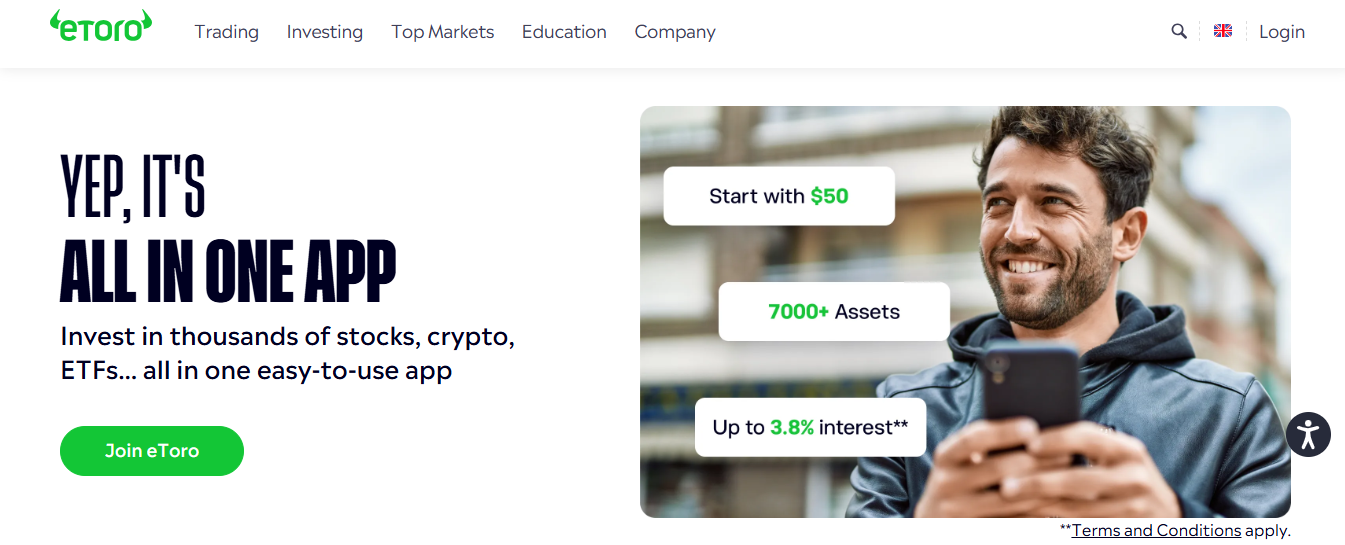
eToro stands out as a beginner‑friendly Robinhood‑style alternative that pairs a paper‑style demo with social trading tools and a broad range of instruments. Its virtual account boots you into a frictionless environment with $100,000 in mock funds, letting you experiment with stocks, ETFs, and cryptos while watching live price movements and order‑flow behavior.
The social angle, CopyTrader, and community feed add a layer of observational learning, so you can practice not just your own trades but also see how others manage positions and risk.
Key Features
- Hands you a virtual $100,000 balance to test different allocations, risk sizes, and strategies without real money.
- Let's you mirror top traders’ portfolios with CopyTrader, letting you “paper‑copy” their moves and see how they evolve over time.
- Offers a real‑time social feed where users share trades, ideas, and market commentary, turning practice into a learning‑rich environment.
- Supports multiple asset classes, including stocks, ETFs, and crypto, so you can diversify your simulated portfolio.
- Runs on desktop and mobile, allowing you to practice from anywhere with a familiar, swipe‑friendly interface.
- Charges no subscription fees for core demo features, keeping the barrier to practice very low.
- Displays real‑time or near‑real‑time quotes, so your paper trades reflect current market conditions instead of abstract replay.
3. thinkorswim (Charles Schwab)

thinkorswim has become the go‑to paper‑trading environment for more advanced traders who want a workstation‑style simulator without paying subscription fees. Its paperMoney mode mimics live trading conditions for stocks, options, futures, and forex, giving you deep tools for strategy testing, options scenarios, and order‑flow analysis, all with virtual funds and real‑time data.
While the learning curve is steeper than Robinhood’s, serious traders often keep it as their long‑term practice hub because the platform closely mirrors how they’d trade with real accounts.
Key Features
- Includes paperMoney mode with customizable virtual balances and real‑time market data for realistic practice.
- Packs over 400 technical indicators and drawing tools, letting you test complex technical setups and patterns.
- Offers advanced options‑chain analysis and strategy builders so you can rehearse multi‑leg orders and risk profiles.
- Provides full‑featured mobile access, enabling you to practice on the go using the same interface as the desktop.
- Delivers a 30‑day guest pass even without an open brokerage account, which lowers the barrier to trying it out.
- Includes educational resources, webinars, and built‑in strategy guides that walk you through how to use simulator tools.
- Let's you switch quickly between paper and live accounts, making it easier to scale strategies from practice to real capital.
4. TradeStation

TradeStation is a powerful alternative for active day traders seeking a simulator that mirrors their live brokerage environment almost exactly. Its paper‑trading module supports stocks, options, and futures with real‑time data, P&L tracking, and backtesting, so you can tune intraday strategies and evaluate performance over time.
Because the order tickets, routing, and interface are identical to the real account, using TradeStation for practice makes the transition to funded trading feel far less jarring.
Key features
- Uses the same order‑entry screens and user interface as the live platform, so your muscle memory carries over smoothly.
- Assigns unlimited paper‑trading capital with access to historical and real‑time data for thorough strategy testing.
- Auto‑tracks P&L, commissions, and performance metrics so you can see how well your simulated system behaves over time.
- Includes built‑in backtesting tools that let you replay strategies against past market conditions and refine rules.
- Supports EasyLanguage for algorithmic traders who want to code, test, and debug automated strategies in a risk‑free setting.
- Let's you simulate different order types and routing behaviors, helping you understand how execution might differ in practice.
- Offers the simulator free to account holders across desktop and mobile, giving you flexibility over where and when you practice.
5. Moomoo

Moomoo is a mobile‑first Robinhood‑style alternative that combines zero‑commission trading with a generous paper‑trading environment tailored to U.S. and international markets. Its simulated account lets you practice with stocks, ETFs, options, and futures while benefiting from live market data and rich analytics, making it a solid fit for traders who learn best on their phones.
Moomoo also incorporates social and gamified elements, such as challenges and leaderboards, to keep practice sessions engaging rather than repetitive.
Key Features
- Offers paper‑trading support for U.S., Hong Kong, and China‑listed securities, letting you practice in multiple market ecosystems.
- Runs on a mobile‑centric interface with intuitive touch controls, which feels similar to Robinhood but with more tools.
- Provides free stock promotions for new users, adding an extra layer of incentive for learning and experimenting.
- Gives access to Level 2 quotes and over 100 technical indicators, helping you drill into order‑book dynamics and technical setups.
- Includes community‑based challenges and leaderboards, turning practice into a competitive environment that can boost consistency.
- Supports unlimited or very high virtual balances, so you can simulate different account‑size scenarios without constraints.
- Delivers real‑time data and commission‑free simulated trades, aligning your practice behavior closely with how you’d trade live.
But knowing which platform fits your style matters less if you don't know how to extract real skill from the hours you spend in simulation.
Tips to Get the Most Out of Paper Trading?

Extracting real skill from paper trading requires deliberate constraints that mirror the conditions you'll face with actual capital. Most traders approach simulation as a playground for wild experiments, testing high-leverage strategies or all-in positions they'd never risk in reality. That disconnect breeds habits that collapse the moment real money enters the picture.
Instead, treat every simulated trade as if it involves your hard-earned savings. Set position sizes that match your future account balance, place stops where you'd actually exit, and log every decision with the same rigor you'd demand from a professional trading journal.
Concentrate on Probable Market Situations
Chasing improbable scenarios in paper trading wastes your preparation time. You might simulate a biotech stock doubling overnight on FDA approval or a currency pair gapping 500 pips on unexpected central bank intervention, but these extreme events occur so rarely that practicing them provides little transferable skill. 90% of traders lose money, often because they train for drama instead of routine.
Focus instead on routine volatility, earnings reactions, sector rotations, and the daily price swings that define most trading sessions. These probable situations occur frequently enough that your practice directly prepares you for the decisions you'll face weekly, or even daily, with live funds.
Tactical Pattern Recognition
When you simulate realistic conditions, your brain builds pattern recognition for setups that actually repeat. You learn to spot when a stock respects support during normal market hours, how volume behaves ahead of scheduled economic releases, or which technical signals precede modest pullbacks versus full reversals.
This focused training creates muscle memory that carries over seamlessly when real capital is at stake, rather than leaving you unprepared for the everyday pressures that separate consistent performers from those who struggle.
Limit Practice to Strategies You'll Actually Deploy
Paper trading opens the door to testing any approach, but experimenting with methods you'd never use with real money creates false confidence. High-risk tactics like overleveraged futures positions or speculative penny stock plays might show impressive simulated returns, yet they fall outside most traders' risk tolerance once emotions and actual losses enter the picture.
Sticking to aligned strategies reinforces discipline and helps you refine a personal playbook that matches your objectives. If you plan to trade mid-cap growth stocks using technical setups, then practice exactly that, not exotic options spreads or forex scalping that feel exciting but don't fit your long-term goals.
Condition-Specific Strategy Validation
This focused approach also reveals whether your preferred methods actually work under varying conditions. You can test how your entry signals perform during trending markets versus choppy consolidation, or whether your position-sizing rules protect capital during drawdowns. Over time, this builds the consistency needed to achieve your investment targets when you move to live accounts, because every simulated hour directly translates to real-world readiness.
Track Performance Data Systematically
Logging your simulated results creates a personal database of insights you can reference later with actual capital. Record not just entry and exit prices, but also your reasoning, market conditions, and emotional state at the time. Did you exit early because fear took over, or did you hold too long hoping for a reversal?
These patterns become visible only through systematic review, turning raw practice into actionable knowledge. 6- and 12-month trade-backtesting periods reveal how strategies perform across different market cycles, a principle that applies equally to forward-testing in paper trading.
Systematic Performance Analysis
Regular analysis of your simulated trades highlights your strengths and weaknesses in forecasting. You might discover that your technical setups work best in the first hour of trading but deteriorate during lunch-hour chop, or that you consistently underestimate volatility around earnings announcements.
This systematic review process sharpens anticipation skills and supports more informed choices when real money is committed, separating consistent performers from those who repeat the same mistakes across live and simulated environments.
Practice Order Mechanics Until They're Reflexive
Paper trading gives you repeated chances to explore order types in a live-market environment, building familiarity that reduces errors once you trade for real.
- A market order fills immediately at the current available price, suitable when speed matters more than exact cost.
- A limit order specifies the maximum or minimum price you'll accept and only executes when the market reaches or improves on that level, offering greater control though with no guarantee of completion.
- A stop order remains hidden from the market until the price hits your trigger point, at which time it converts to a market order for quick execution, ideal for protecting gains or limiting losses in fast-moving situations.
Experimenting with all three in simulation reveals their strategic impact and helps you choose the right tool for each scenario, so execution becomes second nature rather than a source of hesitation.
Structured Capital Progression
Most traders build their progression by mastering paper trading, then cautiously applying small position sizes in live accounts to test execution. That approach works, but it's slow and limits your ability to practice with meaningful capital.
Prop firm platforms offer an alternative path, providing simulated capital with clear evaluation phases (no profit target in Phase 1, 10% target in Phases 2 and 3) and straightforward rules including 3% maximum daily loss, 6% overall maximum loss, and up to 1:100 leverage.
Scalable Capital and Profit Distribution
Successful traders gain funded accounts that scale up to $2 million across FX pairs, stocks, ETFs, and crypto pairs, all executed on MT5 with raw spreads from 0.1 pips and profit splits ranging from 80% to 100%, supported by flexible bi-weekly or on-demand payouts and over $16 million already paid out to more than 250,000 traders worldwide.
This structured environment directly complements paper trading by allowing you to apply refined strategies, risk management, and order execution skills in a setting that can deliver real profit rewards without risking your personal funds.
But mastering simulation and order mechanics only gets you halfway there if you don't know how to access the capital that turns practice into profit.
Get 25-30% off Today - Sign up to Get Access to Up to $800K Today

If you're searching for paper trading alternatives because Robinhood doesn't offer a demo account, you've likely hit the same frustrating wall most traders face. You practice in simulation, build confidence, maybe even see consistent virtual profits, but there's no bridge from those imaginary gains to actual income. The motivation fades because paper trading feels like a rehearsal with no performance date, no real stakes, and no path forward.
Goat Funded Trader closes that gap by giving you simulated capital that carries real earning potential. You're not just logging hypothetical trades anymore. You're trading with up to $800K in virtual funds under live market conditions, following straightforward rules (3% daily loss limit, 6% overall maximum loss), and keeping up to 100% of your profits through flexible bi-weekly or on-demand payouts.
Capital Access and Payout Guarantees
Over 98,000 traders have already received more than $9.1 million in rewards, backed by a 2-day payment guarantee and a $500 penalty for delayed payouts. You can choose a challenge that matches your style, or skip evaluation entirely with instant funding and start trading immediately.
Right now, you can get started with 25 to 30% off, lowering the barrier even further while gaining access to MT5 execution, raw spreads from 0.1 pips, and profit opportunities across FX pairs, stocks, ETFs, and crypto pairs.
Related Reading
- Best Free Paper Trading Platform
- How To Practice Trading Stocks
- Best Paper Trading Simulator
- How To Use Webull Paper Trading
- Best Futures Paper Trading Platform
- Best Simulated Trading Platform
- Best Trading Platform For Beginners
- Best Day Trading Simulator
Be Great and get the App