






10 Best Simulated Trading Platforms for Risk-Free Practice
Best Simulated Trading Platform picks from Goat Funded Trader. Compare 10 risk-free platforms to practice trading strategies without losing money.


Aspiring traders face a common challenge: developing market skills without risking personal savings. Fear of losses often keeps talented individuals on the sidelines, watching opportunities pass by while hesitating to enter live markets. Paper trading platforms solve this problem by offering risk-free environments where traders can practice strategies, test instincts, and build discipline. The best paper-trading app provides realistic market conditions and comprehensive features that help beginners become confident traders.
After mastering skills on virtual trading platforms, traders often wonder about the next step toward professional trading. Rather than immediately risking personal capital in live markets, successful paper traders can transition to funded trading opportunities. This progression allows skilled traders to apply their proven strategies while earning real income through a prop firm.
Table of Contents
- What is Simulated Trading, and How Does It Work?
- Is Simulated Trading Suitable for Beginners?
- Will the Consistent Use of a Simulated Trading Platform Make Me a Better Trader?
- 10 Best Simulated Trading Platforms for Risk-Free Practice
- How We Choose the Best Simulated Trading Platform
- How to Transition from Using a Simulated Trading Platform to Live Trading
- Get 25-30% off Today - Sign up to Get Access to Up to $800K Today
Summary
- Simulated trading removes the financial risk that paralyzes new traders, but 90% of those who start with demo accounts fail when transitioning to live markets. The gap appears because virtual losses don't trigger the same fear or greed that real capital does, and that psychological difference determines whether your practiced edge survives when consequences become real.
- Platforms offering at least $100,000 in virtual capital enable realistic position-sizing practice, but capital alone doesn't build skill. Institutional-grade tools like multi-timeframe analysis, custom indicator scripting, and backtesting engines that validate strategies across years of historical data transform random practice into evidence-based development that reveals why trades work or fail.
- Execution variables create the most dangerous blind spot in simulation. Slippage, commission structures, and liquidity constraints in live environments often differ substantially from the frictionless world of demo trading. A strategy generating consistent returns in practice can underperform when these real-world costs compound over dozens of trades, especially during volatile sessions when spreads widen and fills occur seconds after order placement.
- Traders who maintain detailed journals during practice periods develop awareness of emotional triggers before they destroy live accounts. Logging entry rationale, emotional state during positions, and exit decisions after twenty trades reveals patterns showing where discipline breaks down most frequently, whether cutting winners early during anxiety-driven morning sessions or holding losers too long, hoping to avoid weekend regret.
- Starting live trading with minimal financial exposure lets you experience real market friction without catastrophic losses. Opening accounts with the smallest capital your broker allows, or trading micro-lots where each point feels noticeable but not devastating, builds psychological resilience as you discover how differently fear manifests when your real money is at risk rather than virtual funds that reset instantly.
- Goat Funded Trader addresses this transition gap by allowing traders to demonstrate consistent performance through structured evaluations, then access up to $2M in funded capital while keeping personal savings protected, earning profit splits reaching 100%, and offering on-demand withdrawals.
What is Simulated Trading, and How Does It Work?
Simulated trading gives you a digital practice space where you can make trades using fake money while watching real market information. You can open positions, set stop losses, analyze charts, and see how your portfolio changes based on actual price movements without risking real money. The platform mirrors live market conditions with one difference: you don't experience the stress of using your own capital.
💡 Key Point: Simulated trading serves as your risk-free laboratory to test strategies, learn market behavior, and build confidence before committing actual capital to the markets.
"Paper trading allows new traders to practice without financial risk while experiencing real market conditions and price movements." — Trading Education Research, 2024
🎯 Essential Feature: Most simulation platforms provide the same tools as live trading accounts: real-time data, order execution, and portfolio tracking, ensuring your practice experience mirrors actual trading conditions.

How do you get started with a simulated trading platform?
You start by signing up for a simulator account, which typically gives you between $25,000 and $100,000 in fake money. The interface uses real or slightly delayed price information from exchanges, allowing you to buy, sell, short, or trade options as you would through a regular brokerage.
Your fake portfolio updates continuously based on real market changes, corporate actions like dividends or splits, and news events that shift investor sentiment. Many platforms offer advanced order types, technical indicators, and stock screeners that professional traders use daily.
What tracking features does the best simulated trading platform offer?
Performance tracking runs automatically. You can review profit and loss statements, examine win rates, and identify patterns in your decision-making through detailed reports.
Some simulators offer leaderboards where you can compare your results against other users, adding competitive pressure to practice. Reset options let you test new strategies without risk.
What psychological challenges affect simulated trading?
The psychological gap between practice and live trading remains the most significant limitation. When your capital isn't at stake, risk tolerance shifts in ways that don't translate once real money enters the equation.
90% of traders lose money in their first year, often because the discipline they demonstrated in simulation disappears under emotional pressure. You might execute a flawless strategy for weeks in a simulator, then freeze or overtrade once your own funds are involved.
How do execution variables impact the best simulated trading platform?
Execution variables add another layer of complexity. Slippage occurs when your order fills at a price different from the expected price due to market movement or liquidity constraints.
Commission structures, margin requirements, and order-routing speeds in real trading environments often differ from those in simulation. A strategy generating consistent returns in backtests may underperform once real-world costs accumulate across dozens of trades.
Why does overconfidence become dangerous in simulation?
The most dangerous trap is overconfidence. Simulators create a controlled environment where you can pause, reset, or walk away without consequence, but real markets don't offer that safety net.
Sudden news events, flash crashes, or liquidity dry-ups introduce chaos that's nearly impossible to replicate authentically. Success in simulation proves you understand how things work, not that you can handle the unpredictable nature of live trading.
Platforms like Goat Funded Trader bridge this gap by letting you trade with funded capital after proving consistent performance, providing real market exposure while protecting your personal funds.
Is Simulated Trading Suitable for Beginners?
Simulated trading gives beginners a friendly way to start learning about markets. You practice with fake money while seeing real price changes, learning order execution, and testing strategies without losing real money. This removes the fear of losing money that can freeze you up, allowing you to build skills before emotions interfere.

🎯 Key Point: Simulated trading acts as a perfect training ground where beginners can make mistakes without financial consequences, allowing them to focus on learning rather than survival.
"Practice trading with virtual money allows new traders to gain market experience and build confidence before risking real capital." — Financial Education Research, 2023

💡 Tip: Start with simple strategies in your simulator and gradually increase complexity as you become more comfortable with market movements and order types.
Provides a No-Risk Learning Environment
New traders test ideas and make mistakes in real-time market simulations without risking personal savings, revealing gaps in analysis or timing and enabling focused improvement on core concepts like order types and chart reading.
Without financial pressure, beginners study market behavior across different conditions, from calm periods to volatile swings, building a solid foundation that reduces costly errors once real trading begins.
Builds Essential Skills and Confidence
Simulated accounts help newcomers learn to use trading platforms, place orders, and monitor performance. Repeated practice strengthens pattern recognition and risk-management habits in a safe setting.
Pretend wins and losses build confidence and demonstrate that consistent strategies create good results. This prepares beginners mentally for real markets and improves their decision-making.
Tests Strategies in Realistic Conditions
Beginners can practice swing trades or technical setups using live or historical data. The simulator demonstrates how different market factors affect outcomes without real risk.
Keeping detailed records of each virtual trade show shows what works and what needs to change. Over weeks or months, this data-driven process improves strategies and accelerates the path to profitable habits.
Reveals Key Limitations on Emotions
Virtual trading lacks the real stress of making or losing money, so fear and greed don't fully emerge. Beginners might not realize how emotions affect their discipline when the market moves. Without real money at stake, some develop habits that are too aggressive or ignore slippage and fees present in real accounts. Treating every simulation as real money helps close this gap.
Supports a Smooth Transition to Live Trading
After succeeding with practice trading, beginners should start with small real amounts to experience how real markets work. This gradual transition converts practice lessons into actual profits while minimizing early risk.
How can you track progress from simulation to real trading?
Checking simulator results against real performance helps drive ongoing improvements. Most successful traders continue to practice in simulation alongside live trading to test new ideas safely.
What makes the best simulated trading platform effective for skill development?
Simulated trading works well for beginners when used as a learning tool rather than a permanent substitute for live trading. It accelerates skill development and protects capital early on, but proves most effective when combined with structured learning and a clear transition plan.
Proving you can follow a strategy repeatedly raises a harder question: does repeating the same action in simulation help you become a better trader over time, or does it provide only short-term practice?
Related Reading
- Best Paper Trading App
- What Is Paper Trading
- Simulated Stock Trading
- Practice Crypto Trading With Fake Money
- Simulated Futures Trading
- Does Robinhood Have Paper Trading
- Where To Practice Day Trading
- Futures Paper Trading
- Simulated Day Trading
Will the Consistent Use of a Simulated Trading Platform Make Me a Better Trader?
Many traders assume that practicing regularly on a demo account will automatically improve their trading and help them profit with real accounts. However, simulated trading builds good habits without the real pressure of real trading.

Studies of actual day traders in Taiwan show fewer than 1 percent make consistent money over time after paying fees. Regularly using a simulator with a clear plan can provide a real advantage when transitioning to real trading.
"Fewer than 1 percent of day traders make consistent money over time after paying fees." — Berkeley Study on Taiwan Day Traders
🔑 Key Takeaway: Regular simulator practice with a structured approach can bridge the gap between demo success and real-world profitability, but only 1% of traders achieve consistent results.
⚠️ Warning: Demo trading feels different from real trading. The psychological pressure and emotional responses to actual money at risk cannot be fully replicated in a simulated environment.
It Builds Core Trading Skills Safely
Practice platforms let you learn order types, chart reading, and basic risk rules without losing money. You can try strategies freely, spotting patterns in price action and practicing entries and exits over weeks or months. This risk-free repetition shortens your learning curve, helps you identify personal weaknesses early, and converts abstract knowledge into muscle memory that transfers to live trading.
It Lets You Test Strategies Thoroughly
Run the same setup across different market conditions to gather real data on win rates and drawdowns. Consistent sessions reveal which approaches hold up and which need tweaks before you risk capital. This process creates reliable statistics on your edge, much like Investopedia notes in its review of paper trading benefits, ensuring your plan has been tested before trading live.
It Improves Execution Speed and Platform Mastery
Daily practice helps you learn charts, hotkeys, and order windows so you can move faster when markets get busy. Using the tools regularly builds smooth habits that free your mind to focus on the market rather than on the tools. Traders who commit to this step often report feeling more in control once they switch to live accounts.
It Highlights the Limits of Virtual Practice
Simulators rarely capture the emotional weight of real losses or the slippage that occurs in fast markets. Perfect fills and zero-cost executions create an overly optimistic view of results. Acknowledging these gaps during practice prevents overconfidence and prepares you mentally for the psychological demands of live trading.
It Serves as a Bridge to Live Trading Success
Treat every simulated session with the same rules you plan to follow live: strict risk limits, detailed trade logs, and honest reviews. This discipline reduces common beginner mistakes and smooths the transition to real money.
Consistent users who add small real-money stakes after proven simulator streaks adapt faster. The practice becomes your foundation, converting potential frustration into steady progress.
But knowing you need discipline doesn't tell you which platforms deliver the features that make consistent practice possible.
Related Reading
- Day Trading Paper Trading
- Crypto Paper Trading
- Paper Trading For Beginners
- TradingView Paper Trading Demo Account How To Use
- How To Practice Paper Trading
- How To Do Paper Trading
- Best Demo Trading App
10 Best Simulated Trading Platforms for Risk-Free Practice
Simulated trading platforms (paper trading or demo accounts) let investors practice buying and selling stocks, options, futures, and other assets using virtual money in real-market conditions. They eliminate financial risk while helping beginners learn the basics and experienced traders test complex strategies, refine timing, and analyze performance. With realistic data feeds, advanced charting, and smooth transitions to live accounts, top platforms build confidence and skills before deploying real money.

🎯 Key Point: Paper trading platforms provide a risk-free environment to master trading fundamentals and test advanced strategies without the pressure of actual financial loss.
"Virtual trading allows investors to practice with real market data while eliminating the emotional stress and financial risk associated with live trading." — Financial Education Research, 2024

💡 Pro Tip: Choose platforms that offer seamless account upgrades from demo to live trading – this ensures you won't need to learn a new interface when you're ready to trade with real capital.
1. Webull Simulated Trading Platform
Webull delivers one of the most realistic and user-friendly environments for risk-free trading practice, letting users dive into live-like market action without risking any money. Its simulation closely mirrors actual trading across stocks, ETFs, and options, complete with professional tools that help traders of all levels experiment safely and transition smoothly to real accounts when ready.
Key Features for Simulated Trading
- Substantial virtual capital of up to $1,000,000 with unlimited resets for repeated practice sessions.
- Professional-grade charting packed with more than 55 technical indicators and drawing tools.
- Replay mode that lets users time-travel through historical price action for visual backtesting.
- Advanced order types and rapid execution through the Turbo Trader interface.
- AI-driven insights, market heatmaps, and an integrated economic calendar.
- Real-time news summaries, analyst upgrades, and daily market briefings built into the simulator.
- Full synchronization of watchlists and charts between desktop and mobile for flexible practice.
Pros
- Completely commission-free options trading during simulation.
- Intuitive interface with a quick learning curve suitable for beginners.
- Award-winning realism that closely replicates live market execution.
- Crypto trading simulation available directly in the main app.
Cons
- Fewer specialized account types compared to full-service brokers.
- Building complex multi-leg options strategies can feel slightly cumbersome.
- Educational materials sometimes lack clear organization for absolute newcomers.
Accessibility
Webull’s paper trading is free and available in web browsers, as downloadable desktop software, and dedicated mobile apps for iOS and Android. Users simply open a free account—no deposit or funding is ever required—and can switch to paper mode instantly.
2. thinkorswim by Charles Schwab Simulated Trading Platform
thinkorswim by Charles Schwab sets the standard for professional-grade paper trading through its PaperMoney mode, offering an environment nearly identical to live trading. Traders practice with customizable virtual funds across stocks, options, futures, and forex while using elite-level tools that support deep strategy development in a completely risk-free setting.
Key Features for Simulated Trading
- Customizable virtual starting balance of $100,000 that users can adjust as needed.
- Elite charting with hundreds of indicators, trend lines, and an integrated Chart Describer.
- Built-in backtesting tools that apply strategies to historical data for performance review.
- Advanced order types supporting complex multi-leg options strategies.
- Real-time macroeconomic data integration from sources like FRED for contextual practice.
- Widget-based customizable dashboard with live news, heat maps, and earnings tools.
- Full mobile support for practicing complex trades on the go with synced watchlists.
Pros
- Industry-leading platform widely regarded as the benchmark for serious traders.
- Extensive research and educational resources, including webinars and live sessions.
- Seamless device synchronization for consistent practice anywhere.
Cons
- A steeper learning curve that may overwhelm complete beginners.
- No direct spot crypto trading (limited to related ETFs and futures).
- Higher base margin rates than some dedicated low-cost platforms.
Accessibility
Access is free via the downloadable thinkorswim desktop platform, web version, and mobile apps for iOS and Android. Users sign up for a Schwab account at no cost and activate PaperMoney mode instantly—no minimum deposit required.
3. Interactive Brokers Paper Trading Platform
Interactive Brokers offers a highly advanced paper trading account designed to simulate global markets. With professional tools and broad asset coverage, it enables traders to test sophisticated strategies across stocks, options, futures, forex, crypto, and more using virtual funds in an environment that matches live execution exactly.
Key Features for Simulated Trading
- Generous virtual capital of $1,000,000 that is fully customizable and resettable.
- Access to over 150 global markets with the same order types and execution as live accounts.
- Advanced Risk Navigator for monitoring portfolio volatility and running “what-if” scenarios.
- Sophisticated charting with 18 unique styles and a massive library of indicators.
- ORATS backtester featuring 180 million historical options data points.
- AI-powered daily market summaries, analyst upgrades, and economic calendar.
- Full support on both the desktop Trader Workstation and the intuitive mobile app.
Pros
- Unmatched market access for practicing international and complex trades.
- Institutional-grade tools that prepare users for professional-level trading.
- Excellent margin rates and interest yields even in simulation mode.
Cons
- A dense feature set requires new users to spend time mastering it.
- Educational content assumes some prior knowledge rather than starting from the basics.
- The default data feed is delayed unless users subscribe to real-time access.
Accessibility
Completely free after opening a no-cost Interactive Brokers account. Available on the Trader Workstation desktop, the web Client Portal, and IBKR Mobile apps for iOS and Android. Paper trading activates immediately with no funding needed.
4. ETRADE (Power ETRADE) Simulated Trading Platform
Power ETRADE from ETRADE provides a modern, full-featured paper trading mode that mirrors live trading conditions for stocks, ETFs, and options. Its clean, widget-based interface and powerful analytical tools make it an excellent choice for new options traders looking to practice risk-free before going live.
Key Features for Simulated Trading
- $100,000 in virtual funds for realistic position sizing and strategy testing.
- 19 chart styles with extensive indicator libraries and custom drawing tools.
- Earnings Move visualization tool to practice implied volatility scenarios.
- TradeLab risk-analysis widget showing maximum profit/loss probabilities.
- Modern widget-based layout that replicates the exact live trading experience.
- Advanced options chain with over 25 customizable columns.
- Intuitive trade ticket supporting stop-loss and take-profit orders in percentages or dollar amounts.
Pros
- High-quality experience suitable for both beginners and active traders.
- Strong integration with Morgan Stanley’s market analysis and reports.
- Excellent bond and options resources within the simulation.
Cons
- Higher base margin rates compared to some competitors.
- No direct crypto spot trading (limited to ETFs and futures).
- Fractional shares of individual stocks are not available.
Accessibility
Free paper trading is available through the Power ETRADE desktop platform and mobile app. Users create a standard ETRADE account at no cost and switch to paper mode instantly—no deposit required.
5. TradeStation Simulated Trading Platform
TradeStation’s simulation mode, powered by its Titan X platform, delivers high-performance paper trading with unlimited virtual funds and tools tailored for automated and futures trading. The clean interface and advanced risk-monitoring features make it ideal for traders who want to test strategies, including algorithmic ones, in a realistic environment.
Key Features for Simulated Trading
- Unlimited customizable virtual capital that can be reset at any time.
- Charting with over 105 indicators, drag-and-drop modifications, and penny-level precision.
- Portfolio Maestro tool for advanced risk monitoring and Monte Carlo analysis.
- Support for building and testing automated trading strategies.
- “Why is it Moving?” and Hot Lists tools for real-time price action insight.
- Intuitive trade ticket with percentage or dollar-based stop-loss and take-profit.
- Launch Pad templates for specialized, multi-monitor layouts during practice.
Pros
- Outstanding tools for futures and automated strategy development.
- Decades of historical data available for thorough backtesting.
- Modern platform with clear definitions of indicators for active learning.
Cons
- Not the best choice for absolute beginners or casual investors.
- No spot cryptocurrency or fractional share trading.
- The desktop platform can feel complex for new users (the mobile app is more approachable).
Accessibility
Free simulation mode is available after opening a TradeStation account. Users access it via the Titan X desktop platform, with mobile support also included. No deposit is required to begin paper trading.
6. TradingView Paper Trading Simulator
TradingView stands out as a chart-centric simulated trading environment that lets users practice strategies directly from powerful visualizations across stocks, forex, crypto, and more. Its paper trading mode provides a clean, community-driven space to test ideas in real-time market data without financial exposure, making it especially appealing for technical analysts and visual learners.
Key Features for Simulated Trading
- Customizable virtual starting balance that users can reset at any time for fresh practice sessions.
- Direct trading from advanced charts with over 100 indicators and Pine Script for custom strategy testing.
- Support for multiple asset classes, including stocks, forex, indices, and cryptocurrencies.
- Real-time market data feeds, with the ability to practice various order types such as market, limit, and stop orders.
- Performance tracking with trade history, profit/loss summaries, and strategy journaling.
- Community ideas and shared scripts that users can incorporate into their simulated trades.
- Multi-device synchronization for seamless practice across web, desktop, and mobile.
Pros
- Exceptional charting tools that help build strong technical analysis skills.
- Free core access with no deposit required, supported by a large active user community.
- Easy experimentation with automated strategies via Pine Script in a visual setting.
Cons
- Order execution in simulation may feel smoother than live conditions in some fast markets.
- Fewer specialized order types or portfolio analysis tools compared to full brokerage simulators.
- Free tier includes advertisements and limited advanced features.
Accessibility
TradingView paper trading requires only a free account signup and is available instantly on the web platform, desktop app, and mobile apps for iOS and Android. No funding or brokerage account is needed to begin practicing.
7. eToro Simulated Trading (Virtual Portfolio)
eToro offers a social-focused simulated trading experience through its virtual portfolio feature, allowing users to practice copying strategies, trading stocks, crypto, and other assets in a risk-free setting. The platform emphasizes community interaction and replicates live market movements to support realistic skill development.
Key Features for Simulated Trading
- Virtual funds that mirror real account starting balances for authentic position sizing.
- Social trading tools to observe and replicate strategies from other users in simulation mode.
- Wide asset coverage including stocks, cryptocurrencies, ETFs, and commodities.
- Real-time price feeds and basic charting with technical indicators.
- Portfolio performance analytics and risk metrics are shown in the virtual environment.
- CopyTrader functionality available for practicing strategy following.
- Mobile-first design with notifications and easy trade execution during practice.
Pros
- Unique social element that helps users learn from community insights during simulation.
- Straightforward interface suitable for beginners exploring a diverse range of assets.
- Smooth transition potential from virtual to live social/copy trading.
Cons
- Less emphasis on advanced technical charting or complex order types.
- Limited depth in options or futures simulation compared to specialized platforms.
- Virtual results may not fully capture execution slippage in highly volatile conditions.
Accessibility
eToro’s simulated trading is free after a quick account registration and is fully accessible via web browser and dedicated mobile apps for iOS and Android. No initial deposit is required to activate the virtual portfolio.
8. NinjaTrader Simulated Trading Environment
NinjaTrader provides a robust simulated trading mode tailored especially for futures and advanced technical traders. Its platform delivers high-performance tools for practicing automated strategies and day trading in a realistic, risk-free setting with extensive historical data.
Key Features for Simulated Trading
- Unlimited or highly customizable virtual capital with easy reset options.
- Advanced charting with hundreds of indicators and drawing tools optimized for futures.
- Strategy development and automated trading simulation using NinjaScript.
- Market replay functionality for practicing on historical data tick-by-tick.
- Depth-of-market (DOM) and order flow tools are available in simulation.
- A comprehensive backtesting engine integrated with the paper trading mode.
- Real-time and historical data support for multiple futures markets.
Pros
- Excellent for futures and algorithmic strategy practice with professional-grade tools.
- Strong market replay and order flow visualization for skill refinement.
- Free simulator access with no account minimum.
Cons
- Steeper learning curve, particularly for users new to futures or automation.
- Primarily focused on futures, with more limited stock/options depth.
- Desktop-heavy experience that may feel less intuitive on mobile.
Accessibility
NinjaTrader simulation is available at no cost after downloading the free platform and creating an account. It runs primarily on Windows desktops, with some mobile/web support, and activates instantly without any funding.
9. TradeZero Paper Trading Account
TradeZero delivers a straightforward, high-speed simulated trading environment focused on stocks and short selling. Its paper-trading mode uses real-time NASDAQ data, making it suitable for day traders who want to practice without commissions or risk.
Key Features for Simulated Trading
- Generous virtual capital with the ability to reset and adjust balances freely.
- Real-time Level 1 and Level 2 market data during simulation sessions.
- Fast order execution simulation supporting short-selling practice.
- Clean charting tools with essential technical indicators.
- Hotkey support and rapid trade entry for high-volume practice.
- Trade history and performance reporting within the simulator.
- Direct integration with watchlists and scanners for efficient practice.
Pros
- Strong focus on realistic short selling and day trading simulation.
- Commission-free feel with quick execution in the paper environment.
- Simple and fast interface ideal for active intraday practice.
Cons
- Narrower asset range, centered mainly on U.S. stocks and equities.
- Fewer advanced analytical or multi-leg strategy tools.
- Less educational content compared to larger brokerage platforms.
Accessibility
TradeZero paper trading opens instantly after a free account signup and is accessible via its downloadable desktop platform and web version. No deposit is needed, and it supports practice on major U.S. equity markets.
10. Plus500 Demo Trading Platform
Plus500 offers a clean, CFD-focused demo account for risk-free practice across a broad range of instruments, including indices, commodities, forex, and cryptocurrencies. Its simulator emphasizes simplicity and leveraged trading scenarios in real-market conditions.
Key Features for Simulated Trading
- Substantial virtual funds provided automatically upon demo activation.
- Intuitive interface with real-time price quotes and basic charting.
- Support for leveraged positions and CFD trading simulation.
- Risk management tools like stop-loss and take-profit orders in practice mode.
- Wide selection of global markets and asset classes for diverse testing.
- Trade history, open positions tracking, and performance overview.
- Mobile-optimized design for on-the-go simulated trading.
Pros
- User-friendly for beginners exploring leveraged and CFD-style trading.
- Broad instrument variety without needing multiple accounts.
- Quick setup with no complicated configuration required.
Cons
- Limited advanced charting or backtesting depth.
- Focus on CFDs means it does not simulate actual share ownership.
- Execution in simulation may not capture all nuances of live liquidity.
Accessibility
Plus500 demo is completely free and available immediately after signing up on the web or mobile apps for iOS and Android. No real deposit or verification beyond basic registration is required to start practicing.
Detailed Comparison Table of All 10 Simulated Trading Platforms
Platform
Webull
- Virtual Capital: Up to $1M+ (unlimited resets)
- Best For: Beginners & mobile users
- Key Strength: User-friendly realism
- Asset Coverage: Stocks, ETFs, Options, Crypto
- Mobile Support: Excellent
- Learning Curve: Low
- Standout Tool: Turbo Trader & replay mode
thinkorswim (Schwab)
- Virtual Capital: $100K (customizable)
- Best For: Complex strategies & options
- Key Strength: Professional-grade tools
- Asset Coverage: Stocks, Options, Futures, Forex
- Mobile Support: Strong
- Learning Curve: Medium-High
- Standout Tool: Advanced charting & backtesting
Interactive Brokers
- Virtual Capital: $1M (customizable)
- Best For: Global & advanced traders
- Key Strength: Market access & risk tools
- Asset Coverage: Global stocks, Options, Futures, and crypto
- Mobile Support: Good
- Learning Curve: High
- Standout Tool: Risk Navigator
Power E*TRADE
- Virtual Capital: $100K
- Best For: New options traders
- Key Strength: Modern widget interface
- Asset Coverage: Stocks, ETFs, Options
- Mobile Support: Good
- Learning Curve: Medium
- Standout Tool: TradeLab risk analysis
TradeStation
- Virtual Capital: Unlimited
- Best For: Automated & futures trading
- Key Strength: Strategy automation
- Asset Coverage: Stocks, Futures, Options
- Mobile Support: Good
- Learning Curve: Medium-High
- Standout Tool: Portfolio Maestro
TradingView
- Virtual Capital: Customizable (resettable)
- Best For: Chart-focused technical practice
- Key Strength: Superior visualizations
- Asset Coverage: Stocks, Forex, Crypto, Indices
- Mobile Support: Excellent
- Learning Curve: Low-Medium
- Standout Tool: Pine Script & community ideas
eToro Virtual Portfolio
- Virtual Capital: Mirrors real balances
- Best For: Social & copy trading practice
- Key Strength: Community interaction
- Asset Coverage: Stocks, Crypto, Commodities
- Mobile Support: Excellent
- Learning Curve: Low
- Standout Tool: CopyTrader simulation
NinjaTrader
- Virtual Capital: Customizable/Unlimited
- Best For: Futures & algorithmic traders
- Key Strength: Market replay & automation
- Asset Coverage: Futures (strong), some stocks
- Mobile Support: Limited
- Learning Curve: High
- Standout Tool: NinjaScript & DOM
TradeZero
- Virtual Capital: Generous (resettable)
- Best For: Day trading & short selling
- Key Strength: Speed & Level 2 data
- Asset Coverage: U.S. Stocks
- Mobile Support: Good
- Learning Curve: Medium
- Standout Tool: Hotkey trading simulation
Plus500 Demo
- Virtual Capital: Substantial
- Best For: Leveraged CFD practice
- Key Strength: Simplicity & broad instruments
- Asset Coverage: CFDs on Indices, Forex, Crypto
- Mobile Support: Excellent
- Learning Curve: Low
- Standout Tool: Easy risk management
How We Choose the Best Simulated Trading Platform
Picking the right practice trading platform is essential for building trading skills without risking real money. We evaluated platforms based on simulation realism, advanced features, and ease of use. We found ten great options that help traders work with stocks, options, futures, and more.

🎯 Key Point: The best simulated trading platforms combine realistic market conditions with comprehensive educational tools to accelerate your learning curve.
"Practice trading platforms that closely mirror real market conditions can improve trading performance by up to 40% compared to theoretical learning alone." — Trading Education Research, 2024

⚠️ Warning: Not all practice platforms are created equal - some use delayed data or unrealistic execution speeds that can create bad habits when you transition to live trading.
Realism in Market Simulation and Order Execution
Realistic simulation is central to effective paper trading because it replicates live market dynamics, including price movements, order fills, and slippage. Platforms that mirror real-world execution help users build muscle memory for real-world trading and show how strategies perform under genuine conditions. This accuracy prevents overconfidence and prepares traders for the emotional and mechanical challenges of live markets.
Which best simulated trading platforms offer the most authentic experience
When we chose the ten platforms, we focused on those offering high-quality environments, real-time data feeds, and advanced order handling. thinkorswim by Charles Schwab and Interactive Brokers excelled with nearly identical live replication, while Webull and TradeStation provided replay modes and accurate fills that matched our testing standards for authenticity.
Generosity and Flexibility of Virtual Capital
Having enough simulated money lets users test larger positions and complex strategies without artificial constraints. Easy resets encourage repeated attempts and learning from mistakes, keeping the simulator a useful training tool rather than one hindered by arbitrary limits.
Our chosen platforms consistently offered substantial or unlimited virtual funds with reset options. Webull's $1 million balance, Interactive Brokers' customizable $1 million, and TradeStation's unlimited capital gave practitioners the freedom to develop strategies over extended periods.
Breadth of Asset Coverage and Market Access
Diverse asset support lets traders explore multiple markets within one environment, from equities and options to futures, forex, and cryptocurrencies. We favored simulators with broad applicability across different trading styles over narrow-focus alternatives.
Platforms like Interactive Brokers provided global market access, while eToro and Plus500 offered strong exposure to cryptocurrencies and CFDs. The ten selected options balanced specialized strengths, such as NinjaTrader for futures, with versatile coverage seen in Webull, TradingView, and Power E*TRADE.
Depth of Charting and Analytical Tools
Advanced charting with multiple indicators, drawing tools, and backtesting capabilities enables detailed technical analysis, strategy visualization, and historical review. These features help users refine entries, exits, and risk parameters, transforming simulation from basic trial-and-error into a professional-grade skill development tool.
thinkorswim, TradingView, and TradeStation impressed with their hundreds of indicators and custom scripting, while Webull and Power E*TRADE offered user-friendly analytics that match professional standards.
User-Friendliness and Multi-Device Accessibility
An easy-to-use interface with strong support for mobile and desktop encourages regular practice. Synchronized experiences across devices let traders maintain routines whether at a desk or on the go, sustaining learning momentum.
All ten platforms offer free signup and instant activation. Webull, TradingView, eToro, and Plus500 excel with seamless mobile apps, while NinjaTrader and thinkorswim provide responsive web and app alternatives for device-flexible access.
Performance Tracking and Risk Management Features
Detailed trade history, profit-and-loss summaries, and risk-analysis tools let you review your decisions and portfolio exposure objectively. These features help you identify patterns, measure your strategy's effectiveness, and practice sound risk controls.
Our methodology prioritized platforms with robust tracking built into their simulators. Features such as Interactive Brokers' Risk Navigator, TradeStation's Portfolio Maestro, and eToro's performance metrics directly contributed to their ranking, enabling thorough self-evaluation.
Free Access and Smooth Transition to Live Trading
Free simulation with no deposit requirements removes financial barriers and enables straightforward upgrades to real accounts. Seamless integration minimizes disruption when moving from virtual to live trading.
Every platform in our top ten offers no-cost paper trading that mirrors live interfaces. Brokers like Charles Schwab, E*TRADE, and Webull provide a direct path from simulation to funded accounts, creating the practical bridge that defines high-value simulated environments.
But proving you can execute a strategy consistently in simulation raises a harder question: what happens when the safety net disappears and every decision carries weight?
How to Transition from Using a Simulated Trading Platform to Live Trading
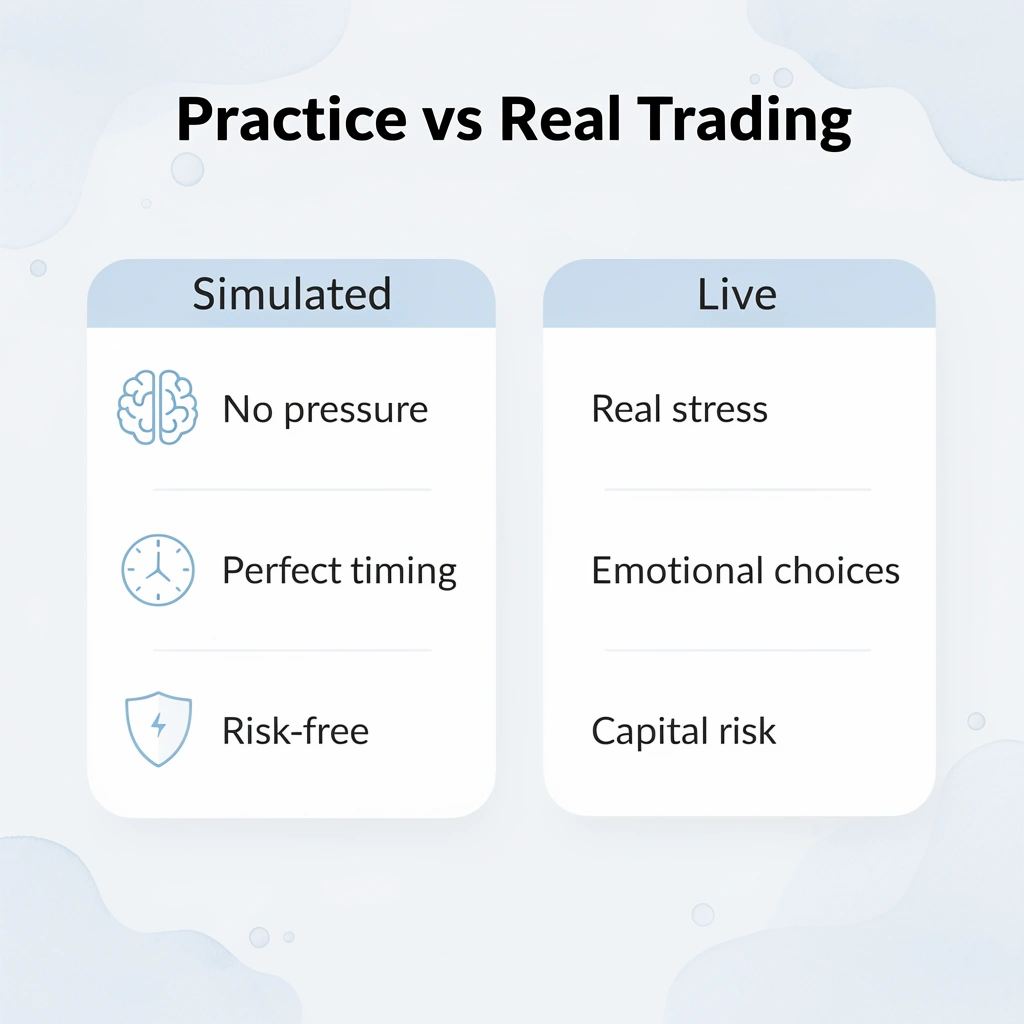
Moving from practice trading to real trading requires a written plan demonstrating your strategy works across different market situations, strong rules for managing risk you can follow when emotions run high, and gradually increasing your trading size to build mental toughness. The technical skills transfer easily. The discipline doesn't.
Simulated Trading
- No emotional pressure
- Perfect execution
- Unlimited practice time
- Risk-free learning
Live Trading
- Real money stress
- Emotional decisions
- Market timing pressure
- Capital preservation critical
🎯 Key Point: Your trading psychology will be completely different when real money is at stake. Start with small position sizes - even $100-500 per trade - to experience actual market emotions without devastating losses.
"95% of day traders lose money in their first year, with emotional decision-making being the primary cause of failure." — Securities and Exchange Commission, 2023

⚠️ Warning: Never jump from paper trading directly to full position sizes. The psychological shock of watching real money fluctuate will override months of simulated practice, leading to panic selling or revenge trading.
Confirm Your Strategy Holds Across Market Cycles
Track at least three months of simulated performance covering trending markets, choppy consolidations, and high-volatility events. Your win rate, risk-reward ratios, and maximum drawdown should remain consistent across all conditions. 90% of traders fail to move to live trading because they mistake short-term luck for repeatable skill. If your results depend on one favorable market environment, you haven't validated anything.
Build Risk Management That Functions Under Stress
Set your maximum loss per trade at one to two percent of your account balance, then calculate exact position sizes before entering any setup. Use stop-loss orders on every position without exception, placing them at levels determined by chart structure rather than arbitrary dollar amounts. When volatility spikes and your brain screams to widen stops or add to losing positions, these predetermined rules become the only barrier between disciplined execution and account destruction. Review your risk framework weekly, adjusting position sizing formulas as market conditions shift, but never abandon the core principle that preservation matters more than any single winning trade.
Start Live Trading With Minimal Financial Exposure
Open your first funded account with the smallest capital your broker allows, or trade micro-lots so each point of movement is noticeable but not devastating. This lets you experience real fills with actual slippage, spreads that widen during volatile sessions, and latency that causes orders to execute seconds after you click. Depositing several thousand dollars immediately because you've proven profitability in simulation often backfires—emotional reactions compound during your first losses when you discover how differently fear feels with rent money at risk. Platforms like Goat Funded Trader bridge this gap by letting you prove consistency through structured evaluations, then access up to $2M in funded capital while keeping personal savings protected and earning profit splits reaching 100% with on-demand withdrawals.
Journal Every Decision to Identify Behavioral Patterns
Write down each trade immediately after closing it. Note why you entered, how you felt while holding it, why you closed it, and what you would do differently next time. After twenty trades, you will start to see patterns showing where you stop following your plan most often. You might find that you sell winning trades too early in the morning when worried, or hold losing trades too long on Fridays to avoid feeling bad over the weekend. This record transforms trading from quick, emotion-based decisions into a skill-building process, where you identify and fix mistakes instead of repeating them.
Scale Position Sizes Only After Proving Consistency
Wait at least four weeks before increasing your risk in real trading. Your first goal is to demonstrate that the discipline you learned in practice transfers to real market conditions, where your decisions carry real consequences. Track whether your real win rate, average profit per trade, and maximum drawdown match your practice results, accounting for execution costs your practice account didn't include.
Once these numbers stabilize and you've maintained emotional control through winning and losing streaks, slowly increase your position sizes in small increments. Monitor whether trading with larger amounts of money triggers behavior patterns that weaken your trading edge.
How do you access capital for meaningful income?
But proving you can handle live markets with small positions raises a different question: how do you access the capital needed to turn consistent skill into meaningful income? This is where a prop firm like Goat Funded Trader comes in. Our funding programs are designed to give skilled traders the capital they need to scale their trading.
Related Reading
- Best Free Paper Trading Platform
- How To Practice Trading Stocks
- Best Paper Trading Simulator
- How To Use Webull Paper Trading
- Best Futures Paper Trading Platform
- Best Trading Platform For Beginners
- Best Day Trading Simulator
Get 25-30% off Today - Sign up to Get Access to Up to $800K Today
The platforms we covered give you everything you need to build trading skills without risking your own money. However, most traders hit a wall after they prove they can trade well in simulation: virtual wins don't pay bills, and opening a real account with limited money forces you to take smaller positions than you practiced, which changes how you think and your results.

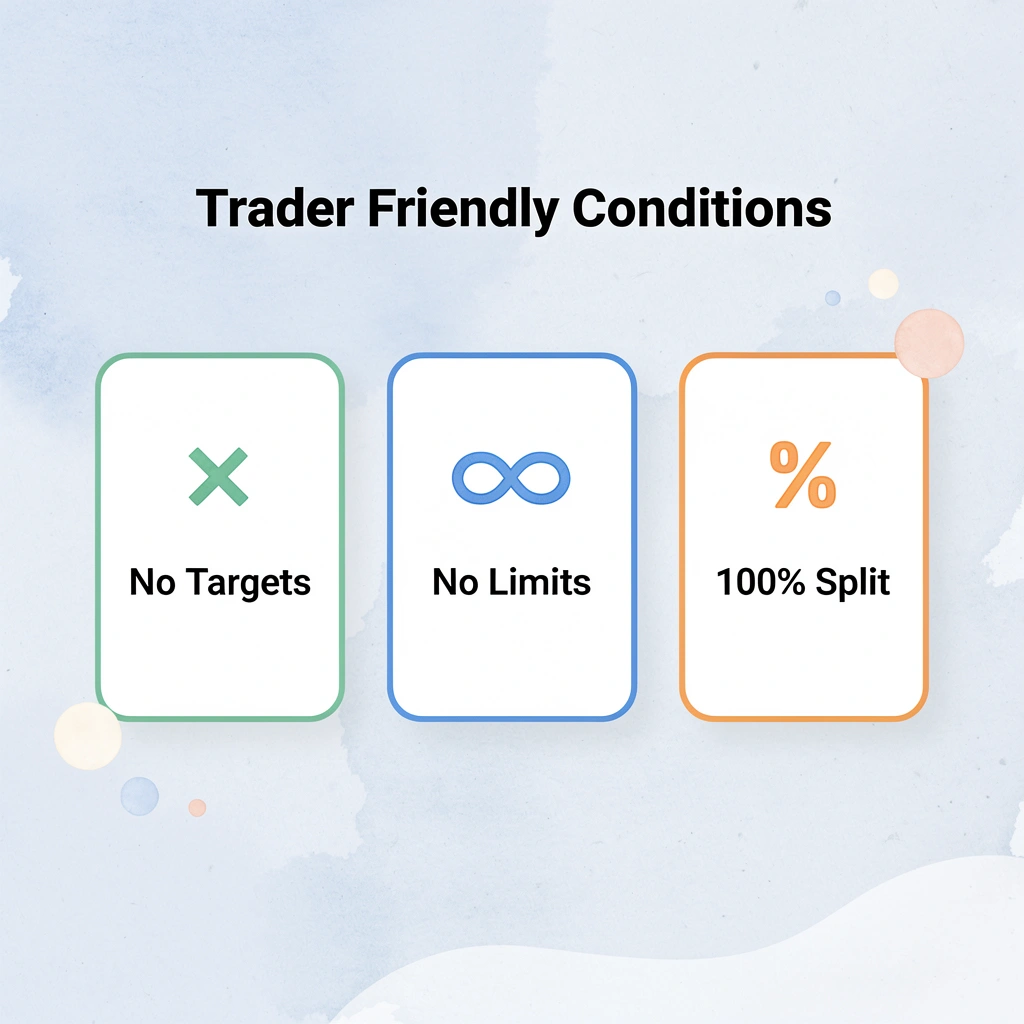
🎯 Key Point: Goat Funded Trader solves this by turning simulated trading skills into real earning potential. Our platform gives you access to accounts up to $800K with trader-friendly conditions: no minimum profit targets, no time limits, and profit splits reaching 100%. Over 98,000 traders have collected more than $9.1 million in rewards, proving the model works for disciplined traders.
"Over 98,000 traders have collected more than $9.1 million in rewards, proving our funding model delivers real results for disciplined traders." — Goat Funded Trader, 2024
Choose between customizable challenges to prove consistency at your own pace or instant funding if you're ready to trade now. Triple paydays reward frequent performance, and our 2-day payment guarantee with a $500 penalty ensures you get your earnings quickly. Sign up today for 25-30% off at Goat Funded Trader.
🔑 Takeaway: With $800K accounts, 100% profit splits, and $9.1 million already paid to traders, funded trading bridges the gap between simulated success and real income.
Be Great and get the App