






Forward Testing in Trading: A Practical Guide for Traders
Forward testing trading strategies with Goat Funded Trader's practical guide. Learn proven methods to validate your crypto trading systems.


Forward testing reveals what backtesting cannot: how to use AI for crypto trading and how a trading strategy performs when volatility spikes, liquidity shifts, and emotions influence decision-making. Paper trading in real-time conditions exposes weaknesses in strategy execution and helps traders build confidence before risking actual capital. Many traders skip this crucial validation step and jump directly into live markets, often discovering costly flaws that could have been identified through proper forward testing.
The key challenge lies in finding an environment that mirrors genuine trading conditions while protecting capital during validation. Traders need access to realistic spreads, slippage, and execution speeds to gather meaningful performance data. This testing phase becomes even more valuable when conducted through a prop firm that provides simulated accounts with authentic market conditions.
Summary
- Forward testing accuracy can reach up to 92% when executed properly, but only if traders apply the same discipline they would to live trading. The critical difference from backtesting lies in the exposure to real-time variables such as slippage, execution delays, and the psychological pressure of watching positions move against you before the market validates your thesis. These behavioral patterns only surface during real-time decision-making, and catching them in a demo environment protects capital while developing the mental discipline to follow a system when emotions push you off course.
- Research shows that 90% of traders who skip forward testing fail within their first year, revealing how critical this validation step is to long-term survival. Additionally, 70% of strategies that perform well in backtesting fail in live trading, highlighting how common overfitting problems are among traders who skip validation. These statistics underscore why forward testing on fresh, unseen data immediately highlights flaws through poor performance or inconsistent results, providing clear evidence to simplify rules or abandon weak approaches rather than discovering the truth only after incurring live losses.
- Statistical research grounded in the central limit theorem shows that fewer than 30 trades produce performance metrics dominated by random variance rather than genuine edge. A rigorous walk-forward study from University College London demonstrated that achieving 80% confidence in detecting a modest edge requires approximately 540 independent test periods; even with 34 periods, statistical power remained as low as 12%. The answer to how long to test isn't a timeline but a sample size large enough that normal market fluctuations no longer overwhelm your edge, typically at least 50 trades across multiple market conditions.
- Markets shift between trending, ranging, and high-volatility phases, and each environment exposes different weaknesses in signal generation, risk management, and execution timing. A strategy that looks unbeatable during a quiet range-bound period falls apart when volatility spikes and spreads widen. Short tests that coincide with favorable conditions create the illusion of robustness through regime bias, where results fail to generalize once markets shift. Comprehensive coverage reveals whether a strategy adapts or breaks when conditions change, which is the difference between theoretical viability and practical sustainability.
- Real-time elements like slippage, partial fills, and execution delays only emerge with repeated exposure, and these factors compound over dozens of trades in ways that backtesting never captures. After 30 or 40 trades, patterns become visible, such as whether fills consistently lag signals during volatile periods or if news events trigger stop hunts that invalidate risk rules. Emotional fatigue and execution drift, where discipline erodes after a string of losses or wins, only become evident after sufficient repetitions that reveal the true consistency of both the strategy and the trader executing it.
- Goat Funded Trader addresses the capital bottleneck by providing evaluation accounts with simulated capital of up to $2 million, allowing traders to generate the necessary sample size faster across multiple asset classes and move from validation to funded status without the artificial constraint of tiny demo balances that would otherwise slow their progress.
What Is Forward Testing in Trading and How Does It Work?
Forward testing runs your trading strategy through live market conditions using a demo account. It executes signals in real time without risking capital. You follow your rules exactly as written, entering positions when criteria match and tracking every result as the market changes. This reveals whether your strategy works in actual trading, where spreads widen during news events, liquidity disappears without warning, and emotional hesitation disrupts your plan.

🎯 Key Point: Forward testing bridges the gap between theoretical backtesting results and real-world trading performance, revealing how your strategy handles live market dynamics and execution challenges.
"Forward testing is the only way to validate whether a trading strategy can perform consistently in live market conditions before committing real capital." — Trading Performance Analytics, 2024

💡 Example: A day trading strategy that showed an 85% win rate in backtesting might only achieve 60% success during forward testing due to slippage, spread widening, and real-time execution delays that historical data cannot replicate.
How Forward Testing Differs from Backtesting
Backtesting replays your rules against historical data, while forward testing puts you in the present with unknown outcomes. According to TradingFinder, forward testing accuracy can reach up to 92% when executed properly. The critical difference lies in exposure to real-time variables: slippage, execution delays, and the psychological pressure of watching positions move against you before the market validates your thesis.
Why Forward Testing Builds Trader Confidence
Most traders skip forward testing because backtests look convincing enough, then wonder why their first month of live trading feels like a different market entirely. Forward testing trains you to execute under conditions backtests can't simulate: hesitating when the last three trades stopped out, or overtrading during quiet sessions because sitting idle feels unproductive. These behavioral patterns only surface in real time, and catching them in a demo environment protects your capital while you develop the mental discipline to follow your system when emotions push you off course. Our prop firm structure at Goat Funded Trader provides simulated accounts with authentic spreads, slippage, and execution speeds, letting you prove your method works before transitioning to live trading with documented results.
Key Metrics to Track During Forward Testing
Focus on profit factor, maximum drawdown, win rate, and average risk-reward ratios as your strategy runs through different market conditions. Track how slippage and commissions affect net results: a strategy profitable in backtesting can become marginal once real-world costs are factored in. Monitor how many valid setups your rules generate weekly, whether you're executing every signal or skipping some due to doubt, and how your strategy performs during high-volatility periods versus range-bound markets. These metrics determine whether your approach deserves real capital or requires refinement.
Transitioning from Forward Testing to Live Trading
Once your forward test shows consistent execution and positive performance matching your goals, move to small live positions while keeping detailed records. This gradual rollout verifies whether your strategy works with real money without excessive risk during the learning phase. Successful forward testing eliminates the guesswork that causes most traders to abandon their plans after a few losing trades.
The real question is whether you'll follow through when the process reveals uncomfortable truths about your strategy or discipline.
Related Reading
- How to Use AI for Crypto Trading
- What Are Crypto Trading Signals
- How Long Does It Take To Learn Forex Trading
- What Is Spot Trading in Crypto
- Is Paper Trading Real Money
- Emotional Trading Mistakes
- Common Mistakes in Stock Trading
- Crypto Trading Mistakes
- Paper Trading vs Live Trading
- Risk Reward Ratio Trading
Why Is Forward Testing Important for Traders?
You followed the rules. You trusted the backtest. You entered trades expecting the same results you saw on historical charts. Then the losses started adding up. Without forward testing, traders enter live markets with unanswered questions and pay for real-money lessons that could have been learned without risk.
🎯 Key Point: Forward testing acts as your critical bridge between backtesting success and live trading reality. It reveals how your strategy performs when market conditions shift and real-time emotions enter the equation.

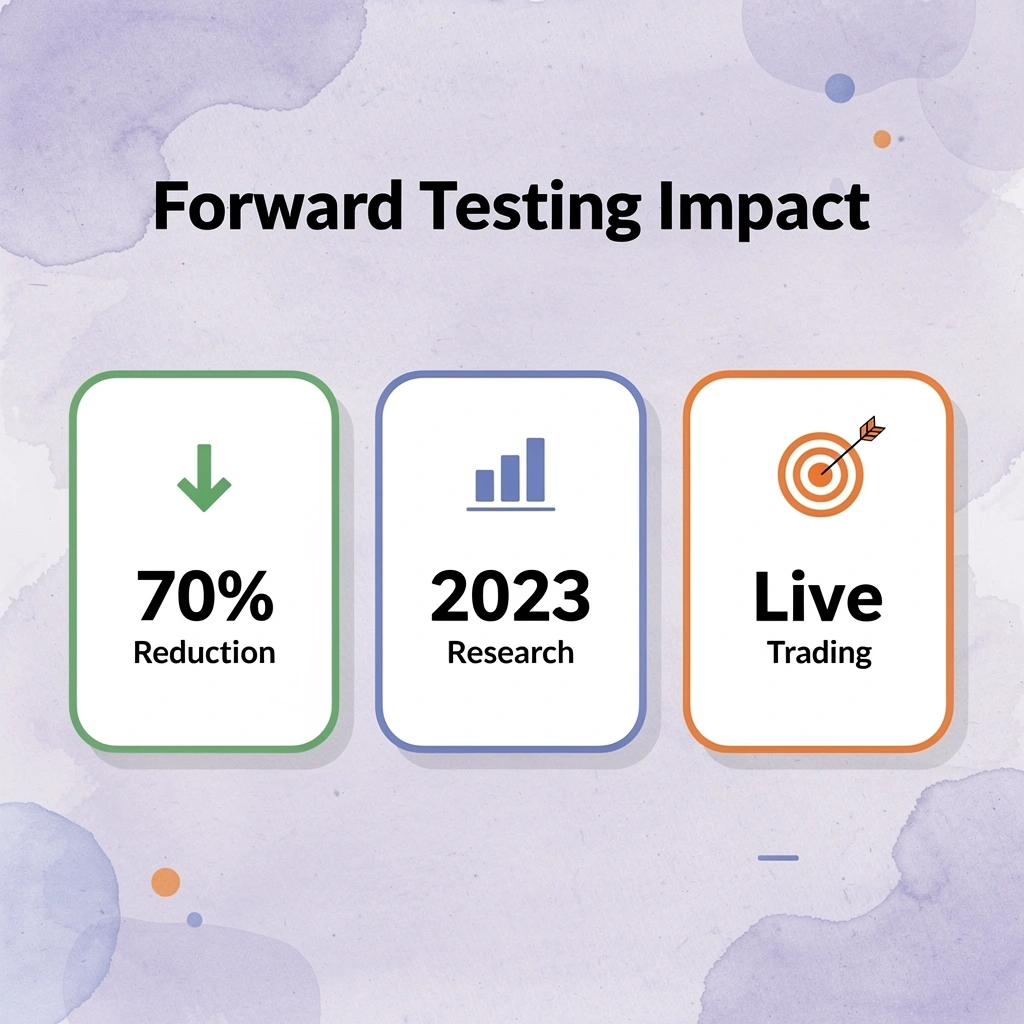
"Forward testing can reduce strategy failure rates by up to 70% compared to traders who jump directly from backtesting to live trading." — Trading Performance Research, 2023
⚠️ Warning: Backtesting shows you what could have happened, but forward testing shows you what actually happens when slippage, spread changes, and execution delays impact your real trades.
How does forward testing trading prevent costly mistakes?
Forward testing identifies problems before they become expensive mistakes. It reveals whether a strategy works under current market conditions and whether you have the discipline to use it consistently. Trading Heroes reports that 90% of traders who skip forward testing fail within their first year. The difference between traders who survive and those who don't often hinges on whether they tested their edge in real time before risking capital.
Reveals Real-Time Execution Gaps
Backtests assume perfect fills and instant decisions, but forward testing exposes actual order execution, spreads, and liquidity issues. You discover how slippage erodes profits on volatile moves and how thin liquidity turns winning setups into partial fills—friction points invisible in historical simulations because the data doesn't capture the reality of competing for fills against other market participants during fast moves.
Builds Unshakable Psychological Discipline
Live market pressure triggers emotions like fear and greed that backtests cannot replicate. Forward testing trains you to stick to your rules under real-time emotional challenges, revealing personal tendencies such as closing winning trades prematurely or skipping valid signals out of doubt.
How does forward testing trading expose overfitting issues?
Strategies built on old market information often fail when markets change because they unknowingly match past patterns. TradersPost Blog notes that 70% of strategies that perform well in backtesting fail in live trading. Forward testing on new, unseen data reveals these problems through poor performance or inconsistent results, providing clear evidence to simplify rules or abandon weak approaches before losing money in live trading.
Why do prop firms use forward-testing trading for validation?
Most traders test strategies on their own money, risking real cash during the validation phase when failure rates are highest. Prop firms like Goat Funded Trader flip this model by providing simulated money for forward testing, enabling traders to prove their edge without personal financial exposure. Once a strategy demonstrates consistent profitability through the challenge process, traders access up to $2M in funded capital with profit splits reaching 100%.
But knowing how long to forward-test before trusting your strategy with real money is where most traders get it wrong.
How Long Should You Forward Test a Trading Strategy?
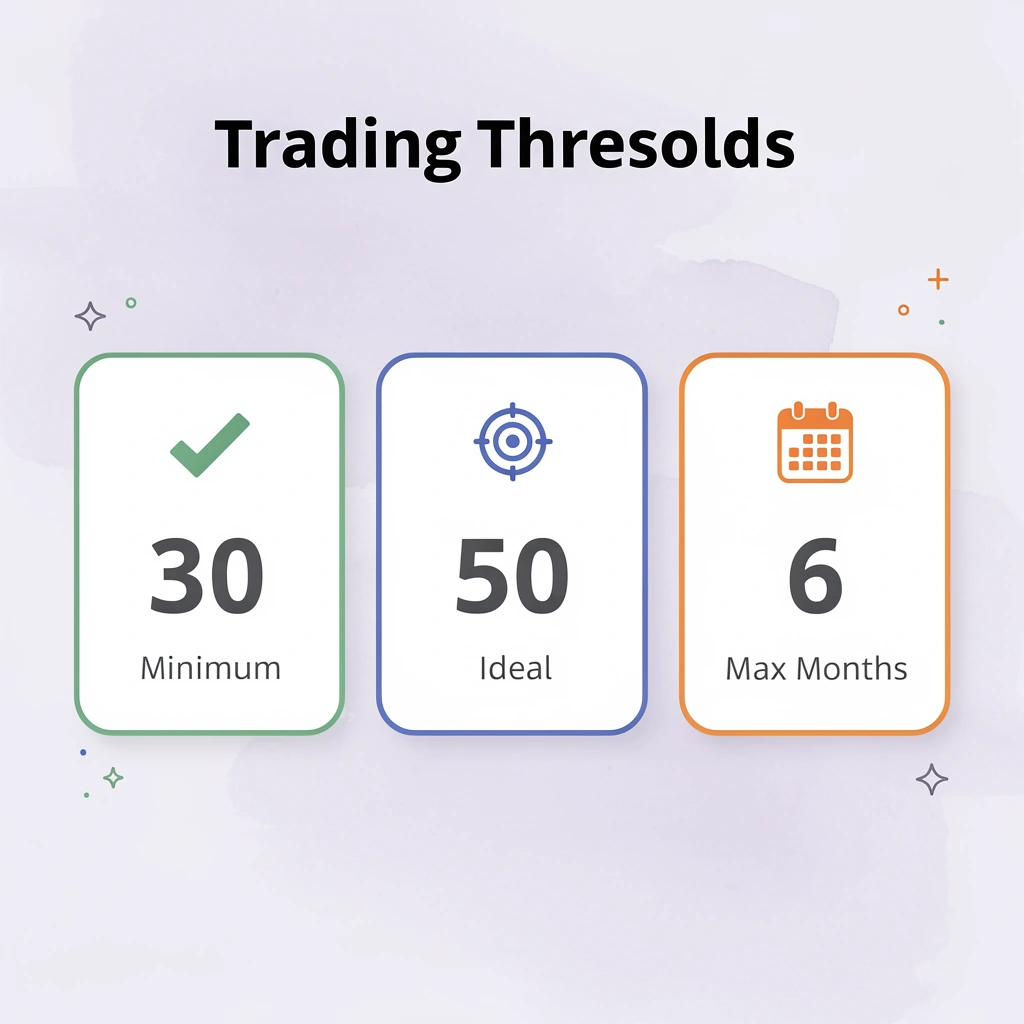
You need at least 30 trades before your results start to mean anything. The real threshold is closer to 50 trades across multiple market conditions. For a day trader, this might take three to six weeks; for a swing trader, three to six months. Calendar time doesn't matter—trade count and market regime coverage do.

🎯 Key Point: The number of trades executed matters more than the time period when evaluating strategy performance.
"You need at least 30 trades before your results start to mean anything, with the real threshold closer to 50 trades across multiple market conditions."
Trading Style — Minimum Trades — Time Required
- Day Trading
- 30-50 trades
- 3-6 weeks
- Swing Trading
- 30-50 trades
- 3-6 months
⚠️ Warning: Focusing on calendar time instead of trade count and market regime coverage can lead to premature strategy conclusions.

Why do most traders ignore statistical significance?
Research based on the central limit theorem shows that fewer than 30 trades produce performance metrics dominated by random chance rather than genuine skill. Small samples create false confidence through small-sample variance, where luck masquerades as consistent performance.
With 20 trades, a single outlier win or loss swings your profitability by 15% or more, making it impossible to know whether your strategy works or you caught a favorable week.
How many test periods does Forward Testing Trading require?
A 2015 study from University College London found that to be 80% sure you detected a real small advantage, you need around 540 independent test periods.
Even with 34 periods, the statistical strength was only 12%, meaning short forward tests yield unreliable results prone to false positives. The answer to how long to test isn't about time—it's about achieving a large enough sample size so that normal market changes stop obscuring your real advantage.
Why do market conditions affect Forward Testing Trading results?
Making 50 trades in two weeks proves little if all of them occurred during a trending market, and your strategy depends on volatility breakouts. Markets cycle through trending, ranging, and high-volatility phases, each exposing different weaknesses in signal generation, risk management, and execution timing.
A strategy that looks unbeatable during a quiet range-bound period falls apart when volatility spikes and spreads widen. Extend your test until the sample includes at least one full cycle of each regime, tracking not just trade count but the diversity of conditions your strategy faced.
How does regime bias impact Forward Testing Trading accuracy?
Short tests conducted under favorable conditions introduce bias into the results, as findings often fail to hold when markets change. Your strategy's advantage may depend on specific situations such as low volatility or clear directional trends, and testing only in those periods produces overly optimistic results.
Testing across many different situations shows whether your strategy can adapt or breaks when conditions change: the difference between something that works in theory and something that works in practice.
How does forward testing trading reveal execution realities?
Real-time factors like slippage, partial fills, and execution delays only become apparent after numerous trades. After 30 or 40 trades, patterns become clear: you'll notice if fills consistently lag signals during volatile periods or if news events trigger stop hunts that invalidate risk rules.
Emotional fatigue and execution drift only become clear after enough repetitions. Our simulated capital environment at Goat Funded Trader allows traders to forward-test with real market conditions without personal financial exposure, surfacing these execution realities before capital deployment.
Why do funded trading platforms improve forward-testing trading outcomes?
The traditional path forces traders to risk their own money during testing, introducing psychological pressure that distorts decision-making and shortens test durations. Our Goat Funded Trader program lets traders reach the necessary 50+ trade threshold across multiple regimes while maintaining discipline, since the capital at risk isn't their own savings.
Once the strategy demonstrates consistent profitability through our challenge process, traders access funded capital with profit splits reaching 100%, transforming the learning phase into a viable pathway.
How does iterative review prevent Forward Testing Trading problems?
Look at your results after every 20 to 30 trades to find patterns and improve your rules without overfitting to recent outcomes. If your win rate drops during the first hour after market open, that's useful information—but only if you've recorded enough trades in that period to trust the pattern.
Regular review prevents small problems—such as a missed stop-loss or an overly active entry filter—from becoming major issues when trading with real money.
What separates successful Forward Testing Trading transitions?
What separates traders who successfully move to funded accounts from those who repeatedly retake the test comes down to how they interpret results and what they do next.
Related Reading
- Crypto Trading For Beginners
- Fear Of Missing Out And Trading
- Discipline In Trading
- Common Forex Trading Mistakes Beginners
- Trading Risk Management 1% Rule Explained
- Risk Management Day Trading
- Crypto Trading Risk Management
- ICT Trading Strategy For Beginners Step By Step
- Trading Risk Management Strategies
- Algorithmic Trading Risk Management
How to Forward Test a Trading Strategy Effectively
Forward testing requires structure, consistency, and discipline: not simply opening a demo account and placing trades. The goal is to determine whether your strategy delivers reliable results under real market conditions before risking real money, not to prove it wins every trade.

🎯 Key Point: Forward testing is about validating your strategy's consistency over time, not achieving a perfect win rate. Focus on risk-adjusted returns and drawdown management rather than individual trade outcomes.
"Forward testing is the bridge between backtesting theory and live trading reality—it reveals how your strategy performs when market conditions actually matter." — Trading Psychology Institute, 2023

⚠️ Warning: Many traders rush into live trading after just 2-3 weeks of forward testing. Proper validation requires at least 3-6 months of consistent data across different market conditions to identify true performance patterns.
Forward Testing Phase
Initial Validation
Duration
4-6 weeks
Key Focus
Basic strategy mechanics
Market Condition Testing
Duration
8-12 weeks
Key Focus
Performance across volatility
Final Assessment
Duration
12-24 weeks
Key Focus
Risk management validation

Prepare Your Trading Playbook First
Before you start, develop a clear, detailed set of rules covering entry and exit criteria, position sizing, risk management, and trade management. This documented playbook eliminates confusion during testing and ensures every decision follows your intended logic.
Choose the Right Platform and Broker
Pick a trusted demo or paper trading account that mirrors your planned live broker's spreads, execution speed, and available instruments. Focus on platforms that offer dependable real-time data feeds and comprehensive trade logging. This replicates actual trading conditions and helps you identify platform-specific issues that could affect profitability with real money.
Set Up a Realistic Trading Environment
Set up your demo account with the same starting capital, leverage, and assets you plan to use in live trading. Use the same trading hours and avoid artificial advantages like faster data or perfect prices. This realistic setup reveals how your strategy actually performs, including the emotional challenge of watching profits and losses fluctuate.
Execute Trades Strictly According to Your Rules
Enter and exit every position exactly as your playbook specifies when signals appear, without making your own choices. Use consistent position sizing and stop placement. This discipline trains your execution and reveals whether the strategy generates actionable signals in the current market.
Maintain a Detailed Trading Journal
Write down every trade you make: when you entered and exited, why you made the trade, what the market was doing, how you felt, and what happened. Note any slippage or surprises. Review your journal regularly to compare your real trades against backtest results. Identify patterns in failures and strategy weaknesses. This record reveals exactly what needs fixing before trading with real money.
Track Key Performance Metrics
Monitor key metrics such as win rate, profit factor, maximum drawdown, and risk-reward ratio. Account for commissions and slippage in your numbers. Analyze how results perform across different market conditions to ensure your strategy is robust. These metrics reveal whether you need adjustments to align your strategy with actual trading outcomes.
Review Results and Iterate Before Scaling
After you collect enough trades, assess your performance against your goals and adjust your rules or risk parameters as needed. Test again if necessary. This step-by-step approach ensures your strategy evolves properly and creates a strong foundation for confident live trading.
Forward testing turns theoretical strategies into proven systems ready for live markets. Follow these steps on your chosen platform to trade with verified execution and a deeper understanding of the market.
When to Transition From Forward Testing to Live Trading a Strategy
Every trader faces the same decision: keep testing or start trading with real money. Move too soon, and you risk real money on an unproven strategy. Wait too long, and endless testing prevents progress. The right time to switch comes when you have enough evidence to feel confident—trading with real money should feel like the next logical step, not a leap of faith.

🎯 Key Point: The transition from forward testing to live trading isn't about timing the market—it's about having sufficient data to make an informed decision about your strategy's real-world performance.
"The biggest mistake traders make is either jumping into live trading too early without proper validation, or getting stuck in analysis paralysis and never making the leap." — Trading Psychology Research, 2023
⚠️ Warning: Overconfidence from limited forward testing results can lead to significant losses when market conditions change. Always ensure your testing period covers different market environments before risking real capital.
Achieve Sufficient Trade Samples
Collect 20–100 trades while forward testing, depending on your strategy's trading frequency. This sample size ensures that your results reflect genuine skill rather than luck and that they cover the varied market conditions your system will encounter in live trading.
Confirm Consistent Performance Metrics
Check that important metrics like win rate, profit factor, maximum drawdown, and risk-reward ratio closely match backtest expectations after accounting for real slippage and commissions. Strong alignment across these metrics confirms the strategy works with current market dynamics and delivers sustainable results before deploying real money.
Demonstrate Flawless Rule Adherence
Follow every signal exactly according to your documented rules throughout the forward test, with no choices based on feelings or personal judgment. High adherence rates demonstrate discipline under live pressure and confirm the strategy creates clear, actionable setups in real time.
Experience Varied Market Conditions
Test your strategy across trending, ranging, volatile, and low-liquidity environments to ensure it is strong and reliable. Strategies that work well in one market type often fail in others. Testing across different market conditions confirms that your approach can adapt, reveals what parameter changes you need, and ensures your strategy handles real market conditions rather than succeeding by chance.
Evaluate Personal Psychological Readiness
Look at how you feel during forward testing: how you handle losing periods, winning periods, and surprising events without changing your plan. Strong mental consistency shows you're ready for live trading, where real money increases pressure and tests whether you've truly learned the process.
Start Small and Scale Gradually
Start with small position sizes while comparing live results to forward test data. Positive alignment at a small scale builds confidence and enables quick adjustments if problems arise. This protects your capital and extends validation into live trading.
Moving to live trading at the right time ensures that your strategy has been proven under real-world conditions. Follow your platform's criteria, review your journal carefully, and start live trading with a verified edge.
How Goat Funded Trader Helps Traders Transition From Forward Testing to Live Trading
Forward testing proves your strategy works, but risking real money creates a paralyzing gap. You've validated the edge and confirmed the win rate, yet funding an account with your savings feels like standing at the edge of a cliff. Goat Funded Trader eliminates that barrier by providing simulated capital up to $2 million, letting you execute your proven strategy without personal financial exposure while earning real profit splits up to 100%.

🎯 Key Point: The transition from forward testing to live trading represents the biggest psychological hurdle most traders face, even with a validated strategy.
"Goat Funded Trader provides simulated capital up to $2 million, enabling traders to execute proven strategies while earning real profit splits up to 100% without personal financial risk."

🔑 Takeaway: Prop trading firms like Goat Funded Trader bridge the critical gap between strategy validation and real money execution, transforming forward testing success into live trading profits without the capital requirements that typically prevent most traders from scaling their proven systems.
Evaluation Phases Replace the Capital Bottleneck
Personal demo accounts limit trading volume and make it difficult to set up meaningful trades. A $5,000 demo balance forces you to wait weeks for sufficient price movement to capture 50 trades across trending and ranging markets. Our evaluation accounts provide upfront simulated capital, with funding opportunities up to $2,000,000, according to Goat Funded Trader. You can generate larger sample sizes faster, test across FX pairs, stocks, ETFs, and crypto simultaneously, and move to funded status without artificial balance constraints.
Transparent Rules Build the Discipline Forward Testing Can't
Testing trades without real consequences lets emotions take over after three losing trades: you overtrade to recover or skip setups matching your plan. Writing down trades in a spreadsheet and hoping discipline carries over to real trading falls apart under pressure when actual money is involved. Hesitation replaces quick action, and good results never turn into steady income. Our Goat Funded Trader platform enforces strict risk rules (3% daily drawdown, 6% maximum loss) and uses automated monitoring to flag violations instantly. You either follow the plan or fail the evaluation, forcing behavioral consistency that personal demos never require.
Funded Accounts Turn Metrics Into Payouts
You've hit your profit target in forward testing three months in a row, but those numbers stay hypothetical until you risk capital. Starting with $500 in personal savings limits the position size so severely that even perfect execution generates only $40 per month, barely covering platform fees. Goat Funded Trader grants access to funded accounts after you pass evaluation phases with 10% profit targets, then pays you 80% to 100% of profits via bi-weekly or on-demand withdrawals. Traders report payouts within 24 to 48 hours, with over $20 million distributed to 250,000+ participants worldwide, transforming validated performance into tangible income.
How does scaling work without personal risk in forward testing trading?
Most traders assume growth requires reinvesting personal savings after each profitable quarter, limiting expansion to their available capital. Goat Funded Trader takes a different approach by helping successful traders scale from small evaluation accounts to $2 million in simulated capital, requiring only consistent rule-following and profitability.
You start with a manageable evaluation size, prove your trading edge under transparent conditions, then access institutional-level position sizes while maintaining the same risk parameters. The firm absorbs losses, you keep the majority of gains, and your income potential expands without requiring additional capital.
What separates successful forward testing trading from strategy validation?
The real test isn't proving your strategy works; it's proving you can execute it when the pressure is on, and the money feels real.
Get 25-30% off Today - Sign up to Get Access to Up to $800K Today
You've built your strategy, tracked results, and proved your edge through testing. The last thing you need is to risk your own money or stay stuck in endless testing. Goat Funded Trader offers a smarter way: access to simulated funding and a structured environment for traders ready to move forward. Our evaluation models let you prove your consistency, trade with simulated capital up to $2 million through scaling opportunities, and earn rewards based on performance. With fast reward processing, multiple funding pathways, and no personal liability for losses within our program, Goat Funded Trader turns preparation into opportunity.

🎯 Key Point: Access up to $2 million in simulated trading capital without risking your personal funds or getting stuck in perpetual testing cycles.
"With fast reward processing, multiple funding pathways, and no personal liability for losses within our program, traders can focus on performance without financial stress." — Goat Funded Trader Program Benefits

💡 Tip: Visit Goat Funded Trader today, select your funding model, and transition from testing to trading with confidence.
Related Reading
- How To Read Crypto Charts For Day Trading
- How To Make Money Trading Crypto
- Best Stock Trading App For Beginners
- Best Crypto Trading App
- How To Learn Crypto Trading
- Risk Management In Stock Trading
- Best Day Trading App For Beginners
- Best Demo Trading Account
- How Do You Manage Risk In Futures Trading
- Best Trading Apps For Beginners
Be Great and get the App