






Paper Trading vs Live Trading: 7 Key Differences Explained
Paper Trading vs Live Trading differ in 7 crucial ways. Goat Funded Trader reveals which approach builds real profits and trading skills.


How to Use AI for Crypto Trading? Traders often discover that profitable demo accounts quickly turn into losing live accounts within days of switching to real money. The gap between paper trading and live trading has derailed more aspiring traders than any market crash, yet most beginners don't understand the critical differences that cause this dramatic shift. Seven key distinctions separate simulated trading from live market execution, and understanding these differences helps traders practice safely before risking their own capital.
Smart traders bridge this dangerous gap by starting with structured evaluation programs that mirror real market conditions without the emotional weight of personal losses. These programs provide accountability and genuine performance standards while protecting traders from costly mistakes during the learning phase. Traders seeking this balanced approach often turn to a prop firm that offers risk-free practice combined with realistic trading discipline requirements.
Summary
- Paper trading success doesn't predict live trading performance because simulation removes the emotional friction that defines real trading. Platforms deliver idealized fills that ignore slippage and liquidity constraints, creating false confidence in strategies that fail under actual market conditions. Alpaca's research shows paper trading accounts generate returns 3 to 5 times higher than live accounts, not because traders suddenly lose skill, but because real capital activates fear and greed that override logical execution.
- The transition from simulation to live capital destroys more traders than any single market event. Beginners often experience significant drawdowns within weeks of switching to real money, even after months of profitable paper trading. The gap exists because no amount of virtual practice can replicate the psychological pressure of watching your rent money evaporate in seconds, and most traders underestimate how profoundly that pressure alters decision-making until it's too late.
- Ninety percent of traders lose money in their first year, largely because they move to live trading before building genuine execution discipline. The problem isn't insufficient practice time. Traders approach simulation with the wrong goal, paper trading until they see green numbers rather than using repetition to identify and correct specific behavioral patterns. When you enforce strict position sizing, realistic commission structures, and mandatory trade journaling in simulation, you're rewiring decision-making patterns that survive emotional pressure.
- Order execution realism separates useful practice from wasted time. Many simulators deliver perfect fills that ignore how position size affects execution quality or how volatility creates slippage during fast markets. Traders who practice exclusively in these environments face brutal surprises when live orders slip past intended prices or partially fill during volatile moments, forcing sudden strategy recalibration under emotional duress when the stakes are highest.
- Structured evaluation programs that mirror live market conditions without risking personal capital solve the transition problem most traders face. When traders prove consistency under clear risk parameters with significant simulated capital, they build the mental discipline needed for funded performance without the financial devastation that comes from premature live trading. Data show that 90% of traders who successfully complete structured evaluation processes transition to funded accounts, compared with the vast majority who fail when risking personal savings too early.
- Goat Funded Trader addresses this gap by providing evaluation accounts with up to $400,000 in simulated capital that scales to $2 million, where traders follow the same risk parameters they practiced in paper trading, but now performance unlocks funded status and real payouts up to 100%.
What Is Paper Trading and How Does It Work?
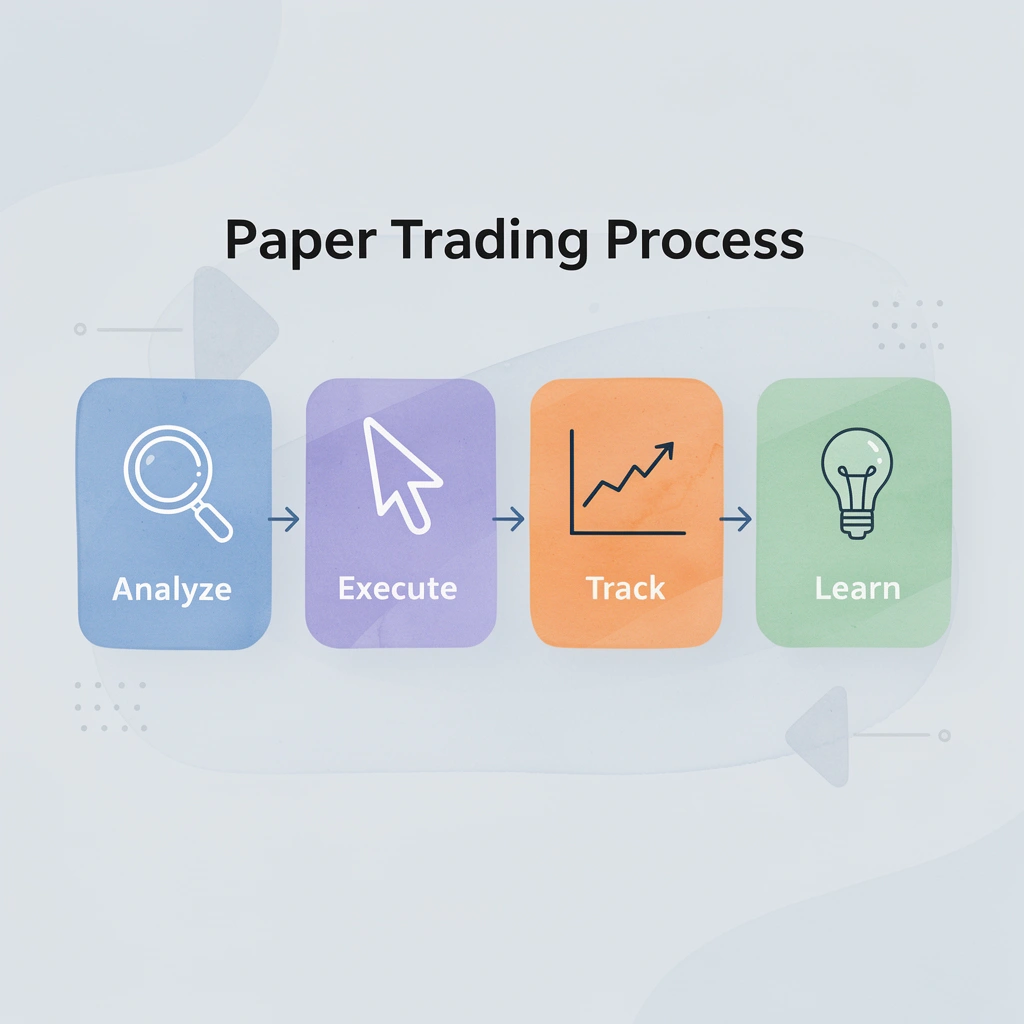
Paper trading is the practice of trading where you execute buy and sell orders using real-time market data without spending actual money. You analyze markets, place trades, manage positions, and track profits and losses as you would in a real account, but without real money at risk. This allows you to build practical skills and confidence while refining your trading approach.
🎯 Key Point: Paper trading provides a risk-free environment to test trading strategies and develop market intuition before committing real capital to the markets.

💡 Example: A beginner trader might use paper trading to practice day trading strategies for 30 days, tracking their hypothetical returns and identifying common mistakes before opening a live trading account.
Paper Trading Components Description
Market Analysis
Study real-time charts and price movements
Order Execution
Place buy/sell orders without actual money
Position Management
Track open trades and portfolio performance
P&L Tracking
Monitor profits and losses from simulated trades
"Paper trading allows traders to gain valuable experience and test strategies without the emotional pressure and financial risk of real money trading." — Trading Education Research, 2024
How Paper Trading Platforms Operate
You open a paper trading account or simulator on a brokerage platform with a virtual starting balance. TradeZero offers $1,000,000 in virtual funds and sets up accounts in less than 1 minute. You then analyze markets, select assets, choose order types such as market, limit, or stop-loss, and execute trades. The platform processes orders against live or near-live prices, updates positions, calculates performance metrics in real time, and logs all results for review.
Setting Up Your First Paper Trading Account
Pick a trusted platform with strong simulation tools from a well-known brokerage. Enable paper trading mode, configure your fake money and layout to match your real trading setup, and test charts, watchlists, and order entry features. Treat this setup as seriously as if you were depositing real money. This builds good trading habits from the start.
Testing Strategies Without Financial Risk
Identify specific approaches that match your goals, whether day trading momentum stocks, swing trading based on technical indicators, or longer-term position strategies. Define clear rules for entries, exits, position sizing, and risk management, such as risking no more than 1% of your virtual portfolio per trade.
Apply these rules consistently across different market conditions to gather reliable data on what performs best for your style. Enter trades based on your analysis, specifying quantity, order type, and protective stops, then observe how slippage, spreads, and volatility affect outcomes in real time.
Why doesn't paper trading success guarantee live trading results?
Paper trading success doesn't automatically translate to live trading success. Beginners often experience significant losses when transitioning to live trading in the first few weeks, even after months of simulated practice. The absence of real money consequences fails to prepare traders for the emotional impact of actual losses.
90% of traders lose money in their first year, often because they underestimate the gap between simulated confidence and real-market discipline.
How can funded trading programs bridge the paper trading vs live trading gap?
Platforms like Goat Funded Trader close this gap by offering simulated trading accounts with up to $2M in capital. Our platform lets you prove consistent trading ability in a risk-free environment before accessing real capital and earning profit splits up to 100%. This model rewards skill over personal savings, transforming paper trading into a genuine income opportunity.
You show discipline under evaluation conditions that mirror live markets, then withdraw actual earnings whenever you want without risking your own funds. But proving consistency in simulation is only half the equation; the transition to live capital reveals challenges most traders never anticipate.
Related Reading
- How to Use AI for Crypto Trading
- What Are Crypto Trading Signals
- How Long Does It Take To Learn Forex Trading
- What Is Spot Trading in Crypto
- Is Paper Trading Real Money
- Emotional Trading Mistakes
- Common Mistakes in Stock Trading
- Crypto Trading Mistakes
- Forward Testing Trading
- Risk Reward Ratio Trading
What Is Live Trading and How Does It Work?
Live trading uses your real money in the market. You place orders that execute through real exchanges, matched with counterparties at prevailing prices, and your account balance changes instantly with every fill. Unlike simulation, slippage occurs when rapid price movement or thin liquidity causes your execution price to differ from what you saw on screen. Spreads widen during volatile periods, and commissions reduce your net return. These frictions add up quickly enough to turn a winning strategy on paper into a break-even or losing one in reality.
💡 Key Point: The biggest difference between live trading and paper trading isn't psychological—it's the real market frictions that can erode profits before you even realize it.
⚠️ Warning: Many traders underestimate how slippage and spread costs can transform a profitable demo account into consistent losses when trading live.
"Market frictions in live trading environments can account for 2-5% of total trading costs, significantly impacting strategy performance compared to simulated conditions." — Market Structure Research, 2023
Live Trading Element: Real money execution
- Impact on Performance: Immediate P&L changes
Live Trading Element: Slippage
- Impact on Performance: Price differences from screen to fill
Live Trading Element: Spread widening
- Impact on Performance: Higher costs during volatility
Live Trading Element: Commissions
- Impact on Performance: Direct reduction in net returns

How Real Orders Execute
You analyze live data, identify a setup, and submit your order through a brokerage platform connected to exchange feeds. Market orders are filled immediately at the best available price, which may differ from your quote by several ticks during rapid price movement. Limit orders wait in the queue until the price reaches your level, but you risk missing the trade if momentum shifts before your order is filled. Stop orders activate after the price crosses your trigger, converting to market orders that execute at the next available price, sometimes far from your expectation during gaps or periods of low liquidity.
Managing Positions Under Pressure
Once filled, monitor the position in real time and enforce your stop-loss without hesitation. Research from Alpaca shows paper trading accounts deliver 3-5x higher returns than live accounts because simulated environments don't trigger the fear that prompts early exits or the greed that leads to holding too long. Real money activates emotional circuits that override logic. Exit according to plan—at your profit target or when conditions invalidate your thesis—but the discipline required to execute that plan under pressure is something no simulation can replicate.
How does emotional intensity differ between Paper Trading vs Live Trading?
Fear and greed emerge the moment your money is at risk. A losing trade tempts you to exit early, to protect what remains, even when your plan says to hold. A winning trade tempts you to let it run past your target, hoping for more. Teams report that the hardest part of live trading isn't finding setups but sticking to predefined rules when emotions scream otherwise.
What strategies help manage the psychological transition?
Starting with small position sizes reduces emotional intensity enough to build resilience through repetition. You learn to execute consistently not by feeling less, but by acting despite what you feel.
Proving you can execute a strategy in simulation doesn't answer the question that determines long-term success.
Is Paper Trading Worth It for Traders?
Paper trading is worth it when you treat it as a way to build skills, not as a test to make money. Most traders who skip this step fail not because they lack intelligence, but because they never develop the habit of following their plan with discipline before real money amplifies their emotions.
🎯 Key Point: The primary value of paper trading isn't about proving profitability—it's about developing the psychological discipline and systematic approach that separates successful traders from those who blow up their accounts.

"95% of day traders lose money, and the majority never practiced with paper trading long enough to develop proper risk management habits." — Financial Industry Research, 2023
Paper Trading Benefits
- Zero financial risk
- Focus on strategy
- Build discipline habits
- Test multiple approaches
Real Trading Risks
- Real money loss
- Emotional decision-making
- Panic under pressure
- Costly trial and error

⚠️ Warning: Many traders make the mistake of rushing into live trading after just a few weeks of paper trading. The real benefit comes from practicing until your trading plan execution becomes automatic, which typically takes 3-6 months of consistent practice.
How does paper trading expose flaws before they cost money?
Paper trading reveals problems in your process before they cost real money. When you complete 100 simulated trades and document every decision, you build a collection of data showing where your strategy fails, where your risk management breaks down, and which market conditions trigger poor choices.
A 2010 study in the American Journal of Business Education tracked 61 students across different class levels using a nine-week equity trading simulation with delayed real market prices. Tests before and after the simulation showed an average 14-point improvement out of 100 on investment fundamentals knowledge. Sixty-six percent of participants found the simulation effective for increasing their knowledge, while 86 percent reported greater interest in investments and equity markets. These gains were especially strong for students with limited previous experience.
Research in the Journal of Business and Behavioral Finance found that traders who used simulators seriously developed better baseline habits and were more likely to open live accounts. A 2018 analysis of financial market trading simulations in college settings found online students showing average score gains of 83 percent. The interactive environment requires active use of concepts, strengthening brain pathways for analysis and execution more effectively than passive study.
What behavioral patterns does paper trading vs live trading reveal?
The real value emerges when you use that practice to identify specific behavioral patterns that need correction. If you can't follow your rules with fake money, you won't follow them when your rent payment is at stake.
Why Most Paper Traders Fail to Benefit
Traders approach simulation with the wrong goal. They paper trade until they see green numbers, then declare themselves ready for live markets. That's like practicing free throws until you make ten in a row, then assuming you can perform under playoff pressure. Paper trading's value lies in repetition under realistic constraints, not the accumulation of virtual profits. Strict position sizing, realistic commission structures, and mandatory trade journaling rewire decision-making at a neurological level. Skip those constraints, and you're watching numbers move without building the skills that matter.
The Path From Simulation to Real Capital
Traditional trading advice says you must risk your own money to learn. Platforms like Goat Funded Trader evaluate traders through simulated challenges and then provide access to capital of up to $2M based on demonstrated skill rather than personal wealth. Traders who pass the evaluation earn profit splits up to 100% without risking their savings. The conventional path of depositing $5,000 and hoping to survive long enough to learn creates unnecessary financial pressure that erodes discipline rather than sharpening it.
What the Data Shows About Simulation Effectiveness
Bookmap's analysis shows that 90% of traders lose money, with most failures stemming from live trading without adequate preparation. Survivors aren't necessarily smarter; they built execution discipline through deliberate practice before emotions took hold. Weekly reviews of simulated trades and adjustments based on recurring mistakes compress years of costly lessons into months of focused learning. Simulation works because feedback loops are immediate and consequence-free, enabling rapid iteration that live trading with limited capital cannot match.
How to Extract Maximum Value
Treat every paper trade as if real money depends on it. Set a virtual account size matching your intended live trading amount, enforce the same risk-per-trade limits, and document why you made each trade and what you felt when you executed it.
Review your journals weekly to spot patterns, such as consistently exiting winning trades too early during volatility spikes. This behavioral pattern can be addressed through focused practice before it costs real money. The traders who benefit most from simulation aren't those who paper-trade the longest, but those who use it to build self-awareness of their decision-making under specific conditions.
When should you transition from paper trading to live trading?
But understanding why paper trading is valuable doesn't answer the harder question: how do you know when you're ready to stop simulating and start trading for real?
Related Reading
- Crypto Trading For Beginners
- Fear Of Missing Out And Trading
- Discipline In Trading
- Common Forex Trading Mistakes Beginners
- Trading Risk Management 1% Rule Explained
- Risk Management Day Trading
- Crypto Trading Risk Management
- ICT Trading Strategy For Beginners Step By Step
- Trading Risk Management Strategies
- Algorithmic Trading Risk Management
Paper Trading vs Live Trading: 7 Key Differences
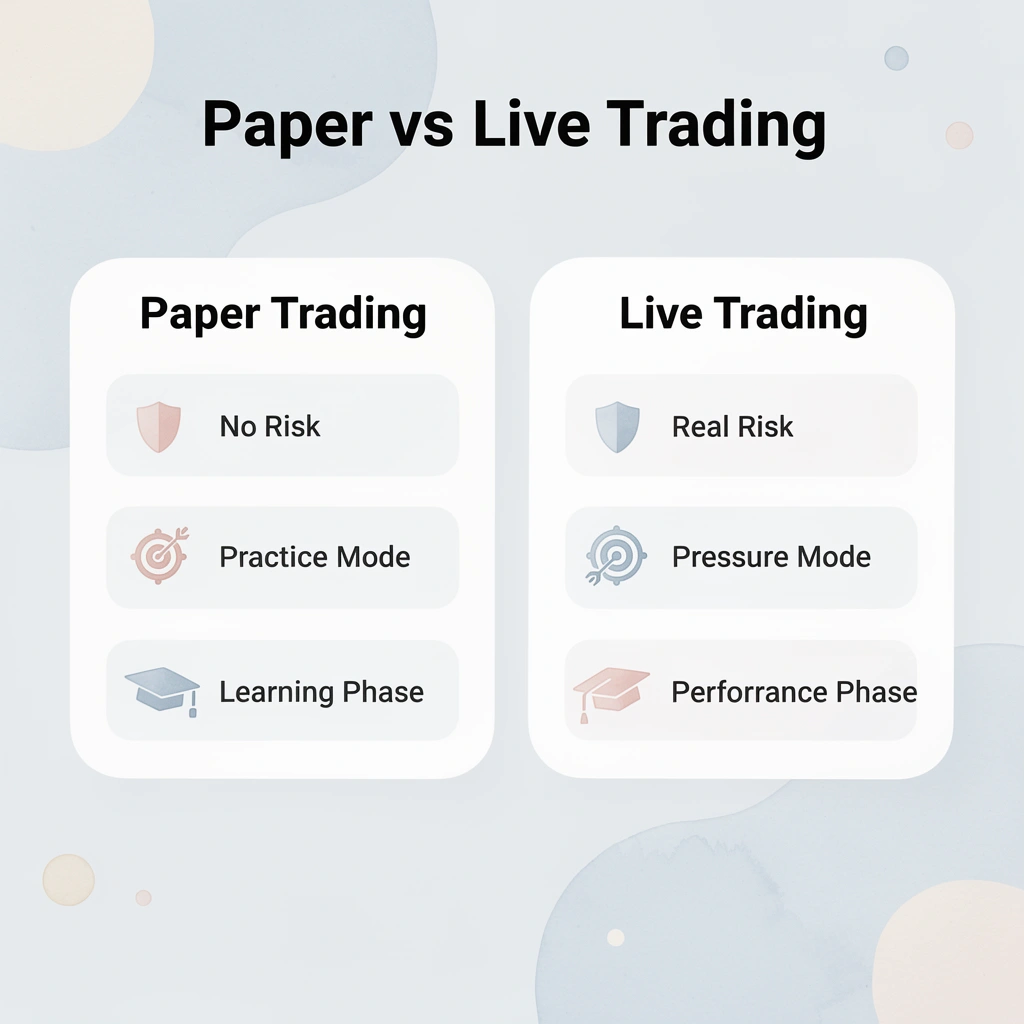
Paper trading and live trading both involve analyzing charts, placing orders, and monitoring positions. The crucial difference: paper trading protects your wallet, while live trading puts real money on the line. Understanding these 7 key differences helps traders choose the right environment for learning, testing strategies, and building consistency before stepping into real markets.
Paper Trading
- ✅ Risk-free learning
- ✅ Perfect execution
- ❌ No emotional pressure
- ❌ Unlimited capital
- ✅ Strategy testing
- ❌ No real profits
- ✅ Instant fills
Live Trading
- ❌ Real financial risk
- ❌ Slippage & delays
- ✅ Real psychological stress
- ✅ Limited account size
- ✅ Real market validation
- ✅ Actual returns
- ❌ Market conditions apply
🎯 Key Point: The biggest difference isn't technical—it's psychological. Paper trading eliminates the fear and greed that drive most trading mistakes.
"The transition from paper trading to live trading reveals that 90% of trading success is mental, not technical." — Trading Psychology Studies
⚠️ Warning: Paper trading can create false confidence because it doesn't replicate the emotional stress of risking real money. Many strategies that work on paper fail when real capital is at stake.

1. Financial Risk Exposure
Paper trading protects your money by using fake money with no real consequences. Live trading puts every real dollar at risk, where mistakes directly reduce your account balance and financial security. This difference forces live traders to learn and follow risk management rules that simulations rarely enforce with the same rigor.
2. Emotional and Psychological Demands
Paper trading creates a detached environment where decisions feel calm and objective because nothing personal is at stake. Live trading heightens fear of loss and greed during wins, often leading to rule-breaking behaviors such as moving stops or chasing entries. Real money activates survival instincts, transforming disciplined paper plans into reactive live decisions.
3. Order Execution Realism
Paper trading gives you fills almost immediately at quoted prices. Live trading differs because you encounter slippage, partial fills, and delays when your order meets real market participants and liquidity pools. This gap exists because real markets operate differently: supply, demand, and algorithms determine final prices rather than the assumptions the simulator makes.
4. Impact of Trading Costs
Paper trading platforms typically ignore or reduce commissions, bid-ask spreads, and other fees. Live trading incurs these costs on every round-trip trade, which accumulate over time and erode profits even from winning strategies. Real brokerage structures and exchange fees that simulations overlook can transform paper gains into smaller or negative live results.
5. Market Impact and Liquidity Effects
Paper trading ignores how your positions affect broader market dynamics because virtual orders do not interact with real order books. Live trading with larger sizes can move prices in thinly traded assets or face liquidity constraints that prevent ideal entries and exits.
6. Access to Corporate Actions and Instruments
Paper trading often omits or simplifies corporate actions like IPOs, dividends, stock splits, and certain derivatives because simulators operate outside the actual clearing houses and exchange rules that govern real-world events. Live trading lets you fully participate in these events with real settlement and adjustments.
7. Performance Feedback and Long-Term Results
Paper trading shows good results because conditions are perfect. Live trading reveals what actually happens: true win rates, drawdowns, and consistency after accounting for all costs. This provides real data for strategy refinement. Live results expose complete market interactions, psychological adherence, and cumulative costs that simulations cannot fully replicate.
When to Transition From Paper Trading to Live Trading
Every trader eventually asks: "Am I ready to trade with real money?" Staying in paper trading forever limits growth, but moving too soon puts your money at risk from mistakes you haven't learned to manage. The transition to live trading requires preparation, consistency, and proof that your process works under controlled conditions, not confidence alone.

🎯 Key Point: The decision to move from paper trading to live trading should be based on measurable performance metrics and emotional readiness, not just a feeling that you're ready to make real money.
"95% of traders who rush into live trading without proper preparation lose money in their first 6 months of real trading." — Trading Psychology Institute, 2023
⚠️ Warning: Many traders make the mistake of transitioning to live trading after just a few winning weeks in paper trading. This premature move often leads to significant losses when real emotions and money pressure enter the equation.
Achieve Consistent Profitability Over Time
Only move forward after you show steady positive results in your simulator across different market conditions for at least three to six months. This timeframe lets you experience bull runs, bear markets, sideways action, and news-driven volatility, ensuring your strategy demonstrates true reliability rather than luck.
Track metrics such as win rate, risk-reward ratio, and overall returns weekly. Consistency here shows your process works regardless of external noise.
Master Your Trading Plan and Risk Rules
Your written trading plan must guide every decision during the simulation, without exception, including exact entry and exit criteria, position sizing based on account risk, and strict use of stop-loss orders. Deep familiarity with these rules transforms them into automatic habits that carry over to live trading.
Review your journal regularly to confirm that you follow the plan during periods of weight loss. This discipline separates successful transitions from emotional blowups when real money is at stake.
Demonstrate Emotional Control in Simulation
Show that you can make calm decisions when you win and lose in the practice account. The simulation should mirror your real risk levels so you experience realistic losses and pressure that test whether you can stick with your plan.
Traders who cut losses quickly, let winners run according to plan, and avoid revenge trading in practice sessions build the mental strength needed for real markets. This prevents the shock that comes when actual money triggers stronger fear or greed.
Validate Performance with Realistic Parameters
Include real-world costs like commissions, spreads, and slippage in your simulator so your results reflect actual trading conditions. Your profits must remain strong after accounting for these costs over time.
Detailed performance reviews should show what you do well and identify recurring problems. This ensures your edge persists when you begin live trading and encounter slippage and changing fill prices.
Start Small and Monitor the Transition Closely
Fund your live account with money you can afford to lose and start with small position sizes that match the risk parameters you proved work in the simulator. Keep a paper account running simultaneously to test new ideas while you adjust to the emotions of real market trading.
What should you monitor during your first live trades
Look at your first real trades and compare them to your journal. Find places where you made different choices because of stress or emotions. Once your real results match your practice results, you can feel confident trading with more money.
When is the right time to make the transition from paper trading vs live trading?
Switch to live trading when your simulator demonstrates consistent profitability, rule adherence, and emotional discipline under pressure. Choose a platform like Goat Funded Trader that streamlines the transition from practice to real trading.
How Goat Funded Trader Helps Traders Transition From Paper Trading to Live Trading
You've spent weeks practicing with virtual money, refining entries, testing stop-loss levels, watching your simulated balance grow. Then comes the moment to trade with real money, and every decision feels heavier. Your hands hesitate before clicking the order button. You second-guess setups that looked perfect in simulation. Goat Funded Trader solves this by creating a structured bridge between paper trading and live performance, where you trade the firm's capital instead of risking your own savings, building confidence through accountability rather than fear.

🎯 Key Point: The psychological gap between paper trading and live trading can derail even the most technically prepared traders, making funded trading programs essential for smooth transitions.
"The transition from demo to live trading is where 90% of traders fail, not due to lack of skill, but due to psychological pressure." — Trading Psychology Institute, 2023

💡 Tip: Goat Funded Trader's evaluation process mimics the emotional intensity of live trading while using the firm's capital, allowing you to develop real market psychology without the devastating financial risk to your personal accounts.
Financial Risk Exposure
Paper trading removes personal financial risk, while live trading puts every dollar at stake, creating fear for most traders as they move from simulation to self-funded accounts. Goat Funded Trader removes this barrier with evaluation accounts that offer up to $400,000 in simulated capital, scaling to $2 million, governed by clear rules: a 3% maximum daily loss and a 6% overall maximum loss. You follow the same risk parameters as paper trading, but now performance unlocks funded status and real payouts; you keep up to 100%. Losses stay with the firm while profits become yours, turning practice into protected earnings without the emotional weight of personal ruin.
How does paper trading vs live trading affect your emotions?
Simulated environments lack the stakes that trigger fear and greed. Most traders discover this when their first live trade feels nothing like their hundredth paper trade, despite identical setups.
What bridges the gap between paper trading and live trading psychology?
Goat Funded Trader addresses this through structured challenges with meaningful consequences, a payout guarantee that delivers within 2 business days or adds an extra $1,000, and real accountability under live market conditions on MT5. You experience genuine pressure when managing significant capital, knowing that a blown challenge costs only the evaluation fee, not your life savings.
According to Goat Funded Trader, 90% of traders who complete their evaluation process successfully transition to funded accounts. The emotional resilience you develop translates directly to funded trading, where multiple successful withdrawals reinforce confidence through results rather than hope.
Order Execution Realism
Paper platforms give you perfect fills that don't match real market conditions. You practice with perfect execution, only to face real problems when live orders slip past your intended price or partially fill during volatile moments. Goat Funded Trader eliminates this disconnect by providing lightning-fast execution, raw spreads as low as 0.1 pips, and realistic market interaction in evaluation accounts that mirror funded conditions. You experience actual order-flow dynamics, learn how position size affects fills, and adjust strategies based on real-world friction before scaling to larger capital. The transition from challenge to funded account feels seamless because execution quality stays consistent, so your strategy calibration reflects true market behavior.
How do realistic trading costs affect Paper Trading vs Live Trading preparation?
Many simulators skip commissions, spreads, and instrument limits that would otherwise reduce real-world performance. Our Goat Funded Trader platform includes realistic cost structures during evaluation: 0% commissions on indices and cryptos, plus access to FX pairs, stocks, ETFs, and crypto pairs with full flexibility.
You learn to factor these costs into every trade during the challenge phase, identifying which strategies remain profitable after accounting for friction. This preparation ensures your net performance translates directly to higher take-home rewards when you reach funded status with Goat Funded Trader, with no hidden erosions or instrument surprises.
What about the costs and commitment of getting started?
But understanding how the transition works doesn't answer the question most traders ask themselves late at night: is the cost of getting started worth it, and what happens if you need to step away before you're ready?
Related Reading
- How To Learn Crypto Trading
- Best Demo Trading Account
- How Do You Manage Risk In Futures Trading
- Best Trading Apps For Beginners
- Best Crypto Trading App
- Best Day Trading App For Beginners
- How To Read Crypto Charts For Day Trading
- Risk Management In Stock Trading
- Best Stock Trading App For Beginners
- How To Make Money Trading Crypto
Get 25-30% off Today - Sign up to Get Access to Up to $800K Today
Every day you delay moving beyond paper trading, you're choosing safety over growth. The question isn't whether stepping away feels risky—it's whether staying where you are serves your goals or protects you from discovering what you're truly capable of.

Goat Funded Trader solves this problem by letting you prove your trading skills through structured evaluation programs instead of risking your own savings. You trade under clear rules that encourage discipline, consistency, and proper risk management across multiple markets: Forex, cryptocurrencies, commodities, indices, and metals. Strong performance leads to funded opportunities, profit-sharing potential up to 100%, and scaling plans designed to help you grow without depleting your bank account.
🎯 Key Point: The challenges discussed throughout this article all have solutions. Struggling to move beyond paper trading? Our Goat Funded Trader evaluation program provides a clear pathway forward. Worried about risking your own capital too soon? Our framework lets you trade within structured parameters. Need accountability to avoid emotional decisions? Our trading objectives and risk parameters build the discipline that separates serious traders from impulsive ones. Looking for growth beyond a small account? Our scaling rewards long-term consistency rather than punishing early mistakes.

"The confidence you've built through paper trading will never be tested, and opportunities to grow will continue to pass you by." — Trading Reality Check
If you wait, nothing changes. You'll remain stuck between endless practice and fear of the next step. The confidence you've built through paper trading will never be tested, and opportunities to grow will pass you by.

⚠️ Warning: Visit Goat Funded Trader and explore the evaluation program that fits your goals. Review account options, understand trading objectives, and choose the challenge matching your experience level. Once started, you'll gain a clear roadmap, defined rules, and a structured environment designed to transition you from practice to performance. Right now, get 25-30% off and access up to $800K in funded capital.
You don't need years of experience or a large personal account to begin. You need a strategy, the discipline to follow it, and the willingness to take the next step. Start your challenge today and give your trading journey what it's been missing: structure, accountability, and an opportunity to turn preparation into progress.
Be Great and get the App