






10 Common Crypto Trading Mistakes and How to Avoid Them
Learn about crypto trading mistakes that cost traders money. Goat Funded Trader reveals 10 costly errors and proven strategies to avoid them.

Crypto traders lose millions every year by making the same preventable mistakes: panic-selling during dips, overleveraging positions, and chasing social media hype without proper analysis. These errors stem from poor risk management, emotional decision-making, and a lack of a structured strategy. Understanding how to use AI for crypto trading can help, but even traditional methods work when traders avoid these common pitfalls. The key lies in recognizing these mistakes before they destroy your portfolio.
Smart traders don't risk their own capital while learning to navigate volatile crypto markets. Instead, they refine their strategies and test their discipline using funded accounts, where each trade becomes a valuable learning experience rather than a potential financial disaster. This approach allows traders to master proper position sizing and emotional control under real market conditions through a prop firm.
Summary
- Overleveraging and skipping stop-loss orders destroy more crypto accounts than bad trade ideas. Research shows 73% of automated crypto traders lose money in their first six months, primarily because leverage amplifies every mistake into catastrophic loss. When traders open 10x positions without margin buffers, a 10% market move against them liquidates the entire position, leaving no capital for recovery. Position sizing based on excitement rather than fixed percentages of total capital triggers margin calls during normal market volatility, turning manageable setbacks into account-wiping events.
- Emotional trading replaces probability-based decisions with fear and greed-driven reactions. Studies indicate 70 to 90 percent of retail traders lose money, with emotional interference at the core of most failures. Fear causes traders to exit winning setups early when prices dip slightly, missing profit targets they spent hours analyzing. Greed keeps them holding through reversals, watching gains evaporate as they imagine unrealistic doubles. The market moves on data and order flow, while emotional traders make decisions based on discomfort rather than their tested strategy.
- Trading mistakes compound like reverse interest, eroding capital through repeated behavioral patterns. Academic research on Brazilian equity futures traders found that only 1.1% earned more than minimum wage despite trading for over 300 days, proving that persistence without correcting core behaviors leads to near-total failure. Lose 50% of your capital, and you need a 100% gain just to break even, creating pressure that pushes traders toward aggressive recovery trades instead of high-probability setups. Retail options traders lose 5% to 9% of their investment on average due to overpaying for volatility and slow reaction times, with losses climbing to 10% to 14% in high-volatility scenarios.
- Overtrading dilutes focus and multiplies transaction costs without improving results. Traders who take six positions in two hours instead of one high-probability trade aren't executing strategy; they're making anxious clicks disguised as productivity. Each marginal setup taken just to stay busy chips away at the discipline required to recognize truly strong opportunities. The compounding effect extends beyond commissions as low-quality trades eliminate the edge that comes from patience and selectivity, quietly draining accounts that could have grown through fewer, better-analyzed positions.
- Revenge trading transforms single manageable losses into catastrophic runs. When a stop-loss triggers, frustration replaces logic, and traders re-enter with double the position size to recover losses and prove their original analysis correct. The market moves against them again, doubling the damage and accelerating an emotional spiral. What began as one data point becomes a sequence of impulsive decisions that shatter both the account balance and confidence, leading to desperate recovery attempts driven by ego rather than probability.
- Goat Funded Trader addresses this by providing simulated capital of up to $2 million, with strict 3% daily and 6% overall drawdown limits, forcing traders to develop precise position sizing and stop-loss discipline before accessing larger capital, while removing the emotional chaos that drives revenge trading and overleveraging with personal savings.
What are Trading Mistakes, and How Do They Affect Trading Decisions?
Trading mistakes aren't gaps in market knowledge—they're behaviors that override your plan when emotions spike or patterns tempt you to break your rules. These errors distort judgment, turning disciplined traders into impulsive ones who chase, hold too long, or abandon setups that took hours to analyze.

🎯 Key Point: Trading mistakes are behavioral failures, not knowledge gaps. Even experienced traders with solid market understanding can fall victim to emotional decision-making that derails their trading strategy.
"Emotional trading decisions account for 70-80% of trading losses, with fear and greed being the primary drivers of poor judgment." — Trading Psychology Research, 2023

⚠️ Warning: The most dangerous trading mistakes happen when you think you're being rational. Overconfidence and pattern recognition bias can make impulsive decisions feel like calculated risks, leading to significant losses even for seasoned traders.
How does fear override your crypto trading system?
You've built a solid entry strategy based on support levels and volume confirmation. The setup triggers, you enter the position, and within minutes, the price drops 2%. Fear floods in.
You exit early, convinced the trade is failing, only to watch it reverse and hit your original profit target. That's emotional trading: replacing decisions based on probability with reactions driven by discomfort.
Why does greed cause identical crypto trading mistakes?
Greed works the opposite way but causes the same damage. Your position makes money faster than expected. Instead of taking your planned exit, you imagine it doubling again and hold through the reversal, watching your gains disappear.
According to the TradeZella Team, 70 to 90 percent of retail traders lose money, with emotional interference at the core of most failures. The market moves on data, sentiment, and order flow, not your feelings.
Overtrading Destroys Capital Through Volume
You open your platform planning to execute one high-probability trade. Two hours later, you've taken six positions because sitting idle felt unproductive. Each additional trade dilutes your focus, multiplies transaction costs, and forces you to monitor too many moving parts simultaneously. This is anxious clicking disguised as strategy, quietly draining accounts that could have grown through patience and selectivity.
When you take marginal setups to stay busy, you abandon your edge and gamble on movement rather than executing a tested process. Every low-quality trade erodes the discipline needed to recognize strong opportunities when they appear.
How does revenge trading turn single losses into devastating streaks?
A stop-loss triggers on a trade you were sure would work. Frustration clouds your judgment. You re-enter with double the position size, convinced you'll recover the loss and prove your original read was correct.
The market moves against you again. Now you're down twice as much, and the emotional spiral accelerates. What started as one manageable loss becomes a series of impulsive decisions that damage both your account balance and confidence.
Why do simulated capital platforms reduce crypto trading mistakes?
When traders operate with simulated capital through platforms like Goat Funded Trader, the psychological dynamic shifts. You're trading real markets with real consequences for your performance metrics, but the fear of personal financial ruin no longer drives desperate recovery attempts.
This separation allows you to treat losses as data points rather than emergencies, breaking the revenge trading cycle before it compounds into career-ending damage.
But even with reduced financial pressure, one specific mistake costs new traders more than all others combined.
What Is the Most Expensive Mistake New Crypto Traders Make?
The most expensive mistake is ignoring position sizing and risk management. New traders fail not because they pick bad trades but because they risk too much money on single positions, skip stop-loss orders, or use excessive leverage while chasing quick gains. One emotional decision during a losing trade can erase months of careful work.

⚠️ Warning: The difference between successful and failed crypto traders isn't market knowledge — it's emotional discipline and proper risk management. Even experienced traders can lose everything with poor position sizing.
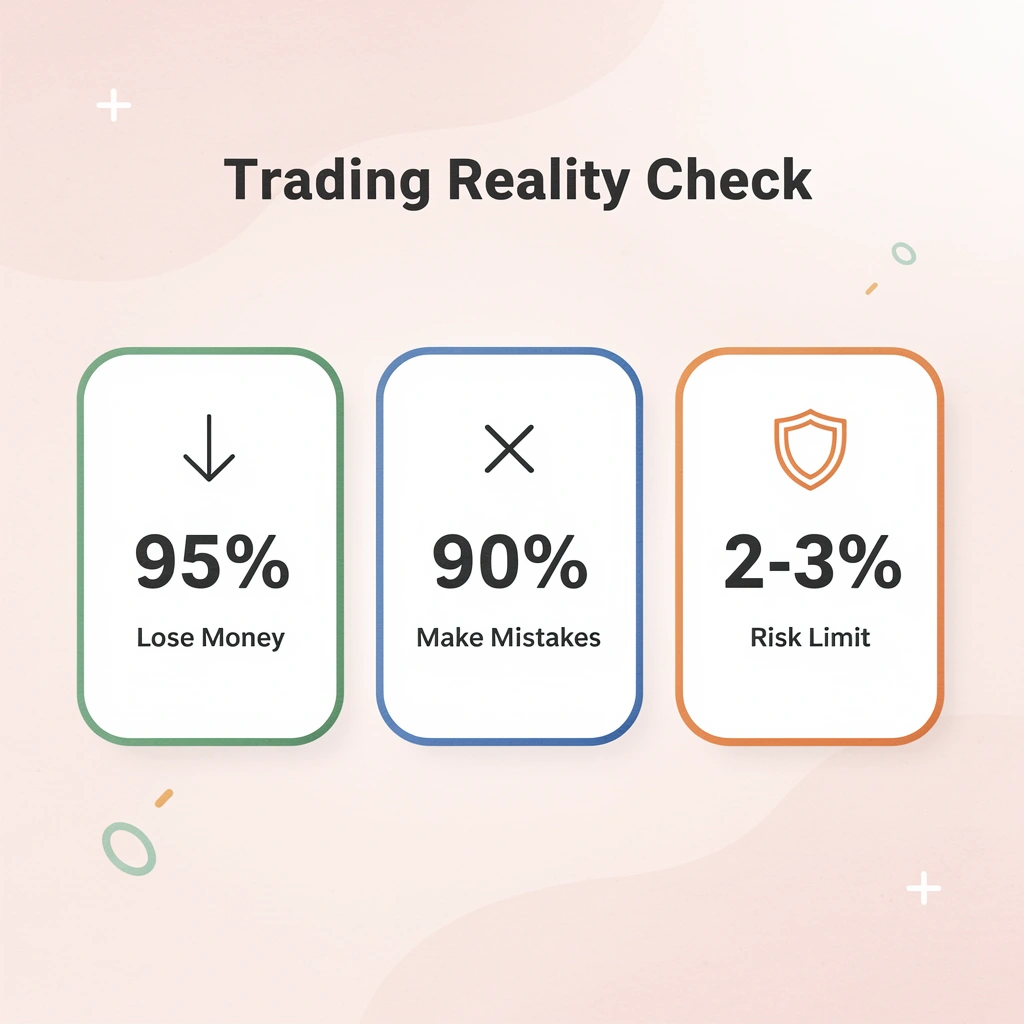
"95% of day traders lose money, with poor risk management being the leading cause of failure." — Securities and Exchange Commission Study
💡 Key Point: Position sizing means never risking more than 2-3% of your total portfolio on a single trade. This simple rule protects you from catastrophic losses that can end your trading career before it truly begins.
Overleveraging Turns Small Losses into Account Wipeouts
Leverage feels like a shortcut to wealth. A trader opens a 10x position on a coin they believe will rally, expecting faster profits. When the market shifts 10% against them, the entire position liquidates. TradingView Hub reports that 73% of automated crypto traders lose money in their first six months, often because leverage amplifies every mistake into catastrophic loss. Without margin buffers, one wrong call forces emotional restarts from near zero.
Skipping Stop-Loss Orders Invites Unlimited Downside
Traders enter positions hoping the market moves their way but skip the automatic exit that caps losses. When crypto reverses sharply, the position drifts deeper into the red without intervention. Manual monitoring fails during 24/7 volatility, turning manageable setbacks into portfolio-destroying events. Paralyzed by hope that the market will recover, traders watch losses expand until damage becomes irreversible.
Risking Too Much per Trade Eliminates Survival Buffers
Many traders put too much of their money into single trades. A few losing trades in a row can wipe out weeks or months of profits in a matter of hours. This removes the safety cushion needed to handle normal market fluctuations. When losing trades occur (as they always do), the account shrinks so quickly that traders lose both their money and the confidence needed for the next trade. What looked like smart analysis becomes a serious financial loss.
Position Sizing Based on Excitement Triggers Margin Calls
Traders size positions based on excitement rather than a fixed percentage of total capital. Large bets relative to the account amplify drawdowns and trigger margin calls or forced sales at the worst moments. This prevents steady compounding and transforms normal market noise into existential threats.
How can simulated trading help avoid crypto trading mistakes?
When trading with simulated capital on platforms like Goat Funded Trader, the dynamics shift. You still need discipline and risk management, but without the fear of losing your own money, you won't make desperate attempts to recover losses. This separation lets you treat losses as information rather than emergencies, breaking the revenge trading cycle before it causes career-ending damage.
Related Reading
- How to Use AI for Crypto Trading
- What Are Crypto Trading Signals
- How Long Does It Take To Learn Forex Trading
- What Is Spot Trading in Crypto
- Is Paper Trading Real Money
- Emotional Trading Mistakes
- Common Mistakes in Stock Trading
- Forward Testing Trading
- Paper Trading vs Live Trading
- Risk Reward Ratio Trading
Do Trading Mistakes Impact Long-Term Profitability?
Trading mistakes compound like the opposite of compound interest, eroding your money through repeated behavior patterns that override any strategic advantage. Long-term profitability depends less on finding perfect setups and more on eliminating recurring errors that sabotage execution, distort risk exposure, and turn statistical advantages into losses.

🎯 Key Point: The most successful traders aren't those who never make mistakes—they're the ones who systematically eliminate their most costly recurring errors over time.
"The difference between profitable and unprofitable traders isn't talent—it's the ability to identify and correct behavioral patterns that consistently undermine performance." — Trading Psychology Research, 2023

⚠️ Warning: Even traders with winning strategies can become unprofitable if they allow emotional decision-making and poor risk management to compound over hundreds of trades.
The Belief That Time Fixes Everything
Most traders view mistakes as a temporary cost of learning on the way to making money. They believe that spending more time analyzing charts will fix bad habits and that losses will teach them to be more careful. This thinking keeps them repeating the same mistakes for months or years, staying convinced that the next trade will be different, even though their account balance shows the same pattern.
Why Mistakes Compound Instead of Disappearing
A single large loss changes recovery time. Lose 50% of your money, and you need a 100% gain to return to your starting point. This pressure drives you toward risky recovery trades instead of high-probability setups. Over time, the cycle transforms steady growth into persistent decline as fees accumulate, emotional decisions dominate, and your system underperforms its analysis. Research from MIT Sloan on retail options activity around earnings announcements revealed that traders lose 5% to 9% of their investment on average due to overpaying for volatility, wide spreads, and slow reactions, climbing to 10–14% in high-volatility cases. This data demonstrates that timing and risk mistakes create measurable, recurring drags that eliminate long-term gains.
What the Data Actually Shows
Research on Brazilian equity futures traders tracked individuals active for over 300 days. Only 1.1% earned more than minimum wage despite having ample time to learn from mistakes. Retail options traders lose 5% to 9% of their investment on average because they overpay for volatility, pay wide spreads, and react slowly—reaching 10-14% when volatility is high. These ongoing costs eliminate long-term gains even when traders win some trades.
Even experienced FX traders experience performance declines over time due to overconfidence and a failure to address fundamental behaviors. Time amplifies mistakes rather than resolving them: traders interpret survival as validation rather than recognizing that they're slowly losing capital through predictable patterns.
Breaking the Cycle Before It Breaks You
Trading with simulated capital on platforms like Goat Funded Trader removes the emotional pressure that leads to mistakes. Most traders risk their own savings, triggering fear-based attempts to recover losses that worsen outcomes.
With up to $2M in simulated capital, you must demonstrate professional-level discipline to maintain access. Avoiding mistakes becomes essential, not optional. Feedback is immediate: fix behaviors that damage your profits, or lose access to capital.
How do you prevent crypto trading mistakes from recurring?
Long-term results depend on protecting your money through strict rules, position sizing that withstands losing streaks, and journaling that exposes patterns. Deliberate systems prevent mistakes from compounding into career-ending damage.
But discipline alone isn't enough when the structure you're trading within amplifies every error.
Related Reading
- Crypto Trading For Beginners
- Fear Of Missing Out And Trading
- Discipline In Trading
- Common Forex Trading Mistakes Beginners
- Trading Risk Management 1% Rule Explained
- Risk Management Day Trading
- Crypto Trading Risk Management
- ICT Trading Strategy For Beginners Step By Step
- Trading Risk Management Strategies
- Algorithmic Trading Risk Management
10 Common Crypto Trading Mistakes and How to Avoid Them
Crypto trading punishes preventable mistakes quickly. Most losses new traders experience follow recognizable patterns. Identifying and correcting these patterns strengthens decision-making, protects capital, and fosters a more disciplined approach to the market.

🎯 Key Point: The difference between successful traders and those who lose money isn't luck—it's avoiding the same recurring mistakes that trap 90% of beginners.
"95% of day traders lose money, with pattern recognition and risk management being the primary differentiators between winners and losers." — Financial Industry Research, 2023

⚠️ Warning: These common trading mistakes can wipe out your portfolio faster than you think. Learning to recognize the warning signs before you make them is essential for long-term success.
Common Mistake Category
- Emotional Trading
Impact Level: High
Prevention Strategy: Set strict rules and stick to them - Poor Risk Management
Impact Level: Critical
Prevention Strategy: Never risk more than 2-3% per trade - FOMO Trading
Impact Level: High
Prevention Strategy: Use predetermined entry points only - Overtrading
Impact Level: Medium
Prevention Strategy: Limit to 3-5 trades per day maximum

1. Failing to Conduct Thorough Research Before Entering Positions
New traders buy coins based on social media hype or price spikes, without examining fundamentals such as technology, team background, tokenomics, or real-world adoption. This leads to holding worthless assets during dumps or missing red flags such as weak security or questionable leadership. Review whitepapers, on-chain metrics, community activity, and independent audits before committing capital. Base every entry on verified data rather than narratives.
2. Letting Emotions Drive Trading Decisions
Fear causes traders to leave good positions too early when prices drop, while greed makes them hold losing trades too long, hoping for recovery. In crypto's 24/7 environment, this emotional cycle destroys discipline. Combat it by creating and strictly following predefined rules for entries, exits, and position management that remove emotion from trading.
3. Overtrading Without Clear Setups
Making too many trades while chasing small price moves or news events damages your account through trading costs and mental fatigue and prevents high-probability setups from delivering full value. Instead, stick to a limited number of carefully vetted trades that match your strategy and risk parameters rather than forcing activity.
4. Ignoring Proper Risk Management Rules
Positions receive oversized allocations relative to total capital, with no stop-losses or position limits. One bad trade can wipe out large portions of the portfolio, making recovery difficult in volatile conditions. Limit risk to 1-2% of total capital per trade, use stop-loss orders, and maintain strict position sizing to preserve longevity.
5. Trading Without a Defined Plan or Strategy
Traders often jump in reactively, based on gut feelings or headlines, rather than outlining entry criteria, exit targets, risk tolerance, and an overall approach in advance. Market noise then dictates every move, leading to inconsistent results and unlearnable performance. Build a written trading plan with specific rules for all scenarios and review it before each session to enforce consistency.
6. Falling for FOMO and Impulse Entries
FOMO pushes traders to jump into surging assets after seeing rapid gains on social media or leaderboards, often at peak prices without personal confirmation. This results in buying high during hype cycles, followed by sharp corrections that lock in losses as momentum fades. Break this pattern by sticking to your predefined criteria and ignoring external noise: wait for pullbacks or confirmed setups that align with your analysis rather than chasing price action.
7. Neglecting Wallet and Exchange Security
Traders leave assets on exchanges or use weak wallet protections, exposing holdings to hacks, phishing, or lost seed phrases, resulting in permanent loss. A single breach or mistake can wipe out entire portfolios, leaving no recovery options in the decentralized space. Secure every asset by moving funds to hardware wallets, enabling 2FA everywhere, using unique strong passwords, and verifying addresses before any transfer. Treat security as essential infrastructure.
8. Overusing Leverage Without Understanding Liquidation Risks
New traders use high leverage to amplify small price movements, expecting rapid profit growth in volatile markets. Even minor adverse price moves can trigger automatic liquidations that wipe out positions entirely, often at the worst times. Keep leverage to conservative levels like 2-3x at most, calculate your liquidation price beforehand, and size positions so normal price swings remain well within your risk tolerance.
9. Chasing Losses with Revenge Trades
After losing money, frustration can push traders to open bigger bets or break their own rules to recover losses quickly. This turns small losses into huge problems because emotions override logic. Cryptocurrency's volatile price swings amplify this cycle. When you lose a trade, step away, review what happened against your plan, and take a break or trade with smaller amounts until you restore your discipline.
10. Ignoring Transaction Fees and Hidden Costs
Trading too often costs you money through exchange fees, withdrawal charges, and slippage that eat into your profits, especially with smaller accounts or volatile markets. Even winning trades can lose money once you add up all the costs. To avoid this, include all fees in your risk-reward calculations before trading, choose lower-cost platforms that match your trading style, combine multiple transactions into one when possible, and focus on longer-timeframe setups that reduce trading frequency.
How to Avoid the Common Mistakes in Crypto Trading
Crypto trading rewards discipline and punishes careless decisions. A single emotional trade, ignored stop-loss, or rushed entry based on social media hype can undo weeks of progress. Trading mistakes are preventable. Building the right habits protects your capital, improves judgment, and increases trading confidence.

⚠️ Warning: Emotional trading is the fastest way to destroy your portfolio. When you let fear or greed drive decisions, you're no longer trading—you're gambling.
"95% of day traders lose money, with emotional decision-making being the primary factor in their failure." — Securities and Exchange Commission Study, 2019

🎯 Key Point: The difference between successful traders and those who lose money isn't luck or market timing—it's risk management and emotional control. Every profitable trader follows strict rules that protect them from their own impulses.
Master Thorough Research Before Every Decision
Look at the project's whitepaper, team credentials, token utility, on-chain activity, and independent audits instead of relying on social media buzz. This reveals legitimate opportunities while exposing red flags like weak fundamentals or centralized control. Verify information from multiple unbiased sources, cross-reference community engagement, and build conviction based on facts. Your entries then rest on solid analysis rather than speculation.
Establish and Follow a Written Trading Plan.
Create a detailed plan that outlines entry criteria, exit rules, risk limits, and preferred timeframes before placing any trade. This removes guesswork during live market action and enforces consistency. Review and update it regularly based on performance data, allowing adaptation without deviating from core principles. Every decision should flow from this framework rather than momentary impulses.
Enforce Strict Risk Management on Every Position
Limit exposure to 1-2% of total capital per trade, set stop-loss orders at logical levels, and calculate position sizes to match your risk tolerance. These boundaries prevent any single loss from threatening your portfolio and provide breathing room through drawdowns. Apply them mechanically to survive losing streaks and preserve capital for high-probability setups.
Control Emotions with Predefined Rules
Identify triggers such as fear during dips or greed during rallies. Counter them by automating exits through stop-loss and take-profit orders and stepping away from screens after reaching daily limits. This separation prevents psychological pressure from overriding your strategy. Journal each trade's emotional state to spot patterns and strengthen mental discipline.
Trade Selectively and Avoid Overactivity
Focus only on setups that fully match your criteria, rather than jumping into every price movement or news headline. This selectivity reduces fees, preserves focus, and allows winning trades to develop fully. Set maximum trade counts per session or week to prioritize quality over quantity and combat boredom-driven activity.
Secure Your Assets with Best Practices
Move your holdings off exchanges into hardware wallets after trades, enable multi-factor authentication everywhere, and verify all addresses before transfers. These steps protect against hacks, phishing, and human error that result in irreversible losses. Use separate wallets for trading and long-term storage, and remain alert to social engineering tactics.
Resist FOMO Through Disciplined Patience
Wait for confirmed setups that align with your analysis rather than entering after sharp moves driven by crowd excitement. This avoids buying at inflated prices likely to drop and prevents forced sales during reversals. Rely on your plan's signals and maintain a watchlist of prepared opportunities to act when conditions align.
Account for All Costs in Your Calculations
Include exchange fees, slippage, withdrawal charges, and tax implications in every risk-reward assessment before entering trades. This reveals which opportunities are truly profitable and prevents small advantages from disappearing due to overhead costs. Choose platforms suited to your trading frequency and group transactions together to reduce costs.
Use Leverage Sparingly and Understand Its Mechanics
Use low leverage only after extensive practice in simulation. Calculate the price that would wipe out your account and potential outcomes. This approach increases gains without risking losses from normal price changes. Start with spot trading to learn how markets work before using borrowed money.
Use these strategies to stop making quick mistakes and start following a plan instead. When you use them regularly—keeping your money safe, improving your process, and building lasting results—your trading improves.
How Goat Funded Trader Helps Build Discipline Against Crypto Trading Mistakes
The structure you trade within determines whether you learn from mistakes or repeat them indefinitely. Goat Funded Trader creates an environment where discipline becomes the only path forward through strict loss limits, no time pressure on quality decisions, and simulated capital that removes emotional chaos. Our platform tests whether you can execute your strategy consistently under professional trading standards.

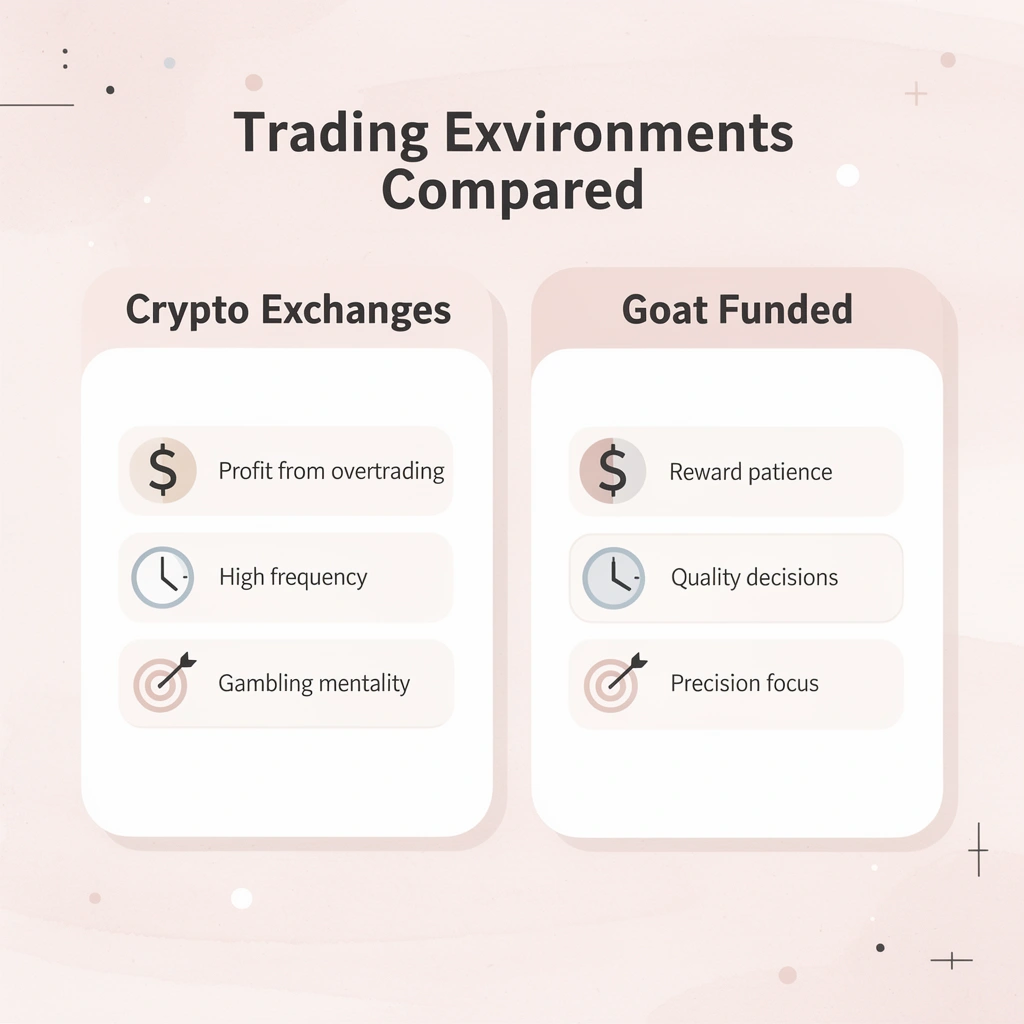
🎯 Key Point: Unlike crypto exchanges that profit from your overtrading, Goat Funded Trader's evaluation process rewards patience and precision over high-frequency gambling.
"Professional traders succeed not because they avoid mistakes, but because they create systems that prevent repeating the same mistakes twice." — Trading Psychology Research, 2024
⚠️ Warning: The simulated environment isn't just practice—it's a complete behavioral reset that forces you to abandon revenge trading and FOMO-driven decisions that destroy crypto portfolios.
Strict Drawdown Limits Force Precision Before Scale
Maximum daily loss limits of 3% and an overall maximum loss of 6% are thresholds that end your evaluation if exceeded. This makes position sizing non-negotiable before accessing larger capital. A trader who previously risked 10% on a single volatile move now calculates exact entry sizes to stay under the 3% threshold, building the muscle memory that prevents catastrophic losses. According to Goat Funded Trader, 95% of traders lose money, often because they never develop this fundamental skill under real constraints. Our evaluation phases train precise stop placement and automatic adherence before you're trusted with up to $2 million in simulated buying power, turning risk management from an abstract concept into a daily habit.
No Time Limits Eliminate Overtrading Pressure
Without minimum trading days or countdown clocks, the urge to force entries disappears. Our challenges require specific profit targets, such as 10% in later phases, while respecting loss rules, rewarding patience and selective setups over constant activity. Traders shift from scanning dozens of low-conviction crypto pairs daily to waiting for high-probability opportunities that align with their plan. The greatest traders don't trade more; they trade better, and unlimited time to hit targets reinforces that waiting is part of the edge.
Simulated Capital Removes Emotional Spirals
Trading with your own money creates fear that overrides rational thinking, leading to revenge trades and early exits that compound mistakes. Prop firms like Goat Funded Trader provide practice capital instead, eliminating the anxiety of personal losses. Quick rewards within 24-48 hours and profit splits up to 100% help traders focus on executing their plan rather than protecting their emotions. Traders stop making emotional decisions after losses and start reviewing trades objectively. They understand that breaking the rules ends the challenge, while following the rules leads to real money—thereby creating accountability without the stress of personal capital at stake.
Multi-Phase Evaluation Counters FOMO and Hype Chasing
FOMO drives traders to buy at the top of rallies, mistaking movement for opportunity. Our multi-phase structure demands consistent performance across defined profit targets before funding, discouraging impulsive entries that appear profitable in isolation but fail under rigorous testing. News trading and weekend holding are permitted within rules, providing flexibility without chaos, but only if you demonstrate control across multiple phases. Traders learn to ignore outside noise and repeatedly wait for setups that meet their criteria, shifting from reactive entries to methodical decisions that unlock scaled capital.
Advanced Dashboard and Scaling Programs Build Professional Structure
Inconsistent decisions stem from blind spots in your own patterns. Our in-house dashboard tracks real-time performance alongside scaling programs that reward disciplined growth up to $2M, with 24/7 support reinforcing accountability. Traders develop written plans to meet targets and rules, with the dashboard visualizing adherence and enabling data-driven adjustments. Every decision becomes measurable, every pattern visible, and steady progression to higher profit splits and on-demand payouts rewards consistency.
But even with the right structure, knowing when to act matters as much as knowing how.
Get 25-30% off Today - Sign up to Get Access to Up to $800K Today
Each undisciplined trade drains money, confidence, and momentum, making recovery harder. Goat Funded Trader offers a different path: access to simulated capital up to $2 million, clearly defined trading goals, and a structure that rewards consistency. You demonstrate disciplined execution, adhere to drawdown protections, and earn profit splits of up to 100% without risking your own savings.
🎯 Key Point: Trade with simulated funds up to $2 million while earning profit splits up to 100%, eliminating personal capital risk.

Choose your evaluation program, complete the challenge requirements, and unlock larger simulated capital as your discipline improves. No personal liability for trading losses. Payouts arrive within two business days when you meet the criteria. Explore Goat Funded Trader at https://www.goatfundedtrader.com/.
"Access to simulated capital up to $2 million with profit splits up to 100% and no personal liability for trading losses." — Goat Funded Trader Program
🔑 Takeaway: Disciplined traders can access substantial simulated capital without personal risk while earning real profits through structured evaluation programs.
Related Reading
- Best Day Trading App For Beginners
- How Do You Manage Risk In Futures Trading
- Risk Management In Stock Trading
- How To Read Crypto Charts For Day Trading
- Best Crypto Trading App
- Best Demo Trading Account
- Best Stock Trading App For Beginners
- How To Make Money Trading Crypto
- Best Trading Apps For Beginners
- How To Learn Crypto Trading
Be Great and get the App