







ICT Trading Strategy for Beginners: A Step-by-Step Guide
ICT Trading Strategy for Beginners Step by Step — Goat Funded Trader breaks down every concept so you can trade smarter starting today.
.jpeg)

Watching a crypto chart move without knowing where prices are headed is a frustrating experience for most beginners. Learning how to use AI for crypto trading has pushed many traders toward more structured methods, and the ICT (Inner Circle Trader) strategy is one of the most effective frameworks available. It covers market structure, order blocks, fair value gaps, liquidity zones, and optimal trade entry, providing traders with a repeatable process rather than guesswork.
Grasping ICT concepts is only half the work. Applying them under real market conditions, with actual capital on the line, is where most traders struggle to bridge the gap. For those ready to put their skills to the test without risking personal funds, Goat Funded Trader offers a prop firm model that provides funded accounts, allowing traders to execute their strategies in live markets while still building their edge.
Table of Contents
- What Is the ICT Trading Strategy and Why Is It Popular Among Traders??
- What Markets and Timeframes Work Best for ICT Trading?
- Is the ICT Trading Strategy Worth Learning for Beginners?
- How to Apply the ICT Trading Strategy in Real Trading Step-by-Step
- Tips to Practice the ICT Trading Strategy Safely
- How Goat Funded Trader Helps ICT Traders Scale Their Accounts
- Get 25-30% off Today - Sign up to Get Access to Up to $800K Today
Summary
- ICT (Inner Circle Trader) methodology differs from standard technical analysis in a fundamental way: it asks traders to anticipate institutional behavior rather than react to price movements. The framework centers on concepts such as order blocks, fair value gaps, liquidity pools, and market structure shifts, which work together as a unified reading system rather than as isolated signals. One independent academic study published on RePEc examined the Power of Three concept across 14 forex pairs over a 21-year period and found statistically meaningful support for the methodology's ability to identify high-probability institutional patterns.
- Instrument and session selection directly impact how reliably ICT concepts perform. Major forex pairs like EUR/USD and GBP/USD, along with Nasdaq futures and Gold, carry the institutional order flow that makes order blocks and fair value gaps meaningful. Thinly traded or exotic instruments lack the large-participant activity that drives the liquidity grabs ICT anticipates, causing setups that look correct on paper to fall apart in execution.
- Multi-timeframe alignment is one of the most commonly skipped steps among beginner and intermediate ICT traders. Entries taken on 5-minute charts without first establishing a directional bias on the daily or 4-hour chart result in trading a local pattern inside a larger opposing move. The top-down process, using the daily chart for premium or discount context, the 4-hour chart for key zones, and the 15-minute or 5-minute chart for entry timing, takes roughly 10 minutes and eliminates the most common counter-trend mistake in the methodology.
- The learning curve for ICT is steeper than most beginners expect, and the timeline matters. According to the Tradervue Blog's breakdown of the ICT trading strategy, ICT concepts require at least 6 to 12 months of study before consistent application becomes realistic. The failure point is usually sequence, not comprehension. Beginners who hunt setups on one-minute charts before establishing any higher-timeframe bias generate false confidence, while those who limit themselves to two setups per session, journal every trade, and review bias accuracy weekly build a genuine edge over time.
- Capital constraints punish disciplined ICT traders in a specific way. A trader risking 1% on a $5,000 personal account has $50 in risk per setup, so even a 3:1 reward-to-risk trade returns only $150. The math discourages consistency, and the common response is overleveraging, which quietly abandons the patience ICT demands. The funded account model separates personal capital from trading capital, allowing a proven ICT edge to operate at a scale where consistent execution produces income that reflects the actual skill behind it. Approximately 90% of retail traders lose money, and most do so not because their strategy failed but because they never built the psychological and procedural discipline to execute consistently under financial pressure.
- Goat Funded Trader addresses the capital access gap that holds back disciplined ICT traders by providing simulated accounts that scale up to $2 million, with built-in risk parameters that mirror the structured approach already demanded by ICT methodology.
What Is the ICT Trading Strategy and Why Is It Popular Among Traders??
The ICT trading strategy gives retail traders a structured way to read institutional behavior, focusing on where large players collect liquidity, build positions, and drive price. It has become increasingly popular because it replaces indicator dependency with raw price logic, fundamentally changing how traders interpret price action.
"The ICT trading strategy shifts the focus from lagging indicators to the actual mechanics of how institutional players move markets — making it one of the most sought-after frameworks in modern retail trading." — ICT Methodology Core Principle
💡 What It Means: The ICT (Inner Circle Trader) strategy is not a traditional indicator-based system — it's a price logic framework built around understanding how banks and institutions accumulate and distribute positions.
⚠️ Why It Matters: Most retail traders lose because they rely on lagging indicators that react to price rather than anticipate institutional moves. ICT replaces that dependency with a structural edge.
- Traditional Indicator Approach
- Relies on lagging signals
- Follows retail crowd behavior
- Indicator-dependent
- Reactive to market moves
- ICT Strategy Approach
- Reads raw price structure
- Tracks institutional footprints
- Price-logic driven
- Anticipates liquidity grabs

What actually makes ICT different from standard technical analysis
Standard technical analysis asks you to react to price. ICT asks you to predict it ahead of time. Support levels get swept clean before price rockets in the direction you originally called. That sweep is a deliberate liquidity grab, and ICT gives you the framework to recognize it before completion rather than after.
How does the ICT trading strategy for beginners, step by step, build a reading system from core concepts?
Core ICT concepts—order blocks, fair value gaps, liquidity pools, breaker blocks, and market structure shifts—form a unified reading system. When price leaves a fair-value gap on the way up, institutions often return to fill the imbalance before continuing higher. Recognizing this pattern in real time, rather than labeling it on a finished chart, is where ICT traders build their edge.
How does ICT reframe stop placement to turn stop-outs into planned entries?
Most retail traders place stops below the nearest visible swing low, where institutional algorithms hunt before reversing. ICT reframes this by teaching traders to place stops beyond the liquidity that price is likely to sweep, turning a stop-out into a planned entry. That shift transforms trading from reactive frustration to structured patience. Our Goat Funded Trader platform serves traders with this disciplined approach, offering simulated funded accounts with up to $2M in capital to apply ICT setups in live market conditions without risking personal savings.
Why the community around ICT keeps growing
The Inner Circle Trader YouTube channel crossed 2 million subscribers because the concepts hold up under scrutiny. Traders backtest the Power of Three model, the Silver Bullet window, and the optimal trade entry zone, finding repeatable patterns that align with how institutional order flow moves price. An independent academic study published on RePEc examined the Power of Three concept across 14 forex pairs over 21 years and found statistically meaningful evidence of high-probability institutional patterns. This external validation matters.
Why does the step-by-step ICT trading strategy for beginners align so well with prop firm requirements?
The strategy fits prop firm evaluation criteria because it produces selective, well-defined setups rather than high-frequency guessing. Traders who learn to identify kill zones—such as the London open or the 10 to 11 AM New York window—avoid overtrading during low-probability periods, a primary reason traders fail in funded account evaluations. ICT builds the trading discipline that funds accounts' rewards. Knowing which concepts to use is only half the equation; the harder half is knowing which markets and timeframes allow those concepts to work.
Related Reading
- How to Use AI for Crypto Trading
- What Are Crypto Trading Signals
- How Long Does It Take To Learn Forex Trading
- What Is Spot Trading in Crypto
- Is Paper Trading Real Money
- Emotional Trading Mistakes
- Common Mistakes in Stock Trading
- Crypto Trading Mistakes
- Forward Testing Trading
- Paper Trading Vs Live Trading
- Risk Reward Ratio Trading
What Markets and Timeframes Work Best for ICT Trading?
The major forex pairs and US index futures create the clearest ICT signals: EUR/USD, GBP/USD, Nasdaq futures (NQ), and Gold (XAU/USD) carry the institutional order flow that makes order blocks and fair value gaps meaningful. Exotic pairs and low-volume instruments don't have the participation needed for these concepts to work reliably.
- Forex (EUR/USD)
- ICT Suitability: ✅ Highly Recommended
- Forex (GBP/USD)
- ICT Suitability: ✅ Highly Recommended
- Index Futures (Nasdaq NQ)
- ICT Suitability: ✅ Highly Recommended
- Commodities (Gold XAU/USD)
- ICT Suitability: ✅ Highly Recommended
- Forex (Exotic Pairs)
- ICT Suitability: ❌ Not Reliable
- Low-Volume Instruments
- ICT Suitability: ❌ Not Reliable
"The markets with the deepest institutional participation — like EUR/USD and NQ futures — are where ICT concepts such as order blocks and fair value gaps produce their most reliable signals."
🎯 Key Point: ICT strategies are built around institutional order flow — only markets with heavy institutional participation, like EUR/USD, GBP/USD, NQ, and XAU/USD, will produce the consistent, high-probability setups these concepts are designed to identify.
⚠️ Warning: Applying ICT concepts to exotic pairs or low-volume instruments is one of the most common mistakes new traders make. Without sufficient institutional participation, order blocks and fair value gaps become unreliable and can lead to costly misreads of market structure.

Where institutional footprints are clearest
The failure point is usually instrument selection. Traders applying ICT methodology to thinly traded pairs find setups that appear correct on paper but fail in execution—insufficient institutional liquidity prevents the moves ICT anticipates. EUR/USD and GBP/USD respond sharply to session overlaps because banks and hedge funds actively reposition, leaving visible footprints through displacement moves and unfilled imbalances. NQ futures amplify this during the American session, producing pronounced fair-value gaps that offer favorable risk-to-reward entries when market structure supports the trade direction.
Multi-timeframe alignment is non-negotiable
Beginner and intermediate ICT traders often enter on 5-minute charts without anchoring to daily or 4-hour bias, trading local patterns within larger moves that work against them. Use the daily chart to define premium or discount arrays, the 4-hour to identify key order blocks and liquidity pools, then drop to the 15-minute or 5-minute chart to time your entry within those pre-identified zones. This top-down process separates a structured ICT trade from a guess dressed in ICT language.
Why does skipping timeframes cost an ICT trading strategy for beginners step by step?
Most traders stick with one timeframe for simplicity, but this mistake costs them money. Checking three timeframes before trading takes about ten minutes and helps you avoid the most common pitfall of this method.
Kill zones are where the edge actually lives
The London session (2:00 to 5:00 AM EST) and New York session (8:00 to 11:00 AM EST) are when institutional desks actively execute, making liquidity grabs intentional and displacement moves decisive. According to TradingFinder's ICT Timeframe analysis, aligning entries with these kill zones significantly improves the probability of capturing clean, directional moves rather than noise. Outside these windows, the same setups frequently resolve into fakeouts due to the absence of institutional participation.
How does kill zone discipline protect your funded account in the ICT trading strategy for beginners, step by step?
Traders who limit themselves to kill zones solve a secondary problem: funded account evaluations reward consistency and controlled drawdown above all else. A trader who executes only during two defined windows each day naturally limits overtrading, in which most evaluation attempts collapse. Our Goat Funded Trader program provides simulated capital up to $2M with up to 100% profit splits, so kill zone discipline directly protects your ability to withdraw real earnings from a funded account.
Why should beginners treat the Asian session as observation only?
The Asian session functions as a range-building period, particularly for JPY and AUD pairs, and should be treated as a lower-energy window for observation rather than active trading. Aggressive positioning during Asian hours on EUR/USD or NQ futures is one of the fastest ways to accumulate losses before institutional activity begins. But knowing the right markets and kill zones leaves one question unanswered: the one that stops more traders than any technical concept ever will.
Is the ICT Trading Strategy Worth Learning for Beginners?
The ICT trading strategy is worth learning for beginners, but only with accurate expectations. It is not a fast way to make profits — it's a structured method that rewards slow skill-building and punishes those looking for complexity as a shortcut.
"The ICT trading strategy rewards slow skill-building — it is a structured method, not a shortcut to fast profits." — Core ICT Principle
- Slow, deliberate skill-building
- What it leads to: Consistent pattern recognition and trust in setups
- Rushing for complexity
- What it leads to: Confusion, overtrading, and blown accounts
- Accurate expectations
- What it leads to: Sustainable progress and long-term edge
💡 Tip: Before diving into advanced ICT concepts, commit to mastering one concept at a time. Trying to learn everything at once is the fastest way to learn nothing.
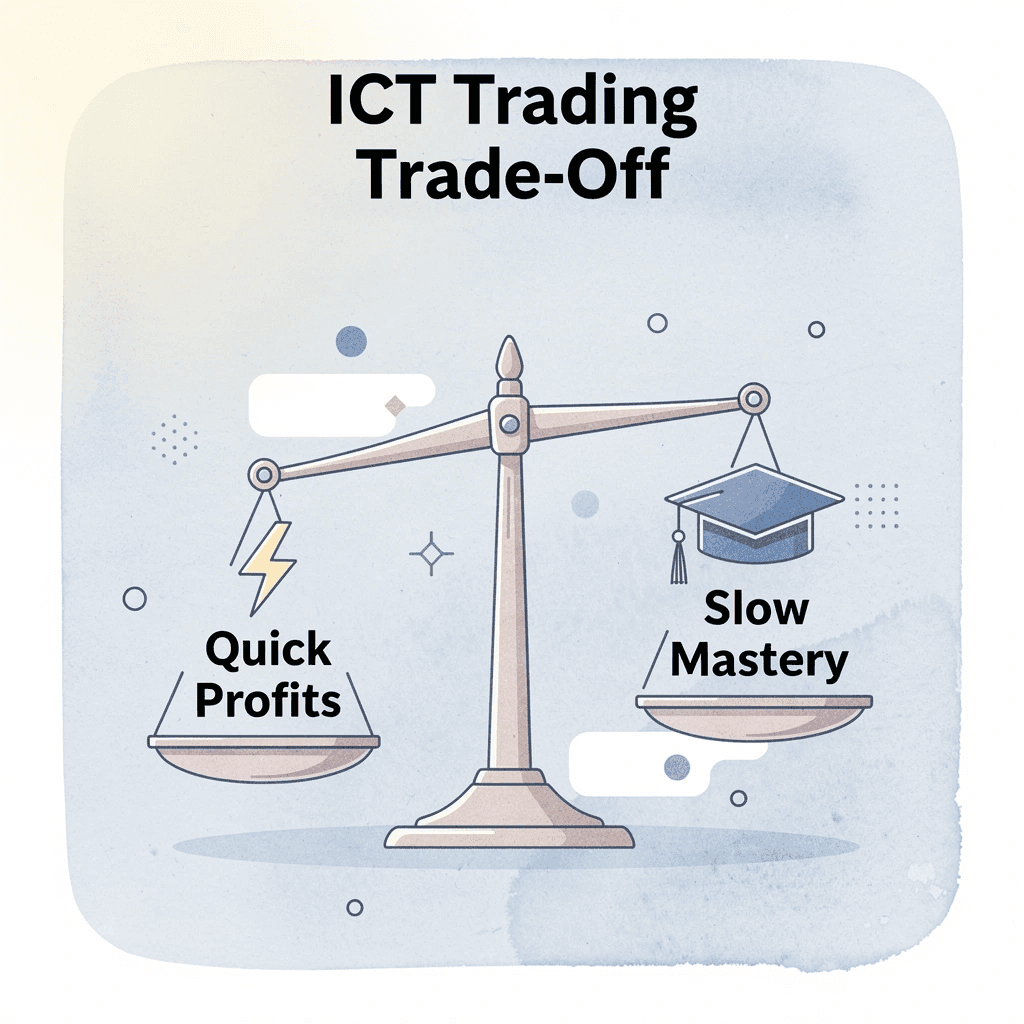
Beginners often feel confused as each layer of ICT understanding reveals another beneath it. This is not a sign the strategy is broken—it's a sign that real learning is working. The gap between recognizing an order block and trusting one in live market conditions is measured in months of deliberate screen time, not hours of YouTube content.
⚠️ Warning: Confusing familiarity with a concept for mastery of it is one of the most common beginner mistakes in ICT trading. Watching a concept explained is not the same as executing it under live pressure.
🎯 Key Point: The ICT learning curve is intentionally deep. Every layer of confusion you push through builds the mental framework that separates consistent traders from those who quit too soon.
Why the learning curve is steeper than it looks
The failure point for most beginners is not understanding the concepts themselves but the order in which to learn them. Beginners often start at the bottom of the timeframe ladder, looking for fair value gaps on the one-minute chart before establishing any higher-timeframe directional bias. Without that anchor, every setup looks valid, and none is. According to the Tradervue Blog's breakdown of the ICT trading strategy, ICT concepts require 6 to 12 months of study before consistent application becomes realistic—a timeline that experienced traders consistently confirm.
Why does adding more concepts slow down the ICT trading strategy for beginners step by step?
Most beginners respond by consuming more content and adding more concepts, hoping that volume will close the execution gap. This delays the one thing that builds competence: structured repetition on a small number of setups across a defined session window. Traders who limit themselves to two setups during London or New York open, journal every trade, and review their bias accuracy weekly build skill. Everyone else accumulates screen time without accumulating edge.
How does practicing on simulated capital protect beginners' skill development?
The funded account model changes this equation. Practicing ICT on a live account with your own money means every mistake costs you real money, affecting your decision-making before you develop the skill. Goat Funded Trader gives you access to simulated capital up to $2M, which mirrors real market conditions without the emotional pain of watching your personal savings decrease while learning. That separation between learning and losing helps you build skills faster without punishing you for mistakes.
Is the strategy legitimate or just popular?
ICT as a method is legitimate. The predatory course ecosystem built around it is not trustworthy, and beginners often conflate the two. The core concepts—price delivery, institutional order flow, session-based timing, and multi-timeframe confluence—are based on how large participants move capital through liquid markets.
Why do most traders lose even with a valid strategy?
The problem is that 90% of retail traders lose money, and most fail not because their strategy is flawed but because they lack the mental toughness and self-discipline to execute consistently. ICT does not address this gap alone. Risk management, journaling, and session discipline fix it; ICT provides a framework for applying these habits.
Is the ICT Trading Strategy for Beginners step-by-step worth the time investment?
For a beginner willing to treat this as a skill requiring several years to master rather than a monthly income source, the strategy rewards the time invested. The question is not whether ICT works, but whether you're willing to do what it takes before expecting results. Knowing what it takes to learn the strategy is only part of the picture. Most beginners never ask what happens once they have the skill.
Related Reading
- Crypto Trading For Beginners
- Fear Of Missing Out And Trading
- Discipline In Trading
- Common Forex Trading Mistakes Beginners
- Trading Risk Management 1% Rule Explained
- Risk Management Day Trading
- ICT Trading Strategy For Beginners Step By Step
- Trading Risk Management Strategies
- Algorithmic Trading Risk Management
How to Apply the ICT Trading Strategy in Real Trading Step-by-Step
Using the ICT trading strategy turns how big institutions move prices into a process you can repeat. This process guides when you enter trades and how you manage risk, helping you avoid making emotional decisions that can destroy trading accounts.
"The ICT trading strategy transforms institutional price movement into a repeatable, rule-based process — giving retail traders a structured edge against emotional, reactive decision-making." — ICT Trading Methodology
💡 Tip: Before placing any trade using the ICT strategy, always identify the institutional order flow direction first — everything else follows from that single decision.
⚠️ Warning: The most common mistake traders make is skipping the risk management step and entering trades based on emotion rather than following the structured ICT process — this is how trading accounts get wiped out fast.
- Institutional Order Flow
- What it does: Tracks how big players move prices
- Why it matters: Sets your overall trade direction
- Trade Entry Process
- What it does: Defines exactly when to enter
- Why it matters: Removes emotional decision-making
- Risk Management Rules
- What it does: Controls position sizing and stops
- Why it matters: Protects your trading account
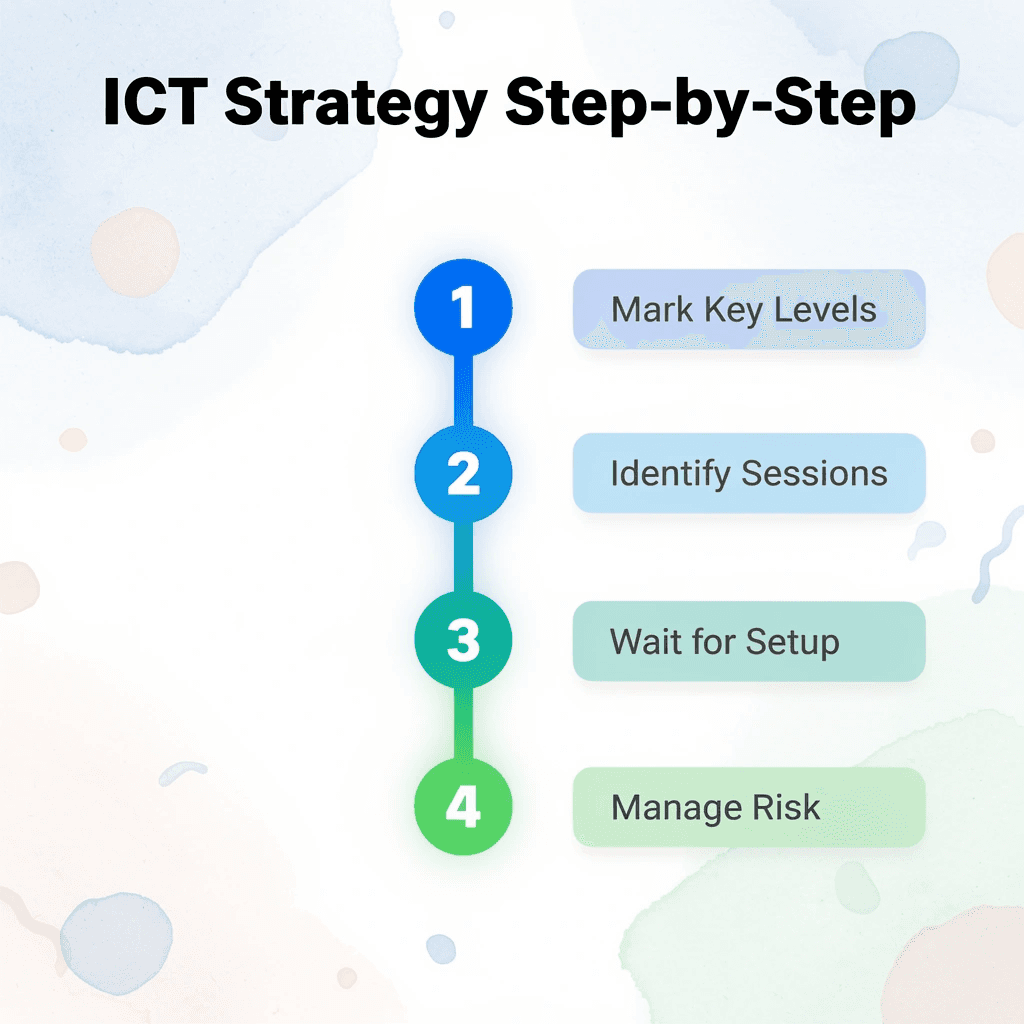
Establish Higher-Timeframe Bias First
Start every trading session by reviewing the daily and 4-hour charts to determine market direction based on structure. Look for higher highs and lows in bullish conditions, or lower highs and lows in bearish conditions. Note the key order blocks and fair value gaps that institutions target. This top-down view guides decisions on lower timeframes and prevents trading against the trend.
Identify Key Kill Zones and Session Timing
Mark high-probability trading windows like the London kill zone (2:00–5:00 AM EST) and New York kill zone (8:00–11:00 AM EST) on your chart. These periods combine liquidity and volatility, where smart money executes large orders and price displacement occurs most reliably.
Locate Liquidity Pools and Inducement Levels
Look for groups of stop orders above recent highs or below lows, along with matching highs or lows that show where liquidity is available. Large institutions clear out these areas to fill orders before changing direction. Document these zones across different timeframes to predict moves rather than react to them.
Pinpoint Order Blocks and Fair Value Gaps
Draw bullish order blocks at the base of strong upward moves and bearish ones at the top of downward moves on the right timeframe. Identify fair value gaps as three-candle imbalances where price left inefficiency. These zones function as high-probability reversal or continuation areas aligned with higher-timeframe bias.
Wait for Confirmation and Optimal Trade Entry
Drop to the 5-minute or 15-minute chart during an active kill zone and wait for price to enter a marked order block or fair value gap. Enter only when multiple confluences align—such as displacement candles, change of character, or optimal trade entry levels around the 62%–79% Fibonacci retracement—to confirm institutional interest.
Execute with Strict Risk Management
Place stops beyond the liquidity sweep or on the opposite side of the order block. Target the next liquidity pool or opposing array for measured moves, aiming for at least a 1:2 risk-to-reward ratio while scaling out partial positions at 1:1. Risk no more than 0.5%–1% of your account per trade to survive drawdown periods.
Manage and Review the Trade
Watch the price movement to see if your trade continues in the right direction or fails. Adjust your profit targets if the price pattern shifts. Document everything about your trade: the expected direction, price levels you monitored, your entry rationale, and the outcome. Review your notes weekly to improve pattern recognition and refine your trading strategy.
Scale and Refine Over Time
After showing consistent profit across at least 100 demo trades, move to small live trading while maintaining the exact same process. Add other models like Silver Bullet only during specific times once you master the basics. Continue testing your strategy with historical data and forward testing to ensure it works as markets change. Get good at these steps by practicing on major forex pairs and indices during busy trading times. Review free mentorship content and chart examples from experienced ICT teachers to accelerate your learning.
Tips to Practice the ICT Trading Strategy Safely
Practicing the ICT trading strategy safely helps you build real skills without risking your money while you learn institutional price action concepts.
"The safest way to master any advanced trading strategy is to practice it before your capital is on the line — discipline in the demo phase separates profitable traders from the rest." — Trading Risk Management Principle
💡 Tip: Always begin your ICT strategy practice in a demo or paper trading environment — never risk live capital until you have consistently demonstrated profitability over a meaningful sample size.
⚠️ Warning: Skipping the safe practice phase is one of the most common mistakes new ICT traders make. Jumping into live markets too early can wipe out your account before you've had a chance to truly understand institutional price action mechanics.
- Demo Trading
- Risk level: None
- Best for: Learning core ICT concepts
- Paper Trading Journal
- Risk level: None
- Best for: Tracking setups and refining entries
- Micro-Lot Live Trading
- Risk level: Very low
- Best for: Transitioning to real market conditions
- Full Live Trading
- Risk level: Standard
- Best for: Proven, consistently profitable traders only
🎯 Key Point: Building real skills through structured, low-risk practice is the essential foundation of any successful ICT trading journey — treat every demo session as if real money is on the line.

Start Exclusively on Demo Accounts
Open a high-quality demo platform that replicates your intended broker's spreads, slippage, and execution. Apply full ICT routines, higher-timeframe bias, kill zone timing, order block identification, and fair value gap entries as you would with real money. This risk-free repetition sharpens pattern recognition and decision-making until win rates stabilize.
Follow a Strict Daily Routine and Journaling Process
Set fixed times to analyze charts during London and New York kill zones only, marking liquidity pools, incentives, and optimal trade entries in advance. Record every setup with screenshots, bias reasoning, entry and exit levels, and emotional notes in a detailed trading journal. Weekly reviews reveal recurring mistakes such as ignoring higher-timeframe structure or overtrading outside high-probability windows, accelerating improvement through objective self-assessment.
Limit Risk and Position Sizing Ruthlessly
Enforce a 0.5%-1% maximum risk per trade, with stops placed beyond liquidity sweeps. Use measured targets based on opposing arrays or the next liquidity levels, aiming for at least a 1:2 risk-to-reward. This discipline builds proper money management habits that transfer when transitioning to funded capital. Prop firms like Goat Funded Trader enforce these parameters through strict drawdown rules, offering instant funding that rewards disciplined ICT application while maintaining predefined risk limits.
Backtest and Forward Test Systematically
Backtest at least 200 historical setups on major pairs like EUR/USD or Nasdaq futures across different market conditions. Forward-test the identical rules on the demo for another 100 trades. Track win rate, average reward-to-risk, and maximum drawdown to confirm you have a statistical edge before trading live.
Focus on One or Two Setups Initially
Focus on learning core models like the Power of Three or the Silver Bullet in specific kill zones, rather than spreading your attention across every ICT concept. Trade only when all confluences align: bias, liquidity, order block, and timing. Expand step by step to build deep expertise in high-probability scenarios.
Incorporate Psychological Training and Breaks
Practice full trading days with screen time limits to build focus, then step away to review without emotional attachment. Use mindfulness techniques to manage losing streaks. Strong mental preparation helps you treat trading as a probability business rather than chasing every move.
Transition Gradually to Live or Funded Trading
Move to small live size or a prop firm evaluation only after achieving consistent demo profitability over several months with detailed records. Start with micro-lots and scale up slowly while maintaining your exact process. Continuous journaling and periodic backtesting keep your strategy strong as market conditions change.
How Goat Funded Trader Helps ICT Traders Scale Their Accounts
Skill without scale is a frustrating place to be. You can read price action correctly, identify the order block, wait for the fair value gap fill, and execute cleanly—yet still walk away with monthly gains that barely justify the hours invested. That is not a strategy problem. That is a capital problem.
"Skill without scale is a frustrating place to be — identifying the order block, waiting for the fair value gap fill, and executing cleanly still isn't enough without the capital to match." — Core ICT Trader Challenge
🎯 Key Point: ICT methodology gives you the edge — but Goat Funded Trader gives you the capital to make that edge actually pay off.
💡 Tip: If your win rate and risk-to-reward are consistently solid but your account size is holding you back, a funded trading program is the most direct path to turning real skill into real income.
- Small monthly gains despite strong execution
- The root cause: Insufficient capital
- The solution: Goat Funded Trader account
- Hours invested vs. returns don't balance
- The root cause: Skill-to-scale mismatch
- The solution: Funded account scaling program
- ICT strategy works but doesn't compound
- The root cause: Limited personal funds
- The solution: External capital access

Why small accounts punish good traders
The failure point is usually not execution but position sizing. An ICT trader working a $5,000 personal account who risks 1% per trade operates with $50 of risk per setup. Even a strong 3:1 reward-to-risk trade returns $150. Across a month of high-conviction setups, the math remains discouraging regardless of win rate. The strategy is sound; the vehicle is too small to matter. Most traders respond by overleveraging, abandoning the discipline ICT demands under financial pressure.
How does account size affect the ICT Trading Strategy for Beginners Step by Step in practice?
Building up a personal trading account through compounding creates a mental burden that affects your decision-making. When each loss depletes meaningful personal savings, the patience ICT requires—waiting for the right kill zone, holding through retracement, skipping low-quality setups—becomes difficult to maintain. Goat Funded Trader addresses this by separating the trader's personal capital from the capital they trade. According to Goat Funded Trader, traders can access up to $2M in simulated trading capital, allowing a proven ICT edge to operate at a scale where consistent execution produces income reflecting the skill behind it.
What structured rules do for the ICT discipline
The built-in risk parameters of a funded account—a 3% daily loss limit and a 6% maximum drawdown—mirror ICT discipline rather than restrict it. ICT methodology already demands that traders define risk before entry, size positions relative to account equity, and walk away from losing sessions. A funded account structure simply enforces what disciplined ICT practitioners should already be doing. The rules become a guardrail, not a cage.
How does payout speed strengthen the ICT Trading Strategy for Beginners Step by Step feedback loop?
How fast you get paid matters more than most traders realize. When profits sit unrealized or delayed for weeks, the connection between good execution and tangible reward weakens. According to the Goat Funded Trader Blog, withdrawals are processed within 24 hours, keeping that feedback loop tight. A trader who executes a clean New York session setup on Tuesday and sees the reward by Wednesday builds a different relationship with their process than one waiting three weeks for payout.
How scaling turns consistency into a career
The scaling structure transforms ICT proficiency from a skill into a professional income source. As traders hit performance milestones and account sizes grow, the same percentage-based risk management that produced modest gains on smaller accounts now generates proportionally larger ones. This compounding effect, applied to a structured program rather than a personal account with a fixed ceiling, separates traders who plateau from those who build something durable over two to three years of consistent execution. This trajectory raises a question most traders never consider until they're already inside it.
Get 25-30% off Today - Sign up to Get Access to Up to $800K Today
The edge you've developed through ICT concepts, kill zone timing, order block identification, and higher-timeframe bias has value. The missing piece isn't more skill — it's access to capital that reflects the skill you already have.
"The missing piece isn't more skill — it's access to capital that reflects the skill you already have."
🔑 Takeaway: Your trading edge is built. The barrier between you and consistent profitability is funded capital — and that gap is now closable.

Our Goat Funded Trader program provides that access directly. With simulated accounts scaling to $2 million, profit splits reaching 100%, and challenge rules that mirror ICT's disciplined risk management, the structure fits the method.
- Account Size
- Details: Scales up to $2,000,000
- Profit Split
- Details: Up to 100%
- Discount Code
- Details: FIRSTGFT — 50% off your first challenge
- Fee Refund
- Details: Fully refundable on success
- Payout Speed
- Details: Within 24 hours
💡 Tip: Use code FIRSTGFT for 50% off your first challenge — fees are fully refundable on success, and payouts arrive within 24 hours.
⚠️ Warning: Don't let undercapitalization be the reason your proven ICT edge goes unrewarded. A funded account is the final piece of the puzzle.
Related Reading
- How To Make Money Trading Crypto
- Best Crypto Trading App
- Best Trading Apps For Beginners
- Best Day Trading App For Beginners
- How To Read Crypto Charts For Day Trading
- How Do You Manage Risk In Futures Trading
- Risk Management In Stock Trading
- Best Stock Trading App For Beginners
- Best Demo Trading Account
- How To Learn Crypto Trading
Be Great and get the App