






Algorithmic Trading Risk Management: 7 Key Strategies
Algorithmic Trading Risk Management done right: 7 proven strategies from Goat Funded Trader to protect your capital and maximize returns.

Algorithmic crypto trading can be unforgiving. One poorly managed position can erase weeks of gains in minutes, which is why risk management is not optional for traders exploring how to use AI for crypto trading. Seven key strategies can help protect algorithmic trading capital, spanning position sizing, drawdown limits, automated stop-loss execution, and portfolio exposure controls.
Applying these strategies effectively requires real market conditions, not just backtests. Trading with funded capital through a structured prop firm like Goat Funded Trader lets traders operate within defined risk parameters, refine their automated systems, and keep a meaningful share of the profits without putting personal funds on the line.
Table of Contents
- What Is Algorithmic Trading, and Why Is Risk Management Essential?
- What Are the Biggest Risks Faced by Algorithmic Traders?
- What Risk Metrics Should Algorithmic Traders Monitor?
- 7 Key Strategies for Effective Algorithmic Trading Risk Management
- Common Risk Management Mistakes Algorithmic Traders Make and How to Avoid Them
- How Goat Funded Trader Helps Algorithmic Traders Develop Better Risk Management Habits
- Get 25-30% off Today - Sign up to Get Access to Up to $800K Today
Summary
- Algorithmic systems now handle roughly 60-75% of trading volume in major global equity markets. At that scale, the competition is no longer hesitant human traders but other automated systems operating with the same speed and precision. The difference between accounts that compound steadily and those that blow up is almost never the strategy itself. It is the risk architecture underneath it.
- Overfitting is one of the most expensive traps in quantitative trading. A strategy that achieves high win rates in backtesting but collapses in live markets has memorized historical noise rather than identified a durable signal. Research published in PMC/Scientific Reports also found that algorithms trained on similar data react to the same market triggers simultaneously, which can amplify short-term volatility and turn a normal correction into a flash event that locks traders out of exits entirely.
- Data quality failures are among the least audited risks in algorithmic systems, yet they cause significant damage. A corrupted price feed, a delayed volume input, or a millisecond timestamp mismatch can cause an algorithm to enter positions based on conditions that no longer exist. Across hundreds or thousands of executions per session, those small distortions accumulate into drawdowns that appear random but ultimately trace back to a single unreliable upstream data source.
- The metrics that separate durable strategies from fragile ones go beyond basic drawdown tracking. A 20% maximum drawdown threshold is commonly used as a circuit breaker for algorithmic systems, according to GCC Brokers. Sharpe ratios above 2.0 are considered very good for algorithmic strategies, while the profit factor (gross profit divided by gross loss) exposes win-rate illusions, where frequent small wins are quietly offset by larger, less frequent losses.
- Over 80% of algorithmic trading strategies fail within the first two years without proper risk management, according to research cited by Goat Funded Trader. The failure is rarely caused by a single bad trade. It is typically the slow drift that happens when no hard boundaries exist to stop a trader from overriding their own plan after a losing session. Traders who operate within structured risk frameworks have shown up to 30% improvement in consistency, which compounds meaningfully across hundreds of trades over time.
- Psychological interference is a variable that no backtest accounts for. When personal capital is at stake, fear of real loss causes premature exits, mid-session rule changes, and emotional interference that can make a technically sound algorithm perform erratically under live conditions. Removing that pressure allows traders to observe actual system performance across volatile conditions and build the patience needed to distinguish a normal drawdown from a genuinely broken strategy.
- Goat Funded Trader addresses this directly by providing access to up to $2 million in simulated capital within enforced drawdown limits, giving algorithmic traders a structured environment where disciplined risk execution connects directly to larger positions and higher profit splits.
What Is Algorithmic Trading, and Why Is Risk Management Essential?
Algorithmic trading is software-driven execution at a scale and speed no human trader can match. Your system scans price feeds, evaluates conditions against coded rules, and places orders in fractions of a second — often across multiple assets at the same time. The same speed that captures opportunity makes every flaw in your logic, every gap in your data, and every market condition you failed to account for much worse.
💡 What It Is: Algorithmic trading uses automated, rule-based systems to execute trades faster and more consistently than any human — but that speed amplifies both gains and mistakes equally.
"The same speed that captures opportunity makes every flaw in your logic, every gap in your data, and every market condition you failed to account for much worse." — Core Principle of Algorithmic Risk
⚠️ Warning: Speed is a double-edged sword. Without robust risk management, an algorithmic system can compound losses across multiple assets simultaneously in the time it takes a human trader to blink.
Algorithmic Trading Factor
Why Risk Management Is Essential
Execution Speed
Errors propagate in fractions of a second before intervention is possible
Multi-Asset Exposure
Flawed logic hits multiple positions at once, not just one
Coded Rule Gaps
Unforeseen market conditions expose blind spots instantly
Data Dependencies
Bad data inputs trigger cascading, automated bad decisions

Why does algorithmic trading risk management determine whether accounts survive?
Algorithmic systems now handle roughly 60-75% of trading volume in major global equity markets. You are competing against other systems, not hesitant humans. The difference between accounts that grow money steadily and those that fail overnight lies in the risk structure underlying the strategy, not the strategy itself.
Why speed without guardrails is a liability
QuantInsti reports that algorithms can execute orders up to 1,000 times faster than human traders. A corrupted data feed, logic error, or position sizing miscalculation that you would catch at human speed causes damage before your screen refreshes at algorithmic speed.
What does Algorithmic Trading Risk Management actually protect?
Risk management is not something that holds back performance—it is the structure that lets your edge survive long enough to pay off. Position sizing rules, maximum drawdown thresholds, exposure limits, and automated kill switches are the operating system that keeps your strategy running through inevitable losing streaks and market dislocations.
Why should Algorithmic Trading Risk Management be built in from the start?
Most traders build algorithms around profitable backtests and treat risk controls as an afterthought. That sequence is backward. Embedding stop-loss logic, daily loss limits, and automated halt conditions into system architecture from the start protects the capital base that enables upside. A prop firm like Goat Funded Trader structures this into the trading environment itself—our platform gives serious traders access to up to $2M in funded capital within defined risk parameters, so disciplined risk management translates directly into larger positions, higher profit splits, and on-demand payouts.
Who benefits most from treating risk management as a foundation?
The traders who treat risk management as the foundation of their edge, not a limit on it, are the ones still running their systems three years from now.
What Are the Biggest Risks Faced by Algorithmic Traders?
The risks that destroy algorithmic trading accounts are rarely the ones traders spend the most time getting ready for. Quiet threats that build up slowly tend to do more lasting damage than the technical failures that make the news.
"The most dangerous risks in algorithmic trading are the ones that operate in silence — building up slowly until they become impossible to ignore." — Industry Insight
⚠️ Warning: Many algorithmic traders over-prepare for headline-grabbing technical failures while completely overlooking the slow-burn risks that quietly erode account value over time.
💡 Key Point: Understanding the full risk landscape — not just the obvious threats — is what separates consistently profitable algo traders from those who blow their accounts.

Why does overfitting make algorithmic trading risk management so fragile?
Overfitting is the most expensive trap in quantitative trading. A strategy that achieves 85% win rates in backtesting but fails in live markets is not a profitable system; it's a well-memorized history lesson. The model learned the noise, not the signal, and when market conditions change, the edge disappears. Rebuilding takes months because the trader must question every assumption underlying the original model.
How does correlated algorithm behavior turn a dip into a flash event?
This becomes dangerous at scale. According to research published in PMC/Scientific Reports, algorithmic trading increases short-term volatility by amplifying price movements during market stress events. Multiple systems trained on similar historical data react to identical triggers simultaneously. When thousands of algorithms withdraw liquidity at once, a normal correction becomes a flash event that locks traders out of exits.
Why is data quality the threat nobody audits carefully enough?
Data quality failures sit quietly inside most algorithmic systems until they do not. A corrupted price feed, a delayed volume input, or a timestamp mismatch of even a few milliseconds causes an algorithm to enter positions based on conditions that no longer exist. Across hundreds or thousands of executions per session, those small distortions accumulate into drawdowns traceable to a single unreliable data source. No amount of strategy refinement fixes a garbage-in problem—the fix must happen upstream at the data layer, before a single order is placed.
How does algorithmic trading risk management expose data integrity gaps before they cost you?
Most traders handle this risk by manually checking feeds or relying on their broker's data system without independent verification. By the time a difference appears in the P&L, the damage is done. Traders scaling into larger positions through a prop firm like Goat Funded Trader, where capital access is tied directly to consistent performance metrics, quickly learn that data integrity is not a technical detail: it is a prerequisite for staying funded.
Cybersecurity and Regulatory Exposure Are Not Secondary Concerns
Most algorithmic traders see cybersecurity as an IT problem rather than a trading risk, a distinction that costs accounts. A compromised API key enables unauthorized order execution at machine speed, draining capital before unusual notifications register. Proprietary strategy logic, once leaked, loses its edge permanently because competitors can reverse-engineer the signals and trade against them. The financial loss from a breach is immediate; the strategic loss persists far longer.
How does regulatory scrutiny affect algorithmic trading risk management?
Regulatory exposure compounds this problem. PMC/Scientific Reports research analyzing the impact of algorithmic trading on 15 financial market indicators explains why regulators scrutinize automated strategies closely. Insufficient pre-trade risk controls, missing audit trails, or order patterns resembling manipulation—even unintentionally—can trigger investigations that halt trading entirely. Successful traders treat compliance documentation with the same rigor as strategy development, because a profitable algorithm that gets shut down generates no returns. Knowing which risks exist is only half the answer. The harder part is knowing which numbers to watch so a small problem doesn't become unfixable.
Related Reading
- How to Use AI for Crypto Trading
- What Are Crypto Trading Signals
- How Long Does It Take To Learn Forex Trading
- What Is Spot Trading in Crypto
- Is Paper Trading Real Money
- Emotional Trading Mistakes
- Common Mistakes in Stock Trading
- Crypto Trading Mistakes
- Forward Testing Trading
- Paper Trading Vs Live Trading
- Risk Reward Ratio Trading
What Risk Metrics Should Algorithmic Traders Monitor?
Tracking drawdown and Sharpe ratio gives you a foundation, but strong strategies require monitoring a connected system of signals that show different failure modes before they become fatal.
"A single metric tells you one story — but a connected system of risk signals reveals the full picture before failure becomes irreversible." — Risk Management
🎯 Key Point: No single metric is sufficient — drawdown and Sharpe ratio are starting points, not endpoints. A robust risk framework monitors multiple signals simultaneously.
⚠️ Warning: Relying on only one or two metrics is one of the most common and costly mistakes algorithmic traders make. Different failure modes require different diagnostic signals — a strategy can look healthy on one metric while silently deteriorating on another.

The numbers that actually tell the truth
Maximum drawdown is where honesty lives in a trading system. According to GCC Brokers' risk management analysis, a 20% maximum drawdown threshold serves as a common circuit breaker for algorithmic systems. A strategy that exceeds it signals flawed position sizing, correlation exposure, or volatility assumptions. Sharpe ratio sits alongside drawdown as a non-negotiable filter. uTrade Algos notes that a Sharpe above 1.0 is acceptable, above 2.0 is good, and above 3.0 is excellent for algorithmic strategies. A Sharpe below 1.0 indicates the profit does not justify the volatility.
Why do metrics in algorithmic trading risk management fail when used alone?
The failure point is treating each metric as a standalone verdict rather than part of a connected diagnostic system. The Sortino ratio separates harmful downside volatility from the upside swings you want—critical for momentum-based crypto strategies, where large positive moves constitute the edge. The Calmar ratio links annualized return directly to maximum drawdown severity, providing a recovery efficiency score that raw returns cannot provide. A strategy returning 18% annually with a 35% drawdown has a Calmar of roughly 0.51, meaning that recovery from a bad stretch would take more than two years of gains.
How does real-time monitoring change outcomes for algorithmic trading risk management?
Most algorithmic traders build these metrics into backtesting dashboards but stop monitoring them in real time once they go live. That gap is where accounts break. A prop firm like Goat Funded Trader structures funded accounts around defined risk parameters and drawdown limits, so traders with real-time metric monitoring find the transition to larger simulated capital smoother than those tracking performance only at month-end. Continuous monitoring unlocks access to greater capital and higher profit splits.
What win rate alone will never show you?
Win rate and profit factor must be read together. A 72% win rate sounds strong until you discover the average losing trade is four times the size of the average winner, producing a profit factor below 1.0 and slowly eroding capital despite frequent small victories. The profit factor calculation—gross profit divided by gross loss—reveals this imbalance immediately. Strategies with profit factors below 1.5 warrant serious scrutiny regardless of win percentage.
How does algorithmic trading risk management account for tail risk and rare events?
Value at Risk adds the final layer by measuring tail risk using statistical measures rather than relying solely on historical worst-case scenarios. A 99% confidence one-day VaR calculation forces traders to size positions for rare but real events that backtest data often misses, particularly in crypto markets where liquidity can evaporate in minutes during stress. Traders who monitor all five metrics continuously—drawdown, Sharpe, Sortino, Calmar, and VaR—aren't being cautious; they're being precise. Precision keeps the edge alive long enough to matter.
Related Reading
- Crypto Trading For Beginners
- Fear Of Missing Out And Trading
- Discipline In Trading
- Common Forex Trading Mistakes Beginners
- Trading Risk Management 1% Rule Explained
- Risk Management Day Trading
- ICT Trading Strategy For Beginners Step By Step
- Trading Risk Management Strategies
- Algorithmic Trading Risk Management
7 Key Strategies for Effective Algorithmic Trading Risk Management
Algorithmic trading removes emotion from execution, but not risk. Every algorithm operates in uncertainty — changing market conditions, technical dependencies, and unexpected events can all threaten performance. Long-term success requires strong risk management systems that actively protect capital when conditions become unfavorable.
"Every algorithm operates in uncertainty — changing market conditions, technical dependencies, and unexpected events demand robust risk management to protect capital." — Algorithmic Trading Risk Principle
🚨 Warning: Assuming your algorithm is emotion-free means it's risk-free — this is one of the most dangerous misconceptions in algorithmic trading. Market conditions can shift faster than any system anticipates.
💡 Tip: Build risk management systems as a core component of your algorithm from day one — never treat them as an afterthought. Capital protection is just as critical as signal generation.
1. Position Sizing Controls Exposure on Every Trade
Position sizing determines how much money you put into each trade based on your account size, risk tolerance, and market volatility. Common approaches include fixed fractional methods (risking 1-2% of your account per position) or volatility-adjusted sizing using ATR, which reduces position size during turbulent periods. This prevents any single trade from threatening your portfolio while enabling safe compounding. Code these rules directly into algorithms with dynamic calculations that update in real time.
2. Drawdown Limits Trigger Automatic Protection
Drawdown limits set the maximum acceptable drops in value from the highest point (typically 10-20% depending on strategy aggressiveness) at which the system stops trading or reduces capital at risk. These thresholds function as circuit breakers during adverse market conditions. Use trailing drawdown rules that reset at new highs and combine them with portfolio-level monitoring to catch problems across multiple strategies early.
3. Exposure Caps Prevent Overconcentration
Exposure caps limit the total capital at risk across positions, sectors, or asset classes through notional-value limits or beta-adjusted equivalents. For example, they restrict any single instrument to 10-15% of portfolio risk or cap overall leverage to maintain buying power reserves. This protects against concentrated losses from correlated moves or liquidity shocks and enforces diversification at the strategy level.
4. Diversification Spreads Risk Across Opportunities
Diversification runs strategies that don't move together or move only slightly together across different timeframes and investment types to reduce overall portfolio volatility. Pairing momentum in stocks with mean reversion in futures or statistical arbitrage pairs, while monitoring correlations in real time, reduces portfolio losses during downturns and improves risk-adjusted returns by offsetting weakness in one area with strength in another.
5. Stress Testing Validates Strategies Under Extreme Conditions
Stress testing simulates historical crashes, liquidity crunches, or volatility spikes to evaluate algorithm performance when normal assumptions break. Apply Monte Carlo methods or replay specific events, such as rapid rate shifts, while varying parameters such as slippage and latency. These exercises identify hidden weaknesses, refine kill conditions, and build confidence that the system survives real-world shocks beyond optimized backtest periods.
6. Kill Switches Deliver Immediate Emergency Shutdowns
Kill switches instantly stop all trading activity when predefined risk thresholds are breached, such as extreme drawdowns, unusual order volumes, or connectivity anomalies. These automated circuit breakers operate at multiple levels (strategy-specific, portfolio-wide, or broker-integrated), with clear activation protocols and manual override options, all under strict governance. Regular testing in simulated environments ensures reliable performance during live stress and prevents minor issues from escalating into catastrophic losses.
7. Continuous Monitoring Maintains Ongoing Vigilance
Continuous monitoring tracks real-time performance metrics, execution quality, and risk indicators via comprehensive dashboards that instantly alert teams to deviations. Integrate alerts for Sharpe degradation, slippage spikes, or correlation breakdowns, combined with automated logging for post-incident analysis. This proactive approach catches emerging problems before they compound, supports rapid parameter adjustments, and keeps algorithms aligned with evolving market conditions.
Common Risk Management Mistakes Algorithmic Traders Make and How to Avoid Them
Algorithmic trading makes mistakes bigger—a small risk management error that might affect a few manual trades can impact hundreds of positions when automated. Understanding common risk management mistakes helps traders protect their money, improve consistency, and build stronger trading systems.
"A small risk management error that might affect a few manual trades can impact hundreds of positions when automated—making systematic risk controls not just helpful, but essential."
⚠️ Warning: The automated nature of algorithmic trading means a single misconfigured risk parameter can cascade across your entire portfolio in seconds—far faster than any manual intervention can stop it.
💡 Tip: Before deploying any algorithm live, audit every risk management rule in your system—position sizing, stop-loss logic, drawdown limits, and exposure caps—to ensure no single mistake can trigger a catastrophic chain reaction.
Risk Management Area
Common Mistake
Best Practice
Position Sizing
Fixed lot sizes ignoring volatility
Dynamic sizing based on risk %
Stop-Loss Logic
No automated stops
Hard-coded stop-loss per trade
Drawdown Limits
No portfolio-level cap
Set a maximum drawdown threshold
Exposure Control
Over-concentration in one asset
Diversified exposure caps across instruments

✅ Best Practice: Treat risk management rules as non-negotiable constraints in your algorithm—not optional filters. The traders who survive in the long term are those who prioritize capital preservation over short-term gains.
Over-Optimization Creates Fragile Strategies
Traders adjust algorithms excessively based on past data until achieving near-perfect backtest results—a process called curve-fitting. This captures random noise rather than genuine market edges, causing live performance to deteriorate when conditions change. Avoid this through walk-forward optimization, out-of-sample testing across multiple regimes, and parameter constraints to maintain strategy robustness.
Inadequate Position Sizing Leads to Rapid Account Blowups
Many traders set random lot sizes or ignore volatility, resulting in positions that are too large and amplifying losses during normal price changes. Fix this by using dynamic sizing rules: risk the same percentage on each trade, use volatility measures like ATR, and adjust sizing as your account balance changes.
Ignoring Real-Time Monitoring Allows Small Issues to Escalate
Putting algorithms to work without constant checking allows problems with how they run, data issues, or setting changes to go unnoticed until serious damage occurs. Set up detailed dashboards with automatic alerts for key thresholds, review trade logs daily, and keep personnel ready to intervene when the market behaves unusually.
Failing to Use Proper Stop-Loss and Exit Rules Exposes Capital Unnecessarily
Algorithms often lack robust exit mechanisms, using stops that are either too tight (triggering prematurely) or too loose (allowing excessive losses). Without stops that adapt to market conditions and volatility, traders face unnecessary false signals or substantial unexpected losses. Build multiple exit layers—hard stops, trailing mechanisms, time-based exits, and profit targets that adjust to current conditions—then backtest them thoroughly to ensure effectiveness.
Over-Leveraging Amplifies Losses Beyond Recovery
Using excessive leverage amplifies both profits and losses, often triggering margin calls during normal market movements. This mistake stems from traders underestimating risk and overconfidence in short-term results. Prop trading firms address this by providing access to simulated capital with strict risk rules, allowing traders to practice and develop without risking personal funds. Our Goat Funded Trader program offers instant funding with clear drawdown limits (3% daily, 6% overall across many models), up to 1:100 leverage, and profit splits up to 100% on select accounts—enforcing disciplined risk parameters that protect both the trader and the firm.
Lack of Diversification Concentrates Hidden Risks
Running multiple similar strategies or investing in assets that move together creates the false impression of diversification while exposing the portfolio to shared risks that materialize simultaneously during market shifts. Address this by regularly monitoring asset correlations, spreading capital across different asset classes and time horizons, and stress testing the full portfolio to ensure its components operate independently.
Neglecting Ongoing Strategy Validation Causes Obsolescence
Traders often use systems without regular checks, allowing them to drift out of sync with changing markets, regulations, or technology updates. Prevent this by conducting planned forward testing, stress testing, monitoring performance degradation, and implementing version control that triggers updates or pauses when metrics fall below acceptable thresholds.
How Goat Funded Trader Helps Algorithmic Traders Develop Better Risk Management Habits
Metrics tell you where you've been. Structure determines where you go next.
"Over 80% of algorithmic trading strategies fail within the first two years without proper risk management." — Goat Funded Trader Blog
🔑 Takeaway: That 80% failure rate stems from a structural problem, not strategy. Long-term survivors aren't necessarily smarter; they operate inside better-designed systems.
💡 Tip: Before optimizing your algorithm's entry signals, audit your risk guardrails first. Most traders skip this step entirely, and it costs them everything.
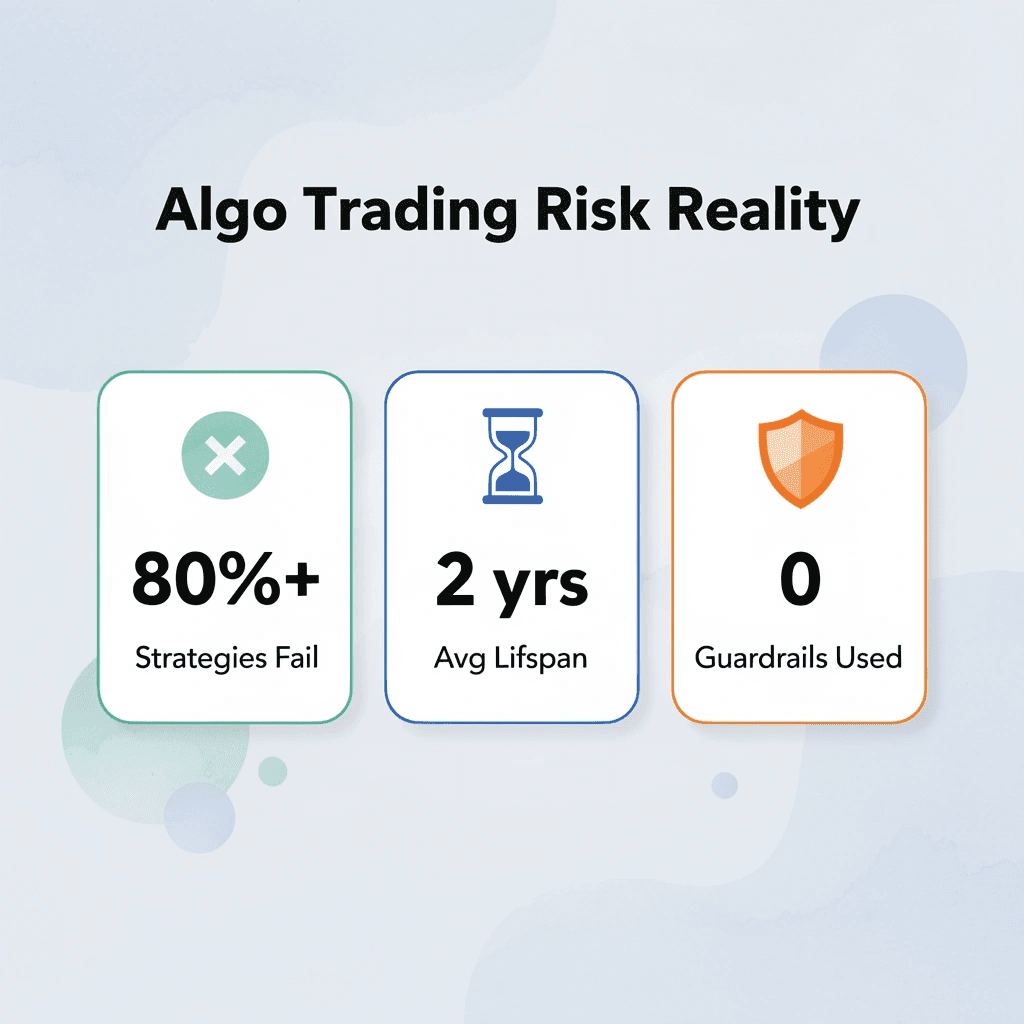
Most algorithmic traders fail not because their strategy was wrong, but because their trading environment lacks guardrails, feedback loops, and consequence architecture that reinforces good behavior. According to the Goat Funded Trader Blog, over 80% of algorithmic trading strategies fail within the first two years without proper risk management. This statistic reflects the absence of structure, not strategy quality.
⚠️ Warning: Chasing better entry signals while ignoring risk architecture is one of the most common — and most costly — mistakes algorithmic traders make.
What enforced limits actually teach you
The failure point is usually not a single bad trade, but rather the slow drift when there's no hard boundary to stop a trader from doubling down after losses. Goat Funded Trader addresses this with maximum daily loss limits around 3% and overall drawdown caps near 6%, applied across simulated accounts holding up to $2M in capital. These aren't suggestions: they're circuit breakers that train position-sizing discipline the same way a weight limit trains a bridge engineer, by making the consequences of excess immediate and unavoidable. Traders who operate within these parameters long enough stop thinking about the limits and start thinking within them, building professional risk behavior.
How does algorithmic trading risk management improve consistency across hundreds of trades?
Research from the Goat Funded Trader Blog reports that traders using structured risk frameworks see up to 30% improvement in consistency. This consistency stems from making fewer catastrophic decisions across hundreds of trades, where real edge preservation occurs.
How simulated capital changes trader psychology
Most algorithmic traders develop strategies using their own money, which introduces fear of real loss: a psychological variable no backtest captures. This fear causes premature exits, mid-session rule changes, and emotional interference that makes technically sound algorithms perform erratically in live conditions. The algorithm stops executing the strategy and starts executing the trader's anxiety instead.
How does removing personal liability support algorithmic trading risk management?
Goat Funded Trader eliminates this problem entirely. With no personal liability on simulated capital, our platform lets traders execute systems without interference, observe performance across volatile conditions, and build patience to distinguish drawdowns from broken strategies. Goat Funded Trader removes time pressure, giving traders unlimited periods to refine systems within our risk framework. This freedom encourages waiting for high-probability setups rather than forcing trades. Bi-weekly rewards, on-demand payouts, and a $1,000 guarantee if processing exceeds two business days create a direct feedback loop between disciplined behavior and tangible results. That direct connection between structure and reward is what most traders spend years trying to build independently.
Related Reading
- How To Learn Crypto Trading
- Best Day Trading App For Beginners
- Risk Management In Stock Trading
- Best Crypto Trading App
- Best Stock Trading App For Beginners
- How Do You Manage Risk In Futures Trading
- How To Read Crypto Charts For Day Trading
- Best Demo Trading Account
- How To Make Money Trading Crypto
- Best Trading Apps For Beginners
Get 25-30% off Today - Sign up to Get Access to Up to $800K Today
The structure you have built across these seven strategies pays off only when the environment around you enforces it. Most traders who understand risk management still lose ground because knowing and doing are separated by real money, real pressure, and temptation to override the plan. Goat Funded Trader closes that gap by putting up to $2 million in simulated capital behind your edge, with enforced drawdown limits and up to 100% profit splits that make disciplined execution the direct path to keeping more of what you earn.
"The rules outlined in this post are already built into the platform — enforced drawdown limits and up to 100% profit splits make disciplined execution the direct path to keeping more of what you earn." — Goat Funded Trader
🔑 Takeaway: Up to $2 million in simulated capital combined with enforced drawdown limits removes the temptation to break your own rules — the #1 reason disciplined traders still lose.

Use code FIRSTGFT for 25–30% off your first account and access up to $800K today. The rules outlined in this post are already built into the platform.
💡 Tip: Don't wait — apply code FIRSTGFT at checkout to unlock 25–30% off and get started with up to $800K in funded capital immediately.
⚠️ Warning: Knowing the right risk management strategies is not enough — without a platform that enforces your rules, real money and real pressure will override even the best plan.
Be Great and get the App