






10 Best Forex Trading Platforms For Beginners in 2026
Compare the 10 best Forex trading platform options for beginners in 202X. Find the right fit to start trading confidently today.


Picture opening a forex app with flashing charts, dozens of currency pairs, and a menu of spreads, leverage, and order types, and feeling stuck about where to start. A best trading simulator can turn that overwhelm into practice time, letting you test strategies on a realistic demo account. What should you look for in the best forex trading platform?
This guide compares brokers, demo accounts, charting tools, mobile apps, execution speed, fees, regulation, risk management features, and educational resources so you can confidently pick and sign up for a beginner-friendly platform, practice trades risk-free, build skills fast, and aim for your first profitable trades without overwhelm or losses.
To help reach those goals, Goat Funded Trader, a funded prop firm, offers a structured program and a practice environment that lets you trade under real trading rules, with support and access to capital, so you can grow into live trading without risking your own funds.
Summary
- Forex platforms are the trader's control room, and with the Forex market trading over $6 trillion per day, they must scale to deliver millisecond execution and deep liquidity to avoid costly slippage.
- MetaTrader dominance shapes onboarding and tooling, with over 90% of retail Forex traders using MetaTrader 4 or 5, which creates community scripts and plugins but does not guarantee training in execution or risk under pressure.
- Beginner attrition is extreme, as about 70% of new Forex traders lose money and roughly 90% quit within the first six months, showing that execution under pressure and rule adherence, not theory, drive early failure.
- Reliable profitability requires robust samples and metrics, for example, aiming for 300+ trades, a profit factor above 1.5, and a Sharpe ratio north of 1 over a full year before scaling position size.
- Retail traders face structural cost disadvantages, since retail accounts make up only about 5.5% of total Forex volume, meaning spreads, commissions, and slippage must be modeled into every backtest, or small edges will evaporate.
- Execution fidelity and security are non-negotiable, with reports that 90% of successful traders use platforms with real-time data feeds and over 70% of traders prioritizing platform security when choosing where to trade.
- This is where Goat Funded Trader fits in; the prop firm addresses the simulation-to-live gap by providing graded evaluation paths, in-house reporting, and scaled simulated capital that mirror funded-account rules.
What is a Forex Trading Platform, and How Does It Work?

A forex trading platform is the live control room where you read prices, place orders, and practice the exact behaviors that either scale capital or burn it. It does more than charting: it routes your orders to liquidity, enforces margin rules, tracks real P&L in real time, and, when done well, gives you a repeatable environment to build consistency under pressure. Use the platform for skill-building, and be honest about limits when that environment is simulated.
What does the platform actually do for your trading day?
It delivers three practical services every minute you trade: market data, order execution, and account management. Market data streams the bid and ask you act on; the execution layer turns your click or algorithm into a matched order; the account layer enforces position sizing, margin, and equity so your math stays disciplined. Real gains come from treating the platform as a discipline enforcer, not just a prettier chart.
How do those orders actually reach the other side?
Orders pass through a broker to liquidity pools, including banks, ECNs, and other brokers. The platform aggregates quotes from those sources, displays the best bid and ask, and then routes your order for execution. That routing happens in milliseconds and operates in the world's largest market. ThePowerMBA (2023) reports that the Forex market is the largest financial market in the world, with a daily trading volume of over $6 trillion, which is why platforms must scale for both speed and depth.
Which platform should you actually learn on?
Most retail traders end up on MetaTrader variants because they are ubiquitous, inexpensive, and supported by hundreds of brokers. Indeed, Mishov Markets (2023) notes that over 90% of retail Forex traders use MetaTrader 4 or MetaTrader 5 as their trading platform. That ubiquity creates real advantages, like community scripts and plugin support, but it also creates blind spots: a tool’s popularity does not guarantee it will teach you how to manage risk under stress or read orderflow.
When we trained traders in an eight-week intensive, a clear pattern emerged: those who treated their platform as a practice lab, layering a few orderflow or execution tools onto basic charts, stopped repeating the same mistakes. Traders who relied exclusively on simple indicators stalled and replayed identical loss patterns. The method change was straightforward, not magical: add higher-fidelity market context, rehearse small, repeat, and make the platform enforce your rules.
Most traders use basic tools because they are familiar, but that comfort costs you consistency
Most traders manage with free charting and a single broker terminal because it requires no extra learning, and it "just works" for small bets. That approach is comfortable, but as position size, speed, or the need to scale increases, fragmentation appears: trade ideas live in one tab, execution in another, and account math in a spreadsheet.
At scale, these gaps produce missed entries, surprise margin calls, and slow payout cycles. Traders find that solutions like Goat Funded Trader give access to large simulated capital, a reliable in-house trading interface, and fast payout mechanics, letting traders iterate faster while preserving realistic constraints; the environment is simulated, so users must still account for live-market slippage and psychology when they transition out of demo.
How do you protect yourself from fake-looking platforms?
Scammers exploit credibility by using familiar engines or glossy UIs, then routing funds through shell identities. It is emotionally brutal when someone loses a large portion of their savings because the platform looked official.
Do the simple checks every time: verify regulatory registration, request proof of live payout history, confirm bank routing information with your bank, and avoid firms that insist on non-standard payment rails. Treat every platform claim with skepticism until you see a verifiable track record.
What tradeoffs should you expect between simulation and live trading?
A simulated platform can replicate price feeds, spreads, and even leverage limits, making it excellent for building routine and risk-taking habits. Simulation cannot fully reproduce liquidity shocks, latency under stress, or the physiological response to real-money losses.
Consider the platform your cockpit trainer: it teaches procedure, muscle memory, and risk math, but you still need staged exposure to live conditions before you assume identical performance with real capital.
Think of the platform as a car cockpit, not the road itself: learning the controls matters, but nothing replaces actual miles driven in weather you did not choose.
That next question is the one that always changes a trader’s timeline.
Related Reading
- Best Trading Simulator
- Is Swing Trading Profitable
- Is Copy Trading Profitable
- Is Crypto Trading Profitable
- Is Options Trading Profitable
- Is Day Trading Profitable
- Are Crypto Trading Bots Profitable
- What Is Backtesting in Trading
- Where Can I Practice Day Trading
- Where Can I Practice Forex Trading Risk-Free?
- How Much Money Do You Need To Start Trading Stocks
- What Is Leverage In Trading
- Is Algorithmic Trading Profitable
- How Much Money Do You Need To Start Trading Options
- What Is The Most Profitable Trading Strateg
- What Is Leverage In Crypto Trading
- How Much Money Do You Need To Start Trading Futures
Is Forex Trading Good for Beginners?

Forex can be useful for beginners, but only if you treat it like a disciplined skill program, not a quick path to easy money. Most new traders underestimate the time, rehearsal, and rule-making required to convert practice into repeatable performance.
Forex trading involves exchanging one currency for another in the global market, aiming to profit from price changes. For those new to investing, it might seem appealing due to its potential to diversify a portfolio through currency trades and related products.
However, it demands a careful approach and thorough preparation because of its complexity. Beginners should prioritize learning about the instruments they plan to use, as numerous platforms offer extensive educational materials to build knowledge before starting.
The foreign exchange market operates around the clock on weekdays, handling daily volumes exceeding $7.5 trillion, making it the world's largest financial arena. Participants buy and sell currency pairs, such as the euro against the US dollar, betting on shifts in value influenced by economic news, interest rates, and global events.
Unlike stock trading, forex doesn't have a central exchange; it's over-the-counter, meaning deals happen directly between parties, often through brokers. This setup offers high accessibility but introduces unique challenges, such as dealing with market makers who may act as counterparties in trades.
Advantages of Forex Trading for Beginners
One key benefit is the minimal capital required to start. Many brokers let newcomers open accounts with as little as $50, enabling small-scale experiments without large upfront commitments. This low barrier to entry contrasts with other markets, such as stocks or futures, where higher initial funds are often required.
Accessibility stands out, too. With the market open 24 hours a day, five days a week, individuals can trade at convenient times that fit around jobs or other obligations. All that's needed is an internet connection and a device, allowing participation from virtually anywhere in the world.
High liquidity is another plus.
The enormous trading volume ensures quick entry and exit from positions with minimal price slippage, especially in major pairs like USD/EUR. This fluidity helps beginners execute strategies without worrying about stuck trades.
Leverage provides amplified exposure. Brokers often offer leverage up to 50:1, meaning a small deposit can control a much larger position, potentially boosting returns. For novices, this can mean starting with modest amounts while gaining experience in real-market dynamics.
Low costs enhance appeal. Spreads (the difference between buy and sell prices) are typically tight, and there are no commission fees in many cases, keeping expenses down compared to other investment types.
Disadvantages and Risks for Beginners
Despite attractions, forex carries significant downsides, particularly for those just starting. Volatility is a major issue; currency values can swing wildly due to news or economic data, leading to rapid losses. Beginners without experience might misjudge these movements, resulting in poor decisions.
Leverage, while beneficial, magnifies risks. A small adverse shift can wipe out an account if not managed properly, as gains and losses are scaled up. Studies show this contributes to high failure rates among retail participants.
The learning curve is steep. Unlike guided stock investing, forex requires self-reliant analysis and discipline, and many quit early due to initial setbacks caused by inadequate knowledge.
Psychological pressures are intense. Emotional trading, like chasing losses or overconfidence after wins, often leads to bigger mistakes. Income variability adds stress, as profits aren't guaranteed and can fluctuate wildly.
Competition and structure pose challenges. Retail traders often face off against sophisticated dealers who control platforms and may profit from client losses.
Forex Trading Success Rates and Statistics
Data reveals a sobering picture for newcomers. According to the Commodity Futures Trading Commission, about two-thirds of over-the-counter forex clients lose money overall, with only one-third profiting after fees and charges. A survey indicates that 85% of retail forex traders fail, with success defined as consistent profitability.
European regulators report 74-89% of retail accounts lose funds when trading contracts for difference, including forex. Only 15% make actual profits, per another analysis, with profitable traders averaging more experience (5.4 years) than losers (2.5 years).
Research from the Bank for International Settlements notes that, while daily volumes are huge, only 6.7% of traders consistently profit each year. A study of day traders found that only 13% maintained profits over six months, with 72% ending the year in the red. These figures underscore that longevity and strategy testing boost odds, but most beginners struggle.
That tension you feel now is exactly why the next part matters more than you expect.
Is Forex Trading Profitable?

Forex can be profitable, but only for a small, disciplined minority who turn a measurable edge into a repeatable process and protect capital while they scale. Profitability is less about finding a secret indicator and more about consistent expectancy, fierce risk control, and shrinking the costs that eat your edge.
Forex trading, the exchange of currencies in the global market, offers the potential for gains but comes with substantial risks. While it is possible to generate profits, success depends heavily on skill, discipline, and realistic expectations rather than luck or quick schemes.
Most retail forex traders struggle to achieve consistent profits. Regulatory disclosures from bodies like the European Securities and Markets Authority (ESMA) and similar reports from brokers indicate that roughly 70-80% of retail accounts lose money over periods of quarters or longer.
Some analyses suggest the figure for profitable accounts hovers around 20-30% in any given quarter, though sustained long-term profitability is rarer, often estimated at 1-3% for those earning a living from it. These numbers challenge the outdated "90% lose" myth, showing a slightly better but still tough landscape for individuals.
Factors That Influence Profitability
Profitability in forex stems from several key elements. Traders who develop a tested strategy, maintain strict risk controls, and avoid excessive leverage tend to fare better. Experience plays a major role—studies show profitable traders often have years of practice, with many enduring initial losses before turning consistent. Proper position sizing, emotional discipline, and market-adaptation skills separate winners from the majority who struggle due to poor habits or overtrading.
The Role of Leverage and Risk Management
High leverage amplifies both gains and losses, making it a double-edged tool in forex. While it allows smaller accounts to access larger positions, it frequently leads to rapid wipeouts for inexperienced traders. Effective risk management—such as limiting risk to 1-2% per trade and using stop-loss orders—is essential for survival and profitability. Those who prioritize capital preservation over chasing big wins build market longevity.
Notable Exceptions and High-Profile Successes
Exceptional cases exist in which traders have achieved massive returns, such as George Soros profiting over a billion dollars by shorting the British Pound in the 1990s. These events highlight that with substantial capital, deep insight, and conviction, outsized gains are possible. However, such outcomes are rare and not replicable for most retail participants, who lack the resources or timing for similar high-conviction bets.
Common Myths Versus Realities
A widespread myth claims that forex trading is an easy path to quick riches, often fueled by promotional content. In reality, it demands extensive learning, patience, and adaptation, with no guaranteed shortcuts. Another misconception is that more trades equal more profits—overtrading typically increases costs and emotional errors, reducing overall returns. Successful traders focus on quality setups and process consistency rather than on trading volume.
Pathways to Improving Chances of Success
To challenge the prevailing low success rates, traders benefit from thorough education, backtesting strategies, and starting with demo accounts. Longer-term approaches, such as swing trading on higher timeframes, often deliver better outcomes for retail participants than high-frequency strategies. Discipline in following a plan, continuous review of trades, and realistic annual return goals (such as 8-15% for experienced traders) help shift odds in one's favor over time.
What objective thresholds show you are ready to risk real capital?
Use a hard checklist: positive expectancy across 300+ trades or multiple regime windows, a profit factor over 1.5, a maximum historical drawdown you can tolerate without changing the rules, and a risk per trade capped so that consecutive losses do not wipe out capital. Run a Monte Carlo that imposes realistic worst-case slippage and requires that your worst-case path still preserves recovery ability. If psychology breaks before the math does, you are not ready to scale.
The raw odds are brutal — the numbers tell part of that story, as ITB Forex Broker (2025) reports that "90% of forex traders lose money", which underscores why systems, not optimism, decide outcomes.
That simple truth changes everything about how you plan the next phase of practice and scale.
Related Reading
- What Is Leverage In Futures Trading
- How To Learn Stock Trading For Beginners
- What Is Leverage In Forex Trading
- How Does After-Hours Trading Work
- How Does Pre-Market Trading Work
- Does Robinhood Allow Day Trading
- Best Practices for Backtesting Trading Strategies
- Backtesting Day Trading Strategies
- How to Set Stop Loss and Take Profit in Trading
- Stop Loss Day Trading
- What Is Take Profit in Trading
- Take Profit vs Stop Loss
- What Is Stop Loss in Trading
- Backtesting Trading Strategies
- Free Backtesting Trading Strategies
- Options Trading For Beginners
- Apps to Practice Day Trading
- How to Practice Day Trading Without Money
11 Best Forex Trading Platforms For Beginners in 2026
These eleven platforms each solve a different beginner problem: some remove cost barriers, some compress learning, and some give you a realistic place to prove consistency before risking personal capital. Pick the constraint you care about most, whether that is demo fidelity, structured education, low cash entry, or a path to funded capital.
1. Goat Funded Trader

Goat Funded Trader stands out in 2026 as a proprietary trading firm that provides beginners with an alternative entry into forex trading by offering access to funded accounts through evaluation challenges or instant funding options.
Launched in 2023, this prop firm enables aspiring traders to demonstrate their skills in simulated environments across forex pairs, indices, commodities, and cryptocurrencies, using platforms such as MetaTrader 5, Match-Trader, and TradeLocker.
With low entry fees for smaller challenges and no traditional deposit minimum beyond challenge costs, it lowers barriers for newcomers who lack large personal capital. User experiences shared on Daily Forex and various prop trading review sites note its appeal for those building experience, though outcomes depend on passing rules-based assessments, and some mixed feedback on support and payouts.
This prop firm approach complements traditional broker platforms by emphasizing performance-based funding, ideal for motivated beginners in forex who prioritize risk-managed growth.
Why Choose It
Goat Funded Trader suits beginners exploring forex without risking substantial personal funds, thanks to its flexible evaluation models (including no-time-limit options), achievable profit targets, and high potential profit splits up to 95-100% on funded accounts, helping novices focus on skill development while trading company capital.
Best For
Beginners and aspiring traders who are motivated, disciplined, and have basic forex knowledge but limited starting capital—particularly those comfortable with challenge-based models, willing to follow strict risk rules, and focused on performance to unlock funded accounts, rather than those needing extensive hand-holding education or guaranteed broker-style support.
Pros
- Low challenge fees and affordable entry points make it accessible for those starting with limited budgets.
- No time limits on most challenges, allowing beginners to trade at their own pace without pressure.
- High profit splits (up to 95-100% with add-ons) and scaling to larger accounts reward consistent performance.
- Flexible rules permitting news trading, overnight/weekend holds, and various strategies like scalping.
- Multiple platform choices (MT5, TradeLocker) with user-friendly dashboards for easier navigation.
- Frequent payout options, including on-demand or bi-weekly, for quicker access to earnings.
- Support for a broad range of assets, enabling diversified practice beyond just forex.
Best Use Cases
- Practicing forex strategies in a simulated funded environment with real profit potential after passing evaluations.
- Scaling trading capital quickly without personal risk once funded, ideal for building a track record.
- Testing consistency rules and risk management in low-stakes challenges before committing to live personal accounts.
- Exploring prop trading as a side path to traditional brokers, especially for disciplined traders seeking leverage on company funds.
- Using instant funding options to bypass multi-phase evaluations and start trading sooner.
Key Features
- Multiple evaluation paths, such as 2-step, 1-step, or 3-step challenges, with clear profit targets (e.g., 8-10% in phases) and minimum trading days for realistic practice.
- Low challenge fees starting at small amounts, making it accessible for beginners to test strategies without a heavy upfront investment.
- Access to a wide range of forex pairs alongside other assets for diversified learning and exposure.
- Platforms, including MT5 and TradeLocke,r with user-friendly interfaces suitable for building foundational technical skills.
- Flexible rules allowing news trading (with some caps) and various styles like scalping, aiding beginners in experimenting safely.
- High profit retention through splits up to 95-100% via add-ons, plus scaling potential to larger accounts as performance improves.
- Payout options include on-demand or frequent schedules (e.g., bi-weekly or triple paydays), supporting gradual confidence-building with real rewards.
2. IG

Established in the UK in 1974, IG is a seasoned provider of trading services, now serving hundreds of thousands of users worldwide through its accessible platforms. In 2026, it continues to appeal to novices by offering a broad selection of assets beyond just forex, including stocks and commodities, all under tight regulatory oversight. With no initial deposit required and tools designed for straightforward navigation, IG helps beginners build confidence as they explore markets in a secure environment. User reviews on Trustpilot praise its reliability and educational support.
Why Choose It
IG earns its spot as the leading overall platform for starters due to its blend of strong security, diverse trading options, and top-notch learning resources, making it easier for new users to grasp concepts without overwhelming complexity.
Key Features
- Robust regulatory compliance from multiple global authorities, providing peace of mind for inexperienced traders.
- Extensive learning materials, including videos and guides, tailored to help novices understand the basics of forex.
- Integration with various third-party tools for simple charting and analysis is suitable for entry-level users.
- Access to a demo account for risk-free practice, ideal for building skills before real trades.
- Competitive pricing with no minimum deposit, lowering the barrier for beginners to start small.
- A responsive support team available to answer questions, crucial for those new to the market.
- A wide range of instruments beyond forex, allowing starters to diversify learning gradually.
3. XTB

Headquartered in Poland since 2004, XTB focuses on delivering value through transparent pricing and user-friendly technology, attracting over half a million clients worldwide. In 2026, its no-deposit requirement and interest on idle funds make it particularly inviting for those dipping their toes into forex. The platform's clean design and educational offerings help simplify the trading process, drawing positive feedback from beginners. Insights from Trustpilot highlight its affordability and ease of use.
Why Choose It
XTB shines for budget-conscious newcomers with low fees, clear pricing, and tools that reduce overall expenses, enabling beginners to focus on learning rather than on high costs.
Key Features
- Zero commission on standard accounts, helping starters keep more of their capital.
- Interest payments on unused cash add a small boost for those building their accounts slowly.
- Advanced yet intuitive charting via xStation 5, perfect for basic technical learning.
- No fees for deposits or withdrawals in most cases, easing financial entry for novices.
- Comprehensive tutorials and webinars to educate users on cost-effective strategies.
- Active trader rebates for growing volumes, rewarding progression without pressure.
- Strong customer assistance is essential for resolving beginner queries quickly.
4. AvaTrade

Founded in Ireland in 2006, AvaTrade supports a global user base through its straightforward setup and focus on education, executing millions of trades each month. By 2026, its low entry deposit of $100 and demo options make it a go-to for beginners. The platform's rich resources, such as articles and live sessions, build foundational knowledge, as noted in Trustpilot reviews.
Why Choose It
AvaTrade is selected as the best choice for novices thanks to its intuitive interface, practice accounts, and extensive educational content, which together create a nurturing environment for learning forex fundamentals.
Key Features
- Demo accounts for unlimited practice, allowing beginners to test strategies safely.
- Wide array of learning tools, from videos to market insights, designed for quick comprehension.
- Competitive spreads without commissions, keeping costs low for small trades.
- Multilingual support is available around the clock to aid global starters.
- Integration with analysis tools for simple signal interpretation.
- Low minimum deposit, making it accessible for those with limited funds.
- Diverse instruments for gradual exploration beyond basic forex pairs.
5. Pepperstone

Starting in Australia in 2010, Pepperstone has grown into a regulated broker emphasizing speed and advanced features, now available in over 160 countries. For 2026 beginners, its no-minimum setup and educational partnerships offer a pathway to develop trading abilities. While geared toward more active users, its tools can be scaled for starters, as user comments on Trustpilot note.
Why Choose It
Pepperstone appeals to aspiring traders by providing fast execution and scalable tools, helping beginners transition to more sophisticated approaches as they gain experience.
Key Features
- Ultra-low latency for quick trades, reducing slippage for novice entries.
- Multiple platform options like MT4 and cTrader, with beginner-friendly customizations.
- Guaranteed stops (with fees) for risk management, vital for new users.
- Social trading integrations to learn from others' strategies.
- Rebates for higher volumes, encouraging steady practice.
- Negative balance protection to cap losses at the investment amount.
- Educational webinars focused on advanced basics for progression.
6. CMC Markets

Launched in the UK in 1989 and publicly listed, CMC Markets offers a vast array of instruments to over a million users, prioritizing innovation and accessibility. In 2026, its demo features and no-deposit start make it beginner-friendly, with platforms that support hands-on experience. Reviews from Trustpilot emphasize its educational depth and user experience.
Why Choose It
CMC Markets stands out for energetic starters with its blend of demo practice, diverse assets, and intuitive tech, fostering an engaging environment to hone trading skills.
Key Features
- Unlimited demo account for experimenting with various strategies.
- Over 175 forex pairs for broad exposure without overload.
- Next Generation platform with easy navigation and built-in education.
- Transparent pricing with active discounts, affordable for growing activity.
- Community forums for sharing insights with peers.
- Mobile apps optimized for on-the-go learning.
- Risk tools, such as stop-losses, to protect beginner portfolios.
7. FOREX.com

FOREX.com, established in 2004 and now part of StoneX Group, delivers a polished experience to users across multiple continents, backed by strong regulatory oversight. In 2026, its mobile-focused design stands out for newcomers who prefer trading on smartphones or tablets, complemented by solid educational content to guide them through the initial steps. The $100 minimum deposit and intuitive apps make it approachable, earning praise in Trustpilot reviews for its usability and learning tools.
Why Choose It
FOREX.com excels for beginners who value on-the-go trading, thanks to its highly customizable mobile app, comprehensive education academy, and reliable platforms that simplify the learning process while providing essential market insights.
Key Features
- Award-winning mobile app with advanced charting via TradingView integration for easy analysis.
- Trading Academy offers interactive courses, videos, and quizzes tailored to different skill levels.
- Demo accounts mirror live conditions so you can practice without financial exposure.
- Performance analytics tools to review personal trading patterns and improve habits.
- Competitive spreads on major pairs with no commissions on standard accounts.
- 24/5 multilingual support to assist new users with setup and questions.
- Economic calendar and research feeds to stay informed about market events.
8. tastyfx
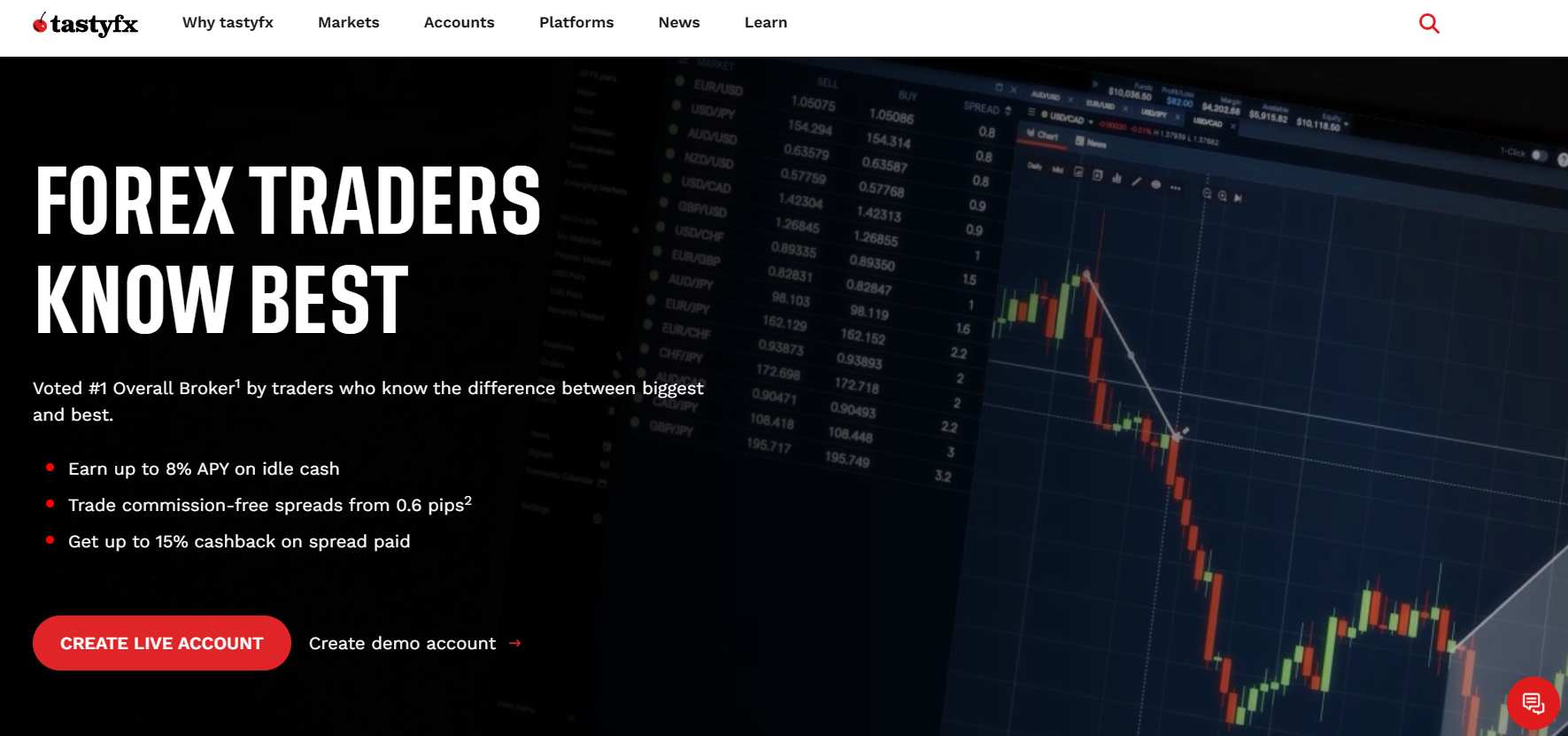
Launched in 2024 as IG's dedicated U.S. brand, tastyfx builds on decades of proven infrastructure to serve American traders with forex-focused services. By 2026, it will offer a smooth, trusted setup with no overwhelming extras, making it ideal for those in regulated U.S. environments seeking straightforward entry. Its low deposit requirement and educational resources receive strong user feedback on ForexBrokers.com.
Why Choose It
tastyfx stands out among U.S.-based options for its high trust rating, competitive U.S.-compliant features, and a blend of simple platforms and robust tools, offering a secure, practical introduction to forex without complexity.
Key Features
- Access to over 80 forex pairs with competitive spreads starting near zero on premium options.
- Platforms including MetaTrader 4 and ProRealTime for structured charting and beginner automation.
- Signals from tools like AutoChartist to help identify potential opportunities.
- Low $100 minimum deposit, enabling small-scale starts under CFTC rules.
- Fast execution and rebates for building volume over time.
- Educational content from IG's network, including guides and market commentary.
- Strong regulatory oversight with high trust scores for added security.
9. Interactive Brokers

Interactive Brokers (IBKR), a globally respected name with vast resources, supports forex alongside other assets for users in multiple regions, including the U.S. In 2026, while its depth suits growing traders, simplified options like the Client Portal and mobile app make it viable for motivated beginners willing to learn. Its zero minimum and tight pricing draw acclaim on ForexBrokers.com.
Why Choose It
Interactive Brokers appeals to beginners with ambition through ultra-low costs, extensive research, and flexible platforms that scale as skills improve, though it rewards those who invest time in mastering its features.
Key Features
- No minimum deposit, allowing tiny test trades to start learning.
- Aggregated interbank pricing for transparent, tight spreads without markups.
- Trader Workstation and simpler apps with economic calendars and news integration.
- Traders' Academy with courses and quizzes covering forex fundamentals.
- Vast research from multiple providers, including forex-specific insights.
- Mobile app for monitoring and basic trading on the move.
- High regulatory standards across numerous Tier-1 bodies for reliability.
10. Charles Schwab

Charles Schwab integrates forex into its broader brokerage ecosystem via the thinkorswim platform, appealing to both those already familiar with the brand and those seeking multi-asset exposure. For 2026 beginners in the U.S., the zero minimum and strong support network provide a comfortable entry, with forex-specific educational webinars. Reviews on ForexBrokers.com highlight the platform's strengths.
Why Choose It
Charles Schwab suits starters with existing accounts or those wanting reliable support, offering a powerful yet educational platform suite with no deposit requirement and access to a broad market context.
Key Features
- $0 minimum deposit for forex access through thinkorswim.
- Advanced charting with hundreds of indicators for visual learning.
- Demo mode in thinkorswim for safe strategy testing.
- Extensive webinars, podcasts, and courses covering technical basics.
- Knowledgeable support staff available for guidance.
- Commission-free forex trades based on spreads.
- Integration with other Schwab tools for diversified learning.
11. OANDA

OANDA, with roots dating back to 1996, remains a go-to for research-driven trading in 2026, offering user-friendly platforms and no minimum deposit. Its focus on clear market analysis and micro-lot trading helps beginners build understanding gradually, earning recognition on ForexBrokers.com for research and beginner suitability.
Why Choose It
OANDA is ideal for research-focused newcomers thanks to its high-quality daily insights, intuitive interfaces, and flexible small-position trading, fostering informed decisions from the start.
Key Features
- No minimum deposit with micro-lot trading for low-risk practice.
- MarketPulse and Trade Tap Blog for accessible daily analysis and education.
- User-friendly Trade platform with TradingView charts and indicators.
- MT4 support for those preferring familiar tools.
- Autochartist signals to aid pattern recognition.
- Webinars and video content for structured learning.
- Strong multi-Tier-1 regulation ensuring trustworthiness.
Most traders feel stuck because their tools reward shortcuts. The harder truth is that the better path is a disciplined, instrumented practice field that turns behavior into data, then rewards consistency with scaled access to capital. That is where the next step becomes decisive.
The surprising crack in your plan shows up when you actually pick a platform and trade for 30 days without a clear readiness checklist.
How to Choose the Best Forex Trading Platform For Your Goals

Pick the platform that enforces the exact constraints you need to become repeatable and scalable, not the one with the flashiest indicators. Choose for funded-path compatibility, reliable in-house reporting, and payout mechanics that match your timeline, then validate those claims with short, objective tests before you commit time or capital.
Selecting an appropriate forex trading platform requires aligning it with your personal objectives, whether you're aiming for short-term gains through day trading or long-term positions based on economic trends. Factors like your risk tolerance, capital availability, and preferred strategies play a crucial role in this decision.
A well-chosen platform can enhance efficiency and profitability, while a poor match might lead to frustration and losses. By systematically evaluating key aspects, you can identify a setup that supports your unique needs in the dynamic currency market.
Assess Your Trading Goals and Experience Level
Begin by clarifying what you want to achieve, such as focusing on major currency pairs for stability or exotic ones for higher volatility, and determine if you're a novice needing simple tools or an expert requiring advanced analytics. Your experience influences the complexity of the platform you can handle effectively.
For beginners, opt for user-friendly interfaces with basic charting to build confidence gradually, while seasoned traders might prioritize customizable dashboards for intricate strategies. This self-assessment ensures the platform complements your skill set and helps avoid overwhelming features that could hinder progress.
Check Regulation and Security
Prioritize platforms overseen by reputable authorities to safeguard your investments from fraud and ensure fair practices. In the US, look for registration with the Commodity Futures Trading Commission (CFTC) and membership in the National Futures Association (NFA), which enforces strict capital requirements and client fund segregation.
Security features such as two-factor authentication, encrypted data transmission, and segregated accounts help protect against cyber threats and broker insolvency. Verifying these elements builds trust, as regulated entities must adhere to transparency rules, reducing the risk of manipulative behaviors in your trading activities.
Evaluate Trading Costs
Analyze the fee structure, including spreads (the gap between buy and sell prices), commissions per trade, and any inactivity charges, as these directly impact your net returns. Competitive platforms often feature tight spreads on popular pairs, sometimes as low as 0.1 pips, combined with low or no commissions for high-volume traders.
Hidden costs, such as overnight swap fees or withdrawal charges, can accumulate, so compare total expenses across brokers. Choosing a cost-effective option aligned with your trading frequency—such as variable spreads for scalpers—helps maximize profits while minimizing unnecessary outflows.
Examine Platform Features and Usability
Review the software's interface for intuitiveness, ensuring quick navigation and customizable layouts that suit your workflow. Essential tools include real-time charts, technical indicators such as moving averages, and automated trading via algorithms.
Mobile compatibility allows monitoring positions on the go, while integration with third-party apps enhances analysis. A platform with a clean design reduces errors during fast-paced sessions, making it ideal for achieving goals like precise entry and exit points in volatile markets.
Consider Available Instruments and Markets
Examine the range of currency pairs offered, from majors like EUR/USD to minors and exotics, to ensure diversification opportunities that match your strategy. Some platforms also provide access to commodities, indices, or cryptocurrencies, broadening your portfolio.
A diverse selection supports goals like hedging risks across assets or capitalizing on global events. Platforms with extensive markets enable flexible responses to economic shifts, helping you pursue varied objectives without switching providers.
Review Leverage and Margin Options
Assess the leverage ratios available, such as up to 50:1 in the US, which amplify positions but increase risk exposure. Higher leverage suits aggressive goals but requires strict margin management to avoid liquidations.
Understanding margin requirements— the minimum equity needed—helps align with your capital goals. Platforms offering flexible leverage let you tailor your approach to a conservative or ambitious one, ensuring you don't overextend while pursuing growth.
Look at Account Types and Minimum Deposits
Explore options like micro accounts for small starting balances or standard ones for larger trades, ensuring the minimum deposit fits your budget. Low-entry accounts, sometimes as little as $50, are ideal for testing strategies without significant commitment.
Different types cater to different goals, such as Islamic accounts that avoid swaps for religious compliance. Selecting the right one supports gradual scaling and aligns with your financial situation and long-term forex aspirations.
Assess Customer Support Quality
Evaluate response times and availability, preferring 24/5 live chat, phone, or email support to resolve issues during market hours. Multilingual assistance benefits global users, while knowledgeable staff can guide on platform-specific queries.
Reliable support minimizes downtime, which is crucial for time-sensitive goals like responding to news events. Platforms with strong service foster confidence, ensuring help is at hand for technical glitches or account concerns.
Explore Educational and Research Resources
Check for tutorials, webinars, and market analysis to build skills, especially if your goal includes ongoing learning. Comprehensive resources, such as economic calendars and expert insights, aid informed decision-making.
Platforms investing in education support progression from beginner to advanced levels. These tools align with goals by providing data-driven strategies that help you navigate forex complexities effectively.
Test with Demo Accounts
Utilize practice environments to simulate real trading without financial risk, testing features against your goals. Demos mirror live conditions, allowing for strategy refinement and platform familiarity.
This step reveals usability issues early, ensuring the chosen setup meets expectations. Regular demo use supports skill development, bridging the gap to live trading for better goal attainment.
Check Deposit and Withdrawal Methods
Review funding options like bank transfers, cards, or e-wallets for convenience and speed, ensuring low fees and quick processing. Secure, varied methods facilitate smooth capital management aligned with your trading pace.
Efficient withdrawals are vital for accessing profits and supporting goals such as reinvestment or cashing out. Platforms with straightforward processes reduce frustration, keeping focus on market opportunities.
Consider Execution Speed and Reliability
Prioritize platforms with fast order fulfillment to capture optimal prices, especially in volatile conditions. Low latency and uptime above 99% prevent slippage that could derail your strategies.
Reliable execution supports precise goal pursuit, such as scalping, which requires split-second actions. Testing during peak hours ensures the platform handles your needs without disruptions.
Leverage Prop Firm Funding
Proprietary trading firms provide capital to skilled traders, allowing access to larger accounts without personal risk, which ties into platform choice by enabling the use of advanced setups through funded programs. This approach lets you select platforms compatible with firm requirements, focusing on performance to achieve profit-sharing goals.
Proprietary trading firms like Goat Funded Trader offer challenges and instant funding models for forex, with profit splits up to 100% and scaling to $2 million, integrating with platforms like TradeLocker or MT5. By passing their evaluations, you gain funded access, aligning platform selection with low-risk growth objectives while leveraging their resources for enhanced trading capacity.
Ready to boost your forex journey with funded capital? Sign up with Goat Funded Trader today to bypass personal risk and choose a platform that powers your goals through their proven funding paths.
Related Reading
- Best Automated Trading Platform
- Best Paper Trading Platform
- Best Stock Trading Simulator
- Best Copy Trading Platform
- Best App For Day Trading
- Best Day Trading Platform For Beginners
- Best Software for Backtesting Trading Strategies
- Best Chart Trading Platform
- Best App for Backtesting Trading Strategies
- Best Stock Trading Platform For Beginners
- How To Practice Day Trading
- Best Automated Trading Platform
- Best Trading Simulator Free
- Best Crypto Trading Simulator
- Best Futures Trading Platform
- Best Trading Simulator App
- Best Options Trading Simulator
- Best Options Trading Platform
- Best Futures Trading Simulator
Get 25-30% off Today - Sign up to Get Access to Up to $800K Today
You don’t have to risk real savings to step up your game; after structured demo work, consider Goat Funded Trader as the next practical step. Traders find it turns scattered practice into verifiable performance with enforced rules, centralized reporting, and a clear funded path that makes proving consistency a real, fast-moving milestone.
Be Great and get the App