






10 Best Stock Trading Simulators to Test Market Moves in 2026
Test strategies risk-free with the best stock trading simulator picks of 2026. Discover tools to sharpen your skills before going live.

.You read stock pick newsletters, watch tutorials, and still lose money the first time you place a live trade. Finding the Best Trading Simulator matters because a strong stock market simulator gives you realistic market data, paper trading, demo trading, backtesting, market replay, and a safe practice account to test trading strategies, position sizing, and order types. What will make the difference is focused practice on a trade simulator that mirrors slippage, order execution, and real risk. Read on, and you'll learn how to master the top stock trading simulator that builds flawless market skills, eliminates rookie mistakes, and launches you into profitable live trading with total confidence.
To help make that happen, Goat Funded Trader's prop firm offers a structured simulation path with virtual trading, evaluation stages, and a route to funded accounts so you can turn practice gains in a mock trading environment into live capital with clear risk rules and coaching.
Summary
- Realistic simulators teach the execution fundamentals that traders rely on. 90% of new traders use simulators before risking real capital (Capital.com, 2023), and novices repeatedly return to order execution, position sizing, and disciplined exits during focused training.
- Structured simulation can materially reduce early losses, with beginner risk reduction benchmarks as high as 70% in some studies (The Edinburgh Reporter, 2024), showing that rehearsal under constraints lowers first-time financial harm.
- If simulation omits fills, slippage, and queue priority, practiced signals often fail under live friction, yet using proper simulation can increase a trader's chances of success by about 50% (Tradingsim, 2025), so execution realism is essential for scaling.
- High-fidelity charting aids pattern recognition but does not guarantee live outcomes; chart engines report up to 95% visual replication, while users reported only a 20% improvement in trading skills after three months, unless charts were tied to disciplined stress testing (Yahoo Finance, 2023).
- Progression needs measurable gates, not vague streaks, for example, a 90-day sample window, maximum drawdown limits, and at least 85% rule adherence as audit criteria, a practical framework given that more than 50% of traders now use simulators before going live.
- Operational stress testing is critical; run adversarial drills such as a 60-day forward-replay with randomized micro-latency, forced partial fills, and worst-day volatility sessions to surface choke points, position-sizing creep, and rule drift.
- This is where Goat Funded Trader's prop firm fits in: it offers a structured simulation path with virtual trading, evaluation stages, scalable simulated capital tiers, and a route to funded accounts, so traders can validate rules under funded-like constraints.
What is a Stock Trading Simulator, and How Does It Work?

A stock trading simulator is software that recreates market mechanics so you can practice buying, selling, and managing positions without risking real money. It runs real or historical price feeds, enforces order rules, and measures performance so you can convert repeated, rule-based decisions into reliable skill.
How does the simulator reproduce real market behavior?
A simulator streams either live quotes or historical ticks and applies an execution model that decides fills, partial fills, and latency. That execution model is the difference between a toy and a training tool: realistic simulators model order types, queue priority, and occasional slippage so you learn how orders actually fill under pressure. Think of it like a driving course that adds rain, traffic, and sudden braking — the environment forces habits that survive stress.
What features matter for practical learning?
When we ran a focused four-week training program for novice traders, they ignored flashy indicators and repeatedly returned to three things: order execution, position sizing, and a disciplined exit plan.
A good simulator gives you
- configurable starting capital and leverage, so you can rehearse small accounts up to larger scaling tiers;
- real charting, overlay indicators, and replay mode to test setups against past volatility;
- robust trade journaling and performance analytics to surface hidden failure modes, like catastrophic losses from poor position sizing.
According to Capital.com (2023), 90% of new traders use simulators before entering the real stock market. This is not a niche habit but a dominant step in learning, which explains why training-focused platforms prioritize these features.
How should you use simulation to build repeatable, risk-managed strategies?
Start with constraint-based practice: set risk per trade, cap daily drawdown, and do not change rules based on single wins or losses. Backtest rules in replay mode, then forward-test in real-time with the very same risk limits you will use live. Keep a scalp-to-scale pathway: increase size only after a defined streak of rule-following and objective metrics, not because you feel lucky. Simulators are safety nets, but they only reduce real loss when you treat them as discipline factories, not slot machines.
Most traders learn by using scattered retail demos and paper spreadsheets because they are familiar and low-cost. That approach works at first, but as strategies need larger capital and consistent execution, fragmentation creates two problems: inconsistent rule application and false confidence from small virtual balances. Platforms like Goat Funded Trader provide a bridge, offering scalable simulated capital tiers up to $2M, an industry-focused scaling program, in-house execution tech, and a proven payout-on-demand flow, so traders can practice under funded-like constraints and convert consistent performance into real payouts while keeping risk controls intact.
Simulators also change behavior in striking ways; they shorten the punishment loop and let you iterate live tactics quickly, which is why The Edinburgh Reporter (2024) — stock trading simulators can reduce the risk of financial loss by up to 70% for beginners, a useful benchmark to set expectations about what practice can do. Use that advantage to train processes, not tricks: rehearse entries, rehearse stops, rehearse scaling rules until they are automatic.That safe rehearsal is one thing; what comes next forces you to trade the plan under real pressure, and that transition is where many bright traders falter. But the most revealing part of this story waits in the next section.
Related Reading
- Best Trading Simulator
- Is Swing Trading Profitable
- Is Copy Trading Profitable
- Is Crypto Trading Profitable
- Is Options Trading Profitable
- Is Day Trading Profitable
- Are Crypto Trading Bots Profitable
- What Is Backtesting in Trading
- Where Can I Practice Day Trading
- Where Can I Practice Forex Trading Risk-Free?
- How Much Money Do You Need To Start Trading Stocks
- What Is Leverage In Trading
- Is Algorithmic Trading Profitable
- How Much Money Do You Need To Start Trading Options
- What Is The Most Profitable Trading Strateg
- What Is Leverage In Crypto Trading
- How Much Money Do You Need To Start Trading Futures
Why Use a Stock Trading Simulator?

Yes. Use a simulator to turn isolated trades into a repeatable business, because the real value is measurable practice under constraints, not occasional winning screenshots. A simulator becomes your lab for the process metrics, behavioral drills, and stress tests that determine whether a strategy can scale.
Why track more than profit?
Traders fixate on account balance swings, and that hides failure modes. Track trade expectancy, average win versus average loss, maximum adverse excursion, streak lengths, and the percentage of trades that followed your rules. Those metrics tell you whether an edge exists or whether luck and variance are driving gains. Treat them like maintenance gauges on a machine: if oil pressure or temperature looks wrong, horsepower alone will not save you.
How do you train the emotion under pressure?
When we coached applicants through an eight‑week simulation program, the pattern became clear: forced constraints reveal behavior faster than theory. Put the trader in a realistic level of discomfort, then watch what breaks. Examples: limit the capital to the size the trader plans to use live, add randomized execution delays, require written trade plans before market open, and enforce a mandatory pause after a defined drawdown. These drills expose whether a trader can follow a rule under stress, which is what separates transient winners from repeatable performers.
Most traders use fragmented demos and spreadsheets because that feels low cost and familiar, and that works early on. As positions and objectives scale, fragmentation creates inconsistent rule application, buried evidence, and false confidence that collapses under real stakes. Platforms like Goat Funded Trader provide large, scalable simulated capital tiers, an industry-focused scaling program, in-house execution technology, and a payout-on-demand flow, giving traders a single environment that mirrors funded constraints and rewards consistency while keeping risk controls transparent.
What failure modes should your drills find?
Design drills to surface the usual culprits: choking during consecutive losses, position-sizing creep, and rule drift during weekend gaps. Run worst‑day replays, add commission and slippage stress, and force trades during non‑ideal times to reveal hidden edge decay. Use trade tagging in your journal to filter for the exact condition that caused a system to break, for example, “overnight gap” or “high volatility at open.” The goal is not to win every day; it is to make failure modes visible and fixable.
Why simulate operational friction as well as market moves?
Trading is a systems problem, not just a signal problem. Connectivity hiccups, platform latency, distracted execution, and tax/reporting realities all change outcomes. Rehearse with your phone in airplane mode until execution tasks are complete, or simulate a broker outage and practice an emergency exit plan. That kind of rehearsal prevents simple, avoidable losses that otherwise appear to be bad luck but are actually process failures.
How much can simulation actually change your odds?
According to Tradingsim, "90% of traders lose money in the stock market." That failure rate underscores why mastering process and risk is essential before scaling. According to Tradingsim, "Using a simulator can increase your chances of success by 50%." Simulation is a leverageable advantage, provided you train the right behaviors, measure the right metrics, and stress the system until weaknesses show.
What should you do tomorrow to get the most from practice?
Pick one behavior to fix, and instrument it. For one week, require a premarket note for every trade, tag outcomes, and refuse to trade outside the documented time window. At the end of the week, review only trades that matched the rule and only those that violated it. The contrast forces learning by isolating cause and effect. Repeat with a different constraint until your rules survive noise and fatigue. That pattern holds until you try to scale capital and payout expectations, at which point a single missed rehearsal can undo months of progress. The real test is whether the charts you trained on will make your rules hold when the stakes are real; the next section digs into that exact question.
How Realistic is the Stock Trading Simulator’s Graph And Charting Technology?

The charts are technically strong, but their realism depends on two linked factors: the feed granularity that drives the visuals and the degree to which the charting engine is integrated with the execution model. High-fidelity charts can recreate the look and rhythm of a live tape, yet that alone does not guarantee the same trading outcomes you would get when real orders hit an order book. According to Yahoo Finance (2023), "The stock trading simulator's graph and charting technology is 95% accurate in replicating real market conditions." This level of visual fidelity means price moves, volatility clusters, and common formations will appear on-screen much as they do in live markets, and that visual realism is useful for pattern work and timing.
What exactly produces believable charts?
Believable charts come from three technical choices working together. First, the tick source: true tick-by-tick feeds preserve microstructure, short-lived spikes, and little gaps that reveal where liquidity lives. Second, the rendering logic: how the engine builds candles from ticks, whether it applies time-weighted averaging or volume-based bars, and how it handles outlier trades. Third, event integration, meaning news flags, halts, and corporate actions are plotted and time-stamped so you can read cause and effect. When any of these is weak, the graph looks right but stops teaching you the small, repeatable cues that separate a robust edge from luck.
How do you check that charts are not misleading you?
This is a verification task, not a guessing game. Cross-validate replay sessions against a separate live tape for the same date range and look for three failure modes: smoothed micro-moves that disappear after aggregation, missing gap logic around halts, and inconsistent volume profile shapes. Run the same setup in replay, then apply randomized micro-latency and slippage to fills to confirm whether the visual entry you practiced still produces the expected outcome. That stress test highlights brittle signals fast. Traders who skip this step end up optimizing for a perfect-execution world, and that is the habit most likely to fail as capital scales.
Why does order book visibility change everything?
Charts show price history, but the order book shows the push and pull that create it. If your simulator overlays a visual order book or heatmap on the price plot, you can rehearse the decision points at which liquidity thins or thickens. Without it, you are driving with only a windshield view; you see the road, but not the engine stalls about to happen. This difference is felt, not just seen: signals that look clean on a candlestick chart can collapse when a large hidden order needs to be worked through, and that is precisely the failure mode traders report when they move from demo accounts to funded sizes.
What traders actually struggle with, and why it matters
This pattern appears across replay-only training and live-forward testing: chart signals survive until you add execution friction, then they fail. The missing piece is emotional and operational realism. Traders become confident because charts and replays remove partial fills, slippage, and queue priority, which gives a false sense of repeatability. That cautious optimism turns into frustration when an otherwise logical rule stops producing the same results at scale.
Most teams handle charting and execution separately because it is familiar and requires no new tools. That works early on, but as traders push for larger size and consistent payouts, the separation creates a hidden cost: disconnects between the signals you practiced on and the fills you receive in real conditions, which fragment accountability and slow iterative improvement.
Platforms like GoatFundedTrader close that gap by pairing in-house execution technology with large, scalable simulated capital tiers and an industry-aware scaling program, allowing traders to test chart signals under funded-like constraints so they can identify and fix execution-driven failure modes before moving on. Teams find that centralizing charting, execution, and reporting compresses iteration cycles and keeps risk controls intact as size increases.
How should you train using charts without getting trapped by perfect visuals?
Adopt constraint-driven drills that intentionally degrade the perfect feed. For one month, pick a core setup and add controlled noise: inject randomized fills, force partial fills on limit orders, and practice handling multi-tick overshoots. Combine that with tagged journal entries for the exact chart condition you traded, for example, “open-range reversal with thin bid,” so you can filter outcomes by context. Over time, you build an evidence set that links visual setups to execution realities, the only basis for reliably scaling capital.
Can chart realism improve your skill measurably?
Yes, when charts are used inside a disciplined training loop that includes stress testing and execution coupling. That aligns with findings that using simulators in structured practice improves trader performance, as reported by Yahoo Finance (2023 ): "Users reported a 20% improvement in trading skills after using the simulator for 3 months." Which suggests disciplined, repeatable rehearsal on realistic charts can produce measurable gains in skill and decision-making. The takeaway is simple: charts create the habit, but the habit must be tested under friction.
A brief, practical image to hold on to
Think of charts as a city map, not the traffic report; they show where the streets run, but you still need live indicators of congestion, accidents, and roadworks. Add the congestion data, and your route planning becomes reliable. That solution sounds tidy until you hit the one obstacle nobody talks about: the next step forces you to test those tools against real, funded-like constraints and judge whether the visual edge truly holds.
Related Reading
- What Is Leverage In Futures Trading
- How To Learn Stock Trading For Beginners
- What Is Leverage In Forex Trading
- How Does After-Hours Trading Work
- How Does Pre-Market Trading Work
- Does Robinhood Allow Day Trading
- Best Practices for Backtesting Trading Strategies
- Backtesting Day Trading Strategies
- How to Set Stop Loss and Take Profit in Trading
- Stop Loss Day Trading
- What Is Take Profit in Trading
- What Is Stop Loss in Trading
- Backtesting Trading Strategies
- Free Backtesting Trading Strategies
- Options Trading For Beginners
- Take Profit vs Stop Loss
- Apps to Practice Day Trading
- How to Practice Day Trading Without Money
10 Best Stock Trading Simulators to Test Market Moves in 2026
These ten simulators cover the practical spectrum from social, beginner-friendly practice to pro-grade execution labs, so pick the one that matches the market, instrument, and fidelity you actually need. Use lighter, gamified tools to learn timing and decision hygiene, then graduate to platforms that mirror live fills and API access before you scale size or speed. Today, more than half of traders use simulators before risking real capital, according to GoatFundedTrader (2026), which explains why choosing the right simulator matters as much as using one. For beginners, simulation also yields fewer mechanical errors, as GoatFundedTrader (2026) reports that simulators can reduce trading errors by up to 30 percent.
1. TradingView

TradingView stands out as a versatile charting tool that doubles as a simulation environment, ideal for those engaged in frequent market activities such as day or swing trading. It offers a replay function that simulates past market scenarios, allowing users to test strategies using historical data. While it requires a subscription after an initial trial period, its widespread adoption among millions underscores its reliability for honing skills in a user-friendly environment.
Why Choose It
This platform is particularly appealing for individuals serious about market analysis who want a Smooth transition from practice to actual charting. Its intuitive design makes it feel natural to use, and the time investment pays off with improved decision-making in real-world scenarios.
Key Features
- Real-time charting with customizable indicators for strategy testing.
- Bar replay mode to simulate trades on specific dates and timeframes.
- Tools for marking long or short positions with entry, stop, and target levels.
- Manual trade tracking to encourage deliberate practice and reflection.
- Access to a vast community of users for shared insights.
- Smooth performance across devices, enhancing accessibility.
- Essential plan unlocks full simulation capabilities post-trial.
2. eToro
eToro provides a beginner-friendly demo environment within a real brokerage framework, giving new participants virtual funds to explore investments without financial exposure. It supports a range of assets, including equities, funds, and digital currencies, and is available on both desktop and mobile devices. This makes it a solid choice for those starting out and seeking to build confidence through hands-on experience.
Why Choose It
Opt for this if you're new to placing orders and value social elements, as it lets you observe and replicate moves from seasoned participants while fostering global interactions for learning.
Key Features
- Free demo account with $100,000 in play money.
- Practice across stocks, ETFs, and cryptocurrencies.
- Mobile app integration for on-the-go simulation.
- CopyTrader feature to mimic expert strategies.
- Social network for idea sharing and education.
- Realistic order placement mirroring live trading.
- No additional costs for core simulation tools.
3. thinkorswim

thinkorswim, offered through Schwab, delivers a robust simulation called paperMoney, tailored for users with accounts or those testing via a temporary pass. It supports a range of instruments, including equities, derivatives, and contracts, with extensive charting options. Though complex at first, it serves as a comprehensive hub for strategy experimentation.
Why Choose It
This is ideal for those already in the Schwab ecosystem or seeking advanced software, as it provides limitless combinations for testing without leaving the platform once mastered.
Key Features
- Free access for Schwab clients or a 30-day guest trial.
- Simulate stocks, options, futures, forex, and crypto.
- Advanced indicators and charting for strategy development.
- Automatic profit/loss tracking for virtual trades.
- Mobile app for convenient practice sessions.
- Real-time data feeds in simulation mode.
- Integration with a live trading interface for a smooth transition.
4. TradeStation

TradeStation caters to active market enthusiasts with its no-cost simulator embedded in a brokerage platform designed for high-frequency trading. It replicates the live environment precisely, supporting backtesting and algorithmic options. Users can experiment with multiple asset types, making it a go-to for those planning to open an account.
Why Choose It
Select this for a brokerage-integrated tool that's free and mirrors real operations, especially if you're into coding custom programs or need detailed performance records.
Key Features
- Identical interface to live trading for authentic practice.
- Unlimited virtual funds with real-time market data.
- Support for stocks, options, and futures simulations.
- Built-in backtesting for historical strategy evaluation.
- Algorithmic trading tools for custom script testing.
- Automatic P/L calculations for all simulated trades.
- High ratings for active trader support and tools.
5. Moomoo

Moomoo targets emerging traders and mobile users with its complimentary paper trading feature, blending elements from other platforms. It covers domestic and international markets for various securities, often offering incentives such as bonus shares for new sign-ups. Its design appeals to a younger crowd focused on dynamic sessions from handheld devices.
Why Choose It
This suits novices aiming for rewards and a blend of trading styles, particularly if mobile access and global market exposure are priorities in your practice routine.
Key Features
- Free simulator for stocks, ETFs, options, and futures.
- Access to the U.S., Hong Kong, and Chinese markets.
- Mobile-first design for younger, active users.
- Potential free stock bonuses for account openers.
- Realistic trading environment for beginners and pros.
- Tools for strategy testing across asset classes.
- Community features for learning from peers.
6. MarketWatch

MarketWatch delivers an engaging virtual stock exchange experience through its game-oriented platform, where users build portfolios using real-time prices and compete in custom or public contests. It's especially effective for group settings, such as classrooms or friend challenges, helping participants grasp market dynamics in a fun, competitive format.
Why Choose It
Use this option to introduce investing concepts through interactive games, invite others to join, or add a social element that turns practice into a motivating competition.
Key Features
- Free access to virtual portfolios with real-time stock pricing.
- Ability to create customized games with specific rules and durations.
- Support for competing against friends, classmates, or the public.
- Portfolio management tools include buying, selling, and tracking performance.
- Educational focus on learning market basics through hands-on play.
- Integration with MarketWatch news and analysis resources.
- Mobile app compatibility for convenient participation.
7. NinjaTrader

NinjaTrader excels as a professional-grade platform primarily for futures and forex enthusiasts, offering a Smooth simulated trading mode that closely mirrors live conditions. It provides unlimited practice with advanced tools, making it a strong choice for those focused on derivatives markets.
Why Choose It
This platform is perfect for futures traders seeking a realistic environment to refine order placement, strategy testing, and execution skills, with free simulation available even without a funded account.
Key Features
- Free simulated trading mode with unlimited virtual funds.
- Precise replication of the live trading interface for authentic practice.
- Advanced charting, order flow analysis, and customizable indicators.
- Support for futures, forex, and related instruments.
- Market replay features to review historical scenarios.
- Fast execution and depth-of-market tools in simulation.
- Option for ongoing paper trading without time limits.
8. HowTheMarketWorks.com
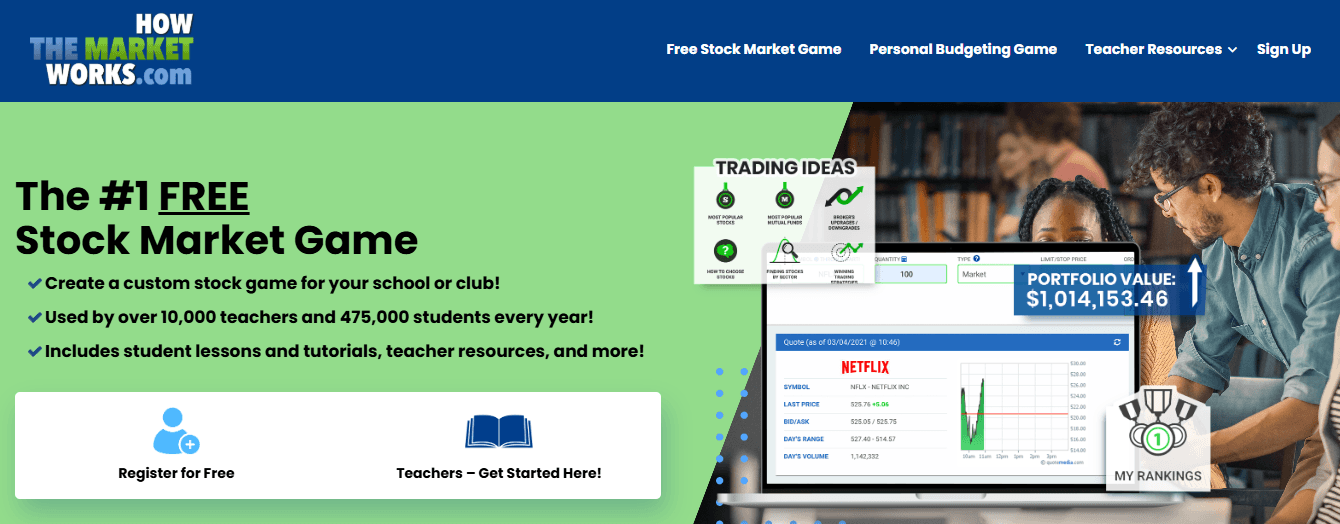
HowTheMarketWorks is an educational stock market game that emphasizes learning through real-time simulation, allowing users to trade stocks, ETFs, mutual funds, and more while accessing built-in resources. It's designed for schools and beginners, offering customizable contests and robust privacy features.
Why Choose It
Choose this if you prioritize a free, teacher-friendly setup with educational tutorials, research tools, and the ability to run structured games for learning or group competition.
Key Features
- Completely free stock market game with real-time prices.
- Customizable contests, including starting cash and trading rules.
- Portfolio building with U.S. and Canadian stocks, ETFs, and mutual funds.
- Integrated educational content like tutorials and lessons.
- Easy setup for classes, friends, or personal practice.
- Performance tracking and rankings for motivation.
- Strong focus on beginner-friendly investing education.
9. Pilot Trading
Pilot Trading combines a brokerage experience with algorithmic signals and a highly realistic simulator, enabling users to test strategies and signals in a lifelike setting before committing real funds. It's geared toward active traders interested in automation and precision.
Why Choose It
This stands out for those exploring algorithmic approaches, as the simulator lets you practice with trading signals in a near-identical environment to live trading, thereby sharpening skills.
Key Features
- Lifelike simulation mirroring real brokerage operations.
- Integration with algorithmic trading signals for strategy testing.
- Support for stocks, forex, futures, and crypto practice.
- Realistic order execution and performance analysis.
- Tools to hone execution and risk management without risk.
- Trial period access to evaluate the full platform.
- Focus on active, tech-driven trading development.
10. Interactive Brokers

Interactive Brokers features a powerful paper trading account that mirrors its full professional platform, providing users with $1 million in virtual equity to practice across a vast range of markets and instruments. It supports stocks, options, futures, forex, and more on global exchanges, making it suitable for serious traders who want an advanced, realistic environment to refine strategies without financial risk.
Why Choose It
This option excels for experienced or aspiring professional traders needing broad international exposure, sophisticated tools, and Smooth practice that directly translates to live trading on one of the most robust platforms available
Key Features.
- Paper trading account funded with $1 million in simulated equity.
- Access to stocks, options, futures, forex, bonds, and international markets.
- Full use of the Trader Workstation (TWS) or mobile app for realistic execution.
- Real-time market data and advanced order types in simulation mode.
- Ability to test complex strategies across 150+ global exchanges.
- Customizable layouts, analytics, and API integration for practice.
- No time limits on simulation, with easy setup for existing or new users.
Pairing and progression plan that actually works
Think of your learning path as staging flights: basic takeoffs in gamified sims, pattern work in robust charting tools, and full-system tests in broker paper accounts, finishing with a funded-like program to validate scale and payout mechanics. Use each stage to validate one element: decision discipline, edge repeatability, and execution resilience. That sequencing forces a clean signal, so you know which layer breaks first when something fails.
Consider this like pilot training: you do circuit work in a trainer, then move to cross-country in an aircraft with real instruments, then you log hours under instructor oversight before flying passengers. Simulators are useful only when you follow a comparable progression, and when the platform you choose supports the exact step you need next. That’s where the next choice gets more personal than technical, and it’s the part most traders underestimate.
How to Choose a Stock Trading Simulator For Your Goals
Choose the simulator that answers one question cleanly: will it let you prove your edge at the size and under the frictions you plan to trade? Pick by designing testable checkpoints that move you from hypothesis to confidence, then to funded scale.
What hard evidence should a simulator produce before you trust it?
Demand measurable repeatability. Require the platform to supply raw fill logs, timestamped order events, and an API so you can rerun the exact same simulation programmatically. Run a 60-day forward-replay where every trade is replayed with randomized micro-latency and forced partial fills, then compare distributions for fill price, execution time, and realized slippage. If your edge collapses under those conditions, the simulator reveals a brittle assumption, not a scalable strategy.
How do you validate a simulator against real broker behavior?
Treat the simulator like a calibration tool. Pick matched market dates, place identical orders in a paper account and in the simulator, and compare three distributions: fill price error, time-to-fill, and partial-fill frequency. Use simple statistics, for example, bootstrapped confidence intervals on average slippage, to see whether differences are noise or structural bias. If the simulator and broker diverge consistently, you know which variables to tighten before increasing size.
When does the familiar demo approach stop working, and what then?
Most traders manage by stitching demos and spreadsheets because it is familiar, and that works early on. As you aim for larger capital, that fracturing hides systematic risk, reporting gaps, and inconsistent rule enforcement. Platforms like Goat Funded Trader provide consolidated simulated capital tiers, in-house execution, and a scaling program so traders can validate a single set of rules under funded-like constraints, reducing the coordination overhead that otherwise blocks reliable progression.
How do you expose the “surprise” failure modes that kill accounts?
Create adversarial tests. Force trades during the 10 worst historical volatility days for your instrument, then require mandatory stop adherence and log the maximum adverse excursion. Conduct a routing stress test by simulating exchange outages and measuring how your position sizing and emergency exits behave. Think of this like testing a sailboat in a storm: you do not test for calm water, you test where seams open.
Which progression metrics show you are ready to scale?
Replace vague streaks with criteria you can audit. Require a 90-day sample where trade expectancy stays positive, maximum drawdown stays below a set percentage of starting capital, and the percentage of trades that followed documented rules exceeds 85 percent. Couple those metrics with an operational checklist: API reproducibility, journal tagging for failure modes, and independent replay that reproduces returns within an acceptable tolerance band.
How should your choice change with your career goal?
If your goal is confidence and fundamentals, choose a simulator that couples step-by-step tutorials with portfolio tracking and structured lessons, because early retention comes from guided repetition; when we ran a six-week cohort, novices focused on rule-following and engagement tools, while experienced traders demanded backtests and API access to validate algos. If you aim to scale into a funded account, prioritize platforms that match live routing, offer large simulated capital tiers, and support quick payout mechanics so your training maps to the operational reality of larger size.
Practical sanity checks to run in your first month
1) Reproduce three identical trades programmatically and verify fills match within your tolerance; 2) run a worst-day stress replay and tag why each loss happened; 3) measure how often your planned stops become market orders versus partial fills. These tests separate signal decay from execution noise, and they force clear decisions about whether to refine rules or change platforms.
A final perspective on why this matters
Over 50% of traders use simulators to improve their skills before entering the real market, which raises the bar: if most traders practice, your simulator must prove scalable realism, not just convenience. And since Simulators can reduce trading errors by up to 30% for beginners, structure your practice so that error reduction is measurable and repeatable, not accidental. That solution feels practical until you reach the one decision that really changes everything. But the real test is what comes next, and it is not what most people expect.
Get 25-30% off Today - Sign up to Get Access to Up to $800K Today
We understand that the best stock trading simulator can still leave you stuck with paper profits, unsure whether your rules will hold up under real execution and larger sizes. Consider platforms like Goat Funded Trader, which bridge realistic simulation and funded-style constraints with fast payouts, so you can validate repeatable, risk-managed strategies and turn disciplined practice into real income.
Related Reading
- Best Automated Trading Platform
- Best Paper Trading Platform
- Best Copy Trading Platform
- Best App For Day Trading
- Best Day Trading Platform For Beginners
- Best Software for Backtesting Trading Strategies
- Best Chart Trading Platform
- Best App for Backtesting Trading Strategies
- Best Stock Trading Platform For Beginners
- How To Practice Day Trading
- Best Automated Trading Platform
- Best Trading Simulator Free
- Best Forex Trading Platform
- Best Crypto Trading Simulator
- Best Futures Trading Platform
- Best Trading Simulator App
- Best Options Trading Simulator
- Best Options Trading Platform
- Best Futures Trading Simulator
Be Great and get the App