






How to Make Money Trading Crypto: 10 Strategies for Beginners
How to make money trading crypto starts here. Goat Funded Trader breaks down 10 beginner strategies that actually work.


Crypto markets move fast, and most traders who lose money do so not because they picked the wrong coins but because they had no real plan. Understanding how to use AI for crypto trading has given serious traders sharper data, faster signals, and a clearer edge when entering and exiting positions. The 10 strategies covered here are designed to help traders grow their portfolios with more confidence, manage risk effectively, and avoid the costly mistakes that wipe out most beginners.
For those ready to apply these strategies without risking personal capital, there is a practical next step. Goat Funded Trader is a prop firm that provides access to funded accounts, allowing traders to take larger positions and keep a share of the profits, while built-in risk controls help protect against account-ending losses.
Summary
- Roughly 80% of day traders lose money within their first year, and the primary cause is rarely a lack of market knowledge. The absence of a structured process, including defined position sizing, stop-loss discipline, and a trading journal, accounts for most failures. Traders who treat early trading as a data-collection exercise rather than an income stream consistently outperform those chasing immediate returns.
- Capital size shapes trading behavior more than most beginners expect. Small accounts create psychological pressure that leads traders to break their own rules, chase losses, and increase leverage to compensate for limited position sizes. A $100 account experiencing a 15% adverse move feels catastrophic in percentage terms, triggering panic-driven decisions unrelated to strategy quality.
- Leverage is one of the most misunderstood tools in crypto trading. A 10x leveraged position gets fully liquidated by a single 10% adverse move, and crypto markets routinely deliver that kind of swing within a single afternoon. Leverage does not solve an undercapitalization problem; it accelerates its consequences, which is why position sizing (typically 1 to 2% of total capital per trade) remains the primary risk-management tool for traders who survive long enough to compound.
- Only 1% of day traders consistently profit over time, including experienced veterans with years of market exposure. Experience without a defined, tested process yields the same outcome as inexperience. The traders who build consistency are those who validated their edge across enough trades to generate real performance data and protected their capital long enough to let that edge play out repeatedly.
- Crypto now has over 500 million users worldwide, according to the a16z State of Crypto Report 2025, making it a global financial system with deep liquidity and intense competition. At that scale, the relevant question is no longer whether opportunity exists in the market. The question is whether a trader's strategy, risk controls, and available capital are sized appropriately to capture that opportunity consistently.
- The gap between skill and earnings often comes down to account size rather than strategy quality. A 5% monthly return on a $2,000 account generates $100; the same edge applied to a $200,000 account generates $10,000. Goat Funded Trader addresses this by offering traders a structured evaluation pathway to access institutional-scale simulated accounts, with profit splits up to 90% and on-demand payouts, so capital constraints no longer limit traders whose process is already sound.
What is Crypto Trading, and How Does It Work?
Crypto trading means actively buying and selling digital assets to make money from price changes—not just holding them and hoping prices go up. You open a position, the market moves, and you close it at a higher or lower price than when you started. Profitable traders succeed by using repeatable processes built on analysis, timing, and disciplined risk management—not luck.
"Profitable traders succeed by using repeatable processes built on analysis, timing, and disciplined risk management—not luck." — Core Principle of Active Trading
💡 Example: A trader buys Bitcoin at $60,000, waits for the price to rise, then closes the position at $65,000—pocketing the difference through active decision-making, not passive holding.
⚠️ Warning: Confusing crypto trading with crypto investing is one of the most common beginner mistakes. Trading is active and short-term; investing is passive and long-term.
Concept: Crypto Trading
- Time Horizon: Short-term
- Goal: Profit from price swings
- Activity Level: Active — frequent decisions
- Key Skill: Analysis & timing
- Risk Type: Execution risk
Concept: Crypto Holding (HODLing)
- Time Horizon: Long-term
- Goal: Profit from overall growth
- Activity Level: Passive — buy and wait
- Key Skill: Patience & conviction
- Risk Type: Market risk
🔑 Takeaway: Crypto trading is a skill-based discipline. Success comes from process, analysis, and risk management—not guesswork.

Why do crypto markets demand a structured routine to make money trading crypto?
Charles Schwab notes that crypto markets operate 24/7, so price-moving events occur outside regular business hours. A regulatory announcement in Asia, a whale wallet moving Bitcoin at 3 am, or a protocol upgrade can shift prices before most traders wake up. Traders who build structured routines around specific sessions and defined setups outperform those who react to every alert.
What actually moves prices
Most new traders fail because they focus only on price charts and miss the full picture. Price is the output, not the input. Behind every candlestick pattern lie the fundamentals: transaction volume on the network, token creation mechanisms (such as Bitcoin halvings that predictably reduce coin supply), large investor movements, and macroeconomic signals like interest rate changes that shift global risk appetite. Technical analysis shows where price might go; fundamentals show why. Traders who use both have a significant advantage over those relying on one alone.
The leverage problem most traders ignore
Leverage is where trading careers end too early. Borrowing money to control a position ten times your account size promises faster profits, but the math works the same way in both directions: a 10% move against a 10x leveraged position wipes out your entire account. The problem isn't using leverage; it's using leverage before you have the discipline to manage it. Position sizing rules exist because even skilled traders go through losing streaks. These rules—risking no more than 1 to 2 percent of total capital per trade—keep you in the game long enough for your edge to grow.
How does account size limit how much money you can trade in crypto?
Most traders fund their own accounts, scaling up slowly as they save capital and absorb losses personally. This creates a hidden cost: skill development slows when account size limits position sizing. A trader with a $2,000 account who applies strict position-sizing rules places trades that are too small to generate meaningful returns, even when every decision is correct. Prop firms like Goat Funded Trader address this by giving skilled traders access to significantly larger simulated funded accounts, up to $2M, shifting the conversation from "how do I grow my account" to "how do I prove my skill and get funded." The capital constraint disappears; the skill requirement remains.
Why does market size matter when making money trading crypto?
According to the a16z Crypto State of Crypto Report 2025, crypto has over 500 million users worldwide. The market is a global financial system with substantial capital flows and intense competition, not a small experiment. In a market this large, the question is never whether opportunity exists; it's whether your strategy, risk controls, and capital are sized to consistently capture it.
What most traders discover too late is that the answer to "how much can I make" depends far less on strategy than on one variable almost nobody discusses upfront.
Related Reading
- How to Use AI for Crypto Trading
- What Are Crypto Trading Signals
- How Long Does It Take To Learn Forex Trading
- What Is Spot Trading in Crypto
- Is Paper Trading Real Money
- Emotional Trading Mistakes
- Common Mistakes in Stock Trading
- Crypto Trading Mistakes
- Forward Testing Trading
- Paper Trading Vs Live Trading
- Risk Reward Ratio Trading
How Much Money Do You Need to Start Trading Crypto?
Capital is the variable nobody discusses upfront. Not strategy, not indicators, not the perfect entry signal. The size of your account shapes every decision you make, including whether you can afford to be wrong.
"The size of your account shapes every decision you make — including whether you can afford to be wrong."
💡 Tip: Before obsessing over entry signals or chart patterns, get clear on your starting capital — it's the single most important variable that determines your risk tolerance, your position sizing, and your long-term survival in the market.
⚠️ Warning: Most beginner traders focus on finding the right strategy when the real limiting factor is account size. A small, underfunded account forces you into high-risk decisions that a well-capitalized trader would never need to make.
Account Size
- Why It Matters: Determines how much risk you can absorb per trade
Position Sizing
- Why It Matters: Scales directly with your available capital
Margin & Leverage
- Why It Matters: Smaller accounts are more vulnerable to margin calls
Emotional Pressure
- Why It Matters: Underfunded traders make fear-driven decisions

What is a realistic starting amount to make money trading crypto?
Platforms like Coinbase and Binance accept accounts with as little as $10, but accessibility doesn't equal practicality. According to Audacity Capital, a realistic starting range for meaningful trading is between $500 and $1,000. Gas fees on certain networks can exceed the value of a small position before a trade closes. Spreads and withdrawal charges compound this problem. A $50 account doesn't give a strategy room to breathe; it gives fees room to feed.
Why small accounts create emotional traps, not learning opportunities
The failure point is usually psychological before it is financial. When your entire account is $100 and a position moves 15% against you, the dollar loss is small, but the percentage feels bad. Aspiring traders stop following their rules and start chasing, doubling down on losing trades because panic overrides strategy. That emotional spiral is what underfunding produces reliably across thousands of accounts, regardless of skill level.
Why does adding leverage make undercapitalization worse, not better?
Most traders respond by adding leverage to compensate for thin capital. A 10x leveraged position on a $100 account gets liquidated by a single 10% adverse move—crypto routinely delivers that in an afternoon. Leverage does not solve undercapitalization; it accelerates its consequences. The traders who survive their first year almost always treat position sizing as their primary risk management tool.
How can you make money trading crypto without grinding up from a small base?
This shifts the conversation from "how much do I need" to "how do I access more without risking more." Most people assume the only way is to save and work hard to move up from a small starting amount. A prop firm like Goat Funded Trader offers a different model: prove your skill through structured evaluation and trade with significantly more capital than you personally own, with up to a 100% profit split and on-demand payouts. Personal financial risk stays small while trading capacity does not.
What responsible risk sizing actually looks like in practice
Even with sufficient capital, position sizing determines whether you survive long enough to grow your money. According to Audacity Capital, risking no more than 1-2% of your trading capital per trade helps protect your account from losing everything in a single bad trade. On a $500 account, that means risking $5 to $10 per trade—small enough to survive 50 consecutive losing trades before your account depletes. This safety net allows a strategy to prove itself over sufficient attempts to generate meaningful data.
Profitability and capital size are inseparable.
Is Crypto Trading Profitable for Beginners?
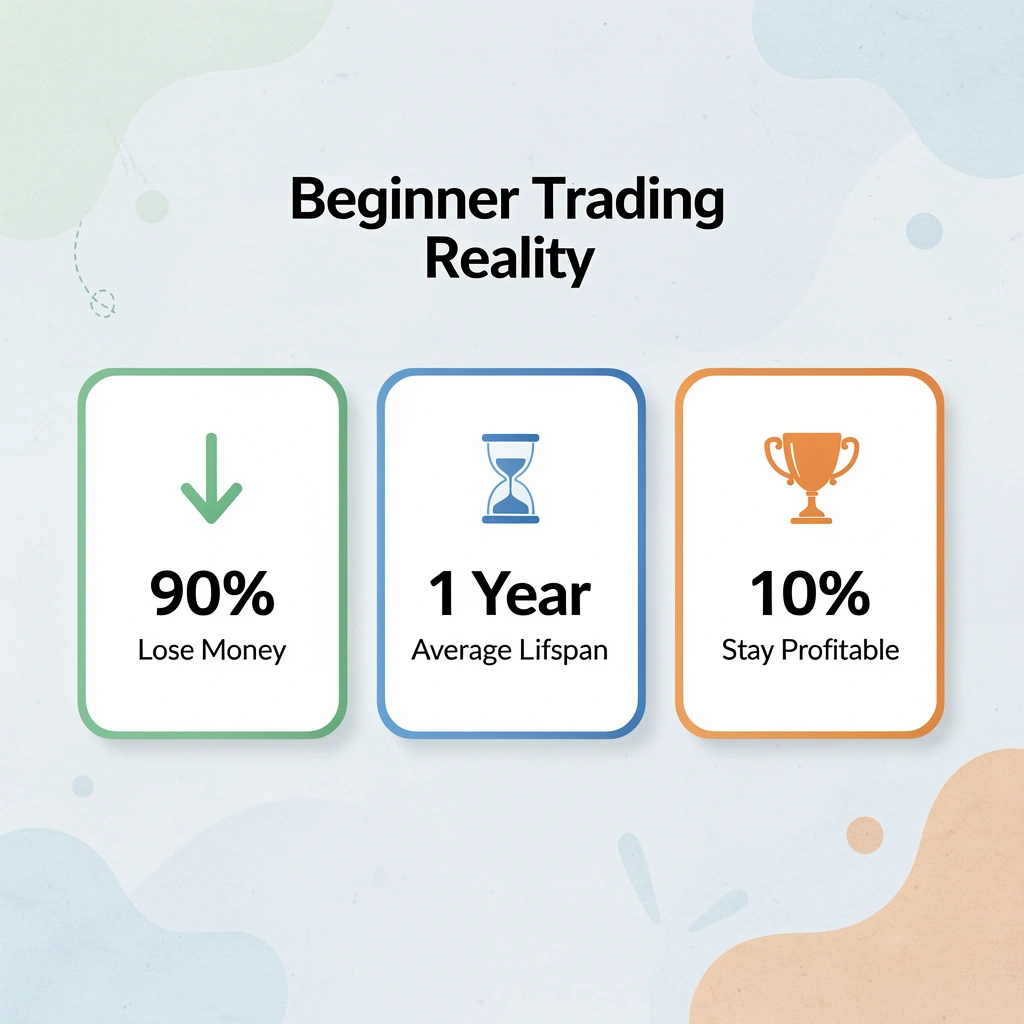
Crypto trading can make money for beginners, but it's hard without the right start. Studies show 90% of traders lose money within a year, mostly because of bad habits like using too much borrowed money and not having ways to control risk. The real problem is no organization: no rules for how much to trade, no stop-loss discipline, no trading journal, no plan.
"90% of traders lose money within a year — mostly due to poor risk management and a complete lack of trading structure." — The Street
⚠️ Warning: The #1 reason beginners fail isn't bad luck — it's skipping the fundamentals: no position sizing rules, no stop-losses, and no trading journal to learn from mistakes.
🔑 Takeaway: 90% failure within one year is a staggering stat — but it also means the 10% who succeed share one thing in common: a structured, disciplined approach from day one.
Common Beginner Mistake: No stop-loss discipline
Why It Causes Losses: Let's lose trades spiral out of control
Common Beginner Mistake: Over-leveraging (borrowed money)
Why It Causes Losses: Amplifies losses beyond the account balance
Common Beginner Mistake: No trading journal
Why It Causes Losses: Prevents learning from past mistakes
Common Beginner Mistake: No position sizing rules
Why It Causes Losses: Risks too much capital on a single trade
What separates beginners who profit from those who don't
The failure point is usually not the market, but the behavior it triggers. New traders are drawn to platforms offering extreme leverage—sometimes 150x on perpetual contracts—without understanding that a 0.7% move against them wipes out the position entirely. Platform design encourages this through low fees, signup bonuses, and TradingView integrations that make traders feel professionally ready, while the critical gap—knowing how to size a position and manage risk—goes unaddressed. Excitement about tools is not competence in risk management.
Why do beginners who make money trading crypto treat it as a data exercise?
Beginners who make money share one thing in common: they treat early trading as information gathering rather than income generation. They start by trading major pairs like BTC/USDT, risk the same small amount per trade (usually 1% of their account), and document every entry and exit. This approach builds a performance record. Without a record, there is no way to learn from results, and without learning, there is no way to improve.
How does capital size affect your ability to make money trading crypto?
Most beginners underestimate how money limits shape decision-making. When an entire account is $500 and a single trade represents a meaningful portion of savings, emotional interference becomes unavoidable. The math of small accounts forces traders toward higher leverage to chase returns worth the effort—the behavior that accelerates losses. Traders who access larger capital through Goat Funded Trader can apply disciplined, low-leverage strategies and generate meaningful returns, since position sizes are larger even when risk percentage remains small.
Does experience actually matter?
One trader built from nothing, only to drop 60-70% from the peak during slumps, repeatedly returning to the starting point due to emotional entries. Another endured six-month periods of missed moves before persistence paid off. These cases demonstrate how skipping risk management turns volatility into sustained drawdowns. Experience without process produces the same outcome as inexperience without process.
Can beginners learn how to make money trading crypto with the right process?
The traders who build consistency—whether they started six months or six years ago—are those who defined their edge, tested it across enough trades to validate it, and protected their capital long enough to let it play out. Beginners can do all of that. It requires treating the learning phase as a non-negotiable cost of entry, not an obstacle to skip.
The real question is not whether beginners can profit, but whether you are willing to build the process before demanding results, because the market has no patience for those who reverse that order.
Related Reading
- Crypto Trading For Beginners
- Fear Of Missing Out And Trading
- Discipline In Trading
- Common Forex Trading Mistakes Beginners
- Trading Risk Management 1% Rule Explained
- Risk Management Day Trading
- ICT Trading Strategy For Beginners Step By Step
- Trading Risk Management Strategies
- Algorithmic Trading Risk Management
How to Make Money Trading Crypto: 9 Strategies for Beginners
Crypto trading offers multiple ways to make money, from holding investments for a long time to buying and selling frequently in the short term. Beginners do well by starting with simple strategies, controlling their risk carefully, and growing their trading as they learn more. Learning about trading and staying disciplined matter more than trying to make quick money in a fast-changing market.
"The traders who succeed long-term are not the ones chasing quick wins — they're the ones who master simple strategies, control risk carefully, and stay disciplined as the market evolves." — Crypto Trading Principle
💡 Tip: Beginners should always prioritize risk management over chasing high returns — protecting your capital is the real foundation of long-term success.
⚠️ Warning: A fast-moving crypto market can wipe out unprepared traders quickly. Never skip the learning phase in pursuit of quick profits.
Long-term Holding
- Best For: Patient beginners
- Risk Level: Low–Medium
Short-term Trading
- Best For: Active, experienced traders
- Risk Level: High
Simple Rule-Based Strategies
- Best For: New traders building discipline
- Risk Level: Medium
🎯 Key Point: Discipline and education are your most valuable assets as a beginner — not luck or timing the market perfectly.

1. Buy and Hold (HODL)
This strategy involves buying cryptocurrencies and holding them long-term, regardless of short-term price fluctuations. You benefit from the market's historical growth, driven by increasing adoption and limited coin supply.
How to Use It: Pick well-known cryptocurrencies like Bitcoin or Ethereum. Set aside money you can leave invested for years. Store your coins safely in a hardware wallet. Rebalance your investments occasionally, but avoid selling frequently when prices fluctuate.
Why Traders Use It: This approach reduces trading fees and taxes while requiring minimal daily management. It suits beginners well, leveraging the compounding effect of crypto's long-term potential.
2. Day Trading
Day trading involves buying and selling multiple times within the same day to profit from intraday price movements. It requires constant market monitoring and quick decision-making based on charts and trading volume.
Use technical indicators like RSI to identify overbought or oversold signals, set tight stop-losses, and limit each trade to a small percentage of your capital. Practice on demo accounts before trading with real money on low-fee platforms.
This method captures frequent small gains in a 24/7 market and avoids overnight risks. Skilled traders achieve consistent returns through volume, though it requires strong emotional control to succeed.
3. Arbitrage Trading
Arbitrage takes advantage of price differences for the same asset across exchanges. Traders buy low on one platform and sell higher on another for theoretically risk-free profits.
Watch prices across centralized and decentralized exchanges using tools or bots, account for transfer fees and times, and execute simultaneous trades. Start with liquid pairs like BTC/USDT to reduce slippage.
The unregulated nature of crypto creates ongoing inefficiencies. This strategy offers lower volatility exposure compared to directional bets and provides steady gains when executed efficiently.
4. Range Trading
Range trading takes advantage of prices moving between support and resistance levels. Traders buy near support and sell near resistance while prices remain within these boundaries.
Find ranges on higher timeframes using candlestick patterns and tools like Bollinger Bands. Place buy orders at the lower boundary and sell orders at the upper boundary, with stops just outside the range to protect your capital.
Crypto markets often consolidate, creating opportunities for repeated trading. This method offers clear risk-reward setups suited for beginners learning technical analysis without needing to predict trends perfectly.
5. Scalping
Scalping means making dozens or hundreds of trades to capture small price movements lasting seconds to minutes through high volume and precision.
Use automated bots or advanced charting on low-fee exchanges, focus on highly liquid pairs, and employ tight spreads with one-tick targets. Maintain strict daily profit goals and cut losses immediately.
It builds up profits through trading frequency rather than large moves, and works well in volatile conditions, with less time your money is at risk per position than with longer holds.
6. Lending and Borrowing
Lending platforms enable crypto holders to earn interest by providing assets to borrowers, generating passive income through DeFi protocols or centralized services.
Deposit stablecoins or major cryptocurrencies on regulated platforms like Aave or established lenders. Select terms with favorable APYs and monitor collateral requirements. Start small and diversify across protocols to spread platform risk.
Yields often exceed those of traditional savings accounts while allowing owners to maintain exposure to potential price appreciation and to provide steady returns during sideways markets without the need for active trading.
7. Staking
Staking locks up tokens to support proof-of-stake blockchain operations in exchange for rewards, allowing participants to secure the network while generating income.
Choose networks like Ethereum, select validators or pools through wallets or exchanges, and commit assets for the required period. Liquid staking options maintain flexibility with tradable receipt tokens.
Rewards compound over time with low effort after setup, offering better returns than idle holdings for compatible assets while aligning incentives with network health.
8. Mining
Mining checks transactions on proof-of-work networks by solving mathematical puzzles and earns block rewards, converting hardware and electricity into new cryptocurrency.
Join mining pools with ASIC hardware or GPU rigs, find low-cost power sources, and assess profitability using current difficulty and reward schedules. Operational efficiency is essential to staying competitive.
Successful setups create coins directly independent of market direction, appealing to tech-savvy traders seeking to own newly created assets.
9. Running a Master Node
Master nodes run full nodes and perform special functions for the network in exchange for regular payments. Operators must invest significant capital to participate.
How to Use It: Pick compatible blockchains like DASH, lock up the required amount of the token, and run servers with reliable uptime.
Why Traders Use It: It generates predictable passive income for those with capital who can manage the technical setup. The collateral requirement ensures operators are invested in network success and deters misconduct.
10. Yield Farming
Yield farming involves providing liquidity to DeFi pools to earn fees and token rewards. Farmers move assets between protocols to maximize returns.
Give balanced token pairs to automated market makers like Uniswap, lock LP tokens in reward farms, and monitor for impermanent loss. Adjust positions based on APY changes using monitoring tools.
Compounding chances yield high returns during busy periods. Yield farming uses protocol rewards to boost returns beyond what holding or lending alone can provide.
Tools and Resources to Help You Improve Your Crypto Trading Results
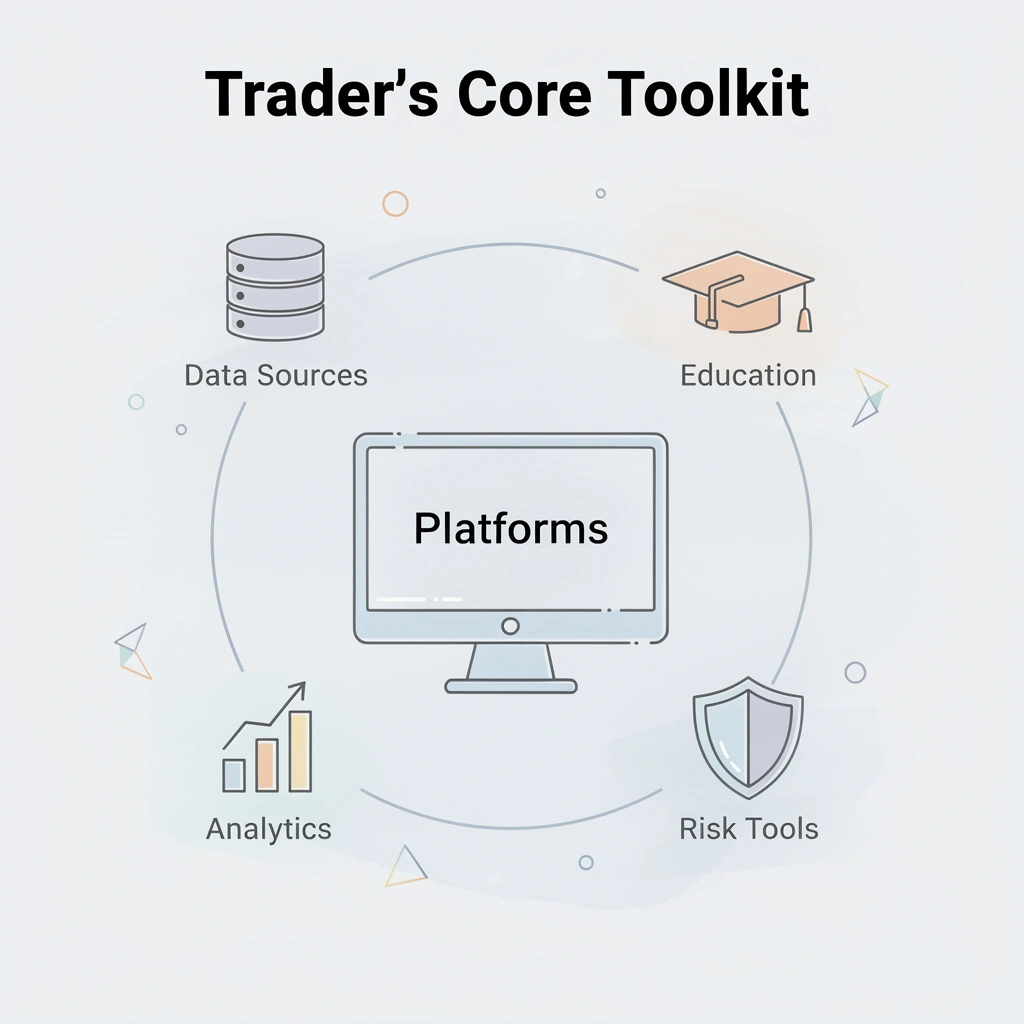
Successful crypto traders depend on platforms, data sources, and educational materials to analyze markets, manage positions, and improve their edge. These tools turn raw information into actionable insights while actively controlling risk in a fast-moving environment.
"The difference between a struggling trader and a consistently profitable one often comes down to the quality of tools they use to interpret data and manage risk." — Industry Insight
💡 Tip: Don't rely on a single platform — the most effective traders combine charting tools, on-chain data sources, and educational resources to build a complete edge in the market.
⚠️ Warning: Using low-quality or unverified data sources is one of the most common mistakes new traders make — always validate your tools before making high-stakes trading decisions.
Trading Platforms
- Purpose: Execute and manage positions
- Impact on Trading: Direct order control and portfolio tracking
Data & Analytics
- Purpose: Market analysis and signals
- Impact on Trading: Turns raw data into actionable insights
Educational Materials
- Purpose: Skill and strategy development
- Impact on Trading: Builds long-term edge and reduces costly errors
TradingView for Advanced Charting
TradingView is the top web-based charting platform, offering thousands of technical indicators, drawing tools, real-time crypto pairs, customizable layouts, and backtesting across multiple timeframes.
Traders use Pine Script to create custom indicators and alerts for key levels and pattern breaks. Social features let beginners follow top analysts and practice in replay mode. The platform supports strategies ranging from simple moving averages to complex multi-indicator systems.
CoinMarketCap and CoinGecko for Market Data
These aggregators provide overviews of thousands of cryptocurrencies with real-time prices, market values, volume rankings, and historical charts, along with fear and greed indexes and on-chain metrics for deeper analysis.
Traders watch dominance percentages, 24-hour movers, and token unlocks to predict volatility. Portfolio tracking features reveal allocation and performance across exchanges, exposing broader market cycles and new opportunities.
Crypto News Aggregators and Alert Services
Websites like CoinDesk, Cointelegraph, and Twitter/X, along with curated lists from trusted analysts, provide quick updates on regulatory changes, security issues, and project developments. RSS feeds and push notifications deliver information without requiring constant monitoring.
Smart traders check multiple sources for reliable information and ignore false signals. They set alerts for specific words or assets to stay ahead of mood shifts that drive price moves.
Portfolio Trackers and Tax Tools
Apps like Delta, Blockfolio (now part of FTX alternatives), or Koinly automatically connect exchange and wallet data to display combined performance, cost basis, and tax reports, calculate realized gains, and support multiple fiat currencies.
These tools demonstrate true profitability beyond individual trade results and simplify tax compliance. Features like goal setting and performance benchmarks encourage disciplined rebalancing and tracking of long-term capital growth.
Secure Wallets and Hardware Solutions
Hardware wallets like Ledger or Trezor work with software options such as MetaMask to provide safe storage and interaction with DeFi protocols. Multisig setups add protection for larger holdings.
Traders move profits off exchanges immediately and use them for staking or lending, while maintaining full control over their private keys. Regular security audits and backup phrase management prevent common loss problems.
Backtesting and Simulation Software
Tools like TradingView and CryptoHopper test strategies against historical data before risking money, measuring win rates, drawdowns, and expectancy across different market conditions.
Systematic traders improve their parameters using out-of-sample data to avoid curve-fitting, build confidence in their approaches, and reveal weaknesses that are invisible during live trading.
Educational Platforms and Communities
Resources from Binance Academy, Investopedia, and active Discord or Reddit groups provide organized learning on technical analysis, risk rules, and psychology. Webinars and recorded sessions accelerate skill development.
Engaged traders participate in review sessions and peer discussions to accelerate improvement while avoiding echo chambers. A consistent study, combined with real-world application, separates those who progress from those who repeat mistakes.
Risk Management Calculators and Journals
Spreadsheet templates or apps like Edgewonk calculate position sizes based on account risk percentage and stop-loss distance. Digital journals log every trade with screenshots, rationale, and post-mortem analysis, enforcing rules like 1% risk per trade and revealing patterns in decision-making over time.
Regular reviews transform losses into specific lessons that improve future performance and protect capital during drawdowns.
Prop Firm Funding
Prop firm funding gives traders access to larger simulated capital without risking personal funds, all for a one-time fee. These programs test skills through challenges and provide funded accounts with shared profits.
Goat Funded Trader offers straightforward rules, up to $2M in simulated capital, 80-100% profit splits, news trading allowance, no time limits, and fast payouts. The platform's MT5 integration and scaling program enable traders to build accounts focused on performance, with built-in risk parameters, including 3% daily loss limits. This removes capital barriers and accelerates growth for consistent traders.
How Goat Funded Trader Helps You Earn More From Crypto Trading
Skill is the entry ticket. Capital determines how much you earn from that skill.
"Skill is the entry ticket. Capital determines how much you earn from that skill."
Skill
- What It Determines: Entry into profitable trading
- Your Edge: Consistent strategy & execution
Capital
- What It Determines: Size of your earnings potential
- Your Edge: Scaled returns on every trade
Funded Account
- What It Determines: Access to larger capital without personal risk
- Your Edge: Maximum earning power
🎯 Key Point: No matter how refined your trading strategy is, your earning potential is directly capped by the capital you deploy — which is exactly why funded trading programs like Goat Funded Trader are a game-changer.
💡 Tip: Don't let limited personal capital be the ceiling on your trading income. A funded account lets your skill do the real heavy lifting — at full scale.
Why does account size limit how much money trading crypto?
Most profitable traders hit an invisible ceiling: their personal accounts are too small to generate meaningful returns, but scaling up risks savings they cannot afford to lose. A 5% monthly return on a $2,000 account yields $100. The same edge on a $200,000 account yields $10,000. The strategy is identical. The outcome is not.
The familiar approach of grinding personal accounts upward over the years works technically but means spending years generating income that barely justifies the time, stress, and discipline required. As traders grow more skilled, the frustration sharpens: the strategy works, risk management holds, but account size keeps earnings small. That gap between ability and reward is where motivation dies.
How does Goat Funded Trader close the gap between skill and earnings?
Goat Funded Trader addresses this directly. Rather than waiting years to save personal capital, traders pass a structured test and gain access to accounts with institutional-scale funds. The platform allows traders to start with challenge accounts from $10,000 in simulated capital, scaling significantly from there, as detailed in our blog on crypto profitability. The evaluation replaces years of slow compounding with a faster, more direct route to meaningful earnings.
What does the profit structure actually look like?
Goat Funded Trader offers up to 90% profit split to funded traders, meaning traders keep most of what their skill generates. With payouts available every two weeks or on demand, the structure functions as a professional trading business rather than a program. Traders often report that this is when trading becomes their primary source of income.
Which rules actually determine how to make money trading crypto here?
The rules are straightforward: a 3% maximum daily loss limit, a 6% overall drawdown cap, no time restrictions, and explicit permission to trade news. That last point matters significantly—many payout disputes in the prop firm space stem from traders violating news trading restrictions. Our rules eliminate this restriction, letting you execute your full strategy without hesitation.
If your edge is already proven, what is the cost of keeping it small?
Related Reading
- How To Read Crypto Charts For Day Trading
- Best Day Trading App For Beginners
- Best Crypto Trading App
- Best Stock Trading App For Beginners
- Best Trading Apps For Beginners
- Risk Management In Stock Trading
- How Do You Manage Risk In Futures Trading
- Best Demo Trading Account
- How To Learn Crypto Trading
Get 25-30% off Today - Sign up to Get Access to up to $800K Today
Every month you trade with undersized accounts, you pay an invisible tax on your skill. Traders who prove their strategy works and join a prop firm like Goat Funded Trader stop paying that tax entirely. With up to $2 million in simulated capital, profit splits of up to 100%, no news trading restrictions, and on-demand payouts within 24 hours, our structure removes every barrier outlined in this post — from capital constraints to emotional risk pressure.
"With up to $2 million in simulated capital and profit splits reaching 100%, Goat Funded Trader removes every barrier standing between your skill and serious earnings." — Goat Funded Trader
🎯 Key Point: The 24-hour payout window and 100% profit split aren't just perks — they're structural advantages that eliminate the two biggest friction points holding skilled traders back.
Capital Access
- Without a Prop Firm: Limited personal funds
- With Goat Funded Trader: Up to $2 million simulated capital
Profit Split
- Without a Prop Firm: 100% risk, limited upside
- With Goat Funded Trader: Up to 100% profit split
Payout Speed
- Without a Prop Firm: Varies, often delayed
- With Goat Funded Trader: On-demand within 24 hours
News Trading
- Without a Prop Firm: Restricted on many platforms
- With Goat Funded Trader: No restrictions
Emotional Pressure
- Without a Prop Firm: High — your money at risk
- With Goat Funded Trader: Reduced — structured risk environment
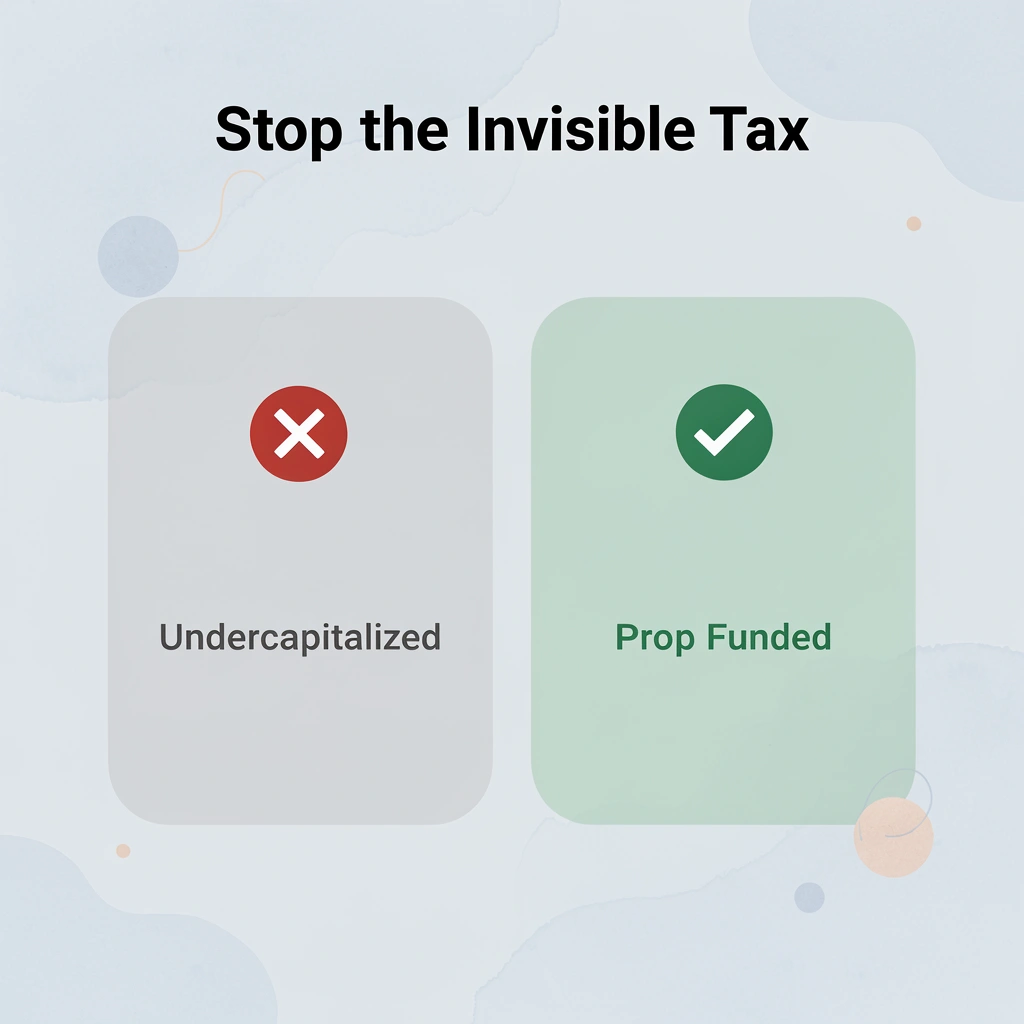
Use code FIRSTGFT for 50% off your first account, complete the challenge, and trade the crypto pairs and strategies you've already built. Your skill is the asset — the capital is waiting.
💡 Tip: Don't let another month pass by paying the invisible tax of undercapitalization. One challenge completion could unlock access to up to $800K in funded capital — today.
⚠️ Warning: Every day you delay is a day your proven strategy generates zero returns at scale. The 25–30% discount with code FIRSTGFT makes it now the lowest-cost entry point available.
Be Great and get the App