






5 Best Free Day Trading Simulators For Beginners in 2026
Best Free Day Trading Simulator guide for beginners in 2026. Learn key features, milestones, and transition tips with Goat Funded Trader’s expert insights.

Trading without risking capital is a practical way to refine strategies. Simulators offer realistic market replays, live quotes, and demo accounts that support practice in order execution and risk management. The Best Trading Simulator provides clear performance metrics and backtesting tools to build confidence in day-trading skills.
Some platforms bridge the gap between simulation and live trading by connecting practice results with structured evaluations. Strong simulator performance can translate into real trading capital when a platform like Goat Funded Trader's prop firm provides a clear path to funded accounts.
Summary
- Realistic simulators matter at scale, with the global Simulators market projected to reach USD 35.77 billion by 2033, signaling faster feature development and wider adoption of level 2 depth, slippage modeling, and replay engines.
- Simulation can cut training costs dramatically, with LinkedIn Pulse reporting up to a 50% reduction in training expenses, which explains why organizations prioritize realistic execution and replay infrastructure.
- Daily simulator use yields measurable skill gains, as FX Replay finds 80% of traders who use simulators report improved trading skills and clearer decision-making.
- Simulators materially reduce downside risk, with FX Replay reporting a 50% reduction in risk exposure for traders who practice in simulated environments.
- Set concrete milestones to prove readiness: aim for 6 to 12 weeks of live-feed practice, 50 to 100 qualified intraday trades, and focused daily sessions of 60 to 120 minutes to build statistically meaningful, rule-compliant evidence.
- Terminal compatibility and auditability predict funder confidence. Given that MetaTrader 4 has over 10 million downloads, and Tradingsim reports a 70% higher success rate for traders who practice with a simulator for at least 6 months, prioritize platforms that export replayable logs and support industry-standard terminals.
- This is where Goat Funded Trader's prop firm fits in: it addresses that gap by providing a simulated evaluation path with up to $2M in virtual capital, MT5 compatibility, and transparent scaling and payout rules that translate verified simulator performance into a funded account.
What are Simulators, and How Do They Work?

Simulators are software programs that recreate market mechanics. They allow users to test their decisions, risk rules, and order execution without risking real money. They function as controlled experiments, helping individuals see how a strategy performs under realistic fills, latency, and account limits before investing.
How do simulators imitate real-life execution?
Good simulators use live or historical data feeds, include an order-matching engine, and apply execution rules. This means that market, limit, and stop orders function as they do on an exchange. The engine simulates bid and ask spreads, order book depth, fills at different price levels, basic slippage, and even commission effects. As a result, your equity curve reflects transaction friction rather than theoretical returns. You can think of this process as a flight simulator that replicates controls, turbulence, and instrument lag; it requires users to handle both routine tasks and unexpected situations.
What features set casual practice apart from professional-grade realism?
High-fidelity platforms provide Level 2 market depth, volume-based random slippage, replay engines for past volatility spikes, detailed trade logs, and customizable risk controls that mirror prop firm rules. These features are important because common failure modes often arise from behavioral problems, affecting both beginners and day traders. Simulators that overlook realistic fills or set no risk limits can teach bad habits. On the other hand, versions with delayed data may create reaction patterns that won't work in live trading.
Why is the market investing in better simulators?
Investment follows results, and demand for simulation technology is growing rapidly. According to Market Data Forecast, the global simulators market is expected to reach USD 35.77 billion by 2033. This indicates that more people are adopting this technology and are pushing vendors to accelerate feature development.
How does simulation save money and scale training?
Organizations are increasingly choosing simulation to cut overhead costs. A LinkedIn Pulse report shows that simulators can reduce training costs by up to 50% compared with traditional methods. This significant reduction provides companies with a strong incentive to invest in more efficient engines and increased replay capacity. This helps trainees learn faster and save money.
Are demo accounts a good choice for traders?
Most traders start with broker demo accounts because they are familiar and free; this approach makes sense at first. However, the hidden cost becomes clear when trying to move into funded programs. Demo accounts often limit capital, lack scaling rules, and offer no clear payout path. In contrast, platforms like Goat Funded Trader offer a different bridge. They provide simulated prop firm programs with up to $2M in virtual capital, MT5 compatibility, transparent scaling rules, and on-demand profit payouts. This setup allows traders to move from practice to paid performance without rebuilding their process.
What should you prioritize when judging a simulator?
When looking at a simulator for a funded trading career, focus on fidelity and outcome alignment. Begin by checking the strict enforcement of risk rules and account scaling. Next, consider the execution realism, which includes Level 2 data and slippage modeling. After that, verify that the simulator is platform-compatible with common terminals, such as MT5. Finally, look for clear payout mechanics and the speed at which payments are processed. A demo that has nice charts but lets you ignore drawdown rules can lead to bad trading habits. Choose a tool that closely imitates the gatekeepers you will face when moving to real prop firm accounts.
What trade-offs should you consider when using free simulators?
The next section asks if a free simulator is the right first step. This question reveals a surprising trade-off that is important to consider.
Related Reading
- Best Trading Simulator
- Is Swing Trading Profitable
- Is Copy Trading Profitable
- Is Crypto Trading Profitable
- Is Options Trading Profitable
- Is Day Trading Profitable
- Are Crypto Trading Bots Profitable
- What Is Backtesting in Trading
- Where Can I Practice Day Trading
- Where Can I Practice Forex Trading Risk-Free?
- How Much Money Do You Need To Start Trading Stocks
- What Is Leverage In Trading
- Is Algorithmic Trading Profitable
- How Much Money Do You Need To Start Trading Options
- What Is The Most Profitable Trading Strateg
- What Is Leverage In Crypto Trading
- How Much Money Do You Need To Start Trading Futures
Why Use a Free Simulator for Day Trading?

A free simulator is the quickest and cheapest way for a beginner to turn learning into measurable results that funds can see. It helps users develop repeatable habits, track objective metrics, and demonstrate consistency before risking real money. This can be seen as a planned performance schedule: practice focused drills, record every trade, and set clear goals that demonstrate the ability to follow rules under pressure. Additionally, engaging with a reliable prop firm can enhance your progress by providing supportive resources and funding options.
What Specific Milestones Prove You’re Ready?
Set clear and observable targets, not vague confidence. Aim for a focused period of 6 to 12 weeks of practice under real market conditions. Use a steady method for position sizing, a maximum simulated loss that you never go over, and always follow your rules for entering and exiting trades. Keep track of execution errors separately. Thenset a sample size limit, such as 50 to 100 qualified intraday trades, so your results are statistically meaningful rather than based on anecdotal evidence. These types of checkpoints turn practice into real proof, and that proof is what funded programs and risk managers actually reward. Our prop firm can help traders navigate these milestones effectively.
How should you structure practice sessions to build useful muscle memory?
Break sessions into three focused drills: 1) Order-entry sprints, where you place market, limit, and stop orders until you can do them correctly under simulated time pressure; 2) Risk-rule rehearsals, where you refuse trades that break your dollar risk or percentage stop; 3) Scenario replays, where you copy a sudden volatility spike and practice exits. Daily sessions should be short and intense, lasting 60 to 120 minutes, and each week should end with a 30-minute review of your trade log and a single measurable change to test the next week. This disciplined practice builds speed while keeping you on track with yourtrading rules.
Does practicing on a simulator actually change outcomes?
Yes, and the industry data support this effect. According to FX Replay, 80% of traders who use simulators report improved trading skills (FX Replay, 2026). This improvement is clear in clearer trade decisions and fewer avoidable mistakes. Furthermore, simulator practice changes the risk profile in live markets. This is important because traders using simulators reduce their risk exposure by 50% (FX Replay, 2026). By doing this, you can keep your capital safe and give yourself more time when you finally start trading live.
What behavior problems does a simulator actually fix?
This challenge often arises for beginners in stocks, futures, and commodities. They often misapply order types, enter incorrect amounts, or misunderstand how quickly their orders are executed, resulting in costly errors. Simulators let users practice the exact steps that cause these errors until they no longer occur automatically. It's also important because it provides a way to address two common emotional mistakes: overtrading and revenge trading. By using a no-money situation, traders can create habits that help break these patterns. Useful strategies include a pre-trade checklist, a daily trading limit, and a required break after a loss.
How do you move simulator gains toward a funded trading path?
Most traders start with familiar broker demos because they are free and easy to use. That works for learning the basics, but as you try to grow, that familiar approach starts to break down: you need larger capital limits, risk rules that follow professional standards, and reliable payout systems to make practice useful. Platforms like Goat Funded Trader provide that bridge, offering simulated prop programs with up to $2M in virtual capital, MT5 compatibility, clear scaling rules, and on-demand profit payouts, so traders can maintain the same execution habits they practiced while being checked against the specific limits that matter when funding is at stake.
What traps should you avoid during practice so you don’t unlearn good habits later?
The most common failure is training with the wrong incentives. If your simulator lets you ignore drawdown limits or encourages position sizes that would be unacceptable to a funder, you will develop habits that fail when real constraints come into play. Another trap is treating the simulator like a playground for low-probability gambles. Instead, measure your edge and expectancy, then focus your practice on consistent, repeatable setups. Finally, don’t rush into increasing your size; only raise simulated capital after you maintain rule-compliant profitability across your milestone sample.
How do you train the psyche, not just the process?
Pairing technical drills with emotional checkpoints can be very effective. After each session, note one emotional trigger that affected your decisions, like feeling impatient or scared after missing an opportunity. Then, create one corrective routine, such as taking a five-minute break or saying the trade out loud before executing it. Over time, these micro-habits can help calm impulse-driven behavior. Think of the simulator as a practice area where you can work on both the steps and the breathing needed for good performance.
What happens when trying to translate simulator consistency into real outcomes?
That simple plan sounds practical, but the hardest and most revealing test comes when translating simulator consistency into a funded payout. This change reveals several surprising gaps that most people do not anticipate.
5 Best Free Day Trading Simulators For Beginners
These five simulators are great starting points for beginners who want to learn quickly and test strategies that could help them move toward a funded trading career. Each simulator offers a different trade-off among how quickly you learn, how realistic the execution is, and how easily your work integrates into a professional workflow. Pick the one that matches the skill you want to develop next.
1. Webull Paper Trading

Webull provides an easy-to-use simulator that lets users practice day-trading basics andadvanced techniques. It works through a simple mobile and desktop interface, allowing users to practice stocks, options, and futures with unlimited virtual cash. Beginners can preview features without committing to an account, but access expands after a quick registration. Key features include easy-to-understand charts with technical indicators, real-time quotes, customizable watchlists, extended-hours trading simulation, and detailed performance tracking. The platform is designed for mobile use, with push notifications and a simple order placement process.
Why should beginners choose Webull?
Webull stands out for its simple design, which avoids overwhelming new users while providing helpful context, such as news feeds and analyst insights. The platform offers unlimited virtual funds, encouraging practice without any limits. This easy entry makes it simple for beginners to start building trading habits early. Many reviews praise Webull for its balance of simplicity and depth, making it ideal for learning without feeling pressured.
2. thinkorswim paperMoney (Charles Schwab)

Thinkorswim PaperMoney is a robust virtual trading platform backed by Charles Schwab's advanced platform. It provides users with $100,000 in simulated buying power to replicate real-market conditions across stocks, options, futures, and forex. You need a Schwab account to access it, but guests can use temporary passes to view it. The full features are available across desktop, web, and mobile. Features include professional-grade charting with numerous indicators, customizable layouts, option analytics (including Greeks and probability tools), backtesting, and built-in news and scanners. Real-time data makes sure practice feels real.
Why should beginners choose thinkorswim paperMoney?
The thinkorswim paperMoney simulator is well-suited for those who want to learn a comprehensive set of tools. It works well with live trading, which is a big benefit for beginners. There is extensive educational material, and support is available 24/7 to help new users gradually understand complex concepts. Even though it may be harder to learn at first, its depth helps dedicated users develop professional-level skills right from the beginning.
3. Interactive Brokers (IBKR) Simulator

Interactive Brokers offers a flexible simulator that mirrors its full brokerage services. Users can practice with $1 million in virtual cash across asset classes, including stocks, options, futures, forex, and other unique instruments. You need to set up an account to use it, which gives you the same experience as real trading. Important features include access to worldwide markets, advanced order types, detailed analytics, risk management tools, and multi-asset charting. The Trader Workstation platform allows for customization to test specific strategies.
Why should beginners choose IBKR?
IBKR is a good choice for motivated beginners who want to start with a diverse range of investments and professional tools right away. The generous virtual capital enables extensive experimentation, while its accuracy helps users prepare for real market conditions. Although the interface may be a bit challenging for beginners at first, it helps them build solid foundational knowledge that supports long-term growth.
4. Moomoo Paper Trading

Moomoo offers a simple stock, options, and futures simulator with $1 million in virtual cash. It has a fun app interface with advanced charts, different order types, and real‑time data. You can get a preview by registering with your email, but you unlock all features after creating an account. Highlights include comprehensive technical tools, educational courses, tutorials, community insights, and performance analytics for trade reviews.
Why should beginners choose Moomoo?
Moomoo prioritizes learning through its rich resource library. This helps newcomers overcome the intimidation that often accompanies data-heavy platforms. The generous virtual balance, along with the helpful materials, encourages steady progress. Plus, the clean design reduces frustration during early trading sessions.
5. TradeStation Simulator
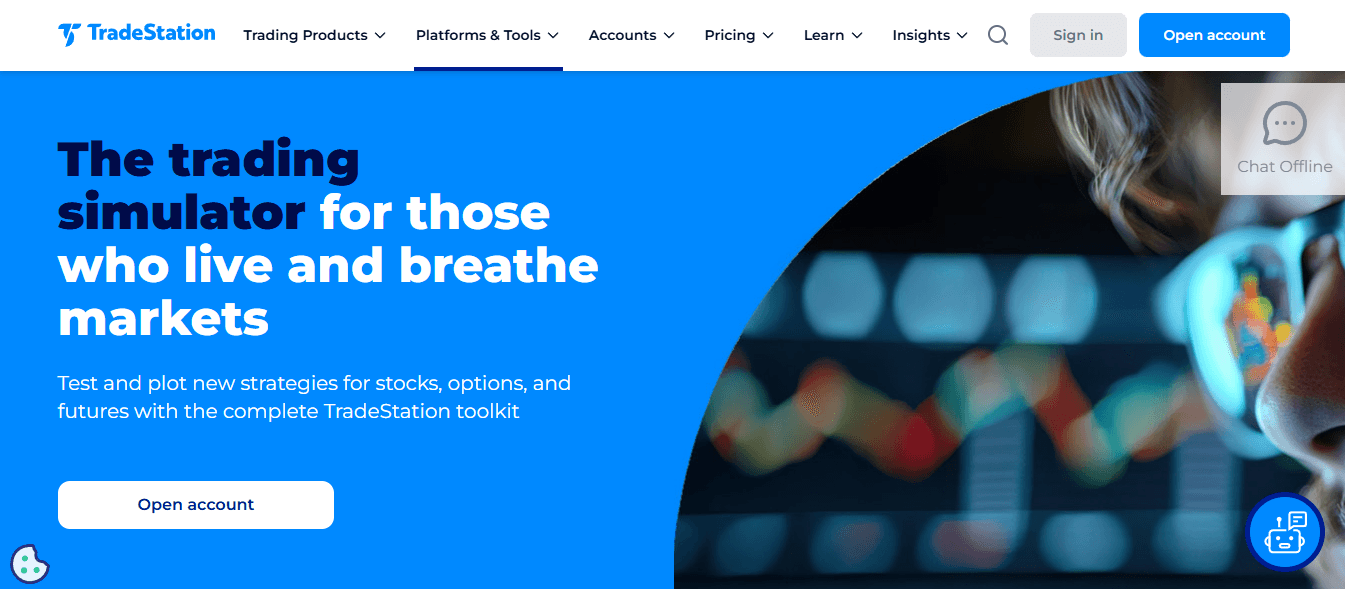
TradeStation offers a strong simulator for practising active trading. It's available to account holders and gives unlimited virtual funds. You can trade stocks, options, and futures in real time, with automation for strategy development and backtesting. Key features include detailed charting, customizable indicators, order execution tools, and performance reports. The platform focuses on accuracy to thoroughly test your ideas.
Why should beginners choose TradeStation?
TradeStation is great for people who like technical depth. It helps beginners develop disciplined approaches through realistic simulations and analytical tools. The platform's focus on strategy refinement boosts confidence as it moves into live markets. This is especially useful for users who are interested in automated or rule-based trading.
What can beginners learn from these simulators?
These simulators provide valuable starting points in 2026. They offer free access and focus on different areas to help various learning styles. Beginners get the most help by choosing a simulator that fits their goals. As they improve, they can look at other simulators to expand their skills. The next important choice is selecting the simulator that best aligns with one’s career goals. This choice is where many traders make mistakes, and it greatly impacts how their practice can lead to funding opportunities.
Related Reading
- What Is Leverage In Futures Trading
- How To Learn Stock Trading For Beginners
- What Is Leverage In Forex Trading
- How Does After-Hours Trading Work
- How Does Pre-Market Trading Work
- Does Robinhood Allow Day Trading
- Best Practices for Backtesting Trading Strategies
- Backtesting Day Trading Strategies
- How to Set Stop Loss and Take Profit in Trading
- Stop Loss Day Trading
- What Is Take Profit in Trading
- Take Profit vs Stop Loss
- What Is Stop Loss in Trading
- Backtesting Trading Strategies
- Free Backtesting Trading Strategies
- Options Trading For Beginners
- Apps to Practice Day Trading
- How to Practice Day Trading Without Money
How to Choose a Free Day Trading Simulator For Your Goals

Select a simulator that tests the specific behaviors needed for your funded path. It should enable turning practice into verifiable evidence. Focus on platforms that support repeatable experiments, offer exportable audit trails, and include automation features. These elements enable you to demonstrate consistent performance that adheres to the rules under realistic conditions.
Which features really demonstrate funders' confidence?
It's important to ask whether the simulator can produce an auditable session rather than just pretty charts. You need raw trade logs that include timestamps, order IDs, exchange codes, and snapshots from before and after trades. This information helps an evaluator replay any trade and check your fills and rule compliance. Also, look for export formats, API access, and data retention policies. A platform that locks your history or cuts off logs can make it hard to build the verified track record that funding managers want. In contrast, our prop firm provides comprehensive support and tools to enhance your trading practices.
How do I know it will scale beyond small accounts?
Run controlled A/B experiments inside the simulator. Split identical setups across two variable sets, changing only position size or slippage parameters. Then, run 50 to 200 replayed sessions to estimate how expectancy and max drawdown change with size. That kind of batch testing shows when your edge decreases and when liquidity or partial fills start to affect your math. Commit to this experimental routine because consistent practice over time is important. Tradingsim reports that traders who practice with a simulator for at least 6 months have a 70% higher success rate. This shows that persistence and realistic tests can change outcomes.
Which UX choices speed learning without hiding constraints?
This is a trade-off: a simple mobile flow accelerates early execution habits, while desktop platforms offer more nuanced order types and routing quirks that traders will face at scale. For those feeling lost in the early stages, choosing a simulator with guided drills and mandatory journaling will help build tidy habits. As you get closer to funded evaluations, focus on platforms that keep the same challenges you will face later. For example, ensure adherence to dollar risk caps or automatic position-size checks. Beginners often get stuck when tools are either too complex or too easy to use. This issue typically occurs among traders during their first two to six weeks, when confusion and feature overload lead to skipped practice.
How should I manage risk when testing aggressively?
Treat loss reduction as an important goal, not just something to consider later. Use simulators that allow you to change fee schedules, slippage distributions, and margin calls, and then test them under the worst-case scenarios. This helps protect your funds: for new traders, Forex Tester Blog shows that simulators can lower the risk of losing money by up to 50%. This way, your capital curve remains safe while you improve your trading strategies. Also, include emotional checkpoints in your journal so that each simulated loss has a way to correct it, rather than just reacting without thought.
What components should a simulator checklist have?
A compact checklist for quick decisions includes the following criteria. Pick a simulator that: (1) exports full, replayable logs and APIs, (2) supports batch replay and randomized slippage for A/B testing, (3) enforces the risk rules you will be judged on, and (4) balances UI simplicity with the terminal features you will need when scaling. If a free platform fails any of these, it will slow your path to verified funding, regardless of how attractive the charts appear. Choosing well requires thinking like both an auditor and an experimenter. What you rehearse should be provable, repeatable, and resilient to larger sizes, not just comfortable.
What should I expect after choosing a simulator?
What happens next will make you question whether your preparation has been genuine or merely an illusion. To choose the best trading simulator, you should think about several important factors. First, look for a simulator that offers a realistic experience. This means it should have features similar to those of real trading platforms. You want to familiarize yourself with the tools and environment you will encounter when you start trading for real. Second, check if the simulator provides good educational resources. Beginners can benefit greatly from tutorials and guides that explain how to trade successfully. It's essential to find a platform that not only lets you practice but also teaches you important concepts.
Another factor to consider is the variety of assets available for trading in the simulator. You want to ensure you can practise with different types of stocks, currencies, and commodities. This will help you understand various markets and strategies. Furthermore, think about the cost of the simulator. Some platforms charge fees, while others are free. A good option should fit your budget while providing valuable features. Lastly, read reviews or testimonials from other users. This feedback can help you gauge whether a simulator is right for you.
Get 25-30% off Today - Sign up to Get Access to up to $800K Today
Transitioning from a day trading simulator to a funded account should show the habits you developed while paper trading. It's important to choose a path that allows your performance to be verified while keeping your trading process. If you are ready, consider Goat Funded Trader a good way to test this transition, with clear terms that reward consistent, rule-based day trading.
Related Reading
- Best Automated Trading Platform
- Best Paper Trading Platform
- Best Stock Trading Simulator
- Best Copy Trading Platform
- Best App For Day Trading
- Best Day Trading Platform For Beginners
- Best Software for Backtesting Trading Strategies
- Best Chart Trading Platform
- Best App for Backtesting Trading Strategies
- Best Stock Trading Platform For Beginners
- How To Practice Day Trading
- Best Automated Trading Platform
- Best Forex Trading Platform
- Best Crypto Trading Simulator
- Best Futures Trading Platform
- Best Trading Simulator App
- Best Options Trading Simulator
- Best Options Trading Platform
- Best Futures Trading Simulator
Be Great and get the App