






How to Become a Full-Time Trader in 11 Steps: A 2026 Guide
How to become a full-time trader in 11 proven steps. Goat Funded Trader's complete 2026 guide covers income requirements, risk management & more.


Transitioning from part-time hobbyist to full-time trader requires more than just chart-reading skills and market knowledge. Capital Growth Trading demands adequate funding, disciplined risk management, and the psychological resilience to handle income volatility. Most aspiring professionals struggle not with strategy development, but with securing sufficient capital to trade without taking excessive risks that could wipe out their accounts.
Access to proper funding remains the primary barrier preventing skilled traders from making the leap to full-time trading. Rather than risking personal savings or taking on financial pressure that can cloud judgment, many successful traders partner with a prop firm to access the capital needed while focusing purely on execution and performance.
Summary
- Full-time trading demands more than market knowledge or technical skill. It requires sufficient capital to generate a livable income without excessive risk per trade. Most traders spend years trying to compound small personal accounts, watching modest percentage gains translate to income that barely covers expenses while every drawdown threatens their ability to continue.
- Prop firms address this capital barrier by providing funded accounts to traders who demonstrate consistency through structured evaluations. Goat Funded Trader offers simulated capital accounts up to $2M with profit splits reaching 100% and on-demand withdrawals, allowing traders to prove their edge and earn professional-level income without risking personal savings during the transition to full-time trading.
- The path from part-time hobbyist to sustainable trader becomes accessible when capital constraints no longer force you to choose between proper risk management and paying rent. Traders who pass evaluations immediately access account sizes that transform the same win rate and strategy into meaningful monthly income, compressing the traditional decade-long accumulation phase into months of focused performance validation.
- Consistent profitability emerges from repeating proven setups across varying market conditions, not from occasional winning streaks during favorable periods. Only 1% of day traders achieve reliable positive returns net of fees, according to academic research, highlighting how rare sustainable success becomes without the discipline to treat trading as a business with strict operational rules and performance tracking.
- The decision to pursue full-time trading hinges on an honest self-assessment of your emotional resilience amid income volatility, a proven edge across multiple market environments, and adequate capital to execute without position-sizing pressure. Traders who skip this validation phase typically discover their limits after quitting stable employment, when financial pressure transforms disciplined execution into desperate gambling that accelerates account destruction.
- Goat Funded Trader supports this transition by offering unlimited evaluations, permitting news trading and weekend holds, and providing scaling programs that grow accounts from initial funded amounts to $2M as traders demonstrate consistency over time.
What Does It Mean to Be a Full-Time Trader?
Being a full-time trader means your income depends entirely on your ability to read markets, execute strategies, and manage risk without a paycheck. Your profits must cover bills, health insurance, taxes, and future growth while you bear the emotional weight of losses no employer will help you through. It's a complete change in how you earn money, plan for the future, and measure success.

🎯 Key Point: Unlike traditional employment, full-time trading requires you to be simultaneously your own boss, risk manager, accountant, and psychologist - there's no safety net beyond your own skill and discipline.
"The transition from part-time to full-time trading represents a fundamental shift from guaranteed income to performance-based earnings where every decision directly impacts your financial survival." — Trading Psychology Institute, 2023

⚠️ Warning: Many aspiring full-time traders underestimate the true cost of independence - you'll need 6-12 months of living expenses saved before making the leap, plus additional capital for trading and business expenses.
What capital requirements do you need to become a full-time trader?
Full-time trading requires substantial capital—more than most people anticipate. You need enough to meet FINRA's $25,000 pattern day trader minimum, size your positions correctly without excessive leverage, and maintain at least one year of living expenses in liquid reserves separate from trading capital.
90% of day traders lose money, often because they start with insufficient capital and take outsized risks that deplete their accounts during losing streaks. If you need $4,000 monthly to survive and your account has $50,000, a single 10% loss threatens your ability to trade long enough for your strategy to work.
How can prop firms help you become a full-time trader without personal risk?
Most traders handle this by risking their own savings or borrowing against assets, believing their skills will generate returns fast enough to justify the risk. As account pressure builds and bills arrive, disciplined risk management breaks down into desperate trades.
Prop firms like Goat Funded Trader offer simulated capital accounts of up to $2M, where traders prove their edge through structured evaluations and then earn profit splits of up to 100% without risking their own funds. This separates skill validation from financial ruin, letting you focus on execution while the firm supplies the capital.
Psychological Endurance Under Isolation
You work alone, without coworkers to share bad days or celebrate wins that feel empty when no one understands what you risked to earn them. Full-time traders develop routines to keep their mental state steady, separating self-worth from daily P&L swings that feel personal even when losses result from perfect execution meeting unfavorable conditions. Only 1% of day traders earn positive abnormal returns net of fees. The other 99% quit, blow up, or grind sideways for years, mistaking activity for progress.
Discipline That Compounds Over Time
Your edge comes from repeating high-probability setups thousands of times, documenting every trade, and improving strategies based on data rather than emotion. Successful full-time traders track performance metrics, conduct regular reviews, and adapt to changing market conditions without abandoning core principles during drawdowns. This commitment transforms experience into a growing advantage that separates professionals from hobbyists.
Freedom That Demands Accountability
You control your schedule, location, and daily structure once profitable, working from anywhere with an internet connection. This freedom requires self-discipline to maintain preparation routines, avoid distractions, and execute your plan when fear or greed tempt you to deviate. Full-time trading offers autonomy only to those who treat it as a business, in which every decision affects their ability to pay rent next month.
But knowing what full-time trading demands don't explain why anyone would choose this path over a stable career with benefits and predictable income.
Related Reading
- How Does Margin Interest Work
- Why Are Fidelity Margin Rates So High
- Why Is Schwab Margin Rate So High
- How Much Do Day Traders Make Per Month
- How To Compare Brokers By Margin Interest Rates
- How Does Margin Work at Interactive Brokers
- Financing Stock Options
- How Does Margin Work On Robinhood
- How Is Margin Interest Calculated
- Options Trading Cash Flow Strategies Explained
- How Much Margin Does Fidelity Offer
- Can You Make A Living Day Trading
- No Consistency Rule Prop Firm
- What Is A Prop Firm Forex
Why Do Traders Choose Full-Time Trading as a Career?
Full-time trading appeals to people who reject income limits set by employers and schedules controlled by others. It offers direct ownership over your financial future, complete control over your schedule, and rewards that grow with skill rather than seniority.

🎯 Key Point: Trading provides unlimited earning potential - your income grows with your skills and market knowledge, not corporate hierarchies or annual review cycles.
"The appeal of trading lies in its direct correlation between skill development and financial rewards, offering complete autonomy over both time and income potential." — Financial Independence Research, 2024

💡 Tip: Successful full-time traders often cite schedule flexibility and performance-based income as the primary motivators for leaving traditional employment to pursue independent trading careers.
The Freedom Equation
You stop asking permission to take time off, move cities, or design your workday around when you think best. Full-time traders build schedules around market hours that fit their strategy: trading during peak hours and spending afternoons as they choose. You can relocate without career consequences, travel without vacation days, and fit personal priorities into your week instead of squeezing life into weekends and holidays.
Unlimited Upside Without Corporate Ceilings
Traditional employment ties your pay to set salary ranges, yearly raises that barely keep up with inflation, and promotion schedules controlled by others. Full-time trading removes those artificial limits. Your earnings reflect the quality of your choices, the discipline of your risk management, and the capital you invest. Skilled traders grow profits as their accounts expand, turning steady monthly gains into substantial yearly income that no performance review or budget cycle can constrain. This advantage becomes clear when comparing a salaried job to a trader capturing even small monthly returns on growing capital. The math shifts dramatically in favor of the trader who proves their edge and grows responsibly.
Intellectual Ownership and Personal Accountability
Markets require constant learning, pattern recognition, and strategic adaptation. You study economic data, understand price action, refine entry signals, and adjust risk parameters as conditions change. Every trade becomes a feedback loop that teaches you what works and why.
That ongoing mastery delivers satisfaction beyond a paycheck because you see direct evidence of your growth in account performance and emotional control under pressure.
Why does personal accountability matter for full-time traders?
The career also forces complete accountability. No team dilutes your success or failure, and no manager takes credit for your wins or shifts blame for losses.
You own every decision, which builds self-reliance and confidence, impossible to develop in environments where outcomes depend on others' efforts or uncontrollable political dynamics.
The Capital Barrier and Modern Solutions
The traditional path to full-time trading required substantial personal capital for minimum account balances and living expenses during the learning phase. Saving $50,000 or $100,000 while covering rent and bills takes years. Prop firms like Goat Funded Trader changed that by providing simulated capital accounts up to $2M after traders pass structured evaluations. You prove your edge with defined risk parameters, earn profit splits up to 100%, and access professional-level capital without risking your savings.
But knowing why traders choose this path doesn't reveal whether most of them succeed once they make the leap.
What is the Success Rate of Full-time Traders?
Full-time trading success rates stay below 5%, with only 1% of day traders making money consistently after accounting for fees, slippage, and psychological costs. Markets reward statistical edges and disciplined execution, not screen time or enthusiasm.
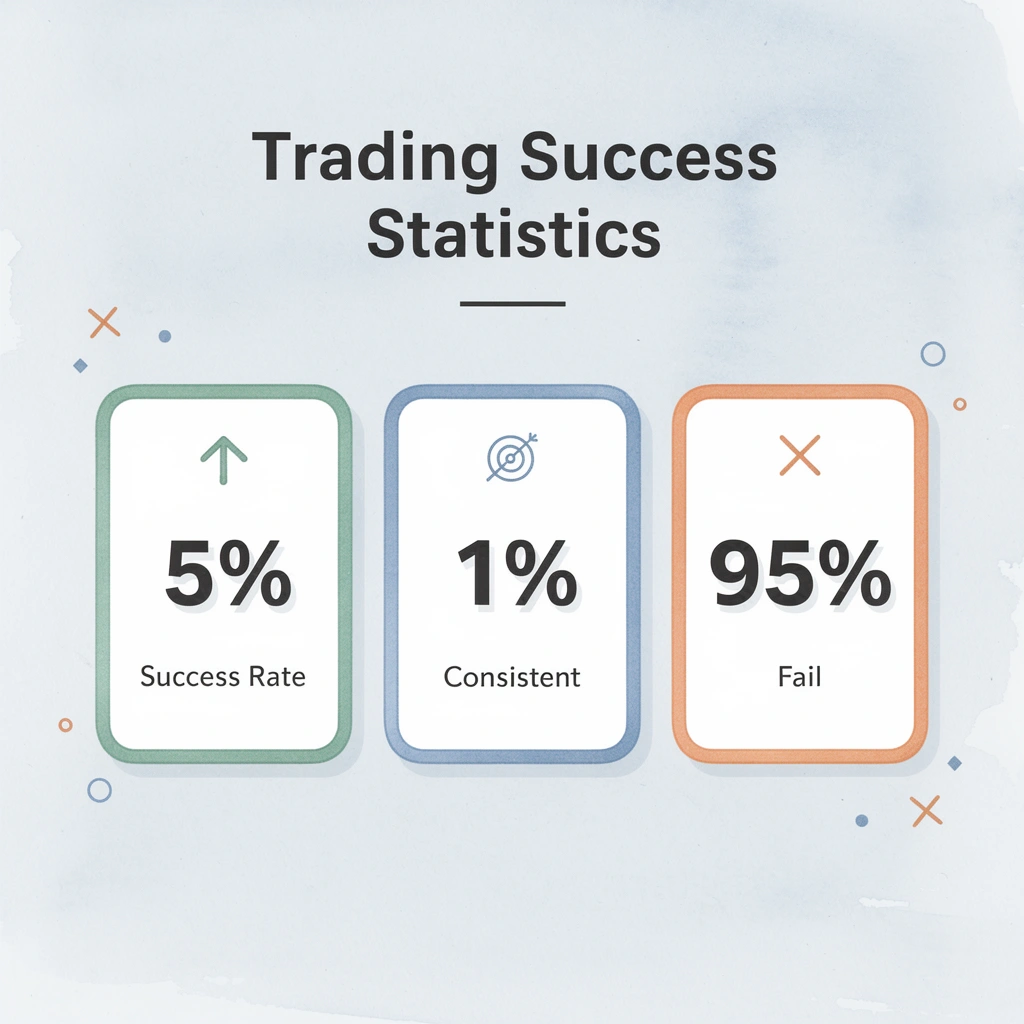
⚠️ Warning: The harsh reality is that 95% of full-time traders fail to generate consistent profits, making trading one of the most challenging career paths in finance.
"Only 1% of day traders make money consistently after accounting for all trading costs and psychological factors." — Trade That Swing Research

🔑 Takeaway: Success in full-time trading requires more than market knowledge—it demands exceptional risk management, emotional discipline, and proven statistical edges that most traders never develop.
Why Most Traders Fail Despite Working Systems
Traders often celebrate individual winning months while ignoring whether they can repeat their success across years. A 77% hit rate for two weeks means nothing if discipline collapses during the first real drawdown. The gap between knowing what to do and executing it under pressure destroys more accounts than bad strategies. Emotional reactions to losses trigger position-sizing errors, revenge trading, and rule violations that compound faster than any edge can recover from.
The Statistical Reality Behind Trading Performance
Researchers tracking active US day traders found that twice as many lost money as made money, with only 20% achieving more than modest profits. The average net yearly return was a $750 loss after commissions, demonstrating how transaction costs and behavioral errors systematically erode capital.
Capital Requirements Create a Hidden Barrier
Most people who want to become full-time traders underestimate the capital required to earn a livable income while taking on reasonable risk. To earn $60,000 per year with a 2% monthly return, you need $250,000 in trading capital—a sum most lack before losing smaller accounts.
This reality pushes many traders to use excessive leverage, risking 5% or 10% per trade to compensate for insufficient capital. This approach destroys accounts faster during the losing streaks that inevitably occur in trading.
How do funded trading platforms solve the capital problem?
Platforms like Goat Funded Trader changed how this works by giving traders practice accounts with up to $2M in fake money after they pass structured tests. With our platform, traders demonstrate a winning strategy within set risk limits, earn up to 100% of profits, and access professional-level capital without needing $250,000 of their own money or risking their savings as they learn.
Consistency Separates Survivors from Statistics
Successful traders treat their activity as a professional business with strict rules, not a flexible side project. They track every trade, maintain detailed performance logs, and stop trading immediately when daily loss limits are triggered. This operational discipline prevents the single catastrophic day that wipes out weeks of gains, a pattern appearing in nearly every failed trading account.
But knowing the statistics and understanding discipline leaves one with a critical question: how do you know if you're genuinely ready to make this leap, or merely caught up in the optimism that precedes most failures?
Related Reading
- Prop Trading Firms' Profit Sharing Models
- Position Sizing In Trading
- Best Crypto Prop Firm
- Lowest Margin Rates Brokers
- Best Prop Firm For Stocks
- How To Borrow Against Stocks
- Sbloc Vs Margin Loan
- How To Day Trade Without 25k
- How To Stay Consistent In Trading
- Position Sizing Day Trading
- How Do You Profit From Day Trading Stocks
- How To Become A Trader From Home
- How Do You Take Profit In Crypto Trading
- Can I Borrow Against My Stocks
- Is Issuing Common Stock A Financing Activity
5 Questions to Ask Yourself Before Quitting Your Job to Become a Full-Time Trader
Before you submit that resignation letter, ask yourself five critical questions that reveal whether you're ready or hopeful. These questions expose the money, mental, and practical realities separating traders who sustain themselves from those who exhaust their savings in six months.

🎯 Key Point: The difference between successful full-time traders and those who fail isn't just skill—it's preparation. Financial cushions, realistic expectations, and proven track records matter more than optimism.
"95% of day traders lose money, and the majority exhaust their capital within the first year of trading full-time." — Financial Industry Research, 2023
⚠️ Warning: Emotional decision-making is the fastest way to drain your trading account. If you're quitting because you're frustrated with your current job rather than confident in your trading abilities, you're setting yourself up for financial disaster.
1. How does income volatility affect your emotional state when learning how to become a full-time trader?
Your paycheck disappears the moment you quit. In its place, you face months where profits swing wildly or vanish entirely, even when you execute your strategy perfectly. Review your actual behavior during past financial uncertainty. Did you panic when your car needed unexpected repairs? Did you lose sleep over a delayed bonus? Trading amplifies that pressure because losing streaks happen to everyone, and they often cluster when bills arrive.
Why do most traders fail when facing emotional pressure during drawdowns?
Most people underestimate how deeply income uncertainty affects decision-making. You'll face pressure to overtrade during slow periods or abandon proven strategies after three losing days. 90% of traders lose money, and emotional reactions during drawdowns drive most failures. Trade part-time for at least twelve months while tracking your emotional state during losing weeks. If you found yourself checking positions obsessively or breaking your rules under pressure, you're not ready yet.
2. Does Your Capital Generate Enough to Live On?
Figure out how much money your account needs to make each month after taxes and fees to cover living expenses. Then verify that your past performance demonstrates you can hit that target. A trader with a $50,000 account averaging 3% monthly returns earns $1,500 before taxes and costs, which is typically insufficient to cover rent, insurance, food, and unexpected expenses.
You need either significantly more capital or a proven ability to generate higher returns without a proportional increase in risk.
How can funded trading accounts help you become a full-time trader?
Traditional trading requires significant personal capital to be at risk, creating a barrier that most aspiring full-time traders cannot safely overcome. Platforms like Goat Funded Trader provide simulated capital accounts up to $2M with profit splits, allowing you to prove your edge and generate income without risking your savings.
This separates your living capital from trading capital, reducing the emotional pressure that destroys discipline when losses threaten your rent payment.
3. What market conditions must you prove your edge across?
Your strategy must work in bull markets, bear markets, periods of high volatility, and quiet periods. Traders who have only experienced favorable conditions often watch their systems collapse when market character shifts.
You need at least two years of documented performance showing consistent execution through different environments, not theoretical backtests. Real trading reveals whether you can follow your rules when fear or greed peaks—something no simulation captures.
How do you track performance metrics beyond profit and loss?
Keep track of specific metrics beyond profit and loss: win rate, average risk-reward ratio, maximum drawdown, and recovery speed from losing streaks. If your edge depends on conditions that appear infrequently, you'll struggle during dry spells.
Full-time trading means your income depends entirely on executing trades regardless of market conditions, so your track record must demonstrate consistent performance.
4. How does isolation affect your ability to become a full-time trader?
Trading full-time means spending most days alone, looking at screens with limited human interaction. The work requires intense focus during market hours, followed by preparation and analysis. Weekends often involve reviewing trades and studying patterns.
This routine wears down people who need outside structure or regular social engagement to stay motivated.
What past work experience helps you become a full-time trader?
Consider whether you have successfully worked independently before. Remote workers and freelancers often adjust more easily because they have already built self-discipline and routines without external accountability.
If you have thrived in office environments with team energy and clear schedules, the loneliness of trading might hurt your performance faster than any market loss. Test this by trading part-time while working from home for several months, and observe whether solitude drains your focus or strengthens it.
5. What happens if your trading income fails when you become a full-time trader?
Build a specific backup plan before you quit. How long can you survive without trading income? What skills do employers want if you need to return to a regular job? How will a resume gap affect your career options? Most traders who fail don't lose because their strategy stopped working. They lost because they ran out of time and money before their advantage could compound.
How should you protect your emergency fund as a full-time trader?
Keep your emergency fund completely separate from trading capital. Save twelve months of living expenses in cash that you never use for trading, regardless of confidence in any trade. This buffer lets you absorb losses without rushed decisions and gives you the confidence to stick to your rules when trades move against you.
How to Become a Full-Time Trader in 11 Steps
The systematic approach starts with proving you can execute under real conditions before scaling capital. Most aspiring traders skip building repeatable processes and jump straight to live markets with savings they can't afford to lose. That gap between knowing what works and doing it consistently separates the 5% who survive from the rest.

🎯 Key Point: Success in trading isn't about having the perfect strategy—it's about consistently executing a proven process under real market pressure.
"The 5% of traders who survive long-term focus on process over profits in their early development stages." — Trading Psychology Research, 2023
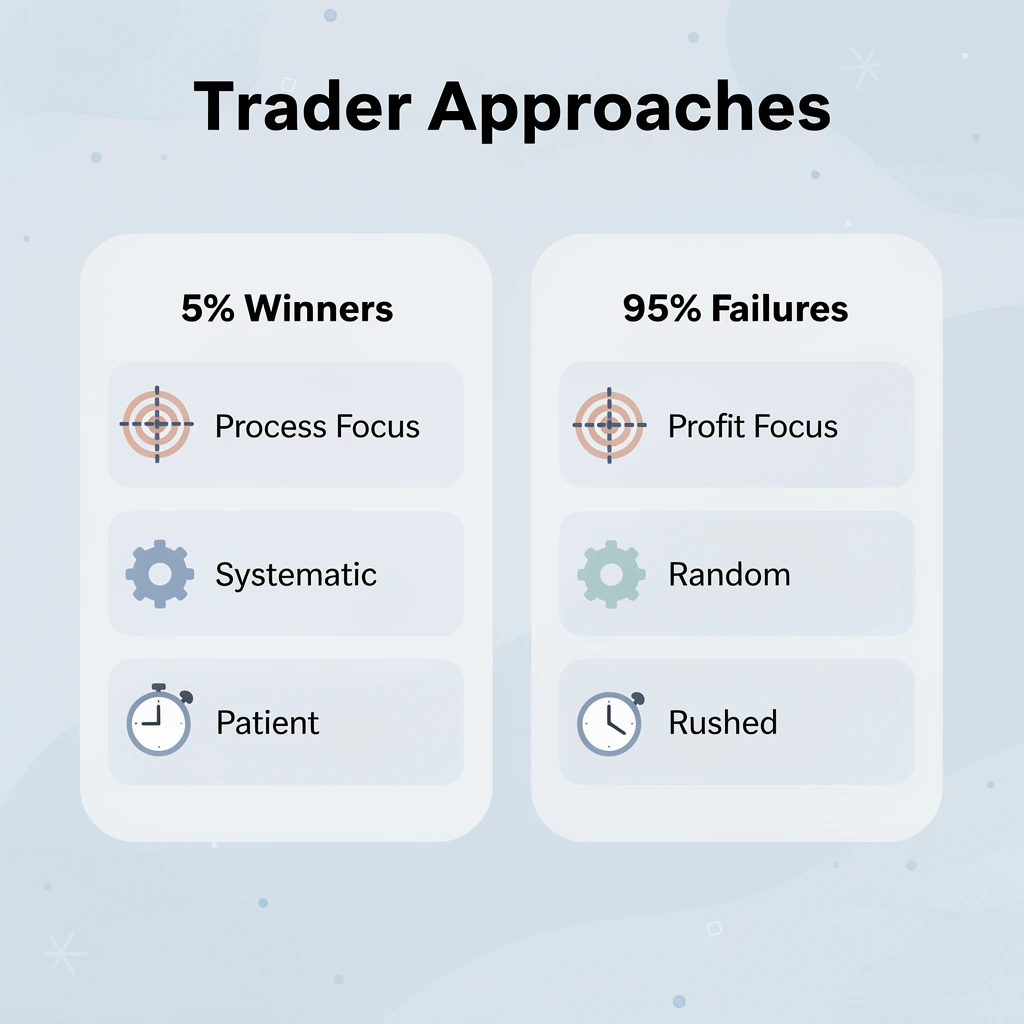
⚠️ Warning: Jumping into live trading without a systematic approach is the fastest way to join the 95% failure rate that plagues retail traders.
Step 1: Conduct an Honest Self-Assessment
Consider whether your personality suits trading before risking money. Full-time trading eliminates income during losing streaks, removes collegial support, and places all decisions on you alone. Reflect on how you've handled past financial stress or setbacks. If a missed bonus or unexpected car repair caused significant worry, trading's volatility will amplify that feeling considerably. This assessment helps you understand your emotional limits before leaving your job.
Step 2: Build Comprehensive Market Knowledge
Learn the basics of technical analysis, fundamental drivers, and how markets work before trading. Study how prices respond to volume changes, economic data releases, and volatility shifts. Strong foundational knowledge enables informed decisions rather than fear- or greed-driven reactions. Think of education as a continuous investment that compounds over time.
Step 3: Select Your Trading Style and Market
Match your approach to your schedule, personality, and money by choosing day trading, swing trading, or position trading. Day trading suits people who enjoy quick decisions and can monitor screens for extended periods. Swing trading suits those who prefer analyzing the market to rapid trades and who lack constant market access. Focus on specific markets—stocks, forex, or futures—where you can identify and exploit repeating patterns. If your approach misaligns with your situation, frustration will follow, regardless of discipline.
Step 4: Develop and Test a Written Trading Strategy
Create detailed rules for entries, exits, position sizing, and risk limits based on your edge. Backtest across multiple years of historical data covering bull markets, bear markets, and sideways movement. Forward-test in real-time using a demo account to catch execution issues your backtest missed. A clear plan enforces consistency when positions move against you, and emotions tempt you to abandon the system.
Step 5: Practice Extensively on Demo Accounts
Practice your strategy in simulated environments until the mechanics become automatic. Track every trade with the discipline you'll use with real money, reviewing outcomes against your rules to identify execution gaps. According to Strike, aspiring traders should dedicate four to eight hours per day to practice and market study before going live. Consistent demo success builds the confidence and muscle memory needed when real capital creates psychological pressure that simulation cannot replicate.
Step 6: Master Risk Management Rules
Use strict position sizing, stop-loss orders, and daily loss limits to protect your money. Risk no more than one percent of your account per trade: even ten consecutive losses won't eliminate your ability to continue trading. Trading success depends on surviving losing streaks, preventing catastrophic losses, and building consistency for long-term profitability.
Step 7: Establish a Daily Trading Routine
Create a structured schedule with pre-market preparation, active trading hours, and post-market review. Successful traders set aside fixed times for scanning setups, executing trades, and analyzing performance. This routine builds discipline, reduces emotional decisions, and maximizes efficiency. Without structure, boredom after hitting targets often leads to overtrading, erasing morning profits by the afternoon close.
Step 8: Transition to Live Trading with Real Capital
Start with small real-money positions after achieving consistent results in demo accounts. Real slippage, wider spreads, and the emotional weight of losing actual money create friction that demo accounts never reveal. Use a minimal size initially to focus on execution and psychology rather than profits. Track every trade carefully and adjust based on these real conditions while limiting financial exposure during the learning curve.
Step 9: Maintain a Detailed Trading Journal
Write down every trade you make, including why you entered, how you exited, how you felt, and what you learned. Review your journal regularly to identify patterns in your winning and losing trades. This converts experience into actionable improvements and deepens your self-awareness as a trader. Without documentation, you'll repeat the same mistakes because you won't recognise the patterns driving your results.
Step 10: Achieve Consistent Profitability
Prove your strategy generates positive returns over multiple months across varying market conditions before increasing size. Focus on metrics like win rate, risk-reward ratio, and maximum drawdown rather than single winning streaks. Only after sustained real-money success should you consider reducing reliance on outside income. Most traders skip this validation phase, scaling up after a few good weeks only to discover their edge doesn't hold during different market conditions.
Step 11: Leverage Prop Firm Funding
Traditional full-time trading requires substantial personal capital to generate a livable income. A $50,000 account earning 2% monthly returns yields only $1,000 before taxes, forcing traders to either risk more per trade or wait years to reach a sustainable account size. This pressure breeds emotional decisions that destroy accounts.
How do prop firms accelerate your path to becoming a full-time trader?
Proprietary trading firms offer another option. They provide access to larger amounts of capital after you pass their evaluation. You trade using their money while keeping most of the profits you generate, typically 70% to 95%, depending on the firm. This accelerates your path to full-time trading by allowing you to trade with more capital without depleting your own savings.
What funding opportunities help you become a full-time trader?
Our Goat Funded Trader platform provides simulated capital accounts with up to $2 million through 1-step or 2-step evaluation challenges. Upon passing, you gain access to funded accounts with profit splits up to 100% on demand and can withdraw earnings immediately. This enables you to demonstrate consistent trading with real position sizes while building your trading record.
How Goat Funded Trader Supports Aspiring Full-Time Traders
People who want to become full-time traders face a fundamental problem: you need enough money to make a living from trading, but saving that money takes years and puts every dollar at risk in the market. Prop firms solve this by giving you fake money to trade with after you demonstrate skill during test challenges. This lets you trade with real-sized accounts without waiting years to save or risking your rent money on a bad week.
🎯 Key Point: Prop firms eliminate the biggest barrier to becoming a full-time trader – the need for massive personal capital that takes years to accumulate.
"Prop firms bridge the gap between trading skill and trading capital, allowing talented traders to access real-sized accounts without risking their personal savings." — Trading Industry Analysis, 2024
💡 Tip: Focus on developing consistent trading skills during the challenge phase rather than maximizing profits – prop firms reward consistency over big wins.

Trading Capital Without the Wait
Most traders spend years growing a $5,000 account into something useful, watching monthly returns of $300 barely cover groceries, only for one big loss to erase six months of progress. According to Goat Funded Trader, traders who pass evaluations get access to up to $2,000,000 in funding. A trader managing $200,000 earning 3% monthly, takes home $6,000 in profit splits versus $150 from a personal $5,000 account at the same return. Prop firms provide scale once you prove your edge through structured challenges, eliminating years of personal risk.
Profit Splits That Reward Performance
Regular brokerage accounts give you 100% of profits but also 100% of the risk, meaning every losing trade threatens your ability to pay bills next month. Prop firms change this model by taking on losses while paying you up to 100% of profits on winning trades, creating an uneven risk profile where your downside is limited to the evaluation fee, but your upside grows with account size. When you make $8,000 in monthly profits on a funded account, you keep $8,000 with on-demand withdrawals rather than waiting for your personal account to recover from drawdowns before accessing earnings. This structure supports full-time income because you are paid for performance without needing six months of reserves to survive losing streaks.
Scaling That Compounds Success
Accounts that don't grow trap profitable traders in low earnings regardless of win rate. A 65% success rate and 2:1 risk-reward on a $10,000 account generates only $2,000 monthly, insufficient to leave your job. Platforms like Goat Funded Trader offer scaling programs that grow your capital to $2 million as you demonstrate consistent trading ability. This lets you increase position sizes and monthly income without personal capital. A trader scaling from $50,000 to $200,000 over six months quadruples earning potential using the same strategy, converting side income into a full-time salary through proven performance rather than years of personal saving.
Rules That Match Real Trading
Restrictive prop firms undermine full-time viability by banning news trading, prohibiting weekend holds, or imposing daily loss limits that conflict with market behavior. You develop a strategy around economic releases or multi-day swing positions, then discover the funded account rules render your edge unusable.
Goat Funded Trader removes these constraints by allowing news trading, weekend holding, and offering no time limits on evaluations, so you trade your actual strategy rather than adapting to arbitrary rules. Full-time traders need to execute their proven edge consistently, not learn a new constrained approach to satisfy a prop firm's risk department.
What determines if you actually make the leap to become a full-time trader?
But even with capital, splits, scaling, and flexible rules in place, one question determines whether you make the leap.
Get 25-30% off Today - Sign up to Get Access to Up to $800K Today
You've built your strategy, mastered risk management, kept your journal, and made consistent profits. Yet one barrier remains: insufficient capital to trade full-time without risking your savings.

Goat Funded Trader solves this problem. Our prop firm gives you access to up to two million dollars in simulated capital after passing an evaluation. You trade our funds, keep up to 100 percent of the profits, and grow your account with one of the programs in the industry.
🎯 Key Point: If you do nothing, you stay stuck trading small personal accounts where losses threaten your financial security and your full-time trading dream keeps getting delayed.
"Our prop firm gives you access to up to two million dollars in simulated capital with up to 100 percent profit sharing." — Goat Funded Trader, 2024
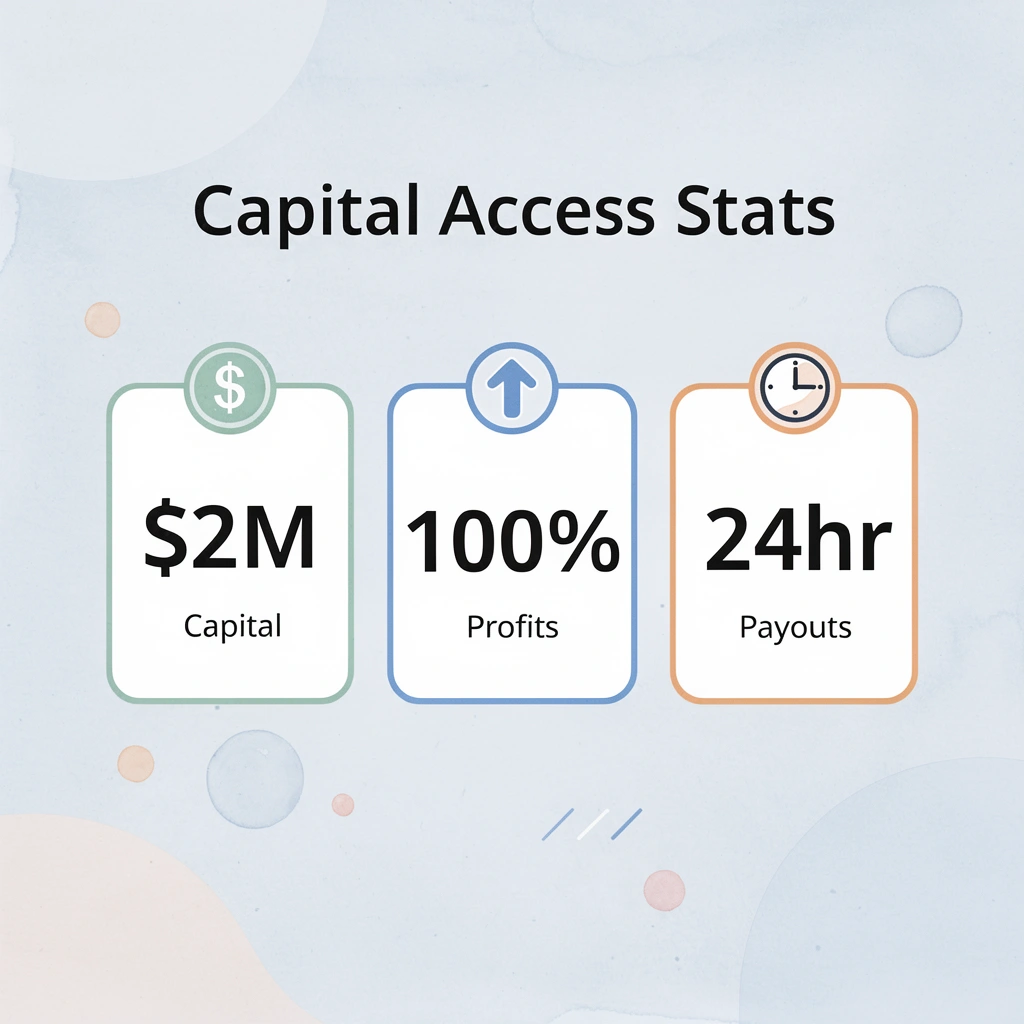
Goat Funded Trader removes the capital barrier, eliminates personal financial risk, and delivers fast payouts so you can focus on performance. Your first payout arrives on demand, and our Reward Guarantee ensures you get paid within 24 hours, or we add an extra $1,000.
Up to $2M capital
Trade larger positions
100% profit share
Keep all your gains
24-hour payouts
Fast access to profits
50% discount code
Reduced evaluation cost
Visit Goat Funded Trader, choose your challenge account size, and apply the code FIRSTGFT for an exclusive 50% discount on your first account. Pass the evaluation and get funded immediately. You risk nothing but the evaluation fee, which becomes 100 percent refundable as you grow. Start trading larger capital at once.
🔑 Takeaway: Take this final step toward your 2026 full-time trading breakthrough today with Goat Funded Trader.

Related Reading
- Best Forex Prop Firm
- Best Margin Rates Brokers
- Margin Loan vs. Securities-Based Lending
- How Does A Margin Loan Work
- How To Trade Forex With A Prop Firm
- Forex Trading Strategies For Consistent Profits
- Options Trading Strategies For Consistent Income
- How To Get Profit In Option Trading
- Day Trading Strategies For Consistent Profits
- Trading Cash Flow
- Recommended Prop Trading Firms With Growth Plans
- Best Trading Strategies For Consistent Profits
Be Great and get the App