






10 Best Trading Strategies for Consistent Profits in 2026
Discover the best trading strategies for consistent profits in 2026. Goat Funded Trader reveals 10 proven methods that actually work.


Every trader faces the same frustrating pattern: a few winning trades build confidence, only for losses to erase those gains just as quickly. Capital Growth Trading focuses on building systems that deliver steady returns month after month, using proven strategies that work across different market conditions. Success comes from identifying high-probability setups, managing risk effectively, and developing the discipline that separates profitable traders from everyone else. The key lies in consistency rather than chasing single big wins.
Traders can practice these strategies with real capital without risking their own money first. Professional funding allows you to apply proven techniques with substantial accounts while keeping a significant portion of the profits. Rather than slowly building a small account over years, skilled traders can access professional-level capital by demonstrating sound risk management and profitable execution through a prop firm.
Summary
- Only 3% of Brazilian day traders were profitable overall, according to research on trading outcomes, with just 1.1% earning more than the minimum wage. The primary separator was consistent risk management, rather than strategy selection or market-timing ability. Most traders fail because they treat markets like gambling rather than implementing strict position sizing, predefined stop-loss levels, and systematic entry criteria that protect capital during inevitable losing streaks.
- Emotional decision-making creates a destructive feedback loop in which losses prompt bigger bets to recoup losses, and wins encourage overconfidence that ignores risk parameters. This pattern feeds on itself until capital disappears, regardless of market direction or technical skill. Research from Tradeciety shows 95% of all traders fail, with the core mechanism being behavioral patterns that compound small inefficiencies into permanent account destruction rather than poor market analysis.
- Position sizing errors turn survivable downturns into account-ending disasters because traders risk oversized portions hoping for quick wins. Industry research shows that 90% of day traders lose money, with poor risk management being the primary driver. The math is unforgiving: losing 50% of your account requires a 100% gain just to break even, yet traders repeatedly expose themselves to this asymmetric risk without recognizing the structural disadvantage they create.
- Strategy selection must match your actual time availability, not your ideal schedule or aspirational goals. Full-time professionals eliminate day trading immediately because it requires constant screen presence during market sessions, with most successful practitioners monitoring positions throughout the session. Swing trading suits those with 5 to 10 hours weekly, while scalping demands 20 to 30 hours of focused execution time.
- Capital constraints limit how far proven strategies can actually take you because a 5% monthly return on $3,000 generates $150 while that same performance on $100,000 produces $5,000. The strategy and execution remain identical, but the outcome transforms completely when the account size matches the method's potential. Goat Funded Trader addresses this by providing simulated capital from $10,000 to $2 million once traders demonstrate consistent execution, letting disciplined traders operate at a professional scale while keeping profit splits up to 100%.
What Is Trading, and How Does It Work?
Trading means buying an asset at one price and selling it at another to capture the difference. You predict whether stocks, currencies, commodities, or derivatives will move up or down, then act on that prediction. Success depends on accurate timing paired with strict risk controls, not luck or social media hype.

🎯 Key Point: Trading is fundamentally about predicting price movements and executing trades with precise timing and disciplined risk management.
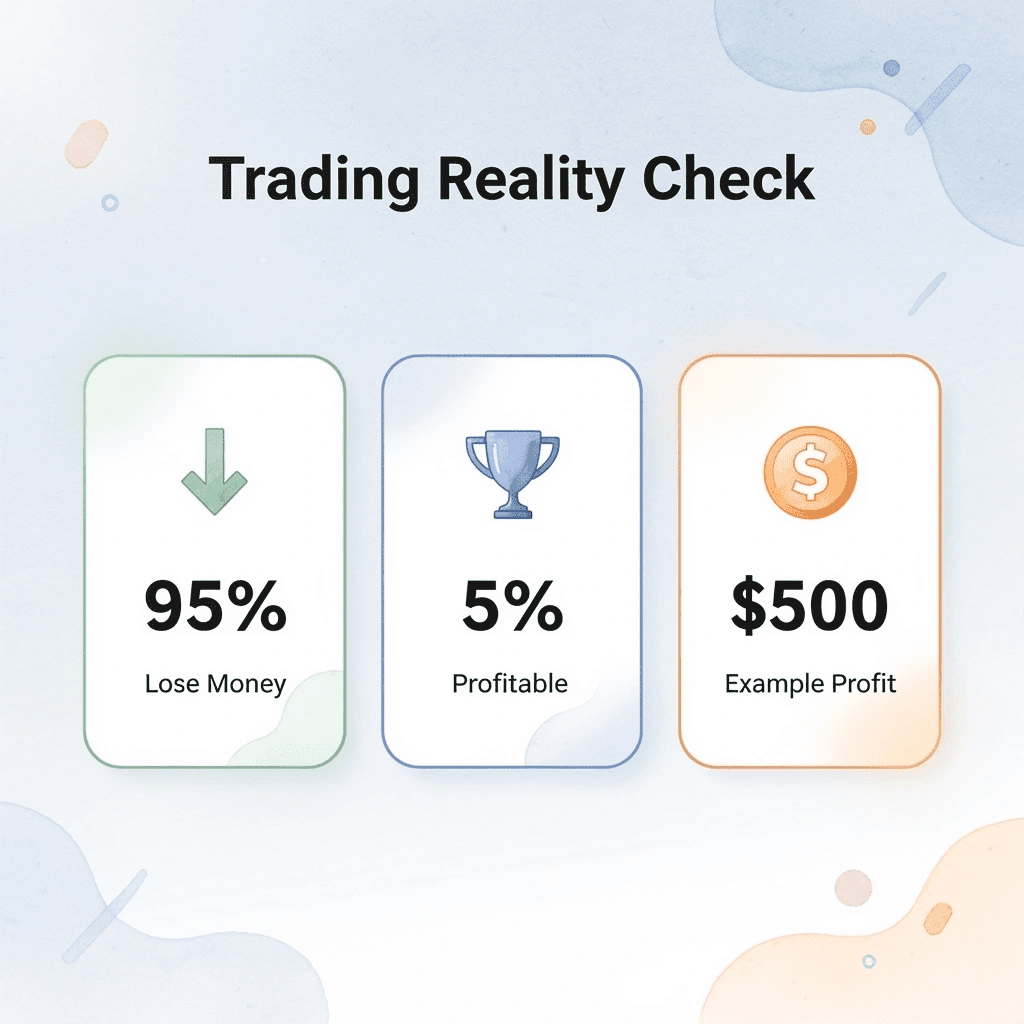
"95% of day traders lose money over time, with only 5% achieving consistent profitability through disciplined strategies." — Securities and Exchange Commission, 2023
💡 Example: A trader might buy 100 shares of Apple stock at $150 and sell them at $155, capturing a $500 profit (minus fees) by correctly predicting a short-term price increase.
How Markets Set Prices
Prices form through constant interactions between buyers and sellers. Stronger demand pushes prices higher while extra supply drives them lower. Order books display bids (buy offers) and asks (sell offers), with trades executing when bids and asks match. Brokers act as intermediaries, providing market access, executing orders, and handling settlement. You open an account, deposit funds, and use their platform to place trades through market orders (instant execution) or limit orders (specific price targets).
Core Trading Strategies
Strategies range from day trading (opening and closing positions within a single session) to swing trading (holding for days or weeks) to scalping (quick, small gains). Each relies on technical patterns, news catalysts, or trends. Consistent traders develop rules for entry, exit, and position sizing tailored to their market edge. Research on Brazilian day traders showed that only 3% were profitable overall, with 1.1% earning more than the minimum wage—a stark reminder that preparation separates profitable traders from those who lose money within weeks.
Risk Management Principles
Every trade carries a possible loss. Successful traders limit risk to no more than one percent of their account per trade, using stop-loss orders to exit at set levels and maintaining strong reward-to-risk ratios. This preserves capital during losing streaks and enables long-term gains. Disciplined traders follow their plan regardless of market conditions, review performance objectively, and treat losses as learning opportunities.
Steps to Begin Trading
Open a brokerage account with a regulated firm, complete verification, and fund it appropriately. Educate yourself on charts and basic analysis, then practice on a demo account before risking real money. Develop a written plan with clear rules, begin small, and track every trade to improve your process. Select assets that match your schedule and risk tolerance: stocks tied to company performance, forex running 24 hours, or commodities responding to global events.
What are the best trading strategies for consistent profits through prop firms?
Most traders build accounts over years with small personal capital. Prop firms like Goat Funded Trader offer an alternative: demonstrate strong risk management and profitable trading to access substantial capital without risking your own money upfront. You keep a large share of profits while the firm absorbs losses. This lets you employ professional-level trading strategies from the start.
Why is having a strategy essential for trading success?
Knowing how to trade and understanding why you need a strategy are two different things.
Related Reading
- How Does Margin Interest Work
- Why Are Fidelity Margin Rates So High
- Why Is Schwab Margin Rate So High
- How Much Do Day Traders Make Per Month
- How To Compare Brokers By Margin Interest Rates
- How Does Margin Work at Interactive Brokers
- Financing Stock Options
- How Does Margin Work On Robinhood
- How Is Margin Interest Calculated
- Options Trading Cash Flow Strategies Explained
- How Much Margin Does Fidelity Offer
- Can You Make A Living Day Trading
- No Consistency Rule Prop Firm
- What Is A Prop Firm Forex
Why Is Having a Trading Strategy Important for Long-Term Success?
A strategy transforms trading from emotional gambling into a repeatable business process. It defines exactly when you enter, when you exit, and how much you risk before the market opens. Without structure, every decision becomes reactive, driven by fear during losses and greed during wins. Long-term success requires consistency, which comes only from following tested rules across hundreds of trades.

🎯 Key Point: Emotional trading is the fastest way to destroy your account. A well-defined strategy removes the guesswork and keeps you disciplined when markets get volatile.
"95% of day traders lose money over time, primarily due to lack of a systematic approach and emotional decision-making." — Financial Industry Research, 2023

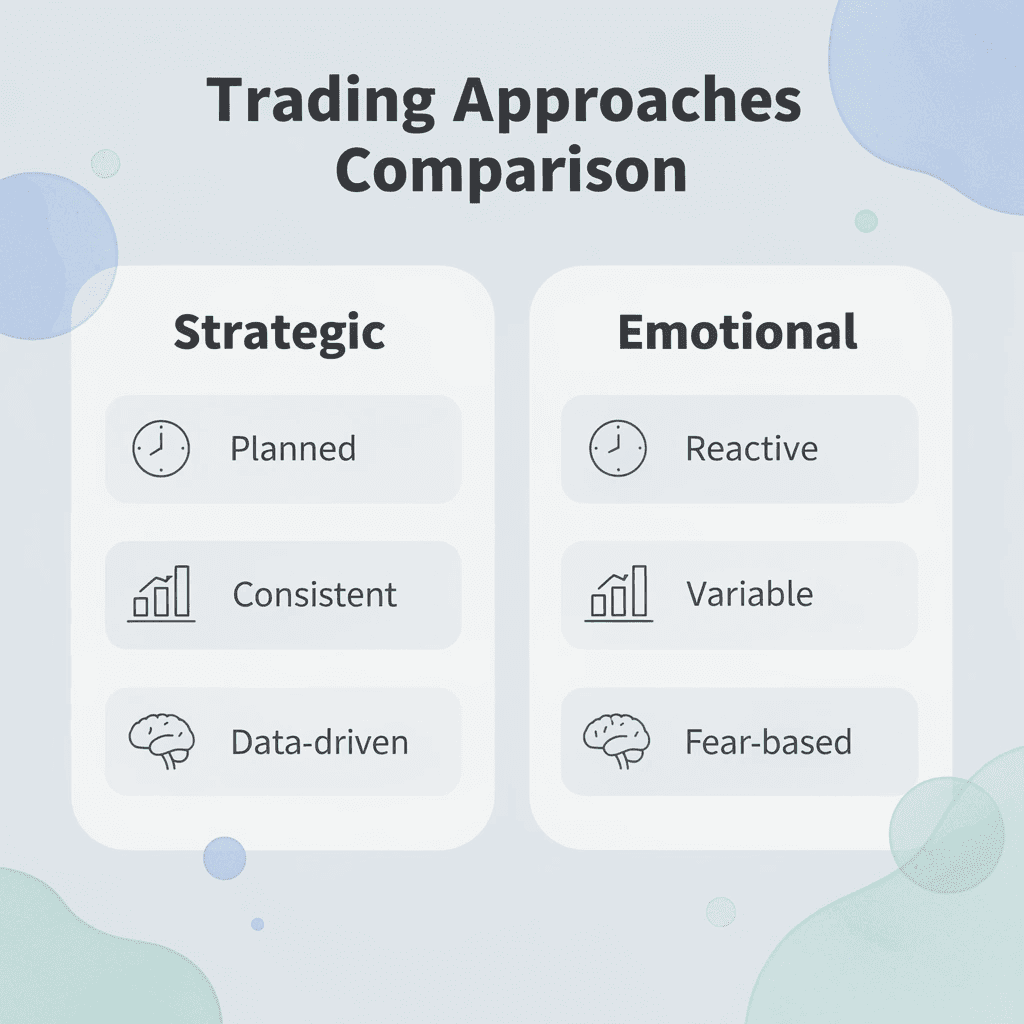
Strategy-Based Trading vs Emotional Trading
- Decision-making
- Strategy-based: Pre-defined entry and exit rules
- Emotional trading: Reactive decisions based on market movement
- Risk management
- Strategy-based: Consistent, structured risk controls
- Emotional trading: Variable and often inconsistent position sizing
- Approach to data
- Strategy-based: Data-driven decisions using analysis and signals
- Emotional trading: Fear and greed-driven reactions
- Outcomes
- Strategy-based: Focus on long-term profitability
- Emotional trading: Tends toward short-term, gambling-like behavior
⚠️ Warning: Even the best trading strategy won't work if you don't have the discipline to follow it. Consistency beats perfection every time in the markets.
The Emotional Trap Without Structure
The cycle plays out the same way every time. Three winning trades create the illusion of mastery. You increase position sizes, then two emotional decisions the next day erase everything. Panic forces early exits from winners, while hope keeps losers open too long. When every market tick triggers a reaction, you're not trading a system; you're managing anxiety. A strategy removes that chaos by outlining exact conditions for every action before emotion enters the equation.
Capital Preservation Through Discipline
Strict position sizing and predefined stop-loss levels limit damage from any single trade. According to research published by the Brazilian Securities Commission in 2013, only 1.1% of day traders earned more than minimum wage over time, with consistent risk management as the primary separator. Preservation forms the foundation for compounding returns: you stay in the game long enough to capture winning trades when they arrive.
How do trading rules create measurable progress instead of guesswork?
Without rules, outcomes blur together and teach nothing. A strategy creates benchmarks to review exact entry criteria, exit timing, and risk parameters against actual results. That analysis reveals which setups work in volatile markets versus ranging conditions and which habits hurt performance. Regular reviews transform repeated mistakes into refined edges that sharpen over months.
What options exist for traders with limited capital?
Traders with limited capital face a harder challenge: building a strategy is one thing, but executing it at a meaningful size requires funds most people lack.
Prop firms like Goat Funded Trader offer a different path: demonstrate consistent execution through an evaluation and gain access to accounts up to $2M. You keep significant profit splits (up to 100%) while the firm absorbs downside risk, enabling disciplined traders to operate at a professional scale without risking personal savings.
Professional Mindset Over Reactive Habits
Treating trading as a business requires systems, not improvisation. A strategy defines your edge, risk tolerance, and daily routines, enabling you to work with a clear plan rather than react to news headlines or social media signals. Discipline develops when you stick to the plan through losing periods and winning streaks alike, creating the mental toughness that separates traders who quit after three bad months from those who grow their results over the years. But even traders who build solid strategies hit an unforeseen wall.
Why Do Most Traders Struggle to Stay Consistently Profitable?
Most traders fail because they operate without structure, treating markets like a game of chance rather than a probability-based business. More than 75% of day traders quit within the first two years. The difference between knowing what to do and executing it consistently separates profitable traders from the rest.
"More than 75% of day traders quit within the first two years due to lack of structure and treating markets like gambling." — Trade That Swing, 2024
🔑 Key Takeaway: The overwhelming majority of traders fail not because they lack knowledge, but because they fail to implement consistent, structured approaches to trading as a probability-based business.

⚠️ Warning: Without proper structure and disciplined execution, even traders with good market knowledge will likely join the 75% failure rate within their first two years.
The Emotional Override Loop
Traders enter positions based on excitement or fear rather than predefined criteria, creating a feedback loop in which losses prompt bigger bets to recoup losses, and wins encourage overconfidence that ignores risk. The pattern feeds on itself until capital disappears. Without written rules for entries, exits, and position sizing, every decision becomes an experiment driven by the moment rather than tested logic. Research on Taiwanese individual investors documents that their aggregate portfolios suffer an annual performance penalty of 3.8 percentage points due to trading activity, with losses stemming from aggressive orders that institutions exploit.
Risk Management Failures That Compound
Position sizing errors turn survivable downturns into account-ending disasters. Traders risk overextending their accounts chasing quick wins, but one bad streak can wipe out weeks of gains without stop-loss discipline. FINRA data indicates that 72% of day traders end the year with net financial losses.
Why do account recovery odds become mathematically impossible?
The math is tough: if you lose 50% of your account, you need to gain 100% just to get back to where you started. Yet traders keep taking this uneven risk without realizing how much it works against them.
How can the best trading strategies for consistent profits avoid capital erosion?
When you trade with your own money while learning through trial and error, most of your early capital goes toward education. As your account shrinks, pressure increases because each loss consumes a larger percentage of remaining funds. This forces you to either add more money or trade positions so small they generate negligible returns. Platforms like Goat Funded Trader provide simulated capital that breaks this cycle. Our platform lets you develop disciplined risk management and proven strategies without risking your own money, while earning real profit splits once you demonstrate consistency.
The Overtrading Tax
Watching the market constantly leads to excessive trading that drains accounts through fees and exposes capital to random market movements. Traders feel compelled to act during slow periods rather than wait for quality opportunities, "forcing trades when market conditions are not aligned, leading to losses in dead chop or low-quality environments." This compounds losses through costs and lower win rates. Fewer, higher-quality trades outperform constant activity, but you must experience the cost of impatience to understand this.
The Review Gap That Prevents Growth
Most traders skip detailed record-keeping that would reveal process problems. They treat each loss as bad luck rather than system feedback, repeating the same mistakes for months without an objective performance review. Without tracking entry quality, exit timing, and emotional state during trades, improvement stalls. Successful traders build structures that counteract these human tendencies, creating professional processes that address behavioral patterns that cause failure rather than relying on willpower alone. Knowing these failure patterns doesn't automatically lead to consistent profits; the real challenge is choosing which strategy to execute.
10 Best Trading Strategies for Consistent Profits in 2026
Choosing the right strategy matters more than timing the market because executing well compounds over hundreds of trades. The ten approaches below represent proven frameworks that skilled traders use to achieve consistent returns across different market conditions, timeframes, and risk tolerances.

🎯 Key Point: The difference between profitable and losing traders isn't luck—it's having a systematic approach that works consistently across multiple market cycles.
"Successful trading is about process, not predictions. The traders who survive and thrive are those who focus on execution rather than trying to be right about market direction." — Trading Psychology Institute

💡 Best Practice: Before implementing any strategy, backtest it on at least 2-3 years of historical data to understand its performance characteristics and maximum drawdown periods.
1. Trend Following Strategy
Trend following captures sustained directional moves by identifying and riding established market momentum, profiting from prices that continue in their current direction once momentum builds.
How do you implement trend following for consistent profits?
Find the overall direction using moving averages or identifying higher highs and higher lows that signal uptrends. Start positions in the direction of the trend when prices pull back or break out, confirming the move with volume. Place stop-losses below recent swing points and move them up as the trend continues. Exit when the trend shows clear signs of weakening, such as reversal patterns or indicator crossovers.
When should you apply this trading strategy?
Use this strategy in markets moving in a strong, clear direction with moderate to high volatility, such as during economic expansions or sector rotations. It works best when trends continue over days to weeks and avoids choppy, range-bound conditions.
Who benefits most from trend following strategies?
Trend following works well for patient traders with full-time or part-time availability who prefer fewer, higher-quality trades. It suits stocks, forex pairs, and commodities where big-picture factors drive sustained price moves.
2. Swing Trading Strategy
Swing trading targets price swings within a larger trend by holding positions for several days to weeks, reducing daily noise while capturing medium-term movements.
How do you implement swing trading for consistent profits?
Look for assets at key support or resistance levels on daily charts, using technical indicators such as RSI to identify overbought or oversold conditions. Enter trades when pullbacks are confirmed with candlestick patterns, set stops beyond the swing low or high, and target the next major level or use a 2:1 reward-to-risk ratio. Check positions daily, but avoid constant changes.
When should you deploy swing trading strategies?
Use swing trading during trending markets with predictable volatility, particularly around earnings seasons or after major news events that create clear opportunities. It works well when you have limited time to monitor the market during the trading day.
Who benefits most from swing trading approaches?
This approach suits working professionals and part-time traders who cannot monitor markets continuously. They accept overnight position risk in exchange for fewer decisions and favorable risk-reward setups.
3. Day Trading Strategy
Day trading involves opening and closing positions within the same session to capitalize on intraday price changes. This method leverages short-term volatility to create multiple daily opportunities.
How do you implement the best trading strategies for consistent profits in day trading?
Focus on liquid assets during peak hours using 5- to 15-minute charts with volume and momentum indicators. Enter on breakouts or reversals at key levels with tight stops, scale out partial profits at predefined targets, and exit all positions before market close. Maintain strict daily loss limits to protect capital.
When should you apply day trading strategies for optimal results?
Use day trading during periods of high volume, particularly around news or earnings announcements that create intraday price movements. Day trading works best in volatile markets and should be avoided during low-liquidity periods.
Who benefits most from day trading approaches?
Day trading suits disciplined individuals who can monitor markets closely and manage their emotions. It's a good choice if you prefer not to hold investments overnight.
4. Scalping Strategy
Scalping profits from numerous small price changes through frequent, quick trades lasting seconds to minutes. Gains accumulate through consistent, high-volume trading rather than waiting for large single price moves.
How do you implement scalping for consistent profits?
Trade liquid instruments on tick or 1-minute charts using tight bid-ask spreads and level II data. Enter on minor imbalances or order flow signals with tight stops, take profits quickly at small targets, and focus on high-probability setups near major support or resistance.
When should you use scalping strategies?
Use scalping during periods of high buying and selling activity with small bid-ask spreads. This works well at market opens or when trading sessions overlap in forex. Scalping performs best when prices move within a range or drift slightly in one direction, allowing you to capture small, consistent profits.
Who benefits most from scalping trading strategies?
Scalping suits traders with fast-execution platforms, low commissions, and a strong focus on short trading windows. It works well for those who thrive in fast-paced environments and prioritize trade frequency over per-trade profit.
5. Position Trading Strategy
Position trading involves holding assets for weeks to months, using fundamental and technical analysis to capture major market trends and ignoring short-term price fluctuations.
How do you implement the best trading strategies for consistent profits with position trading?
Combine basic factors that drive price changes with chart patterns on weekly or monthly charts, and use moving averages to confirm the trend. Enter on strong breakouts or when price pulls back to the trendline; use wider stops based on price volatility; and trail your position or exit when fundamentals shift, or you reach your target.
When should you apply position trading for optimal results?
Use position trading during established macro trends driven by economic cycles, policy changes, or sector growth. It works well in less volatile periods where patience yields substantial rewards.
Who benefits most from position trading strategies?
Position trading suits investors with substantial capital who prefer not to monitor trades daily. It works well for those who can tolerate temporary losses and prioritize long-term growth over quick profits.
6. Breakout Trading Strategy
Breakout trading identifies moments when the price moves decisively beyond established support or resistance levels, signaling the start of a new directional move with increased momentum.
How do you implement breakout trading for consistent profits?
Watch for times when the price stays in a tight range on daily or hourly charts. Mark clear horizontal support and resistance zones. Enter a trade when the price closes beyond the level on high volume. Place a stop-loss just inside the broken level. Set profit targets at the next major level or use a measured move based on the consolidation height. Move your stops up to protect your gains.
When should you deploy breakout trading strategies?
Use breakout trading after the price has been stuck in a tight range, especially ahead of major economic news or earnings reports. This strategy works well when markets shift from calm to active periods.
Who benefits most from breakout trading approaches?
Breakout trading suits active traders comfortable with volatility and can react quickly to confirmed moves. It works especially well for those trading stocks, forex, and futures with access to real-time volume data.
7. Mean Reversion Strategy
Mean reversion takes advantage of the tendency of prices to return to their average after moving too far in one direction. With this strategy, you buy when prices have dropped too low and sell when prices have risen too high.
How do you implement mean reversion trading strategies effectively?
Use indicators such as Bollinger Bands or RSI to spot assets trading at levels that are multiple standard deviations from the mean. Enter counter-trend positions when extremes align with support or resistance, set tight stops beyond recent extremes, and exit near the moving average or at predefined profit levels. Confirm with volume to avoid false signals.
When should you apply mean-reversion strategies to achieve consistent profits?
Use mean reversion in sideways or range-bound markets without strong trends. This strategy works well when prices lack momentum or after the market overreacts sharply to news.
Who benefits most from mean reversion trading approaches?
This strategy works well for patient traders skilled at timing short-term corrections, particularly options traders or those trading forex and indices. These traders prioritize winning more trades over maximizing profit per trade.
8. Momentum Trading Strategy
Momentum trading follows assets moving strongly in one direction as buying or selling pressure builds. It focuses on price continuation rather than reversal.
How do you identify and execute momentum trades effectively?
Look for assets that are strengthening relative to others, have high trading volume, and are accelerating in price. Use tools like MACD or rate-of-change indicators to identify these. Enter trades in the direction of momentum, either on pullbacks or continued movement. Place stops below recent lows during uptrends. Sell portions of your position as momentum slows, but let winning trades run using trailing stops.
When are the best market conditions for momentum trading?
Make momentum trades when strong trends, sector rotations, or positive catalysts sustain buying pressure. This approach works well in bull markets or during earnings seasons when clear winners emerge.
What type of trader succeeds with momentum strategies?
Momentum trading suits aggressive traders who monitor markets closely and capitalize on fast-moving opportunities. It fits those seeking growth in stocks and cryptocurrencies who are comfortable with rapid trend fluctuations.
9. Range Trading Strategy
Range trading profits from prices that fluctuate between set low and high points in non-trending markets. Traders repeatedly buy at lows and sell at highs.
How do you implement range trading for consistent profits?
Find trading ranges already established on different timeframes. Buy near the bottom when indicators confirm oversold conditions. Sell near the top when indicators show overbought conditions. Place stop losses outside range boundaries and target the opposite side of the range, or take partial profits incrementally. Watch for breakouts that invalidate this setup.
When should you use range trading strategies?
Use range trading during periods of low market volatility, between major news events or when prices oscillate predictably within established channels.
Who benefits most from range trading approaches?
Range trading works best for disciplined traders seeking high-probability setups with defined risk. It suits part-time traders who trade forex pairs or stable stocks.
10. Price Action Trading Strategy
Price action trading uses candlestick patterns, support and resistance levels, and market structure to read buyer and seller behavior, without relying heavily on indicators.
How do you implement price action trading for consistent profits?
Look at naked charts for pin bars, engulfing patterns, or inside bars at key levels to determine market direction. Enter a trade when the pattern confirms and aligns with higher-timeframe structure, place stops beyond the pattern extreme, and target measured moves or next structure levels. Use price action across all market conditions, especially at major turning points or during trend continuations where patterns form reliably. It works across any timeframe once you master it.
Who benefits most from price action trading strategies?
Price action trading works well for independent thinkers who develop strong chart-reading skills and prefer simplicity over multiple indicators.
Related Reading
- Prop Trading Firms' Profit Sharing Models
- Position Sizing In Trading
- Best Crypto Prop Firm
- Lowest Margin Rates Brokers
- Best Prop Firm For Stocks
- How To Borrow Against Stocks
- Sbloc Vs Margin Loan
- How To Day Trade Without 25k
- How To Stay Consistent In Trading
- Position Sizing Day Trading
- How Do You Profit From Day Trading Stocks
- How To Become A Trader From Home
- How Do You Take Profit In Crypto Trading
- Can I Borrow Against My Stocks
- Is Issuing Common Stock A Financing Activity
How to Choose the Best Trading Strategy for Your Goals
The right strategy matches your financial goals, personal limits, and temperament to a method you can follow consistently without breaking under pressure.
🎯 Key Point: Your trading strategy should align with three core elements: your risk tolerance, time availability, and emotional temperament. A mismatch in any of these areas leads to poor execution and costly mistakes.

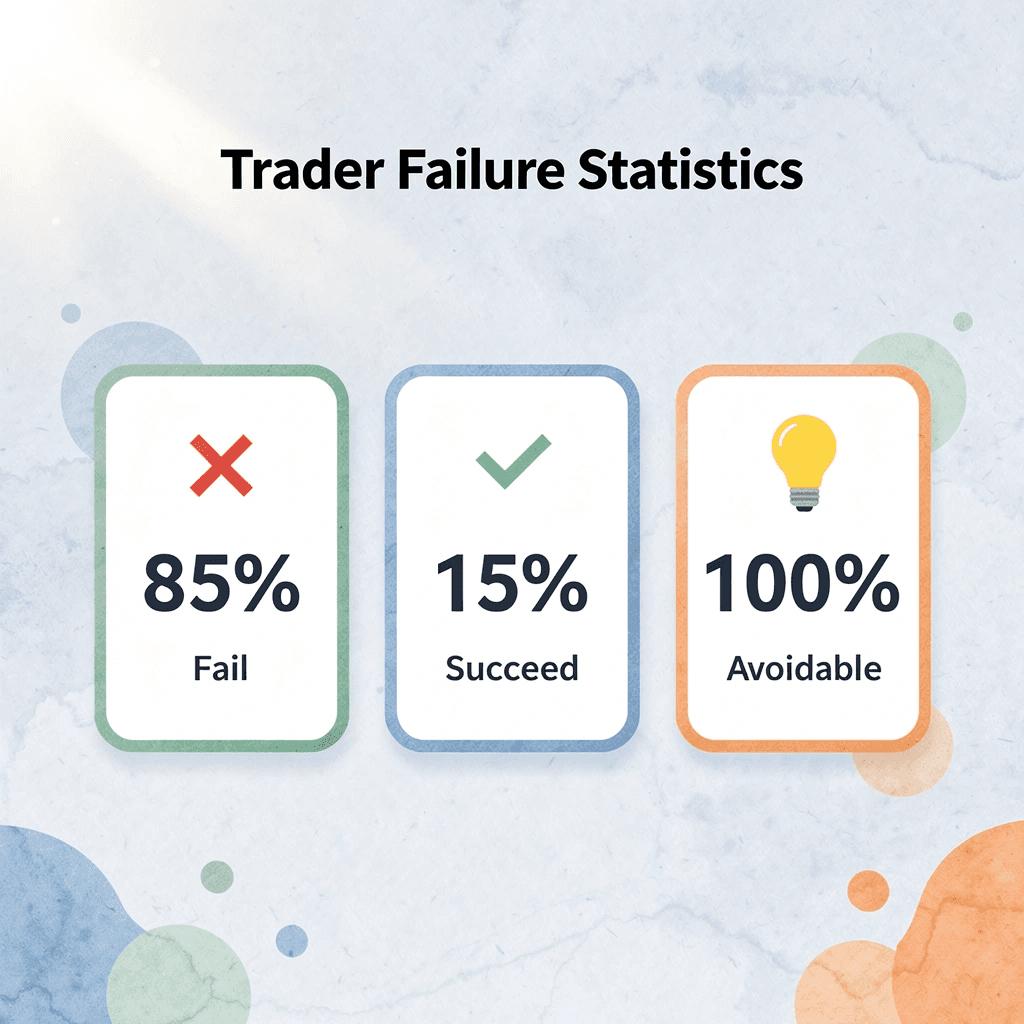
"85% of retail traders fail because they choose strategies that don't match their psychological profile and available capital." — Financial Markets Research, 2023
Trading Strategy Comparison
- Day trading
- Time commitment: 6–8 hours daily
- Risk level: High
- Best for: Active traders with large capital and full-time availability
- Swing trading
- Time commitment: 1–2 hours daily
- Risk level: Medium
- Best for: Working professionals with moderate risk tolerance
- Position trading
- Time commitment: ~30 minutes weekly
- Risk level: Low–medium
- Best for: Long-term investors with a patient mindset
⚠️ Warning: Never choose a high-frequency strategy if you can only dedicate limited time to monitoring markets. This fundamental mismatch leads to missed exits and emotional trading decisions that destroy account equity.
Start With Measurable Financial Targets
Vague goals like "make money" or "grow my account" create strategy confusion because they don't clarify whether you need 10% annual returns or 5% monthly income. Write down the exact dollar amount or percentage return you need within a specific timeframe, then calculate the required win rate and average trade size to reach that target. A trader seeking $2,000 in monthly income from a $50,000 account needs a 4% return, which dictates the frequency and risk of positions differently than someone targeting 15% annual growth. This precision eliminates strategies that cannot mathematically deliver your outcome.
Match Time Availability to Strategy Demands
Full-time professionals with limited market hours should eliminate day trading because it requires constant screen presence during market sessions. Most successful day traders monitor positions within 1.5 to 2 standard deviations of price movement throughout the session, which makes this incompatible with other job commitments. Check your available hours per week, including preparation and review time, then select methods that fit: swing trading suits 5–10 hours weekly, while scalping demands 20–30 hours of focused execution time.
Test Your Risk Capacity Under Real Conditions
Figure out the biggest loss your account and mindset can handle without making emotional decisions or causing financial stress. A careful trader with a $25,000 account who cannot accept $500 losses needs strategies with tighter stops and smaller position sizes, which rules out volatile breakout methods requiring wider risk parameters. Many traders discover their true risk tolerance only after experiencing actual drawdowns, not through hypothetical calculations.
Paper trade your selected strategy through at least 50 trades, tracking profitability and your emotional state after losing streaks. If three consecutive losses cause you to abandon your rules or hesitate on the next setup, your strategy exceeds your psychological capacity regardless of its theoretical edge.
Align Strategy Complexity With Current Skill Level
Beginners who analyze multiple timeframes and combine options spreads with technical indicators create unnecessary confusion, obscuring whether losses stem from market conditions or execution errors. Start with single-method approaches, like basic trend following with one or two indicators; master entry and exit mechanics until they become automatic; then add complexity only after demonstrating consistent execution. The gap between conceptual understanding of a strategy and executing it under live market pressure is where most skill-level mismatches surface.
How can prop firms help traders develop the best trading strategies for consistent profits?
Prop firms like Goat Funded Trader change the traditional model by providing simulated capital after you demonstrate consistent results through evaluation phases. Our platform lets you grow proven strategies without risking your own money during the learning phase. Traders can access up to $2M in funded accounts once they prove their method works, shifting risk from personal savings to firm capital while keeping profit splits up to 100%. This structure rewards mastery of strategy and discipline rather than account size, making access to capital dependent on skill rather than wealth.
How Goat Funded Trader Helps Traders Scale Their Strategies for Consistent Profits
You already know your strategy works. The problem is the account size. A 5% monthly return on $3,000 is $150. On $100,000, it's $5,000. Your edge doesn't change, but the outcome transforms when you trade at the scale your strategy deserves.
🎯 Key Point: The difference between a $3,000 account and a $100,000 account isn't your trading skill—it's access to capital scaling that matches your proven strategy.
"A 5% monthly return on $100,000 generates $5,000 compared to $150 on a $3,000 account—that's a 33x difference in monthly income from the same trading performance."
💡 Tip: Goat Funded Trader bridges this gap by providing funded accounts up to $200,000, allowing traders to apply their proven strategies at an institutional scale without risking their own capital.
Trading Without Your Own Money on the Line
The emotional weight of risking personal savings creates hesitation at exactly the wrong moments: you second-guess entries, exit winners too early, and hold losers hoping they'll recover because the money feels too real. Goat Funded Trader removes that burden by providing simulated capital from $10,000 to $2 million. Funded accounts let you execute the same setups and follow the same risk rules without the fear of losing your rent money. One trader described the shift: after years of timid position sizing on a $5,000 account, moving to a $100,000 funded account felt like finally being able to breathe. The strategy stayed identical. The clarity and confidence changed everything.
Scaling Up as You Prove Consistency
Most traders hit a ceiling because their capital can't grow meaningfully. Our scaling program increases your allocation progressively up to $2 million as you demonstrate consistent performance. Early wins unlock exponentially larger capital, turning steady 3-4% monthly gains into four-figure or five-figure payouts. According to Goat Funded Trader Review, top performers can earn a 100% profit split, meaning every dollar of profit above the baseline goes directly to you. This structure rewards discipline and skill, not luck or initial wealth.
Getting Paid Fast Enough to Matter
Waiting weeks for withdrawals creates cash flow problems and breaks the psychological link between good trading and real rewards. We process on-demand payouts within 24 hours, or we guarantee an extra $1,000 if delayed. You can withdraw via bank transfer, crypto, or other methods. When you close a profitable week and see funds hit your account two days later, it reinforces the habits that generated those profits. Trading stops feeling theoretical and becomes the business it is.
Flexibility That Fits Real Strategies
Strict rules about news trading, weekend holds, or required trading days undermine effective strategies. Goat Funded Trader allows news trading and weekend positions without time limits. If your strategy involves holding through earnings announcements or catching Sunday gap moves, you can execute without artificial constraints. Our platform supports multiple assets on MT5: forex pairs, indices, and commodities, so the infrastructure adapts to your approach rather than forcing you into a template that weakens your edge. But having capital and flexibility matters only if you can access it without draining your savings.
Get 25-30% off Today - Sign up to Get Access to Up to $800K Today
Strategies only make money when you have enough capital to trade them at a meaningful size. Our Goat Funded Trader program gives you access to up to $2 million in simulated capital so you can try trend following, breakout systems, or momentum plays without risking your own money. Pass a straightforward challenge, get funded right away, and keep up to 100% of your profits with payouts processed in as little as 24 hours. Use code FIRSTGFT for 50% off your first account and start turning strategies into real money you can withdraw.
🎯 Key Point: Access to $2 million in capital means you can finally test your trading strategies at an institutional scale without the personal financial risk.
"Keep up to 100% of your profits with payouts processed in as little as 24 hours." — Goat Funded Trader Program
💡 Pro Tip: The 50% discount with code FIRSTGFT makes this one of the most affordable paths to serious trading capital in today's market.
Program Features & Benefits
- Up to $2 million capital
- Trade at meaningful size with scalable buying power
- 100% profit share
- Keep all your earnings from successful trades
- 24-hour payouts
- Fastest withdrawal processing for quick access to profits
- 50% off first account
- Reduced entry cost to lower the barrier to starting

Related Reading
- Best Forex Prop Firm
- Best Margin Rates Brokers
- Margin Loan vs. Securities-Based Lending
- How Does A Margin Loan Work
- How to Become a Full Time Trader
- Forex Trading Strategies For Consistent Profits
- Options Trading Strategies For Consistent Income
- How To Get Profit In Option Trading
- Day Trading Strategies For Consistent Profits
- Trading Cash Flow
- Recommended Prop Trading Firms With Growth Plans
- Best Trading Strategies For Consistent Profits
Be Great and get the App