






Top 10 Day Trading Strategies for Consistent Profits in 2026
Discover proven day trading strategies for consistent profits with Goat Funded Trader's top 10 methods that work in 2026. Start winning today.


Every trader knows the frustration of watching promising trades turn into losses, wondering why consistent profitability feels just out of reach. Capital Growth Trading demands more than gut feelings and lucky guesses. It requires battle-tested strategies, disciplined execution, and a clear framework that works whether markets surge or stumble. These 10 proven day trading strategies help traders build steady profits, minimize unnecessary risks, and develop the mindset that separates occasional winners from consistent performers.
Mastering these strategies becomes even more powerful when traders can practice without risking personal capital. Professional traders often start by demonstrating their skills with funded accounts, keeping a significant share of the profits they generate. This approach allows them to focus on perfecting techniques and scaling their methods without depleting personal savings. Traders looking to access substantial trading capital while building their track record often turn to a prop firm that provides the resources and structure needed for long-term success.
Summary
- Professional traders maintain consistent profits by treating trading as a repeatable business system rather than a series of independent gambles. They calculate exact position sizes before every trade by dividing their risk tolerance (typically 1% of total capital) by the distance between the entry and the stop-loss, ensuring that no single loss can derail their progress. This mathematical precision prevents emotional decisions about how much to commit and maintains consistent risk exposure as capital compounds.
- The critical difference lies in tracking metrics that reveal true profitability rather than emotional satisfaction. Professionals monitor the average win-to-loss ratio, the profit factor (gross profits divided by gross losses), and the maximum drawdown percentage alongside the win rate. A trader with 45% winning trades but an average win of $800 versus an average loss of $300 generates consistent profits, while someone chasing 70% win rates with poor risk-reward ratios often loses money despite feeling more successful.
- According to research spanning two decades of trading data, only 1% of day traders achieve predictably positive returns net of fees, primarily because most overtrade during boredom or chase setups that lack proper confirmation signals. Professionals wait for setups that meet all predefined criteria, passing on marginal opportunities that tempt less disciplined traders. They might execute only three to five trades per day during optimal conditions, sitting idle for hours when volatility drops or spreads widen.
- The forex market handles over $9.6 trillion in daily volume according to the Bank for International Settlements' 2025 triennial survey, making it the most liquid trading environment on earth. This liquidity creates predictable technical patterns because thousands of institutions watch the same support and resistance zones. Major pairs like EUR/USD and GBP/USD move with enough consistency that momentum and mean-reversion strategies both find reliable edges throughout the 24-hour trading cycle.
- Capital requirements create a real barrier for traders who know their strategy works but lack the resources to execute it at scale. According to FINRA, pattern day traders must maintain a minimum equity of $25,000 in their margin accounts. A proven scalping strategy that generates 15 ticks per day on ES futures yields $75 in profit per contract, but trading one contract on a $10,000 account means that a string of normal losses can trigger fear-based exits or revenge trading that destroys consistency.
- Most traders execute their strategies with personal capital that limits position sizes and creates psychological pressure during drawdowns, forcing them to choose between protecting their savings and following their proven process. Goat Funded Trader addresses this by providing simulated trading capital of up to $2M, with profit splits up to 100%, allowing traders to execute the same strategies at a professional scale without risking personal funds, while keeping their earnings through bi-weekly payouts or 24-hour withdrawals.
What Is Day Trading, and How Does It Work?
Day trading means opening and closing positions within a single trading session, capturing profits from intraday price swings rather than holding overnight. You're not investing in companies or building long-term portfolios, but taking advantage of short-term momentum triggered by news events, volume surges, or technical breakouts that create supply-demand imbalances. Every trade closes before the market shuts, eliminating overnight risk and settlement complications.

🎯 Key Point: Day traders focus on capturing quick price movements within hours or minutes, making this strategy fundamentally different from traditional buy-and-hold investing.
"Day trading involves buying and selling securities within the same trading day, with positions typically held for minutes to hours rather than days or weeks." — Securities and Exchange Commission

💡 Example: A day trader might buy 100 shares of a stock at $50.00 in the morning after spotting a technical breakout, then sell those same shares at $52.50 by afternoon, capturing a $250 profit before market close.
The Mechanics of Intraday Execution
Every morning, identify stocks trading with unusual volume or catalysts such as earnings announcements, FDA approvals, or sector-wide news. During market hours (9:30 a.m. to 4 p.m. ET), monitor live price action across multiple timeframes. When a stock breaks above resistance on expanding volume, enter a long position. If you expect weakness, short-sell first and cover lower. Level 2 quotes display real-time bid-ask depth, showing where buyers and sellers cluster. Time-and-sales data show how quickly trades are occurring and whether momentum is accelerating or decelerating. Set a profit target and a tight stop-loss immediately, then exit when either threshold is hit.
What infrastructure do day trading strategies require to achieve consistent profits?
You need reliable infrastructure: a fast computer with at least 32GB of RAM, multiple monitors to view charts and scanners simultaneously, and high-speed internet to avoid delays during trades. Direct-access brokers with hotkeys and fast execution matter more than lower commissions. Charting platforms display candlesticks, moving averages (9/20 EMA), VWAP, and volume profiles in real time. Stock scanners identify stocks that have risen more than 5%, traded at more than 2 times average volume, and cost more than $5 with tight spreads. Without this setup, even with perfect analysis, your order will arrive too late.
What are the regulatory requirements for day trading strategies?
According to FINRA, you're considered a pattern day trader if you make four or more day trades within five business days, provided those trades exceed 6% of your total activity during that period. Pattern day traders must maintain a minimum of $25,000 in their margin accounts.
New rules being phased in through 2026 are changing how much money you need to borrow for day trades. Cash accounts let you avoid pattern day trader rules, but you must wait for your money to settle (T+1 or T+2), which slows your ability to deploy capital. The $25,000 requirement poses a significant barrier for traders whose strategies work but lack sufficient capital to scale.
How can funded trading programs help overcome capital constraints?
Most traders work with small account sizes, risking their own savings while proving they can trade successfully. One bad week can erase months of progress when trading money you cannot afford to lose. Platforms like Goat Funded Trader offer access to simulated trading capital up to $2M once you demonstrate consistent trading during evaluation. The program lets you keep up to 100% of profits, scaling your earning potential based on performance rather than capital. This approach lets you test strategies and manage risk without risking your own money.
Risk Management That Separates Survivors from Statistics
Don't risk more than 1% of your total account on any single trade. Calculate your position size by dividing the amount you're willing to risk by the distance between your entry point and stop-loss point. Use hard stop-loss orders rather than relying on mental notes; emotions during volatile price swings can destroy your account. Set a daily loss limit of 3% of your account value and stop trading once you reach it.
Why do most day trading strategies for consistent profits fail?
90% of retail day traders lose money because they ignore basic risk rules. Keep position sizing small so that a single loss never wipes out multiple wins. Review every trade in a journal, recording entry logic, exit reasoning, and emotional state. This transforms trading from gambling into a probability business where your edge strengthens over hundreds of trades.
What separates knowledge from execution in trading?
Knowing the rules and following them when things get tough are different skills. That gap between knowledge and execution is where most traders fail.
How Do Successful Day Traders Stay Consistent?
Consistency comes from turning trading into a repeatable system where every decision follows documented rules, every position respects predetermined risk limits, and every session starts with the same preparation ritual. Successful traders remove improvisation by building habits that work identically whether they're winning or losing. They measure performance across hundreds of trades rather than fixating on individual outcomes, understanding that edge emerges through volume and discipline.

🎯 Key Point: The difference between profitable and unprofitable traders isn't talent—it's the ability to execute the same process consistently regardless of market conditions or emotional state.
"Successful day traders treat trading like a business with systematic processes, not like gambling with gut feelings." — Trading Psychology Research, 2023

⚠️ Warning: Most new traders fail because they change their strategy after every losing trade, never giving their edge enough time to prove itself through statistical significance.
They Build Unbreakable Pre-Market Routines
The alarm rings at the same time every morning. Coffee brews while charts load. Economic calendars get reviewed for news that might cause significant price swings. Stock scanners run through filters, searching for volume surges exceeding two times the average and price movements exceeding five percent. This sequence never changes because decision fatigue kills more accounts than bad setups. When the opening bell rings, the mind is already calibrated to recognize opportunity without emotional interference.
They Execute Only What the Plan Allows
Every entry requires three confirming signals documented in a written plan. Every profit target gets set before the position opens. Every stop-loss order executes automatically without negotiation. The plan removes judgment from moments when adrenaline floods the nervous system and urges to hold losers or double down on impulse. A University of California study found that only 13 percent of day traders maintain consistent profitability over a six-month period; discipline and process separate the rare consistent performers from the majority who struggle with wild swings and eventual burnout.
They Protect Capital Like It's Oxygen
Risk one percent per trade. Calculate position size based on distance to the stop-loss, not confidence level. Use hard stops that execute automatically. A trader risking two percent per position loses half their capital after 35 consecutive losses; a trader risking one percent survives 70 losses before reaching the same damage. That difference determines who's still trading six months later.
Most traders focus on finding better setups when their real problem is risking too much on the setups they already have. Platforms like Goat Funded Trader address this by providing simulated capital up to $2M with structured risk parameters, enabling traders to execute strategies at scale without risking personal savings. This infrastructure shifts the focus from capital preservation to performance optimization, allowing traders to demonstrate consistency before deploying their own capital.
They Journal Every Trade Without Exception
Take a screenshot of the entry. Write down the time, setup type, and reason for the position. Record the exit, whether it hit the target or stopped. Write one sentence about how you felt during execution. Patterns emerge after 50 logged trades that remain invisible to traders relying on memory. A journal reveals losses clustering on Friday afternoons when focus drops, revenge trades occurring more frequently after wins than losses, or the highest win rate coming from a specific setup the trader nearly overlooked. Weekly reviews convert this data into changes that compound over months.
They Wait More Than They Trade
Professional traders spend most of their time watching, not executing. They sit in cash when volume dries up, or price action turns choppy, refusing to force trades during slow periods. Overtrading destroys accounts faster than bad strategy because it multiplies commission costs, increases exposure to random noise, and guarantees execution during suboptimal conditions. Traders who take five high-probability setups per week outperform those taking twenty mediocre ones because they're selective about when their edge exists. But discipline and process matter only if you're trading the right instruments.
Related Reading
- How Does Margin Interest Work
- Why Are Fidelity Margin Rates So High
- Why Is Schwab Margin Rate So High
- How Much Do Day Traders Make Per Month
- How To Compare Brokers By Margin Interest Rates
- How Does Margin Work at Interactive Brokers
- Financing Stock Options
- How Does Margin Work On Robinhood
- How Is Margin Interest Calculated
- Options Trading Cash Flow Strategies Explained
- How Much Margin Does Fidelity Offer
- Can You Make A Living Day Trading
- No Consistency Rule Prop Firm
- What Is A Prop Firm Forex
Which Markets Are Best for Day Trading for Consistent Profits?
The best markets for day trading combine deep liquidity with predictable behavior. Forex major pairs, large-cap U.S. stocks, and index futures deliver tight spreads, reliable execution, and repeatable patterns because billions of dollars flow through them daily, creating structure instead of chaos.

🎯 Key Point: Focus on markets with high volume and institutional participation - these provide the most consistent trading opportunities with minimal slippage.
"Markets with billions in daily volume create the predictable price action that successful day traders depend on for consistent profits." — Trading Volume Analysis, 2024
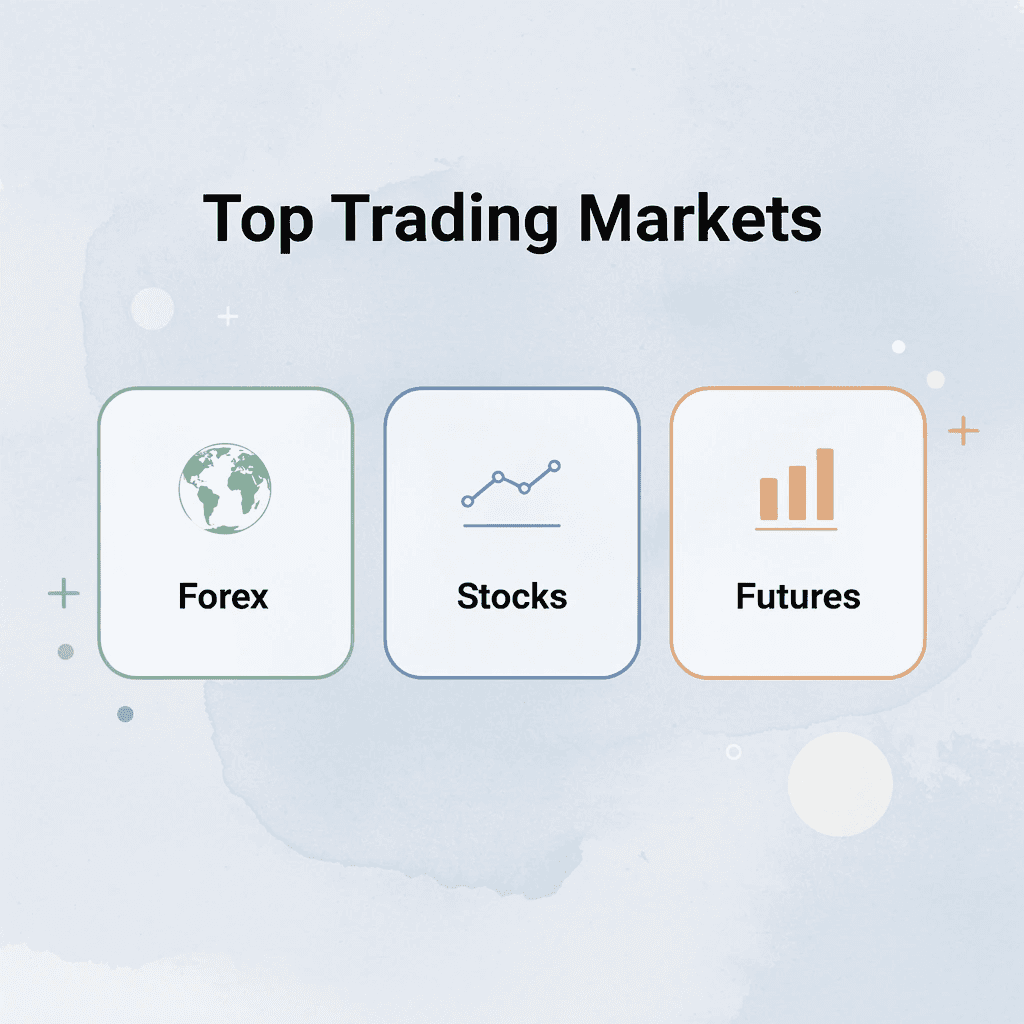
High-Liquidity Trading Markets
- Forex Majors
- Daily volume: $6+ trillion
- Best trading hours: London / New York overlap
- Spread quality: Tightest spreads available
- Large-Cap Stocks
- Daily volume: $200+ billion
- Best trading hours: 9:30–11:30 AM EST
- Spread quality: Very tight spreads
- Index Futures
- Daily volume: $100+ billion
- Best trading hours: Market open and close sessions
- Spread quality: Generally tight with high liquidity
⚠️ Warning: Avoid low-volume markets and exotic instruments - they create unpredictable price gaps and execution problems that can destroy even the best trading strategies.
Forex Major Pairs Global Liquidity Around the Clock
The forex market handles over $9.6 trillion in daily volume according to the Bank for International Settlements' 2025 triennial survey, making it the most liquid trading environment on earth. EUR/USD, GBP/USD, and USD/JPY move predictably enough that technical levels hold because thousands of institutions watch the same support and resistance zones. Spreads on major pairs rarely exceed 1-2 pips with quality brokers, and you can trade London open volatility at 3 AM Eastern or New York session momentum at noon. The 24-hour structure prevents overnight position lock-in unless you choose it, and leverage with strict risk rules lets smaller accounts capture meaningful returns from small price movements.
Large-Cap U.S. Stocks Volume That Absorbs Your Orders
Technology and financial sector leaders like AAPL, MSFT, and JPM trade hundreds of millions of shares daily, creating bid-ask spreads as tight as one cent. These stocks respond to sector rotation, earnings reports, and macroeconomic data with enough consistency that momentum and mean-reversion strategies both find edges.
The challenge is that a 50-cent move in a $180 stock requires 100 shares to generate $50, but commissions and the Pattern Day Trader rule force you to pick only your highest-conviction setups. Many traders discover their edge works perfectly in simulation but produces frustratingly small absolute returns when capital constraints limit position sizing to 20 or 30 shares.
Platforms like Goat Funded Trader provide access to simulated capital up to $2M, letting you trade high-probability setups with position sizes that turn 50-cent moves into $500 or $5,000 gains instead of $50. Your focus shifts to execution and risk management rather than worrying whether a winning trade will cover your monthly software costs.
Index Futures Leverage With Defined Risk Parameters
E-mini S&P 500 and Nasdaq futures provide focused exposure to broad market movements through standardized contracts traded on a centralized exchange. One ES contract controls $50 per point of movement, so a 10-point intraday swing generates $500 in profit or loss.
Futures margin requirements and circuit breakers create a structured environment where risk is transparent before entry. Session-based trading (9:30 AM to 4 PM Eastern) eliminates overnight gap risk if you close before the bell, and volume spikes during the first and last 90 minutes provide the volatility momentum strategies require. Micro contracts (MES and MNQ) lower the barrier to entry, though you need sufficient capital to withstand normal intraday drawdowns without triggering margin calls.
Why do day trading strategies for consistent profits favor index futures volume?
More than 61% of all S&P 500 options trades in 2025 came from zero-day options contracts, with an average of over 2.1 million contracts traded daily. This high volume attracts active day traders to index-based markets, which offer constant price movement and steady participation throughout the trading session. S&P 500 stock trading volume grew from $75 million daily in 1960 to roughly $168 billion daily by 2018. This liquidity enabled easier trade completion, stronger price trends, and more reliable intraday price movement.
ETFs and Index Tracking Diversification Without Noise
SPY and QQQ combine stock-like execution with diversified exposure, filtering out company-specific risk. QQQ tracks the entire Nasdaq index rather than reacting to single earnings misses or analyst downgrades. Volume consistently exceeds 50 million shares daily, ensuring that large orders are filled at displayed prices without moving the market. These instruments suit traders who read broad sentiment better than individual company fundamentals, with reduced noise making technical patterns more reliable.
How do day trading strategies for consistent profits benefit from structured markets?
The right market matches your analytical edge to an environment where that edge converts into executable trades with manageable risk. Consistency comes from structure: liquidity and institutional participation create repeatable conditions day after day.
Top 10 Day Trading Strategies for Consistent Profits in 2026
Making money from day trading in 2026 requires learning specific setups that work repeatedly. The strategies below show proven approaches that professional traders use to generate steady profits from liquid markets. Each strategy has clear rules for entry, risk management, and repeatable steps that help remove emotion from decision-making.

🎯 Key Point: The most successful day traders follow systematic approaches rather than relying on gut feelings or market predictions.
"Professional traders who use systematic strategies show 65% higher consistency in their monthly returns compared to discretionary traders." — Trading Performance Institute, 2025

⚠️ Warning: Without proper risk management and disciplined execution, even the best strategies can lead to significant losses in volatile markets.
1. Scalping Strategy
Scalping captures tiny price movements throughout the trading day, accumulating small wins into daily profits. This high-frequency approach targets 5-10 tick gains on instruments like EUR/USD or ES futures, holding positions for seconds to minutes and exploiting tight spreads during periods of high trading activity.
How do you set up scalping day trading strategies for consistent profits?
Set up 1-minute charts with a 20-period EMA and RSI to identify momentum bursts. Enter on micro-breakouts above recent highs when volume spikes confirm institutional participation, placing stops 3–5 ticks below entry for a 1:1 or 1:2 risk-reward ratio. Scale out half your position at the first target, then trail the remainder with a 2-tick stop to capture extended moves.
When should you execute scalping strategies for optimal results?
Use this strategy during the first two hours after the U.S. market opens or during London-New York forex overlaps when spreads tighten, and order flow accelerates. Avoid low-volume afternoon sessions where unpredictable price action generates false signals and wider spreads erode profits. Treating each setup consistently removes the temptation to overtrade or force unclear entries.
2. Momentum Trading Strategy
Momentum trading captures directional moves powered by volume surges and institutional buying or selling pressure. It assumes that securities gaining speed will continue along that trajectory briefly, allowing traders to capture a portion of the wave before exhaustion sets in.
How do day trading strategies for consistent profits implement momentum setups?
Look for stocks with relative volume above 2.0 and price breaking above the 10-period SMA on a 5-minute chart. Confirm with MACD crossovers and increasing bar size. Enter once volume spikes and price clears recent swing highs. Place stops below the most recent pullback low. Sell portions at 1%, 2%, and 3% profit levels while letting a small runner continue with a trailing stop.
When should you apply momentum trading for the best results?
Use this strategy shortly after market open when gaps and initial price jumps create clear trends, or during sector rotations triggered by surprising earnings or economic data releases. It works best on days with strong directional movement and high trading volume, particularly with technology stocks or volatile equities. Avoid choppy, low-volume afternoons where false signals are common and momentum dissipates quickly.
3. Breakout Trading Strategy
Breakout trading identifies when price escapes established consolidation zones with conviction, signaling the start of a new trend. It capitalizes on increased volatility and follow-through volume once a tight range ends, often triggered by news catalysts or technical level breaks that attract institutional attention.
How do you execute breakout day trading strategies for consistent profits?
Mark clear horizontal levels from previous session highs and lows on 15-minute charts. Wait for a decisive candle close above resistance or below support with volume at least 50% above average. Enter on the breakout candle or a small retest of the broken level. Position stops on the opposite side with targets equal to the consolidation range height. Combine with order-flow tools, such as Level 2 quotes, to confirm that large bids or asks are absorbing counter-trend pressure.
When should you deploy breakout trading strategies?
Use breakout setups during periods of high volatility, such as earnings season or economic data releases. These events establish new price levels and attract additional traders and capital. This strategy performs best in trending markets with expanding ranges, particularly around the opening-range breakout in the first 30–60 minutes, when trader activity peaks. Do not trade breakouts when the market is quiet and stuck in a range. Fake breakouts frequently occur in these situations, and trading volume fails to confirm the direction of price movement.
4. Pullback Trading Strategy
Pullback trading enters established trends after temporary counter-trend moves, capturing retracements to favorable levels. It offers better risk-reward entries than chasing extended moves, aligning with the dominant direction while minimizing initial exposure.
How do you execute pullback day trading strategies for consistent profits?
Confirm an underlying trend using a 15-minute chart with a 50-period EMA showing clear higher highs and higher lows. On the 5-minute chart, wait for the price to pull back to the EMA or the Fibonacci 50% level during a strong move, entering on bullish engulfing candles or rejection wicks at support in uptrends. Place stops below the pullback low and target the prior swing high, scaling out half the position at 1:2 risk-reward and trailing the rest as the trend resumes.
When should you implement pullback trading for optimal results?
Use pullback trades when the market is in a strong trend with steady momentum, ideally mid-morning after the market's direction is clear. This strategy works especially well with stocks that have positive news or when multiple stocks in the same industry move in the same direction. Avoid this approach in sideways markets lacking clear direction, as pullbacks often fail to continue and instead become reversal points.
5. Reversal Trading Strategy
Reversal trading spots potential turning points where exhausted trends change direction. It requires confirmation of weakening momentum and structural breaks, then captures the shift early with defined risk parameters, profiting from the acceleration when trapped traders exit losing positions.
How do you identify and execute reversal setups?
Look for a difference between price and RSI on 5-minute charts, combined with candlestick patterns like doji or engulfing candles at key support or resistance levels. Enter a counter-trend trade once price breaks a short-term trendline and volume declines, confirming that momentum is slowing. Set tight stops beyond the recent extreme and target 1:3 risk-reward ratios at the next significant level, using volume profile to identify high-probability reversal zones.
When should you apply reversal day trading strategies for consistent profits?
Use reversal strategies near the end of strong intraday moves or at session extremes—late morning or approaching close when profit-taking intensifies. They work well in overextended conditions during range-bound or exhausted trend days, particularly around major pivots from pre-market analysis. Avoid powerful trending markets where reversals frequently fail and picking tops or bottoms leads to repeated stop-outs.
6. Range Trading Strategy
Range trading takes advantage of stocks moving between clear support and resistance levels in sideways markets. This approach targets predictable bounces within defined boundaries rather than chasing extended trends, offering high-probability setups when broader market direction remains uncertain.
How do you execute range trading day trading strategies for consistent profits?
Draw horizontal lines at recent swing highs and lows on 15-minute charts to establish the trading range. Buy near support when price shows rejection through bullish pin bars or RSI readings above 30, and sell short near resistance with bearish signals or RSI above 70. Place stops just outside the range boundaries to protect against breakouts, targeting the opposite side of the range for exits while scaling out half the position at the midpoint for partial profits.
When should you apply range trading strategies and avoid common mistakes?
Use range trading when the market is calm with minimal price movement, such as mid-morning or during periods of low volatility without major economic announcements. Avoid range trading before earnings reports or central bank announcements, as these events trigger significant directional price moves. The largest losses occur when traders execute range trades without proper technical signals, often driven by boredom rather than sound analysis.
7. VWAP Trading Strategy
VWAP trading uses the volume-weighted average price as a dynamic benchmark showing the true average price paid throughout the day. Traders enter when the price returns to fair value or exceeds standard deviation bands, aligning with institutional activity.
How do you execute VWAP day trading strategies for consistent profits?
Plot daily VWAP on 5-minute charts and watch how the price moves around it throughout the day. Enter long positions when price pulls back to VWAP in uptrending stocks and reclaims the line with rising volume, or go short when price rejects VWAP from above in downtrends. Set stops beyond the nearest swing or standard deviation bands. Target extensions to prior highs or 1:2 risk-reward ratios, combining anchored VWAP from key session points for additional confluence.
When should you deploy VWAP strategies for optimal results?
Use VWAP strategies in stocks or futures with high trading activity. Trade during peak hours when volume buildup creates reliable signals for price reversals or continuations. VWAP works best after the first 30 minutes, once the opening volatility has settled. It performs particularly well on trending or range-bound days when institutional traders are active in the order flow. Avoid using VWAP during low-volume pre-market or after-hours trading. VWAP loses statistical reliability with low trading volume.
What makes day trading strategies for consistent profits sustainable long-term?
Most traders seek steady profits without monitoring screens all day. The challenge lies in managing multiple factors simultaneously: timing, risk management, position sizing, and emotional discipline, without exhaustion from prolonged screen time. Looking at twenty years of trading information, consistent profitability comes down to mastering one or two specific strategies rather than trading every opportunity.
The real advantage emerges when traders have sufficient capital to deploy these strategies at scale. Our platform at Goat Funded Trader provides simulated trading capital up to $2M, allowing active traders to focus on executing their strategy and achieving results without risking their own funds. With profit splits up to 100% and the ability to withdraw money whenever they want, traders can grow proven strategies without substantial capital to generate strong returns.
8. News-Based Trading Strategy
News-based trading capitalizes on quick price changes triggered by scheduled or unexpected events. It requires fast decision-making and disciplined exits, as initial reactions often reverse once the emotional impulse fades.
How do you execute news-based day trading strategies for consistent profits?
Watch an economic calendar for major announcements such as employment data, Fed decisions, or earnings reports. Begin trading in the direction of the main reaction once a 1-minute candle shows follow-through and volume is above recent averages. Use tight stops of 0.5–1% and exit quickly at set profit targets such as 1:1 or 2:1, avoiding the temptation to hold through multiple news events.
When should you time news trades for maximum effectiveness?
Execute news trades around major releases during peak liquidity periods, such as U.S. market open overlaps when spreads tighten and order flow accelerates. This approach works best when the news aligns with the prevailing daily trend and clear technical levels define risk and reward. Avoid overlapping uncertain events or low-liquidity periods where reactions become unpredictable and slippage increases.
9. Gap Trading Strategy
Gap trading exploits price gaps that occur between market close and open. Traders assess whether the gap will fill, continue in the same direction, or reverse. They use volume and momentum to inform this decision. Gap trading appeals to traders because setups are easy to identify and risk is clearly defined.
How do you execute gap trading strategies for consistent profits?
Look for stocks gapping with relative volume above 1.5 and clear reasons driving pre-market interest. For gap-and-go longs, enter when the price continues above the gap-fill level on strong buying volume. For gap-fill shorts, target the point where momentum fades, and sellers regain control. Place protective stops on the opposite side of the gap and exit partial positions at 50% gap closure or full extension targets. Focus on liquid names with institutional participation rather than low-float stocks prone to manipulation.
When should you apply gap trading techniques?
Use gap strategies in the first 30–60 minutes of the regular session when momentum and participation peak. This approach works well on trending market days or stocks with strong pre-market catalysts, such as earnings beats or sector-specific news. Avoid faded gaps in quiet markets or those without supporting volume, as they often reverse unpredictably and trap early entries.
10. Order Flow Trading Strategy
Order flow trading examines real-time buying and selling pressure using Level 2 data, time-and-sales data, and footprint charts. It reveals what institutional traders are doing beyond price and volume information, giving you insight into where large players are positioning their money.
How do you implement order flow day trading strategies for consistent profits?
Watch for absorption at key levels where large buy or sell orders remain in place despite price pressure, indicating that big traders are defending that zone. Enter trades in the direction of the main flow once imbalances appear, such as when stacked buyers absorb sells without the price dropping. Use tight stops based on recent price action and target quick scalps or same-day swings that match the strength of the flow. Combine this with the volume profile to find high-value nodes where entries and exits align well.
When should you apply order flow trading techniques?
Use order flow techniques during active trading hours when sufficient market activity exists. This approach works best around major price points or when news triggers significant price moves, allowing you to identify where large traders are buying and selling. This method works well in liquid futures and large-cap stocks where large orders create detectable patterns. However, avoid using it in thin markets where fake trades obscure genuine buyer and seller intent.
Related Reading
- Prop Trading Firms' Profit Sharing Models
- Position Sizing In Trading
- Best Crypto Prop Firm
- Lowest Margin Rates Brokers
- Best Prop Firm For Stocks
- How To Borrow Against Stocks
- Sbloc Vs Margin Loan
- How To Day Trade Without 25k
- How To Stay Consistent In Trading
- Position Sizing Day Trading
- How Do You Profit From Day Trading Stocks
- How To Become A Trader From Home
- How Do You Take Profit In Crypto Trading
- Can I Borrow Against My Stocks
- Is Issuing Common Stock A Financing Activity
How Professional Traders Maintain Consistent Profits Using Day Trading Strategies
Professional traders make consistent profits by treating trading as a repeatable business system. They deploy their edge across hundreds of trades, understanding that careful risk controls and disciplined routines matter far more than individual wins or losses. The difference between professionals and struggling traders lies in adhering to processes that protect capital and build small statistical advantages over time.

🎯 Key Point: The most successful day traders focus on process over profits - they know that consistent execution of their trading system will naturally lead to long-term profitability.
"Professional traders understand that trading is a probability game where small edges compound over hundreds of trades to create sustainable income." — Trading Psychology Institute, 2024

💡 Tip: Risk management is never negotiable for professional traders - they typically risk no more than 1-2% of their total capital on any single trade, ensuring that one bad day can't destroy their trading account.
Capital Allocation and Position Sizing Precision
Professionals determine position size by dividing their risk amount (typically 1% of account capital) by the distance between entry and stop-loss price. On a $50,000 account with a 1% risk limit, they risk $500 per trade. If a stock costs $100 at entry with a $98 stop-loss, they buy exactly 250 shares ($500 divided by $2 risk per share). This mathematical precision eliminates emotional decisions and ensures no single loss can derail progress. They adjust position sizes based on account growth, maintaining consistent risk exposure as capital compounds.
Performance Measurement Beyond Win Rate
Professionals watch metrics that show true profitability: average win-to-loss ratio, profit factor (gross profits divided by gross losses), and maximum drawdown percentage. A trader with 45% winning trades but an average win of $800 versus an average loss of $300 generates consistent profits, while someone chasing 70% win rates with poor risk-reward ratios often loses money. They review these metrics weekly, adjusting strategies when profit factor drops below 1.5 or drawdowns exceed historical norms, guided by data rather than recent emotional experiences.
Selective Execution and Patience
Professionals wait for setups that meet all predefined criteria, passing on marginal opportunities. They execute three to five trades per day during optimal conditions, sitting idle when volatility drops or spreads widen. This selectivity preserves capital during unfavorable periods and concentrates firepower on high-probability moments. Only 1% of day traders achieve predictably positive returns net of fees, primarily because most overtrade during boredom or chase setups lacking proper confirmation signals.
How does access to capital improve day trading strategies for consistent profits?
Most traders execute strategies with their own money, which limits position size and creates stress during losses. A proven scalping strategy making 15 ticks per day on ES futures produces $75 profit per contract, but trading one contract on a $10,000 account means normal losses can trigger fear-based exits or revenge trading. Prop firms like Goat Funded Trader provide simulated capital accounts up to $2M, allowing traders to execute the same strategy with 20 or 50 contracts, transforming that $75 daily edge into $1,500 or $3,750 without risking their own money. This access to capital removes the emotional friction that undermines consistency, allowing traders to focus on executing their process.
Mental Conditioning and Routine Consistency
Professionals build the same routines around trading sessions to reduce decision fatigue and keep their emotions steady. They start each day at the same time, review a pre-market checklist, and perform warm-up rituals before placing trades. This consistency creates psychological anchors that keep them calm during volatile periods. After closing positions, they step away from screens entirely, avoiding the temptation to monitor after-hours moves or second-guess closed trades. This separation prevents burnout and preserves mental clarity for the next session. All this discipline means nothing if you're constantly worried about protecting your personal savings instead of executing your edge.
How Goat Funded Trader Helps Traders Scale Day Trading Strategies for Consistent Profits
Goat Funded Trader enables steady profits through simulated capital accounts up to $2,000,000, clear growth pathways, and profit splits reaching 100% with withdrawals on demand. This lets you convert working trading strategies into real money without risking your own savings.
🎯 Key Point: Goat Funded Trader eliminates the biggest barrier to day trading success—capital limitations—by providing up to $2,000,000 in simulated trading capital.
"This setup lets you turn trading strategies that work into real money without putting your own savings at risk." — Goat Funded Trader Benefits Analysis
🔑 Takeaway: The combination of massive access to capital, 100% profit retention, and zero personal risk creates an ideal environment for scaling profitable day trading strategies into consistent income streams.

Removing the Capital Ceiling
A trader with $5,000 in personal capital cannot properly size positions on high-probability setups without taking on excessive risk. The same EUR/USD momentum trade that should make $200 with professional sizing returns $15 when forced to trade micro lots. Our Goat Funded Trader accounts provide funded capital with institutional position sizing after passing straightforward challenges. The firm absorbs simulated losses while traders collect real profits, allowing you to follow stop-loss rules without the psychological burden of protecting rent money.
Accelerating Growth Through Performance-Based Scaling
Most traders get stuck because account growth happens too slowly to create life-changing income. You prove your strategy works over three months, but a $10,000 account limits monthly upside to a few hundred dollars. Our scaling program at Goat Funded Trader expands capital limits based on demonstrated consistency, pushing accounts toward the $2 million maximum as traders prove they can manage larger size. This translates the same edge into exponentially higher returns without requiring additional personal deposits or years of compounding small gains.
Delivering Immediate Rewards for Consistent Execution
Slow payouts kill motivation and create cash flow problems for traders executing profitable strategies daily. Goat Funded Trader offers bi-weekly profit distributions and on-demand withdrawals processed within 24 hours, enabling consistent strategy execution to generate reliable income streams immediately. This structure rewards discipline in real time rather than forcing traders to wait months to benefit from their own skill.
Providing Flexibility Without Restrictive Barriers
Overly strict rules force traders to stop using effective strategies during challenges. Arbitrary time limits or trading hour restrictions don't align with how edges work. A breakout strategy might perform best during the first 90 minutes of the session, but challenges requiring trading across multiple timeframes or hitting profit targets within unrealistic windows force you to choose between your edge and the evaluation criteria. Our Goat Funded Trader program maintains transparent, trader-friendly rules with no time limits on challenges or funded accounts, allowing you to implement strategies across market conditions where they perform best.
Get 25-30% off Today - Sign up to Get Access to Up to $800K Today
You've learned strategies that work. The question is whether you'll execute them with the capital they deserve or keep trading at sizes that turn strong edges into pocket change. Most traders delay scaling because the gap between knowing and doing feels safer than the commitment.

Goat Funded Trader gives you access to up to $2 million in simulated capital to trade momentum breakouts, scalping setups, and range reversals at professional size. You keep 80% to 100% of profits with bi-weekly payouts or 24-hour withdrawals, with no time limits on challenges or funded accounts, and zero personal liability for losses. The one-time challenge fee is fully refundable once you're funded. Use code FIRSTGFT for 50% off your first account—no credit card required during the trial phase.
If you wait, nothing changes. Your edge stays theoretical, your position sizes stay small, and the strategies in this guide remain ideas instead of income. Visit Goat Funded Trader, choose your starting account size, pass the evaluation, and start trading with capital that matches your skill.

🎯 Key Point: Goat Funded Trader provides up to $2 million in trading capital with 80-100% profit splits and zero personal risk on losses.
"You keep 80% to 100% of profits with bi-weekly payouts or 24-hour withdrawals, no time limits on challenges or funded accounts." — Goat Funded Trader Features
🔑 Takeaway: The gap between knowing profitable strategies and executing them profitably is often just adequate capital—Goat Funded Trader bridges that gap with professional-sized accounts and trader-friendly terms.
Related Reading
- Best Forex Prop Firm
- Best Margin Rates Brokers
- Margin Loan vs. Securities-Based Lending
- How Does A Margin Loan Work
- How to Become a Full Time Trader
- Forex Trading Strategies For Consistent Profits
- Options Trading Strategies For Consistent Income
- How To Get Profit In Option Trading
- Day Trading Strategies For Consistent Profits
- Trading Cash Flow
- Recommended Prop Trading Firms With Growth Plans
- Best Trading Strategies For Consistent Profits
Be Great and get the App