






10 Forex Trading Strategies for Consistent Profits in 2026
Discover 10 forex trading strategies for consistent profits that work in 2026. Goat Funded Trader reveals proven techniques to grow your capital.

Forex traders often experience the frustration of winning multiple trades only to lose everything on a single bad position. Capital Growth Trading focuses on building systematic approaches that generate reliable returns through proven strategies, proper risk management, and high-probability setups. These methods protect trading accounts while allowing profitable trades to develop fully. The following strategies offer precise entry and exit rules, position sizing that risks only 1-2% per trade, and setups designed to stack the odds in traders' favor.
Consistent profits require more than solid strategies alone. Traders need sufficient capital to execute their plans without constantly worrying about depleting personal savings. Professional funding allows implementation of proven methods while maintaining proper risk management and maximizing profit potential through a trusted prop firm.
Summary
- Only 7.7% of forex traders achieve consistent annual profitability, according to research by professional traders using FX market data. The gap between knowing profitable strategies and executing them under pressure explains most failures. Traders abandon proven approaches after short losing streaks, override stop-losses when fear spikes, and exit winning trades prematurely because anxiety about giving back profits outweighs the tested exit rules that would capture full moves.
- Undercapitalization creates a psychological trap that amplifies every trading mistake. When accounts hold just $500 to $2,000, normal drawdowns that any strategy experiences wipe out capital before the edge manifests over statistically meaningful sample sizes. The emotional pressure of trading scares money, leading to poor decisions because each loss feels existential rather than statistical, creating a cycle in which insufficient capital causes the very execution errors that justify the fear.
- Daily forex trading volume reached $7.5 trillion in 2024, reflecting unmatched liquidity across decentralized networks spanning London, New York, Tokyo, and Sydney. This structure operates 24 hours, from Sunday evening to Friday evening, across major time zones, providing nearly continuous access and competitive spreads. The challenge isn't finding opportunities in this massive market but surviving the behavioral traps that destroy accounts during inevitable rough patches every strategy encounters.
- Win rate alone misleads because five small wins disappear with one oversized loss. A strategy with 40% wins but a 3:1 reward-to-risk ratio outperforms one with 60% wins and 1:1 ratios because the math compounds favorably across hundreds of trades. Calculating the average winning trade size divided by the average losing trade size, then multiplying by the win rate, reveals whether your system generates positive expectancy over time rather than just feeling successful in the moment.
- Ninety percent of traders lose money, largely because they lack predefined risk parameters that withstand losing streaks, or they use methods that don't align with their available time and psychological temperament. Someone trying to scalp with a full-time job or swing trade, or with the temperament for quick action, sabotages themselves, regardless of strategy quality. Matching the method to personal constraints creates the consistency that allows the edge to manifest, while forcing incompatible approaches guarantees failure even when the strategy itself proves sound.
- Goat Funded Trader addresses the capital barrier by providing simulated trading accounts up to $2M, allowing traders to implement proven strategies with institutional-level position sizes while keeping personal financial risk contained to evaluation fees rather than depleting savings during the learning curve.
What Is Forex Trading, and How Does It Work?
Forex trading means buying one currency while selling another to profit from changes in their exchange rates. You trade in pairs like EUR/USD or GBP/JPY, betting that one currency will strengthen or weaken relative to the other. Unlike stocks, you never own a physical asset—you're speculating on relative value in a decentralized, over-the-counter market that operates 24 hours a day across global financial centers.

🎯 Key Point: Forex trading is always about currency pairs—you can't buy one currency without simultaneously selling another, making it fundamentally different from traditional asset investing.
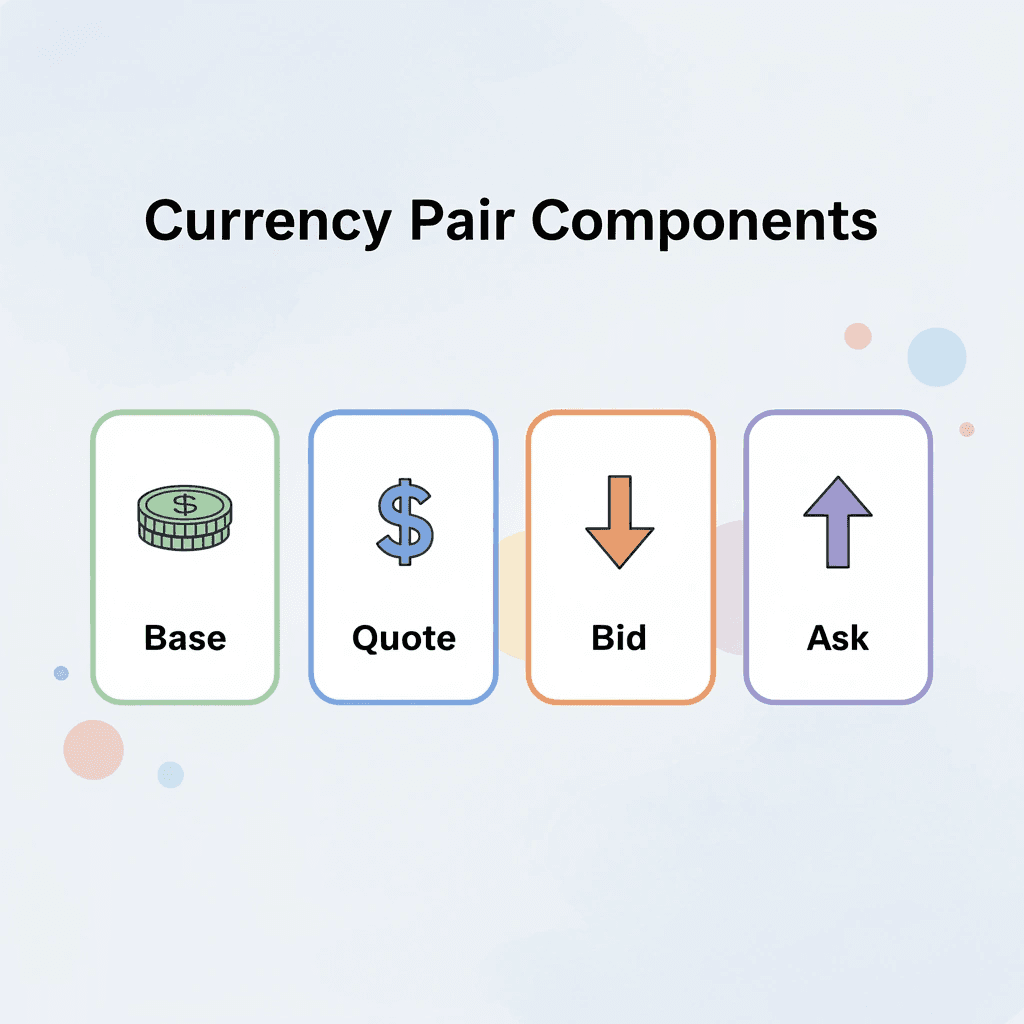
Core Forex Market Components
- Base currency
- Description: The first currency in a pair (e.g., EUR in EUR/USD)
- Function: Represents the currency being bought or sold
- Quote currency
- Description: The second currency in a pair (e.g., USD in EUR/USD)
- Function: Shows how much of it is needed to buy one unit of the base currency
- Bid price
- Description: The price at which you can sell the base currency
- Function: Reflects demand from buyers in the market
- Ask price
- Description: The price at which you can buy the base currency
- Function: Reflects supply from sellers in the market
"The foreign exchange market is the most liquid financial market in the world, with over $7.5 trillion traded daily." — Bank for International Settlements, 2022
💡 Example: If you believe the Euro will strengthen against the US Dollar, you'd buy EUR/USD. If the pair moves from 1.1000 to 1.1050, you've made 50 pips profit on the Euro's relative strength.

How Currency Pairs Work
Every forex quote shows two currencies: the base currency on the left and the quote currency on the right. When you see GBP/USD at 1.30, one British pound equals 1.30 U.S. dollars. Buying the pair means you expect the pound to strengthen against the dollar; selling signals the opposite. This paired structure creates opportunities whether markets rise or fall.
The Market's Structure and Scale
Forex operates without a central exchange. Banks, hedge funds, corporations, and retail traders connect through electronic platforms in a decentralized network spanning London, New York, Tokyo, and Sydney. Saxo Bank reports that daily trading volume reached $7.5 trillion in 2024. This structure maintains competitive spreads and enables nearly continuous access from Sunday evening to Friday evening.
What factors drive currency price movements in the market?
Exchange rates change based on interest rate decisions, economic data releases, geopolitical events, and capital flows. Stronger economic growth or higher rates typically support a currency, while weakness or uncertainty pushes it lower. The challenge is to enter and exit before the crowd reacts.
Why does risk management matter more than perfect setups?
Many beginners think that finding the right currency pair solves everything. The real learning curve emerges when you realize surviving bad risk management matters more than picking the perfect setup. Proper position sizing and stop-loss discipline protect your capital during losing streaks, while leverage amplifies both gains and losses in ways that catch new traders off guard.
How can forex trading strategies for consistent profits work with limited capital?
Prop firm solves the problem of insufficient capital by providing simulated trading accounts with up to $2M. This allows you to deploy your strategies with institutional-level funding while protecting your own money. By demonstrating consistent trading performance, you earn profit splits without depleting your savings during the learning phase. Knowing how forex works and making money from it are two different things.
Related Reading
- How Does Margin Interest Work
- Why Are Fidelity Margin Rates So High
- Why Is Schwab Margin Rate So High
- How Much Do Day Traders Make Per Month
- How To Compare Brokers By Margin Interest Rates
- How Does Margin Work at Interactive Brokers
- Financing Stock Options
- How Does Margin Work On Robinhood
- How Is Margin Interest Calculated
- Options Trading Cash Flow Strategies Explained
- How Much Margin Does Fidelity Offer
- Can You Make A Living Day Trading
- No Consistency Rule Prop Firm
- What Is A Prop Firm Forex
Why Is Having a Trading Strategy Important for Long-Term Success?
Without a trading strategy, winning streaks breed overconfidence while losses trigger panic, a cycle that drains accounts fast. Every market move feels personal, and emotional decisions can erase gains in days.

🎯 Key Point: A structured trading approach eliminates the emotional rollercoaster that destroys 90% of retail traders. When you have predefined rules for entries, exits, and risk management, you trade the plan, not your feelings.
"Traders without a systematic approach have a 95% failure rate within their first two years of trading." — Financial Industry Research, 2023

⚠️ Warning: Inconsistent trading without a strategy turns the markets into a casino. You might win in the short term, but long-term success requires disciplined execution of proven methods that protect your capital during inevitable drawdowns.
Emotional Discipline Beats Market Predictions
Fear and greed destroy more accounts than bad analysis ever will. A strategy outlines precise conditions for every action in advance, enabling mechanical execution during sharp market drops or euphoric rallies. This prevents revenge trading after losses and abandonment during drawdowns, allowing steady execution for compounding returns.
How does proper risk management protect your trading capital?
Every trade puts money at risk of loss, but a strategy enforces strict position sizing and stop-loss levels that limit damage on any single position. 90% of traders lose money, largely because they lack predefined risk parameters that survive losing streaks. Traders who follow structured risk rules stay in the game long enough to benefit when winning trades arrive, turning survival into the foundation for long-term account growth.
Why do prop firms help with Forex trading strategies for consistent profits?
Prop firm addresses this by providing simulated trading accounts up to $2M, allowing you to test and refine your strategy with institutional-level capital while containing personal risk. You demonstrate trading excellence through consistent execution of your proven system, then earn profit splits without the emotional burden of depleting your savings during the learning phase.
Performance Tracking Turns Failures Into Refinement
Without rules, outcomes blur together and offer no lessons. A strategy creates measurable benchmarks to review exact entry and exit criteria against results. This analysis reveals what works in specific market conditions and highlights flaws to fix, turning repeated failures into refined edges that sharpen performance over time.
Adaptability Without Starting Over
Markets shift between trends, ranges, and volatile periods. A core strategy includes guidelines for adjusting parameters, allowing you to maintain core principles while tweaking based on data rather than daily whims. This balance keeps you grounded in proven methods while evolving to match changing environments without abandoning what you've built. But even the best strategy cannot protect you from the psychological traps that sabotage execution when real money is on the line.
Why Do Most Traders Struggle to Stay Consistently Profitable?
Traders destroy their accounts because they operate without fixed rules, allowing emotions to override logic at every decision point. 95% of traders fail not because profitable setups don't exist, but because they lack the behavioral infrastructure to execute them consistently.
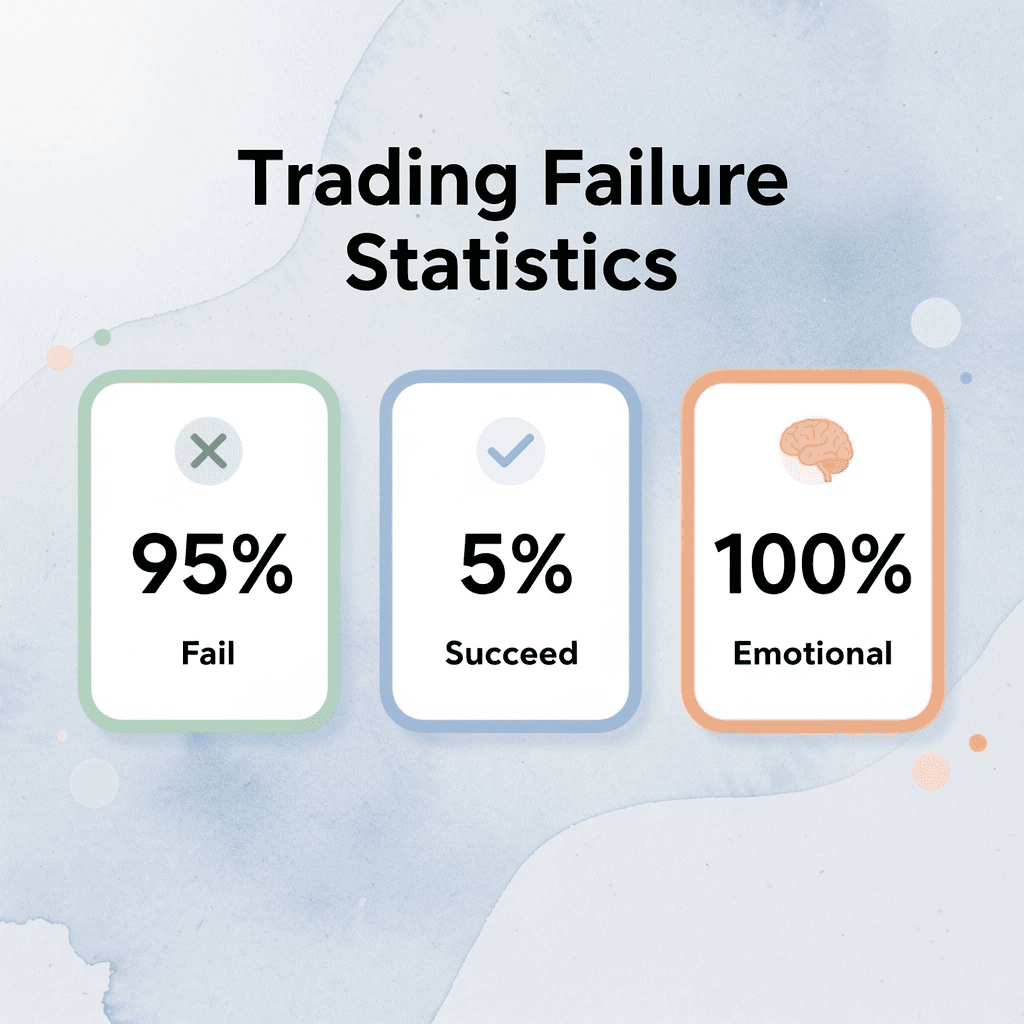
⚠️ Warning: The failure rate in trading is staggering - only 5% of traders achieve long-term profitability, making it one of the most challenging professions in finance.
"95% of traders fail, not because profitable setups don't exist, but because they lack the behavioral infrastructure to execute them consistently." — Market Commentary Analysis

🔑 Takeaway: The overwhelming majority of trading failures stem from psychological factors and lack of discipline, not from the absence of profitable opportunities in the markets.
How do emotions sabotage Forex trading strategies for consistent profits?
Fear and greed override your decision-making the moment real money enters the picture. A trader watches a position move against them and freezes, unable to execute the stop-loss they planned during calm analysis. The same person closes a winning trade early because worry about giving back profits overrides the exit rule that would have captured the full move. This pattern repeats until the account bleeds out through small compromises, each justified in the moment but collectively fatal over weeks.
Why does emotional trading destroy systematic execution?
Losses can trigger revenge trading, in which position sizes grow in desperate attempts to recover quickly. A few wins breed overconfidence that abandons risk limits entirely. Traders experience this emotional whipsaw for months, never recognizing that their strategy isn't broken: their execution discipline is. Without predefined criteria that remove choice during volatile moments, every trade becomes a referendum on self-control rather than a probability-based business decision.
Why do most traders fail with small account sizes?
Most traders work with accounts too small to survive normal losing periods while learning to execute trades properly. They risk $500 or $2,000—amounts that disappear after three bad trades, even with good risk management. The psychological pressure of trading money you can't afford to lose magnifies every mistake. Each loss feels like a threat to survival rather than a normal part of trading, creating a cycle where insufficient capital forces poor decisions that confirm the initial fear.
How do prop firms solve the capital barrier problem?
Prop firms offering simulated capital accounts up to $2M separate skill development from personal financial survival. Traders demonstrate that their strategy works during evaluation periods, then access institutional-level capital that enables proper position sizing and drawdown tolerance. This structure lets traders focus on the process rather than panic.
Why Most Never Build a Repeatable System
Traders abandon strategies after 15 losses that would succeed over 200 trades, chasing magical indicators that never lose. Research from Bookmap shows that 90% of day traders lose money, primarily because they treat markets like a slot machine rather than building a consistent structure that converts small advantages into career-changing results.
What mechanical rules do successful forex trading strategies require?
Traders who break through establish mechanical rules that work regardless of mood: exact entry criteria, position sizes calculated as percentages of account size, and stop-losses placed before execution. They journal every decision to identify patterns in failures rather than dismiss losses as bad luck. This infrastructure prevents the emotional sabotage that destroys accounts during inevitable rough patches.
Related Reading
- Prop Trading Firms' Profit Sharing Models
- Position Sizing In Trading
- Best Crypto Prop Firm
- Lowest Margin Rates Brokers
- Best Prop Firm For Stocks
- How To Borrow Against Stocks
- Sbloc Vs Margin Loan
- How To Day Trade Without 25k
- How To Stay Consistent In Trading
- Position Sizing Day Trading
- How Do You Profit From Day Trading Stocks
- How To Become A Trader From Home
- How Do You Take Profit In Crypto Trading
- Can I Borrow Against My Stocks
- Is Issuing Common Stock A Financing Activity
10 Forex Trading Strategies for Consistent Profits in 2026
Building consistency across hundreds of trades requires matching your strategy to both market conditions and your personal constraints. The ten approaches below span different timeframes, volatility requirements, and trader profiles, offering frameworks that work when applied with discipline. Each strategy addresses specific market environments and demands different levels of screen time, capital commitment, and psychological stamina.

🎯 Key Point: The most profitable traders don't chase every opportunity—they master 2-3 strategies that align with their schedule and risk tolerance.
"Successful forex trading isn't about finding the perfect strategy—it's about finding the perfect strategy for you and executing it with unwavering consistency." — Professional Trading Institute, 2024

⚠️ Warning: Jumping between multiple strategies without proper backtesting is one of the fastest ways to destroy your trading account and confidence.
1. Trend Following Strategy
Trend following captures sustained directional moves by aligning with momentum rather than predicting reversals. Identify the primary trend using moving averages on daily or weekly charts, enter on pullbacks to support or resistance within that trend, and hold until clear reversal signals appear. This method works best during strong economic cycles, when differences in central bank policy or sustained growth disparities push currency pairs in one direction for weeks or months.
When should you deploy trend following strategies?
Use this strategy when major currency pairs like EUR/USD or GBP/USD show a clear pattern of higher highs and higher lows on daily charts, particularly after policy announcements that reinforce the prevailing trend. For long positions, place your stop loss below the recent swing low; for short positions, place it above the swing high. Aim for profits several times larger than your initial risk. This method suits patient traders who prefer fewer trades, tolerate small pullbacks without panic, and cannot monitor markets constantly.
2. Scalping Strategy
Scalping targets small price inefficiencies during high-liquidity sessions by executing numerous quick trades lasting seconds to minutes. You focus on 1- to 5-minute charts with tight spreads, using indicators like RSI or moving average crossovers to identify micro-movements, with stops of 5–10 pips and equally small targets. This demands full attention during London-New York overlap hours, when volume creates the brief dislocations necessary for profit.
When should you apply scalping for consistent profits?
Use scalping in ranging, low-volatility conditions, or after minor news that creates temporary order-flow imbalances in liquid pairs. It requires fast decision-making, low-latency platforms with minimal slippage, and strict per-trade risk limits. Traders who thrive on constant engagement and can dedicate uninterrupted sessions to active execution find this method appealing, but it can be exhausting for those seeking passive income or flexibility.
3. Day Trading Strategy
Day trading captures intraday swings by opening and closing all positions before the session ends, avoiding overnight gaps from news surprises. Analyze 15-minute to 1-hour charts for support and resistance breaks or candlestick patterns, keeping to three to five trades per day with predefined entry rules and daily loss limits. This approach works during high-volume sessions with clear directional bias, especially following central bank announcements or economic data releases that create sustained intraday momentum.
When should you use Forex trading strategies for consistent profits through day trading?
Use this when you can watch markets closely during specific hours but want no exposure to after-hours events that could gap against your positions. Set stops beyond recent swing points and exit all positions before the close. Active professionals who can block out trading hours and prefer defined risk windows find this balance between engagement and overnight peace of mind, though it demands more screen time than swing or position trading.
4. Swing Trading Strategy
Swing trading captures medium-term price swings by holding positions for several days to two weeks. Analyze daily charts for swing highs and lows, combine them with oscillators like Stochastic to time entries on retracements, then target the next major level or use a minimum 1:2 risk-reward ratios. This method works well in trending markets with moderate volatility; avoid major news periods that could disrupt the swing.
When should traders deploy swing trading strategies for consistent profits?
Use swing trades when you can't watch the market all day but want bigger price moves than day trading offers. You also avoid locking up capital for months, as longer-term investing requires. Set your stop-losses beyond the recent swing point, and check positions once or twice daily rather than hourly. For part-time traders seeking solid profit potential per trade without extended capital commitment, this approach aligns well with your schedule.
5. Breakout Trading Strategy
Breakout trading occurs when price moves decisively past important support or resistance levels, accompanied by increased volume, signaling a new trend after consolidation. Mark where price has consolidated on hourly or daily charts, wait for a candle to close past that boundary with momentum confirmation, then enter with stops just inside the range and targets based on the pattern's measured move. This works after periods of low volatility or ahead of scheduled economic events that typically trigger expansions.
When should you use breakout trading strategies?
Use breakouts when ranges are well-defined, and the market has coiled for several sessions. Confirm genuine momentum with volume spikes or additional filters to avoid false breaks that reverse quickly. Traders comfortable with occasional whipsaws and skilled at confirming momentum shifts rather than predicting them find this method effective, especially when they can react quickly to breakout signals.
6. Position Trading Strategy
Position trading captures major currency trends by holding trades open for weeks or months. Analyze weekly and monthly charts using moving averages and key levels, combined with economic outlooks to enter trades aligned with larger trends. Set wide stops based on major swing points and monitor positions periodically. This approach works when clear economic differences exist between countries, such as divergent central bank interest rate policies or growth trajectories.
When should you apply position trading for consistent profits?
Use this method if you have a full-time job and want to spend less time looking at screens. Let your winning investments grow toward their goals without having to manage daily fluctuations. Measure success by checking if your main investment idea remains sound, not by tracking short-term price changes. If you can tolerate temporary declines, this method suits your lifestyle. However, you need confidence to hold steady during volatile periods.
How can prop firms accelerate your forex trading strategies for consistent profits?
Most traders start with small personal accounts, risking $500 to $2,000 while learning through trial and error. Normal drawdowns wipe out accounts before an edge can demonstrate itself over large sample sizes. Prop firms like Goat Funded Trader change this by providing simulated capital accounts up to $2M, letting you test and refine your strategy with institutional-level position sizes while risking only the evaluation fee, then earning profit splits once you show consistency.
7. Range Trading Strategy
Range trading profits from prices moving between set support and resistance levels in sideways markets. Identify clear horizontal boundaries on 4-hour or daily charts and confirm them with oscillators like RSI that show overbought or oversold conditions. Buy near support with stops below the level and sell near resistance with stops above, targeting the opposite boundary. This method works best during low-volatility periods between major economic events or holiday seasons.
When should you deploy range trading strategies?
Use range trades when technical levels have held multiple times and the market has no reason to break the consolidation. Maintain a minimum 1:2 risk-reward ratio and exit if price clearly breaks the range, as failed ranges often lead to strong breakouts. This approach suits traders who value technical precision and can monitor key levels, though it requires discipline to avoid forcing trades in narrow ranges.
8. News Trading Strategy
News trading capitalizes on rapid price movements triggered by economic announcements or central bank decisions. Identify major events using an economic calendar, compare expert forecasts against actual results, then trade the surprise with strict risk controls and predetermined exit rules. Events such as non-farm payrolls, GDP figures, or interest rate decisions have historically moved currency pairs 50–100 pips or more within minutes.
How do you execute news trading with proper risk management?
Use limit orders around key levels or wait for the initial spike to be confirmed before committing money, with stops that account for wider spreads during event periods. Lock in gains quickly since news-driven moves often reverse after the initial reaction. This method suits decisive traders comfortable with fast execution and volatility spikes, but demands preparation and instant action when opportunities appear.
Why do most traders fail at news trading strategies?
90% of traders lose money when trading based on news without understanding what moves prices or having the discipline to execute trades under pressure. The problem stems from using methods mismatched to skill level and insufficient capital to sustain the learning phase these risky trades demand.
9. Carry Trade Strategy
Carry trading exploits interest rate differentials by holding currency pairs in which the base currency yields higher returns than the quote currency. You enter leveraged long positions and maintain them for extended periods, earning daily swap payments while benefiting from favorable exchange rate movements. This approach works best in stable global risk environments with widening rate gaps between developed and higher-yielding economies.
When should you apply carry trades for optimal results?
Use carry trades when the interest advantage is large enough to offset possible adverse price movements and when market conditions support holding higher-yielding currencies. Use stops to protect your capital against sudden shifts from policy changes or risk-off events that can eliminate months of earned interest in days.
Long-term traders seeking steady income alongside capital appreciation find this appealing, though they must accept the costs of rolling over losing positions and the risk that interest rates could equalize or economic problems could eliminate the carry advantage.
10. Momentum Trading Strategy
Momentum trading identifies currencies gaining strength quickly and enters before the momentum fades. Track momentum indicators like MACD or ADX across multiple timeframes to spot rising strength, enter on breakouts with volume confirmation, and trail stops behind recent price action. This method works following trend-confirming events or during strong directional phases in liquid pairs driven by persistent economic narratives.
How do you exit momentum trades effectively?
Exit when momentum diverges or weakens rather than waiting for full reversals. Target extensions based on measured moves and accept that some trades will exit early as momentum fades faster than expected. Traders who respond quickly to shifting momentum signals without holding into reversals find this approach matches their style.
What separates successful Forex Trading Strategies for Consistent Profits?
The key difference between traders who make money and the 90% who fail isn't finding a secret strategy. Instead, it's recognizing which of these ten methods fits your personality, available time, and comfort level with different market behaviors. Someone trying to scalp while working a full-time job or swing trade without the temperament for quick action will undermine their results, regardless of strategy quality. Matching your method to your life situation creates the consistency that lets your edge work over hundreds of trades. But knowing which strategy fits your life only matters if you understand how to test whether it works for you.
How to Choose the Best Forex Trading Strategy for Consistent Profits
Backtesting applies your rules to months or years of historical price data, revealing win rates, average gains versus losses, and maximum drawdown periods. Demo accounts then simulate live execution without risking real money, letting you practice entries, exits, and emotional responses when prices move against you. According to professional trader Chris Capre, who uses FX market research data, 7.7% of traders consistently profit annually, making this validation phase critical before committing real funds.
🎯 Key Point: Backtesting and demo trading are essential validation steps that help you understand your strategy's performance characteristics before risking real capital.
"Only 7.7% of traders can profit consistently on an annual basis, making validation critical before committing real funds." — Chris Capre, Professional Trader
⚠️ Warning: Never skip the demo phase. Even experienced traders use paper trading to test new strategies and avoid costly mistakes in live markets.

Does your strategy survive different market conditions?
A method that works during trending weeks often fails when volatility drops, and prices move sideways for months. Test across bull runs, bear markets, and flat consolidation periods to confirm your edge persists when momentum disappears, or reversals accelerate. Strategies built on single conditions create false confidence that evaporates when the market shifts character, leaving you scrambling to adjust rules mid-trade or abandoning the approach after preventable losses.
Can you execute it without hesitation?
Rules mean nothing if you override them when fear spikes or boredom tempts larger positions. Practice each setup in demo mode until the sequence becomes automatic: spotting the signal, calculating position size, placing the stop, and exiting at your target without second-guessing. Prop firms like Goat Funded Trader offer simulated capital accounts up to $2M that let you prove your strategy works under real market conditions without risking personal savings. This shifts the learning curve from costly trial-and-error to an evidence-based progression, where your performance earns you access to institutional-level capital and profit splits.
What does your data actually tell you?
Write down every trade in a journal that records entry price, exit price, timeframe, emotional state, and rule adherence. Patterns emerge after 50 to 100 trades: you might exit winners too early during Asian sessions, or your stops might be too tight on GBP pairs during news releases. This detailed feedback converts vague impressions into actionable adjustments that refine your edge.
Are you measuring the right performance metrics?
Win rate alone can be misleading because five small wins can be overshadowed by one oversized loss. Calculate your risk-reward ratio by dividing the average winning trade size by the average losing trade size, then multiplying by the win rate to determine whether your system generates positive expectancy. A strategy with 40% wins but a 3:1 reward-to-risk ratio outperforms one with 60% wins and 1:1 because the math compounds across hundreds of trades. Proving a strategy works in testing only matters if you can scale it without limited capital eroding your confidence before the edge manifests.
How Goat Funded Trader Helps Forex Traders Scale Their Strategies for Consistent Profits
Proven strategies fail on small accounts because position sizes are too small to matter psychologically and train you to ignore your own rules. When a 0.5% risk equals $25 on a $5,000 account, the temptation to double up after losses or exit early on winners becomes overwhelming. Goat Funded Trader removes this barrier by granting access to simulated capital accounts starting at $25,000 and scaling to $2 million, letting you execute the exact same setups with position sizes that enforce discipline through meaningful profit potential per trade.

🎯 Key Point: The psychological impact of meaningful position sizes cannot be overstated - when your risk per trade jumps from $25 to $250 or more, your brain automatically treats each decision with the respect it deserves.
"When a 0.5% risk equals $25 on a $5,000 account, the temptation to double up after losses becomes overwhelming."

🔑 Takeaway: Goat Funded Trader's capital scaling from $25,000 to $2 million transforms amateur trading psychology into a professional discipline by making every trade decision financially meaningful enough to follow your proven strategies without deviation.
Capital Without Liability Changes How You Execute
Funded accounts eliminate the emotional spiral that breaks most traders. According to Goat Funded Trader's research, only 10-15% of forex traders achieve consistent profitability. The gap between knowing what to do and executing under pressure explains most of that failure. When you risk your own savings, fear rewrites your strategy mid-trade: you exit winners at breakeven instead of trusting your take-profit level, and widen stops on losers because admitting the loss hurts more than following your risk management rules. Funded accounts sever this emotional connection by using simulated capital, which carries no personal liability and lets you follow your plan with the detachment that consistency requires.
Scaling Paths That Match Performance
Most prop firms trap you in evaluation loops that reset your progress with random time limits or inconsistent rule enforcement during volatile sessions. Goat Funded Trader structures challenges with unlimited trading periods and transparent rules that remain consistent whether you trade during NFP releases or quiet Asian sessions. Pass the evaluation by hitting profit targets while respecting drawdown limits, and you receive a funded account with profit splits up to 100%. Performance unlocks scaling opportunities that grow your account size based on results, not calendar milestones, letting you progress from $25,000 to $200,000 or more without restarting when market conditions shift.
Payout Speed That Supports Trading Psychology
Waiting two weeks for withdrawals disrupts trade management. If you need money by month-end, you might hold positions past exit signals or initiate trades prematurely because calendar pressure overrides chart signals. Goat Funded Trader processes payouts within 24 to 48 hours, eliminating cash flow problems that can turn patient traders into desperate ones. Each trade remains a statistical event in your system rather than becoming entangled with outside financial stress unrelated to price action.
Platform Flexibility and Leverage That Fits Your Method
Restrictive platforms or capped-leverage kill strategies that are built around specific execution tools or volatility requirements. Prop firms offering up to $400,000 in funding pair that capital with MT5 access and leverage up to 1:100, enabling you to apply the exact technical setups, indicators, and risk-per-trade calculations your backtesting validated. Whether you scalp EUR/USD during the London open with 10-pip stops or swing-trade GBP/JPY across weekly ranges, the infrastructure supports your method without forcing you to adapt to arbitrary constraints. Accessing capital and fast payouts matter only if the evaluation structure doesn't sabotage traders before they reach funding.
Related Reading
- Best Forex Prop Firm
- Best Margin Rates Brokers
- Margin Loan vs. Securities-Based Lending
- How Does A Margin Loan Work
- How to Become a Full Time Trader
- Forex Trading Strategies For Consistent Profits
- Options Trading Strategies For Consistent Income
- How To Get Profit In Option Trading
- Day Trading Strategies For Consistent Profits
- Trading Cash Flow
- Recommended Prop Trading Firms With Growth Plans
- Best Trading Strategies For Consistent Profits
Get 25-30% off Today - Sign up to Get Access to Up to $800K Today
You now understand the strategies that work. The question is whether you'll keep trading them at 0.01 lots on a $500 account, watching clean setups generate $12 wins, or whether you'll execute them with the capital they deserve. Goat Funded Trader gives you simulated accounts up to $2 million, so your trend-following, breakout, and momentum trades finally generate returns that match the quality of your execution. You keep up to 100% of profits, withdraw within 24 hours, and never risk personal savings while you prove what you already know works.
🎯 Key Point: Stop limiting profitable strategies with insufficient capital - funded accounts let you execute quality setups with the position sizes they deserve.
"You keep up to 100% of profits, withdraw within 24 hours, and never risk personal savings while you prove what you already know works." — Goat Funded Trader Benefits
Account Size vs Returns & Risk
- $500 personal account
- Potential monthly return: $50–$150
- Risk to personal capital: High
- $100K funded account
- Potential monthly return: $5,000–$15,000
- Risk to personal capital: Zero
- $2M funded account
- Potential monthly return: $100,000–$300,000
- Risk to personal capital: Zero

Use code FIRSTGFT at checkout for 50% off your first evaluation. No credit card required, and your fees are refunded completely on your first payout. Over 250,000 traders trade funded.
🔑 Takeaway: With zero personal risk, complete fee refunds on first payout, and access to $2 million in trading capital, the only question is whether you'll keep limiting your proven strategies with inadequate position sizes.
Be Great and get the App